Cardano Leadership Structure Comes Under Scrutiny, Clouding Its Future – See Why

bitcoinistОпубліковано о 2026-04-20Востаннє оновлено о 2026-04-20

Анотація

Cardano is recognized as one of the most decentralized blockchains, yet recent criticism highlights its lack of clear leadership. Analyst Cardano Yoda argues that despite the introduction of on-chain governance—which involves DReps (governance decision-makers) and Pentad (leadership and execution)—the network remains centralized in practice. While DReps control treasury spending, they lack coordination and strategic direction, relying instead on founding entities like IOG, the Cardano Foundation, and EMURGO. This creates fragmented leadership and accountability issues. Yoda suggests that DReps should evolve into a more coordinated body, possibly through a board or DAOs, to define strategy and improve governance effectiveness. Enhanced cooperation between DReps, founding entities, and Intersect is essential for Cardano’s future leadership clarity and operational unity.

In the dynamic blockchain sector, the Cardano network is being flagged as the most decentralized blockchain by several crypto analysts, with security being a major part of this assertion. However, the highly decentralized network has been called out for its lack of clear leadership.

Unclear Cardano Leadership Raises Concerns In The Ecosystem

Recently, a fresh debate has been raised around the Cardano network, particularly involving its leadership state. A crypto pundit and ADA enthusiast, Cardano Yoda, argues that the leading network is lacking clear leadership. Once again, the focus is on how Cardano strikes a compromise between decentralization and the requirement for unified leadership.

The pundit stated that in the past, the network was centered around the IOGs, the Cardano Foundation, and EMURGO, and its founder, Charles Hoskinson, was considered the leader. However, after the introduction of on-chain governance, the model evolved, breaking into two parts. These include DReps (governance decision-making) and Pentad (leadership and execution), which go hand-in-hand to produce a unified platform.

While DReps decide on Treasury spending, they also grant legitimacy to the strategy that Pentad offers because DReps are not coordinated. Since they cannot define the strategy and prioritize, on-chain governance is still dependent on the founding entities, indicating that the network remains strongly centralized in leadership and execution. These entities can offer their experience, knowledge, and expertise, but DReps will set the path from the ground up.
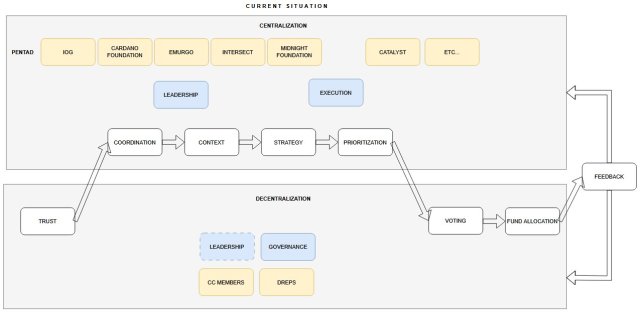
Source: Chart from Cardano Yoda on X

A strong player is intersect as it plays the role of coordinator, particularly preparing the budget framework process. Meanwhile, intersect is required to balance the role of facilitator and leader because it may not want to be a leader. However, being a leader means taking on responsibilities.

According to Yoda, on-chain governance is not the same as leadership, and Cardano does not have one. The issue is that it is difficult, if not impossible, to decentralize leadership and execution. A leader bears responsibility, which is diluted somewhere between Pentad and DReps, causing a fragmented network.

Despite this, Yoda still believes that leadership should not be dismissed because of decentralization. In the meantime, there may be a struggle for leadership, as new leaders may be born, or it might remain the same.

An Ideal Direction For Leadership

After carefully analyzing the Cardano network, Yoda claims that the logical direction for leadership is toward DReps because they have a stronger position and must be coordinated. With the emergence of a DReps board, they are expected to take responsibility for treasury spending, defining strategy, and prioritizing.

By using DAOs, DReps can be involved in the process of an effective execution. This is because they are responsible for supporting builders, ecosystem growth, innovation, marketing, and open-source activities, among others.

To have clear leadership, a more robust layer of cooperation between DReps, founding entities, and Intersect is required. However, this can only be built by a clearly defined coordination layer between DReps and sub-DAOs. Meanwhile, to create a dialogue between DReps and founding entities, the governance system must evolve.

Currently, communication is carried out through on-chain proposals, and may result in a rejected proposal regarding Summit and TOKEN2049 due to the diverse views of DReps and founding entities. Although it may not be easy, the goal remains finding a consensus on the future functioning because governance needs to be more effective.

ADA trading at $0.24 on the 1D chart | Source: ADAUSDT on Tradingview.com

Пов'язані питання

QWhat is the main concern raised about the Cardano network in the article?

AThe main concern is that despite being highly decentralized, the Cardano network lacks clear leadership, creating a fragmented system and raising questions about its future direction.

QAccording to the article, what are the two key parts of Cardano's governance model after the introduction of on-chain governance?

AThe two key parts are DReps (governance decision-making) and Pentad (leadership and execution).

QWhy does the article suggest that on-chain governance does not equate to leadership for Cardano?

ABecause leadership involves taking responsibility, which is currently diluted between Pentad and the uncoordinated DReps, making it difficult to decentralize leadership and execution effectively.

QWhat role does the entity 'Intersect' play in the Cardano ecosystem, as described in the article?

AIntersect acts as a coordinator, primarily in preparing the budget framework process, and is required to balance the roles of facilitator and leader.

QWhat does the article propose as the ideal direction for leadership to address Cardano's current issues?

AThe ideal direction is for leadership to move towards the DReps, who should be coordinated through a board to take responsibility for treasury spending, strategy, and prioritization, potentially using DAOs for effective execution.

Пов'язані матеріали

Both Suffer Massive Losses Exceeding $90 Billion, Which Is in Greater Peril: Strategy or Bitmine?

Facing massive paper losses exceeding $90 billion each amidst a sharp market downturn, "Digital Asset Treasury" (DAT) giants Strategy and Bitmine find themselves in a precarious position, but with different underlying risks. Strategy, heavily invested in Bitcoin (BTC), faces significant financial strain. Its strategy relies heavily on debt, including convertible notes and preferred stock (STRC) requiring substantial dividend payments. With its cash reserves dwindling and BTC offering no staking yield for cash flow, Strategy's high leverage makes it vulnerable. A continued price decline could force asset sales to meet obligations, potentially creating a negative feedback loop. Its market value has already fallen sharply. In contrast, Bitmine, an Ethereum (ETH) holder, appears on firmer financial ground. It primarily funds its purchases through equity offerings (like ATM programs), avoiding debt pressure. It also generates income by staking a large portion of its ETH holdings. While not immune to market drops and shareholder dilution concerns, Bitmine maintains more flexibility, recently announcing a new preferred share offering to raise further capital. The core divergence lies in their financing: Bitmine uses equity (investor money), while Strategy uses debt (borrowed money). Consequently, Bitmine currently faces less immediate liquidity pressure than Strategy, which must navigate the dual challenge of servicing debt/dividends and a declining core asset (BTC) price.

marsbit10 хв тому

Both Suffer Massive Losses Exceeding $90 Billion, Which Is in Greater Peril: Strategy or Bitmine?

marsbit10 хв тому

Where the AI Bubble Really Is: Which Layer of Players Are Naked

AI Bubble: Where It Really Is and Who's Swimming Naked This analysis dissects the AI industry not as a single entity but as a five-layer pyramid, arguing that bubbles are concentrated in specific tiers, not uniformly distributed. **Key Distinction from the 2000 Dot-com Bubble:** Unlike 2000, where companies had stock prices before revenue, today's leading AI players have massive, contract-backed revenue driving their valuations. Core infrastructure demand is real, with every GPU running at full capacity for paying customers. **The Five-Layer Pyramid & Bubble Assessment:** * **L0 (Fab/Manufacturing) & Top L4 (Leading AI Apps): NO BUBBLE.** Companies like TSMC, NVIDIA, major cloud providers (Microsoft, Google, Meta, Amazon), and top AI labs have real revenues and orders. Supply is tightly constrained by TSMC's disciplined capacity control and physical limits like power/land for data centers, preventing a supply glut. * **L1 (Memory): BATTLEGROUND.** Sky-high HBM margins could signal a new structural cycle or a classic "boom before bust." The oligopoly of three major players may enforce supply discipline, making this a high-stakes bet. * **L2 (Interconnect/Optical Modules): BUBBLE TERRITORY.** Companies like Lumentum and AAOI have seen stock surges (4-10x) far outpacing revenue growth. This hardware segment has lower physical barriers to expansion than fabs, allowing speculation. It mirrors the 2000 bubble's epicenter—optics. * **L3 (Infrastructure/"GPU Landlords"): VULNERABLE.** GPU leasing companies profit from the current compute shortage but own no long-term moat. Their business model relies on a temporary bottleneck that will ease as big tech expands and new tech (e.g., potential space-based data centers) emerges. * **L4 Long Tail (VC-backed Startups): STRONG BUBBLE SIGNALS.** VC funding concentration in AI is twice that of the 1999 peak. Many startups with little revenue use the valuation logic of successful giants to justify their own, creating high risk of a "valuation crunch" when funding dries up. **Critical Risks to Monitor:** 1. **GPU Depreciation & Accounting:** Companies extending the assumed useful life of GPUs artificially boost profits. The true economic life depends on future generational leaps from NVIDIA. 2. **"GPU Credit" & Off-Balance-Sheet Leverage:** Emerging structures where shell companies borrow to buy GPUs and lease them out (with chipmakers sometimes investing) move debt off major balance sheets. This echoes the "vendor financing" of 2000 and the securitization risks of 2008, though currently small-scale. 3. **TSMC Abandoning Caution:** If the primary supply bottleneck (TSMC's conservative capacity planning) breaks, runaway supply could trigger a bust. 4. **Algorithmic Efficiency Breakthrough:** A major leap in software efficiency could drastically reduce the need for raw compute hardware, undermining the investment thesis. **Conclusion:** The AI boom is expensive and has frothy areas, but its core is underpinned by real demand and physical supply constraints. The bubble risk is layered: most present in optical components, GPU leasing, and the long-tail startup ecosystem, while the foundational chip manufacturing and leading application layers remain relatively solid—for now.

marsbit22 хв тому

Where the AI Bubble Really Is: Which Layer of Players Are Naked

marsbit22 хв тому

Торгівля

Спот
Ф'ючерси

Популярні статті

Як купити ADA

Ласкаво просимо до HTX.com! Ми зробили покупку Cardano (ADA) простою та зручною. Дотримуйтесь нашої покрокової інструкції, щоб розпочати свою криптовалютну подорож.Крок 1: Створіть обліковий запис на HTXВикористовуйте свою електронну пошту або номер телефону, щоб зареєструвати обліковий запис на HTX безплатно. Пройдіть безпроблемну реєстрацію й отримайте доступ до всіх функцій.ЗареєструватисьКрок 2: Перейдіть до розділу Купити крипту і виберіть спосіб оплатиКредитна/дебетова картка: використовуйте вашу картку Visa або Mastercard, щоб миттєво купити Cardano (ADA).Баланс: використовуйте кошти з балансу вашого рахунку HTX для безперешкодної торгівлі.Треті особи: ми додали популярні способи оплати, такі як Google Pay та Apple Pay, щоб підвищити зручність.P2P: Торгуйте безпосередньо з іншими користувачами на HTX.Позабіржова торгівля (OTC): ми пропонуємо індивідуальні послуги та конкурентні обмінні курси для трейдерів.Крок 3: Зберігайте свої Cardano (ADA)Після придбання Cardano (ADA) збережіть його у своєму обліковому записі на HTX. Крім того, ви можете відправити його в інше місце за допомогою блокчейн-переказу або використовувати його для торгівлі іншими криптовалютами.Крок 4: Торгівля Cardano (ADA)Легко торгуйте Cardano (ADA) на спотовому ринку HTX. Просто увійдіть до свого облікового запису, виберіть торгову пару, укладайте угоди та спостерігайте за ними в режимі реального часу. Ми пропонуємо зручний досвід як для початківців, так і для досвідчених трейдерів.

973 переглядів усьогоОпубліковано 2024.12.10Оновлено 2026.06.02

Як купити ADA

Обговорення

Ласкаво просимо до спільноти HTX. Тут ви можете бути в курсі останніх подій розвитку платформи та отримати доступ до професійної ринкової інформації. Нижче представлені думки користувачів щодо ціни ADA (ADA).

活动图片













