Cardano Isn’t ‘Fading,’ Hoskinson Says: ‘I’ve Lost Over $3B’ And Still Building

bitcoinistОпубліковано о 2026-02-06Востаннє оновлено о 2026-02-06

Анотація

Charles Hoskinson, during a livestream from Tokyo, refuted claims that Cardano is "fading" or "dead," emphasizing that the project is transitioning into a phase of commercialization after years of infrastructure development. Despite the bear market, he highlighted that key building blocks like decentralization and governance are complete, and efforts are now focused on developing real-world use cases such as Hydra for scaling and the privacy-focused sidechain Midnight. Hoskinson argued that global economic shifts and institutional mistrust make blockchain-based systems essential for a neutral global settlement layer. Addressing critics who attribute his optimism to wealth, he revealed he has lost over $3 billion but remains committed to Cardano, stating he is "here for life" regardless of financial outcomes. At the time of reporting, ADA was trading at $0.2521.

Charles Hoskinson used a Feb. 6 livestream from Tokyo to push back on a familiar narrative he says he’s hearing on the ground in Japan: that Cardano is “fading” or “dead,” and that the bear market has drained the ecosystem’s momentum.

Speaking midway through a multi-city tour tied to Cardano’s third cohort of ambassadors, Hoskinson said long-time community members and newcomers alike have been approaching him with relief that the project is still active. He framed the trip as a signal that Cardano, after years of protocol work, is shifting into what he called a commercialization phase, building products that feel less like infrastructure demos and more like mainstream use cases.

Hoskinson Rallies Cardano Through The Downturn

“We’ve been on tour all throughout Japan,” Hoskinson said, describing meetings with “a lot of investors, a lot of developers,” including people who have followed Cardano “for more than 10 years.” The message he said he’s delivering is that major building blocks are in place: “The infrastructure is strong. We’re fully decentralized. Governance has been done. So now it’s the time to go build some fun, exciting, real use cases and get them into the ecosystem.”

Hoskinson name-checked Hydra, Cardano’s scaling effort, and pointed to projects he characterized as the “vanguard” of the next phase, including Midnight — the privacy-focused sidechain he has promoted as a cornerstone of Cardano’s broader roadmap. He also referenced “Starstream,” a WASM-based zero-knowledge virtual machine (zkVM) designed for the Cardano blockchain to enable private, scalable smart contracts.

The backdrop, he acknowledged, is a market environment that “is red, red, red,” with sentiment weak enough that some attendees told him they had assumed Cardano’s best days were behind it. Hoskinson’s response was less a price defense than a thesis about why crypto persists through cycles and why he believes the longer-term direction of global finance makes open networks unavoidable.

“Globalism has finally reached its peak, accelerated by AI and accelerated by demographic changes,” he said. “The human race is starting to think in terms of we instead of nation by nation... And the old guard and the old way of doing things is fading. And they’re kicking and screaming as they’re being dragged off the stage.”

He argued that a more integrated global economy ultimately needs a neutral settlement layer: an “economic franca,” in his words and that blockchain-based systems are the practical option. “The only way to run a world like this is through cryptocurrency. Full stop,” Hoskinson said. “Otherwise, you have to build an empire and no one’s strong enough to conquer the world right now... We need an economic franca. And you tell me how we’re going to do that without a blockchain.”

The livestream veered into broader institutional mistrust, with Hoskinson citing political instability, corruption, and high-profile scandals as evidence that “deep down inside, we all know this can’t last.” He cast crypto as a mechanism to constrain human behavior through “rules” and “regulating functions,” rather than relying on institutional goodwill.

But the most pointed moment came when he anticipated a common critique that his optimism is easy because he’s wealthy and responded with a personal financial claim and a commitment to keep building regardless of market outcomes:

“Every now and then you hear something like this, you say, ‘Yes, but it’s easy for you to say, Charles, you’re rich. You can ride it out.’ I’ve lost more money than anyone listening to this. Over $3 billion now. It would have been real easy to cash out. Just walk away. And do you think I honestly care if I lose it all? Do you think I’m doing this for money? You’re pretty mistaken if you do.”

Hoskinson also portrayed his distance from past industry blowups as a matter of personal discipline rather than luck. “There’s a reason I didn’t get rolled up in FTX,” he said, adding that his “default answer is no” when it comes to the kinds of deals that later become liabilities.

In closing, Hoskinson urged builders and community members to treat the drawdown as an endurance test rather than a verdict, tying Cardano’s ambassador programs, including a call to become a Midnight ambassador and engage via Intersect.

His core message was simple: the market may get “more red” but he isn’t leaving. “I’m here for life,” Hoskinson said. “As long as I’m alive, I’m just going to keep going.”

At press time, ADA traded at $0.2521.
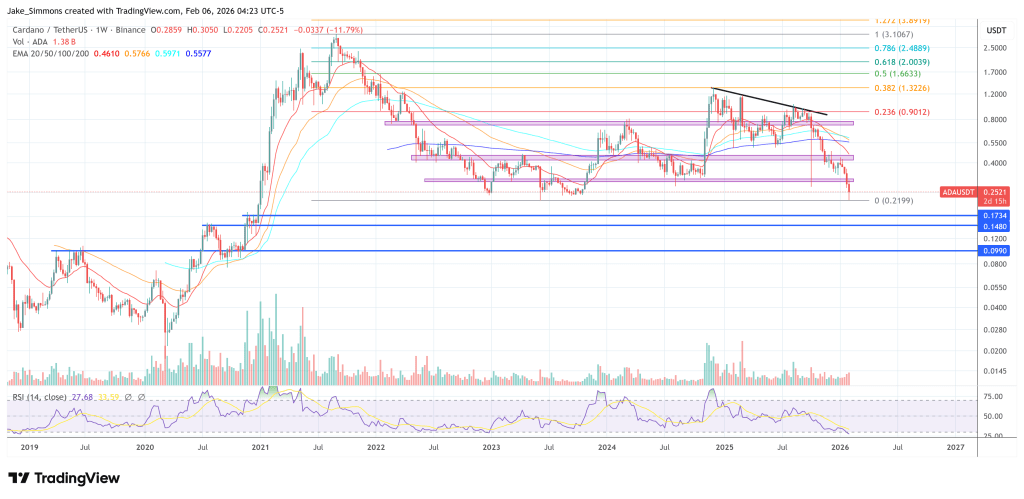
ADA fell to the June 2023 low again, 1-week chart | Source: ADAUSDT on TradingView.com

Пов'язані питання

QWhat is the main narrative that Charles Hoskinson is pushing back against during his livestream from Tokyo?

AHoskinson is pushing back against the narrative that Cardano is 'fading' or 'dead,' and that the bear market has drained the ecosystem's momentum.

QAccording to Hoskinson, what phase is Cardano now entering after years of protocol work?

AHoskinson stated that Cardano is shifting into a 'commercialization phase,' building products that feel more like mainstream use cases rather than infrastructure demos.

QWhat was Hoskinson's personal financial claim to counter the critique that his optimism is due to his wealth?

AHoskinson claimed that he has lost over $3 billion and stated that he is not doing this for money, emphasizing that he would continue building even if he lost it all.

QWhat did Hoskinson argue is the only practical way to run a more integrated global economy?

AHoskinson argued that the only way to run a more integrated global economy is through cryptocurrency, which he called an 'economic franca,' as a neutral settlement layer.

QWhat two specific Cardano projects did Hoskinson name-check as part of the 'vanguard' of its next phase?

AHoskinson name-checked Hydra, Cardano's scaling effort, and Midnight, a privacy-focused sidechain.

Пов'язані матеріали

The Niche Consensus Among Elites: Has College Become an Expensive Waste?

**Summary:** A growing "anti-college" movement is gaining traction among elite circles in Silicon Valley, challenging the traditional value of a four-year university degree. Proponents argue that college has become an expensive, slow, and increasingly irrelevant waste of time, especially in the fast-paced tech world where opportunities pass by quickly. The movement is led by figures like billionaire Peter Thiel, who criticizes universities for high costs, ideological indoctrination, and stifling true innovation. His "Thiel Fellowship" pays young people to drop out and pursue ventures. Companies like Palantir Technologies (co-founded by Thiel) fuel this trend with programs like the "Meritocracy Fellowship," which offers high school graduates paid internships as an alternative to immediate college enrollment, promising a practical "Palantir Degree." Key drivers include: 1. **Economics:** Skyrocketing student debt versus the allure of immediate, high-paying tech jobs or startup funding. 2. **Technology:** AI and online tools lowering barriers to self-education and product development, making formal instruction seem inefficient. 3. **Culture:** A backlash against perceived "woke" ideology and DEI policies in universities, coupled with a belief that these institutions suppress meritocracy and masculine drive. The movement is notably male-dominated. Critics, like economist David Deming, warn against overgeneralizing from dropout success stories (survivorship bias). He emphasizes that genuine autodidacts are rare, corporate training is narrowly focused, and the "college wage premium" remains high for most people. University liberal arts education, he argues, builds adaptable problem-solving skills and broad perspectives. The debate highlights a deeper crisis in education. The core model of the modern university appears increasingly mismatched with the speed of the information age. The movement signals a shift in the locus of learning from institutional "education" to personal, active "learning" powered by the internet and AI. Ultimately, this may not mean the end of university, but rather a painful evolution. The future likely holds more hybrid, personalized, and lifelong learning pathways. The central question becomes: in a world changing faster than any curriculum, how do we best learn?

marsbit18 хв тому

The Niche Consensus Among Elites: Has College Become an Expensive Waste?

marsbit18 хв тому

From Subsidies to Token-Based Pricing to Price Cuts: Is OpenAI Sparking a Price War? Is the Inflection Point for Token Economics Nearing?

The commercialization of generative AI is facing a critical inflection point as a potential price war looms. According to The Wall Street Journal, OpenAI is considering a significant cut to its token fees to compete with rival Anthropic, signaling a shift from a growth-at-all-costs model focused on token consumption. This move comes as both companies, reportedly losing billions on compute, prepare for IPOs, and as enterprise customers face "bill shock" from switching to usage-based token billing. Reports indicate poor ROI, with one analysis finding only 18 cents of every dollar spent on AI tokens generates user-facing value. The industry's initial phases—from flat-rate subscriptions to aggressive subsidies—have given way to a reckoning with real costs. Analysts debate the future: some predict a bifurcation between premium, high-cost models for complex tasks and cheaper alternatives for routine work, while others believe overall spending will still rise as agentic AI increases tokens per task. Notably, Chinese model DeepSeek's low-cost API is gaining traction with U.S. enterprises, adding competitive pressure. The core challenge is redefining value beyond token volume ("tokenmaxxing") toward measurable productivity ("valuemaxxing"), as the entire AI value chain, from cloud providers to chipmakers, feels the ripple effects of unsustainable pricing.

marsbit23 хв тому

From Subsidies to Token-Based Pricing to Price Cuts: Is OpenAI Sparking a Price War? Is the Inflection Point for Token Economics Nearing?

marsbit23 хв тому

Торгівля

Спот
Ф'ючерси

Популярні статті

Як купити T

Ласкаво просимо до HTX.com! Ми зробили покупку Threshold Network Token (T) простою та зручною. Дотримуйтесь нашої покрокової інструкції, щоб розпочати свою криптовалютну подорож.Крок 1: Створіть обліковий запис на HTXВикористовуйте свою електронну пошту або номер телефону, щоб зареєструвати обліковий запис на HTX безплатно. Пройдіть безпроблемну реєстрацію й отримайте доступ до всіх функцій.ЗареєструватисьКрок 2: Перейдіть до розділу Купити крипту і виберіть спосіб оплатиКредитна/дебетова картка: використовуйте вашу картку Visa або Mastercard, щоб миттєво купити Threshold Network Token (T).Баланс: використовуйте кошти з балансу вашого рахунку HTX для безперешкодної торгівлі.Треті особи: ми додали популярні способи оплати, такі як Google Pay та Apple Pay, щоб підвищити зручність.P2P: Торгуйте безпосередньо з іншими користувачами на HTX.Позабіржова торгівля (OTC): ми пропонуємо індивідуальні послуги та конкурентні обмінні курси для трейдерів.Крок 3: Зберігайте свої Threshold Network Token (T)Після придбання Threshold Network Token (T) збережіть його у своєму обліковому записі на HTX. Крім того, ви можете відправити його в інше місце за допомогою блокчейн-переказу або використовувати його для торгівлі іншими криптовалютами.Крок 4: Торгівля Threshold Network Token (T)Легко торгуйте Threshold Network Token (T) на спотовому ринку HTX. Просто увійдіть до свого облікового запису, виберіть торгову пару, укладайте угоди та спостерігайте за ними в режимі реального часу. Ми пропонуємо зручний досвід як для початківців, так і для досвідчених трейдерів.

452 переглядів усьогоОпубліковано 2024.12.10Оновлено 2026.06.02

Як купити T

Обговорення

Ласкаво просимо до спільноти HTX. Тут ви можете бути в курсі останніх подій розвитку платформи та отримати доступ до професійної ринкової інформації. Нижче представлені думки користувачів щодо ціни T (T).

活动图片













