Cardano Founder Calls For Insider Recusal In Liqwid Governance Dispute

bitcoinistОпубліковано о 2026-03-16Востаннє оновлено о 2026-03-16

Анотація

Cardano founder Charles Hoskinson has intervened in a governance dispute at DeFi protocol Liqwid, urging insiders to recuse themselves from a revote on the distribution of nearly $1 million in NIGHT tokens. The conflict centers on whether the protocol should honor prior public commitments to return all assets deposited in its smart contracts. Hoskinson argued that DAO legitimacy depends on broad participation and trust, not just a vote, especially when insiders could directly benefit from the outcome. He warned that failing to address the perceived breach of trust could severely damage Liqwid's credibility and growth, and recommended a new vote focused solely on whether to honor the original promises.

Cardano founder Charles Hoskinson has weighed in on a governance dispute surrounding Liqwid, arguing that insiders tied to the protocol should step aside from any revote on disputed asset distribution and let token holders decide whether earlier public commitments should be honored. His intervention matters because it cuts to a familiar pressure point in DeFi governance: whether a DAO vote is truly legitimate when founding insiders may be voting on an outcome that benefits them directly.

In a livestream from Wyoming, Hoskinson said he generally avoids involvement in the DeFi layer of the Cardano ecosystem unless there is a broader community mandate. But he said the Liqwid situation had crossed into a more serious issue of trust after October representations that “100% of the assets in the smart contracts” allocated to the protocol would be returned to their “rightful owners.”

The dispute centers on a sizeable pool of Midnight’s NIGHT tokens tied to Liqwid’s ADA market. Public governance materials indicate the allocation totals roughly 18.81 million NIGHT, which at current market prices is worth just under $1 million. That helps explain why the vote has drawn so much attention: the argument is not over a symbolic governance gesture, but over the handling of a seven-figure crypto allocation that users say was supposed to be fully returned.

Cardano Founder Urges Second Liqwid Vote

According to Hoskinson, the team later ran into a governance and legal problem inside the DAO structure itself. “I guess that team did not have, according to the user agreement of their DAO, legal authorization to do so,” he said. “It somehow violated the terms of how they’ve set things up.” Even granting that point, he argued, the more troubling issue was how the matter was then handled.

His proposed fix was straightforward: rerun the vote, but on narrower and cleaner terms. “If you have to go to the DAO for a vote, two things should be done,” Hoskinson said. “First and foremost, those who are insiders should recuse themselves if they’re going to be direct beneficiaries of a governance action of this nature. Second, the question should have been, should we honor our marketing commitments, yes or no?”

That framing goes to the heart of his criticism. In Hoskinson’s telling, users deposited funds into the relevant smart contracts on the understanding that the prior commitments would be respected. “Commitments were already made, people put money into the contracts understanding those terms and conditions and had no reasons to believe that such things would be violated,” he said. “People in a position of trust and people in a position to maintain this type of software, they frankly speaking should be a little bit better.”

Hoskinson repeatedly returned to legitimacy, not just procedure. DAOs, he said, do not derive credibility from the mere existence of a vote. They derive it from broad participation and confidence that the process is not tilted by a small cluster of insiders. “DAOs require legitimacy and the legitimacy comes from participation,” he said. “If the belief is that participation is only controlled by a small group of insiders, there’s no path forward for a DAO to have governance legitimacy.”

His recommendation was for insiders associated with the protocol’s core entities to publicly declare their holdings, recuse themselves, and let holders vote only on whether the October commitments should be honored. If the answer is yes, then the protocol should simply follow through. If the answer is no, then the community could move to a second-stage debate over alternative allocations.

Hoskinson was equally clear about the stakes if that does not happen. He said he has no special powers to reverse the outcome, no control over assets already distributed into smart contracts, and no formal authority over the Cardano ecosystem. But he warned that perception alone could do lasting damage.

“It is my belief that this violation of public trust or at least the perception of it will badly damage the protocol’s ability, Liqwid’s ability to grow and thrive in the future,” he said. “Simply put, if people can’t trust what the core accounts are saying and when votes are taken, people don’t trust those votes, it creates a reality where people will just simply move to other options.”

Overall, if Liqwid wants to restore credibility, he argued, the path is still open. But it runs through disclosure, recusal and a cleaner vote.

At press time, Cardano traded at $0.29.
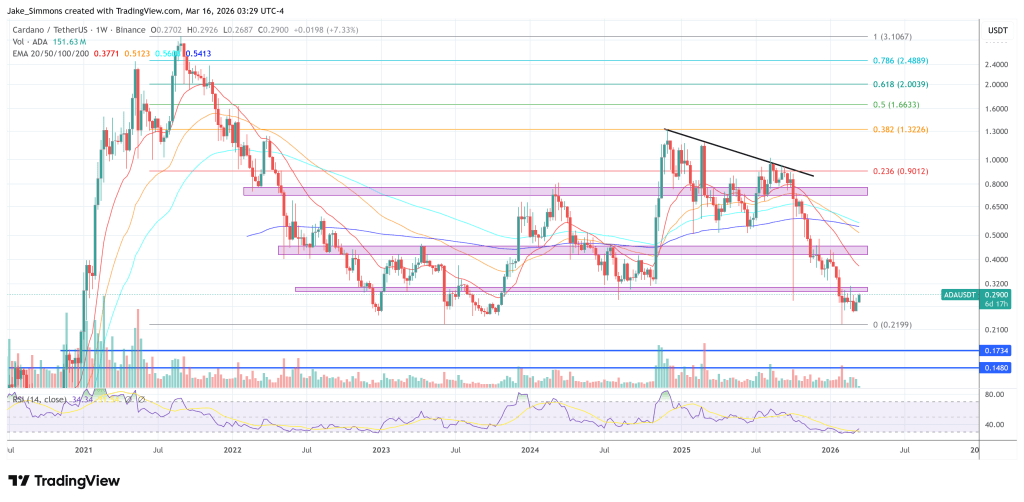
Cardano hovers below key resistance, 1-week chart | Source: ADAUSDT on TradingView.com

Пов'язані питання

QWhat is the core issue in the Liqwid governance dispute that Charles Hoskinson is addressing?

AThe core issue is whether insiders tied to the Liqwid protocol should be allowed to vote on a disputed asset distribution that could directly benefit them, and whether a prior public commitment to return 100% of assets in smart contracts to their rightful owners should be honored.

QWhat specific solution did Charles Hoskinson propose to resolve the Liqwid governance dispute?

AHoskinson proposed rerunning the vote with two key changes: first, insiders who are direct beneficiaries should recuse themselves; second, the vote should ask a clear yes or no question on whether the protocol should honor its prior marketing commitments.

QAccording to Hoskinson, what is the source of a DAO's legitimacy in governance?

AHoskinson stated that a DAO's legitimacy comes from broad participation and the confidence that the process is not controlled or tilted by a small group of insiders, not merely from the existence of a vote.

QWhat is the approximate value of the disputed NIGHT token allocation at the center of this controversy?

AThe disputed allocation is roughly 18.81 million NIGHT tokens, which at current market prices is worth just under $1 million.

QWhat potential consequence did Hoskinson warn about if the trust issue in Liqwid governance is not properly addressed?

AHoskinson warned that the violation of public trust, or even the perception of it, would badly damage Liqwid's ability to grow and thrive in the future, as users would lose trust in core accounts and governance votes, leading them to move to other options.

Пов'язані матеріали

$30 Billion DeFi Capital Exodus: LayerZero Stumbles, Chainlink Feasts

Following the major DeFi security incident involving Kelp DAO, a significant migration of funds is underway from the cross-chain protocol LayerZero to Chainlink's CCIP (Cross-Chain Interoperability Protocol). Over $30 billion in Total Value Locked (TVL) from protocols like Kelp DAO, Solv Protocol, Re, and Tydro has moved to Chainlink in the past week, driven by security concerns. LayerZero is facing a severe trust crisis after the attack. Initially denying responsibility, LayerZero Labs has now issued a public apology, acknowledging management oversights. These include a vulnerable "1/1" single-node configuration for its Decentralized Verification Network (DVN) and past misuse of a multi-signature wallet by a team member. The protocol's weekly bridge volume has slumped to near-historic lows of around $470 million. In contrast, Chainlink is experiencing a surge in adoption and activity. Its independent active addresses recently hit multi-month highs, and whales have been accumulating LINK tokens. Beyond DeFi, Chainlink is securing partnerships with traditional finance giants like DTCC, European stock exchange operator SIX Group, and asset manager Amundi. While LayerZero has announced security upgrades—such as migrating to stronger multi-signature configurations and developing a second DVN client—and contributed to a rescue fund, the event underscores that security is becoming a decisive competitive factor as DeFi matures.

marsbit31 хв тому

$30 Billion DeFi Capital Exodus: LayerZero Stumbles, Chainlink Feasts

marsbit31 хв тому

The $13 Trillion Repo Market Is Quietly Being Rewritten by Blockchain

The $13 trillion repurchase agreement (repo) market, a crucial artery for global short-term funding, is experiencing a significant transformation through blockchain technology. After years of limited impact in finance, blockchain is finding substantial adoption in repo transactions. Major institutions like JPMorgan Chase, HSBC, and Broadridge are deploying tokenized repo platforms, with daily volumes already reaching tens of billions of dollars. Traditional repo markets operate with fixed hours, rely on intermediaries, and involve manual, time-consuming processes. Tokenized repos, by contrast, use blockchain to create digital tokens representing cash and securities collateral. This enables near-instantaneous settlement, 24/7 trading, automated execution, and enhanced auditability. The key drivers for adoption include maturing technology, more receptive regulators, and growing client recognition of tangible benefits like reduced operational friction and capital efficiency. Analyses, such as one from Broadridge, indicate that moving a portion of repo activity onto blockchain can significantly reduce a bank's required liquidity buffers, potentially freeing up billions in capital. The infrastructure is also seen as foundational for a future of round-the-clock trading for traditional assets. Challenges remain, including the existence of fragmented blockchain networks, the need for stress testing under extreme market conditions, and the loss of operational flexibility compared to manual processes. However, the industry consensus is that these are implementation hurdles. Tokenized repo has moved beyond pilot stages to become one of blockchain's most concrete and impactful applications in traditional finance, marking a pivotal shift in how a core market functions.

marsbit32 хв тому

The $13 Trillion Repo Market Is Quietly Being Rewritten by Blockchain

marsbit32 хв тому

From Gas Limit to 'Keyed Nonces', How to Understand the Next Step in Ethereum Scalability?

Ethereum’s scalability efforts are shifting toward a user-centric approach—focusing not only on higher TPS, but on translating technical upgrades into lower costs, smoother operations, and better wallet experiences. Two recent developments highlight this direction: - **Raising the Gas Limit to 200 million**: Following the Fusaka upgrade that increased it to 60 million, a consensus has formed around a potential future increase to 200 million. This would boost Ethereum’s execution capacity, but it is planned alongside other upgrades—such as ePBS, Block-Level Access Lists (BAL), and EIP-8037—to manage state growth and keep node operation viable for average participants. - **Keyed Nonces (EIP-8250)**: This proposal aims to improve how transactions are queued. Instead of a single linear nonce per account, it introduces multiple independent nonce domains. This prevents different types of transactions—such as private payments, session keys, or batch operations—from blocking each other. Vitalik Buterin views this as a foundational step toward better privacy support and more flexible state scalability. Together, these upgrades are part of a broader move to push complexity from wallets, DApps, and relays back into the protocol layer. For everyday users, this means future Ethereum interactions could become less congested, more intuitive, and safer—especially as core improvements in account abstraction, cross-L2 interoperability, and node decentralization continue to progress. Ultimately, Ethereum is evolving to handle not just more transactions, but more varied and complex on-chain use cases while preserving its decentralized foundation.

marsbit54 хв тому

From Gas Limit to 'Keyed Nonces', How to Understand the Next Step in Ethereum Scalability?

marsbit54 хв тому

Торгівля

Спот
Ф'ючерси

Популярні статті

Як купити ADA

Ласкаво просимо до HTX.com! Ми зробили покупку Cardano (ADA) простою та зручною. Дотримуйтесь нашої покрокової інструкції, щоб розпочати свою криптовалютну подорож.Крок 1: Створіть обліковий запис на HTXВикористовуйте свою електронну пошту або номер телефону, щоб зареєструвати обліковий запис на HTX безплатно. Пройдіть безпроблемну реєстрацію й отримайте доступ до всіх функцій.ЗареєструватисьКрок 2: Перейдіть до розділу Купити крипту і виберіть спосіб оплатиКредитна/дебетова картка: використовуйте вашу картку Visa або Mastercard, щоб миттєво купити Cardano (ADA).Баланс: використовуйте кошти з балансу вашого рахунку HTX для безперешкодної торгівлі.Треті особи: ми додали популярні способи оплати, такі як Google Pay та Apple Pay, щоб підвищити зручність.P2P: Торгуйте безпосередньо з іншими користувачами на HTX.Позабіржова торгівля (OTC): ми пропонуємо індивідуальні послуги та конкурентні обмінні курси для трейдерів.Крок 3: Зберігайте свої Cardano (ADA)Після придбання Cardano (ADA) збережіть його у своєму обліковому записі на HTX. Крім того, ви можете відправити його в інше місце за допомогою блокчейн-переказу або використовувати його для торгівлі іншими криптовалютами.Крок 4: Торгівля Cardano (ADA)Легко торгуйте Cardano (ADA) на спотовому ринку HTX. Просто увійдіть до свого облікового запису, виберіть торгову пару, укладайте угоди та спостерігайте за ними в режимі реального часу. Ми пропонуємо зручний досвід як для початківців, так і для досвідчених трейдерів.

920 переглядів усьогоОпубліковано 2024.12.10Оновлено 2025.03.21

Як купити ADA

Обговорення

Ласкаво просимо до спільноти HTX. Тут ви можете бути в курсі останніх подій розвитку платформи та отримати доступ до професійної ринкової інформації. Нижче представлені думки користувачів щодо ціни ADA (ADA).

活动图片