Cardano, Avalanche, Sui And IOTA Submit Joint UK Crypto Rules Response

bitcoinistОпубліковано о 2026-02-13Востаннє оновлено о 2026-02-13

Анотація

Cardano, Avalanche, Sui, and IOTA have jointly responded to the UK Financial Conduct Authority’s crypto consultation, advocating for regulations that clearly distinguish between custodial and non-custodial crypto activities. They argue that rules should target intermediaries who control user assets—requiring disclosures, consent, and record-keeping—while exempting developers and infrastructure providers who don’t hold custody or exercise unilateral control. The submission emphasizes that staking and DeFi should be regulated uniformly, and obligations should align with actual risks. The goal is to protect consumers without stifling non-custodial, decentralized innovation, ensuring the UK remains a competitive jurisdiction for blockchain technology.

Organisations around Cardano, Avalanche, Sui and IOTA have filed a joint response to the UK Financial Conduct Authority’s CP25/40 consultation, arguing that the rulebook should draw hard lines around “custody and control” and avoid sweeping non-custodial crypto activity into regimes designed for intermediaries.

The submission, led by the IOTA Foundation alongside the Sui Foundation, Cardano Foundation and the Avalanche Policy Coalition, is a targeted push on two areas the group says are most exposed to “scope, proportionality and technical interpretation” problems: staking and decentralized finance.

In a post on X, IOTA framed the core message as a scoping exercise as much as a policy one: “focus on custody & control, keep it proportionate, and support non-custodial, decentralized innovation for UK.”

Cardano, Avalanche, Sui And IOTA Warn Against Overregulation

The open letter expands that into a broader architecture: “A consistent theme across our feedback on both staking and decentralized finance is the importance of clearly distinguishing between infrastructure functions and intermediary functions. We recommend that regulatory obligations remain focused on entities that exercise custody, discretion, or commercial intermediation, while preserving the neutrality of public blockchain infrastructure.”

The letter adds that developers and infrastructure providers should be exempted: “[They] deliver software development, validation, communications, or other protocol-level services without controlling client assets or exercising unilateral decision-making are performing infrastructure roles rather than financial intermediation, and warrant a proportionate and differentiated regulatory treatment.”

That distinction matters, the group argues, because staking and DeFi aren’t single business models. They sit on a spectrum from fully custodial services where a firm safeguards assets and intermediates execution to protocol-native activity where users retain control of keys and assets.

On staking, IOTA’s X thread distilled the policy ask into a binary: “regulation must clearly distinguish custodial vs non-custodial/models.” It adds that custodial staking “where firms safeguard assets” warrants “appropriate retail disclosures, consent + record-keeping,” while “non-custodial/protocol-level staking (no control of user assets/keys) should not be swept into the same regime.”

The letter mirrors that framing and narrows it to where the risk sits: “Where staking is provided through a custodial arrangement, and the firm safeguards client assets and intermediates the staking process, we recommend applying the proposed requirements on information provision, key contractual terms, express prior consent for retail clients, and record-keeping.”

It then draws the line the signatories want the FCA to adopt: “For non-custodial and delegated staking arrangements, where firms do not control client assets or private keys, we recommend that such activities remain outside the scope of regulated staking activity, as this maintains proportionality and aligns regulatory obligations with the actual sources of risk.”

The second pressure point is the FCA’s concept of a “clear controlling person” in DeFi. IOTA’s post argues the term needs a “technical, objective definition,” warning that obligations should scale with “custody, discretion, and unilateral control; not with writing code, participating in governance, or providing neutral infrastructure.”

The open letter keeps the same structure: it accepts the FCA’s intent to capture cases where an identifiable party is “effectively carrying on regulated cryptoasset activities,” but pushes back on triggering regulatory status based on development and infrastructure. Instead, it urges the FCA to anchor expectations to “demonstrable, unilateral control over protocol operation, governance or economic outcomes,” particularly because DeFi “rel[ies] on self-custody, automated execution and open participation.”

IOTA positioned the argument as pro-scope, not anti-rules: “smarter scoping = better consumer protection where risk is real, plus legal certainty that keeps non-custodial innovation from being regulated out of existence.”
The letter closes on the same trade-off: obligations tied to “custody, discretion and unilateral control” would, the group says, “strengthen legal certainty, enhance consumer protection where it is most needed, and reinforce the UK’s position as a jurisdiction that understands the architectural realities of decentralized technologies.”

At press time, Cardano traded at $0.264.
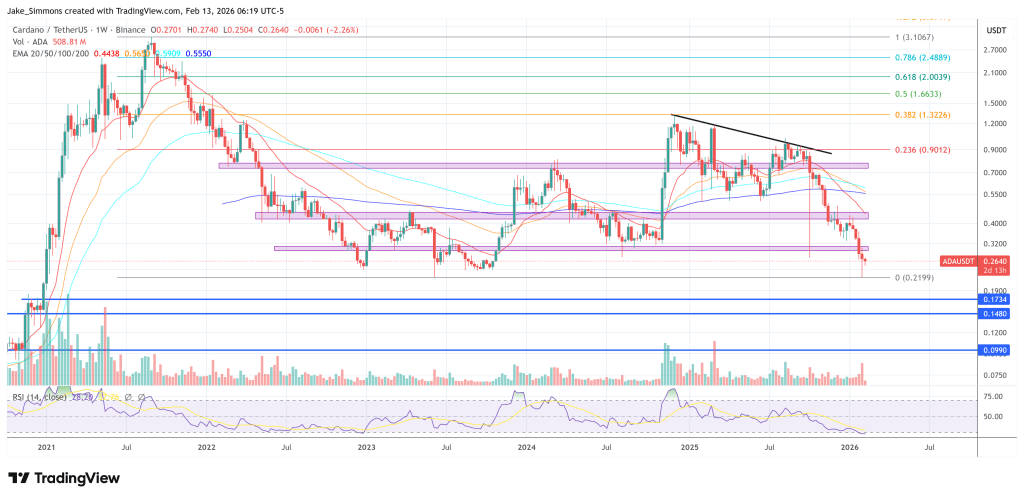
Cardano hovers above key support, 1-week chart | Source: ADAUSDT on TradingView.com

Трендові криптовалюти

Пов'язані питання

QWhich blockchain organizations jointly submitted a response to the UK Financial Conduct Authority's CP25/40 consultation?

AThe IOTA Foundation, Sui Foundation, Cardano Foundation, and the Avalanche Policy Coalition.

QWhat two areas did the joint submission identify as most exposed to problems of scope, proportionality, and technical interpretation?

AStaking and decentralized finance (DeFi).

QAccording to the open letter, what is the key distinction that should be made in regulation between different types of staking services?

AA clear distinction between custodial staking, where a firm safeguards assets, and non-custodial or protocol-level staking, where users retain control of their keys and assets.

QWhat term used by the FCA in relation to DeFi did the group argue needs a 'technical, objective definition'?

AThe term 'clear controlling person'.

QWhat core principle does the group argue should determine regulatory obligations, rather than writing code or providing neutral infrastructure?

AObligations should be tied to custody, discretion, and unilateral control over assets or protocol operation.

Пов'язані матеріали

In Conversation with Ray Dalio: We Are Currently in an AI Bubble, with 1% of My Portfolio in Bitcoin

Ray Dalio, founder of Bridgewater Associates, warns in an interview that the current AI boom shows classic bubble characteristics, which could lead to significant economic downturns as seen in past cycles like 1929 or 2000. He explains that speculative enthusiasm, fueled by debt and overvaluation, often precedes a crash when rising rates or taxation force asset sales, causing widespread losses and recession. Dalio also outlines his "Big Cycle" theory, describing an approximate 80-year pattern where widening wealth gaps, massive government deficits, and shifting geopolitical power (like China's rise) create internal conflict and global instability. He emphasizes that we are in a late-cycle, transitional phase where traditional powers like the US and UK face decline. For personal wealth protection, Dalio advises diversification beyond cash into assets like stocks, bonds, real estate, and particularly gold, which he prefers over Bitcoin. While he holds about 1% of his portfolio in Bitcoin as a non-printable hard asset, he views gold as more secure from technological or governmental threats. Regarding AI's impact, Dalio believes it will disproportionately benefit capital owners, worsening inequality by replacing both physical and cognitive labor. He suggests that human intuition and emotional intelligence, combined with AI, will be key for future workers. On taxation, Dalio argues that wealth taxes are impractical and risk triggering asset sell-offs, reducing productive investment. He points to the UK as a cautionary example of debt, low productivity, and political strife. Geopolitically, Dalio foresees a more regionalized world, with the US showing weakness in prolonged conflicts like with Iran, akin to past imperial declines. The ideal outcome, he suggests, is coexisting powerful blocs (e.g., Americas, China-Asia Pacific) without major war.

marsbit2 год тому

In Conversation with Ray Dalio: We Are Currently in an AI Bubble, with 1% of My Portfolio in Bitcoin

marsbit2 год тому

Daily 7.2 Trillion KRW: Foreign Capital's Record Net Buying on Friday! Wall Street Says Headwinds for Korean Stock Fund Flows Have Subsided

South Korean stock market sees a dramatic shift in fund flows. On July 31, foreign investors made a record net purchase of approximately KRW 7.2 trillion in KOSPI stocks, marking a fundamental reversal from the persistent large-scale net outflows seen in previous months. This contributed to a significant narrowing of foreign net selling in July to KRW 9.8 trillion, down sharply from KRW 48.4 trillion in June and KRW 44.5 trillion in May. Simultaneously, domestic institutional pressure eased. South Korean pension funds and asset managers turned to a net buying position in July, purchasing KRW 1.0 trillion worth of KOSPI shares, contrasting with net sales in May and June. Market volatility is expected to be dampened by new financial regulations. Effective July 31, the Financial Services Commission tightened access for retail investors to single-stock leveraged ETFs by raising the minimum cash deposit requirement. Trading volumes for these products subsequently dropped to about 50% of their monthly average. Citigroup Research maintains its year-end KOSPI target of 10,000 points. The firm cites several supportive factors: the substantial easing of headwinds from capital outflows, a robust fundamental outlook for the semiconductor sector, historically low market valuations, strong economic fundamentals, and the potential for policy support from financial authorities if needed.

marsbit2 год тому

Daily 7.2 Trillion KRW: Foreign Capital's Record Net Buying on Friday! Wall Street Says Headwinds for Korean Stock Fund Flows Have Subsided

marsbit2 год тому

Thanks to Dice Rolls, Bitcoin Keys Are Stored Offline, But Not Everyone Will Do It

The article discusses using dice rolls to generate secure Bitcoin wallet seeds, providing entropy independent of potentially flawed hardware random number generators. It explains that each fair dice roll offers about 2.585 bits of entropy, with around 50 rolls needed for a standard 12-word seed phrase and 99+ recommended for higher security. This method gained attention after a vulnerability was revealed in some Coldcard hardware wallets, where a faulty firmware RNG (dating back to 2021) compromised generated keys. The analysis notes that while a dice-generated main seed was safe from this specific flaw, other Coldcard functions (like creating paper wallets, backup keys, or passwords) could still be vulnerable if they used the defective RNG. The piece argues that while dice-based entropy is technically robust, the manual process is error-prone, tedious, and unrealistic for most new users, who might make mistakes in recording or inputting rolls. It concludes that while manual entropy generation should remain an option for advanced users, the long-term goal is to develop reliable, user-friendly hardware and software that securely generates randomness without requiring specialized knowledge. Coldcard users are advised to check their firmware version and replace any secondary secrets (like paper wallet keys) created with vulnerable devices, while also considering multi-signature setups with devices from different manufacturers for added security.

cryptonews.ru7 год тому

Thanks to Dice Rolls, Bitcoin Keys Are Stored Offline, But Not Everyone Will Do It

cryptonews.ru7 год тому

Торгівля

Спот

Популярні статті

Як купити ADA

Ласкаво просимо до HTX.com! Ми зробили покупку Cardano (ADA) простою та зручною. Дотримуйтесь нашої покрокової інструкції, щоб розпочати свою криптовалютну подорож.Крок 1: Створіть обліковий запис на HTXВикористовуйте свою електронну пошту або номер телефону, щоб зареєструвати обліковий запис на HTX безплатно. Пройдіть безпроблемну реєстрацію й отримайте доступ до всіх функцій.ЗареєструватисьКрок 2: Перейдіть до розділу Купити крипту і виберіть спосіб оплатиКредитна/дебетова картка: використовуйте вашу картку Visa або Mastercard, щоб миттєво купити Cardano (ADA).Баланс: використовуйте кошти з балансу вашого рахунку HTX для безперешкодної торгівлі.Треті особи: ми додали популярні способи оплати, такі як Google Pay та Apple Pay, щоб підвищити зручність.P2P: Торгуйте безпосередньо з іншими користувачами на HTX.Позабіржова торгівля (OTC): ми пропонуємо індивідуальні послуги та конкурентні обмінні курси для трейдерів.Крок 3: Зберігайте свої Cardano (ADA)Після придбання Cardano (ADA) збережіть його у своєму обліковому записі на HTX. Крім того, ви можете відправити його в інше місце за допомогою блокчейн-переказу або використовувати його для торгівлі іншими криптовалютами.Крок 4: Торгівля Cardano (ADA)Легко торгуйте Cardano (ADA) на спотовому ринку HTX. Просто увійдіть до свого облікового запису, виберіть торгову пару, укладайте угоди та спостерігайте за ними в режимі реального часу. Ми пропонуємо зручний досвід як для початківців, так і для досвідчених трейдерів.

1.1k переглядів усьогоОпубліковано 2024.12.10Оновлено 2026.06.02

Як купити ADA

Обговорення

Ласкаво просимо до спільноти HTX. Тут ви можете бути в курсі останніх подій розвитку платформи та отримати доступ до професійної ринкової інформації. Нижче представлені думки користувачів щодо ціни ADA (ADA).

活动图片













