Burning $160,000, Frenziedly Coding 1 Million Lines: Bun's Creator Rewrites the Foundation with Claude

marsbitОпубліковано о 2026-07-17Востаннє оновлено о 2026-07-17

Анотація

**The Bun creator used Claude to rewrite its core in Rust in under two weeks for $165,000.** Jarred Sumner, the creator of the Bun JavaScript runtime, leveraged Claude Code to migrate the project's entire codebase from Zig to Rust—generating 1 million lines of code in less than two weeks. This cost approximately $165,000 in API tokens, a fraction of the estimated $3 million and 4 years a manual rewrite might have required. The new Rust-based version passed all existing tests and was quietly released in June. Inspired by this, Instagram co-founder Mike Krieger also used Claude to migrate a Python library to 165,000 lines of TypeScript over a weekend, slashing build times dramatically. Anthropic, the creator of Claude, formalized the process into a six-step framework for large-scale AI-assisted migrations. The core principle is to "fix the loop, not the code": the system uses existing code as specification, automated tests as judges, and iterates through generation, review, and repair cycles without constant human intervention. This approach makes large-scale migrations, once a daunting and costly task, a feasible and cost-effective automated process.

A project that once required 4 years was forcefully compressed into two weeks by Claude Code!

Costs were slashed from $3 million to just over a hundred thousand.

Recently, Anthropic publicly unveiled the full process of large-scale code migration using Claude Code for the first time. Their six-step framework has left the entire internet in awe.

The protagonist of the story is Jarred Sumner, the creator of Bun.

He once spent a year writing Bun, a JavaScript runtime that outperforms Node.js.

Now, in less than two weeks, he frenziedly wrote one million lines of code, migrating the entire project from Zig to Rust.

Bun's Creator Has AI Rewrite a Million Lines of Code

Back then, Jarred Sumner's logic for betting on Zig was pure: achieve performance comparable to C language through extreme simplicity.

This was almost a tool tailor-made for solo founders.

In his own words, "Before LLMs existed, I built Bun in a small apartment in Oakland in one year."

However, the dark side of extreme simplicity is the countless hidden pitfalls laid down early on.

Now, Bun's CLI monthly downloads have robustly surpassed the 10 million mark, and it has even become a heavy dependency at the core of Claude Code.

With the ecosystem's frenetic growth, the "technical debt" accrued over the years has come due, demanding repayment with interest.
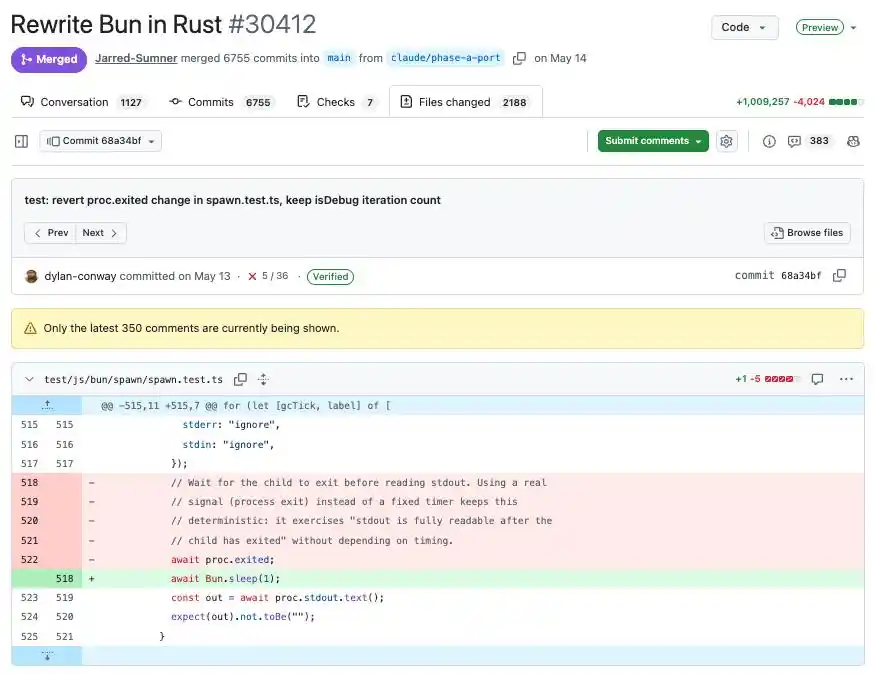
So he did something he never dared to think of before: using Claude Code to migrate the entire Bun codebase from Zig to the more memory-safe Rust.

In less than two weeks, it produced one million lines of code.

Before merging, all existing Bun test cases passed 100% in CI. After merging, 19 regressions surfaced, but they have all been fixed now. The Rust version quietly went live with Claude Code in June.

This migration consumed 5.9 billion input tokens and 690 million output tokens. Calculated at API pricing, it cost approximately $165,000.

It sounds expensive, but compared to the old budget of 4 years and $3 million, this amount is practically pocket change.

A Python Library Transformed into 165,000 Lines of TypeScript

Jarred Sumner is far from the only one using CC as an efficiency engine.

Mike Krieger, Head of Anthropic Labs and co-founder of Instagram, has an even more representative story.

Over a weekend, he migrated an entire Python codebase to 165,000 lines of TypeScript. The core part consumed about 27 million tokens.

Hundreds of agents, 8 checkpoints, 3 rounds of adversarial reviews, and finally, a consistency check that compared the output of every single command with the original Python version line-by-line. Any behavioral deviation was treated as a bug to be fixed.

He even had Claude design a set of end-to-end tests that ran for four consecutive nights, specifically targeting unforeseen corner-case issues.

Why was migration absolutely necessary?

His team's internal tools needed to be packaged as a single binary for delivery to users.

Using the Python toolchain, compilation took 8 minutes per platform, and the entire build matrix required a half-hour wait for each release.

After the migration, the same compilation takes only 2 seconds. The binary launches 6 times faster, and they also managed to retire an entire deployment pipeline.

Don't Fix the Code: The Six-Step Core Framework

So, what is the soul of this approach?

Anthropic summarizes it in one sentence: Don't fix the code; fix the loop that produces the code.
Large-scale migrations are particularly well-suited for AI, for simple reasons—

The work is inherently parallelizable; thousands of files can be processed simultaneously.

The old code itself serves as the best specification.

The test suite is a ready-made judge.

If compilation or testing fails, the next task automatically surfaces.

The model can relentlessly iterate against this "objective truth" for days, with no human arbitration needed in between.

Thus, Anthropic proposes a reusable six-step framework: First, set up the judge (tests), write the rulebook, draw the dependency graph, and list the gap inventory.

Then, conduct a small-scale "shakedown" to stress-test the rules, catching critical issues before scaling to thousands of files.

Next, perform the full translation, running a multi-agent cycle of "implementation—review—fix"; finally, compile, run, and compare behavior line-by-line.
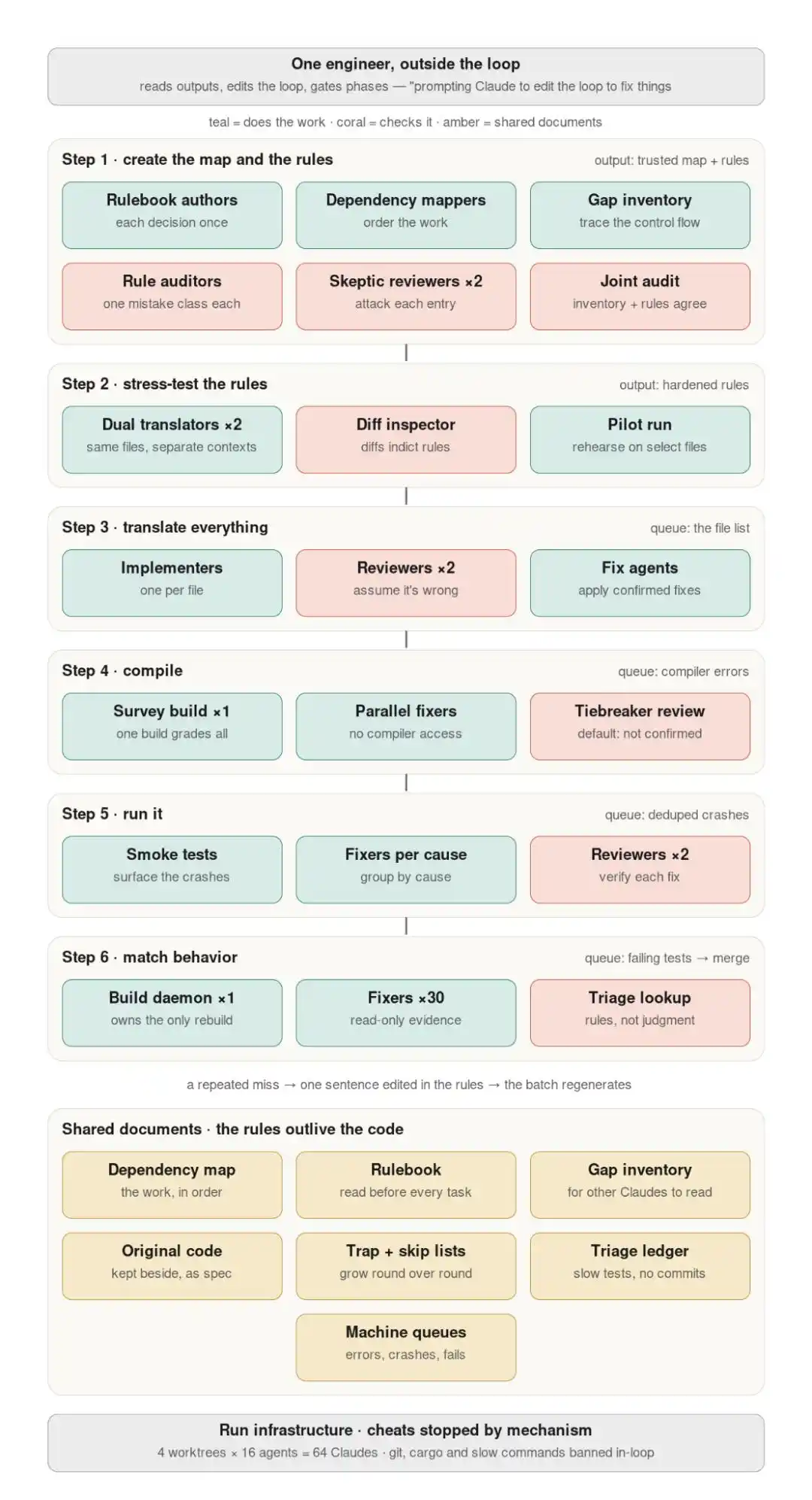
Throughout the entire process, rules are never manually patched:

Every time a reviewer catches an error, they add a sentence to the rulebook and regenerate the affected batch of files.

Anthropic's final suggestion: Pick a codebase you've been tolerating for too long, and go ask Claude what its migration process would look like.

Four years ago, this statement was a joke. Today, it's a check that can actually be cashed.

In the past, migration was a chasm developers dared not cross; now, it's just a progress bar waiting to be cleared.

This article is from the WeChat public account "New Zhi Yuan," author: ASI Revelation

Трендові криптовалюти

Пов'язані питання

QWho is the main developer behind the migration of Bun from Zig to Rust using Claude Code, and what is notable about his previous work?

AThe main developer is Jarred Sumner, known as the 'father of Bun'. He is notable for previously writing the Bun JavaScript runtime, which is faster than Node.js, in just one year from a small apartment in Oakland before the era of large language models (LLMs).

QWhat was the estimated cost and time saved by using Claude Code to migrate Bun from Zig to Rust, compared to the traditional method?

AThe migration using Claude Code cost approximately $165,000 and was completed in less than two weeks. In contrast, the traditional method was estimated to take 4 years and cost $3 million, making the AI-assisted approach drastically cheaper and faster.

QWhat are the six key steps in Anthropic's framework for large-scale code migration using AI?

AThe six-step framework involves: 1) Setting up the 'referee' (test suites), 2) Writing the rulebook (specifications), 3) Mapping dependencies, 4) Listing gaps, 5) Running a small-scale pilot to test rules, and 6) Conducting full translation with a multi-agent 'implement-review-fix' loop, followed by compilation, execution, and behavioral verification.

QBesides the Bun migration, what is another example of a successful code migration using Claude Code mentioned in the article?

AAnother example is by Mike Krieger, co-founder of Instagram, who migrated a Python codebase to 16.5万 lines of TypeScript over a weekend. This migration reduced compilation time from 8 minutes per platform to 2 seconds, sped up binary startup by 6 times, and eliminated an entire deployment pipeline.

QWhat is the core philosophy behind Anthropic's approach to AI-assisted code migration, as summarized in the article?

AThe core philosophy is: 'Don't fix the code; fix the loop that produces the code.' Instead of manually patching individual issues, the process focuses on improving the automated generation and review cycle, using existing code as the specification and test suites as the objective referee to guide the AI.

Пов'язані матеріали

CLARITY Act Delays Have Become a Compliance Crisis, Not Just a Political Stalemate

The article discusses the ongoing delay in the US Senate regarding the CLARITY Act, a bill intended to clarify the regulatory status of digital assets as either securities under the SEC or commodities under the CFTC. A year after the House passed it, this inaction is creating a concrete governance, risk, and compliance crisis for businesses, moving beyond mere political gridlock. While related bills for stablecoins and CBDC prohibitions have become law, the comprehensive CLARITY Act remains stalled. The delay creates profound uncertainty for companies on fundamental rules for exchanges, custodians, and all market participants. Without clear congressional action, regulatory classification depends on shifting enforcement actions and presidential administrations, making stable compliance impossible. The Senate's window for action is narrowing, with key votes needed before the August recess. Several major issues are blocking passage, including ethical concerns over crypto holdings by officials, law enforcement opposition to certain provisions, perceived loopholes for stablecoin rewards, and regulatory agency vacancies at the SEC and CFTC. Bipartisan support is fragile. Further delay risks postponing the legislation until 2030, perpetuating a costly "regulation by enforcement" environment. In contrast, passage would provide a durable regulatory framework. Regardless of the outcome, compliance leaders are urged to immediately map their digital asset exposures, prepare governance materials for both scenarios, and stress-test their arrangements. The article concludes that while the Senate's action is uncertain, corporate preparedness is not.

Foresight News3 хв тому

CLARITY Act Delays Have Become a Compliance Crisis, Not Just a Political Stalemate

Foresight News3 хв тому

The 'Big Short' Burry: Now is an Excellent Time to Bottom-Fish in Hong Kong Stocks

The article discusses growing optimism towards Hong Kong stocks, led by prominent investor Michael Burry of "The Big Short" fame. Burry recently stated it is an "excellent time" to find cheap stocks in the Hong Kong market. His bullish view is based on the prediction that as the global AI chip stock frenzy cools, capital will flow out of markets like South Korea and Japan and seek undervalued opportunities, positioning Hong Kong as a potential beneficiary. Supporting this view, Goldman Sachs' Asia equity capital markets head, Wang Yajun, argues the Hong Kong market has already entered the AI era, but major indices have not yet reflected this reality. He points to active AI-related IPOs and transactions as evidence of underlying market vitality, contrasting with the weak performance of key indices like the Hang Seng. Data highlights Hong Kong's underperformance: the Hang Seng Index is down about 7% year-to-date, while markets in South Korea and Japan and semiconductor ETFs have seen significant gains. This disparity is seen by Burry and others as creating a valuation gap and a potential buying opportunity. The article notes Burry has acted on his view by increasing holdings in Chinese e-commerce firm JD.com. Morgan Stanley has also recently advocated buying Hong Kong stocks, citing positive corporate earnings expectations. However, challenges remain, including persistent concerns over Chinese consumer spending and e-commerce profitability, which continue to weigh on the market. The divergence between weak index performance and strong activity in specific sectors like AI presents both opportunity and complexity for investors looking to capitalize on Hong Kong's potential turnaround.

marsbit32 хв тому

The 'Big Short' Burry: Now is an Excellent Time to Bottom-Fish in Hong Kong Stocks

marsbit32 хв тому

The Big Short's Burry: Now is the Perfect Time to Bottom-Fish in Hong Kong Stocks

Michael Burry, the investor famous for predicting the 2008 financial crisis, recently stated on X that now is an "excellent time" to look for cheap stocks in the Hong Kong market. His bullish view is based on the expectation that the global AI chip stock frenzy will cool, leading funds to flow out of Korea, Japan, and semiconductor ETFs and into undervalued areas like Hong Kong. He has already acted by increasing his stake in JD.com. Hong Kong stocks have significantly underperformed global peers this year, with the Hang Seng Index down about 7% and the Hang Seng Tech Index falling over 15%. This contrasts sharply with major gains in Korean, Japanese, and semiconductor markets. Burry sees this disparity as creating a bargain-hunting opportunity. Adding another perspective, Goldman Sachs' Asia equity capital markets head, Wang Yajun, argues that while the Hong Kong market has already entered the AI era with active related IPOs and trading, its major indices have not yet reflected this reality due to structural lag. He expects record equity fundraising this year, driven by more AI company listings. Morgan Stanley has also recently advocated buying Hong Kong stocks, citing optimistic corporate earnings prospects. However, challenges remain, including concerns over China's consumer recovery and e-commerce profitability. The key for investors is navigating the overall index pressure while identifying specific structural opportunities highlighted by these bullish narratives.

链捕手37 хв тому

The Big Short's Burry: Now is the Perfect Time to Bottom-Fish in Hong Kong Stocks

链捕手37 хв тому

Xi Jinping Attends Opening Ceremony of World Artificial Intelligence Conference 2026 and High-Level Meeting on Global AI Governance, Delivers Keynote Speech

On July 17, 2026, Chinese President Xi Jinping delivered a keynote speech titled "Working Together to Build a Fair and Equitable Global Governance System on Artificial Intelligence" at the opening ceremony of the 2026 World Artificial Intelligence Conference and High-level Conference on Global AI Governance in Shanghai. President Xi pointed out that the rapid development of AI, alongside the accelerated global changes, presents both significant opportunities and governance challenges. He raised critical questions for humanity regarding human-machine coexistence, safety, ethics, and bridging divides. China advocates for a people-oriented, benevolent approach to AI, making it a force for common prosperity and security, and jointly building a fair and reasonable global AI governance system. Xi Jinping put forward a four-point proposal: 1. **Uphold Openness for Win-Win Cooperation and Drive Innovation:** Seize the historic opportunity by encouraging open-source collaboration and sharing to foster AI innovation, industry growth, and application, empowering all sectors. 2. **Enhance Risk Awareness and Ensure Security and Controllability:** Attach great importance to AI's inherent and derivative risks. Build systems for laws, technical monitoring, risk warning, and emergency response to safeguard security, prevent misuse, and ensure human control. Oppose the practice of politicizing national security in AI. 3. **Encourage Inclusiveness and Promote Cultural Exchange:** Shape AI's values with humanity's common values. Use AI to enhance understanding and tolerance between civilizations, fostering a garden of diverse cultures. 4. **Advocate Solidarity and Improve Global Governance:** Practice true multilateralism, leverage the UN's role, and strengthen coordination on AI development strategies, governance rules, and technical standards to form a widely accepted global governance framework. Assist Global South countries in capacity building to bridge the digital divide and avoid new historical inequities. Xi highlighted that as a responsible major country, China, in its 15th Five-Year Plan period, is committed to being a provider of international public goods in AI, contributing Chinese solutions. China has promoted an "AI Plus" initiative, with its core intelligent economy exceeding RMB 10 trillion. To support global AI development, China will provide 5,000 AI training opportunities for developing countries, establish international AI application cooperation centers with regional organizations, and deploy its "Mazu" meteorological AI warning system in 30 countries. The establishment of the World Artificial Intelligence Cooperation Organization in Shanghai marks a significant milestone. Leaders from Kazakhstan, Cambodia, Thailand, and the UN Secretary-General delivered speeches, commending China's contributions to global AI governance and echoing President Xi's proposals. They agreed that AI's opportunities and challenges are borderless, requiring cooperative, inclusive, and equitable international efforts to ensure a secure, prosperous future that leaves no country behind. The conference issued a Chair's Statement. President Xi and his wife hosted a welcome banquet for international dignitaries on July 16. Senior Chinese officials attended the events.

链捕手40 хв тому

Xi Jinping Attends Opening Ceremony of World Artificial Intelligence Conference 2026 and High-Level Meeting on Global AI Governance, Delivers Keynote Speech

链捕手40 хв тому

Торгівля

Спот

Популярні статті

Що таке $S$

Розуміння SPERO: Комплексний огляд Вступ до SPERO Оскільки ландшафт інновацій продовжує еволюціонувати, виникнення технологій web3 та криптовалютних проектів відіграє ключову роль у формуванні цифрового майбутнього. Один з проектів, який привернув увагу в цій динамічній сфері, — це SPERO, позначений як SPERO,$$s$. Ця стаття має на меті зібрати та представити детальну інформацію про SPERO, щоб допомогти ентузіастам та інвесторам зрозуміти його основи, цілі та інновації в рамках web3 та крипто-сектору. Що таке SPERO,$$s$? SPERO,$$s$ — це унікальний проект у криптопросторі, який прагне використати принципи децентралізації та технології блокчейн для створення екосистеми, що сприяє залученню, корисності та фінансовій інклюзії. Проект розроблений для полегшення взаємодії між користувачами новими способами, надаючи їм інноваційні фінансові рішення та послуги. У своїй основі SPERO,$$s$ прагне надати можливості індивідам, забезпечуючи інструменти та платформи, які покращують користувацький досвід у криптовалютному просторі. Це включає в себе можливість більш гнучких методів транзакцій, сприяння ініціативам, що підтримуються спільнотою, та створення шляхів для фінансових можливостей через децентралізовані додатки (dApps). Основна концепція SPERO,$$s$ обертається навколо інклюзивності, прагнучи зменшити розриви в традиційній фінансовій системі, використовуючи переваги технології блокчейн. Хто є творцем SPERO,$$s$? Особистість творця SPERO,$$s$ залишається дещо невідомою, оскільки є обмежені публічно доступні ресурси, що надають детальну інформацію про його засновників. Ця відсутність прозорості може бути наслідком зобов'язання проекту до децентралізації — етики, яку багато проектів web3 поділяють, ставлячи колективні внески вище за індивідуальне визнання. Зосереджуючи обговорення навколо спільноти та її колективних цілей, SPERO,$$s$ втілює суть наділення без виділення конкретних осіб. Таким чином, розуміння етики та місії SPERO є більш важливим, ніж ідентифікація єдиного творця. Хто є інвесторами SPERO,$$s$? SPERO,$$s$ підтримується різноманітними інвесторами, починаючи від венчурних капіталістів до ангельських інвесторів, які прагнуть сприяти інноваціям у крипто-секторі. Зосередження цих інвесторів зазвичай узгоджується з місією SPERO — пріоритет надається проектам, які обіцяють технологічний прогрес у суспільстві, фінансову інклюзію та децентралізоване управління. Ці інвесторські фонди зазвичай зацікавлені в проектах, які не лише пропонують інноваційні продукти, але й позитивно впливають на спільноту блокчейн та її екосистеми. Підтримка з боку цих інвесторів підкріплює SPERO,$$s$ як значного конкурента в швидко змінюваній сфері крипто-проектів. Як працює SPERO,$$s$? SPERO,$$s$ використовує багатогранну структуру, яка відрізняє його від традиційних криптовалютних проектів. Ось деякі ключові особливості, які підкреслюють його унікальність та інноваційність: Децентралізоване управління: SPERO,$$s$ інтегрує моделі децентралізованого управління, надаючи користувачам можливість активно брати участь у процесах прийняття рішень щодо майбутнього проекту. Цей підхід сприяє відчуттю власності та відповідальності серед членів спільноти. Корисність токена: SPERO,$$s$ використовує свій власний криптовалютний токен, розроблений для виконання різних функцій в екосистемі. Ці токени дозволяють здійснювати транзакції, отримувати винагороди та полегшувати послуги, що пропонуються на платформі, підвищуючи загальну залученість та корисність. Шарова архітектура: Технічна архітектура SPERO,$$s$ підтримує модульність та масштабованість, що дозволяє безперешкодно інтегрувати додаткові функції та додатки в міру розвитку проекту. Ця адаптивність є надзвичайно важливою для збереження актуальності в постійно змінюваному крипто-ландшафті. Залучення спільноти: Проект підкреслює ініціативи, що підтримуються спільнотою, використовуючи механізми, які стимулюють співпрацю та зворотний зв'язок. Підтримуючи сильну спільноту, SPERO,$$s$ може краще задовольняти потреби користувачів та адаптуватися до ринкових тенденцій. Фокус на інклюзію: Пропонуючи низькі комісії за транзакції та зручні інтерфейси, SPERO,$$s$ прагне залучити різноманітну базу користувачів, включаючи осіб, які раніше не брали участі в крипто-просторі. Це зобов'язання до інклюзії узгоджується з його загальною місією наділення через доступність. Хронологія SPERO,$$s$ Розуміння історії проекту надає важливі уявлення про його розвиток та етапи. Нижче наведено пропоновану хронологію, що відображає значні події в еволюції SPERO,$$s$: Етап концептуалізації та ідеації: Початкові ідеї, що стали основою SPERO,$$s$, були сформовані, тісно пов'язані з принципами децентралізації та фокусом на спільноті в індустрії блокчейн. Запуск білого паперу проекту: Після концептуального етапу був випущений комплексний білий папір, що детально описує бачення, цілі та технологічну інфраструктуру SPERO,$$s$, щоб залучити інтерес та зворотний зв'язок від спільноти. Створення спільноти та ранні залучення: Активні зусилля були спрямовані на створення спільноти ранніх прихильників та потенційних інвесторів, що полегшило обговорення цілей проекту та отримання підтримки. Подія генерації токенів: SPERO,$$s$ провів подію генерації токенів (TGE) для розподілу своїх рідних токенів серед ранніх прихильників та встановлення початкової ліквідності в екосистемі. Запуск початкового dApp: Перший децентралізований додаток (dApp), пов'язаний з SPERO,$$s$, став доступним, дозволяючи користувачам взаємодіяти з основними функціями платформи. Постійний розвиток та партнерства: Безперервні оновлення та вдосконалення пропозицій проекту, включаючи стратегічні партнерства з іншими учасниками блокчейн-простору, сформували SPERO,$$s$ у конкурентоспроможного та еволюціонуючого гравця на крипто-ринку. Висновок SPERO,$$s$ є свідченням потенціалу web3 та криптовалют для революціонізації фінансових систем та наділення індивідів. Завдяки зобов'язанню до децентралізованого управління, залучення спільноти та інноваційно спроектованих функцій, він прокладає шлях до більш інклюзивного фінансового ландшафту. Як і з будь-якими інвестиціями в швидко змінюваному крипто-просторі, потенційним інвесторам та користувачам рекомендується ретельно досліджувати та обдумано взаємодіяти з поточними подіями в SPERO,$$s$. Проект демонструє інноваційний дух крипто-індустрії, запрошуючи до подальшого дослідження його численних можливостей. Хоча подорож SPERO,$$s$ ще триває, його основні принципи можуть справді вплинути на майбутнє того, як ми взаємодіємо з технологією, фінансами та один з одним у взаємопов'язаних цифрових екосистемах.

131 переглядів усьогоОпубліковано 2024.12.17Оновлено 2024.12.17

Що таке $S$

Що таке AGENT S

Агент S: Майбутнє автономної взаємодії в Web3 Вступ У постійно змінюваному ландшафті Web3 та криптовалюти інновації постійно переосмислюють, як люди взаємодіють з цифровими платформами. Один з таких новаторських проектів, Агент S, обіцяє революціонізувати взаємодію людини з комп'ютером через свою відкриту агентну структуру. Прокладаючи шлях для автономних взаємодій, Агент S прагне спростити складні завдання, пропонуючи трансформаційні застосування в штучному інтелекті (ШІ). Це детальне дослідження заглиблюється в складності проекту, його унікальні особливості та наслідки для сфери криптовалюти. Що таке Агент S? Агент S є революційною відкритою агентною структурою, спеціально розробленою для вирішення трьох основних викликів в автоматизації комп'ютерних завдань: Набуття специфічних знань у галузі: Структура інтелектуально навчається з різних зовнішніх джерел знань та внутрішнього досвіду. Цей подвійний підхід дозволяє їй створити багатий репозиторій специфічних знань у галузі, покращуючи її продуктивність у виконанні завдань. Планування на довгих горизонтах завдань: Агент S використовує планування з підкріпленням досвіду, стратегічний підхід, який полегшує ефективний розподіл та виконання складних завдань. Ця функція значно підвищує її здатність ефективно та результативно управляти кількома підзавданнями. Обробка динамічних, неоднорідних інтерфейсів: Проект представляє Інтерфейс Агент-Комп'ютер (ACI), інноваційне рішення, яке покращує взаємодію між агентами та користувачами. Використовуючи багатомодальні великі мовні моделі (MLLMs), Агент S може безперешкодно орієнтуватися та маніпулювати різноманітними графічними інтерфейсами користувача. Завдяки цим новаторським функціям Агент S надає надійну структуру, яка вирішує складнощі, пов'язані з автоматизацією людської взаємодії з машинами, прокладаючи шлях для численних застосувань у ШІ та за його межами. Хто є творцем Агент S? Хоча концепція Агент S є фундаментально новаторською, конкретна інформація про його творця залишається невідомою. Творець наразі невідомий, що підкреслює або початкову стадію проекту, або стратегічний вибір зберегти засновників у таємниці. Незважаючи на анонімність, акцент залишається на можливостях та потенціалі структури. Хто є інвесторами Агент S? Оскільки Агент S є відносно новим у криптографічній екосистемі, детальна інформація про його інвесторів та фінансових спонсорів не задокументована. Відсутність публічно доступних відомостей про інвестиційні фонди або організації, що підтримують проект, викликає питання щодо його фінансової структури та дорожньої карти розвитку. Розуміння підтримки є критично важливим для оцінки стійкості проекту та потенційного впливу на ринок. Як працює Агент S? В основі Агент S лежить передова технологія, яка дозволяє йому ефективно функціонувати в різних умовах. Його операційна модель побудована навколо кількох ключових функцій: Взаємодія з комп'ютером, подібна до людської: Структура пропонує розширене планування ШІ, прагнучи зробити взаємодії з комп'ютерами більш інтуїтивними. Імітуючи людську поведінку при виконанні завдань, вона обіцяє підвищити досвід користувачів. Наративна пам'ять: Використовується для використання високорівневого досвіду, Агент S використовує наративну пам'ять для відстеження історій завдань, тим самим покращуючи свої процеси прийняття рішень. Епізодична пам'ять: Ця функція надає користувачам покрокові інструкції, дозволяючи структурі пропонувати контекстуальну підтримку в міру виконання завдань. Підтримка OpenACI: Завдяки можливості працювати локально, Агент S дозволяє користувачам зберігати контроль над своїми взаємодіями та робочими процесами, узгоджуючи з децентралізованою етикою Web3. Легка інтеграція з зовнішніми API: Його універсальність і сумісність з різними платформами ШІ забезпечують те, що Агент S може безперешкодно вписатися в існуючі технологічні екосистеми, роблячи його привабливим вибором для розробників та організацій. Ці функціональні можливості колективно сприяють унікальному положенню Агент S у крипто-просторі, оскільки він автоматизує складні, багатоступеневі завдання з мінімальним втручанням людини. У міру розвитку проекту його потенційні застосування в Web3 можуть переосмислити, як відбуваються цифрові взаємодії. Хронологія Агент S Розробка та етапи Агент S можуть бути узагальнені в хронології, яка підкреслює його значні події: 27 вересня 2024 року: Концепція Агент S була представлена в комплексній науковій статті під назвою “Відкрита агентна структура, яка використовує комп'ютери як людина”, що демонструє основи проекту. 10 жовтня 2024 року: Наукова стаття була опублікована на arXiv, пропонуючи детальне дослідження структури та її оцінки продуктивності на основі бенчмарку OSWorld. 12 жовтня 2024 року: Було випущено відеопрезентацію, що надає візуальне уявлення про можливості та особливості Агент S, ще більше залучаючи потенційних користувачів та інвесторів. Ці маркери в хронології не лише ілюструють прогрес Агент S, але й вказують на його прихильність до прозорості та залучення громади. Ключові моменти про Агент S У міру розвитку структури Агент S кілька ключових характеристик виділяються, підкреслюючи її новаторський характер та потенціал: Інноваційна структура: Розроблена для забезпечення інтуїтивного використання комп'ютерів, подібного до людської взаємодії, Агент S пропонує новий підхід до автоматизації завдань. Автономна взаємодія: Здатність автономно взаємодіяти з комп'ютерами через GUI означає стрибок до більш інтелектуальних та ефективних обчислювальних рішень. Автоматизація складних завдань: Завдяки своїй надійній методології він може автоматизувати складні, багатоступеневі завдання, роблячи процеси швидшими та менш схильними до помилок. Безперервне вдосконалення: Механізми навчання дозволяють Агенту S покращуватися на основі минулого досвіду, постійно підвищуючи свою продуктивність та ефективність. Універсальність: Його адаптивність до різних операційних середовищ, таких як OSWorld та WindowsAgentArena, забезпечує його здатність служити широкому спектру застосувань. Оскільки Агент S займає своє місце в ландшафті Web3 та криптовалюти, його потенціал покращити можливості взаємодії та автоматизувати процеси означає значний прогрес у технологіях ШІ. Завдяки своїй інноваційній структурі Агент S є прикладом майбутнього цифрових взаємодій, обіцяючи більш безперешкодний та ефективний досвід для користувачів у різних галузях. Висновок Агент S представляє собою сміливий крок вперед у поєднанні ШІ та Web3, з можливістю переосмислити, як ми взаємодіємо з технологією. Хоча проект все ще на ранніх стадіях, можливості для його застосування є величезними та переконливими. Завдяки своїй комплексній структурі, що вирішує критичні виклики, Агент S прагне вивести автономні взаємодії на передній план цифрового досвіду. У міру того, як ми заглиблюємося в сфери криптовалюти та децентралізації, проекти, подібні до Агент S, безсумнівно, відіграватимуть ключову роль у формуванні майбутнього технологій та співпраці людини з комп'ютером.

754 переглядів усьогоОпубліковано 2025.01.14Оновлено 2025.01.14

Що таке AGENT S

Як купити S

Ласкаво просимо до HTX.com! Ми зробили покупку Sonic (S) простою та зручною. Дотримуйтесь нашої покрокової інструкції, щоб розпочати свою криптовалютну подорож.Крок 1: Створіть обліковий запис на HTXВикористовуйте свою електронну пошту або номер телефону, щоб зареєструвати обліковий запис на HTX безплатно. Пройдіть безпроблемну реєстрацію й отримайте доступ до всіх функцій.ЗареєструватисьКрок 2: Перейдіть до розділу Купити крипту і виберіть спосіб оплатиКредитна/дебетова картка: використовуйте вашу картку Visa або Mastercard, щоб миттєво купити Sonic (S).Баланс: використовуйте кошти з балансу вашого рахунку HTX для безперешкодної торгівлі.Треті особи: ми додали популярні способи оплати, такі як Google Pay та Apple Pay, щоб підвищити зручність.P2P: Торгуйте безпосередньо з іншими користувачами на HTX.Позабіржова торгівля (OTC): ми пропонуємо індивідуальні послуги та конкурентні обмінні курси для трейдерів.Крок 3: Зберігайте свої Sonic (S)Після придбання Sonic (S) збережіть його у своєму обліковому записі на HTX. Крім того, ви можете відправити його в інше місце за допомогою блокчейн-переказу або використовувати його для торгівлі іншими криптовалютами.Крок 4: Торгівля Sonic (S)Легко торгуйте Sonic (S) на спотовому ринку HTX. Просто увійдіть до свого облікового запису, виберіть торгову пару, укладайте угоди та спостерігайте за ними в режимі реального часу. Ми пропонуємо зручний досвід як для початківців, так і для досвідчених трейдерів.

1.6k переглядів усьогоОпубліковано 2025.01.15Оновлено 2026.06.02

Як купити S

Обговорення

Ласкаво просимо до спільноти HTX. Тут ви можете бути в курсі останніх подій розвитку платформи та отримати доступ до професійної ринкової інформації. Нижче представлені думки користувачів щодо ціни S (S).

活动图片