Bullish Reports Massive Q4 Loss; Investors Pivot to $BMIC Presale

bitcoinistОпубліковано о 2026-02-05Востаннє оновлено о 2026-02-05

Анотація

Bullish shares tumbled after the company reported a massive Q4 net loss of $563 million, a sharp reversal from its profit a year earlier. This occurred amid a broader tech and crypto market downturn, prompting investors to seek safer, long-term infrastructure plays. Attention has shifted to the $BMIC presale, a quantum-secure wallet project built on Ethereum. BMIC offers post-quantum cryptography to protect against future decryption threats, positioning itself as a defensive solution for asset security. With over $433K raised, the project addresses growing concerns over quantum computing risks. However, it faces execution challenges and market volatility. The article cautions that this is not financial advice and presale investments carry high risk.

Shares of Bullish tumbled after the firm disclosed a staggering Q4 net loss of $563M, a brutal reversal from the $104.8M profit booked just a year earlier. The timing couldn’t be worse.

The report landed while tech and crypto sectors were already reeling, dragging broader equities down with them. It’s a harsh reminder: even heavyweight, institutional-grade platforms aren’t immune to macro pressure.

Amid the fallout, attention has quietly shifted to BMIC, a quantum-secure wallet project currently in presale. Why? Investors seem to be repositioning toward infrastructure that promises long-term safety rather than just short-term gains.

Frankly, if established platforms like Bullish can stumble on financials, securing assets with post-quantum cryptography suddenly feels less like a luxury and more like insurance.

The context is undeniable: the market is in correction mode. Bitcoin has plunged below $70K (down roughly 20% since January), while Ethereum is off more than 10%, both caught in a wave of tech-sector weakness and policy uncertainty. When majors slip this hard, capital often rotates toward protocols addressing deeper structural risks, like the looming threat of quantum decryption.

BMIC Brings Quantum-Proof Security to Crypto Finance

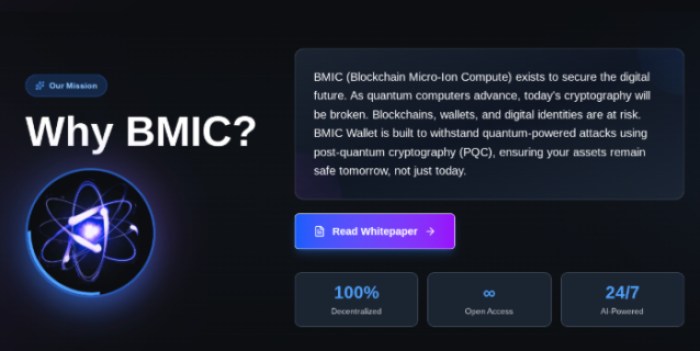
BMIC ($BMIC) isn’t just another wallet and token. It positions itself as the only Post‐Quantum‐Cryptography (PQC)-backed ecosystem for staking and payments on Ethereum.

Its full-stack, RSA-resistant design tackles ‘harvest now, decrypt later’ attacks directly. Sound paranoid? It’s not; it’s a realistic response to advancing quantum capabilities.

With zero public-key exposure, ERC-4337 smart accounts, and AI-enhanced threat detection, the project is building defense for a future that’s approaching faster than most realize.
The numbers are specific: tokens are currently priced at $0.049474, and total raised stands at over $433K.
That suggests solid early demand, nearly half a million dollars, for a security-first offering. We haven’t seen massive whale wallets enter just yet, but that’s typical for this stage. The story here is about preservation and preparedness, not pump mechanics.

The logic is simple. As markets shake, defensive plays aren’t just about ROI; they’re about resilience. BMIC offers asset-level protection that conventional solutions (still relying on old encryption standards) simply lack. The pivot makes sense.

CHEcK OUT THE $BMIC PRESALE

What’s Next and What to Watch

Quantum headlines: Any news about advances in quantum computing, or regulatory chatter on encryption standards, could turbocharge demand for this specific tech stack.
Crypto market stabilization: If $BTC or $ETH recovers, altcoins and infrastructure layers like $BMIC often see inflows shortly after.
Regulatory clarity: Early alignment on post-quantum encryption could deliver institutional confidence and adoption fast.

Risks? Plenty. BMIC faces execution hurdles common to deep-tech projects. Quantum resistance today doesn’t guarantee immunity tomorrow; it’s an arms race that requires continuous evolution. Plus, wallet adoption cycles are notoriously sticky. And let’s be real—even promising token sales can buckle under a deep bear market.

But here’s the second-order effect casual observers might miss: BMIC isn’t just ‘one more alt.’ It’s a modular infrastructure. That positions it for future ecosystem integration, think cold wallets, DeFi rails, and enterprise-grade custody.

LEARN MORE ABOUT THE QUANTUM STACK THAT’S PREPARING FOR THE FUTURE

This article is not financial advice. Presale participation involves high risk, and markets may continue to fall sharply. Evaluate tech maturity and institutional adoption before investing.

Пов'язані питання

QWhat was the primary reason for the significant shift in investor attention from Bullish to the BMIC presale, as mentioned in the article?

AInvestors are repositioning towards infrastructure that promises long-term safety, like quantum-secure wallets, following Bullish's massive Q4 loss and the broader market downturn, seeking asset protection rather than just short-term gains.

QAccording to the article, what specific technological threat does the BMIC project aim to address?

ABMIC aims to address the threat of 'harvest now, decrypt later' attacks by providing a post-quantum-cryptography (PQC)-backed, RSA-resistant ecosystem to protect against the looming risk of quantum decryption.

QWhat are two key technical features of the BMIC wallet mentioned in the report?

ATwo key features are zero public-key exposure and ERC-4337 smart accounts, which are part of its quantum-proof security and AI-enhanced threat detection system.

QWhat market conditions, as described in the article, are driving interest in defensive projects like BMIC?

AThe market is in correction mode, with Bitcoin down roughly 20% and Ethereum off more than 10% since January, due to tech-sector weakness and policy uncertainty, causing capital to rotate towards protocols that address structural risks.

QWhat are some of the major risks associated with investing in the BMIC presale, as outlined in the article?

ARisks include execution hurdles common to deep-tech projects, the need for continuous evolution to maintain quantum resistance, sticky wallet adoption cycles, and the potential for the token sale to struggle in a deep bear market.

Пов'язані матеріали

Can Generative Models Finally Be Trained End-to-End? The Core Is a For Loop

This article introduces a novel training paradigm for generative models called Explorative Modeling (XM), which enables true end-to-end training. Traditionally, powerful generative models like autoregressive and diffusion models are not trained end-to-end. They are trained to predict a single small step but require iterative multi-step sampling for inference. This "exposure bias" leads to error accumulation and limits performance. The core challenge XM addresses is "mode blurring." In generative tasks, a single input (e.g., "generate a dog") corresponds to many valid outputs (multiple modes). Standard training objectives like reconstruction loss force the model to average these modes, producing unrealistic, blurry outputs. To avoid this, existing models break generation into many small, almost deterministic steps, sacrificing end-to-end training. XM tackles this by restructuring the training loop itself. Its key insight is to amplify "generative expressivity." For each training input, instead of generating one sample, the model generates K candidate outputs. Only the candidate closest to the real data is used for computing the loss and updating the model via backpropagation. This simple "best-of-K" mechanism is implemented as a short for-loop. By exploring multiple possibilities, the model learns to distribute its guesses across different modes rather than collapsing to their uninformative average. The paper demonstrates that "exploration" acts as a new, powerful scaling axis. Gains from XM increase with model size, data scale, and compute. Experiments show improvements in FID scores for image generation and significant efficiency gains, sometimes outperforming larger models without exploration. When pushed to the limit, XM enables fully single-step, end-to-end generative models. In robotics tasks, an "Explorative Policy" matched the performance of a 100-step Diffusion Policy with a single forward pass, drastically improving inference speed. While the best-of-K concept is not entirely new, the authors' contribution lies in formally understanding it as a direct method to boost generative expressivity without fragmenting the generation process. This work suggests that as models scale, enhancing exploration during training may become crucial for overcoming fundamental performance bottlenecks.

marsbit50 хв тому

Can Generative Models Finally Be Trained End-to-End? The Core Is a For Loop

marsbit50 хв тому

Annual Salary of Millions Competing for Electricians, Meta Rushes to Open Its Own Technical School

The AI boom is facing an unexpected bottleneck: a severe shortage of skilled construction workers and electricians. As tech giants like Meta, OpenAI, and Alphabet race to build massive data centers—such as OpenAI's $16 billion "Stargate" project—they are hitting a critical labor wall. The U.S. needs an estimated 130,000 more electricians, 240,000 construction workers, and 150,000 supervisors by 2030 for AI infrastructure alone, but tens of thousands of electrician jobs go unfilled each year. While AI companies offer high premiums, with electricians earning up to $280,000 annually, worker scarcity still causes massive losses—delays on a single project can cost $14.2 million per month. The complexity of building AI data centers, which require immense power (equivalent to powering hundreds of thousands of homes), sophisticated electrical systems, and advanced liquid cooling solutions, demands highly skilled technicians who are in short supply. To combat this, companies are investing heavily in training. Meta has committed $115 million to a free training school offering tuition, housing, and stipends, targeting 5,000 new workers. OpenAI is partnering with unions to secure skilled labor. These efforts are paying off, with a significant rise in Gen Z interest in trade schools over college. However, the power demands are staggering. AI data centers are driving a rapid surge in electricity consumption, projected to account for up to 12% of U.S. power use by 2028 and raising costs for consumers. Furthermore, the construction boom is project-based, leading to a potential future glut of trained workers once building peaks, which could depress wages industry-wide. The race for AI supremacy now depends as much on skilled hands as on advanced chips.

marsbit2 год тому

Annual Salary of Millions Competing for Electricians, Meta Rushes to Open Its Own Technical School

marsbit2 год тому

Торгівля

Спот
活动图片