Bull Run: Four Key Drivers Behind the Overnight Market-Wide Surge in Crypto

marsbitОпубліковано о 2026-08-20Востаннє оновлено о 2026-08-20

Анотація

"Crypto markets surged overnight with Bitcoin reclaiming $69,000 and Ethereum jumping nearly 20%. Key drivers include: 1) The U.S. Treasury doubling its long-term bond buyback size, lowering yields and boosting risk appetite. 2) Positive regulatory signals from a White House crypto summit and a new SEC proposal offering funding exemptions. 3) A reversal in Bitcoin ETF outflows, indicating renewed institutional buying. 4) A massive short squeeze, with over 93% of recent liquidations being short positions, amplifying the price moves."

Author|jk

The quiet crypto market suddenly roared "bull run" today, with mainstream cryptocurrencies collectively experiencing a sharp rally. Bitcoin reclaimed the $69,000 mark, Ethereum surged nearly 20% in a single day, and Hyperliquid skyrocketed over 22%. The rapid price surge was accompanied by a large-scale liquidation of short positions.

Mainstream Cryptocurrencies Rise Across the Board

  • Bitcoin: According to Coingecko data, currently trading at $69,165, up 7.4% in 24 hours, with a 24-hour trading range between $64,123.86–$69,892.23, a total market cap of $1.393 trillion, and 24-hour volume of $41.587 billion. After maintaining a narrow range in the morning, the price initiated a rapid rally during the European trading session.
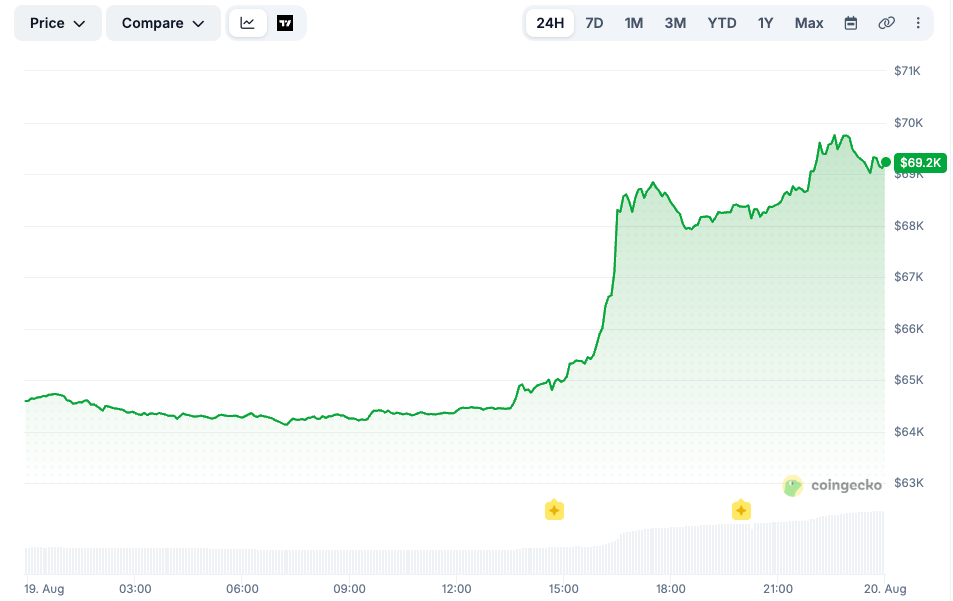
Bitcoin Price Chart, Source: Coingecko

  • Ethereum: Currently trading at $2,269.04, surging 18.6% in 24 hours, with a trading range of $1,905.44–$2,318.66, market cap reaching $274.047 billion. Ethereum's gains in this rally significantly outperformed Bitcoin's, and its exchange rate against BTC also strengthened, indicating accelerated capital inflow back into the Ethereum ecosystem.
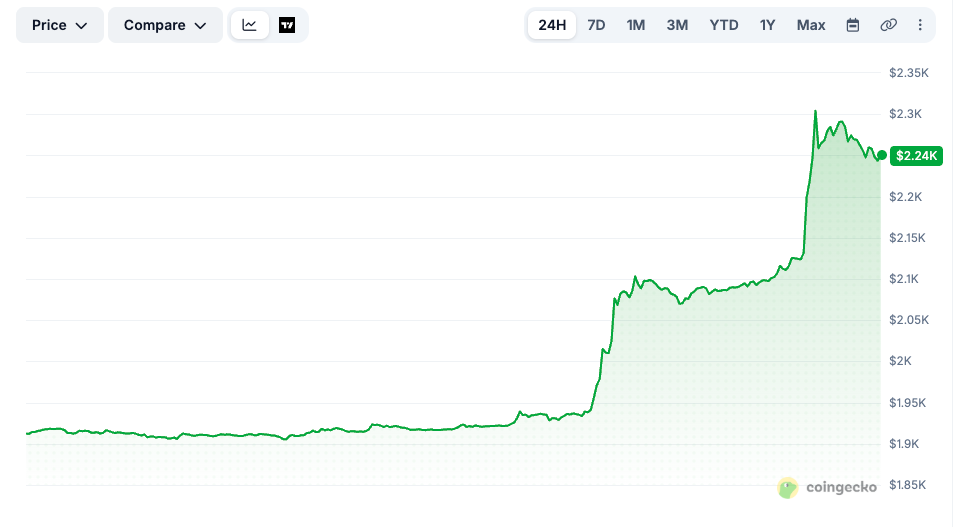
Ethereum Price Chart, Source: Coingecko

  • BNB: Currently trading at $631.92, up 4.9% in 24 hours, with a relatively moderate gain among mainstream large caps, trading range $600.92–$635.85.
  • Solana: Currently trading at $85.65, up 11.2% in 24 hours, trading range $76.59–$86.96, market cap $49.952 billion, the chart shows an accelerated breakout above previous highs.
  • Hyperliquid (HYPE): The most dramatic gainer in this rally, currently trading at $71.41, surging 22.2% in 24 hours, trading range $58.04–$72.28.

Reason Analysis: Macro Spark, Leveraged Structure Amplifies Gains

Considering recent market dynamics and derivatives data, this rally was not driven by a single factor, but rather the combined effect of macro liquidity tailwinds, warmer regulatory signals, and the concentrated unwinding of leveraged short positions.

Reason One: U.S. Treasury's unexpected "injection," lowering long-term rates, boosting risk appetite. On August 19 local time, the U.S. Treasury Department announced it would at least double the size of its long-term Treasury buyback operations, increasing from $2 billion per operation to over $4 billion, covering the period from September 9 to November 4, primarily targeting 10 to 30-year Treasury bonds. This move was seen as a direct response to the recent surge in the 30-year Treasury yield to its highest level since 2007 (briefly reaching 5.34%). Following the announcement, yields on both the 10-year and 30-year Treasuries immediately fell, and U.S. stock futures rose in tandem, with the overall improvement in risk appetite providing a tailwind for the crypto market. The market interpreted the Treasury's operation as a de facto liquidity injection, and its timing aligns closely with the start of the crypto market rally.

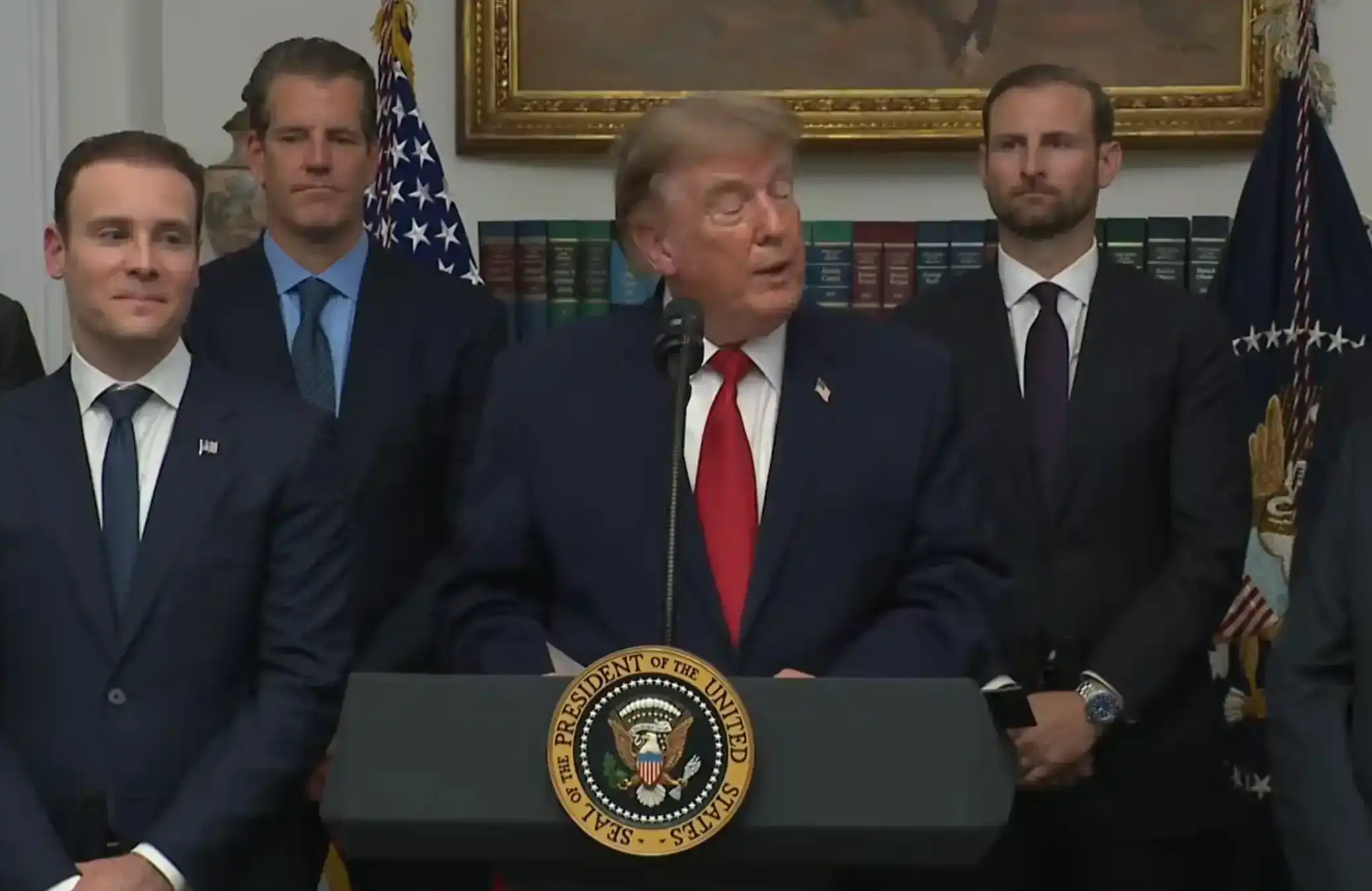
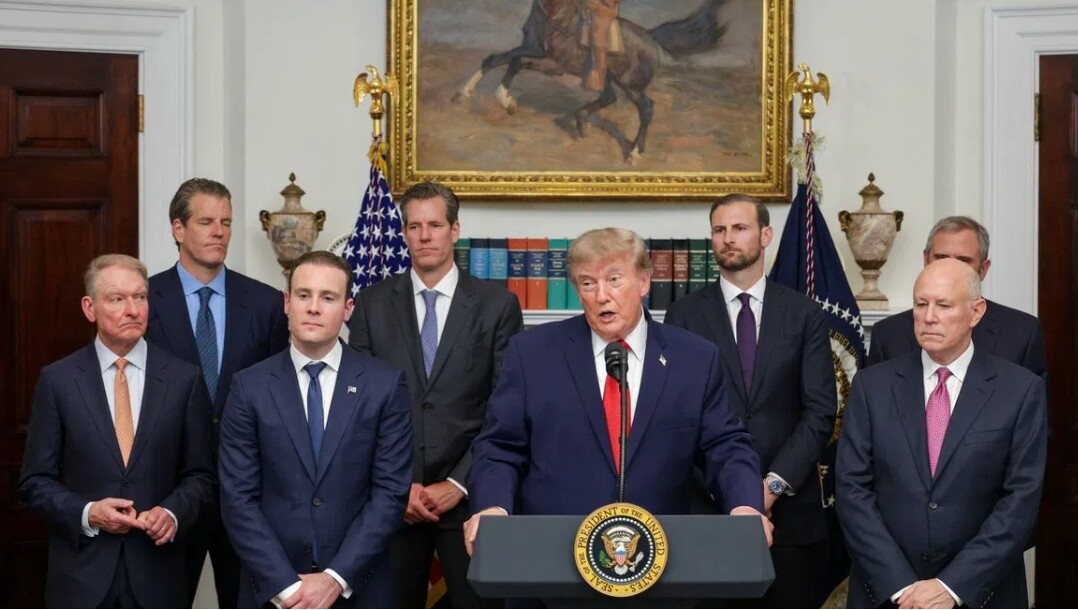
Reason Two: White House crypto summit combined with SEC regulatory easing shifts policy sentiment positively. On the same day, Trump met with crypto industry executives from companies like Coinbase, Ripple, Gemini, and leaders from the SEC and CFTC at the White House, reiterating efforts to push the CLARITY Act through the Senate quickly to provide a clearer regulatory framework for the industry. Just one day before the summit, the SEC formally proposed a new draft rule named Regulation Crypto Assets, aiming to provide crypto project teams with a fundraising exemption channel of up to $75 million per year. The intensive release of friendly signals from regulators and the White House within the same week has somewhat alleviated market concerns about previous policy uncertainty, providing a narrative foundation for capital to flow back into crypto assets.
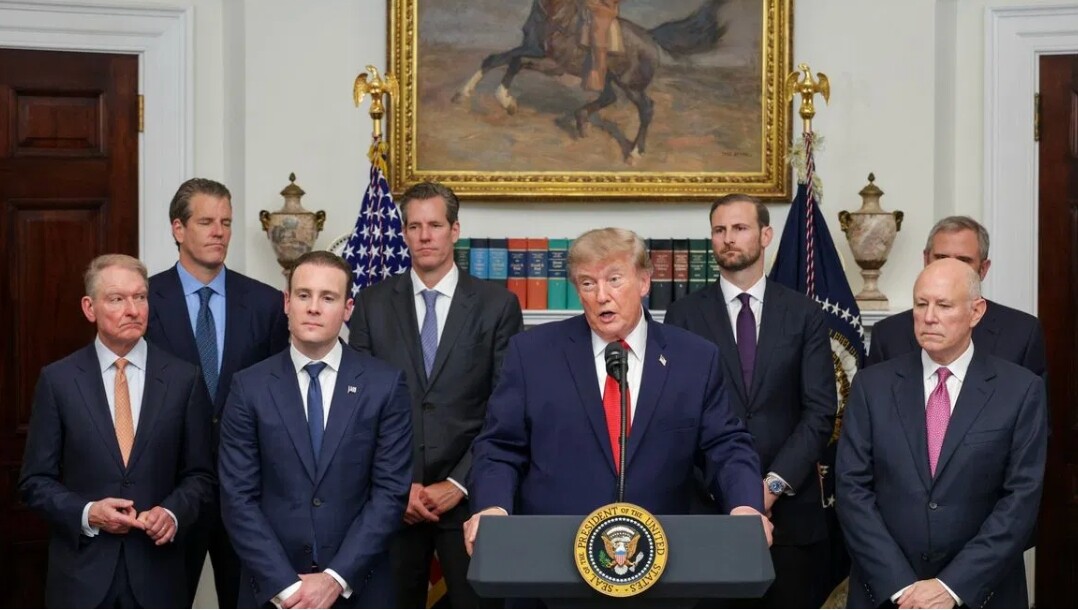
Trump meets industry leaders, Source: ABCNews

Reason Three: Bitcoin Spot ETF outflows trend reverses, whales accumulating on dips. Previously, Bitcoin Spot ETFs had seen consecutive days of net outflows. However, this rally is accompanied by signs of improving fund flows, with leading products like BlackRock's IBIT and Fidelity's FBTC recording net inflows again, indicating institutional capital is returning. Meanwhile, on-chain data shows that large holder addresses, after a period of sustained selling for about 60 days, have begun accumulating again, providing support on the spot side for price stabilization and creating conditions for the subsequent squeeze on leveraged shorts.

Reason Four: Concentrated liquidation of leveraged shorts creates a typical "short squeeze" scenario. Looking at derivatives data, the scale of short liquidations during this rally far exceeded long liquidations. According to Coinglass data, as of publication time, total 24-hour liquidations across all exchanges have expanded to $2.98 billion, with over 170,000 traders liquidated, the vast majority being shorts; in a 4-hour window, short liquidations once accounted for up to 93.3% of the total. The largest single liquidation order across all networks appeared on Hyperliquid's BTC-USD contract, amounting to $48.8 million. The forced liquidation of large short positions often creates an instantaneous vacuum of buy orders in the order book, pushing prices to accelerate away from their previous range, thereby triggering more stop-loss orders and forming a positive feedback loop of "longs squeezing shorts."

Пов'язані питання

QWhat were the four main reasons identified in the article for the sudden surge across the cryptocurrency market?

AThe four main reasons were: 1) The US Treasury's unexpected liquidity injection by doubling its long-term Treasury bond buyback operation, which lowered long-term yields and boosted risk appetite. 2) Positive regulatory sentiment from the White House crypto summit and the SEC's new regulatory draft, easing policy uncertainty. 3) A reversal in the outflow trend of Bitcoin spot ETFs and renewed accumulation by large investors ('whales'). 4) A classic 'short squeeze' where leveraged short positions were liquidated on a large scale, amplifying the price rise.

QAccording to the article, which cryptocurrency posted the highest 24-hour gain, and what was its percentage increase?

AAccording to the article, Hyperliquid (HYPE) posted the highest 24-hour gain, with a surge of 22.2%.

QHow did the article describe the role of the SEC's new regulatory draft in the market rally?

AThe article described the SEC's proposed new rule, 'Regulation Crypto Assets,' as a positive regulatory signal that eased market concerns about policy uncertainty. The draft aims to provide a financing exemption channel for crypto projects, offering up to $75 million per year. This, combined with signals from the White House summit, provided a supportive narrative for capital flowing back into crypto assets.

QWhat specific action by the US Treasury coincided with the start of the crypto market rally, and what was its intended effect?

AThe specific action was the US Treasury's announcement to at least double the size of its long-term Treasury bond buyback operations, increasing from $2 billion to over $4 billion per operation. This was a direct response to high long-term bond yields and was interpreted by the market as a form of liquidity injection. Its intended effect was to lower long-term interest rates (like the 10-year and 30-year Treasury yields), which in turn boosted overall risk appetite among investors.

QWhat data point from Coinglass indicated that a short squeeze was a major factor in the price surge?

AThe data point from Coinglass indicating a major short squeeze was that within a 4-hour window, short liquidations accounted for as high as 93.3% of the total liquidations. Furthermore, over a 24-hour period, the total liquidation amount reached $2.98 billion, with short positions making up the overwhelming majority of that figure.

Пов'язані матеріали

A Trillion-Dollar Consumer Credit Market Lacks Key Players

The trillion-dollar global consumer credit market remains largely untapped by blockchain technology. While projects like Pharos have rapidly attracted millions in stablecoin deposits for short-term consumer loans in emerging markets, they represent early attempts to bring this massive asset class on-chain. The core challenge isn't technical tokenization, but the "repackaging" of countless small, heterogeneous loans into standardized, investable products that digital asset funds can understand and price. Current approaches primarily change the *distribution* of capital—using stablecoins for settlement and smart contracts for transparency—but do not eliminate underlying credit risk. Several models are emerging: Pharos and Huma Finance/Tala focus on connecting high-yield emerging market loans to global crypto capital. Figure stands out by building full-stack, regulated infrastructure, securing AAA ratings for its securitizations and proving blockchain assets can meet traditional institutional standards. Conversely, Goldfinch's difficulties highlight that on-chain transparency cannot replace offline credit underwriting and collection capabilities. The article identifies a four-layer value chain: 1) loan origination, 2) credit structuring & securitization, 3) on-chain infrastructure, and 4) capital. The current gap is in the second layer—the mature capital markets expertise for structuring, rating, credit enhancement, and institutional distribution. This is the critical link needed to transform scattered loans into large-scale, trustworthy on-chain credit assets, bridging traditional finance's rigor with blockchain's new capital pools.

marsbit34 хв тому

A Trillion-Dollar Consumer Credit Market Lacks Key Players

marsbit34 хв тому

Interpretation of SEC's New Crypto Regulatory Rules: Fundraising Below $5 Million Exempt from Registration, Is Altcoin Season Making a Comeback?

The U.S. Securities and Exchange Commission (SEC) has proposed a new regulatory framework titled "Regulation Crypto Assets." This proposal aims to establish tailored exemptions for crypto asset fundraising and a pathway for tokens to transition out of being classified as securities. The core provisions include two exemptions from standard securities registration: 1. **Startup Exemption**: Allows early-stage projects to raise up to $5 million over four years with simplified, narrative-based disclosures, avoiding full registration. 2. **Fundraising Exemption**: Permits raising up to $75 million within any 12-month period. It requires audited financial statements and imposes ongoing reporting obligations, similar to the Regulation A+ framework. A key component is the **Investment Contract Safe Harbor**. This rule allows a token initially sold as an investment contract (a security) to lose that designation once the issuer has completed or permanently ceased the "essential managerial efforts" promised to investors. This theoretically clears regulatory hurdles for tokens where development is finished or abandoned. The proposal defines a narrow scope, applying only to crypto assets that are not securities themselves and are part of an investment contract involving no other assets. This SEC initiative is seen as a response to the stalled progress of the comprehensive *CLARITY Act* in Congress. It represents a shift from relying solely on the historical Howey test, which the SEC admits is ill-suited for dynamic crypto assets. The proposal is currently in a 60-day public comment period, with a final rule likely months away, leaving the U.S. regulatory landscape for crypto in a transitional state.

Odaily星球日报1 год тому

Interpretation of SEC's New Crypto Regulatory Rules: Fundraising Below $5 Million Exempt from Registration, Is Altcoin Season Making a Comeback?

Odaily星球日报1 год тому

Latest: Korean QFI Has Bought Changxin Technology

Latest Data Shows Korean QFI Has Purchased Changxin Technology According to data from SEIBro (under Korea Securities Depository, KSD), Korean investors, acting as Qualified Foreign Investors (QFI), have been actively purchasing shares of Changxin Technology (stock code 688825), a company recently listed on China's Sci-Tech Innovation Board (STAR Market). Over the past month until August 18, they made a net purchase of this stock worth approximately $45.32 million (around CNY 307 million), making it the top A-share by net purchase volume for Korean investors during that period. This activity has significantly boosted overall Korean net buying in A-shares. As Changxin Technology is not yet included in the Stock Connect schemes, QFI is currently the only channel for overseas investors like these Koreans to access its shares. SEIBro data indicates Korean buying began as early as July 28, the stock's second trading day. The stock appeared in Korean investor purchase lists using a temporary virtual ISIN code in settlement instructions, as its official international code had not yet been assigned. The listing has garnered significant international attention. On its first trading day (July 27), the actively managed U.S. ETF Tema Memory ETF (DISK) swiftly added Changxin Technology to its portfolio, giving it a substantial 10.56% weighting. Another active ETF, Roundhill Memory ETF (DRAM), also quickly included the stock. Furthermore, global index provider MSCI has added Changxin Technology to its MSCI China All Shares Index, prompting passive fund inflows. Analysts highlight Changxin Technology's unique position to serve China's rapidly growing AI ecosystem amid a global semiconductor memory supply shortage driven by AI demand. Besides Changxin Technology, other A-shares heavily bought by Korean investors recently include Weichai Power, Demingli, Changdian Technology, and CSOP China STAR Chip ETF.

marsbit2 год тому

Latest: Korean QFI Has Bought Changxin Technology

marsbit2 год тому

Торгівля

Спот
活动图片