BTC Medium-Term Trend Weakens, Short-Term Volatility Fails to Mask Directional Risks | Guest Analysis

marsbitОпубліковано о 2025-12-22Востаннє оновлено о 2025-12-22

Анотація

This analysis by Odaily's guest analyst Conaldo examines Bitcoin's (BTC) current market stance, highlighting a weakening medium-term trend and short-term consolidation with directional risks. The core view is that BTC is in a corrective phase after breaking its long-term bullish trend line (since late 2022) and is now constrained by both this and a descending trend line from the October 2025 high. Until a significant volume-backed breakout occurs above these key levels, any price rises should be considered rebounds within a bearish structure. Last week's prediction of a shift to a consolidation pattern was accurate, with price oscillating in the $87.5K–$89K zone. The analyst successfully executed four short-term trades based on a quant model, yielding a 2.14% return. Technical analysis using weekly and daily charts (incorporating momentum and sentiment quant models) indicates BTC remains in a bearish market on both timeframes, with weak buying momentum and neutral sentiment, suggesting continued consolidation and downside risk. For the upcoming week (Dec 22–28), the market is expected to see wide-range fluctuations. The key area to watch is $89.5K–$91K. A breakdown could lead to deeper correction, while holding could allow for a limited rebound. Specific short-term trading plans (A and B) are outlined for both scenarios, involving 30% short positions with precise entry, stop-loss, and take-profit levels. Key macro events this week include reduced holiday liquidity, potent...

Odaily Guest Market Analyst Conaldo, Master of Financial Statistics from Columbia University, USA, focused on quantitative trading of US stocks during university and gradually expanded to digital assets such as Bitcoin, building a systematic quantitative trading model and risk control system through practical experience; possesses keen data insight into market fluctuations and is committed to continuous development in the professional trading field, pursuing stable returns; will delve into BTC technical, macro, and capital changes weekly, review and demonstrate practical strategies, and preview major upcoming events for reference.
Core Summary:

• From a macro technical perspective (see Figure 3 below): In the Bitcoin daily chart, the upward trend line representing the long-term bull market (since the end of 2022) and the downward trend line defining the recent correction (since the October 2025 high) are about to converge. The market is currently in a period of repair and volatility after breaking the long-term trend. Bitcoin's price is under dual pressure. Unless the price breaks through this dual pressure with strong volume, all upward movements can only be considered rebounds within a bearish pattern. The effective breakthrough of these two key trend lines will serve as the ultimate basis for judging the market's medium-term direction.

• Core View Validation: The core judgment proposed last week that "the market will most likely transition into a volatile adjustment pattern" was highly consistent with the actual market movement. The bulls and bears repeatedly contested the $87,500~$89,000 area, and the mid-week adjustment low of $84,456 had a relative error rate of about 1.18% compared to the predicted support area upper limit of $83,500.

• Strategy Execution Results Validation: Last week's trading strictly followed the established strategy, successfully completing four operations, achieving a cumulative return of 2.14%.

The following will review the market prediction, strategy execution, and specific trading process in detail.

I. Bitcoin Market Review Last Week (12.15~12.21)

1. Last Week's Trend Prediction and Operation Strategy Review:

Last week's forward-looking analysis clearly stated: The market will most likely transition into a volatile adjustment pattern. Among them, the $87,500~$89,000 area was defined as the key observation area. The outcome of the battle between bulls and bears here would directly determine the market's short-term direction choice. Special attention was needed: if this area was effectively broken below, it would directly affect the subsequent intensity and depth of the coin price adjustment. Below is the strategy review and analysis.

1. Market Trend Prediction Review:

• Core Pressure Level: First pressure looking at the $92,500~$94,500 area; second pressure looking at the $96,500~$98,500 area.

• Core Support Level: First support looking at the $87,500~$89,000 area; second support looking at the $80,000~$83,500 area.

2. Operation Strategy Review:

• Medium-term Strategy: Maintain a medium-term position (short) of about 65%.

• Short-term Strategy: To cope with the market trend, we initially drafted two short-term operation plans, A/B. Based on the actual evolution of the market, we ultimately executed Plan B as the core strategy.

• Opening Position: If the coin price falls below the $87,500~$89,000 area and is confirmed, establish a 30% short position.

• Risk Control: Stop loss set above $89,000.

• Closing Position: When the coin price falls to the $80,000~$83,500 area and shows resistance, close all short positions to take profits.

2. Last week, four short-term operations were successfully completed according to the plan (Figure 1), achieving a cumulative return of 2.14%. Specific transaction details and review are as follows:

Bitcoin 30-minute K-line chart: (Momentum Quantitative Model + Spread Trading Model)
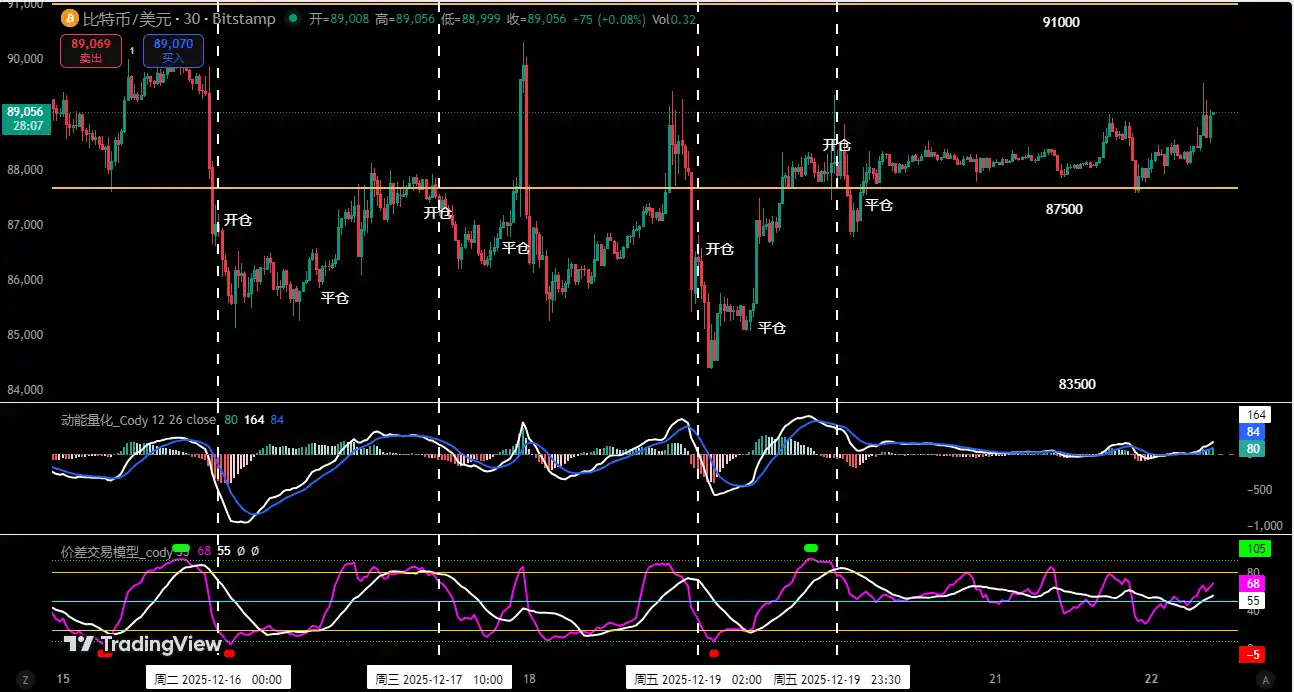
Figure 1

1. Transaction Details Summary:

2. Short-term Trading Review:

• First Transaction (Profit 0.73%): We strictly adhered to the idea of "effectively breaking through key points and going short with the trend." When the trigger condition was met, the spread trading model simultaneously issued a top signal. Based on this, we decisively established a 30% short position and finally took profits when the price fell near the previous low area.

• Second and Third Transactions (Cumulative Profit 1.41%): Based on the operation mode of "going short upon encountering resistance at the core pressure area during a rebound." When the coin price hit the $87,500~$89,000 area and encountered resistance, combined with resonance signals from both models, these two transactions were successfully completed.

• Fourth Transaction (Profit 0): The logic for opening the position was consistent with the previous two transactions. It must be emphasized that in this transaction, we strictly executed the principle of "immediately moving the stop loss to the opening cost price when the floating profit reaches 1%", resulting in the position being closed at breakeven.

II. Quantitative Technical Analysis: Based on Multi-Model and Multi-Dimensional Operations

Combining last week's market performance, the author will conduct an in-depth analysis of the evolution of Bitcoin's internal structure using multi-dimensional analysis models.

Bitcoin Weekly K-line Chart: (Momentum Quantitative Model + Sentiment Quantitative Model)
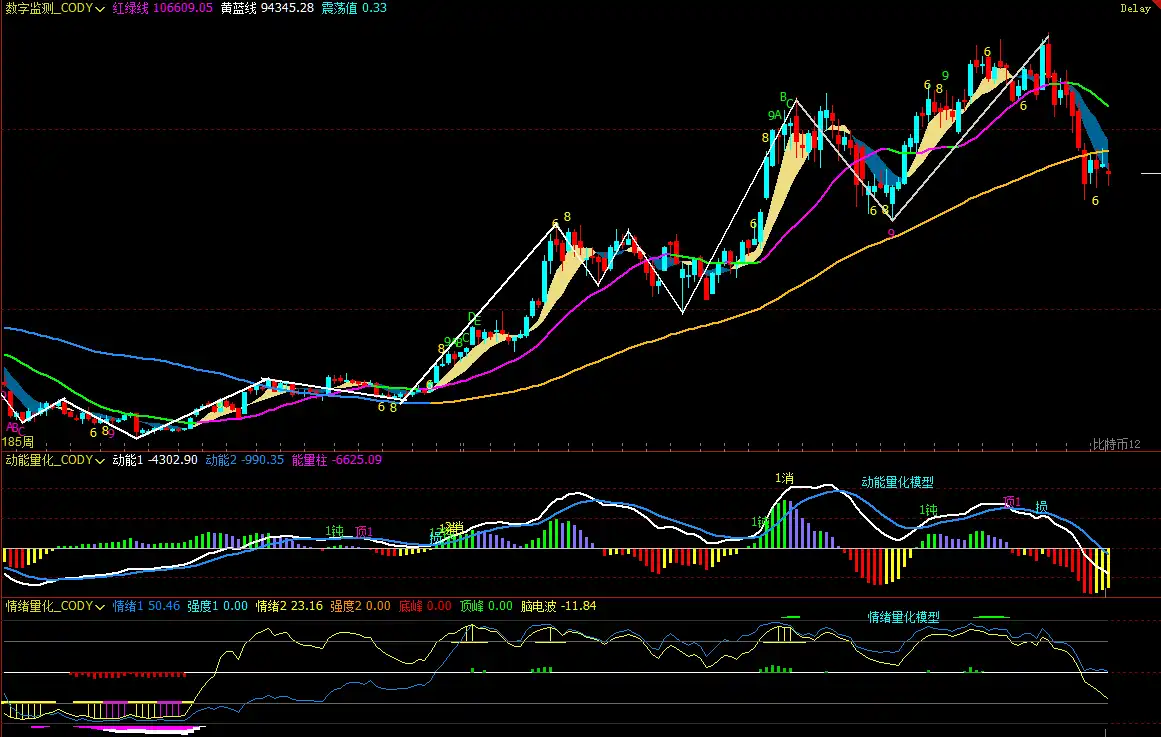
Figure 2

1. As shown in (Figure 2), analysis from the weekly chart:

Momentum Quantitative Model: After last week's adjustment, the two momentum indicator lines continue to operate below the zero axis. Although the rebound in the previous weeks prevented the negative momentum bars from expanding significantly, the current market structure remains weak, and we need to be vigilant about the risk of further release of adjustment pressure.

Momentum Quantitative Model Indicates: Coin price decline index: High

• Sentiment Quantitative Model: Blue sentiment line value 50.46, strength zero; yellow sentiment line value 23.16, strength zero, peak value is 0.

Sentiment Quantitative Model Indicates: Coin price pressure and support index: Neutral

• Digital Monitoring Model: The chart shows that the coin price has been below the bull-bear (yellow-blue line) dividing line for 5 weeks, increasing the probability of an effective break. Short-term bottom digital signals (above 9) have not yet appeared.

The above data indicates: Bitcoin is in a downward trend, entering a bear market on the weekly level, beware of adjustment risks.

Bitcoin Daily K-line Chart:
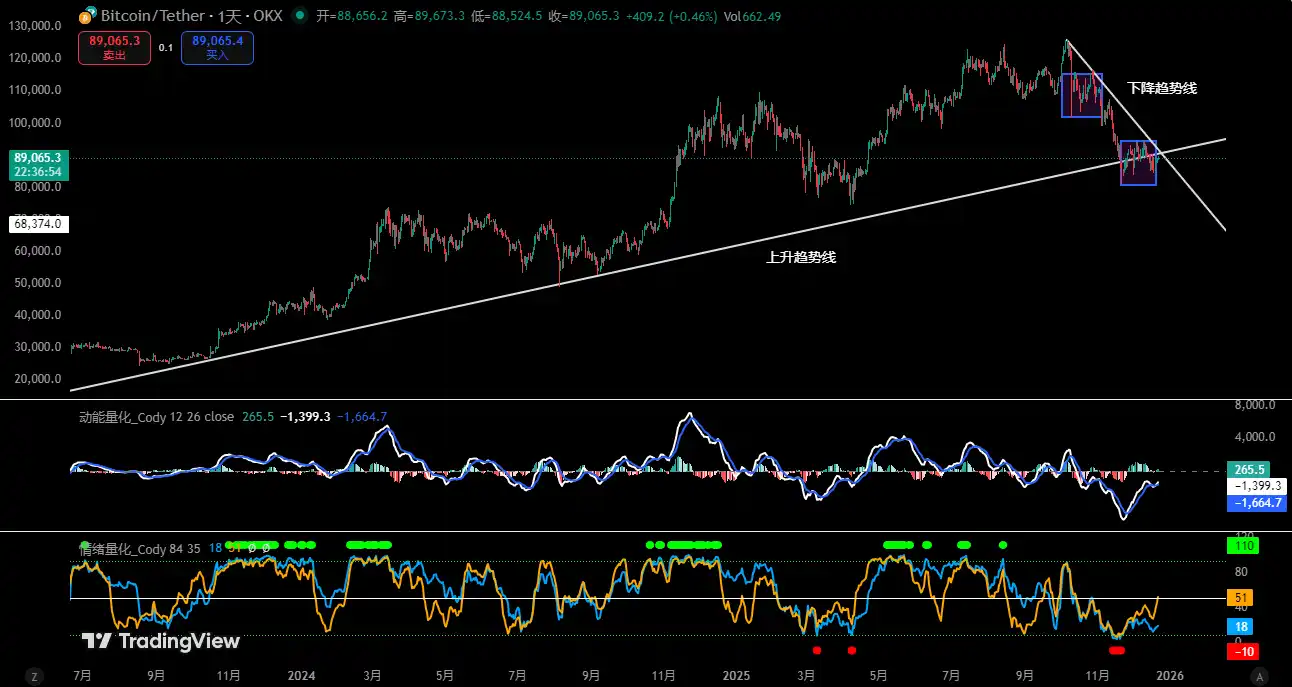
Figure 3

2. As shown in (Figure 3), analysis from the daily chart:

• Momentum Quantitative Model: In last week's行情, the two momentum lines experienced a repeated crossover process of "golden cross—dead cross—golden cross" below the zero axis. Trading volume did not放大, and the positive momentum bars did not grow significantly.

Momentum Quantitative Model Indicates: Fierce battle between bulls and bears for market control, weak buying momentum.

• Sentiment Quantitative Model: After last week's daily close, blue sentiment line value 17, strength zero; yellow sentiment line value 45, strength zero.

Sentiment Quantitative Model Indicates: Pressure and support index: Neutral

The above data suggests: The daily level is in a bear market, short-term market movements will still be反复.

III. This Week's Market Prediction (12.22~12.28)

1. The market is expected to mainly present a wide-range volatile pattern this week. The core observation interval is $89,500~$91,000. The outcome of the battle for this area will determine the short-term direction:

If effectively broken below: It will mean the adjustment intensity strengthens, and the expected adjustment range will expand, and the周期 will also延长.

If effectively held above: The market is expected to continue its volatile rebound, but the rebound space is expected to be relatively limited.

2. Core Pressure Levels:

• First Pressure Area: $89,500~$91,000 area

• Second Pressure Area: $93,000~$94,500 area

• Important Pressure Area: Around $97,000

3. Core Support Levels:

• First Support Level: $86,500~$87,500 area

• Second Support Level: $83,500~$84,500 area

• Important Support Level: Around $80,000.

IV. This Week's Operation Strategy (Excluding Sudden News Impact)(12.22~12.28)

1. Medium-term Strategy: Maintain a medium-term position (short) of about 65%.

2. Short-term Strategy: Use 30% of the position, set stop loss points, and look for "spread" opportunities based on support and pressure levels. (Using 30-minute as the operation cycle).

3. Focus on observing the battle between bulls and bears for the $89,500~$91,000 area and its outcome. To cope with the market行情, we have drafted two short-term operation plans, A/B:

Plan A: If this area is effectively held above:

• Opening Position: If the coin price rebounds to the $93,000~$94,500 area and encounters resistance, establish a 30% short position.

• Risk Control: Short stop loss set above $96,000.

• Closing Position: When the coin price falls to the $89,500~$91,000 area and shows resistance, close all short positions to take profits.

Plan B: If this area is effectively broken below:

• Opening Position: If the coin price falls below this area and is confirmed, establish a 30% short position.

• Risk Control: Stop loss set above $92,000.

• Closing Position: When the coin price falls to the $83,500~$84,500 area and shows resistance, consider partially or fully closing the position to take profits.

V. Special Notes

1. When opening a position: Immediately set the initial stop loss level.

2. When profit reaches 1%: Move the stop loss to the opening cost price (breakeven point) to ensure principal safety.

3. When profit reaches 2%: Move the stop loss to the position of 1% profit.

4. Continuous Tracking: Thereafter, for every additional 1% profit the coin price makes, move the stop loss同步 by 1%, dynamically protecting and locking in existing profits.

(Note: The above 1% profit trigger threshold can be flexibly adjusted by investors according to their own risk preferences and标的 volatility.)

VI. This Week's Macro Outlook and Key Events (12.22~12.28|Christmas Week)

1. Christmas Holiday Compresses Trading Hours, Liquidity Significantly Decreases

US stocks will close early on Wednesday and be closed all day Thursday this week. The holiday factor combined with year-end settlement results in overall lower market liquidity. Prices are more easily driven by sentiment and one-sided funds. Be wary of "false breakouts" and amplified short-term fluctuations under low trading volume.

2. Fed Chair Nomination Expectations Heat Up, Policy Continuity Becomes Market Focus

The market is watching whether Trump will announce the next Fed Chair nominee during the Christmas holiday. Currently, Kevin Hassett is seen as the明显领先 probability nominee, and his policy stance is considered偏向 "predictable gradual adjustment."

(If the nomination is announced, it will help stabilize interest rate expectations and risk appetite in the short term; if an unexpected candidate emerges, it may cause阶段性波动 in interest rates and the US dollar.)

3. US Q3 Data Finale, Verifying the "Soft Landing" Narrative

The revised US Q3 GDP, personal consumption expenditure, and core PCE data released on Tuesday will be used to confirm whether economic resilience and the inflation path are consistent with previous judgments.

(If the revisions are温和, the market will more easily maintain pricing for next year's interest rate cut path; if there are significant upward revisions, it may重新抬升 long-term rates.)

4. Employment Data as a Marginal Observation Indicator at Year-End

The initial jobless claims released on Wednesday, while not having trend significance, remain an auxiliary signal for observing whether the labor market is loosening around the holidays.

(Currently more偏向 "stable rather than deteriorating", the impact on the market is expected to be limited.)

5. BOJ Dynamics Provide Global Liquidity Reference

BOJ Governor Ueda's speech and the November unemployment rate data will continue to affect the market's judgment on the pace of Japan's monetary policy normalization.

(If yen volatility放大, it may cause emotional disturbance to global risk assets, especially US stocks and the crypto market.)

Financial markets are changing rapidly, all market analysis and trading strategies need to be adjusted dynamically. All views, analysis models, and operation strategies involved in this article are derived from personal technical analysis and are for personal trading log purposes only. They do not constitute any investment advice or operational basis. The market has risks, investment needs to be cautious, DYOR.


Трендові криптовалюти

Пов'язані питання

QWhat is the core technical perspective on Bitcoin's medium-term trend according to the analyst's daily chart analysis?

AThe analyst states that from a macro technical perspective, Bitcoin is in a period of repair and consolidation after breaking its long-term uptrend. The price is under dual pressure from the long-term bull market trendline (since late 2022) and the recent downtrend line (since the October 2025 high). All upward moves are considered rebounds within a bearish structure until the price breaks through this dual resistance with strong volume, using the effective break of these key trendlines as the final basis for judging the market's medium-term directional choice.

QWhat was the outcome of the trading strategy execution for the previous week (Dec 15-21)?

AThe trading strategy was strictly followed, resulting in four successful short-term operations with a cumulative realized return of 2.14%.

QBased on the weekly chart analysis (Figure 2), what do the momentum and sentiment quantitative models indicate about Bitcoin's market structure?

AThe momentum quantitative model shows both momentum indicator lines continue to run below the zero axis, indicating the market structure is still weak with a high risk of further adjustment pressure release. The sentiment quantitative model shows neutral pressure and support indices, with the blue sentiment line at 50.46 and the yellow at 23.16, both with zero intensity. This data suggests Bitcoin is in a downward trend on the weekly level, having entered a bear market, warranting caution against adjustment risks.

QWhat are the two short-term operation plans (A and B) proposed for the current week (Dec 22-28) and what triggers each?

APlan A is triggered if the price effectively holds above the 89,500-91,000 USD region: open a 30% short position if the price rebounds to the 93,000-94,500 USD region and meets resistance, with a stop-loss above 96,000 USD, and close the position for profit when the price falls to the 89,500-91,000 USD region and finds support. Plan B is triggered if the 89,500-91,000 USD region is effectively broken: open a 30% short position upon confirmation of the break, with a stop-loss above 92,000 USD, and close all or part of the position for profit when the price falls to the 83,500-84,500 USD region and shows resistance.

QWhat are the key macro events and their potential impacts highlighted for the Christmas week (Dec 22-28)?

AKey events include: 1) Reduced trading hours and significantly lower liquidity due to the Christmas holiday, increasing the potential for 'false breakouts' and amplified short-term volatility. 2) Increased expectations for the Fed Chair nomination, where the appointment of Kevin Hassett could stabilize rate expectations, while an unexpected pick might cause volatility. 3) The release of final US Q3 GDP, PCE, and core PCE data to confirm the 'soft landing' narrative; significant upward revisions could push long-term rates higher. 4) Jobless claims data as a marginal indicator, expected to have limited impact. 5) BOJ dynamics providing global liquidity cues, where amplified Yen volatility could cause sentiment disturbances in risk assets like crypto.

Пов'язані матеріали

Must-Watch Events Next Week|CLARITY Act Could Face Senate Vote; SpaceX, Circle to Report Earnings (8.3-8.9)

**Summary: Key Events and Developments to Watch (August 3-9)** The upcoming week is marked by significant financial disclosures, key legislative deadlines, and notable product updates. **Major Financial Events:** Several companies are scheduled to release their Q2 2026 earnings. American Bitcoin (ABTC) will report on August 3, followed by SpaceX and Hut 8 Mining Corp. on August 4, and Circle on August 5. Notably, a significant portion of SpaceX shares (up to 12% of total shares) will be unlocked on August 6 following their earnings release. **Key Legislative Deadline:** The U.S. Senate faces an August 7 deadline to secure 60 votes for the CLARITY Act, a bipartisan bill aiming to establish a federal regulatory framework for cryptocurrencies. The Senate may hold a full vote on the bill during the week. **Economic Data:** The U.S. July Non-Farm Payrolls report will be released on August 7, providing crucial labor market data. **Technology & Product Updates:** * **Shutdowns:** DeFi portfolio tracker Zapper and wallet app Ctrl Wallet will cease operations on August 3. * **Upgrades:** LayerZero will deprecate its v1 relayers on August 3. XRP Ledger's new version 3.3.0, featuring five new functions, is expected next week. * **AI:** Elon Musk announced that the advanced Grok 4.6 AI model is set for release around August 7. * **Bitcoin:** The BIP-110 forced signaling for a potential Bitcoin network change is scheduled to begin around August 8. **Other Notable Events:** Chinese robotics firm Unitree Tech has set its preliminary price inquiry for its IPO for August 5. South Korean exchange Upbit will delist AQT and AERGO tokens on August 3.

marsbit51 хв тому

Must-Watch Events Next Week|CLARITY Act Could Face Senate Vote; SpaceX, Circle to Report Earnings (8.3-8.9)

marsbit51 хв тому

Stocks Are Plummeting More Sharply Than Cryptocurrencies. Where Has the Money Gone?

Stock Markets Plunge Deeper Than Cryptocurrencies: Where Did the Money Go? In late July, Seoul's Kospi index triggered circuit breakers for two consecutive days, plummeting over 40% from its June high. The collapse was led by heavyweight stocks like SK Hynix, whose record profits still disappointed investors, and devastating leveraged ETFs, with one major product losing over 83% of its value. This signaled a global, forced deleveraging targeting the most crowded trades. Interestingly, while stocks exhibited extreme volatility akin to crypto markets, Bitcoin rose nearly 15% in July after a prior steep drop. Analysis shows the money fleeing equities did not flow into Bitcoin. Instead, Bitcoin had already absorbed its sell-off in May-June, when U.S. spot Bitcoin ETFs saw historic outflows. The true safe-haven beneficiary was gold, whose price rose over 20% year-on-year, highlighting a decoupling between Bitcoin and gold as "digital gold." The sell-off was a targeted unwinding of leveraged positions in tech and semiconductors, accelerated by broker-dealer risk management and shifts in the AI narrative, including new competition from Chinese memory chipmakers. The retreat path was clear: from high-valuation tech stocks to cash and U.S. Treasuries, then to gold. For Bitcoin to attract sustained institutional inflows, conditions like eased global liquidity pressure, a "soft-landing" Fed rate cut, and U.S. regulatory clarity via legislation like the stalled CLARITY Act are needed. Currently, Bitcoin is not a safe haven but an already-cleared asset. Its low correlation with tech stocks, however, makes it a potential diversification play for institutional portfolios once the storm passes. The money isn't here yet, but the positioning is underway.

marsbit51 хв тому

Stocks Are Plummeting More Sharply Than Cryptocurrencies. Where Has the Money Gone?

marsbit51 хв тому

In Conversation with Ray Dalio: We Are Currently in an AI Bubble, with 1% of My Portfolio in Bitcoin

Ray Dalio, founder of Bridgewater Associates, warns in an interview that the current AI boom shows classic bubble characteristics, which could lead to significant economic downturns as seen in past cycles like 1929 or 2000. He explains that speculative enthusiasm, fueled by debt and overvaluation, often precedes a crash when rising rates or taxation force asset sales, causing widespread losses and recession. Dalio also outlines his "Big Cycle" theory, describing an approximate 80-year pattern where widening wealth gaps, massive government deficits, and shifting geopolitical power (like China's rise) create internal conflict and global instability. He emphasizes that we are in a late-cycle, transitional phase where traditional powers like the US and UK face decline. For personal wealth protection, Dalio advises diversification beyond cash into assets like stocks, bonds, real estate, and particularly gold, which he prefers over Bitcoin. While he holds about 1% of his portfolio in Bitcoin as a non-printable hard asset, he views gold as more secure from technological or governmental threats. Regarding AI's impact, Dalio believes it will disproportionately benefit capital owners, worsening inequality by replacing both physical and cognitive labor. He suggests that human intuition and emotional intelligence, combined with AI, will be key for future workers. On taxation, Dalio argues that wealth taxes are impractical and risk triggering asset sell-offs, reducing productive investment. He points to the UK as a cautionary example of debt, low productivity, and political strife. Geopolitically, Dalio foresees a more regionalized world, with the US showing weakness in prolonged conflicts like with Iran, akin to past imperial declines. The ideal outcome, he suggests, is coexisting powerful blocs (e.g., Americas, China-Asia Pacific) without major war.

marsbit4 год тому

In Conversation with Ray Dalio: We Are Currently in an AI Bubble, with 1% of My Portfolio in Bitcoin

marsbit4 год тому

Daily 7.2 Trillion KRW: Foreign Capital's Record Net Buying on Friday! Wall Street Says Headwinds for Korean Stock Fund Flows Have Subsided

South Korean stock market sees a dramatic shift in fund flows. On July 31, foreign investors made a record net purchase of approximately KRW 7.2 trillion in KOSPI stocks, marking a fundamental reversal from the persistent large-scale net outflows seen in previous months. This contributed to a significant narrowing of foreign net selling in July to KRW 9.8 trillion, down sharply from KRW 48.4 trillion in June and KRW 44.5 trillion in May. Simultaneously, domestic institutional pressure eased. South Korean pension funds and asset managers turned to a net buying position in July, purchasing KRW 1.0 trillion worth of KOSPI shares, contrasting with net sales in May and June. Market volatility is expected to be dampened by new financial regulations. Effective July 31, the Financial Services Commission tightened access for retail investors to single-stock leveraged ETFs by raising the minimum cash deposit requirement. Trading volumes for these products subsequently dropped to about 50% of their monthly average. Citigroup Research maintains its year-end KOSPI target of 10,000 points. The firm cites several supportive factors: the substantial easing of headwinds from capital outflows, a robust fundamental outlook for the semiconductor sector, historically low market valuations, strong economic fundamentals, and the potential for policy support from financial authorities if needed.

marsbit4 год тому

Daily 7.2 Trillion KRW: Foreign Capital's Record Net Buying on Friday! Wall Street Says Headwinds for Korean Stock Fund Flows Have Subsided

marsbit4 год тому

Торгівля

Спот

Популярні статті

Як купити MASK

Ласкаво просимо до HTX.com! Ми зробили покупку Mask Network (MASK) простою та зручною. Дотримуйтесь нашої покрокової інструкції, щоб розпочати свою криптовалютну подорож.Крок 1: Створіть обліковий запис на HTXВикористовуйте свою електронну пошту або номер телефону, щоб зареєструвати обліковий запис на HTX безплатно. Пройдіть безпроблемну реєстрацію й отримайте доступ до всіх функцій.ЗареєструватисьКрок 2: Перейдіть до розділу Купити крипту і виберіть спосіб оплатиКредитна/дебетова картка: використовуйте вашу картку Visa або Mastercard, щоб миттєво купити Mask Network (MASK).Баланс: використовуйте кошти з балансу вашого рахунку HTX для безперешкодної торгівлі.Треті особи: ми додали популярні способи оплати, такі як Google Pay та Apple Pay, щоб підвищити зручність.P2P: Торгуйте безпосередньо з іншими користувачами на HTX.Позабіржова торгівля (OTC): ми пропонуємо індивідуальні послуги та конкурентні обмінні курси для трейдерів.Крок 3: Зберігайте свої Mask Network (MASK)Після придбання Mask Network (MASK) збережіть його у своєму обліковому записі на HTX. Крім того, ви можете відправити його в інше місце за допомогою блокчейн-переказу або використовувати його для торгівлі іншими криптовалютами.Крок 4: Торгівля Mask Network (MASK)Легко торгуйте Mask Network (MASK) на спотовому ринку HTX. Просто увійдіть до свого облікового запису, виберіть торгову пару, укладайте угоди та спостерігайте за ними в режимі реального часу. Ми пропонуємо зручний досвід як для початківців, так і для досвідчених трейдерів.

223 переглядів усьогоОпубліковано 2024.12.12Оновлено 2026.06.02

Як купити MASK

Обговорення

Ласкаво просимо до спільноти HTX. Тут ви можете бути в курсі останніх подій розвитку платформи та отримати доступ до професійної ринкової інформації. Нижче представлені думки користувачів щодо ціни MASK (MASK).

活动图片












