BTC Market Pulse: Week 4

insights.glassnodeОпубліковано о 2026-01-19Востаннє оновлено о 2026-01-19

Анотація

Bitcoin market conditions show early signs of improvement in Week 4. Spot trading volume has risen modestly with a notable reduction in sell-side pressure, though demand remains fragile. Derivatives activity is mixed: futures open interest is rising cautiously, while funding rates have cooled and perpetual CVDs remain negative, indicating ongoing leveraged selling. Options markets reflect elevated uncertainty with high implied volatility and persistent demand for downside protection. US spot ETFs have reversed sharply into strong inflows, signaling renewed institutional accumulation, though high holder profitability poses a near-term profit-taking risk. On-chain metrics are stabilizing, with gradual improvements in active addresses and transfer volume. Despite ongoing defensive positioning, strengthening buy-side dynamics and institutional interest suggest a gradual move toward a more constructive market structure.

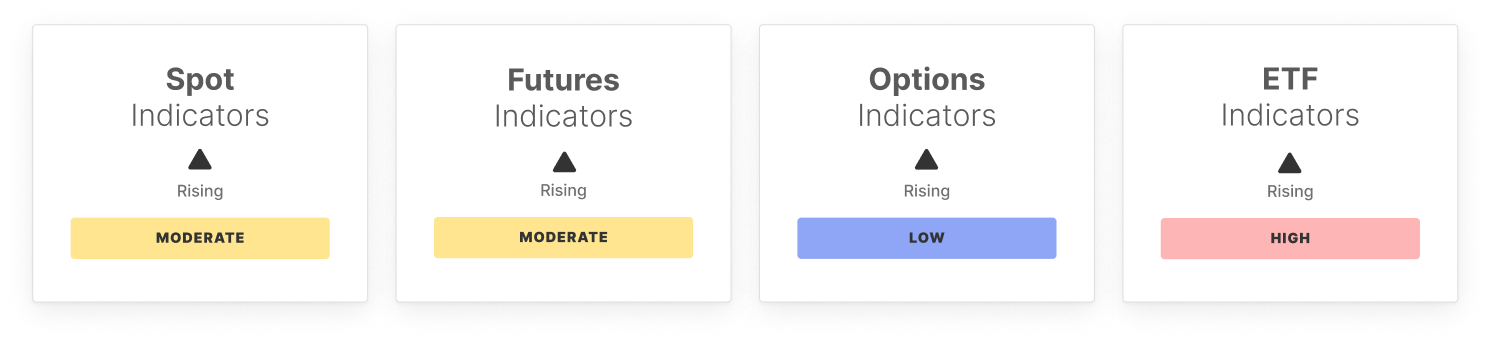
Spot conditions show early signs of improvement. Trading volume has lifted modestly, while the net buy–sell imbalance has broken above its upper statistical band, signalling a clear reduction in sell-side pressure. Despite this, spot demand remains fragile and uneven.

Derivatives positioning is mixed. Futures open interest has edged higher, reflecting a cautious rebuild in speculative engagement, while funding rates have cooled sharply, indicating reduced long-side urgency. Perpetual CVD remains negative, highlighting ongoing sell-side activity in leveraged markets.

Options markets continue to price elevated uncertainty. Options open interest has risen, while the volatility spread sits near the upper end of its historical range, signalling implied volatility remains elevated relative to realised levels. Downside protection demand remains persistent.

US spot ETF flows have reversed sharply into strong inflows, moving beyond statistical extremes and signalling renewed institutional accumulation. ETF trading volumes have risen alongside this shift, though elevated holder profitability raises near-term profit-taking risk.

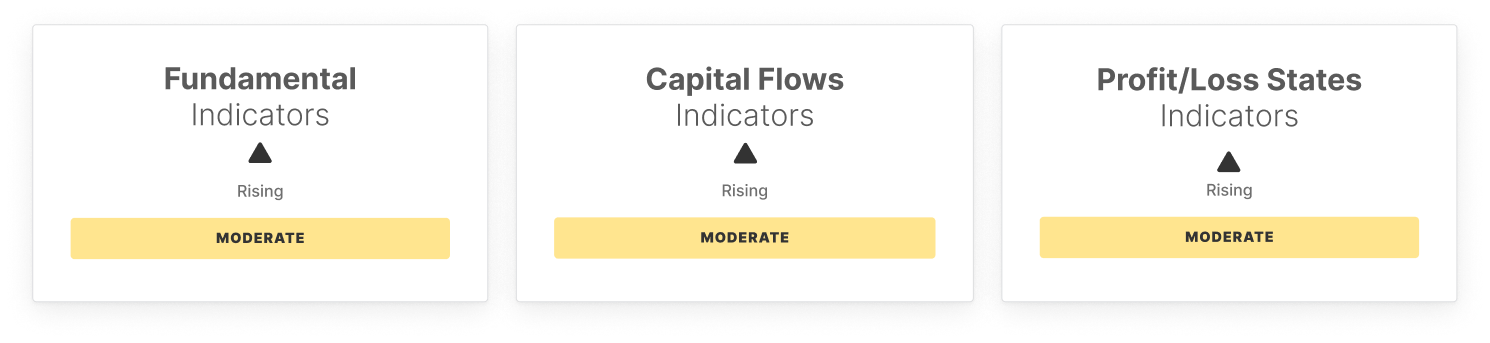
On-chain activity is stabilising. Active addresses remain subdued but are improving, while transfer volume continues to trend higher. Network fees have lifted modestly, and elevated short-term holder supply keeps the market sensitive to price moves.

Overall, Bitcoin remains in consolidation, but internal conditions are improving. While defensive positioning persists, strengthening buy-side dynamics and renewed institutional interest suggest a gradual rebuild toward a more constructive market structure.

Off-Chain Indicators
On-Chain Indicators
🔗 Access the full report in PDF

Don't miss it!

Smart market intelligence, straight to your inbox.

Subscribe now
  • Follow us and reach out on X
  • Join our Telegram channel
  • For on-chain metrics, dashboards, and alerts, visit Glassnode Studio

Disclaimer: This report does not provide any investment advice. All data is provided for information and educational purposes only. No investment decision shall be based on the information provided here and you are solely responsible for your own investment decisions.

Exchange balances presented are derived from Glassnode’s comprehensive database of address labels, which are amassed through both officially published exchange information and proprietary clustering algorithms. While we strive to ensure the utmost accuracy in representing exchange balances, it is important to note that these figures might not always encapsulate the entirety of an exchange’s reserves, particularly when exchanges refrain from disclosing their official addresses. We urge users to exercise caution and discretion when utilizing these metrics. Glassnode shall not be held responsible for any discrepancies or potential inaccuracies.

Please read our Transparency Notice when using exchange data.

Пов'язані питання

QWhat are the early signs of improvement in the spot market conditions for Bitcoin?

ATrading volume has lifted modestly, and the net buy-sell imbalance has broken above its upper statistical band, signaling a clear reduction in sell-side pressure.

QHow does the derivatives market reflect current speculative engagement and sentiment?

AFutures open interest has edged higher, reflecting a cautious rebuild in speculative engagement, while funding rates have cooled sharply, indicating reduced long-side urgency. Perpetual CVD remains negative, highlighting ongoing sell-side activity.

QWhat does the options market indicate about current volatility and investor hedging behavior?

AThe options market continues to price elevated uncertainty, with open interest rising and the volatility spread near the upper end of its historical range. This signals that implied volatility remains high relative to realized levels, and downside protection demand remains persistent.

QWhat recent shift has occurred in US spot ETF flows, and what does it signify?

AUS spot ETF flows have reversed sharply into strong inflows, moving beyond statistical extremes. This signals renewed institutional accumulation, though elevated holder profitability raises near-term profit-taking risk.

QHow is on-chain activity behaving, and what does it suggest about market sensitivity?

AOn-chain activity is stabilizing, with active addresses improving and transfer volume trending higher. Network fees have lifted modestly, but elevated short-term holder supply keeps the market sensitive to price moves.

Пов'язані матеріали

How Much Debt Does Strategy Really Have? Is There a Risk of Implosion?

MicroStrategy's Debt Risk: A Turning Point in the "Never Sell" Strategy As of June 3, 2026, MicroStrategy holds 843,706 bitcoins (valued at ~$53.1B) but faces significant financial obligations. Its capital structure includes $6.75B in convertible notes and $15.48B in perpetual preferred stock (led by the $8.5B STRC series), creating an annual payout burden of ~$1.71B. With software revenue at only ~$500M, interest and dividend obligations far exceed operating income. A critical shift occurred in late May 2026 when the company sold 32 bitcoins for ~$2.5M to cover dividends, breaking CEO Michael Saylor's long-standing "never sell" pledge. This symbolic move triggered a sharp decline in both Bitcoin's price and MSTR stock, reflecting market fears about cash flow sustainability. The core of the strain is the STRC perpetual preferred stock, designed as a "permanent loan" with no maturity date but requiring high monthly dividends (currently 11.5%). Its business model relies on a three-part cycle: issuing new STRC shares, using proceeds to buy more Bitcoin and fund a USD reserve, and using that reserve to pay dividends. This cycle depends on continuous investor demand for STRC and Bitcoin's price appreciation. Analysis shows Bitcoin needs to appreciate at least 2.3% annually to cover the $1.71B in yearly obligations at current holdings. With Bitcoin price down ~22% from March 2026 highs, this pressure has intensified. The company's $900M USD reserve can only cover about 7 months of payments if STRC issuance stalls. Key risks are not immediate bankruptcy or forced Bitcoin liquidation (as BTC is not collateral), but rather: 1) The erosion of MSTR's premium to its Bitcoin holdings (mNAV), which would cripple its ability to raise cheap capital; 2) A vicious cycle where stagnant Bitcoin prices reduce STRC demand, draining the USD reserve and forcing BTC sales, further depressing prices. The period from February 2027 to September 2028 is a crucial test, with over $5.9B in convertible notes facing put options or maturity. In essence, MicroStrategy has evolved from a simple Bitcoin holder into a complex financial entity acting like a "private Bitcoin bank," leveraging its BTC holdings to create layered financial products. Its survival depends on maintaining Bitcoin's price trend, its stock premium, and market appetite for its preferred shares. The recent token sale marks not a betrayal of its Bitcoin thesis, but an admission that the leveraged strategy must eventually be paid for.

marsbit9 хв тому

How Much Debt Does Strategy Really Have? Is There a Risk of Implosion?

marsbit9 хв тому

Anthropic Cries Wolf: Is the AGI Threat Real, or Just an IPO Story?

Anthropic has published an article titled "When AI builds itself," discussing the emerging concept of "recursive self-improvement," where AI begins to actively participate in designing, training, testing, and optimizing its own subsequent versions. The company presents internal data showing that by May 2026, over 80% of code merged into its codebase was written by Claude, its AI model. Claude's capabilities have expanded to handling complex, open-ended engineering tasks, achieving a 76% success rate in such areas, and even contributing to research processes, such as optimizing code performance and conducting AI safety experiments. Anthropic outlines an evolution from human-driven development to AI-assisted workflows, culminating in the current stage where AI agents can autonomously write, run, and delegate code. The company cautions that the path toward a "closed loop," where AI continuously improves itself, is becoming visible. It calls for coordinated global mechanisms to potentially slow or pause frontier AI development to allow safety research and societal structures to catch up. However, the timing of this warning coincides with Anthropic's preparations for an IPO, framing the narrative not just as a safety concern but also as a demonstration of Claude's advanced capabilities and its integral role in accelerating Anthropic's own R&D—creating a potential "flywheel" effect for competitive advantage. This contrasts with OpenAI's recent, more policy-oriented discussion of the same risks, highlighting the competitive dynamics in the AI industry as companies position themselves in both the technological and regulatory landscape.

marsbit1 год тому

Anthropic Cries Wolf: Is the AGI Threat Real, or Just an IPO Story?

marsbit1 год тому

BIT Research: ETF Purchases Have Slowed, Strategy (MicroStrategy) Has Slowed, What Else Can Drive Bitcoin's Rise?

Market Refocus on Inflation and Rate Expectations Weighs on Bitcoin Currently, the market is in a phase of macro-repricing dominated by inflation and interest rate expectations. Bitcoin, which previously benefited from easy liquidity and low inflation, is seeing its core bullish drivers weaken. These drivers were market expectations for interest rate cuts and strong inflows from Bitcoin ETFs and institutions like MicroStrategy (referred to as "Strategy" in the text). The logic has shifted. Recent high inflation data (e.g., CPI hitting 3.8% in a May 2026 report) has caused the market to sharply reduce its rate cut expectations for 2025 and even price in potential hikes. This is a key constraint for Bitcoin, as it lacks cash flows and is highly sensitive to rate expectations. Concurrently, institutional capital flows have slowed significantly. Following the hot CPI data, Bitcoin ETFs saw accelerated outflows, with around $4.3 billion leaving over a period. MicroStrategy's ability to keep adding substantial Bitcoin to its balance sheet is also diminishing. Together, ETF and MicroStrategy holdings total roughly $110 billion, but their momentum as growth engines is cooling. In summary, Bitcoin's current pressure stems not from its own fundamentals but from a changing macro environment. As long as inflation stays elevated, Bitcoin is likely to remain in a consolidating phase. However, historically, inflation eventually peaks. Once it recedes and rate cut expectations rebuild, institutional capital could return, potentially fueling a new and more robust recovery phase for Bitcoin.

marsbit1 год тому

BIT Research: ETF Purchases Have Slowed, Strategy (MicroStrategy) Has Slowed, What Else Can Drive Bitcoin's Rise?

marsbit1 год тому

Торгівля

Спот
Ф'ючерси

Популярні статті

Як купити 4

Ласкаво просимо до HTX.com! Ми зробили покупку 4 (4) простою та зручною. Дотримуйтесь нашої покрокової інструкції, щоб розпочати свою криптовалютну подорож.Крок 1: Створіть обліковий запис на HTXВикористовуйте свою електронну пошту або номер телефону, щоб зареєструвати обліковий запис на HTX безплатно. Пройдіть безпроблемну реєстрацію й отримайте доступ до всіх функцій.ЗареєструватисьКрок 2: Перейдіть до розділу Купити крипту і виберіть спосіб оплатиКредитна/дебетова картка: використовуйте вашу картку Visa або Mastercard, щоб миттєво купити 4 (4).Баланс: використовуйте кошти з балансу вашого рахунку HTX для безперешкодної торгівлі.Треті особи: ми додали популярні способи оплати, такі як Google Pay та Apple Pay, щоб підвищити зручність.P2P: Торгуйте безпосередньо з іншими користувачами на HTX.Позабіржова торгівля (OTC): ми пропонуємо індивідуальні послуги та конкурентні обмінні курси для трейдерів.Крок 3: Зберігайте свої 4 (4)Після придбання 4 (4) збережіть його у своєму обліковому записі на HTX. Крім того, ви можете відправити його в інше місце за допомогою блокчейн-переказу або використовувати його для торгівлі іншими криптовалютами.Крок 4: Торгівля 4 (4)Легко торгуйте 4 (4) на спотовому ринку HTX. Просто увійдіть до свого облікового запису, виберіть торгову пару, укладайте угоди та спостерігайте за ними в режимі реального часу. Ми пропонуємо зручний досвід як для початківців, так і для досвідчених трейдерів.

410 переглядів усьогоОпубліковано 2025.10.20Оновлено 2026.06.02

Як купити 4

Обговорення

Ласкаво просимо до спільноти HTX. Тут ви можете бути в курсі останніх подій розвитку платформи та отримати доступ до професійної ринкової інформації. Нижче представлені думки користувачів щодо ціни 4 (4).

活动图片