Brokerage Giant Charles Schwab Rolls Out Spot Crypto Trading To Retail Investors

bitcoinistОпубліковано о 2026-05-14Востаннє оновлено о 2026-05-14

Анотація

Charles Schwab has officially launched its spot crypto trading platform, Schwab Crypto, to a select group of retail investors in the US, excluding New York and Louisiana. The service allows direct trading of Bitcoin (BTC) and Ethereum (ETH) with a 75-basis-point fee, linked to clients' brokerage accounts. Schwab Premier Bank will serve as custodian, with Paxos handling trade execution. The firm plans to add more assets and transfer capabilities. This move expands Schwab's offerings beyond indirect crypto investment products. It follows a trend of major institutions entering the space, as Morgan Stanley also recently launched a crypto trading pilot on its E*Trade platform with a 50-basis-point fee, aiming for wider rollout later this year.

Brokerage and banking firm Charles Schwab officially began rolling out its crypto trading platform to retail clients in the US, joining the list of traditional financial institutions expanding their digital asset offering.

Schwab Launches Spot Trading For BTC, ETH

On Tuesday, the $11.7 trillion brokerage giant Charles Schwab revealed that it officially launched its spot digital asset trading platform, Schwab Crypto, to a select group of retail customers.

According to the X announcement, the first group of clients can trade Bitcoin (BTC) and Ethereum (ETH) directly on its platform alongside their other digital asset-related investment products.

The crypto trading platform is available in all US states, excluding New York and Louisiana, and will charge a 75-basis-point fee on the dollar value of each trade, which is among the lowest in the industry.

Last month, the firm revealed the platform would be introduced in phases, starting with an internal employee pilot, moving to a client waitlist, and then opening to eligible customers throughout the rest of 2026.

As reported by Bitcoinist, the company explained that Schwab clients will maintain separate accounts under the new platform, which will be linked directly to their brokerage accounts.

Notably, Charles Schwab Premier Bank (CSPB) will serve as the custodian for customers’ assets, handling safekeeping and record-keeping. Meanwhile, blockchain infrastructure provider Paxos will handle trade execution and sub-custody, using a federally overseen trust model and enterprise-grade technology

The brokerage giant also revealed plans to add additional digital assets to the platform and introduce transfer capabilities for both deposits and withdrawals, allowing clients with existing digital asset investments to bring them to Schwab alongside their other accounts.

Jonathan Craig, Head of Retail Investing at Charles Schwab, previously noted that with Schwab Crypto, the firm seeks to allow clients who want direct access to the asset class to benefit from the service, educational resources, and research tools they expect from the company.

Traditional Institutions Expand Crypto Offerings

This move marks a major expansion from Schwab’s previous digital asset-related offerings, which included indirect exposure to investments through spot crypto Exchange-traded products (ETPs), futures, options on spot crypto ETPs, crypto-related ETFs, and mutual funds that invest in the broader digital asset ecosystem. Schwab clients hold approximately 20% of spot crypto ETPs, the firm noted.

Moreover, the launch comes as major banks and brokerages race to add digital‐asset products and integrate crypto into mainstream investing, with several firms expanding retail digital asset offerings in recent years.

Last week, Wall Street behemoth Morgan Stanley also launched a crypto trading pilot on its E*Trade platform to a limited number of users, seeking to challenge major players, including Schwab, with competitive pricing.

The banking giant is charging E*Trade users a 50-basis-point fee on the transaction value, placing its prices below Robinhood’s 95 basis points, Coinbase’s 60 basis points, and Schwab’s 75 basis points.

While the pilot is currently available only to a limited group, Morgan Stanley expects to expand access to all of E*Trade’s 8.6 million clients later this year. The bank’s executives are reportedly preparing an offering to directly convert digital assets into shares of ETPs without selling the assets, and planning to add the ability to trade tokenized equities in the second half of 2026.

Jed Finn, Morgan Stanley’s head of wealth management, affirmed that the launch is “much bigger than trading crypto at a cheaper rate,” explaining that their strategy is “disintermediating the disintermediators.”
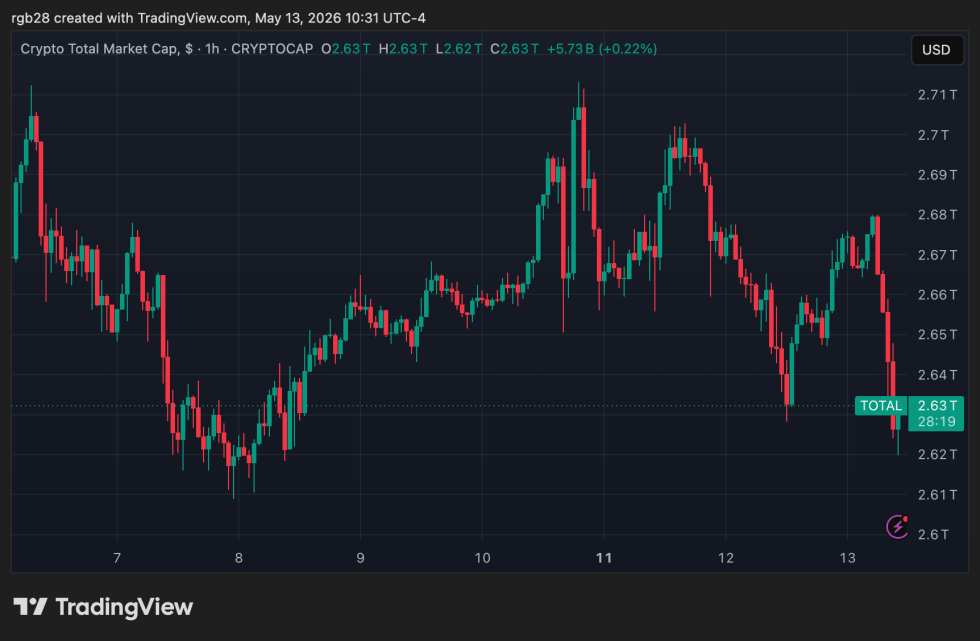
The total crypto market capitalization is at $2.63 trillion in the one-week chart. Source: TOTAL on TradingView


Пов'язані питання

QWhat is the name of the new crypto trading platform launched by Charles Schwab and which two major cryptocurrencies can users trade on it?

AThe new platform is called Schwab Crypto. Users can trade Bitcoin (BTC) and Ethereum (ETH) directly on the platform.

QWhat is the trading fee charged by Charles Schwab on its Schwab Crypto platform, and how does it compare to competitors like Coinbase and Morgan Stanley?

ACharles Schwab charges a 75-basis-point (0.75%) fee on the dollar value of each trade on Schwab Crypto. This is higher than Morgan Stanley's 50 basis points but lower than Coinbase's 60 basis points for its users.

QWhat two US states are currently excluded from accessing the Schwab Crypto platform?

AThe Schwab Crypto platform is available in all US states, excluding New York and Louisiana.

QWhat are the roles of Charles Schwab Premier Bank (CSPB) and Paxos in the operation of the Schwab Crypto platform?

ACharles Schwab Premier Bank (CSPB) serves as the custodian for customers' assets, handling safekeeping and record-keeping. Blockchain infrastructure provider Paxos handles trade execution and sub-custody.

QWhat is the stated strategic goal of Morgan Stanley's crypto launch on E*Trade, according to Jed Finn, its head of wealth management?

AJed Finn stated that the launch is 'much bigger than trading crypto at a cheaper rate,' explaining that their strategy is 'disintermediating the disintermediators.'

Пов'язані матеріали

The Value Distribution of Stablecoins

**Summary: The Value Distribution of Stablecoins** The article argues that stablecoins are evolving from mere trading tools into broader channels for dollar access. It divides the stablecoin ecosystem into four layers to analyze how value is distributed: 1. **Issuance Layer:** Mints stablecoins, holds reserve assets, and captures the spread between reserve yield and user costs (e.g., Tether, Circle). This layer currently earns the largest profit margin. 2. **Infrastructure Layer:** Connects stablecoins to the traditional financial system, handling fiat on/off-ramps, banking integration, compliance (KYC/AML), and asset management (e.g., Bridge, BVNK). This is the "unglamorous" but critical work, building the essential bridges between crypto and real-world finance. 3. **Acquiring/Distribution Layer:** Integrates stablecoins into merchant systems, manages payment flows, and provides enterprise financial software (e.g., Stripe, Coinbase). They act as the access point for businesses. 4. **Application Layer:** The end-users and businesses that ultimately use stablecoins for payments, settlements, or as a store of value. They benefit from convenience but have little pricing power. The core thesis is that while the issuance layer currently dominates profits, the often-overlooked **infrastructure layer holds significant long-term potential**. The real challenge and barrier to mass adoption is not the on-chain transfer of stablecoins (which is simple), but the complex "last mile" integration into existing business workflows, banking systems, and regulatory frameworks across different countries. Companies in this layer are currently in a "land grab" phase, investing heavily to build networks, secure bank partnerships, and establish compliance pathways. While their position is currently pressured by the profitable issuers above and distribution platforms below, the article suggests that if stablecoins become a default financial rail for businesses, the infrastructure providers who have done the hard work of integration will ultimately gain strong pricing power and become entrenched, essential players.

marsbit5 год тому

The Value Distribution of Stablecoins

marsbit5 год тому

The Value Distribution of Stablecoins

The Value Distribution of Stablecoins The article argues that stablecoins are evolving from a mere trading tool into a broad "dollar channel." It analyzes the industry's value chain through four layers: 1. **Issuance Layer (e.g., Tether, Circle):** The top layer that mints stablecoins, holds reserve assets, and captures the thickest interest rate spread. 2. **Infrastructure Layer (e.g., Bridge, BVNK):** Connects stablecoins to the traditional financial system, handling critical but complex "dirty work" like fiat on/off-ramps, banking integration, compliance (KYC/AML), and cross-border settlement. 3. **Acquiring/Distribution Layer (e.g., Stripe, Coinbase):** Embeds stablecoins into merchant systems, manages payment flows, and integrates with enterprise software. 4. **Application Layer:** End-users and businesses that ultimately use stablecoins for payments, settlement, or storing value. The author posits that while the issuance layer currently captures the most profit, the most overlooked and potentially critical layer is infrastructure. The core challenge for stablecoin adoption isn't the on-chain transfer (which is simple), but bridging the gap between blockchain and the real-world financial system. This involves solving practical problems for businesses: fiat conversion, reconciliation, tax handling, and user onboarding. Infrastructure companies are currently in a difficult "land-grab" phase—building networks, securing banking relationships, and achieving compliance country-by-country. They face pressure from both the profitable issuance layer above and distribution platforms below. However, the author suggests this layer is building a crucial moat. Once stablecoins become a default business rail, the infrastructure players who have done the hard work of integration may gain significant, durable value and pricing power.

链捕手5 год тому

The Value Distribution of Stablecoins

链捕手5 год тому

Торгівля

Спот
Ф'ючерси
活动图片