British Police Return £1 Million Stolen from Deceased Money Laundering Suspect

cryptonews.ruОпубліковано о 2026-08-28Востаннє оновлено о 2026-08-28

Анотація

UK police confiscated over £1 million in cash and cryptocurrency from a deceased money laundering suspect. This represents the largest single crypto confiscation to date under new powers that allow police to freeze digital wallets based on suspicion, without requiring a criminal conviction. The seized assets, deemed proceeds of crime, include Bitcoin and other digital currencies. Authorities highlight that blockchain's permanent transaction record provides valuable evidence, countering criminal assumptions of anonymity. The seizure is part of a wider UK crackdown on crypto-related crime, involving coordinated operations by police and financial regulators to track and recover illicit digital assets.

Police in the Avon and Somerset county of the United Kingdom announced the completion of the confiscation of over £1 million in cash, Bitcoin, and other digital assets seized from a deceased individual convicted of money laundering.

According to a statement from the Financial Investigation Unit on August 27th, this is the largest single cryptocurrency confiscation in history, occurring against the backdrop of a nationwide campaign in the UK against criminal elements using blockchain technology to conceal and move digital assets through shadowy channels.

British Police Seize Cryptocurrency from Deceased Accused

A British court allowed Avon and Somerset Police to confiscate a total of £1,032,487.86 under the Proceeds of Crime Act (POCA), filed earlier this year. The confiscated assets comprised a total of 20.21 BTC, other crypto assets, and cash in a bank account.

The police stated they moved to seize the assets as they were identified as "proceeds of unlawful conduct" after the person under investigation was convicted of money laundering.

The police did not name the accused, who has since died. However, according to Bristol Live,

Besides the identity of the deceased asset owner, this case drew attention also because it is the largest such confiscation carried out by Avon and Somerset Police since authorities gained the power to issue orders to freeze cryptocurrency wallets in April 2024.

Under the new regime, British police do not require a conviction to block a crypto wallet. Reasonable suspicion of criminal activity is sufficient.

Funds seized under the Proceeds of Crime Act (POCA) do not go into the general treasury fund. According to Avon and Somerset Police, the additional £1 million in funding will be directed towards community and police work, including plans for education and training, early intervention, and crime prevention.

British Police Use Blockchain Technology to Combat Criminals

Detective Constable Anthony Davies from the Financial Investigation Unit pointed to a common misconception among criminals who mistakenly believe cryptocurrency by default provides them with anonymity.

"Many believe that cryptocurrencies provide anonymity, help conceal wealth, and make assets inaccessible to law enforcement," said Davies. "In reality, a permanent record of transactions is stored in a digital ledger called the blockchain, which can become an invaluable source of evidence."

He added that the police "will continue to use all available powers to identify, trace, and recover criminally obtained property, regardless of its form."

Part of a Broader UK Campaign Against Crypto Crime

The seizure fits an overall trend where UK authorities view the blockchain as a clue, not a dead end. In July, Metropolitan Police arrested three men who impersonated law enforcement officers to steal over £4 million in cryptocurrency from eight victims, returning about £1 million of the victims' funds after tracing wallets, aliases, and exchange records, police reported.

Regulators have also taken steps. In April, the Financial Conduct Authority (FCA) conducted what it called its first coordinated operation against illegal peer-to-peer cryptocurrency trading, targeting eight London offices jointly with His Majesty's Revenue and Customs (HMRC) and the South West Regional Organised Crime Unit, according to its own press release.

The same SWROCU unit closed a separate £2.2 million money laundering case where laundered cash was immediately converted into cryptocurrency.

Common to all is that the cryptocurrency transaction ledger is now doing the work for which investigators previously relied on tracking cash flows.


Пов'язані питання

QWhat was the total value confiscated by Avon and Somerset Police, and what did it consist of?

AAvon and Somerset Police confiscated a total of £1,032,487.86. The assets consisted of 20.21 BTC, other unspecified cryptocurrency assets, and cash from a bank account.

QUnder what authority did the British police confiscate the assets, and what condition does this new regime not require?

AThe assets were confiscated under the Proceeds of Crime Act (POCA). The new regime, in effect since April 2024, does not require a criminal conviction for police to freeze a crypto wallet; only reasonable grounds for suspicion of crime are needed.

QAccording to Detective Constable Anthony Davies, what is the common misconception among criminals regarding cryptocurrency?

ADetective Constable Anthony Davies stated that a common misconception among criminals is that cryptocurrency by default provides anonymity, helps hide wealth, and makes assets inaccessible to law enforcement.

QHow will the £1 million seized under POCA be used, according to Avon and Somerset Police?

AAccording to Avon and Somerset Police, the seized £1 million will be used for public and police work, including funding plans for education and training, early intervention, and crime prevention.

QWhat recent trend in the UK's approach to fighting crypto crime is highlighted in the article?

AThe article highlights a trend where UK authorities now view the blockchain as a lead or investigative tool rather than a dead end. They are actively using the transaction ledger, which was previously relied on for tracking cash flows, to gather evidence and recover illicit assets.

Пов'язані матеріали

Bitcoin Added $14,264 in a Week; According to Galaxy, a Signal the Next Bottom is Near

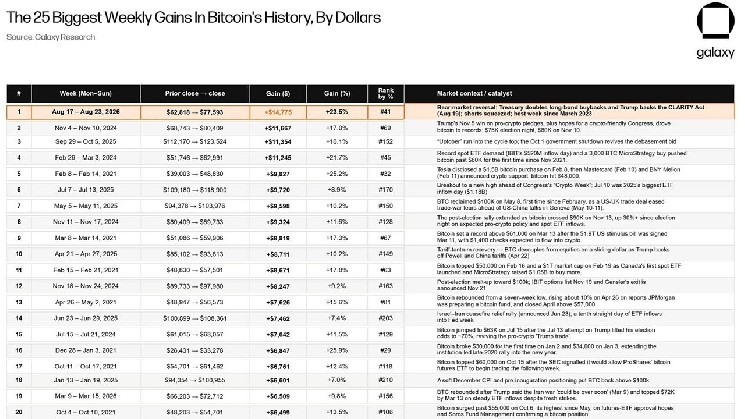
Bitcoin concluded the week ending August 23rd with a gain of $14,264, or 22.7%, closing at $77,387. This marked its largest weekly dollar gain on record, though percentage gains have been larger when prices were lower. The subsequent rally pushed prices to a three-month high above $81,000 before a slight pullback. The catalyst for the surge was identified as the U.S. Treasury's announcement to at least double its long-term bond buyback operations to support liquidity. Galaxy Digital's Head of Research, Alex Thorn, also noted a significant "buying shift" in BlackRock's iShares Bitcoin Trust (IBIT) by retail investors, a signal not seen in two years. Galaxy Research highlighted a key technical level to watch: the 50-week moving average around $82,470. Historical data shows that in 11 of the past 13 bear markets since 2011, a weekly close above this average has coincided with the cycle bottom being in. Failure to achieve this close could mean the rally is merely a corrective bounce within a longer downtrend rather than the start of a new bullish trend. Matt Cole, CEO of Strive, offered an optimistic view, suggesting the next Bitcoin cycle could be the strongest ever, citing its performance relative to the dollar and gold as evidence of changing dynamics. However, as the price base grows, record dollar gains become easier to achieve, making sustainability the key question.

cryptonews.ru24 хв тому

Bitcoin Added $14,264 in a Week; According to Galaxy, a Signal the Next Bottom is Near

cryptonews.ru24 хв тому

Торгівля

Спот
活动图片