Bitwise: The Institutional Wave Has Arrived, Why Is the Market Still Asleep?

marsbitОпубліковано о 2026-02-25Востаннє оновлено о 2026-02-25

Анотація

The biggest alpha opportunities in financial markets come from behavioral biases like anchoring, where investors cling to initial impressions. This is why the crypto market is currently mispriced: traditional investors still anchor crypto to its early, counterculture image, while crypto natives suffer from "crying wolf" fatigue after years of promised institutional adoption. Yet, the institutional wave is already here. Wall Street is loudly announcing its move on-chain. SEC Chair Paul Atkins has initiated a commission-wide project to modernize securities regulation for blockchain. BlackRock’s Larry Fink declared we are at the beginning of asset tokenization, evidenced by the firm’s $2+ billion BUIDL tokenized treasury fund on Uniswap and an investment in UNI. Apollo is tokenizing a credit fund on six blockchains and acquiring a stake in Morpho. JPMorgan, Bank of America, Citi, and Wells Fargo are collaborating on a stablecoin. JPMorgan has issued a deposit token on Base, and Fidelity is hiring for a DeFi treasury role. The potential market is enormous: a $30 trillion ETF market, $110 trillion in equities, and $145 trillion in bonds. In contrast, the entire tokenized market is just $20 billion, suggesting potential for exponential growth. The chart of tokenized real-world assets (RWA) value shows a near-vertical growth trajectory, yet this reality is disconnected from market perception. The key challenge is determining how to capture this opportunity, as unanswered question...

Author: Matt Hougan, Chief Investment Officer of Bitwise

Compiled by: Saoirse, Foresight News

The greatest excess returns (Alpha) in financial markets often come from behavioral biases. Investors always make mistakes, and if you can exploit these mistakes, you can achieve substantial returns.

One of my favorite behavioral biases to exploit is anchoring: people cling to the first piece of information they receive and are reluctant to change. This is why retailers price items at $9.99 instead of $10.00—you remember the '9' first, and your brain struggles to let go.

Anchoring was one of the reasons I decided to dive into the crypto industry full-time in 2018.

At that time, most people still viewed cryptocurrency as a joke. They first learned about it through the 2013 Silk Road scandal, the 2014 Mt. Gox exchange collapse, and witnessed its extreme boom-and-bust cycles.

Fortunately, a few people I trusted urged me to take crypto seriously.

When I looked beyond the surface, to see it for what it truly is rather than what people thought it was, I was completely astonished. The technology was far more mature than most people realized, and the opportunities were much greater. Yet people were still stuck with the old impressions from 2014.

Right now, I feel like I'm back in that moment.

The Whole World Is Shouting at You

Look around, Wall Street is loudly proclaiming: the financial industry is moving on-chain. Not just a small part, but all of it.

Last July, SEC Chairman Paul Atkins launched the 'Crypto Project,' a committee-wide initiative aimed at modernizing securities regulation. In his words, it's about enabling the U.S. financial markets to 'run on-chain.' And indeed, the markets have already started moving on-chain:

  • In October, BlackRock CEO Larry Fink publicly stated that we are at the starting point of tokenizing all assets. Two weeks ago, BlackRock launched the BUIDL tokenized treasury fund on Uniswap, the world's largest decentralized exchange; it has already grown to over $2 billion in size. As part of the collaboration, BlackRock also invested in Uniswap's native token, UNI.
  • Apollo, a credit institution managing $700 billion, partnered with Securitize to tokenize its diversified credit fund and list it on six public blockchains. Since January 2025, the product has attracted over $100 million. The company recently also announced plans to acquire a 9% stake in the leading global decentralized lending protocol, Morpho.
  • JPMorgan Chase, Bank of America, Citigroup, and Wells Fargo are in talks to jointly launch a stablecoin.

At the same time, JPMorgan issued a deposit token on Coinbase's Base network; Fidelity is hiring a head of decentralized finance treasury... Similar moves are emerging one after another.

The scale of the related markets is enormous: the ETF market is $30 trillion, the stock market is $110 trillion, and the bond market is $145 trillion.

In contrast, the current total global tokenized market is only $20 billion.

If Larry Fink is right—'every stock, every bond... will eventually be tokenized'—this means the market has tens of thousands of times more room to grow.

The Disconnect in Perception

Yet traditional investors just can't hear it.

They can't hear it because of anchoring.

When they think of cryptocurrency, the image that comes to mind is still that of the tattooed, punk, skateboarding figure. They don't realize that this person has long shaved his beard, put on a suit, and is building the infrastructure that will support the next generation of capital markets.

Amusingly, crypto investors themselves also seem unable to hear it.

They suffer from 'wolf cry' syndrome. Having heard promises of 'institutions are coming' for so long, now that they are actually here, they feel numb and unresponsive.

But the data doesn't lie.

Look at the growth curve of tokenized real-world assets (RWAs)—it's as steep as Mount Everest.

Value of Tokenized Real-World Assets (RWAs):
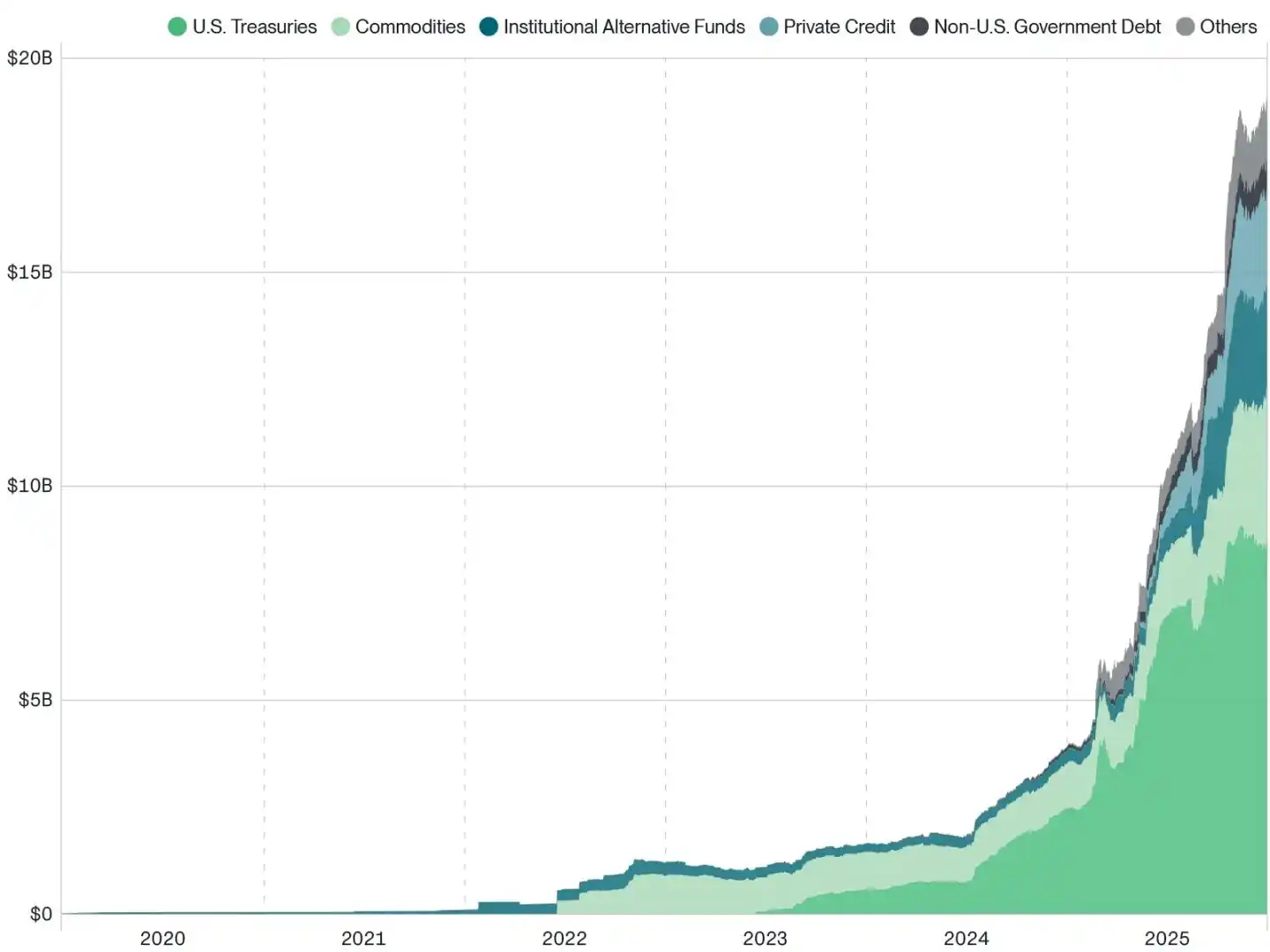
Source: Bitwise Asset Management, data from RWA.xyz. Data timeframe is from January 1, 2020, to December 31, 2025.

Note: Stablecoin issuers like Circle and Tether are intentionally omitted.

Seizing the Opportunity

The challenge is that it's difficult to know precisely how to profit from this.

Because the crypto industry still has a series of key questions unanswered, such as:

  • Will the value created by tokenization flow to underlying protocols like Ethereum and Solana, or is the underlying block space becoming commoditized?
  • If value settles on the underlying public chains, will new quasi-private chains like Canton Network and Tempo outperform public chains?
  • As institutions like BlackRock and Apollo embrace DeFi en masse, will DeFi tokens explode, or will the economic model challenges of DeFi tokens themselves be difficult to overcome?
  • If the value ultimately flows to the builder companies rather than the blockchain itself, will the beneficiaries be traditional giants like BlackRock and JPMorgan, or crypto-native institutions?

I have my own judgments on these questions and will share them in articles over the coming months. But honestly, for most of these questions, the answer right now is: no one knows.

The only thing I am certain of is:

There is a huge gap between what people think the crypto market is and what the crypto market actually is.

In my view, this gap represents a major opportunity—not to rush to pick winners in advance, but to broadly position across the entire sector while the market is still mispricing this structural shift.

The greatest opportunities for alpha often arise when market consensus is outdated, reality has moved forward, and investors are still anchored to the old narrative.

The crypto industry is at that point right now.

If you can see it for what it is, opportunities abound.

Пов'язані питання

QWhat behavioral bias does the author identify as a key source of alpha in financial markets, and how does it relate to the current state of crypto?

AThe author identifies anchoring bias as a key source of alpha. Investors are anchored to their initial impressions of crypto from events like the Silk Road scandal and Mt. Gox bankruptcy, failing to see that it has matured into a technology building the infrastructure for the next generation of capital markets.

QAccording to the article, what major Wall Street developments signal that the entire financial industry is moving on-chain?

AMajor developments include: the SEC's 'Crypto Project' to modernize securities regulation; BlackRock's CEO stating all assets will be tokenized and the launch of their BUIDL fund on Uniswap; Apollo tokenizing a credit fund and investing in Morpho; and major banks like JPMorgan, Bank of America, Citi, and Wells Fargo planning to launch a joint stablecoin.

QWhat is the current size of the tokenized market compared to the potential market, illustrating the growth opportunity?

AThe current global tokenized market is valued at only $20 billion. In contrast, the potential market for tokenizing ETFs, stocks, and bonds is massive, with the ETF market at $30 trillion, the stock market at $110 trillion, and the bond market at $145 trillion, representing a potential growth of thousands of times.

QWhy are both traditional investors and crypto investors failing to recognize the current institutional adoption of crypto, according to the author?

ATraditional investors are held back by anchoring bias, clinging to old stereotypes of crypto. Crypto investors suffer from a 'boy who cried wolf' syndrome, having heard promises of institutional adoption for so long that they have become numb to it now that it is actually happening.

QWhat is the author's recommended investment strategy to capitalize on the current disconnect between perception and reality in crypto?

AThe author recommends not trying to pick individual winners prematurely, but instead taking a broad-based approach to invest across the entire sector while the market is still mispricing this structural shift, as the greatest alpha is found when consensus is outdated.

Пов'язані матеріали

Warsh Hearing Concludes: What Are the Notable Signals for the Crypto Industry?

The Senate Banking Committee held a confirmation hearing for Judy Shelton, a Federal Reserve nominee, who faced intense questioning regarding her ability to maintain the central bank's independence amid pressure from President Trump to lower interest rates. Shelton denied any pre-arranged commitments on rate cuts and emphasized her independence, though Democrats remained skeptical, citing contradictions with Trump's public statements. Shelton characterized post-pandemic inflation as a major policy failure and called for a "regime change" in the Fed’s approach, including reforms to inflation measurement and communication strategies. She criticized the current practice of Fed officials frequently signaling future rate moves and did not commit to maintaining post-meeting press conferences, suggesting potential reductions in transparency. Regarding crypto markets, Shelton’s extensive investments in digital asset companies—including Solana, DeFi, and blockchain infrastructure—were noted, though she has pledged to divest these holdings due to ethics rules. Her familiarity with the crypto industry and deregulatory leanings may signal a more open, though cautious, stance toward digital assets. However, concerns were raised about potential conflicts of interest, especially given Trump family involvement in crypto-financial ventures. The timing of her confirmation remains uncertain, pending a Justice Department investigation into current Chair Powell. Shelton’s potential leadership could lead to a more hawkish, productivity-focused Fed with tighter policy communication—factors that may significantly influence liquidity conditions and macro narratives for crypto markets.

marsbit6 год тому

Warsh Hearing Concludes: What Are the Notable Signals for the Crypto Industry?

marsbit6 год тому

Торгівля

Спот
Ф'ючерси

Популярні статті

Як купити F

Ласкаво просимо до HTX.com! Ми зробили покупку Synfutures (F) простою та зручною. Дотримуйтесь нашої покрокової інструкції, щоб розпочати свою криптовалютну подорож.Крок 1: Створіть обліковий запис на HTXВикористовуйте свою електронну пошту або номер телефону, щоб зареєструвати обліковий запис на HTX безплатно. Пройдіть безпроблемну реєстрацію й отримайте доступ до всіх функцій.ЗареєструватисьКрок 2: Перейдіть до розділу Купити крипту і виберіть спосіб оплатиКредитна/дебетова картка: використовуйте вашу картку Visa або Mastercard, щоб миттєво купити Synfutures (F).Баланс: використовуйте кошти з балансу вашого рахунку HTX для безперешкодної торгівлі.Треті особи: ми додали популярні способи оплати, такі як Google Pay та Apple Pay, щоб підвищити зручність.P2P: Торгуйте безпосередньо з іншими користувачами на HTX.Позабіржова торгівля (OTC): ми пропонуємо індивідуальні послуги та конкурентні обмінні курси для трейдерів.Крок 3: Зберігайте свої Synfutures (F)Після придбання Synfutures (F) збережіть його у своєму обліковому записі на HTX. Крім того, ви можете відправити його в інше місце за допомогою блокчейн-переказу або використовувати його для торгівлі іншими криптовалютами.Крок 4: Торгівля Synfutures (F)Легко торгуйте Synfutures (F) на спотовому ринку HTX. Просто увійдіть до свого облікового запису, виберіть торгову пару, укладайте угоди та спостерігайте за ними в режимі реального часу. Ми пропонуємо зручний досвід як для початківців, так і для досвідчених трейдерів.

186 переглядів усьогоОпубліковано 2024.12.21Оновлено 2025.03.21

Як купити F

Обговорення

Ласкаво просимо до спільноти HTX. Тут ви можете бути в курсі останніх подій розвитку платформи та отримати доступ до професійної ринкової інформації. Нижче представлені думки користувачів щодо ціни F (F).

活动图片