Bittensor: Should TAO bulls buy now or wait for a pullback below $300?

ambcryptoОпубліковано о 2026-03-28Востаннє оновлено о 2026-03-28

Анотація

Bittensor (TAO) has demonstrated notable strength by maintaining its position above the critical $300 support level, even as major cryptocurrencies like Bitcoin and Ethereum faced selling pressure. The recent move above $302.4 confirmed a bullish structural shift on the 3-day chart, supported by new highs in the On-Balance Volume (OBV) indicator. This resilience is attributed to growing demand for decentralized AI infrastructure. Analysts suggest that a pullback toward the $286–$305 zone could offer a strategic buying opportunity, with potential upward targets at $405–$450. The 4-hour chart reinforces this bullish outlook, showing steady buying pressure and a constructive price structure. However, a drop below $261 would invalidate this optimistic setup. Traders are advised to consider entering within the $286–$319 range, anticipating further gains in the near term.

Bittensor [TAO] continued to trade above the psychological $300 level. While the market leaders Bitcoin [BTC] and Ethereum [ETH] faced strong selling pressure over the past week and were forced to register losses, TAO continued to trend higher.

The $300 was therefore an important support level that swing traders should keep an eye on. Is the sustained uptrend another buying opportunity for TAO traders, or should they take profits and expect a deep retracement next?

The bullish TAO swing structure confirms the trend direction
Source: TAO/USDT on TradingView

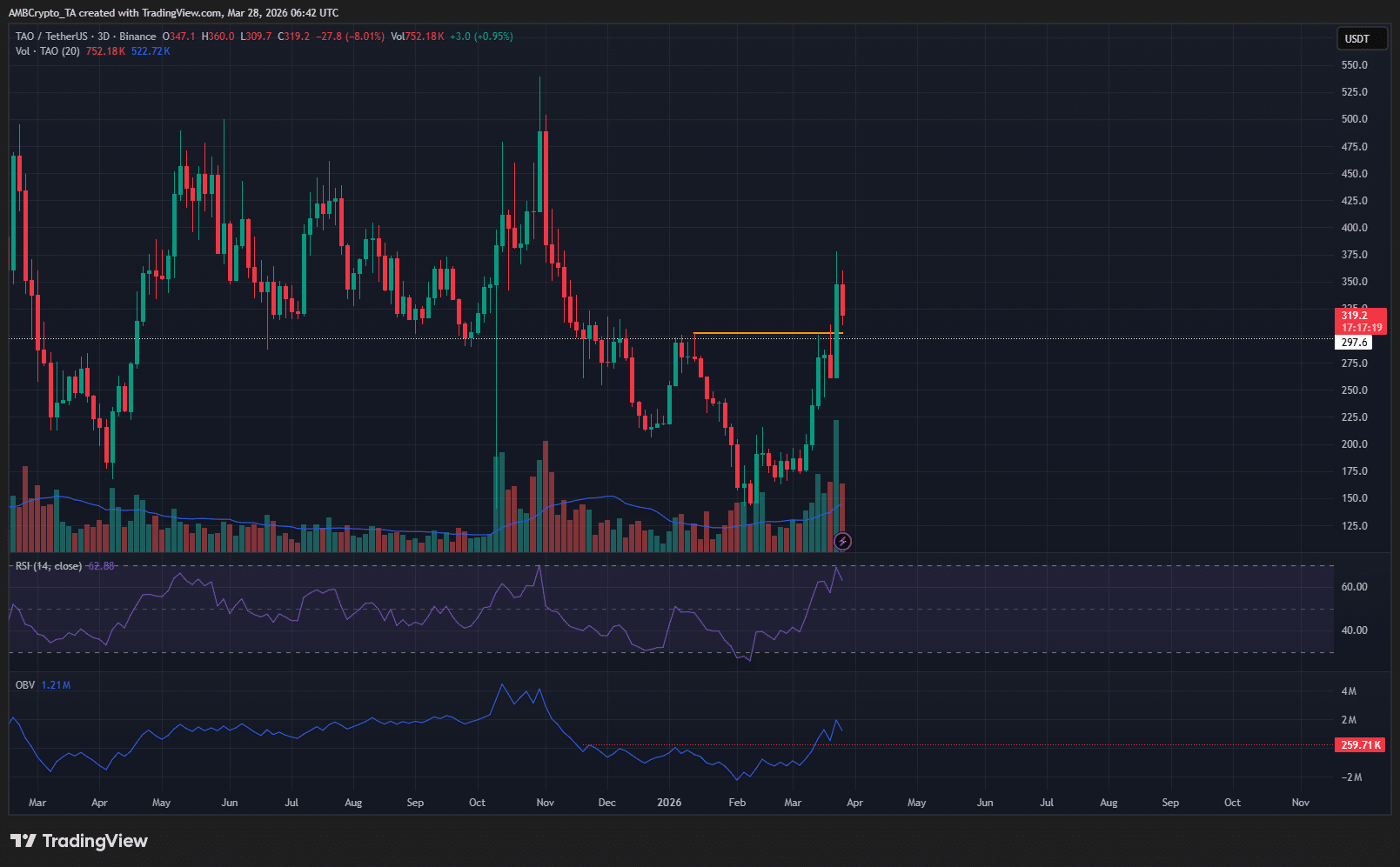
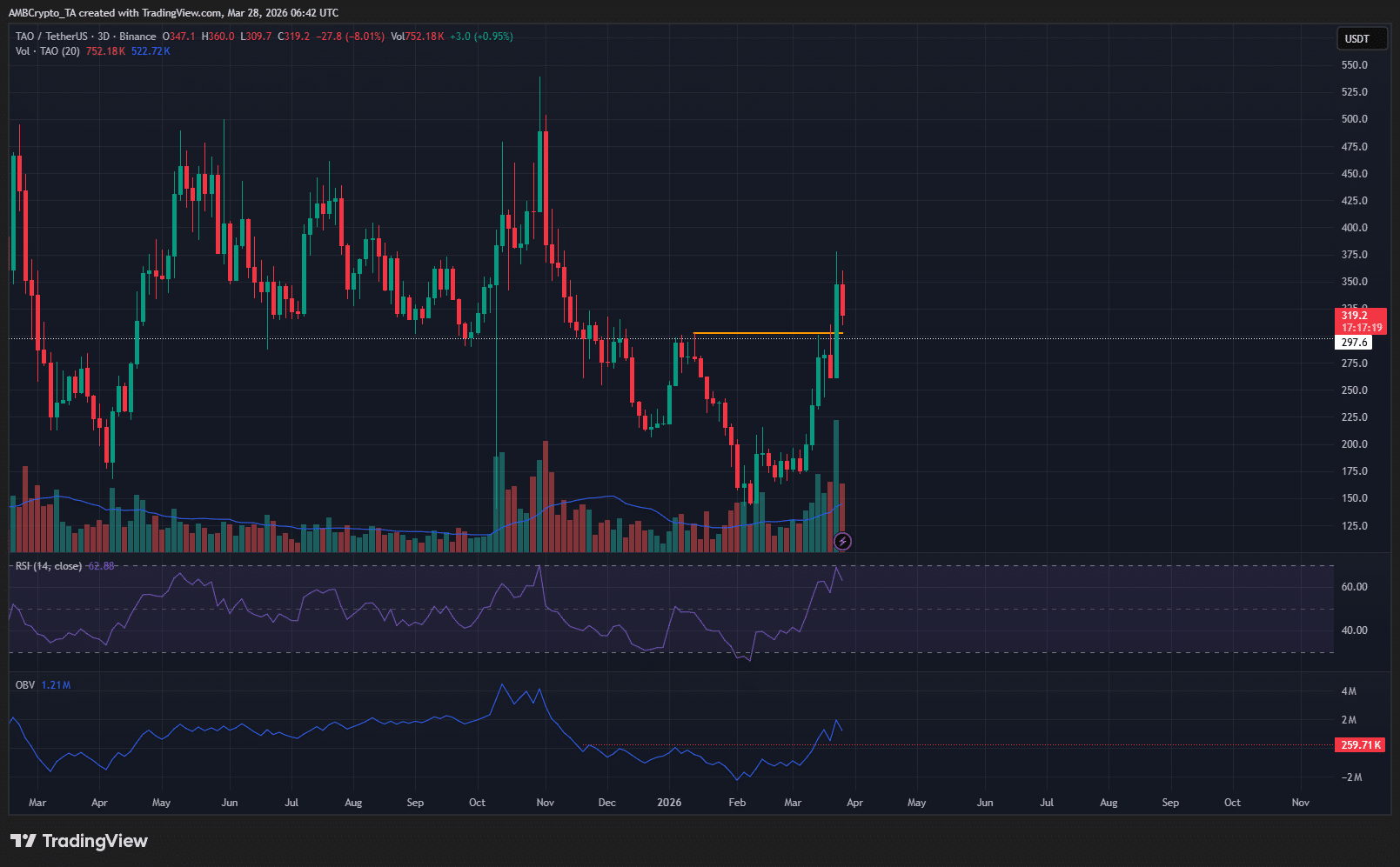
The move above $302.4 last week represented a bullish swing structural shift for TAO on the 3-day chart. At the same time, the OBV was making new local highs, and a psychological round number resistance had been overcome.

These developments were remarkable, especially as Bitcoin and many altcoins were forced to go lower or trade sideways. The demand for decentralized AI infrastructure likely explained the AI token’s relative strength.

A pullback toward $300 would be a buying opportunity for Bittensor traders and investors. Their next targets would be $450-$500.

Why traders should buy now
Source: TAO/USDT on TradingView

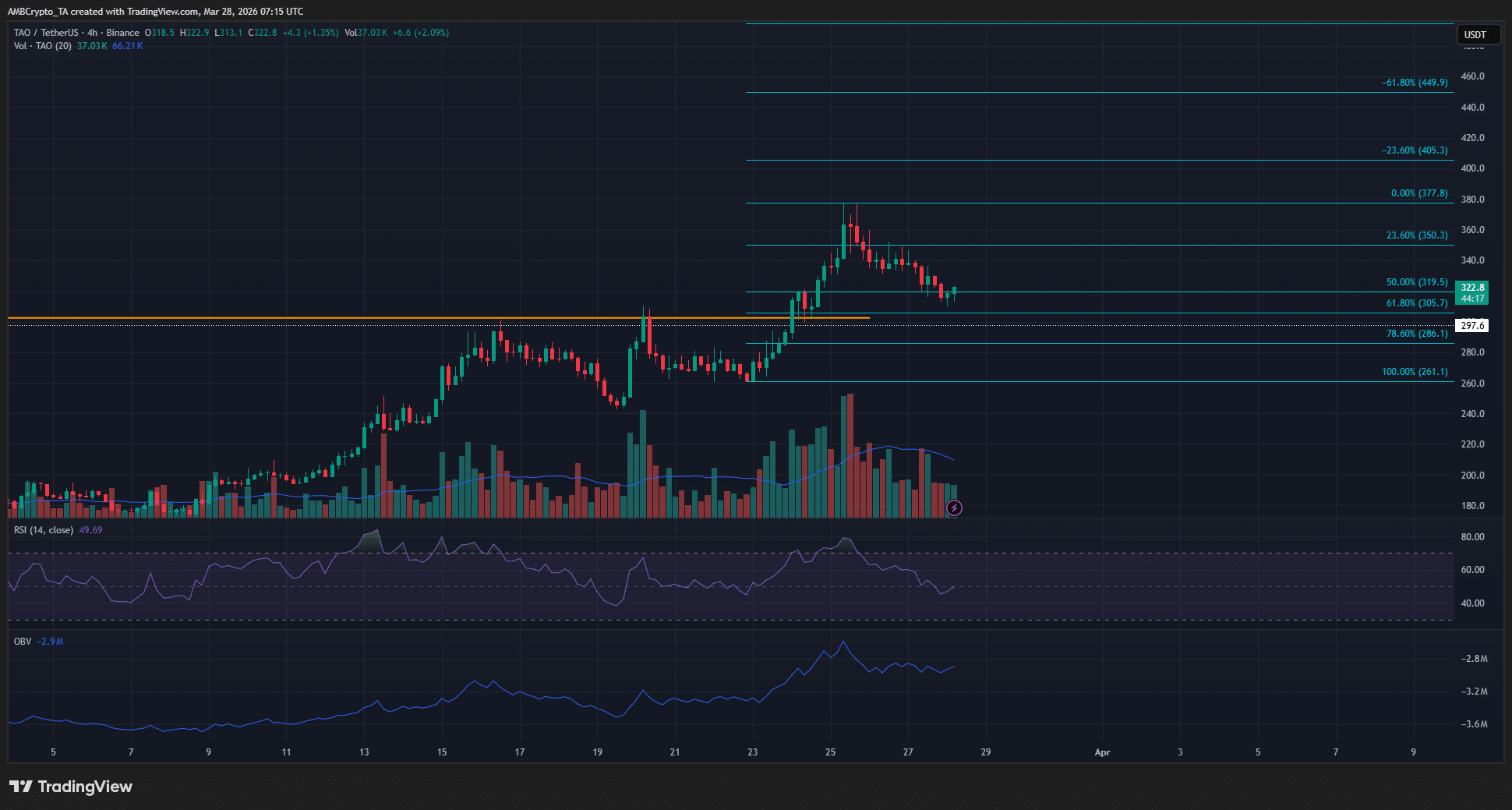
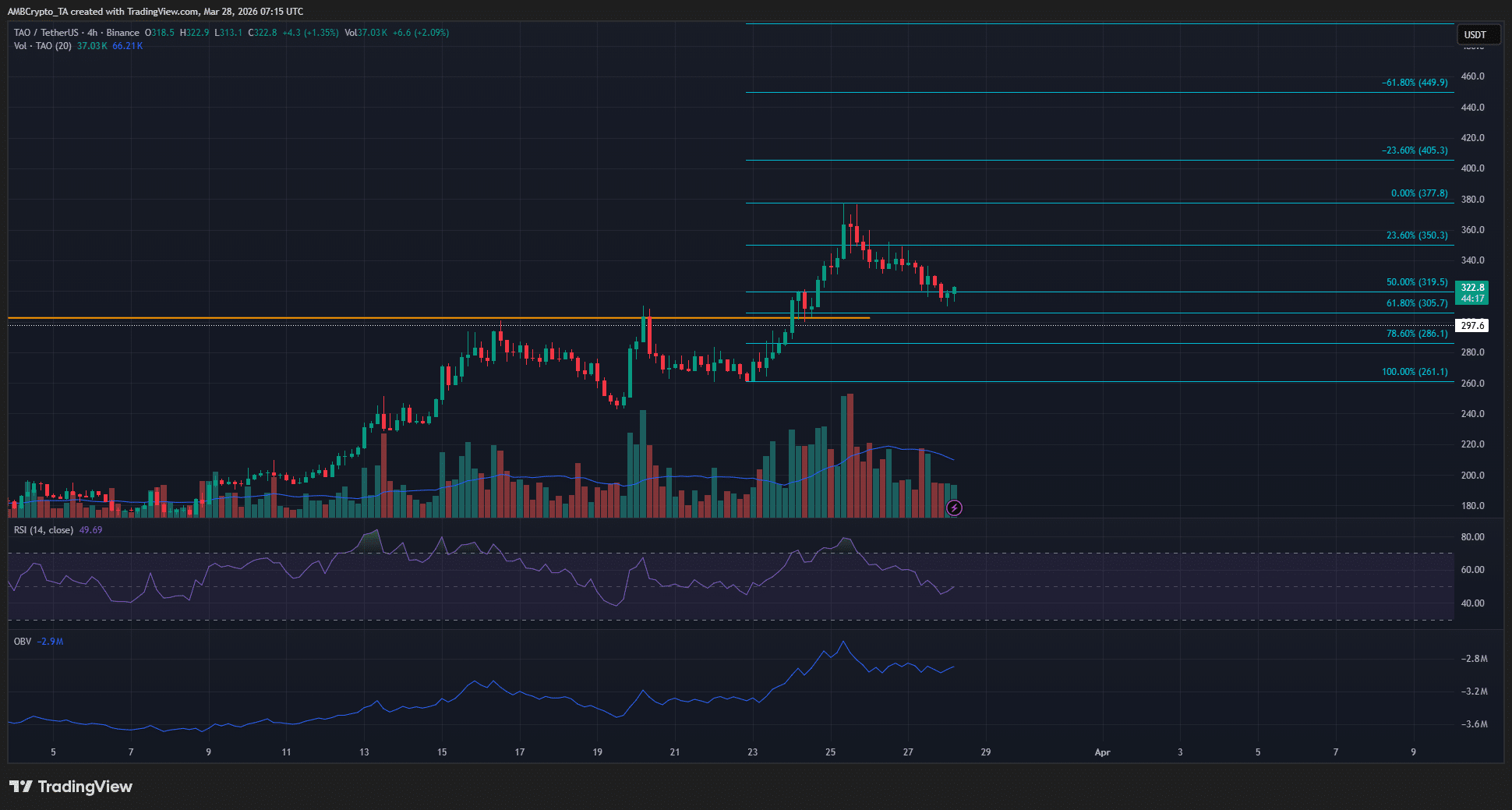
The 4-hour chart was quite encouraging. In this timeframe, the price structure was firmly bullish. The technical indicators also supported the upward momentum and reflected steady buying pressure on the altcoin.

The Fibonacci retracement levels (cyan) showed that a retracement was underway. The $286-$305 pocket would be the ideal buying zone, but it is unclear if we will get this dip.

Traders can look to buy anywhere within the $286-$319 area, as many traders and analysts also consider the 50% retracement as a key support in an uptrend. In either scenario, the $405 and $449 levels would be the next targets.

A drop below the $261.1 mark will shift the H4 structure bearishly and invalidate the bullish setup laid out above.


Final Summary

  • Bittensor continued to trade above the $300 level despite the crypto market correction over the past two days.
  • This show of relative strength could see another uptrend next week, with $409 and $450 being the next targets.


Пов'язані питання

QWhat is the key psychological support level for Bittensor (TAO) mentioned in the article?

AThe key psychological support level for Bittensor (TAO) is $300.

QWhat did the move above $302.4 represent for TAO on the 3-day chart?

AThe move above $302.4 represented a bullish swing structural shift for TAO on the 3-day chart.

QAccording to the article, what is the ideal buying zone for TAO on the 4-hour chart?

AThe ideal buying zone for TAO on the 4-hour chart is the $286-$305 price pocket.

QWhat price level would invalidate the bullish setup and shift the H4 structure bearishly?

AA drop below the $261.1 mark would invalidate the bullish setup and shift the H4 structure bearishly.

QWhat are the next major price targets for TAO if the uptrend continues?

AThe next major price targets for TAO are the $405, $409, $449, and $450 levels.

Пов'язані матеріали

Bitcoin's 'Rally Ends,' Officially Entering the Later Stage of a Bear Market?

Bitcoin prices declined 13% this week, reversing the recent rebound and signaling a likely transition into the later stages of a bear market. Key on-chain metrics deteriorated, with the short-term holder cost basis falling below the Realized Price—a pattern last seen in early 2022, characteristic of bear market maturity. The rally to ~$82k proved to be a bear market bounce, as evidenced by the 90-day realized profit/loss ratio failing to sustain above the bullish threshold of 2. Daily realized losses surged to $1.35B, including significant selling from long-term holders who accumulated near cycle tops, indicating ongoing supply redistribution. Price was rejected almost precisely at the aggregate US spot ETF cost basis of ~$83k, turning that level into resistance and leaving the average ETF investor underwater again. Spot market selling pressure intensified, with the 7-day volume delta turning significantly negative to its weakest level since February. While a major long liquidation event cleared over $400M in leverage, spot demand has not yet stepped in to absorb the resulting supply. Options markets continue pricing in higher future volatility (elevated volatility risk premium) and maintain a skew toward put options, reflecting persistent demand for downside protection, though not yet panic. Overall, market structure remains fragile. Sustained recovery likely requires a reclaim of the ETF cost basis, a shift back to positive spot demand, and a slowdown in realized loss-taking. Until then, the market risks further downside or extended consolidation within the broader bear trend.

Foresight News1 год тому

Bitcoin's 'Rally Ends,' Officially Entering the Later Stage of a Bear Market?

Foresight News1 год тому

How Risky is the "Death Spiral" of MSTR and STRC?

Summary: This article explores the perceived "death spiral" risk between MicroStrategy (MSTR), its Bitcoin holdings, and its perpetual preferred stock (STRC), drawing comparisons to the LUNA-UST collapse. While both systems feature price anchors, high yields for holders, and potential feedback loops, their core mechanisms differ fundamentally. The MSTR-STRC structure relies on continuous financing to sustain its high dividend payouts, primarily through stock ATM offerings. A negative feedback cycle could occur: falling MSTR stock price makes raising equity capital harder, increasing pressure to sell Bitcoin, which undermines STRC confidence and further depresses MSTR. However, unlike LUNA-UST's automated, direct linkage, the MSTR-STRC loop is weaker and has brakes: STRC dividends can be deferred or rates lowered, and STRC holders have a $100/share liquidation preference in bankruptcy, providing a price floor. The company's sustainability hinges on its ability to continue financing. Its current ~$900 million USD reserves cover only about 6.3 months of its ~$1.71 billion annual interest/dividend burden. The next six months are critical, aligning with both the potential bottom in Bitcoin's four-year cycle and the depletion timeline of its reserves. While a LUNA-style catastrophic collapse is deemed highly unlikely due to structural differences, the key question is whether MicroStrategy can navigate this period through healthy deleveraging to restart its capital engine.

Foresight News1 год тому

How Risky is the "Death Spiral" of MSTR and STRC?

Foresight News1 год тому

Торгівля

Спот
Ф'ючерси
活动图片