Bitnomial gains CFTC approval to launch prediction markets in the US

cointelegraphОпубліковано о 2025-12-12Востаннє оновлено о 2025-12-12

Анотація

Bitnomial Clearinghouse LLC has obtained approval from the U.S. CFTC to clear fully collateralized swaps, enabling its parent company, Bitnomial, to launch prediction markets and provide clearing services to external platforms. The prediction markets will cover crypto and economic events, allowing traders to take positions on outcomes like token prices and macroeconomic data. This expands Bitnomial’s existing suite of Bitcoin and crypto derivatives products. The company’s operates as an infrastructure-only clearing provider, offering margin and settlement systems with support for both USD and cryptocurrency collateral. The approval follows recent regulatory clearance for Bitnomial to operate a CFTC-regulated spot crypto exchange. The article also notes the growing momentum of prediction markets in the U.S., highlighting platforms like Kalshi and Polymarket, the latter of which recently received CFTC approval for intermediated trading platform operations.

Bitnomial Clearinghouse LLC received approval from the US Commodity Futures Trading Commission (CFTC) to clear fully collateralized swaps, enabling its parent company, Bitnomial, to launch prediction markets and offer clearing services to other platforms.

According to Friday’s announcement, Bitnomial’s prediction market will cover crypto and economic events, alongside its existing Bitcoin (BTC) and crypto derivatives products. The contracts are designed to allow traders to take positions on outcomes, such as token price levels and macroeconomic data.

The approval expands the umbrella of the trading products offered by Bitnomial. Based in Chicago, the company’s exchange and clearing arms offer perpetuals, futures, options contracts and leveraged spot trading. The company’s clearinghouse also supports crypto-based margin and settlement, allowing approved products to be margined and settled directly in digital assets.

Bitnomial president Michael Dunn said the approval allows the company to serve “both our own exchange and external partners, building a clearing network that strengthens the entire prediction market ecosystem.”

Bitnomial Clearinghouse operates as an infrastructure-only clearing provider, rather than a retail competitor, giving approved partners access to its margin and settlement systems and allowing collateral to be converted between US dollars and cryptocurrency.

The approval follows a recent green light to launch a CFTC-regulated spot cryptocurrency trading platform in the US, allowing customers to buy, sell and trade leveraged and non-leveraged crypto products on a federally supervised exchange.

Event contracts on Polymarket. Source: Polymarket

Related: Coinbase may debut prediction markets, tokenized stocks on Wednesday: Report

Polymarket gains momentum in the US

Prediction markets have emerged as a major trend in 2025. According to DefiLlama data, prediction market Kalshi has generated $5.27 billion in trading volume over the last 30 days, while blockchain-based Polymarket recorded just under $2 billion over the same time period.
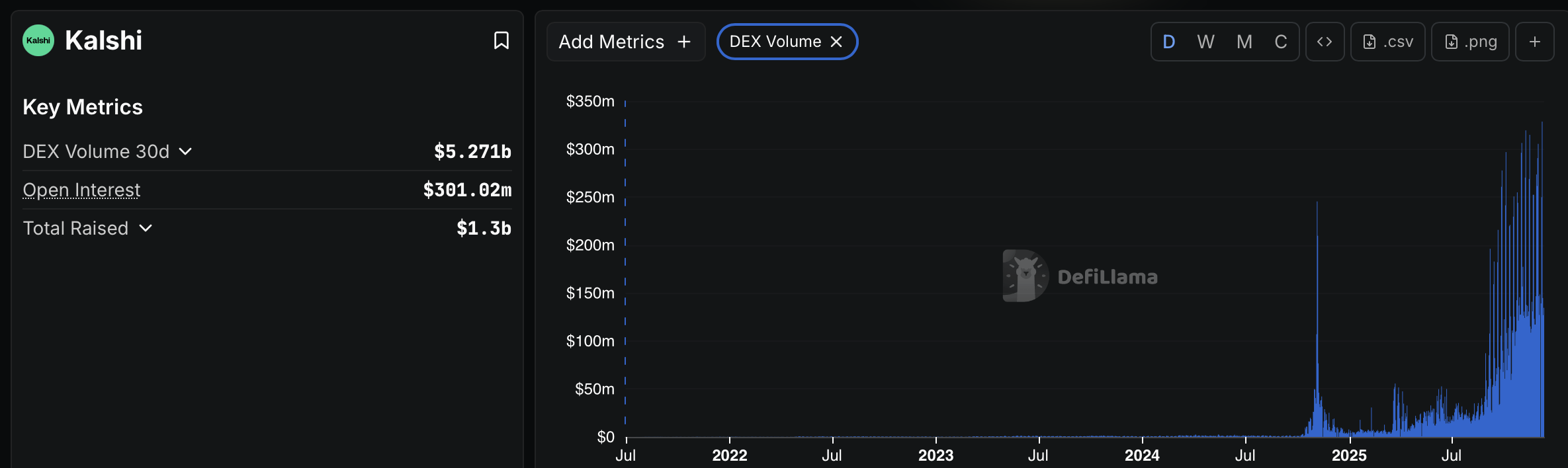
Kalshi trading volume. Source: DefiLlama

In November, Polymarket received regulatory approval from the CFTC to operate an intermediated trading platform, allowing access through registered brokers under the rules governing US markets.

The approval followed the closure of an investigation in July led by the CFTC and US Department of Justice into whether Polymarket had allowed trading by US users, a probe that included an FBI search of founder Shayne Coplan’s home.

Polymarket, which settles contracts on the Polygon blockchain using the USDC (USDC) stablecoin, has also secured several partnerships in recent months, including the UFC and Zuffa boxing and fantasy sports operator PrizePicks in November.

Magazine: Meet the onchain crypto detectives fighting crime better than the cops

Трендові криптовалюти

Пов'язані матеріали

Behind Robinhood's Launch of Its Own Chain, the Beautifully Packaged "Tokenized Stocks" Still Have No Equity Rights

Robinhood has launched "Robinhood Chain," an Ethereum-based Layer 2 built with Arbitrum technology, and introduced "Stock Tokens." This article clarifies that these tokens are not actual on-chain equity. They are tokenized debt securities issued by Robinhood Assets Jersey Limited, offering economic exposure to reference stocks or ETFs but lacking direct ownership, voting rights, or other shareholder privileges. The legal structure is conservative, relying on traditional financial intermediaries, custody, KYC/AML controls, and specific jurisdiction rules, even though the tokens are transferable on-chain. The move is part of Robinhood's broader strategy to evolve from a retail brokerage into a global financial ecosystem, integrating services like banking, retirement, crypto, and DeFi. Robinhood Chain aims to provide a programmable settlement layer, making financial products more portable and accessible while masking underlying complexity. However, the "brokerage chain paradox" lies in balancing a simple user interface with the intricate, regulated reality of the wrapped assets. The success of this model depends on users and regulators accepting this structured approach without misunderstanding the tokens as direct stock ownership. Key components supporting this strategy include the Bitstamp acquisition (expanding institutional crypto capabilities), the Robinhood Wallet (bridging brokerage and self-custody), the Robinhood Earn program (integrating DeFi lending), and the Lighter perpetual contracts platform. While ambitious, the initiative is still early, facing challenges in achieving liquidity, developer adoption, and regulatory clarity across jurisdictions.

marsbit45 хв тому

Behind Robinhood's Launch of Its Own Chain, the Beautifully Packaged "Tokenized Stocks" Still Have No Equity Rights

marsbit45 хв тому

Strategy's Accounting Gimmick: The Cap on BTC Sales Far Exceeds $1.25 Billion

The article, originally from Bankless, discusses how MicroStrategy's (MSTR) recent Bitcoin (BTC) sales reveal a much larger potential selling capacity than the widely reported $1.25 billion "reserve-building" cap. On July 7, MicroStrategy disclosed a sale of 3,588 BTC (~$216M) to pay dividends for its STRAT (STRC) preferred shares and replenish its USD Reserve. Crucially, the company stated this sale did not count against its stated $1.25 billion "reserve-building capacity." The analysis explains that MicroStrategy's "BTC Monetization Plan," part of its broader "Digital Credit Capital Framework," actually outlines three main purposes for selling BTC, only one of which has the $1.25B cap: 1. **Building the USD Reserve** (capped at $1.25B). 2. **Covering preferred share/ debt costs** (replenishing the reserve after payments). 3. **Funding buybacks** (up to $10B for preferred shares and $10B for MSTR common stock). The key nuance is the accounting distinction between "building" the reserve (selling BTC before making payments) and "replenishing" it (selling BTC after using reserve funds for payments). While functionally the same—converting BTC to cash for obligations—only "building" counts against the publicized $1.25B limit. This means sales for "replenishing" and the $20B+ buyback pool allow for total potential sales exceeding $30B. The article frames this as part of MicroStrategy's shift from a simple "buy and hold" Bitcoin narrative to an "active capital management" model, where BTC becomes a balance-sheet tool to manage pressures between its common stock, preferred shares, dollar reserve, and Bitcoin holdings. This creates complex trade-offs and potential conflicts of interest. The conclusion warns investors that the $1.25B figure is not a total sales ceiling. Understanding terms like "build," "replenish," and "repurchase" in MicroStrategy's disclosures is now critical, as the company navigates a new, more complex role as an actively managed entity rather than a passive Bitcoin accumulator.

Odaily星球日报1 год тому

Strategy's Accounting Gimmick: The Cap on BTC Sales Far Exceeds $1.25 Billion

Odaily星球日报1 год тому

The Networking Game in Silicon Valley's Elite Circles: Those with Connections Get $50 Million, While the Truly Talented Can't Raise Money?

"Silicon Valley's Meritocracy to Relationship Game: How Networks Now Trump Talent." The article argues that Silicon Valley has shifted from a meritocracy to a "kingmaker" system where connections and background outweigh true ability. Key factors driving this change include: 1. **AI-Distorted Expectations:** Unprecedented growth curves (e.g., Anthropic) have led VCs to seek only "sure things" or pattern-match against past successes. 2. **Capital Concentration:** LP funds are concentrated in a few large, multi-stage funds, pushing VCs to overpay for hot deals to secure capital. 3. **VC Professionalization:** The industry has become a standardized career path, attracting conformist "NPCs" rather than independent thinkers. The long IPO timeline incentivizes safe, consensus bets for career advancement over risky, fund-returning outliers. This consensus capital fuels consensus founders. Startups are now a standard career option, with accelerators pressuring uniform ideas (e.g., 81% AI). Founders from elite schools (Stanford, OpenAI) easily raise millions based on pedigree, not proof. Large funds preemptively back "centrally cast" teams with $10-50M war chests to dominate categories, sidelining outsiders. The "kingmaker" strategy has downstream effects: it encourages aggressive, sometimes fraudulent, revenue reporting and allows founders to sell significant secondary shares early, attracting grifters. The author predicts a mean reversion. History shows the hottest trends rarely produce the most valuable companies. They advocate backing underestimated outsiders with "a chip on their shoulder" over anointed insiders, believing true meritocracy will ultimately win. "Those chasing the herd are set up for slaughter."

marsbit1 год тому

The Networking Game in Silicon Valley's Elite Circles: Those with Connections Get $50 Million, While the Truly Talented Can't Raise Money?

marsbit1 год тому

Торгівля

Спот

Популярні статті

Як купити US

Ласкаво просимо до HTX.com! Ми зробили покупку Talus Network (US) простою та зручною. Дотримуйтесь нашої покрокової інструкції, щоб розпочати свою криптовалютну подорож.Крок 1: Створіть обліковий запис на HTXВикористовуйте свою електронну пошту або номер телефону, щоб зареєструвати обліковий запис на HTX безплатно. Пройдіть безпроблемну реєстрацію й отримайте доступ до всіх функцій.ЗареєструватисьКрок 2: Перейдіть до розділу Купити крипту і виберіть спосіб оплатиКредитна/дебетова картка: використовуйте вашу картку Visa або Mastercard, щоб миттєво купити Talus Network (US).Баланс: використовуйте кошти з балансу вашого рахунку HTX для безперешкодної торгівлі.Треті особи: ми додали популярні способи оплати, такі як Google Pay та Apple Pay, щоб підвищити зручність.P2P: Торгуйте безпосередньо з іншими користувачами на HTX.Позабіржова торгівля (OTC): ми пропонуємо індивідуальні послуги та конкурентні обмінні курси для трейдерів.Крок 3: Зберігайте свої Talus Network (US)Після придбання Talus Network (US) збережіть його у своєму обліковому записі на HTX. Крім того, ви можете відправити його в інше місце за допомогою блокчейн-переказу або використовувати його для торгівлі іншими криптовалютами.Крок 4: Торгівля Talus Network (US)Легко торгуйте Talus Network (US) на спотовому ринку HTX. Просто увійдіть до свого облікового запису, виберіть торгову пару, укладайте угоди та спостерігайте за ними в режимі реального часу. Ми пропонуємо зручний досвід як для початківців, так і для досвідчених трейдерів.

1.3k переглядів усьогоОпубліковано 2025.12.11Оновлено 2026.06.02

Як купити US

Обговорення

Ласкаво просимо до спільноти HTX. Тут ви можете бути в курсі останніх подій розвитку платформи та отримати доступ до професійної ринкової інформації. Нижче представлені думки користувачів щодо ціни US (US).

活动图片