BitMine joins NYSE ‘Big Board’ with expanded $4B buyback plan

ambcryptoОпубліковано о 2026-04-10Востаннє оновлено о 2026-04-10

Анотація

BitMine Immersion Technologies achieved a major milestone by uplisting from NYSE American to the prestigious New York Stock Exchange (NYSE), enhancing its visibility and trading potential. The company also announced a significant expansion of its share buyback program, increasing it from $1 billion to $4 billion, positioning it among the top 10 corporate buyback initiatives. This strategy aims to repurchase shares if they trade below intrinsic value relative to its ETH holdings. Additionally, BitMine reported holding 4.8 million ETH, nearing its 6 million ETH target, and plans to stake its entire ETH stash on its MAVAN platform, potentially generating $300 million annually in staking rewards. Despite these developments, its stock (BMNR) declined 2% to $21.29, with a year-to-date loss of 22%.

BitMine Immersion Technologies hit a major milestone on Wall Street today, marking a big start to Q2.

On Thursday, the firm was uplisted to the New York Stock Exchange (NYSE) from the ‘smaller’ NYSE American. In a statement, Tom Lee, Chairman of the world’s largest Ethereum treasury said that being uplisted to the “big board” is a “major milestone.” He added,

“The NYSE is the most prestigious venerable stock exchange with a storied history.”

This could increase the firm’s visibility and, by extension, its trading volume.

Additionally, the firm’s board approved the overhaul of its share buyback from 2025’s $1 billion to $4 billion. Commenting on the massive buyback cash, Lee claimed,

Bitmine’s expanded $4 billion buyback reflects our commitment to shareholders. There may be a time in the future when Bitmine shares are trading below intrinsic value, and the Company wants to be in a position to accretively retire common shares.

This means that the firm could actively begin its share buyback if the mNAV (market-to-Net Asset Value) falls below 1. In other words, when its share trades at a discount to its ETH holdings, then the buyback will be initiated.

The $4B program ranked BitMine among the top 10 firms with the largest corporate buybacks.

BitMine’s holdings hit 4.8M ETH

Separately, the firm reported that it now holds 4.8 million ETH and was 79% done with its target of holding 6 million ETH or the ‘5% Alchemy.’ In the past week alone, it bought 40K ETH.

Unlike Strategy, which currently holds BTC for pure price appreciation and to extend the same volatility to MSTR, BitMine eyes a steady annual revenue.

The firm recently launched a MAVAN staking platform and plans to stake its entire ETH stash on it. Thanks to current staking rewards, BitMine could earn $300 million annually. In fact, the MAVAN platform won’t stop at ETH, with planned expansion to target other Proof-of-Stake (PoS) chains like Solana.

Meanwhile, BitMine’s stock, BMNR, slipped by 2% and closed the Thursday market session at $21.29 after the bullish update. On a year-to-date (YTD) basis, BMNR and ETH have posted nearly similar losses of 22% and 26%, respectively.
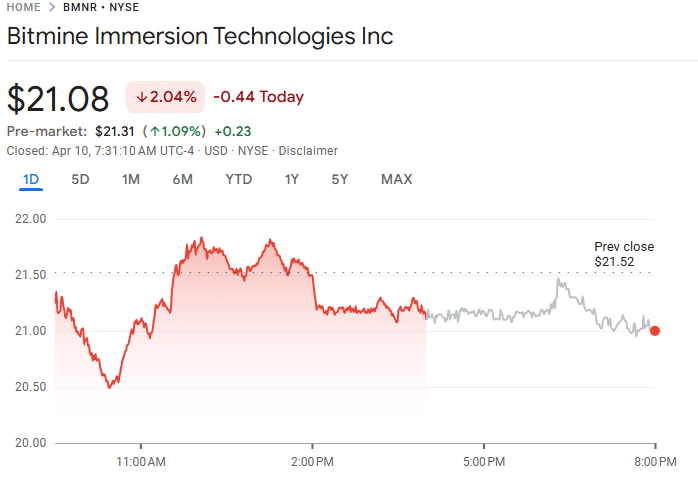
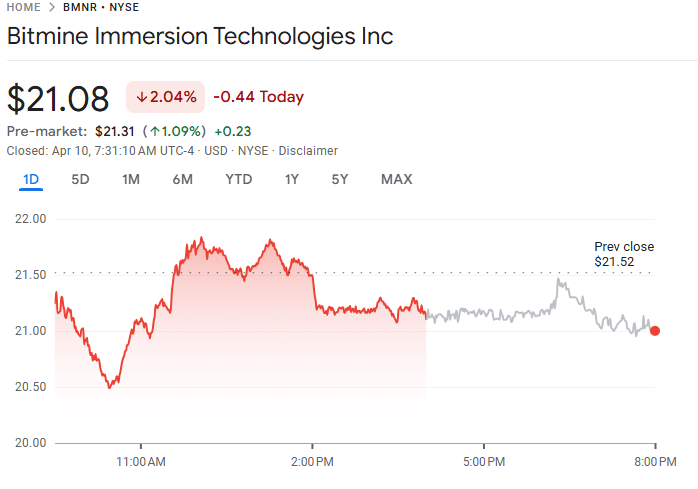
Source: Google Finance

Final Summary

  • BitMine was uplisted to the NYSE, an upgrade from the prior NYSE American, offering it an extra visibility to Wall Street investors seeking indirect exposure to ETH.
  • Treasury firm now holds 4.8 million ETH and is about 20% away from hitting its goal of holding 6 million ETH.

Пов'язані матеріали

Aave Is Surrendering the Throne of DeFi Lending Due to Its Own Stupidity

Aave, a leading DeFi lending protocol, is facing a severe crisis and losing its dominant market position due to its poor handling of a recent security incident. The crisis began when Kelp DAO suffered a hack resulting in a loss of $292 million in rsETH. In the aftermath, approximately $17.2 billion in funds flowed out of Aave as user panic escalated. The article criticizes Aave's crisis management as "extremely foolish." Instead of promptly offering reassurance or committing to cover the potential bad debt—estimated between $123.7 million and $230.1 million, which Aave could have afforded—the protocol initially deflected blame, emphasizing that its code was not at fault. This delay and lack of a clear guarantee led to widespread user anxiety, triggering a bank run-like scenario where users withdrew funds or borrowed aggressively from other pools, causing liquidity shortages. Meanwhile, Aave’s competitor Spark—a fork of Aave’s own code—has benefited significantly. Having removed support for rsETH months earlier, Spark avoided any losses from the incident and has since seen its TVL grow by nearly $2 billion, attracting major deposits such as over $1.24 billion from Justin Sun. Spark has actively capitalized on the situation, publicly criticizing Aave’s security reputation. Although Aave’s founder Stani eventually announced a relief plan named "DeFi United" with several partners and a personal donation, the damage to user trust and capital outflows may be irreversible. The article concludes that Aave is losing its throne in DeFi lending to aggressive competitors like Spark, Morpho, and Jupiter Lend.

Odaily星球日报1 год тому

Aave Is Surrendering the Throne of DeFi Lending Due to Its Own Stupidity

Odaily星球日报1 год тому

Торгівля

Спот
Ф'ючерси
活动图片