Silicon Valley Godfather Naval Takes the Helm, AngelList Packs Pre-IPO Growth Companies into USVC Fund

marsbitОпубліковано о 2026-04-24Востаннє оновлено о 2026-04-24

Анотація

This article discusses the USVC Venture Capital Access Fund (USVC), a new investment vehicle co-founded by prominent Silicon Valley investor Naval Ravikant through AngelList. The fund's core mission is to provide retail investors access to high-growth, pre-IPO companies—a segment of the market traditionally reserved for venture capitalists and accredited investors. USVC invests in a portfolio of late-stage private companies, including notable names like xAI, Anthropic, and OpenAI. Its key selling point is allowing ordinary investors to gain exposure to the significant value creation that occurs before a company goes public, as the average age of companies at IPO has increased from 6 years in 1980 to 13 years today. However, the article highlights several important constraints: investors buy fund shares, not direct stock; the fund carries a net annual fee of 2.5%; it offers limited liquidity through quarterly share repurchases; and investments are long-term with no fixed end date. The fund has also garnered attention in the Web3 community due to Naval’s and AngelList’s history of supporting crypto and blockchain projects, positioning USVC at the intersection of traditional venture capital and emerging digital asset investment trends.

Author: KarenZ, Foresight News

In Silicon Valley, the name Naval Ravikant is synonymous with credibility.

He is the co-founder of AngelList and one of the most representative early-stage investors of the past decade, having backed companies like Uber, Twitter, and Notion. Now, in the new USVC Venture Capital Access Fund (USVC), Naval is not just a symbolic figure. According to the fund's April 2026 supplemental disclosure document, he serves as the Chairman of the Investment Committee, responsible for portfolio construction and strategy oversight.

This arrangement is significant because USVC is not merely selling the concept of a "low-threshold fund." What it is truly attempting to package and offer is a capability that was previously available only to a select few: earlier access to pre-IPO growth-stage companies.

On the surface, USVC is most easily understood as a "venture capital fund for retail investors." But when viewed together—the official website, the prospectus, and the portfolio page—the core story AngelList wants to tell becomes clearer and more pointed: the most imaginative companies today are taking longer to go public; IPOs are increasingly becoming exit points rather than entry points; what ordinary investors are shut out of is not just the risk, but also the most "lucrative" period of growth.

The significance of USVC lies in its attempt to pry that door open a little.

The Core of USVC: Not a Fund, But Selling 'Pre-IPO' Access

The USVC homepage states the problem bluntly: The next wave of growth is happening in the private markets. The website also provides a telling comparison: in 1980, the median age of a U.S. company at IPO was 6 years; today, it's 13 years. Those extra 7 years mean a massive amount of value creation is occurring outside the public markets.

This is the crucial product logic behind USVC. The USVC prospectus clearly states that USVC primarily invests in VC funds, SPVs, and private, pre-IPO growth-oriented companies. The most easily overlooked, yet most critical term here is "pre-IPO growth-oriented companies." The definition in the document is equally direct: private companies that the investment adviser believes "have significant growth potential at the time of investment."

In other words, USVC's selling point is not the abstract "allocation to venture capital," but rather bringing ordinary investors face-to-face with the truly most attractive segment of assets in the private markets. It aims to sell a channel for accessing pre-IPO growth companies.

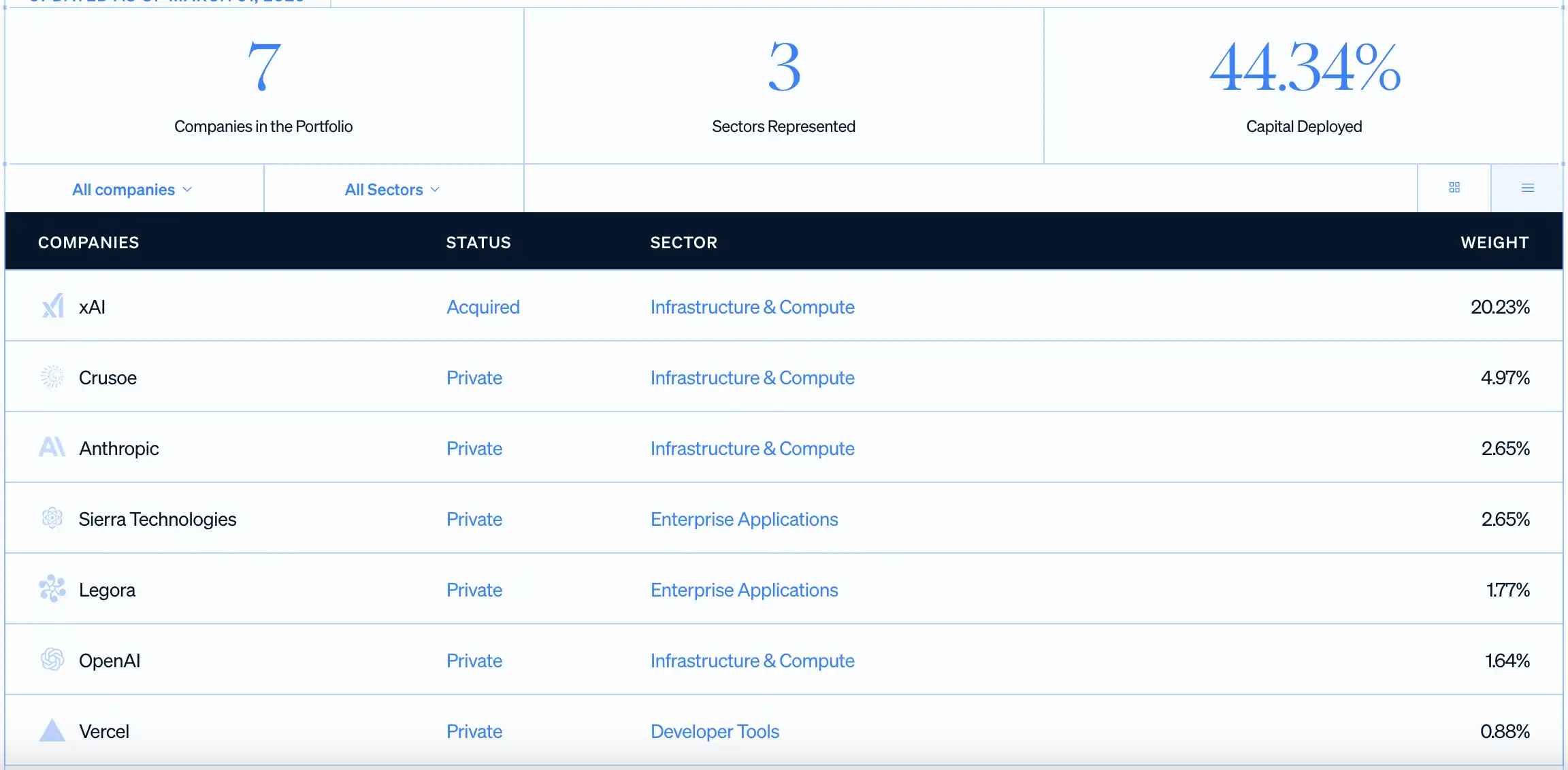
This is also why it consistently emphasizes names like OpenAI, Anthropic, xAI, and Vercel. The portfolio page on the website shows that as of March 31, 2026, USVC had deployed 44.34% of its capital, with 7 companies in its portfolio. The largest single holding is xAI, followed by Crusoe, Anthropic, Sierra, Legora, OpenAI, and Vercel. Regardless of the eventual performance of these positions, the message AngelList wants to send investors is clear enough: companies you once only read about in the news, you can now gain some exposure to *before* they go public, through a single fund.
This is highly attractive to ordinary investors. Because under the traditional path, they typically only get the chance to buy in *after* a company's IPO. And by that point, the earliest, most explosive growth has likely already been captured by the founding team, employees, early-stage funds, and institutional shareholders.

Legally, this fund is registered as a closed-end management investment company under the U.S. Investment Company Act of 1940. It was initially established on April 8, 2021, converted to a Delaware statutory trust on August 7, 2025, and is currently raising capital through a continuous offering. The initial investment threshold is $500, with no minimum for subsequent additions; the website even supports monthly dollar-cost averaging.

This packaging is clever. It retains the core attraction of the private markets—pre-IPO growth companies—while making the purchase process resemble a retail financial product as much as possible. U.S. users don't need to first become accredited investors, enter high-net-worth circles, or deal with the complex tax forms typical of traditional private funds. At the point of purchase, at least, AngelList tries to make it seem simple enough.

Access to Pre-IPO Companies Does Not Mean a Simple Investment

Precisely because USVC's narrative is so enticing, it's the constraints behind it that need to be clearly spelled out.

First, investors are buying a share of a fund. The fund holds these pre-IPO growth companies indirectly or directly through VC funds, SPVs, and direct investments. This means investors get *access* to pre-IPO growth companies, not the clear, readily realizable ownership experience of buying a stock.

Second, this access comes at a cost, and it's not low. The fee table on page 20 of the Prospectus shows that USVC has a management fee of 1.00%, a shareholder servicing fee of 0.25%, underlying fund fees and expenses of 0.95%, other expenses of 1.41%, resulting in a total annual expense ratio of 3.61%. After fee waivers (in place at least until October 29, 2026), the net annual expense ratio is 2.50%. After accounting for the underlying VC vehicle and operational costs, investors are facing a product with a current net expense ratio that is not insignificant.
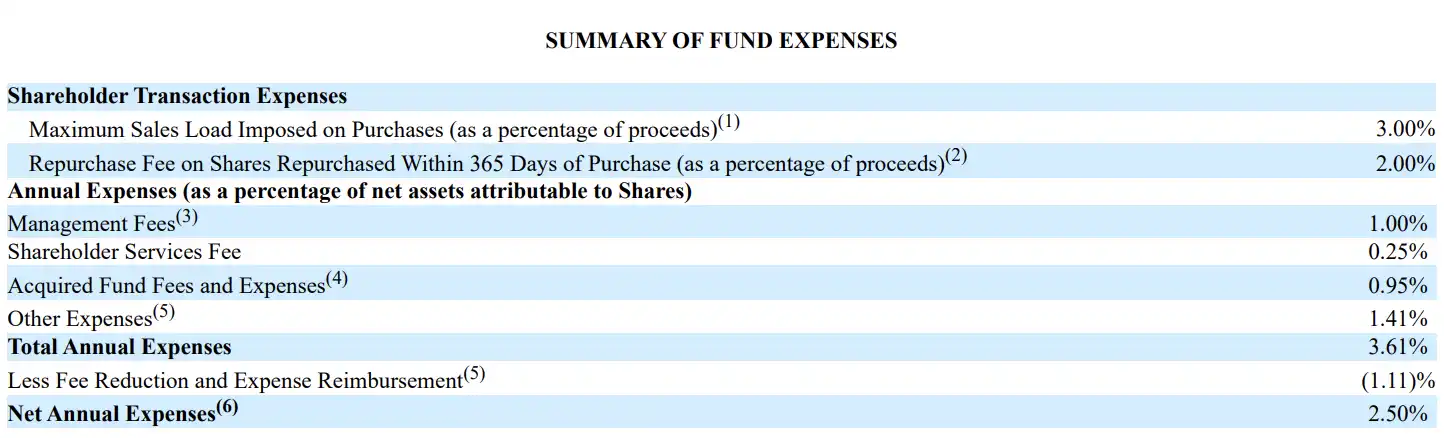
Third, this fund does not provide ordinary investors with a truly high-liquidity exit path. USVC is not listed on an exchange, has no public trading market, and liquidity primarily depends on whether the Board of Directors initiates quarterly share repurchases, which typically will not exceed 5% of net assets. The documents originally included a 2% repurchase fee for shares held less than a year, but the Board has currently decided to waive it (subject to modification or termination). This means it offers slightly more flexibility than a traditional VC fund, but is still far from "in and out anytime."

Fourth, USVC does not have a fixed termination/ liquidation date like a traditional 10+2 year venture capital fund, but it is still a long-term, closed-end structure with no defined end date. When the underlying assets realize their value still depends on liquidity events like IPOs, mergers and acquisitions, or private secondary transactions. The prospectus also clearly warns that many portfolio investments may take several years to appreciate significantly.

And even after a portfolio company goes public, it is often subject to lock-up restrictions, commonly for 180 days. During this period, the fund itself, or the managers of the underlying VC/SPV the fund invested in, may not be able to sell immediately.

Why is the Web3 Circle Paying Attention to This Fund?

The additional attention USVC is receiving from the Web3 circle is also related to Naval's and AngelList's sustained investment in the crypto industry over the years.

Naval has long been one of Silicon Valley's most publicly supportive investors of crypto assets and the Web3 narrative. In 2017, he told Laura Shin in an interview that his attention had largely shifted to Crypto; by 2021, he systematically discussed Web3, NFTs, and digital property rights with a16z partner Chris Dixon in a long conversation with Tim Ferriss.

On the platform side, AngelList has not treated Crypto as a fringe business in recent years, beginning to support investments in USDC on its platform in 2022. AngelList's website currently has a dedicated Crypto solutions page, explicitly stating its collaboration with CoinList to support Crypto SPVs and related fund vehicles.

Furthermore, on the other side, more and more cryptocurrency exchanges and Web3 projects are accelerating the launch of Pre-IPO products. USVC represents a slow-moving variable within the system, while most Web3 Pre-IPO products represent fast-moving variables driven by efficiency, often offering the ability to exit at any time.

These two worlds originally spoke different languages but are now competing for the same investors, the same narrative, and the same anxiety: If great companies are taking longer to go public, can ordinary people still get a share of the pie *before* the IPO?

Naval's name can push that door open. AngelList's platform network can bring pre-IPO companies closer. But the world behind the door hasn't necessarily become much easier because of it.


Пов'язані питання

QWhat is the primary investment focus of the USVC Venture Capital Access Fund (USVC)?

AThe USVC primarily invests in VC funds, SPVs, and private growth-oriented companies that are not yet publicly traded, aiming to provide access to high-growth potential companies before they IPO.

QWho is Naval Ravikant and what role does he play in the USVC fund?

ANaval Ravikant is the co-founder of AngelList and a prominent early-stage investor. In the USVC fund, he serves as the Chairman of the Investment Committee, responsible for portfolio construction and strategy oversight.

QWhat are some of the constraints or risks associated with investing in USVC?

AConstraints include high fees (a net annual fee rate of 2.50% after waivers), limited liquidity with no public trading market and reliance on quarterly share repurchases, no fixed expiration date, and underlying assets subject to lock-up periods post-IPO.

QWhy is the USVC fund particularly relevant to the Web3 and crypto community?

AIt is relevant because Naval Ravikant and AngelList have been strong supporters of crypto and Web3, with AngelList offering Crypto SPVs and fund vehicles. The fund also addresses the same narrative as Web3 Pre-IPO products: providing access to high-growth companies before public listing.

QHow does USVC lower the barrier to entry for average investors compared to traditional venture capital investments?

AUSVC lowers barriers by allowing an initial investment of just $500, supporting monthly investments, and not requiring investors to be accredited or high-net-worth individuals, while simplifying tax reporting compared to traditional私募 funds.

Пов'язані матеріали

The More It Rises, the More Dangerous? The Systemic Risks Behind SpaceX's Soaring Valuation

Summary: The article raises concerns about the systemic risks posed by SpaceX's skyrocketing valuation, arguing that modern market mechanics, rather than fundamentals, are driving its price discovery. Following SpaceX's market capitalization surpassing $3 trillion in after-hours trading, the author contends that the market is no longer functioning properly. The core issue is not SpaceX's business prospects but the unhealthy market structure surrounding it. With limited float and the imminent launch of options trading, the stage is set for a potential "gamma squeeze"—a feedback loop where market makers hedging call options are forced to buy shares, pushing the price higher and attracting more speculative momentum traders. This mechanism, seen previously with Tesla and meme stocks, can decouple valuation from financial reality. The danger escalates as extreme valuations force passive funds, ETFs, pensions, and major indices to hold the stock. If SpaceX grows large enough—hypothetically reaching $5 or even $10 trillion—its performance would increasingly dictate broader market indices, embedding systemic risk. The author warns that when price appreciation itself becomes the primary bullish thesis, the market transforms from a capital allocation mechanism into a self-reinforcing speculative machine, endangering the retirement savings of ordinary investors tied to passive strategies. The piece questions whether such a system can still perform its fundamental role of price discovery.

marsbit5 хв тому

The More It Rises, the More Dangerous? The Systemic Risks Behind SpaceX's Soaring Valuation

marsbit5 хв тому

How Much of the Subscription Fee You Pay to Claude Can Optical Module Companies Get?

How much of your $20 Claude Pro subscription actually goes to AI model companies like Anthropic? A viral breakdown image highlights the fundamental valuation challenge for AI applications versus traditional SaaS. Unlike SaaS with high software margins, AI subscriptions face variable "inference costs": every user query consumes GPU time, power, and cloud resources. This creates a tension between fixed subscription fees and usage-driven expenses. While the specific dollar splits are illustrative, the core question is whether AI revenue can achieve SaaS-like margins as usage scales. Currently, infrastructure providers (cloud platforms, GPU makers like Nvidia, HBM suppliers, power/data centers) capture more certain revenue from growing AI usage. Their financials reflect pricing power and faster earnings validation. The bullish case hinges on efficiency improvements: model optimization, caching, smaller models, and custom chips could lower per-token costs over time. The key debate is whether cost declines can outpace increases in user workload complexity and volume. Ultimately, for AI companies to command high SaaS-like valuations, they must demonstrate not just user growth but also improving gross margins after accounting for inference costs. Investors will scrutinize not just subscriber numbers, but usage patterns, enterprise pricing tiers, and real efficiency gains.

marsbit15 хв тому

How Much of the Subscription Fee You Pay to Claude Can Optical Module Companies Get?

marsbit15 хв тому

OpenAI's Hyperliquid Pre-IPO Pricing Venture: Why Did It Last Only Half a Year?

The article discusses the rise and fall of Pre-IPO pricing markets on the Hyperliquid blockchain. Trade.xyz, an anonymous team, successfully built the largest pre-market for SpaceX (SPCX) by launching a contract with a clear anchor: the eventual Nasdaq listing price. This provided inherent price stability and validation. In contrast, Ventuals, a team backed by Paradigm, failed despite holding exclusive contracts for highly sought-after companies like OpenAI and Anthropic. Its key mistake was its pricing mechanism. For companies with no near-term IPO date, Ventuals' oracle relied partly on opaque private market transactions and, critically, partly on its own contract's moving average price. This created a self-referential feedback loop where prices were artificially propped up and detached from genuine supply and demand, leading to illiquid markets. Ventuals shut down after nine months, settling positions at final prices of $1,341.80 for OpenAI and $1,618.90 for Anthropic. Ironically, some employees and late-stage investors of these very companies reportedly used these flawed Ventuals prices for valuation reference, highlighting the acute demand for any price signal in illiquid private markets. The article concludes that while demand for pre-IPO trading is real and growing, with players like Coinbase now entering the space, the fundamental challenge remains: without a public listing to provide a definitive price anchor, these markets struggle to establish truly accurate and liquid pricing. The need for a transparent, self-correcting market is the critical lesson from Ventuals' failure.

marsbit31 хв тому

OpenAI's Hyperliquid Pre-IPO Pricing Venture: Why Did It Last Only Half a Year?

marsbit31 хв тому

With Daily Active Users Reaching 3-4 Times That of the Industry's Second Place, Which Crack in the Office Agent Market Has Tencent's WorkBuddy Torn Open?

Tencent's AI office assistant, WorkBuddy, has achieved daily active users (DAU) 3-4 times that of the industry's second-place product, primarily driven by non-technical users like HR, operations, and administrative staff. Its rapid growth, starting with a public beta in March 2026, highlights a key strategic divergence from competitors like OpenAI's Codex and Anthropic's Claude Code. Unlike those tools, which originated as developer-focused assistants (in command lines or IDEs) and are now expanding towards office scenarios, WorkBuddy was built from the ground up for non-technical office workers. Its development was user-driven, initiated after腾讯云's team observed non-technical employees using their CodeBuddy coding tool for general tasks. WorkBuddy's design is defined by three core decisions aimed at lowering barriers: 1) Using natural language instead of technical concepts, so users describe their goal without needing to understand prompts or agents. 2) Providing pre-packaged "Skill" templates for common office tasks like data processing, content creation, and research. 3) Natively integrating into existing腾讯 ecosystems like腾讯 Docs and WeChat, making the agent a seamless part of the user's workflow rather than a separate tool. This "scenario encapsulation" approach, prioritizing the shortest path for users to get work done, contrasts with the "underlying capability" focus of Codex and Claude, which offer more flexibility but require more technical setup. Analysts confirm WorkBuddy's leading market position in China by mid-2026, with massive user and request growth following its launch. Recognizing the same trend of surging non-technical adoption, OpenAI and Anthropic are now pivoting their products with features like role-based plugins (Codex) and a simplified desktop interface (Claude Cowork). However, adapting tools built for developers requires significant changes to interaction models and integrations. WorkBuddy currently holds an estimated six-month lead in delivering a complete solution for non-technical office users. Its recently launched enterprise version aims to solidify this advantage. The competition underscores two valid paths: embedding agent capabilities directly into familiar work environments versus building powerful, general-purpose agents that users must learn to access. WorkBuddy's early success demonstrates the effectiveness of the former strategy for mainstream office adoption.

marsbit39 хв тому

With Daily Active Users Reaching 3-4 Times That of the Industry's Second Place, Which Crack in the Office Agent Market Has Tencent's WorkBuddy Torn Open?

marsbit39 хв тому

Торгівля

Спот
Ф'ючерси
活动图片




