Bitfinex Hack Mastermind Released Early From Prison, Credits 2018 Trump Law – Details

bitcoinistОпубліковано о 2026-01-03Востаннє оновлено о 2026-01-03

Анотація

Ilya Lichtenstein, the mastermind behind the 2016 Bitfinex hack that stole 119,574 Bitcoin, has been released early from prison after serving 14 months of his five-year sentence. He credited his release to the First Step Act, a 2018 criminal justice reform law signed by former President Donald Trump. The stolen Bitcoin, initially worth $71 million, is now valued at nearly $11 billion. Lichtenstein expressed remorse and pledged to contribute positively to cybersecurity. His wife, Heather Morgan, who was also convicted for laundering the stolen funds and released early under the same law, celebrated their reunion. The couple used sophisticated methods to launder a portion of the stolen cryptocurrency.

The mastermind behind the Bitfinex hack, one of the most prominent cases in crypto security history, has been released early from prison after serving 14 months, under a 2018 law signed by US President Donald Trump.

Bitfinex Hack Mastermind Receives Early Release

On Friday, Ilya Lichtenstein, the mastermind behind the 2016 hack that stole over 120,000 Bitcoin (BTC) from crypto exchange Bitfinex, announced that he had been released from prison a year after receiving a five-year sentence.

On X, Lichtenstein thanked a law signed by President Trump during his first administration for his release. “Thanks to President Trump’s First Step Act, I have been released from prison early,” the post stated.

Notably, Trump signed the bipartisan First Step Act on December 21, 2018, aiming to improve criminal justice outcomes and reduce the size of the federal prison population. The law included a series of reforms, including one to establish a “risk and needs assessment system” that offers some inmates rehabilitative programming and the opportunity to be released early into home confinement.

According to CNBC, A Trump administration official stated on January 2 that the mastermind behind the Bitfinex hack “has served significant time on his sentence and is currently on home confinement consistent with statute and Bureau of Prisons policies.”

The US Department of Justice (DOJ) previously declared that Lichtenstein used advanced hacking techniques and tools to access Bitfinex’s network. He then transferred 119,574 Bitcoin to one of his crypto wallets through more than 2,000 transactions.

At the time, the stolen funds were valued at around $71 million. However, its value has increased exponentially in the past decade, being worth nearly $11 billion at current prices. During his sentencing hearing, he expressed remorse for using his talents on criminal activities “instead of a positive contribution to society.”

“I remain committed to making a positive impact in cybersecurity as soon as I can,” Lichtenstein affirmed on his Friday announcement, thanking his supporters for the help and vowing to prove “the haters” wrong.

Crypto Heist Figures Reunite Under Trump’s Law

Lichtenstein’s wife, Heather Morgan, reacted to the news online, declaring that being reunited at home with her husband after four years was “the best New Year’s present” she could get.

Morgan, a rapper known online as “Razzlekhan,” entered prison in February 2025 but was released early from prison after eight months under the First Step Act. In late October, she posted a video on X, sharing the news and thanking President Trump for her release.

“It is very good to be back, and I want to give a shout out to Papa Trump for making my 18-month sentence shorter,” she stated. However, it appears that the US President was not directly involved in the decision.

As reported by Bitcoinist, the self-titled “Crocodile of Wall Street” was sentenced to 18 months in prison on November 18, 2024, for her role in the Bitfinex heist. Despite not being involved in the hack, Morgan assisted her husband in laundering the stolen funds by using “numerous sophisticated laundering techniques” to disguise them.

Notably, they used fake identities to create online accounts, deposited the stolen Bitcoin in several darknet markets and crypto exchanges to withdraw the funds, converted BTC to other cryptocurrencies, and deposited part of the funds into crypto mixers. The couple seemingly managed to launder 21% of the total funds stolen from Bitfinex.

At the time, prosecutors argued that Morgan was “a willing participant and bears full responsibility for her actions.” Nonetheless, they noted that she was “a lower-level participant,” which resulted in her reduced sentence.
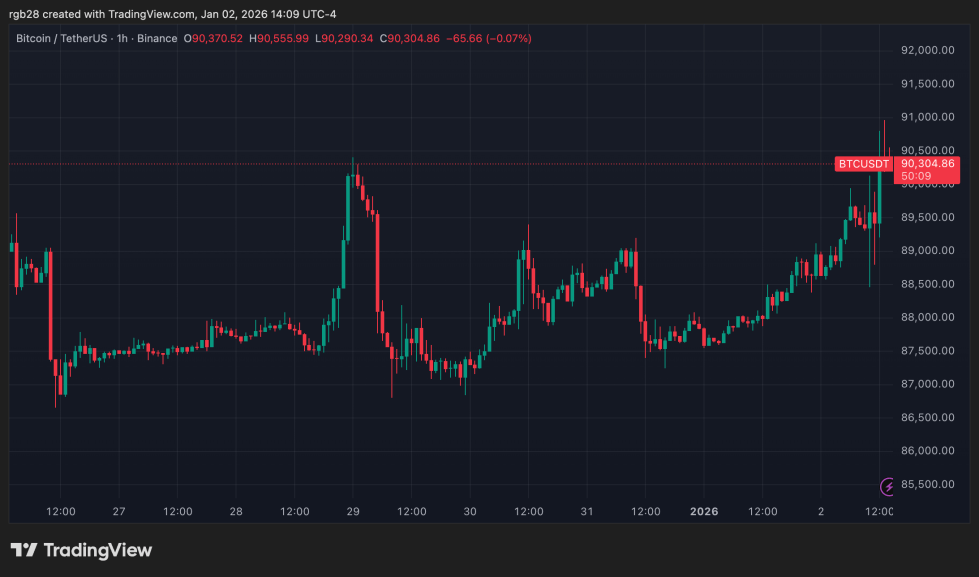
Bitcoin (BTC) trades at $90,304 in the one-week chart. Source: BTCUSDT on TradingView

Пов'язані питання

QWho was released early from prison for the Bitfinex hack and what law was credited for the release?

AIlya Lichtenstein, the mastermind behind the Bitfinex hack, was released early from prison. He credited his release to the First Step Act, a 2018 law signed by President Donald Trump.

QWhat was the value of the stolen Bitcoin at the time of the hack and what is its approximate value now?

AAt the time of the hack, the stolen 119,574 Bitcoin were valued at around $71 million. At current prices, the stolen funds are worth nearly $11 billion.

QWhat role did Heather Morgan play in the Bitfinex heist and what was her sentence?

AHeather Morgan, Ilya Lichtenstein's wife, did not participate in the hack itself but assisted in laundering the stolen funds. She was sentenced to 18 months in prison but was released early after 8 months under the First Step Act.

QWhat specific techniques did the couple use to launder the stolen Bitcoin?

AThe couple used numerous sophisticated laundering techniques, such as creating online accounts with fake identities, depositing Bitcoin into darknet markets and crypto exchanges to withdraw funds, converting BTC to other cryptocurrencies, and using crypto mixers.

QWhat was the primary goal of the First Step Act signed by President Trump?

AThe First Step Act, signed on December 21, 2018, was a bipartisan law aimed at improving criminal justice outcomes, reducing the federal prison population, and establishing a system that offers rehabilitative programming and the opportunity for early release into home confinement for some inmates.

Пов'язані матеріали

After R&D Investment Catches Up with the U.S., Is the Sino-U.S. Chip Competition Still Just About Money?

The article examines the significance of recent data showing China's total R&D expenditure, measured by purchasing power parity (PPP), catching up to or slightly surpassing that of the United States in 2024. It argues that while this milestone reflects China's immense capacity to mobilize research resources, the competition in semiconductors now extends far beyond sheer financial input. The analysis highlights key differences: China's R&D is heavily skewed towards experimental development (over 80%), focusing on product engineering and industrialization, whereas the U.S. allocates a proportionally larger share (about 15%) to basic research. Furthermore, leading U.S. semiconductor firms reinvest a significant portion of their substantial global sales revenue into R&D, creating a sustainable commercial innovation cycle that is difficult to replicate. The article emphasizes that semiconductor progress depends on converting R&D into commercially viable products that pass rigorous customer validation and achieve repeat orders, not just on spending levels. It concludes that as China enters the top tier of R&D spenders, the critical challenges shift to improving resource allocation efficiency, fostering long-term basic research, and building effective mechanisms to bridge the gap between laboratory discoveries and reliable, market-ready industrial capabilities.

marsbit22 хв тому

After R&D Investment Catches Up with the U.S., Is the Sino-U.S. Chip Competition Still Just About Money?

marsbit22 хв тому

Top 10% of American Households Capture 88% of Wealth, How Is the AI Era Cake Divided?

AI Worsens Wealth Inequality as Top 10% of US Families Garner 88% of Stock Gains (2019-2026) A report from the China Finance 40 Forum highlights that the AI boom is significantly widening wealth inequality in the United States. From 2019 to Q1 2026, wealth from directly held stocks by US households nearly doubled from $29 trillion to approximately $55 trillion, with rapid growth concentrated post-2023, coinciding with the AI-driven stock market surge. The distribution of these gains has been starkly uneven. Between 2022 and Q1 2026, the wealth increase of about $21 trillion was captured almost entirely by the wealthiest families: the top 10% secured roughly 88% ($18.5 trillion), while the bottom 50% received only about 1% ($0.2 trillion). This has contributed to a growing disparity in disposable income shares. The report, referencing economic historian Robert Allen, draws parallels to historical technological shifts like the "Engels' Pause" during the First Industrial Revolution, where worker wages stagnated despite productivity gains. It suggests AI could induce a similar period where capital收益 outpace labor income, exacerbating inequality. Huang Yiping of Peking University identifies four mechanisms through which AI impacts income distribution: capital-bias (reducing labor's income share), task polarization (hollowing out middle-skill jobs), skill-based digital divides, and wealth amplification through assets. He warns that if this trend continues, strong supply growth driven by AI could be undermined by persistently weak consumer demand, threatening sustainable economic growth. To address these challenges, the report proposes a three-pronged strategy: 1) Defensive measures like strengthening social safety nets and antitrust enforcement; 2) Empowering workers through education reform and lifelong learning to collaborate with AI; and 3) Rebalancing via policies such as potential taxes on AI超额收益 and mechanisms for broader sharing of technology's benefits, ensuring AI's红利 are more equitably distributed.

marsbit27 хв тому

Top 10% of American Households Capture 88% of Wealth, How Is the AI Era Cake Divided?

marsbit27 хв тому

Торгівля

Спот
活动图片