Probability of Fed Rate Hike Surges After Warsh Issues 'Hawkish' Warning

cryptonews.ruОпубліковано о 2026-07-30Востаннє оновлено о 2026-07-30

Анотація

The probability of a Fed rate hike has surged following hawkish comments from Chairman Kevin Warsh. At its latest meeting, the Federal Open Market Committee voted 9-3 to hold rates steady. Warsh emphasized the committee's singular commitment to 2% inflation, signaling no softening of its stance. Markets reacted by pricing in a higher chance of a September hike. The CME FedWatch Tool now sees a 61.4% probability of a 25-basis-point increase. Prediction markets from Kalshi and Polymarket show similar odds. Warsh highlighted two key developments since the last meeting: a significant rise in Treasury yields, which tightens financial conditions, and persistent business investment in AI, which complicates the inflation outlook by boosting demand for expensive infrastructure. Stock markets initially sold off sharply post-announcement but partially recovered the next day, led by tech. Bitcoin traded in a narrow range above $64,000. The next FOMC decision is on September 16, with incoming data on inflation, employment, and consumer spending set to be crucial. Warsh concluded that policy is shifting away from predictable signals toward a more data-dependent approach.

The Federal Open Market Committee voted 9-3 to keep the target range unchanged. Federal Reserve Chairman Kevin Warsh addressed the dissent during the post-meeting press conference, making clear the Committee aims to reinforce its commitment to price stability, not soften its stance.

"There is no soft inflation target, there is no soft implicit target — not at least while this Committee is at the helm," Warsh told reporters. The Fed Chair added:

"There is only one target, and it is 2 percent."

Markets Price in September Rate Hike

Rate expectations shifted almost immediately after the meeting: traders on the three largest exchanges now lean toward a hike occurring in September. This reaction follows a familiar pattern. When the Fed makes a 'hawkish' hold decision rather than a 'dovish' pause, markets often spend more time reevaluating the next meeting than reacting to the current one.

The CME Fedwatch Tool now prices a 61.4% chance of a 25 basis point hike, which would raise the target range to 3.75%–4.00% on September 16; a month ago, that probability was 50.6%. Expectations for a larger 50 basis point hike have vanished entirely, down from 25% a week prior to 0.0%, while the probability of a rate cut is zero.
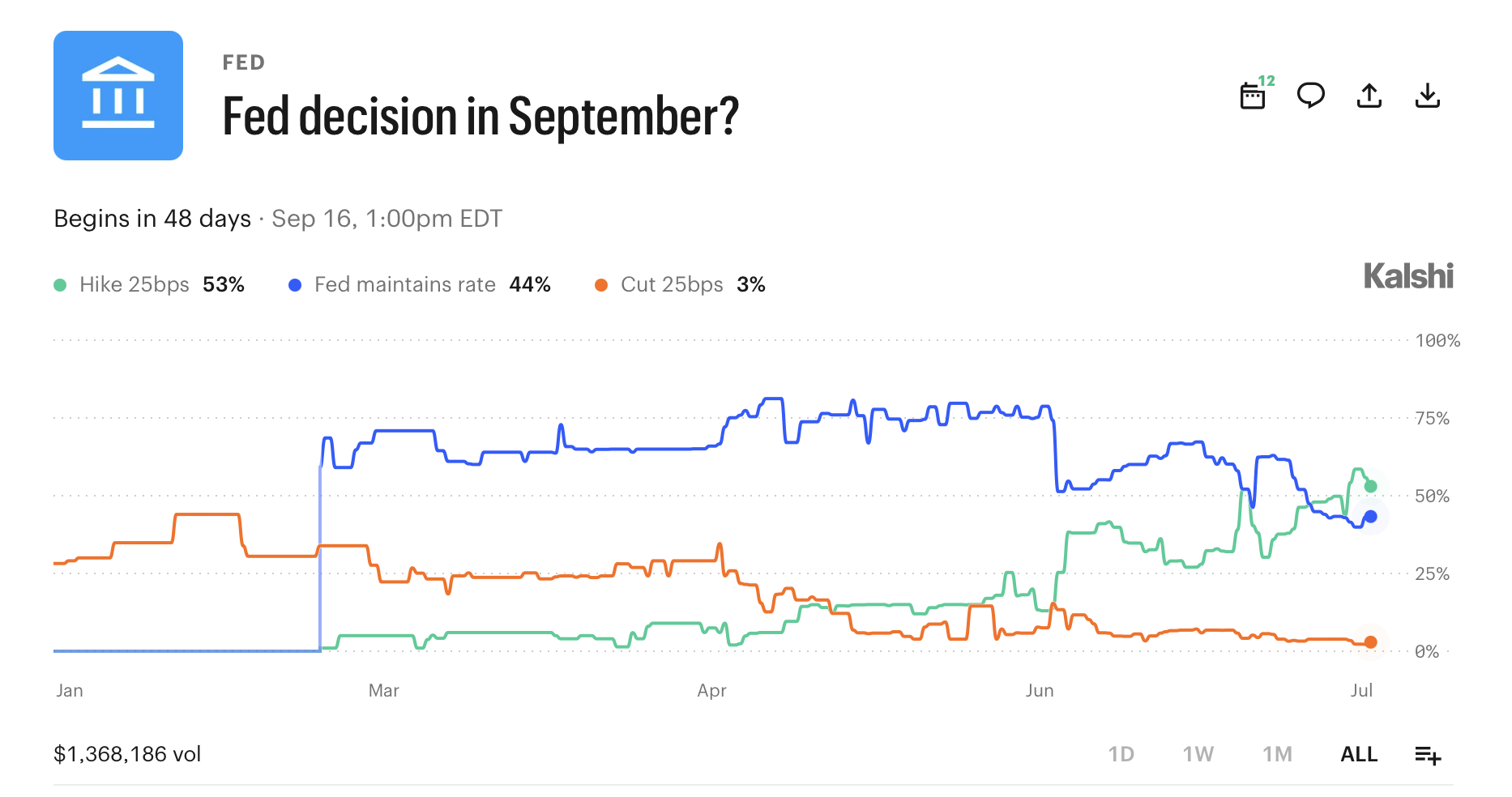
Kalshi market data on the Fed's interest rate decision for September, recorded on July 30, 2026.

Prediction markets paint a similar picture. Traders on Kalshi price a 53% chance of a 25 basis point hike versus 44% for holding rates steady, with trading volume exceeding $1.36 million. On Polymarket, where trading volume surpassed $8 million, betting participants price a 52% chance of a hike compared to 46% for maintaining the current rate.

While each platform arrives at these conclusions differently, all three are reacting to the same signals: inflation hasn't cooled enough to satisfy policymakers, and Warsh's remarks leave little doubt that the Committee remains focused on restoring credibility, not preparing markets for policy easing.

Warsh Highlights Treasury Yields, AI Spending

Warsh began by highlighting two developments that stood out particularly over the 42 days since the Committee's last meeting.

The first was the shift in Treasury yields. Sharp rises in both nominal and real yields tend to tighten financial conditions even before the Fed changes rates, making it an important signal policymakers watch closely. The U.S. central bank chief described the increase as "among the most significant in the past two decades" and partly attributed it to the Fed stepping back from detailed forward guidance, telling reporters markets were "learning to play ball, not umpire."

The second factor concerned business investment. Spending related to artificial intelligence (AI) is becoming harder to separate from broader capital expenditure trends, as large-scale infrastructure projects simultaneously impact manufacturing, semiconductors, power demand, and construction. Warsh noted that investment in AI equipment and software has risen almost 20% over the past four quarters, supporting industrial output but also complicating the inflation picture as these same expenditures boost demand for costly equipment and infrastructure.

Warsh said the Committee devoted much of its meeting to discussing four practical questions: how five years of above-target inflation should influence today's monetary policy decisions; how various economic shocks affect employment and growth; whether AI-driven capital expenditures represent temporary price pressure or a broader inflation risk; and to what extent monetary policy easing is still provided by the Fed's balance sheet, separate from interest rate policy.

Stocks Recover, Bitcoin Stabilizes

On Wednesday, markets parsed the Fed statement, then shifted direction the following day. This sequence is typical following major policy announcements, especially when investors first react to headlines before reassessing the overall tone of the press conference.

Wednesday's sell-off marked the Dow Jones Industrial Average's sharpest one-day drop in roughly 15 months, with the index falling about 2.2%. The S&P 500 declined about 1.5%, and the Nasdaq Composite dropped about 1.7%. During Wednesday's session, the U.S. stock market shed $1.2 trillion in value.

By midday Thursday, buyers returned to the market. The Dow Jones recovered about 0.6%, trading near 51,900. The S&P 500 gained roughly 1% to 1.2%, and the Nasdaq rose 1.5%–2.4% on the back of better-than-expected results from Microsoft's Azure cloud segment. Meta shares lagged amid tempered forecasts, and rising long-term Treasury yields — with 30-year bonds nearing multi-year highs — continued to cap overall optimism.

Bitcoin traded in a relatively narrow range throughout the session, holding above $64,000 with a slight upward bias. Price action remained orderly despite 24-hour trading volume exceeding $20 billion, suggesting market participants preferred to await additional macroeconomic data rather than take aggressive positions immediately following the Fed meeting. Such consolidation often follows a sharp move, especially after Bitcoin pulled back from highs near $66,000 in early July.

What Comes Next

The next Fed monetary policy decision will occur on September 16, giving officials roughly seven weeks to study additional inflation, employment, and consumer spending data before voting again. Historically, when the Committee is split, incoming economic reports carry even greater weight, as they can rapidly shift internal consensus.

Concluding, Warsh emphasized the Committee is moving away from predictable policy signals and toward decisions more driven by incoming data and internal debates regarding inflation, supply-side pressures, and AI-related investment.

For investors, the gap between the Fed's official decision and market expectations will remain the dominant theme heading into September. If inflation remains stubbornly high and long-term bond yields stay elevated, a quarter-percentage-point hike will no longer be a surprise. Instead, it will be the next step in a policy course markets have already begun to price in.

end-content

Пов'язані питання

QWhat was the outcome of the Federal Open Market Committee's vote on interest rates?

AThe Federal Open Market Committee voted 9 to 3 to keep the target range for the federal funds rate unchanged.

QAccording to market data from CME Fedwatch, what is the probability of a 25-basis-point rate hike in September?

AAccording to the CME Fedwatch Tool, the probability of a 25-basis-point rate hike in September is now 61.4%.

QWhat two events did Fed Chairman Kevin Warsh highlight as significant since the last Committee meeting?

AFed Chairman Kevin Warsh highlighted two significant events: a major shift in Treasury yields, which he called one of the most significant in two decades, and the difficulty of separating business investments related to artificial intelligence (AI) from broader capital expenditure trends.

QHow did major US stock indices perform on the day following the Fed's policy announcement?

AOn the day following the announcement, the Dow Jones Industrial Average recovered roughly 0.6%, the S&P 500 gained approximately 1% to 1.2%, and the Nasdaq Composite rose between 1.5% and 2.4%.

QWhat is the next date for a Federal Reserve monetary policy decision, and what will officials focus on before then?

AThe next Federal Reserve monetary policy decision is scheduled for September 16. Officials will use the roughly seven weeks to study additional data on inflation, employment, and consumer spending before the next vote.

Пов'язані матеріали

In Conversation with Ray Dalio: We Are Currently in an AI Bubble, with 1% of My Portfolio in Bitcoin

Ray Dalio, founder of Bridgewater Associates, warns in an interview that the current AI boom shows classic bubble characteristics, which could lead to significant economic downturns as seen in past cycles like 1929 or 2000. He explains that speculative enthusiasm, fueled by debt and overvaluation, often precedes a crash when rising rates or taxation force asset sales, causing widespread losses and recession. Dalio also outlines his "Big Cycle" theory, describing an approximate 80-year pattern where widening wealth gaps, massive government deficits, and shifting geopolitical power (like China's rise) create internal conflict and global instability. He emphasizes that we are in a late-cycle, transitional phase where traditional powers like the US and UK face decline. For personal wealth protection, Dalio advises diversification beyond cash into assets like stocks, bonds, real estate, and particularly gold, which he prefers over Bitcoin. While he holds about 1% of his portfolio in Bitcoin as a non-printable hard asset, he views gold as more secure from technological or governmental threats. Regarding AI's impact, Dalio believes it will disproportionately benefit capital owners, worsening inequality by replacing both physical and cognitive labor. He suggests that human intuition and emotional intelligence, combined with AI, will be key for future workers. On taxation, Dalio argues that wealth taxes are impractical and risk triggering asset sell-offs, reducing productive investment. He points to the UK as a cautionary example of debt, low productivity, and political strife. Geopolitically, Dalio foresees a more regionalized world, with the US showing weakness in prolonged conflicts like with Iran, akin to past imperial declines. The ideal outcome, he suggests, is coexisting powerful blocs (e.g., Americas, China-Asia Pacific) without major war.

marsbit1 год тому

In Conversation with Ray Dalio: We Are Currently in an AI Bubble, with 1% of My Portfolio in Bitcoin

marsbit1 год тому

Daily 7.2 Trillion KRW: Foreign Capital's Record Net Buying on Friday! Wall Street Says Headwinds for Korean Stock Fund Flows Have Subsided

South Korean stock market sees a dramatic shift in fund flows. On July 31, foreign investors made a record net purchase of approximately KRW 7.2 trillion in KOSPI stocks, marking a fundamental reversal from the persistent large-scale net outflows seen in previous months. This contributed to a significant narrowing of foreign net selling in July to KRW 9.8 trillion, down sharply from KRW 48.4 trillion in June and KRW 44.5 trillion in May. Simultaneously, domestic institutional pressure eased. South Korean pension funds and asset managers turned to a net buying position in July, purchasing KRW 1.0 trillion worth of KOSPI shares, contrasting with net sales in May and June. Market volatility is expected to be dampened by new financial regulations. Effective July 31, the Financial Services Commission tightened access for retail investors to single-stock leveraged ETFs by raising the minimum cash deposit requirement. Trading volumes for these products subsequently dropped to about 50% of their monthly average. Citigroup Research maintains its year-end KOSPI target of 10,000 points. The firm cites several supportive factors: the substantial easing of headwinds from capital outflows, a robust fundamental outlook for the semiconductor sector, historically low market valuations, strong economic fundamentals, and the potential for policy support from financial authorities if needed.

marsbit1 год тому

Daily 7.2 Trillion KRW: Foreign Capital's Record Net Buying on Friday! Wall Street Says Headwinds for Korean Stock Fund Flows Have Subsided

marsbit1 год тому

Thanks to Dice Rolls, Bitcoin Keys Are Stored Offline, But Not Everyone Will Do It

The article discusses using dice rolls to generate secure Bitcoin wallet seeds, providing entropy independent of potentially flawed hardware random number generators. It explains that each fair dice roll offers about 2.585 bits of entropy, with around 50 rolls needed for a standard 12-word seed phrase and 99+ recommended for higher security. This method gained attention after a vulnerability was revealed in some Coldcard hardware wallets, where a faulty firmware RNG (dating back to 2021) compromised generated keys. The analysis notes that while a dice-generated main seed was safe from this specific flaw, other Coldcard functions (like creating paper wallets, backup keys, or passwords) could still be vulnerable if they used the defective RNG. The piece argues that while dice-based entropy is technically robust, the manual process is error-prone, tedious, and unrealistic for most new users, who might make mistakes in recording or inputting rolls. It concludes that while manual entropy generation should remain an option for advanced users, the long-term goal is to develop reliable, user-friendly hardware and software that securely generates randomness without requiring specialized knowledge. Coldcard users are advised to check their firmware version and replace any secondary secrets (like paper wallet keys) created with vulnerable devices, while also considering multi-signature setups with devices from different manufacturers for added security.

cryptonews.ru6 год тому

Thanks to Dice Rolls, Bitcoin Keys Are Stored Offline, But Not Everyone Will Do It

cryptonews.ru6 год тому

Торгівля

Спот
活动图片




