Bitcoin's Weak Rebound Fails to Conceal Adjustment Trend; HYPE's Top Signals Warn of Short-Term Risks | Guest Analysis

Odaily星球日报Опубліковано о 2026-06-01Востаннє оновлено о 2026-06-01

Анотація

Bitcoin's Weak Bounce Fails to Mask Correction Trend; HYPE Top Signals Warn of Short-Term Risks | Invited Analysis Core Weekly View: Bitcoin's daily chart structure has weakened. The key question is whether its short-term rebound can effectively break above the upper boundary of the descending channel. Has HYPE's seven-wave advance reached its conclusion? This analysis systematically examines the current market structure across multiple timeframes and outlines operational strategies for the week. **Bitcoin (BTC) Analysis:** The daily chart shows BTC trading within a long-term rising channel (yellow) since February but has recently broken below its midline, indicating structural weakness. It is currently confined within a short-term descending channel (blue) originating from the May 6 high. The ongoing bounce appears to be a weak technical correction targeting the blue channel's upper rail (approx. $75,000-$76,000). The 4-hour chart reveals a complex 10-segment corrective structure from the May high, containing two downward pivot zones (Central D and E). The current rebound (segment 36-37) is expected to face resistance in the $75,000-$76,000 area. A failure to break above could lead to a resumption of the downtrend, testing support at $69,500-$70,500 and potentially $65,000. **BTC Weekly Strategy:** The price is currently below the "Bull-Bear Channel," placing it in a technically weak zone. The core focus is on the test of the $75,000-$76,000 resistance and $69,500-$70,500...

This Week's Core: Bitcoin's daily structure weakens; can the short-term rebound effectively break above the upper rail of the descending channel? Has HYPE's seven-segment rally reached its endpoint? The following analysis systematically reviews the current market structure from multiple timeframes and outlines mid- and short-term trading strategies for this week, for reference.

Summary of This Week's Core Trading Views:

• BTC multi-timeframe trend structure analysis. (Details in Part 1)

• BTC price outlook and mid-/short-term trading strategies for this week. (Details in Part 2)

• HYPE hourly timeframe trend structure analysis. (Details in Part 3)

• HYPE price outlook and short-term trading strategies for this week. (Details in Part 4)

Market Validation of Last Week's Trading Strategies and Core Views:

• BTC short-term trading performance: Bitcoin completed one short-term short trade (1x leverage) last week, successfully achieving a return of approximately 5.07%. (Details in Table 1)

• Market validation of BTC price trend prediction: Last week's article indicated that Bitcoin would continue its consolidation and downward adjustment pattern, with the short-term strategy primarily focused on 'selling on rallies'. The current market movement validates our previous prediction.

I. Bitcoin Multi-Timeframe Trend Structure Analysis

1. BTC Daily Timeframe Trend Structure Analysis

Bitcoin _ Daily K-Line Chart:
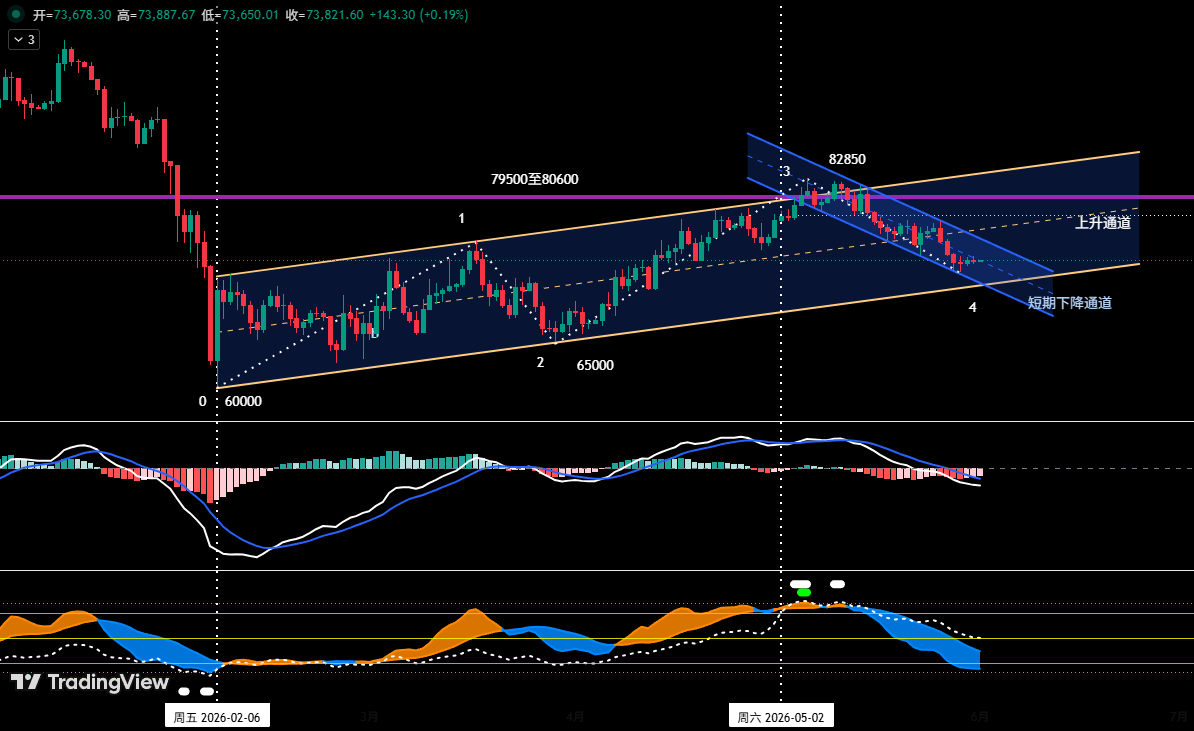
Figure 1

Ascending Channel (Yellow): As shown in (Figure 1), since the low on February 6, 2026, Bitcoin has maintained a consolidation uptrend within an ascending channel. (Lower rail: line connecting the lows of February 6 and March 29; Upper rail: a line parallel to the lower rail drawn through the high of March 17)

Short-term Descending Channel (Blue): Since touching the high of $82,850 on May 6, Bitcoin has entered and is operating within a short-term descending channel. (Upper rail: line connecting the rally highs of May 14 and May 26; Lower rail: line connecting the correction lows of May 7 and May 23)

Based on the Ascending Channel (Yellow) analysis, the price has broken below the channel's midline and is seeking stronger support towards the lower rail.

Based on the Short-term Descending Channel (Blue) analysis, the price found brief support upon reaching the channel's lower rail (approximately $72,500) and is currently in a period of weak rebound towards the channel's upper rail.

Comprehensive Judgment: From a technical structure perspective, Bitcoin is facing the dual influence of long and short-term channels. The current rebound is primarily a correction for short-term oversold conditions, targeting the upper rail of the short-term descending channel (Blue). However, as the price has broken below the midline of the ascending channel (Yellow), the overall technical structure has weakened. It is expected that after the rebound concludes, the price will most likely revert to the previous downtrend and further test the support strength of the ascending channel's lower rail.

2. In-depth Analysis of BTC Hourly Timeframe Trend Structure: (Using the 4-hour chart as the analysis timeframe)

Bitcoin _ 4-hour K-Line Chart
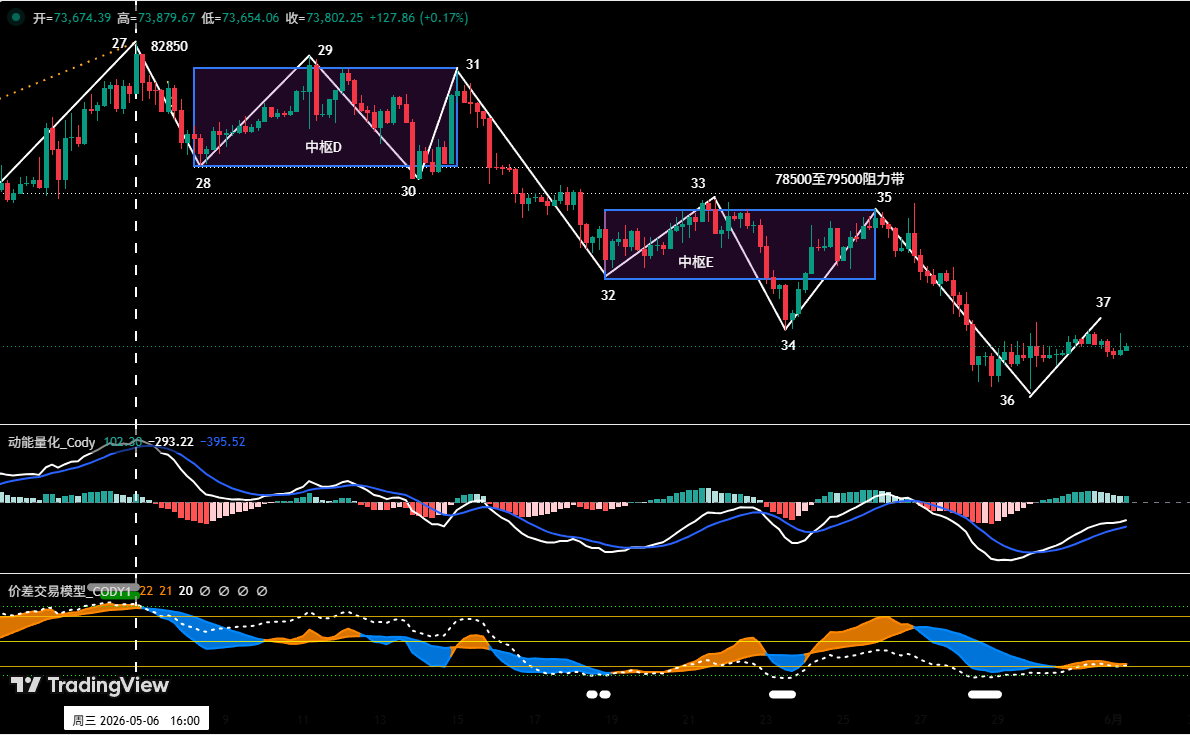
Figure 2

1. As shown in (Figure 2), from the high of $82,850 on May 6 to the ongoing adjustment, the 4-hour chart reveals a detailed subdivision into a total of 10 segments of adjustment structure: from "Segment 27-28" to "Segment 36-37". This includes two descending pivots (zhongshu):

• Pivot D: Formed by the overlapping of segments 28-29, 29-30, and 30-31.

• Pivot E: Formed by the overlapping of segments 32-33, 33-34, and 34-35.

2. From the 4-hour trend structure perspective, the market is currently undergoing the rebound of segment 36-37. If the price faces resistance and falls back after rebounding to the $75,000~$76,000 area, failing to form an effective breakout, the market is highly likely to continue its previous pattern of consolidation and decline, testing the support strength around $69,500~$70,500.

II. Bitcoin Price Outlook and Trading Strategies for This Week

1. BTC Price Trend Outlook for This Week:

This week's core view: Focus on the test results of the resistance area at $75,000~$76,000 and the support area at $69,500~$70,500 by both bulls and bears.

2. Core Resistance Levels:

• First Resistance Area: $75,000~$76,000 region (near the lower rail of Pivot E)

• Second Resistance Area: $78,500~$79,500 region (near the upper/lower rails of the two pivots)

3. Core Support Levels:

• First Support Level: $69,500~$70,500 region (previous important support level)

• Second Support Level: Around $65,000 (previous important support level)

4. Trading Strategies for This Week (Excluding Impact of Unexpected News)

1. Mid-term Strategy:

Bitcoin _ Daily K-Line Chart: (Position Monitoring Model)
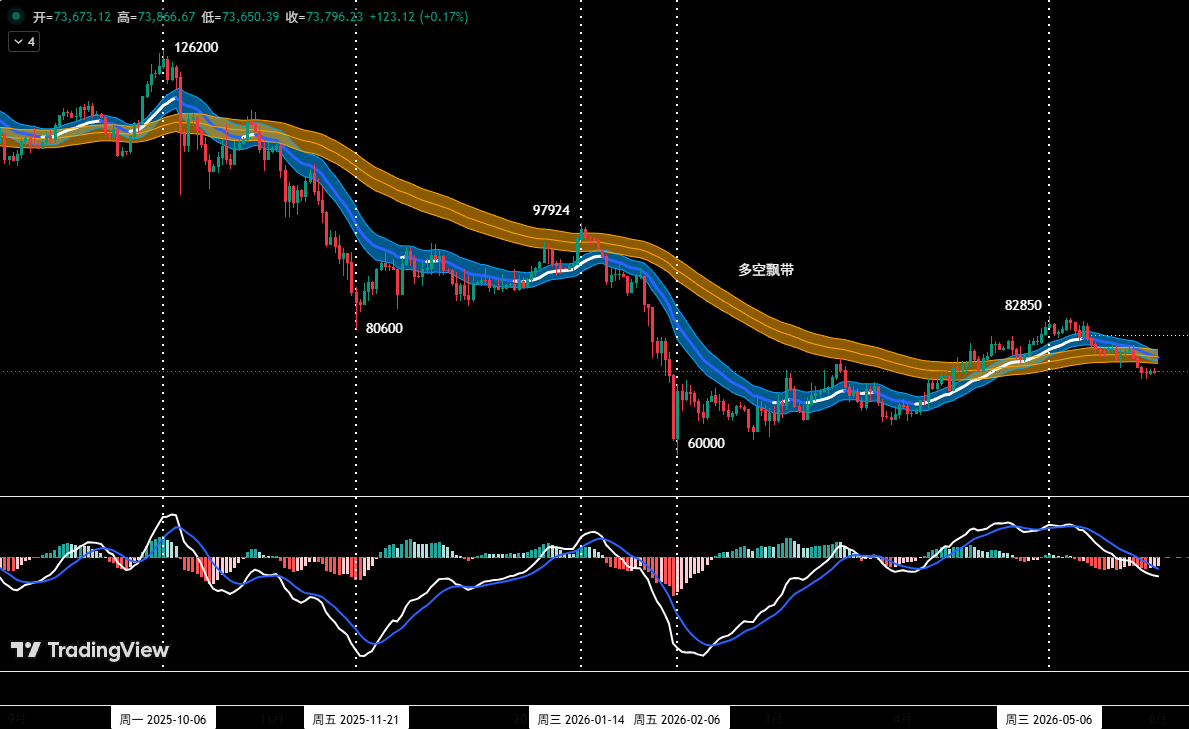
Figure 3

Position Monitoring Model: As shown in (Figure 3), the price has fallen below the "Bull-Bear Channel", entering a technically weak area. This week, focus on its retest of the Bull-Bear Channel (approximately the $75,000~$76,000 region). If the price shows signs of stalling, encountering resistance, and falling back after rebounding to this level, initiating a mid-term short position layout will begin. To control risk, the initial position can be set below 30% of the total capital; subsequently, after the price breaks below the lower rail of the ascending channel (Yellow), the mid-term position can be increased to around 60%.

2. Short-term Strategy: Utilize 30% of capital, set stop-loss points, and look for 'spread' trading opportunities based on support and resistance levels. (Use the 30-minute/60-minute chart as the operational timeframe).

3. In short-term trading, to dynamically respond to the complex evolution of the market, we have pre-formulated two specific operational plans: Plan A/B.

Plan A: Rebound Meets Resistance, Sell High.

• Entry: When the price rebounds to the $75,000~$76,000 area and encounters resistance, combined with a top signal from the quantitative model, a short position of less than 30% can be established.

• Risk Control: Initial stop-loss set above $77,000.

• Exit: Gradually close the position to take profits when the price adjusts near important support levels combined with model signals.

Plan B: Effectively Breaks Support, Follow the Trend Short.

• Entry: When the price effectively breaks below the support area of $69,500~$70,500 combined with a model top signal, a short position of less than 30% can be established.

• Risk Control: Initial stop-loss set above $72,000.

• Exit: Gradually close the position to take profits when the price falls to important support levels combined with model signals.

III. HYPE Hourly Timeframe Trend Structure Analysis:

HYPE_4-hour K-Line Chart
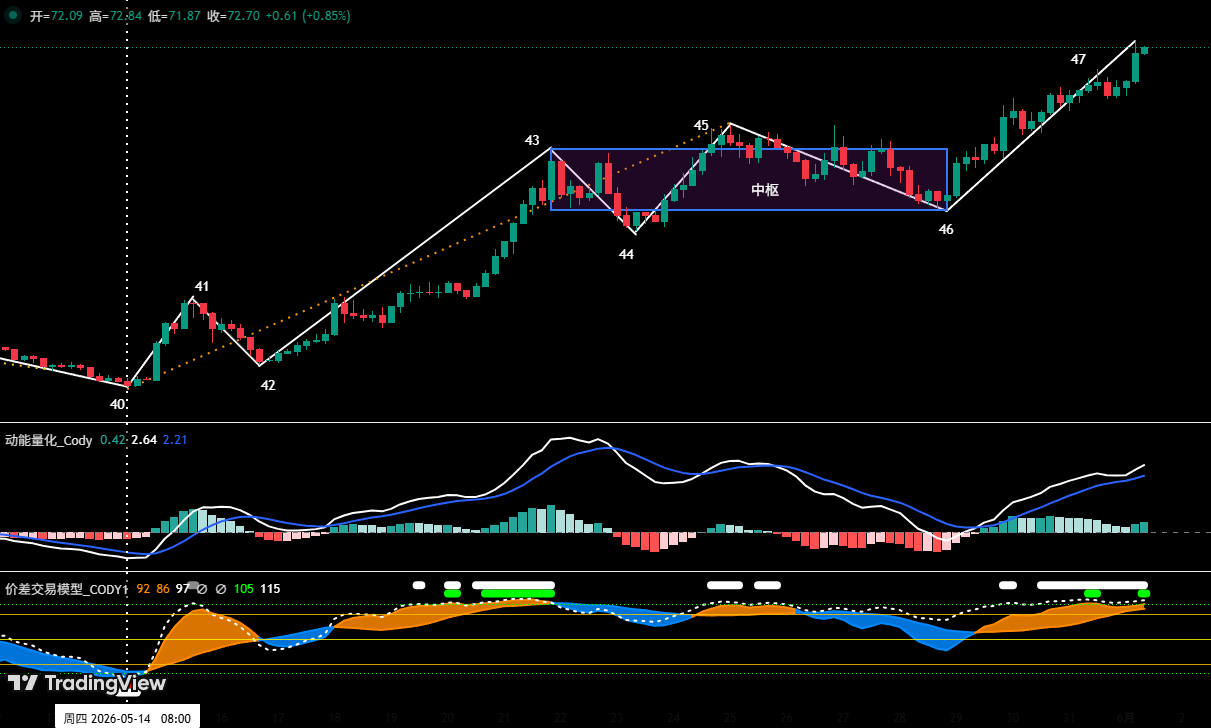
Figure 4

1. As shown in (Figure 4), on the 4-hour timeframe, since the low of $38.14 on May 14, HYPE has clearly constructed a seven-segment structure (i.e., 40-41 to 46-47) including a "rising pivot". Segments 43-44, 44-45, and 45-46 overlap with each other, forming the "rising pivot".

2. Last week's review warned: Due to the momentum top divergence state at "Endpoint 45", coupled with the top warning signal from the "Spread Trading Model", a resonance formed. Therefore, the probability of forming a short-term high here was significant. Market movement confirmed this judgment: the price adjusted from "Endpoint 45" ($64.75) to "Endpoint 46" ($56.30), with a maximum decline of 13.05%.

3. Currently, comparing the pivot exit segment (46-47) with the entry segment (42-43), its upward momentum appears weak, constituting a high probability of potential "momentum divergence".

4. Analysis based on our self-built "Spread Trading Model" shows that "Endpoint 47" has triggered a strong top warning signal (red dot + white dot).

5. In summary, if the price forms a topping signal at "Endpoint 47" while the "momentum divergence" signal remains valid, the probability of this point becoming the phase endpoint of the rally since "Endpoint 40" will significantly increase. Subsequent price action needs to focus on the test results of the key area between $62.5 and $64.57.

IV. HYPE Price Outlook and Short-term Trading Strategies for This Week

1. HYPE Price Trend Outlook for This Week:

This week's core HYPE view:

• Observe whether "momentum divergence" is established when "Endpoint 47" issues a clear topping signal.

• If this phenomenon occurs and the subsequent price effectively breaks below the support area of $62.5 to $64.57, it can be considered that "Endpoint 47" has become the endpoint of the uptrend since the low on May 14.

2. HYPE Short-term Trading Strategies for This Week: (Buy on Support)

This week's HYPE short-term trading should follow the strategy of "buying on dips, avoiding chasing rallies". The core is to observe the test results of the price retracement on the $62.5 to $64.75 area:

Strategy One: Test Long on Support Area Stabilization

If the price retraces to this area, shows signs of stopping the decline and stabilizing, and is combined with bottom signals triggered by both major models, consider a light long position test. The position must be controlled below 30%, with strict stop-loss discipline.

Strategy Two: Support Fails, Transitioning to a Larger Correction

If the price effectively breaks below this area, the short-term correction will upgrade to a larger-scale (e.g., daily timeframe) adjustment, extending its duration and space. The downward target initially looks at the $54 to $56.3 area.

V. Bitcoin Trade Review

1. Short-term Trade Review: (See Table 1)

We strictly followed the operational plan, based on trading signals issued by our self-built "Spread Trading Model" and "Momentum Quantitative Model", and completed one short-term (short) trade last week, achieving a profit of 5.07%.

1. Bitcoin Short-term Trade Details Summary: (Leverage*1x)
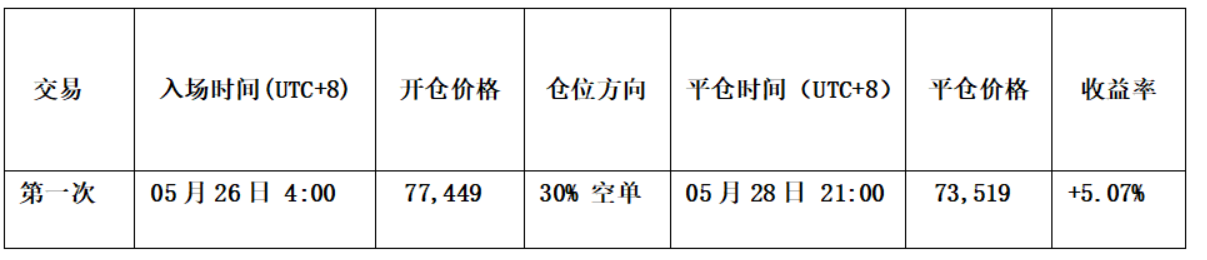
Table 1

2. Short-term Trade Review: (See Figure 5)

• Entry Strategy:

a. When the price rebounded near $78,000 and showed resistance signals, the K-line formed a 'top reversal' bearish pattern;

b. The "Spread Trading Model" triggered a top warning signal (white dot);

c. The "Momentum Quantitative Model" issued a momentum top divergence signal.

Therefore, we established a 30% short position at $77,449.

• Exit Strategy:

a. When the price fell near $73,000 and issued a stopping decline signal, the K-line formed a 'bottom reversal' pattern;

b. The "Spread Trading Model" triggered a strong bottom warning signal (red dot + white dot), forming a bottom resonance signal with the "Momentum Quantitative Model".

Therefore, we closed all positions near $73,519.

• Summary: This trade successfully achieved a profit of approximately 5.07%.

BTC_60-minute K-Line Chart: (Momentum Quantitative Model + Spread Trading Model)
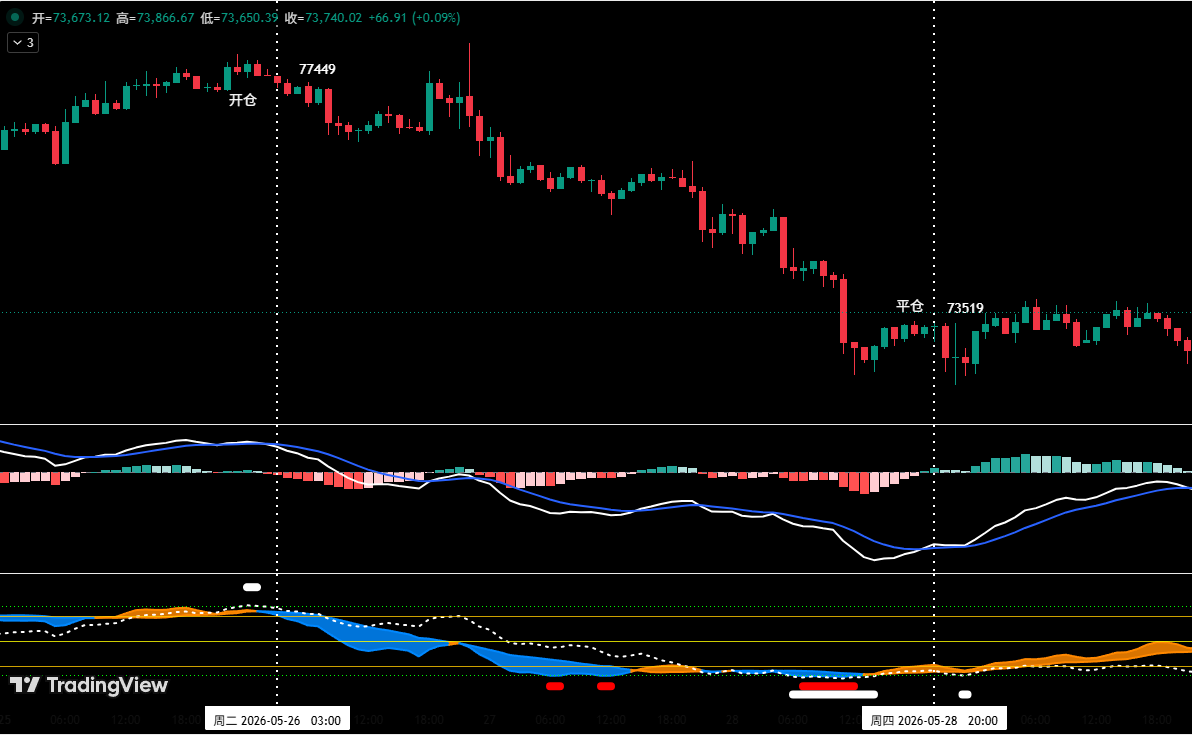
Figure 5 (Short-term Trade Illustration)

VI. Special Notes:​​

1. When opening a position: Immediately set the initial stop-loss level.

2. When profit reaches 1%: Move the stop-loss to the entry cost price (breakeven point) to ensure capital safety.

3. When profit reaches 2%​​: Move the stop-loss to the 1% profit level.

4. Continuous tracking: Thereafter, for every additional 1% profit the price makes, move the stop-loss up by 1% accordingly, dynamically protecting and locking in profits.

Financial markets change rapidly; all market analysis and trading strategies require dynamic adjustment. All views, analytical models, and operational strategies mentioned in this article are derived from personal technical analysis, intended solely for personal trading log purposes, and do not constitute any investment advice or operational basis. The market involves risks; investment requires caution. Please do not make decisions based on this.


Пов'язані питання

QBased on the analysis, what are the key resistance levels for Bitcoin (BTC) this week?

AThe key resistance levels for Bitcoin this week are the first resistance zone at 75,000~76,000 USD (near the lower rail of Central E) and the second resistance zone at 78,500~79,500 USD (near the upper and lower rails of the two central structures).

QWhat technical condition suggests HYPE may be reaching a top in its current uptrend?

AHYPE shows a potential 'momentum divergence' on the 4-hour chart, where the momentum of the central breakout segment (46-47) appears weaker than the initial entry segment (42-43). Furthermore, the proprietary 'Spread Trading Model' has triggered a strong top warning signal (red dot + white dot) at 'endpoint 47', increasing the probability of a significant short-term top.

QWhat are the two main short-term operational plans (A and B) outlined for Bitcoin trading?

APlan A: 'Sell on rallies upon encountering resistance.' Open a short position of less than 30% when the price rebounds and faces resistance in the 75,000~76,000 USD zone, with a stop-loss above 77,000 USD. Plan B: 'Sell on a breakdown of support.' Open a short position of less than 30% when the price effectively breaks below the 69,500~70,500 USD support zone, with a stop-loss above 72,000 USD.

QWhat was the profit from last week's Bitcoin short trade, and what signals triggered the entry and exit?

ALast week's Bitcoin short trade yielded a profit of approximately 5.07%. The entry was triggered at 77,449 USD due to: price resistance near 78,000 USD forming a 'top-fractal' bearish candlestick pattern, the 'Spread Trading Model' giving a top warning (white dot), and the 'Momentum Quantification Model' showing a bearish momentum divergence. The exit at 73,519 USD was triggered by a 'bottom-fractal' pattern near 73,000 USD and a strong bottom resonance signal from both the 'Spread Trading Model' (red+white dots) and the 'Momentum Quantification Model'.

QWhat is the core strategy recommended for HYPE's short-term trading this week, and what is the key support area to watch?

AThe core short-term strategy for HYPE this week is to 'buy on dips and avoid chasing rallies.' Traders should observe the price test of the key support area between 62.5 and 64.75 USD. Strategy 1 is to attempt a light long position (under 30%) if the price finds support and stabilizes in this zone with confirming bottom signals from the models. Strategy 2 warns that an effective break below this support area would likely lead to a larger-scale (e.g., daily chart) correction towards the 54-56.3 USD zone.

Пов'язані матеріали

From Return to Resignation: Chen Hang's 437 Days at DingTalk

The 437-Day Return and Departure of Chen Hang at DingTalk This article chronicles the 437-day period from March 31, 2025, to June 11, 2026, when Chen Hang (also known as "No Move") returned as CEO of DingTalk, the enterprise communication platform he originally founded, only to later step down. Chen Hang, the creator of DingTalk in 2015, was brought back by Alibaba in 2025 after the company acquired his subsequent startup, HHO. His return was driven by Alibaba's renewed focus on AI and DingTalk's strategic role as its key to-B AI application. However, his aggressive management style, marked by strict work policies like mandatory clock-ins and extended hours, quickly caused internal friction and was criticized as being at odds with Alibaba's culture. Despite the internal turmoil, Chen Hang drove significant product launches. In August 2025, he unveiled "AI DingTalk 1.0," featuring new products like the AI-native entry point "DingTalk ONE." By March 2026, he announced "Wukong," touted as the world's first enterprise-grade AI-native work platform, representing a fundamental rebuild of DingTalk's architecture. The turning point came in early June 2026. A detailed internal post criticizing DingTalk's work culture went viral, followed by a public critique from a former executive. This prompted an unprecedented public rebuke from the Alibaba Partners Committee, which stated such management was not aligned with company values. One day later, on June 11, Alibaba announced Chen Hang's departure. He was succeeded by Chen Yusen, a 32-year-old technical expert known for founding cybersecurity firm Changting Technology. While Chen Hang's tenure laid the technical foundation for DingTalk's AI transformation with "Wukong," his leadership style ultimately led to his replacement as the company seeks a new direction under younger leadership.

marsbit4 хв тому

From Return to Resignation: Chen Hang's 437 Days at DingTalk

marsbit4 хв тому

The 2026 Landscape of Decentralized AI: Why Blockchain is the Inevitable 'Antidote' for AI?

Decentralized AI 2026 Landscape: Why Blockchain is AI's Essential "Antidote" Centralized AI faces structural bottlenecks—expensive compute, concentrated control, unverifiable outputs, and difficult data access—that cannot be solved by capital or code alone. Blockchain offers a path to make intelligence open, verifiable, and economically accessible. The decentralized AI stack comprises: * **Infrastructure:** The foundation with compute, verifiable inference, distributed training, data/storage, and privacy/verification layers. Projects like Akash, Render, and Filecoin provide cheaper, decentralized alternatives for raw resources. * **Middleware:** The coordination layer for agent discovery, identity, and commerce. Key players include Bittensor (a network of specialized AI subnets), Virtuals (an agent economy OS), and frameworks providing agent identity and tooling. * **Applications & Services:** Dominated by Agentic Finance (AI agents executing on-chain actions based on natural language) and Agentic Payments (machine-to-machine transactions using blockchain as a settlement layer). Projects like Giza, Infinit Labs, and x402 are enabling these use cases. Key trends for 2026-2027 show AI demand outgrowing infrastructure, compute becoming an asset class, and tokenomics emerging as a structural advantage for coordinating capital, compute, and data. While still early—with adoption uneven and revenue often trailing token incentives—projects like Bittensor, NEAR, and Venice demonstrate decentralized AI is evolving from a narrative into a new model for coordinating intelligence.

Foresight News25 хв тому

The 2026 Landscape of Decentralized AI: Why Blockchain is the Inevitable 'Antidote' for AI?

Foresight News25 хв тому

Торгівля

Спот
Ф'ючерси

Популярні статті

Що таке $S$

Розуміння SPERO: Комплексний огляд Вступ до SPERO Оскільки ландшафт інновацій продовжує еволюціонувати, виникнення технологій web3 та криптовалютних проектів відіграє ключову роль у формуванні цифрового майбутнього. Один з проектів, який привернув увагу в цій динамічній сфері, — це SPERO, позначений як SPERO,$$s$. Ця стаття має на меті зібрати та представити детальну інформацію про SPERO, щоб допомогти ентузіастам та інвесторам зрозуміти його основи, цілі та інновації в рамках web3 та крипто-сектору. Що таке SPERO,$$s$? SPERO,$$s$ — це унікальний проект у криптопросторі, який прагне використати принципи децентралізації та технології блокчейн для створення екосистеми, що сприяє залученню, корисності та фінансовій інклюзії. Проект розроблений для полегшення взаємодії між користувачами новими способами, надаючи їм інноваційні фінансові рішення та послуги. У своїй основі SPERO,$$s$ прагне надати можливості індивідам, забезпечуючи інструменти та платформи, які покращують користувацький досвід у криптовалютному просторі. Це включає в себе можливість більш гнучких методів транзакцій, сприяння ініціативам, що підтримуються спільнотою, та створення шляхів для фінансових можливостей через децентралізовані додатки (dApps). Основна концепція SPERO,$$s$ обертається навколо інклюзивності, прагнучи зменшити розриви в традиційній фінансовій системі, використовуючи переваги технології блокчейн. Хто є творцем SPERO,$$s$? Особистість творця SPERO,$$s$ залишається дещо невідомою, оскільки є обмежені публічно доступні ресурси, що надають детальну інформацію про його засновників. Ця відсутність прозорості може бути наслідком зобов'язання проекту до децентралізації — етики, яку багато проектів web3 поділяють, ставлячи колективні внески вище за індивідуальне визнання. Зосереджуючи обговорення навколо спільноти та її колективних цілей, SPERO,$$s$ втілює суть наділення без виділення конкретних осіб. Таким чином, розуміння етики та місії SPERO є більш важливим, ніж ідентифікація єдиного творця. Хто є інвесторами SPERO,$$s$? SPERO,$$s$ підтримується різноманітними інвесторами, починаючи від венчурних капіталістів до ангельських інвесторів, які прагнуть сприяти інноваціям у крипто-секторі. Зосередження цих інвесторів зазвичай узгоджується з місією SPERO — пріоритет надається проектам, які обіцяють технологічний прогрес у суспільстві, фінансову інклюзію та децентралізоване управління. Ці інвесторські фонди зазвичай зацікавлені в проектах, які не лише пропонують інноваційні продукти, але й позитивно впливають на спільноту блокчейн та її екосистеми. Підтримка з боку цих інвесторів підкріплює SPERO,$$s$ як значного конкурента в швидко змінюваній сфері крипто-проектів. Як працює SPERO,$$s$? SPERO,$$s$ використовує багатогранну структуру, яка відрізняє його від традиційних криптовалютних проектів. Ось деякі ключові особливості, які підкреслюють його унікальність та інноваційність: Децентралізоване управління: SPERO,$$s$ інтегрує моделі децентралізованого управління, надаючи користувачам можливість активно брати участь у процесах прийняття рішень щодо майбутнього проекту. Цей підхід сприяє відчуттю власності та відповідальності серед членів спільноти. Корисність токена: SPERO,$$s$ використовує свій власний криптовалютний токен, розроблений для виконання різних функцій в екосистемі. Ці токени дозволяють здійснювати транзакції, отримувати винагороди та полегшувати послуги, що пропонуються на платформі, підвищуючи загальну залученість та корисність. Шарова архітектура: Технічна архітектура SPERO,$$s$ підтримує модульність та масштабованість, що дозволяє безперешкодно інтегрувати додаткові функції та додатки в міру розвитку проекту. Ця адаптивність є надзвичайно важливою для збереження актуальності в постійно змінюваному крипто-ландшафті. Залучення спільноти: Проект підкреслює ініціативи, що підтримуються спільнотою, використовуючи механізми, які стимулюють співпрацю та зворотний зв'язок. Підтримуючи сильну спільноту, SPERO,$$s$ може краще задовольняти потреби користувачів та адаптуватися до ринкових тенденцій. Фокус на інклюзію: Пропонуючи низькі комісії за транзакції та зручні інтерфейси, SPERO,$$s$ прагне залучити різноманітну базу користувачів, включаючи осіб, які раніше не брали участі в крипто-просторі. Це зобов'язання до інклюзії узгоджується з його загальною місією наділення через доступність. Хронологія SPERO,$$s$ Розуміння історії проекту надає важливі уявлення про його розвиток та етапи. Нижче наведено пропоновану хронологію, що відображає значні події в еволюції SPERO,$$s$: Етап концептуалізації та ідеації: Початкові ідеї, що стали основою SPERO,$$s$, були сформовані, тісно пов'язані з принципами децентралізації та фокусом на спільноті в індустрії блокчейн. Запуск білого паперу проекту: Після концептуального етапу був випущений комплексний білий папір, що детально описує бачення, цілі та технологічну інфраструктуру SPERO,$$s$, щоб залучити інтерес та зворотний зв'язок від спільноти. Створення спільноти та ранні залучення: Активні зусилля були спрямовані на створення спільноти ранніх прихильників та потенційних інвесторів, що полегшило обговорення цілей проекту та отримання підтримки. Подія генерації токенів: SPERO,$$s$ провів подію генерації токенів (TGE) для розподілу своїх рідних токенів серед ранніх прихильників та встановлення початкової ліквідності в екосистемі. Запуск початкового dApp: Перший децентралізований додаток (dApp), пов'язаний з SPERO,$$s$, став доступним, дозволяючи користувачам взаємодіяти з основними функціями платформи. Постійний розвиток та партнерства: Безперервні оновлення та вдосконалення пропозицій проекту, включаючи стратегічні партнерства з іншими учасниками блокчейн-простору, сформували SPERO,$$s$ у конкурентоспроможного та еволюціонуючого гравця на крипто-ринку. Висновок SPERO,$$s$ є свідченням потенціалу web3 та криптовалют для революціонізації фінансових систем та наділення індивідів. Завдяки зобов'язанню до децентралізованого управління, залучення спільноти та інноваційно спроектованих функцій, він прокладає шлях до більш інклюзивного фінансового ландшафту. Як і з будь-якими інвестиціями в швидко змінюваному крипто-просторі, потенційним інвесторам та користувачам рекомендується ретельно досліджувати та обдумано взаємодіяти з поточними подіями в SPERO,$$s$. Проект демонструє інноваційний дух крипто-індустрії, запрошуючи до подальшого дослідження його численних можливостей. Хоча подорож SPERO,$$s$ ще триває, його основні принципи можуть справді вплинути на майбутнє того, як ми взаємодіємо з технологією, фінансами та один з одним у взаємопов'язаних цифрових екосистемах.

73 переглядів усьогоОпубліковано 2024.12.17Оновлено 2024.12.17

Що таке $S$

Що таке AGENT S

Агент S: Майбутнє автономної взаємодії в Web3 Вступ У постійно змінюваному ландшафті Web3 та криптовалюти інновації постійно переосмислюють, як люди взаємодіють з цифровими платформами. Один з таких новаторських проектів, Агент S, обіцяє революціонізувати взаємодію людини з комп'ютером через свою відкриту агентну структуру. Прокладаючи шлях для автономних взаємодій, Агент S прагне спростити складні завдання, пропонуючи трансформаційні застосування в штучному інтелекті (ШІ). Це детальне дослідження заглиблюється в складності проекту, його унікальні особливості та наслідки для сфери криптовалюти. Що таке Агент S? Агент S є революційною відкритою агентною структурою, спеціально розробленою для вирішення трьох основних викликів в автоматизації комп'ютерних завдань: Набуття специфічних знань у галузі: Структура інтелектуально навчається з різних зовнішніх джерел знань та внутрішнього досвіду. Цей подвійний підхід дозволяє їй створити багатий репозиторій специфічних знань у галузі, покращуючи її продуктивність у виконанні завдань. Планування на довгих горизонтах завдань: Агент S використовує планування з підкріпленням досвіду, стратегічний підхід, який полегшує ефективний розподіл та виконання складних завдань. Ця функція значно підвищує її здатність ефективно та результативно управляти кількома підзавданнями. Обробка динамічних, неоднорідних інтерфейсів: Проект представляє Інтерфейс Агент-Комп'ютер (ACI), інноваційне рішення, яке покращує взаємодію між агентами та користувачами. Використовуючи багатомодальні великі мовні моделі (MLLMs), Агент S може безперешкодно орієнтуватися та маніпулювати різноманітними графічними інтерфейсами користувача. Завдяки цим новаторським функціям Агент S надає надійну структуру, яка вирішує складнощі, пов'язані з автоматизацією людської взаємодії з машинами, прокладаючи шлях для численних застосувань у ШІ та за його межами. Хто є творцем Агент S? Хоча концепція Агент S є фундаментально новаторською, конкретна інформація про його творця залишається невідомою. Творець наразі невідомий, що підкреслює або початкову стадію проекту, або стратегічний вибір зберегти засновників у таємниці. Незважаючи на анонімність, акцент залишається на можливостях та потенціалі структури. Хто є інвесторами Агент S? Оскільки Агент S є відносно новим у криптографічній екосистемі, детальна інформація про його інвесторів та фінансових спонсорів не задокументована. Відсутність публічно доступних відомостей про інвестиційні фонди або організації, що підтримують проект, викликає питання щодо його фінансової структури та дорожньої карти розвитку. Розуміння підтримки є критично важливим для оцінки стійкості проекту та потенційного впливу на ринок. Як працює Агент S? В основі Агент S лежить передова технологія, яка дозволяє йому ефективно функціонувати в різних умовах. Його операційна модель побудована навколо кількох ключових функцій: Взаємодія з комп'ютером, подібна до людської: Структура пропонує розширене планування ШІ, прагнучи зробити взаємодії з комп'ютерами більш інтуїтивними. Імітуючи людську поведінку при виконанні завдань, вона обіцяє підвищити досвід користувачів. Наративна пам'ять: Використовується для використання високорівневого досвіду, Агент S використовує наративну пам'ять для відстеження історій завдань, тим самим покращуючи свої процеси прийняття рішень. Епізодична пам'ять: Ця функція надає користувачам покрокові інструкції, дозволяючи структурі пропонувати контекстуальну підтримку в міру виконання завдань. Підтримка OpenACI: Завдяки можливості працювати локально, Агент S дозволяє користувачам зберігати контроль над своїми взаємодіями та робочими процесами, узгоджуючи з децентралізованою етикою Web3. Легка інтеграція з зовнішніми API: Його універсальність і сумісність з різними платформами ШІ забезпечують те, що Агент S може безперешкодно вписатися в існуючі технологічні екосистеми, роблячи його привабливим вибором для розробників та організацій. Ці функціональні можливості колективно сприяють унікальному положенню Агент S у крипто-просторі, оскільки він автоматизує складні, багатоступеневі завдання з мінімальним втручанням людини. У міру розвитку проекту його потенційні застосування в Web3 можуть переосмислити, як відбуваються цифрові взаємодії. Хронологія Агент S Розробка та етапи Агент S можуть бути узагальнені в хронології, яка підкреслює його значні події: 27 вересня 2024 року: Концепція Агент S була представлена в комплексній науковій статті під назвою “Відкрита агентна структура, яка використовує комп'ютери як людина”, що демонструє основи проекту. 10 жовтня 2024 року: Наукова стаття була опублікована на arXiv, пропонуючи детальне дослідження структури та її оцінки продуктивності на основі бенчмарку OSWorld. 12 жовтня 2024 року: Було випущено відеопрезентацію, що надає візуальне уявлення про можливості та особливості Агент S, ще більше залучаючи потенційних користувачів та інвесторів. Ці маркери в хронології не лише ілюструють прогрес Агент S, але й вказують на його прихильність до прозорості та залучення громади. Ключові моменти про Агент S У міру розвитку структури Агент S кілька ключових характеристик виділяються, підкреслюючи її новаторський характер та потенціал: Інноваційна структура: Розроблена для забезпечення інтуїтивного використання комп'ютерів, подібного до людської взаємодії, Агент S пропонує новий підхід до автоматизації завдань. Автономна взаємодія: Здатність автономно взаємодіяти з комп'ютерами через GUI означає стрибок до більш інтелектуальних та ефективних обчислювальних рішень. Автоматизація складних завдань: Завдяки своїй надійній методології він може автоматизувати складні, багатоступеневі завдання, роблячи процеси швидшими та менш схильними до помилок. Безперервне вдосконалення: Механізми навчання дозволяють Агенту S покращуватися на основі минулого досвіду, постійно підвищуючи свою продуктивність та ефективність. Універсальність: Його адаптивність до різних операційних середовищ, таких як OSWorld та WindowsAgentArena, забезпечує його здатність служити широкому спектру застосувань. Оскільки Агент S займає своє місце в ландшафті Web3 та криптовалюти, його потенціал покращити можливості взаємодії та автоматизувати процеси означає значний прогрес у технологіях ШІ. Завдяки своїй інноваційній структурі Агент S є прикладом майбутнього цифрових взаємодій, обіцяючи більш безперешкодний та ефективний досвід для користувачів у різних галузях. Висновок Агент S представляє собою сміливий крок вперед у поєднанні ШІ та Web3, з можливістю переосмислити, як ми взаємодіємо з технологією. Хоча проект все ще на ранніх стадіях, можливості для його застосування є величезними та переконливими. Завдяки своїй комплексній структурі, що вирішує критичні виклики, Агент S прагне вивести автономні взаємодії на передній план цифрового досвіду. У міру того, як ми заглиблюємося в сфери криптовалюти та децентралізації, проекти, подібні до Агент S, безсумнівно, відіграватимуть ключову роль у формуванні майбутнього технологій та співпраці людини з комп'ютером.

692 переглядів усьогоОпубліковано 2025.01.14Оновлено 2025.01.14

Що таке AGENT S

Як купити S

Ласкаво просимо до HTX.com! Ми зробили покупку Sonic (S) простою та зручною. Дотримуйтесь нашої покрокової інструкції, щоб розпочати свою криптовалютну подорож.Крок 1: Створіть обліковий запис на HTXВикористовуйте свою електронну пошту або номер телефону, щоб зареєструвати обліковий запис на HTX безплатно. Пройдіть безпроблемну реєстрацію й отримайте доступ до всіх функцій.ЗареєструватисьКрок 2: Перейдіть до розділу Купити крипту і виберіть спосіб оплатиКредитна/дебетова картка: використовуйте вашу картку Visa або Mastercard, щоб миттєво купити Sonic (S).Баланс: використовуйте кошти з балансу вашого рахунку HTX для безперешкодної торгівлі.Треті особи: ми додали популярні способи оплати, такі як Google Pay та Apple Pay, щоб підвищити зручність.P2P: Торгуйте безпосередньо з іншими користувачами на HTX.Позабіржова торгівля (OTC): ми пропонуємо індивідуальні послуги та конкурентні обмінні курси для трейдерів.Крок 3: Зберігайте свої Sonic (S)Після придбання Sonic (S) збережіть його у своєму обліковому записі на HTX. Крім того, ви можете відправити його в інше місце за допомогою блокчейн-переказу або використовувати його для торгівлі іншими криптовалютами.Крок 4: Торгівля Sonic (S)Легко торгуйте Sonic (S) на спотовому ринку HTX. Просто увійдіть до свого облікового запису, виберіть торгову пару, укладайте угоди та спостерігайте за ними в режимі реального часу. Ми пропонуємо зручний досвід як для початківців, так і для досвідчених трейдерів.

1.5k переглядів усьогоОпубліковано 2025.01.15Оновлено 2026.06.02

Як купити S

Обговорення

Ласкаво просимо до спільноти HTX. Тут ви можете бути в курсі останніх подій розвитку платформи та отримати доступ до професійної ринкової інформації. Нижче представлені думки користувачів щодо ціни S (S).

活动图片