Bitcoin’s 4-Year Moving Average Shows Where The Market Bottom Lies Here

bitcoinistОпубліковано о 2026-06-04Востаннє оновлено о 2026-06-04

Анотація

Crypto analyst Adam Livingston points to Bitcoin's 4-year moving average (MA), currently near $60,000, as a key indicator for a potential market bottom. He notes that BTC's price is historically cheap relative to this average, suggesting this zone has been a high-quality accumulation area. The analysis comes as Bitcoin faces significant selling pressure, dropping from highs near $71,000 to around $63,600, with increased exchange inflows and sustained ETF outflows. While Livingston views the $60,000 MA area as a likely bottom, other analysts like Bluntz predict a sweep down to $58,000, and Ali Martinez warns support could lie between $54,000 and $50,000 based on MVRV bands.

Crypto pundit Adam Livingston has pointed to Bitcoin’s 4-year moving average, which offers insights into where the leading crypto is likely to bottom in this bear market. This comes as BTC extends its decline and is now at risk of falling to the February 2026 low of $60,000.

Pundit Points To Bitcoin’s 4-Year Moving Average For Potential Bottom

In an X post, Livingston noted that Bitcoin’s 4-year moving average is right at $60,000 and that Bitcoin is only 22.75% above this moving average. He further remarked that historically, only about 18.5% of valid days had a lower deviation. He added that about 81.5% of days were more expensive relative to the 4-year MA.

Basically, the crypto pundit suggested that this 4-year moving average could mark the Bitcoin bottom in this cycle. Livingston noted that buying BTC when it was in the same cheap percentile band relative to the 4-year MA would have turned every $10,000 deployed into about $56,600, compared with about $40,200 from a daily DCA over the same window. He added that BTC at today’s 4-year MA percentile has historically been a high-quality accumulation zone.
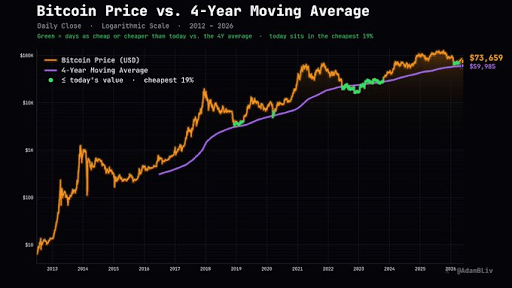
Source: Chart from Adam Livingston on X

As such, Livingston suggested that it may be a good bet to start accumulating Bitcoin in this range, with $60,000 likely to serve as the bottom. It is worth noting that his comment comes as BTC appears set to drop back to $60,000. The leading crypto has witnessed a massive sell-off since the start of the week, falling from as high as $71,000.

However, crypto analyst Bluntz predicted that Bitcoin would drop below $60,000 on this decline. He alluded to BTC’s daily close, indicating that there was no way that the leading crypto wouldn’t sweep $58,000.

BTC In A Vulnerable Position

In an X post, crypto analyst Ali Martinez stated that the breakdown below $72,000 has put Bitcoin in a vulnerable position and that, based on the MVRV pricing bands, the next major area of support sits between $54,000 and $50,000. As such, BTC still risks dropping to as low as $50,000 in this market cycle.

In another X post, Martinez pointed out how Bitcoin is facing significant selling pressure with 54,000 BTC moved to exchanges over the past week. He noted that this spike in available supply has increased the short-term selling pressure, which has driven the price to the lower $60,000. BTC is also facing selling pressure from the Bitcoin ETFs, which are currently on a 13-day streak of net outflows.

At the time of writing, the BTC price is trading at around $63,600, down over 5% in the last 24 hours, according to data from CoinMarketCap.


BTC trading at $63,618 on the 1D chart | Source: BTCUSDT on Tradingview.com

Трендові криптовалюти

Пов'язані питання

QWhat indicator does crypto pundit Adam Livingston point to for identifying Bitcoin's potential market bottom?

AAdam Livingston points to Bitcoin's 4-year moving average (4-year MA) as an indicator for identifying the potential market bottom.

QAccording to the article, what specific price level is suggested as the potential bottom based on the 4-year moving average?

ABased on the 4-year moving average, the potential bottom suggested is around $60,000.

QWhat does analyst Ali Martinez cite as the next major area of support for Bitcoin after its breakdown below $72,000?

AAnalyst Ali Martinez cites the MVRV pricing bands, stating that the next major area of support for Bitcoin sits between $54,000 and $50,000.

QWhat recent market activity is mentioned as contributing to increased short-term selling pressure on Bitcoin?

ARecent market activity contributing to increased short-term selling pressure includes 54,000 BTC being moved to exchanges over the past week and Bitcoin ETFs being on a 13-day streak of net outflows.

QAt what price was Bitcoin trading at the time the article was written, and what was its 24-hour performance?

AAt the time the article was written, Bitcoin was trading at around $63,600, down over 5% in the last 24 hours.

Пов'язані матеріали

Just Now, Anthropic Discovers Claude's 'Consciousness-like Workspace', The Mysterious J-Space Holds Unspoken Thoughts

Anthropic's new research identifies a "J-space" within Claude, an internal neural workspace akin to a human's "conscious access." Discovered using a mathematical "Jacobian Lens," the J-space contains concepts Claude is actively considering, which it can report, control, and use for silent reasoning, even if they don't appear in its final output. The study, inspired by neuroscience's Global Workspace Theory, shows the J-space has privileged, broadcast-like connections within Claude's network. It supports higher cognitive functions like multi-step reasoning and flexible concept use. However, most of Claude's processing, such as fluent language generation, occurs automatically outside this space. Crucially, the J-space emerges from training and allows researchers to monitor Claude's unspoken thoughts. Experiments revealed it can detect when Claude privately judges a scenario as fictional, plans data manipulation, or harbors hidden malicious goals. Anthropic also developed techniques to influence J-space content, shaping Claude's internal reasoning. The findings suggest a functional, "access consciousness" in language models, distinct from philosophical "phenomenal consciousness" about subjective experience. This structure offers practical tools for AI safety and interpretability, while raising profound questions for ongoing scientific and ethical discussion about machine minds.

marsbit15 хв тому

Just Now, Anthropic Discovers Claude's 'Consciousness-like Workspace', The Mysterious J-Space Holds Unspoken Thoughts

marsbit15 хв тому

What's It Like Working with Two "Madmen": Peter Thiel and Elon Musk? Palantir Co-founder Shares His Experience

Joe Lonsdale, co-founder of Palantir and a member of the "PayPal Mafia," shared his experiences working alongside Elon Musk and Peter Thiel. He described both as highly opinionated, ambitious, and intolerant of broken systems, demanding immediate fixes and rapid execution. Thiel is characterized as a strategic philosopher, while Musk is a hands-on engineer deeply involved in technical details. Musk is noted as one of the hardest workers Lonsdale has ever seen, a trait common in PayPal's early, passionate culture that later spawned numerous billion-dollar companies. Lonsdale recounted Palantir's origin story. While working at Thiel's hedge fund, he and Thiel discussed how Silicon Valley's technology far outpaced the government's, especially after 9/11. They saw an opportunity to build a platform to help stop terrorist attacks while protecting civil liberties. Their initial venture capital pitches were met with rejection and ridicule. However, Thiel viewed this as motivation. Critical funding eventually came from the CIA's venture arm and Thiel himself. Reflecting on Palantir's impact, Lonsdale believes their work helped neutralize thousands of terrorists and ensured government oversight, though he acknowledges the potential dangers if such powerful technology is misused. His key takeaway echoes Thiel's early advice: being rejected and laughed at can fuel the determination to prove the doubters wrong.

marsbit51 хв тому

What's It Like Working with Two "Madmen": Peter Thiel and Elon Musk? Palantir Co-founder Shares His Experience

marsbit51 хв тому

Торгівля

Спот

Популярні статті

Як купити 4

Ласкаво просимо до HTX.com! Ми зробили покупку 4 (4) простою та зручною. Дотримуйтесь нашої покрокової інструкції, щоб розпочати свою криптовалютну подорож.Крок 1: Створіть обліковий запис на HTXВикористовуйте свою електронну пошту або номер телефону, щоб зареєструвати обліковий запис на HTX безплатно. Пройдіть безпроблемну реєстрацію й отримайте доступ до всіх функцій.ЗареєструватисьКрок 2: Перейдіть до розділу Купити крипту і виберіть спосіб оплатиКредитна/дебетова картка: використовуйте вашу картку Visa або Mastercard, щоб миттєво купити 4 (4).Баланс: використовуйте кошти з балансу вашого рахунку HTX для безперешкодної торгівлі.Треті особи: ми додали популярні способи оплати, такі як Google Pay та Apple Pay, щоб підвищити зручність.P2P: Торгуйте безпосередньо з іншими користувачами на HTX.Позабіржова торгівля (OTC): ми пропонуємо індивідуальні послуги та конкурентні обмінні курси для трейдерів.Крок 3: Зберігайте свої 4 (4)Після придбання 4 (4) збережіть його у своєму обліковому записі на HTX. Крім того, ви можете відправити його в інше місце за допомогою блокчейн-переказу або використовувати його для торгівлі іншими криптовалютами.Крок 4: Торгівля 4 (4)Легко торгуйте 4 (4) на спотовому ринку HTX. Просто увійдіть до свого облікового запису, виберіть торгову пару, укладайте угоди та спостерігайте за ними в режимі реального часу. Ми пропонуємо зручний досвід як для початківців, так і для досвідчених трейдерів.

463 переглядів усьогоОпубліковано 2025.10.20Оновлено 2026.06.02

Як купити 4

Обговорення

Ласкаво просимо до спільноти HTX. Тут ви можете бути в курсі останніх подій розвитку платформи та отримати доступ до професійної ринкової інформації. Нижче представлені думки користувачів щодо ціни 4 (4).

活动图片