Bitcoin Weak and Volatile, Is a Big Fluctuation Coming?

深潮Опубліковано о 2025-12-11Востаннє оновлено о 2025-12-11

Анотація

Bitcoin remains trapped in a structurally fragile range, with rising unrealized losses, elevated realized losses, and significant profit-taking by long-term holders. Despite persistent selling pressure, patient demand has anchored the price above the Realized Price (~$81.3K). A reclaim of the $95K level (0.75 cost basis quantile) and the Short-Term Holder cost basis (~$102.7K) is possible if seller exhaustion emerges. Off-chain conditions remain weak, with negative ETF flows, thin spot liquidity, and muted speculative interest in futures markets. Options markets show a defensive stance, with traders accumulating short-term implied volatility and demanding downside protection ahead of the FOMC meeting. Market stability relies on patient buyers absorbing sales, but the path forward depends on whether liquidity improves and sellers retreat, or if time-driven bearish pressure persists. Post-FOMC, implied volatility is expected to decay into year-end barring a hawkish surprise.

Written by: Chris Beamish, CryptoVizArt, Antoine Colpaert, Glassnode

Compiled by: AididiaoJP, Foresight News

Bitcoin remains trapped in a fragile range, with increasing unrealized losses, long-term holders selling, and persistently weak demand. ETFs and liquidity remain sluggish, futures markets are weak, and options traders are pricing in short-term volatility. The market is currently stable, but confidence is still lacking.

Summary

Bitcoin remains in a structurally fragile range, pressured by increasing unrealized losses, high realized losses, and significant profit-taking by long-term holders. Despite this, demand is anchoring the price above the true market mean.

The market has failed to reclaim key thresholds, particularly the short-term holder cost basis, reflecting continued selling pressure from recent high buyers and experienced holders. If signs of seller exhaustion emerge, a retest of these levels is possible in the short term.

Off-chain indicators remain weak. ETF flows are negative, spot liquidity is thin, futures open interest shows a lack of speculative confidence, making prices more sensitive to macro catalysts.

The options market shows a defensive setup, with traders buying short-term implied volatility (IV) and consistently showing demand for downside protection. Volatility surface signals indicate short-term caution, but longer-term sentiment is more balanced.

With the FOMC meeting as the last major catalyst of the year, implied volatility is expected to gradually decay in late December. Market direction depends on whether liquidity improves and sellers step back, or whether the current time-driven bearish pressure persists.

On-Chain Insights

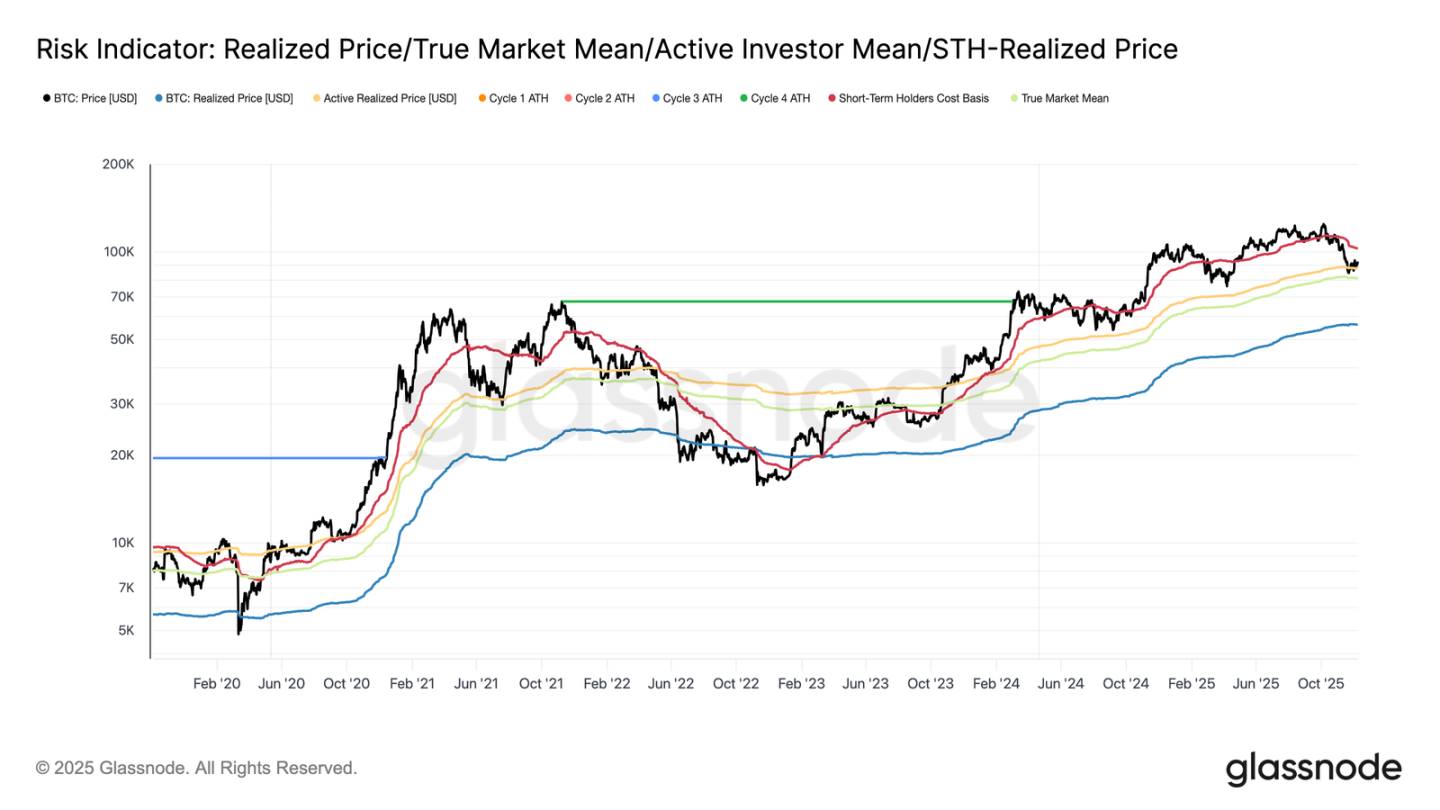
Bitcoin entered the week still confined to a structurally fragile range, bounded above by the short-term holder cost basis ($102.7k) and below by the true market mean ($81.3k). Last week, we highlighted weakening on-chain conditions, thin demand, and a cautious derivatives landscape, collectively echoing the market setup of early 2022.

Although the price barely holds above the true market mean, unrealized losses continue to expand, realized losses are rising, and spending by long-term investors remains elevated. The key ceiling to reclaim is the 0.75 cost basis quantile ($95k), followed by the short-term holder cost basis. Until then, barring a new macro shock, the true market mean remains the most likely area for bottom formation.
Time is Not on the Bulls' Side

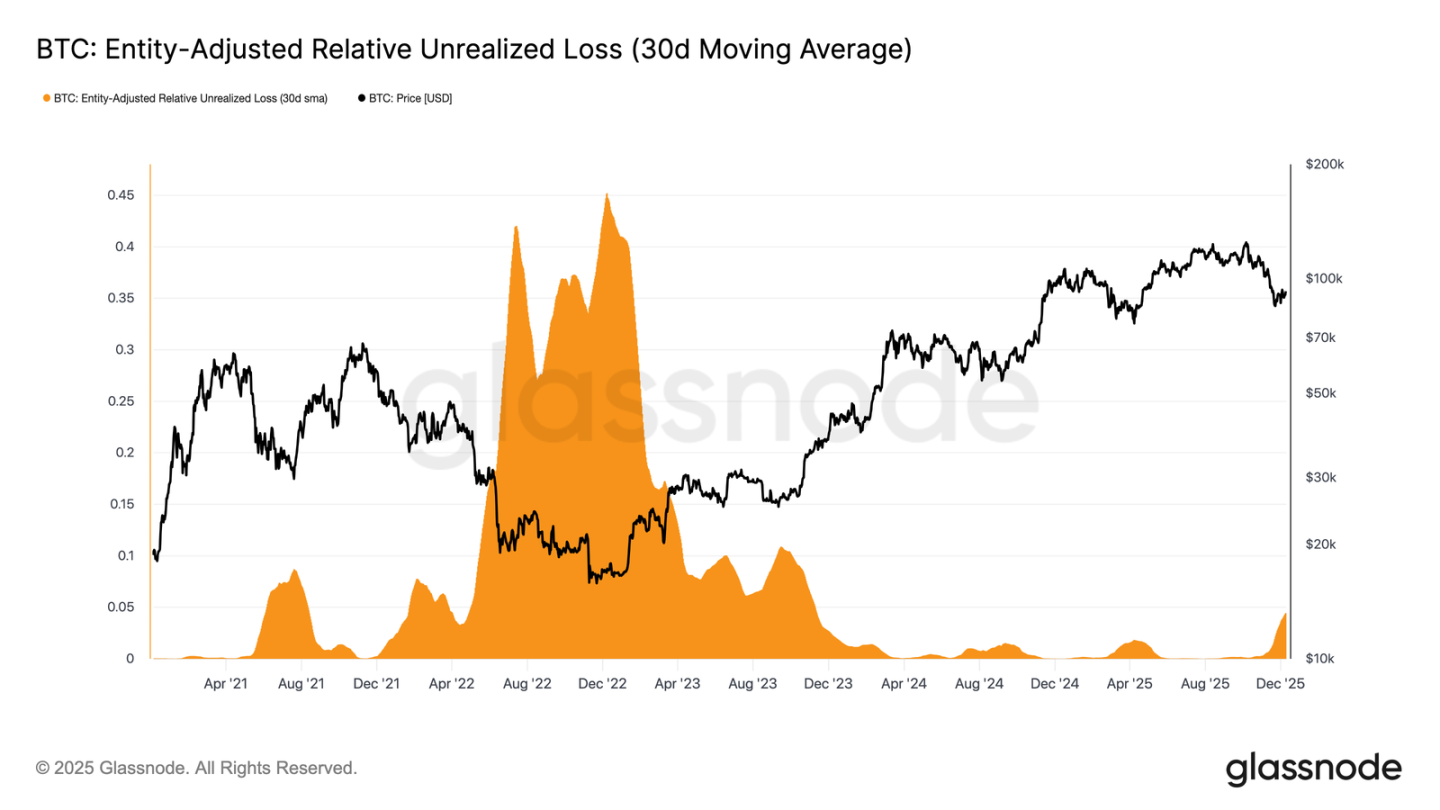
The market is stuck in a mild bearish phase, reflecting the tension between modest capital inflows and persistent selling pressure from high buyers. As the market drifts in a weak but bounded range, time becomes a negative force, making it harder for investors to bear unrealized losses and increasing the likelihood of realizing losses.

The Relative Unrealized Loss (30-day SMA) has climbed to 4.4%, after staying below 2% for nearly two years, marking a shift from a phase of euphoria to one of increased stress and uncertainty. This indecision currently defines this price range, and resolving it will require a new wave of liquidity and demand to rebuild confidence.
Losses Mounting

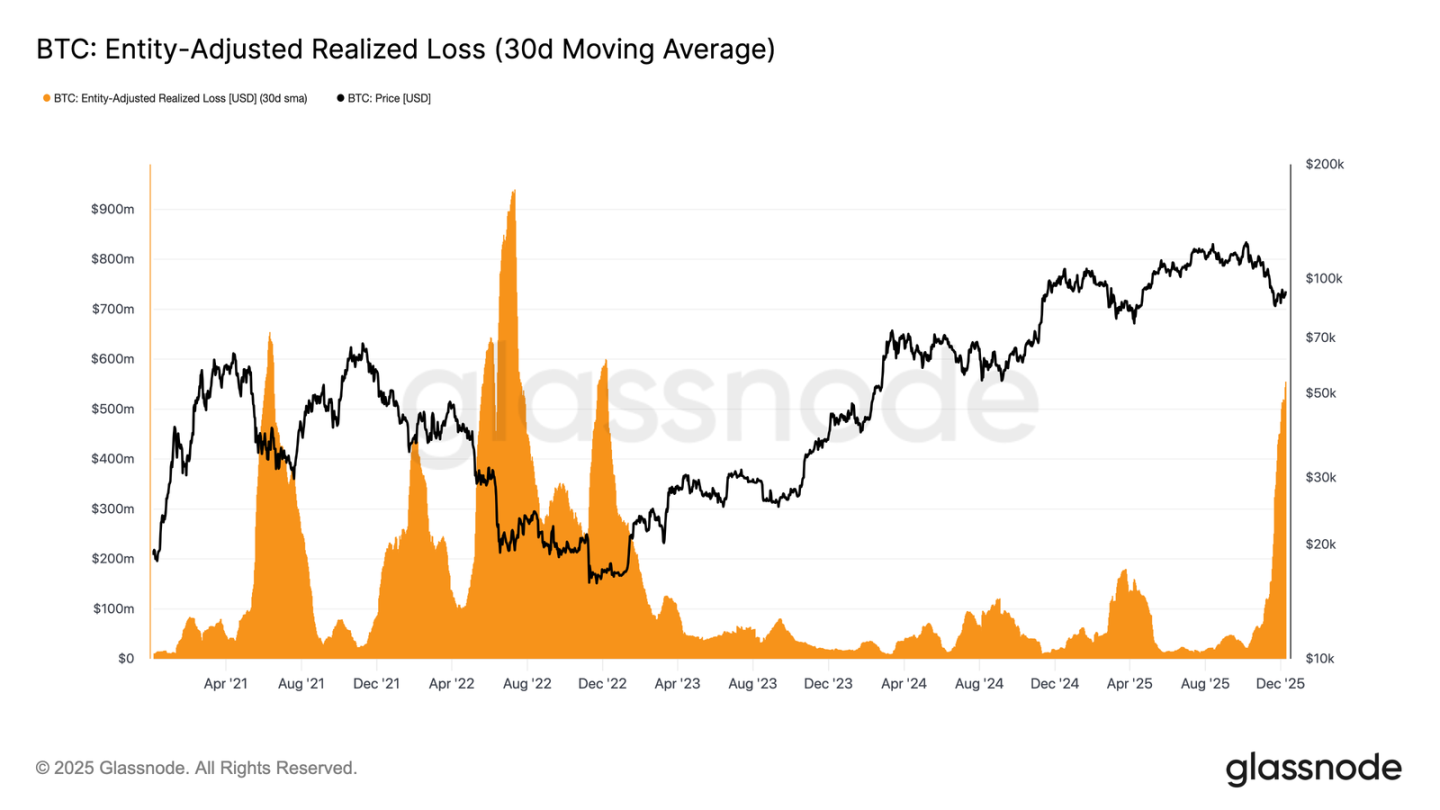
This time-driven pressure is even more evident in spending behavior. Although Bitcoin has rebounded from the November 22nd low to around $92.7k, the Entity-Adjusted Realized Loss (30-day SMA) has continued to climb, reaching $555 million per day, the highest level since the FTX collapse.

Such high realized losses during a modest price recovery reflect the growing frustration of high buyers, who are choosing to capitulate as the market strengthens rather than holding through the rebound.
Hindering a Reversal

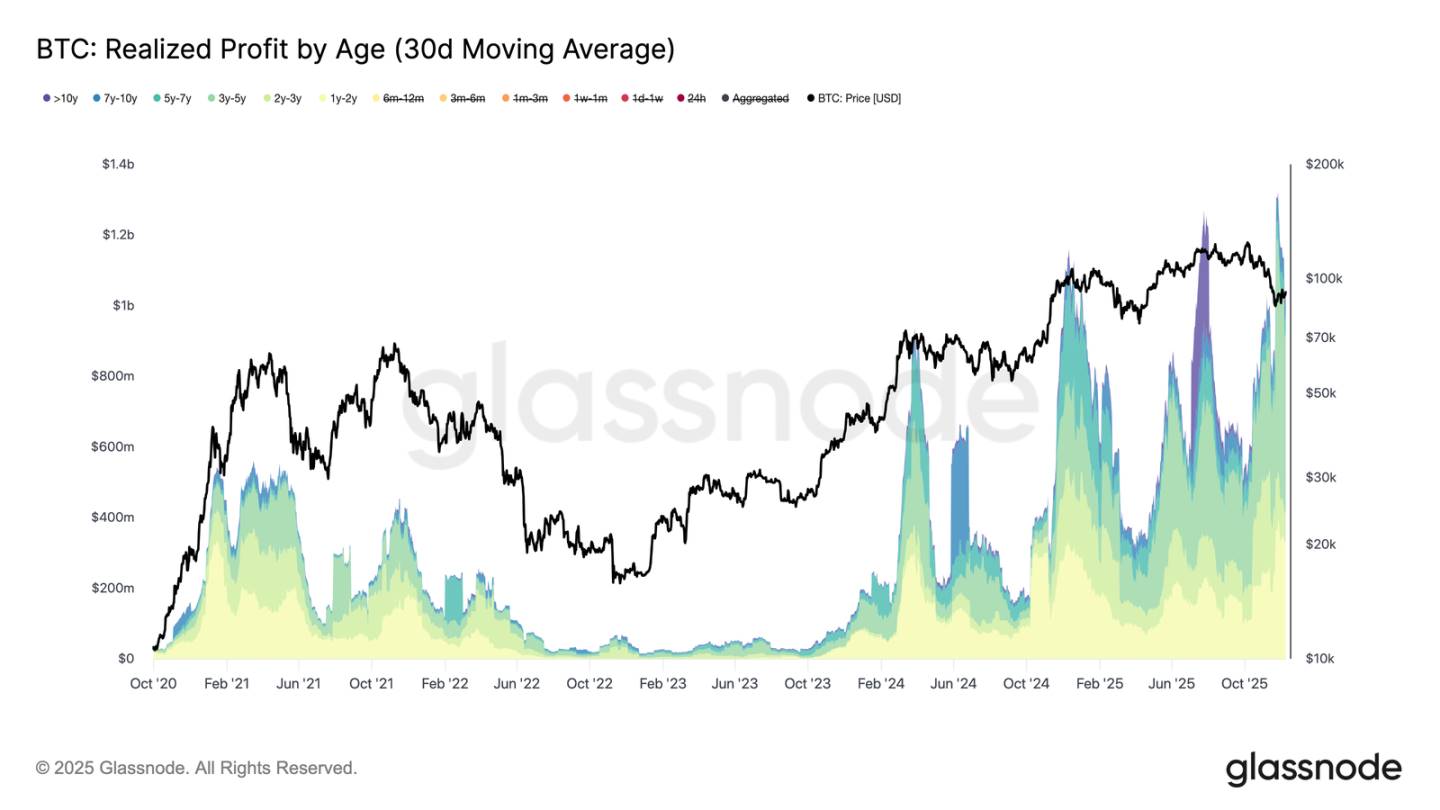
Rising realized losses further hinder recovery, especially when they coincide with a surge in realized profits from veteran investors. During the recent rebound, realized profits for holders over 1 year (30-day SMA) exceeded $1 billion per day, peaking at over $1.3 billion near the new all-time high. The combination of high buyer capitulation and substantial profit-taking by long-term holders explains why the market is still struggling to reclaim the short-term holder cost basis.

However, despite such significant selling pressure, the price has stabilized and even slightly recovered above the true market mean, suggesting that sustained and patient demand is absorbing the sell-off. In the short term, if sellers begin to show signs of exhaustion, this underlying buying pressure could drive a retest of the 0.75 quantile (~$95k) and even the short-term holder cost basis.
Off-Chain Insights

ETF Woes

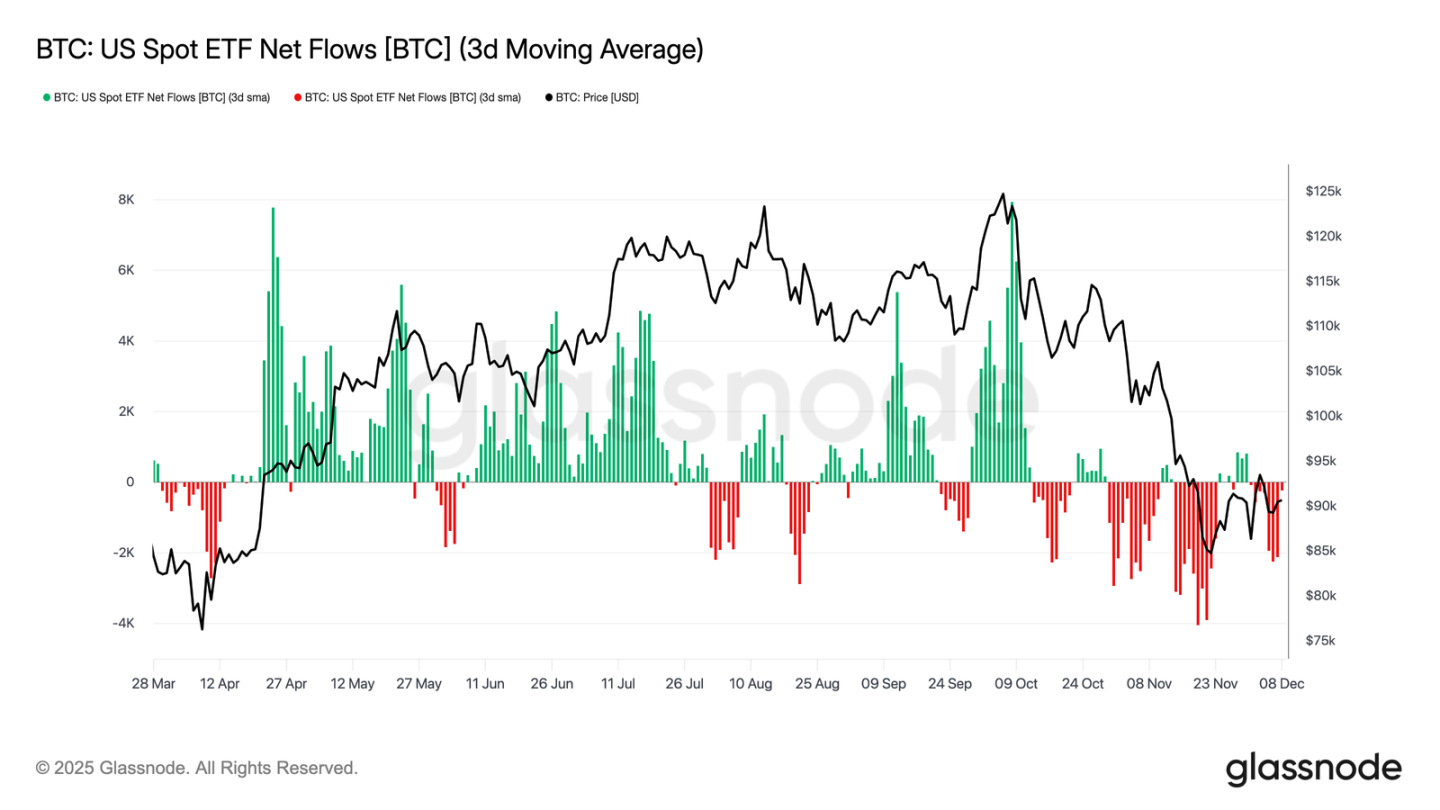
Turning to the spot market, U.S. Bitcoin ETFs had another quiet week, with the three-day average net inflows remaining negative. This continues the cooling trend that began in late November, marking a clear departure from the strong inflow regime that supported price appreciation earlier this year. Redemptions from several major issuers remained steady, highlighting a more risk-off stance from institutional allocators amid a shaky broader market environment.

As a result, the demand buffer in the spot market has thinned, reducing immediate buyer support and leaving prices more vulnerable to macro catalysts and volatility shocks.
Liquidity Remains Subdued

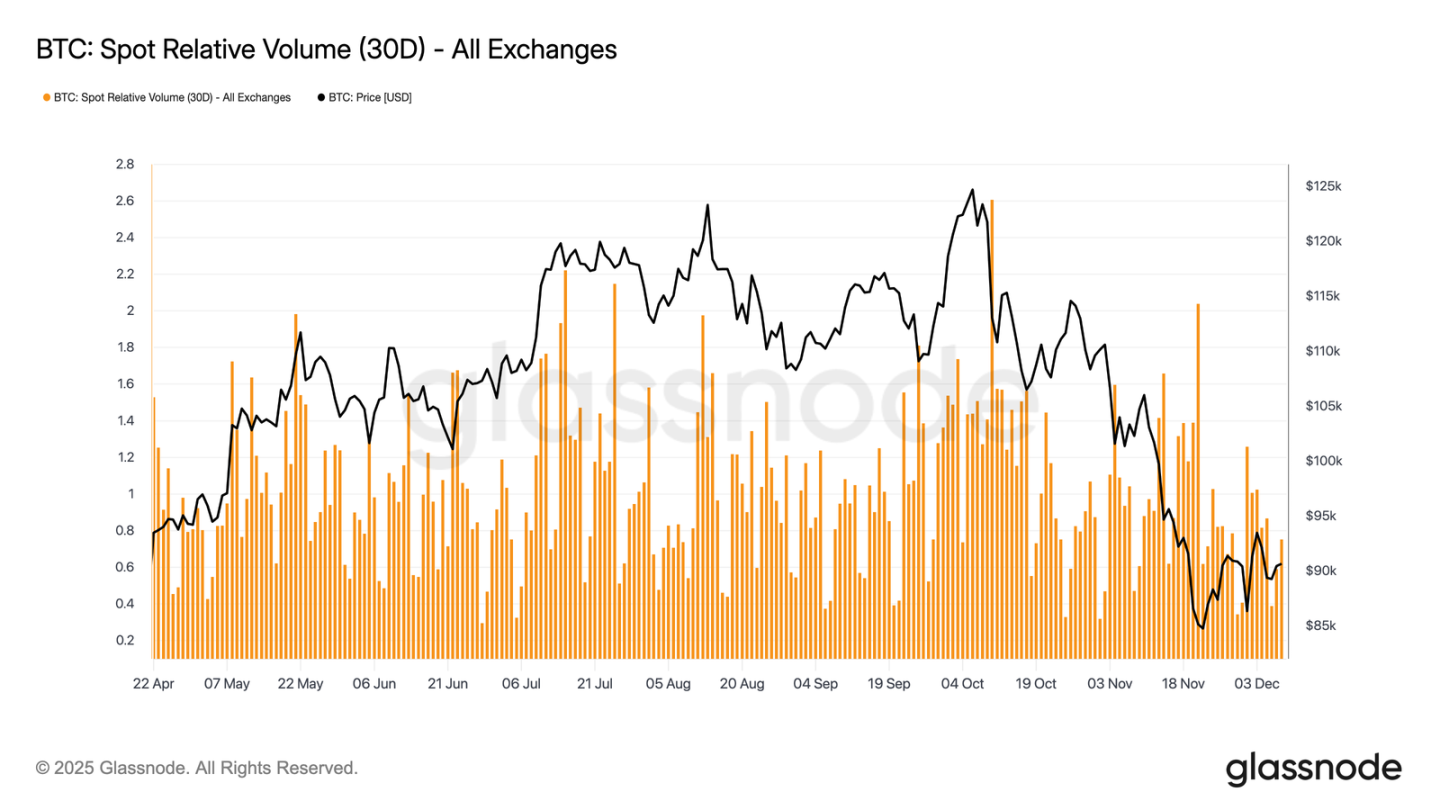
Parallel to weak ETF flows, Bitcoin's spot relative volume continues to hover near the lower end of its 30-day range. Trading activity has weakened persistently from November into December, reflecting both price declines and reduced market participation. The contraction in volume reflects a more defensive positioning overall, with fewer liquidity-driven flows available to absorb volatility or sustain directional moves.

With spot markets quieting down, attention now turns to the upcoming FOMC meeting, which could serve as a catalyst to reactivate market participation depending on its policy tone.
Futures Market Muted

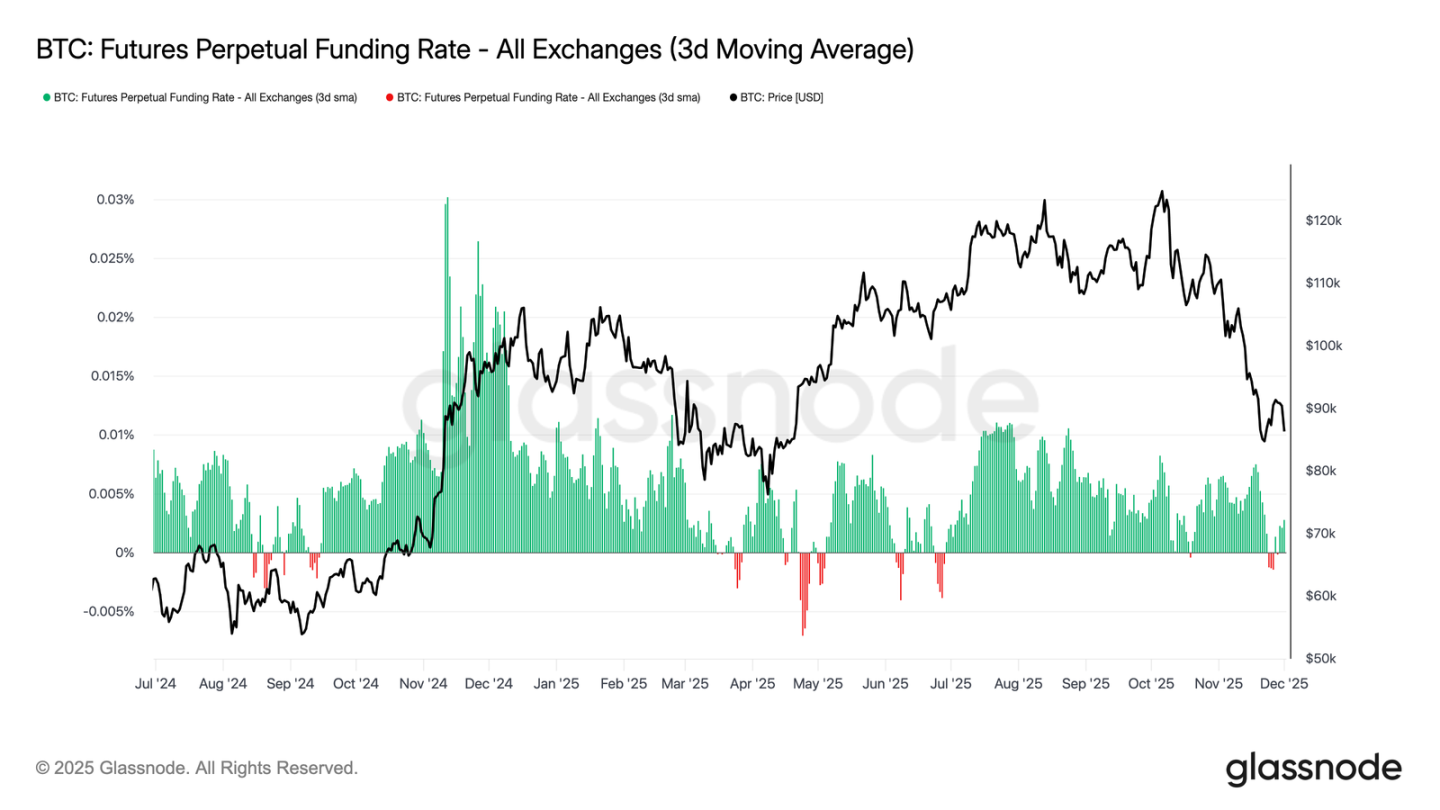
Continuing the theme of subdued market participation, the futures market also shows limited interest in leverage, with open interest failing to rebuild substantially and funding rates holding near neutral. These dynamics highlight a derivatives environment defined by caution rather than confidence.

In the perpetual swap markets, funding rates hovered around zero to slightly negative this week, highlighting the continued exodus of speculative long positions. Traders maintain balanced or defensive postures, applying little directional pressure via leverage.

With derivative activity muted, price discovery leans more on spot flows and macro catalysts rather than speculative expansion.
Short-Term Implied Volatility Spikes

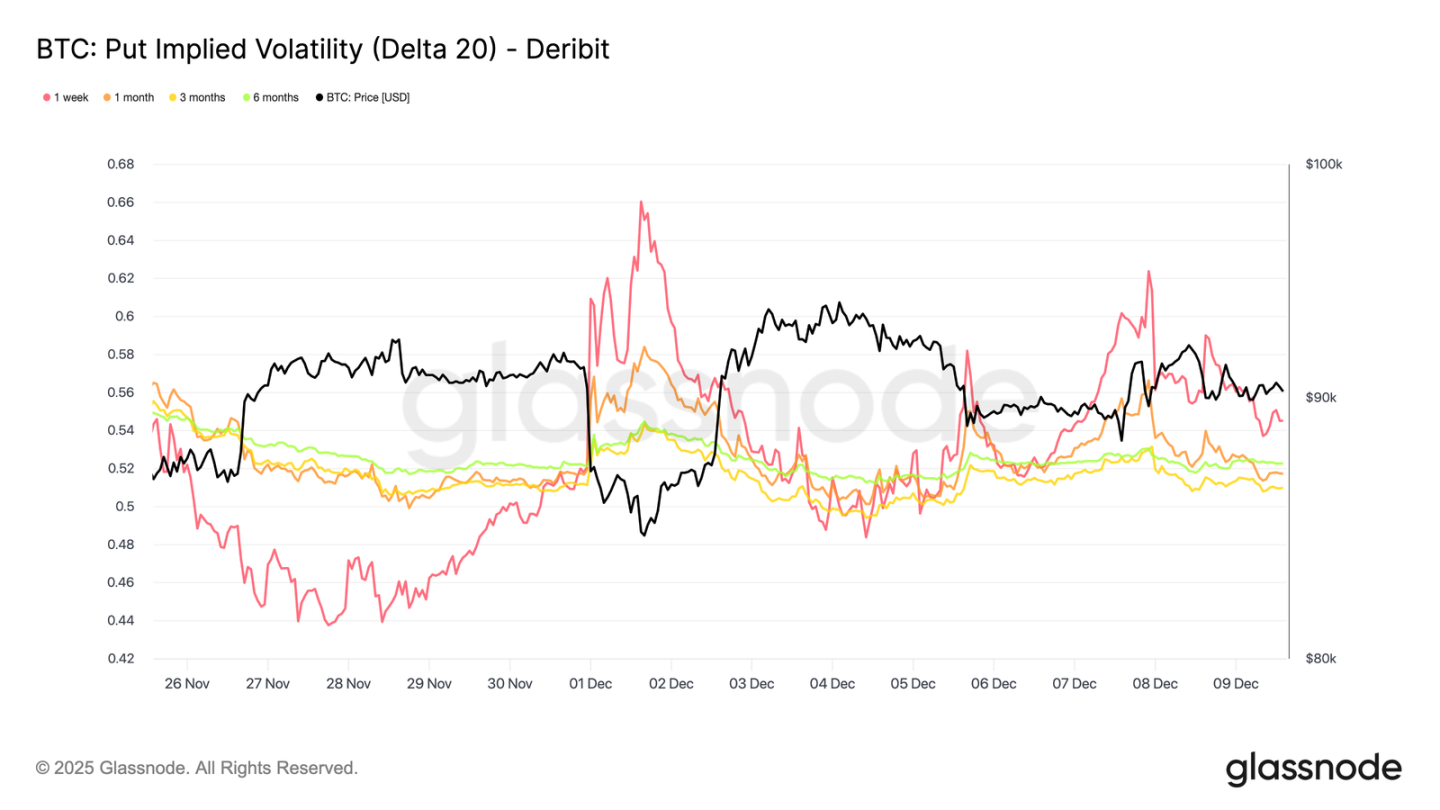
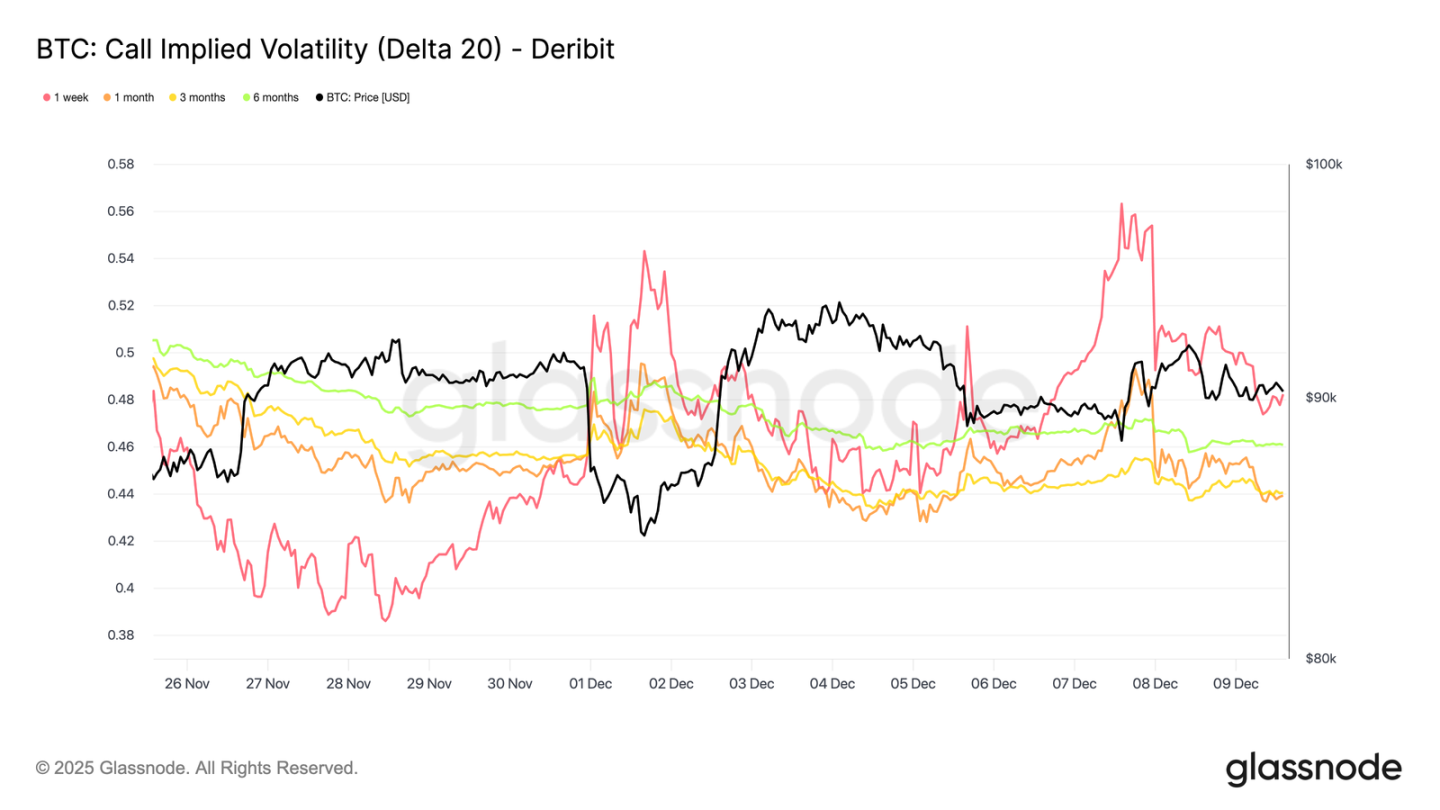
Turning to the options market, Bitcoin's flat spot activity contrasts with a sudden rise in short-term implied volatility, as traders position for larger price moves. Interpolated Implied Volatility (which estimates IV using fixed delta values rather than relying on listed strikes) provides a clearer view of how risk is priced across maturities.

On 20-Delta calls, 1-week IV rose by about 10 volatility points compared to last week, while longer tenors remained relatively flat. The same pattern appears on 20-Delta puts, with short-term downside IV rising while longer tenors stay calm.

Overall, traders are accumulating volatility where they expect stress, favoring convexity over selling into the December 10th FOMC meeting.
Downside Demand Returns

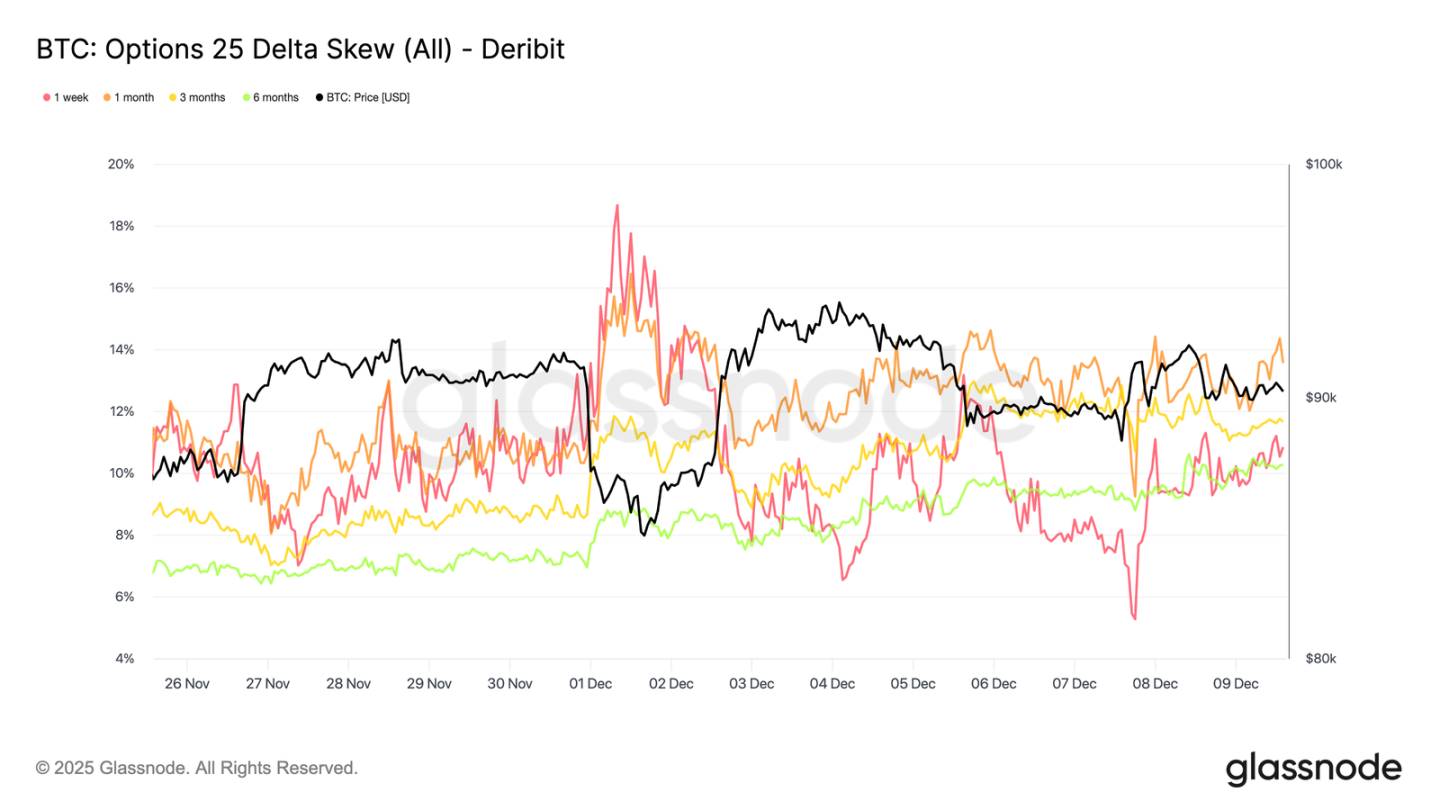
Accompanying the rise in short-term volatility, downside protection is again commanding a premium. The 25-delta skew, which measures the relative cost of puts versus calls at the same delta value, has climbed to around 11% for the 1-week tenor, indicating a clear increase in demand for short-term downside insurance ahead of the FOMC.

Skew remains tightly clustered across tenors, ranging from 10.3% to 13.6%. This compression suggests that the preference for put protection is curve-wide, reflecting a consistent risk-off tilt rather than isolated pressure at the short end.
Volatility Accumulation

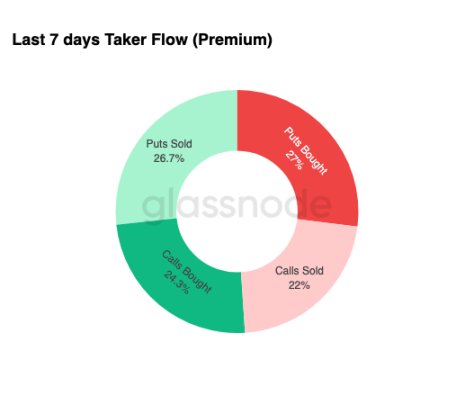
Summarizing the options market conditions, weekly flow data reinforces a clear pattern: traders are buying volatility, not selling it. Paid option premiums dominate the total notional flow, with puts slightly leading. This does not reflect a directional bias, but a state of volatility accumulation. When traders buy both sides, it signals hedging and convexity-seeking behavior, not sentiment-based speculation.

Coupled with rising implied volatility and a downside-leaning skew, the flow picture suggests market participants are preparing for a volatility event with a downward bias.
Post-FOMC

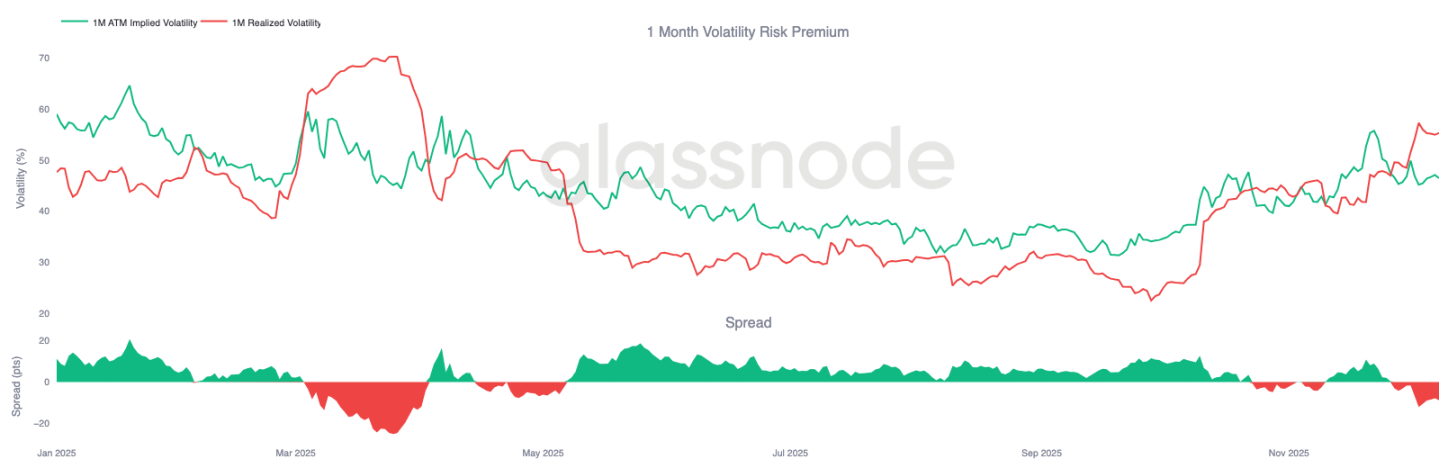
Looking ahead, implied volatility has already begun to ease, and historically, IV tends to compress further once the last major macro event of the year passes. With the December 10th FOMC meeting as the last meaningful catalyst, the market is preparing to transition into a low-liquidity, mean-reverting environment.

Post-announcement, sellers typically re-enter the market, accelerating IV decay into year-end. Barring a hawkish surprise or a significant shift in guidance, the path of least resistance points to lower implied volatility and a flatter volatility surface persisting into late December.
Conclusion

Bitcoin continues to trade in a structurally fragile environment, with rising unrealized losses, high realized losses, and substantial profit-taking by long-term holders collectively anchoring price action. Despite persistent selling pressure, demand remains resilient enough to hold price above the true market mean, suggesting patient buyers are still absorbing the sell-off. If signs of seller exhaustion begin to emerge, a near-term push toward $95k and the short-term holder cost basis remains possible.

Off-chain conditions echo this cautious tone. ETF flows remain negative, spot liquidity is subdued, and futures markets lack speculative participation. The options market reinforces the defensive posture, with traders accumulating volatility, buying short-term downside protection, and positioning for a near-term volatility event ahead of the FOMC.

Taken together, the market structure suggests a weak but stable range, underpinned by patient demand but constrained by persistent selling pressure. The near-term path depends on whether liquidity improves and sellers step back, while the longer-term outlook hinges on the market's ability to reclaim key cost basis thresholds and move beyond this time-driven, psychologically taxing phase.


Трендові криптовалюти

Пов'язані питання

QWhat are the key factors contributing to Bitcoin's current structurally fragile trading range according to the article?

ABitcoin is trapped in a fragile range due to increasing unrealized losses, elevated realized losses, and significant profit-taking by long-term holders, while demand remains weak and fails to reclaim key thresholds like the short-term holder cost basis.

QHow are ETF flows and liquidity conditions affecting the Bitcoin market as described in the article?

AETF flows have turned negative, and spot liquidity remains thin, reducing immediate buyer support and making prices more vulnerable to macro catalysts and volatility shocks.

QWhat does the options market indicate about trader expectations for Bitcoin's near-term price movement?

AOptions traders are pricing in short-term volatility, buying short-dated implied volatility and showing increased demand for downside protection, particularly around the FOMC meeting, indicating defensive positioning and anticipation of potential price swings.

QWhy is time described as a negative force for Bitcoin bulls in the current market environment?

ATime is negative for bulls because prolonged consolidation in a weak range increases pressure on investors with unrealized losses, making them more likely to capitulate and realize losses, which hinders price recovery.

QWhat potential catalyst could trigger a change in market dynamics, and what is the expected outcome post-FOMC?

AThe FOMC meeting is seen as the last major catalyst for the year. If there are no hawkish surprises, implied volatility is expected to decay into year-end, with markets transitioning to a low-liquidity, mean-reverting environment unless liquidity improves or selling pressure subsides.

Пов'язані матеріали

Dialogue with Yihui Capital, SoundAI Technology, Ling Universe, and Zhongbo Jili: Opportunities and Challenges in the AI Smart Hardware Track

On June 28, 2026, an event titled "New Opportunities in AI Hardware: The Battle for Interactive Entry Points Begins" was held in Beijing. It featured a report from ITJuzi and discussions with experts from SoundAI, Ling Universe, One Reed Capital, and Zhongbo Juli on the opportunities and challenges in China's AI hardware sector. Key report findings highlight the sector's intense activity: 327 out of 431 startups founded post-2023 have secured funding, with 179 investments in H1 2026 alone. The landscape is dominated by embodied intelligent robots, while wearable tech like smart rings and AI glasses shows rapid growth. Geographically, Shenzhen leads, leveraging its superior hardware supply chain, followed by Beijing and Shanghai. The overarching trend is for companies to focus on micro-innovations within specific scenarios rather than reinventing foundational technology. Industry leaders shared several critical insights: 1. **Balancing Innovation & Market Readiness**: Entrepreneurs face the "hammer looking for a nail" dilemma. Success requires balancing technical capability with user acceptance, cost control, and incremental design improvements rather than chasing disruptive innovation. 2. **Competitive Landscape**: The future interactive entry point may not be a single super-device but a mix of universal terminals and specialized, scenario-specific hardware. While large companies have ecosystem advantages, startups can win by deeply targeting vertical markets and specific user groups. 3. **Core Challenges & Business Models**: Key hurdles include deep understanding of AI models and navigating non-transparent hardware supply chains. Viable business models may involve selling hardware at cost and generating revenue through software subscriptions, but this requires tight control over both hardware BOM and model inference costs. 4. **The Road to Commercialization**: The ultimate test is market validation—achieving sales growth and sustainable cash flow. Companies must find the right application scenario, use edge computing effectively, and close the loop from technology to commercial success. 5. **The Future of Interaction**: Proactive, context-aware interaction is the next frontier, though it's currently limited by issues like model hallucinations and environmental perception. The near-term focus should be on identifying target users and creating a coherent experience in specific domains, such as health wearables. In summary, to succeed in the competitive AI hardware arena, companies must strategically choose their niche, build a team with the right geographical advantages (e.g., leveraging Shenzhen's supply chain), and most importantly, execute a flawless commercialization strategy that translates technology into market-accepted products and sustainable business growth.

marsbit40 хв тому

Dialogue with Yihui Capital, SoundAI Technology, Ling Universe, and Zhongbo Jili: Opportunities and Challenges in the AI Smart Hardware Track

marsbit40 хв тому

CryptoQuant Founder: The Cost to Double BTC Has Increased by 20,000 Times, Where Will the $100 Billion Buying Power Come From?

CryptoQuant founder Ki Young Ju analyzes Bitcoin's current capital challenge. He notes that the cryptocurrency market has grown too large for retail-driven momentum alone to generate massive price increases as in past cycles. His calculations show that in 2011, approximately $2.7 million in capital inflow could push BTC's price up by 550x, whereas the current cycle requires an estimated $101 billion in new capital just for a 100% price increase. This shift underscores that sustaining a bull run now depends on attracting large-scale, long-term institutional capital rather than short-term speculative trading. Recent outflows from US spot Bitcoin ETFs, totaling nearly $10 billion since May, highlight the fragility of current demand and challenge the narrative of deep institutional support. While surveys indicate continued institutional interest, these entities prioritize regulated products, risk management, and portfolio integration over speculative gains. For the next significant bull market, Bitcoin must transition to being a core macro asset. The key drivers are no longer just more buyers, but capital allocation from larger, slower-moving entities like wealth advisors, corporate treasuries, banks, and sovereign wealth funds. This new phase pits Bitcoin against other major asset classes like AI for a share of institutional capital, making its growth trajectory dependent on sustained, high-quality inflows from diversified financial balance sheets.

marsbit44 хв тому

CryptoQuant Founder: The Cost to Double BTC Has Increased by 20,000 Times, Where Will the $100 Billion Buying Power Come From?

marsbit44 хв тому

Торгівля

Спот

Популярні статті

Як купити O

Ласкаво просимо до HTX.com! Ми зробили покупку O1 exchange (O) простою та зручною. Дотримуйтесь нашої покрокової інструкції, щоб розпочати свою криптовалютну подорож.Крок 1: Створіть обліковий запис на HTXВикористовуйте свою електронну пошту або номер телефону, щоб зареєструвати обліковий запис на HTX безплатно. Пройдіть безпроблемну реєстрацію й отримайте доступ до всіх функцій.ЗареєструватисьКрок 2: Перейдіть до розділу Купити крипту і виберіть спосіб оплатиКредитна/дебетова картка: використовуйте вашу картку Visa або Mastercard, щоб миттєво купити O1 exchange (O).Баланс: використовуйте кошти з балансу вашого рахунку HTX для безперешкодної торгівлі.Треті особи: ми додали популярні способи оплати, такі як Google Pay та Apple Pay, щоб підвищити зручність.P2P: Торгуйте безпосередньо з іншими користувачами на HTX.Позабіржова торгівля (OTC): ми пропонуємо індивідуальні послуги та конкурентні обмінні курси для трейдерів.Крок 3: Зберігайте свої O1 exchange (O)Після придбання O1 exchange (O) збережіть його у своєму обліковому записі на HTX. Крім того, ви можете відправити його в інше місце за допомогою блокчейн-переказу або використовувати його для торгівлі іншими криптовалютами.Крок 4: Торгівля O1 exchange (O)Легко торгуйте O1 exchange (O) на спотовому ринку HTX. Просто увійдіть до свого облікового запису, виберіть торгову пару, укладайте угоди та спостерігайте за ними в режимі реального часу. Ми пропонуємо зручний досвід як для початківців, так і для досвідчених трейдерів.

102 переглядів усьогоОпубліковано 2026.06.19Оновлено 2026.06.19

Як купити O

Як купити PROS

Ласкаво просимо до HTX.com! Ми зробили покупку Pharos (PROS) простою та зручною. Дотримуйтесь нашої покрокової інструкції, щоб розпочати свою криптовалютну подорож.Крок 1: Створіть обліковий запис на HTXВикористовуйте свою електронну пошту або номер телефону, щоб зареєструвати обліковий запис на HTX безплатно. Пройдіть безпроблемну реєстрацію й отримайте доступ до всіх функцій.ЗареєструватисьКрок 2: Перейдіть до розділу Купити крипту і виберіть спосіб оплатиКредитна/дебетова картка: використовуйте вашу картку Visa або Mastercard, щоб миттєво купити Pharos (PROS).Баланс: використовуйте кошти з балансу вашого рахунку HTX для безперешкодної торгівлі.Треті особи: ми додали популярні способи оплати, такі як Google Pay та Apple Pay, щоб підвищити зручність.P2P: Торгуйте безпосередньо з іншими користувачами на HTX.Позабіржова торгівля (OTC): ми пропонуємо індивідуальні послуги та конкурентні обмінні курси для трейдерів.Крок 3: Зберігайте свої Pharos (PROS)Після придбання Pharos (PROS) збережіть його у своєму обліковому записі на HTX. Крім того, ви можете відправити його в інше місце за допомогою блокчейн-переказу або використовувати його для торгівлі іншими криптовалютами.Крок 4: Торгівля Pharos (PROS)Легко торгуйте Pharos (PROS) на спотовому ринку HTX. Просто увійдіть до свого облікового запису, виберіть торгову пару, укладайте угоди та спостерігайте за ними в режимі реального часу. Ми пропонуємо зручний досвід як для початківців, так і для досвідчених трейдерів.

120 переглядів усьогоОпубліковано 2026.06.22Оновлено 2026.06.22

Як купити PROS

Що таке VERONA

I. Вступ до проекту VERONA - це блокчейн, створений для всіх, скрізь, через абстракцію ланцюга. Використовуючи свій загальний шар абстракції, VERONA вирізняється інтеграцією складних функцій блокчейну, таких як рахунки, підписи та взаємодія, безпосередньо на рівні протоколу. Цей підхід дозволяє взаємодіяти з блокчейн-додатками без необхідності розуміти основні технології.1) Основна інформація Назва: VERONA (VERONA)III. Пов'язані посилання Офіційне посилання на сайт: https://xion.burnt.com/ Біла книга: https://xion.burnt.com/whitepaper.pdf Експлорери: https://explorer.burnt.com/ Соціальні мережі: https://x.com/burnt_xion Примітка: Вступ до проекту взято з матеріалів, опублікованих або наданих офіційною командою проекту, які є лише для довідки і не є інвестиційною порадою. HTX не несе відповідальності за будь-які прямі або непрямі збитки, що виникають внаслідок цього.

83 переглядів усьогоОпубліковано 2026.06.22Оновлено 2026.06.22

Що таке VERONA

Обговорення

Ласкаво просимо до спільноти HTX. Тут ви можете бути в курсі останніх подій розвитку платформи та отримати доступ до професійної ринкової інформації. Нижче представлені думки користувачів щодо ціни A (A).

活动图片