Bitcoin Stabilizes At $68K as Fund Flow Ratios Signal An Institutional Standstill

bitcoinistОпубліковано о 2026-02-27Востаннє оновлено о 2026-02-27

Анотація

Bitcoin is testing the $69,000 resistance level after rebounding from $64,000, though the broader market shows limited conviction. Analyst Darkfost notes that February is set to record the lowest spot trading volumes of 2024, indicating a defensive market posture rather than expansion. Major exchanges like Binance, Gate.io, and Bybit have seen significant volume declines since October, reflecting reduced participation and systemic caution. Shrinking spot volumes suggest weaker conviction and delayed trend formation, as sustained recoveries typically require expanding spot demand. The market's direction hinges on whether spot activity stabilizes or continues to contract amid ongoing liquidity constraints.

Bitcoin is currently testing the $69,000 level as resistance after rebounding from the $64,000 zone, attempting to recover from its recent corrective phase. While the short-term momentum appears constructive, broader market conditions suggest that conviction remains limited. The move higher is unfolding in an environment characterized by reduced participation and compressed liquidity.

According to top analyst Darkfost, February is on track to close as the month with the lowest Bitcoin spot trading volumes since the beginning of 2024. This contraction in activity coincides with BTC revisiting price levels last observed last year, reinforcing the perception of a market stuck in a defensive posture rather than entering a renewed expansion phase.

Despite the slowdown, Binance continues to dominate spot trading with nearly $75 billion in monthly volume, significantly ahead of Gate.io at $25 billion and Bybit at $20 billion. However, overall liquidity across the crypto market remains constrained, particularly following the October 10 shock that saw open interest decline by more than 70,000 BTC — roughly $8 billion in notional value.

Spot Volume Contraction Signals Market Caution

The ongoing decline in spot trading activity provides a useful lens for understanding current Bitcoin market dynamics. Darkfost notes that participation across major exchanges has fallen markedly since the October peak, with aggregate spot volumes roughly halved. Binance’s monthly volume has dropped from about $198 billion to $75 billion, Gate.io from $53 billion to $25 billion, and Bybit from $41 billion to roughly $20 billion. The fact that this pattern spans multiple leading venues suggests a systemic shift rather than exchange-specific behavior.
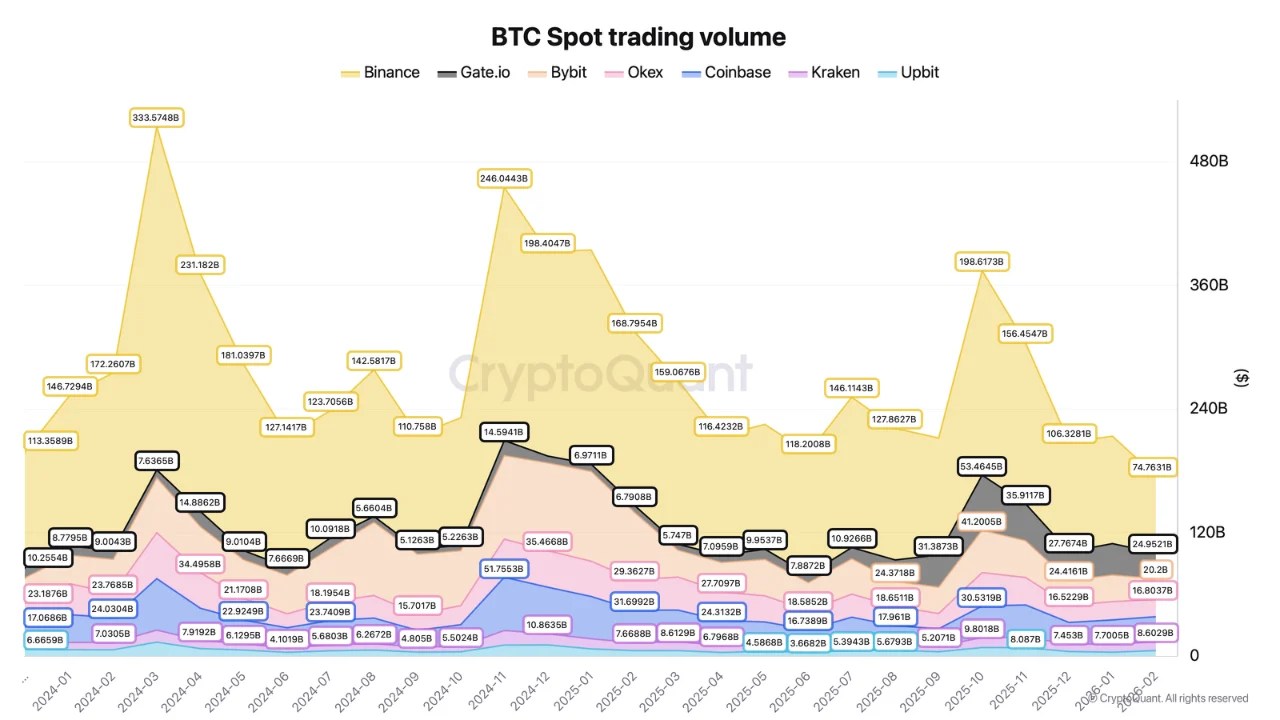
Bitcoin Spot Trading Volume | Source: CryptoQuant

From a market-structure perspective, shrinking spot volumes typically indicate reduced conviction. When liquidity thins, price moves can become less reliable because they are driven by smaller capital flows. This environment often coincides with consolidation phases, where both buyers and sellers adopt a wait-and-see approach rather than aggressively positioning.

Importantly, weaker spot participation can delay trend formation. Sustained bullish recoveries historically require expanding spot demand, as derivatives-driven rallies alone tend to lack durability. Conversely, declining spot flows may also reflect capital rotation toward other asset classes amid macro uncertainty.

The key variable will be whether spot participation stabilizes or begins to recover. A meaningful rebound in volumes would signal renewed confidence, whereas continued contraction would reinforce the current defensive market posture.


Пов'язані питання

QWhat is the current resistance level Bitcoin is testing, and from which zone did it rebound?

ABitcoin is currently testing the $69,000 level as resistance after rebounding from the $64,000 zone.

QAccording to the analyst Darkfost, what is significant about Bitcoin spot trading volumes in February 2024?

AFebruary is on track to close as the month with the lowest Bitcoin spot trading volumes since the beginning of 2024.

QWhich exchange dominates the spot trading market, and what is its approximate monthly volume?

ABinance dominates the spot trading market with nearly $75 billion in monthly volume.

QWhat does a decline in spot trading volume typically indicate from a market-structure perspective?

AShrinking spot volumes typically indicate reduced conviction and can make price moves less reliable as they are driven by smaller capital flows, often coinciding with consolidation phases.

QWhat event in October caused a significant decline in open interest, and what was the approximate notional loss?

AThe October 10 shock caused open interest to decline by more than 70,000 BTC, which is roughly $8 billion in notional value.

Пов'язані матеріали

In-Depth Report on the On-Chain Lending Market: When Off-Chain Credit Meets On-Chain Liquidation

The on-chain lending market has evolved from a peripheral DeFi niche into core financial infrastructure. As of early 2026, total value locked (TVL) in on-chain lending protocols has reached $64.3 billion, accounting for 53.54% of total DeFi TVL, making it the largest and most mature vertical within decentralized finance. Aave dominates the sector with approximately $32.9 billion in TVL, commanding nearly half of the market—a leadership position that is unlikely to be challenged in the foreseeable future. However, the path of on-chain lending forward is not without risk. Liquidation cascades, credit defaults, and cross-chain vulnerabilities remain systemic threats hanging over the industry. At the same time, a deeper structural transformation is underway: on-chain lending is shifting from a “leverage tool for crypto-native users” to a “compliant gateway for institutional capital”. The scale of RWA (Real World Asset) lending has surpassed $18.5 billion, with U.S. Treasuries and government securities increasingly serving as core collateral. Institutional capital inflows are reshaping both the user base and risk appetite of the sector. This report systematically analyzes the evolution of on-chain lending definitions, competitive dynamics, core risks, and future trends, providing a comprehensive industry outlook for investors and trade practitioners. Key findings suggest that the “one dominant player with several strong challengers” structure will persist in the short term, while fixed-rate lending, compliant collateral, and institutional credit underwriting will define the next phase of competition. For investors focused on DeFi infrastructure, three key opportunity tracks stand out, namely, the Aave ecosystem (Morpho, Spark), RWA lending protocols (Ondo, Maple) and fixed-rate innovation (Notional, Pendle).

HTX Learn8 хв тому

In-Depth Report on the On-Chain Lending Market: When Off-Chain Credit Meets On-Chain Liquidation

HTX Learn8 хв тому

Fu Peng's First Public Speech in 2026: What Exactly Are Crypto Assets? Why Did I Join the Crypto Asset Industry?

Fu Peng, a renowned macroeconomist and now Chief Economist at New火 Group, delivered his first public speech of 2026 at the Hong Kong Web3 Festival. He explained his perspective on crypto assets and why he joined the industry, framing it within the context of macroeconomic trends and financial evolution. Fu emphasized that crypto assets are transitioning from an early, belief-driven phase to a mature, institutionally integrated asset class. He drew parallels to the 1970s-80s, when technological advances (like computing) revolutionized traditional finance, leading to the rise of FICC (Fixed Income, Currencies, and Commodities). Similarly, current advancements in AI, data, and blockchain are reshaping finance, with crypto assets becoming part of a new "FICC + C" (C for Crypto) framework. He noted that institutional capital, including traditional hedge funds, avoided early crypto due to its speculative nature but are now engaging as regulatory clarity emerges (e.g., stablecoin laws, CFTC classifying crypto as a commodity). Fu predicted that 2025-2026 marks a turning point where crypto becomes a standardized, financially viable asset for diversified portfolios, akin to commodities or derivatives in traditional finance. Fu defined Bitcoin not as "digital gold" in a simplistic sense but as a value-preserving, financially tradable asset. He highlighted that crypto's future lies in regulated, institutional adoption, moving away from retail-dominated trading. His entry into crypto signals this maturation, where traditional finance integrates crypto into mainstream asset management.

marsbit1 год тому

Fu Peng's First Public Speech in 2026: What Exactly Are Crypto Assets? Why Did I Join the Crypto Asset Industry?

marsbit1 год тому

Justin Sun Sues Trump Family: What $75 Million Bought Was Only a Blacklist

Justin Sun, founder of Tron, has filed a lawsuit in federal court against World Liberty Financial (WLF), alleging he was made the "primary target of a fraudulent scheme" after investing $75 million. Sun claims the investment secured him an advisor title and WLFI tokens, which were later frozen by WLF, causing "hundreds of millions in losses." The dispute began in late 2024 when Sun's investment helped revive WLF's struggling token sale, which ultimately raised $550 million. Shortly after, the SEC dropped its lawsuit against Sun following Donald Trump's inauguration. However, relations soured when Sun refused WLF's demands for additional funding. In August 2025, WLF added a "blacklist" function to its smart contract, allowing it to unilaterally freeze tokens. Sun's holdings, worth approximately $107 million, were frozen, and he was threatened with token destruction. The lawsuit highlights WLF's structure, which directs 75% of token sale profits to the Trump family, who had earned $1 billion by December 2025. WLF's CEO is Zach Witkoff, son of U.S. Middle East envoy Steve Witkoff. The project faces scrutiny for opaque operations, including a controversial loan arrangement on the Dolomite platform, co-founded by a WLF advisor. Despite Sun's history with the SEC, the case underscores centralization risks within DeFi, as WLF controls governance and holds powers to freeze assets arbitrarily. Sun's tokens remain frozen as legal proceedings begin.

marsbit1 год тому

Justin Sun Sues Trump Family: What $75 Million Bought Was Only a Blacklist

marsbit1 год тому

Торгівля

Спот
Ф'ючерси

Популярні статті

Як купити FLOW

Ласкаво просимо до HTX.com! Ми зробили покупку Flow (FLOW) простою та зручною. Дотримуйтесь нашої покрокової інструкції, щоб розпочати свою криптовалютну подорож.Крок 1: Створіть обліковий запис на HTXВикористовуйте свою електронну пошту або номер телефону, щоб зареєструвати обліковий запис на HTX безплатно. Пройдіть безпроблемну реєстрацію й отримайте доступ до всіх функцій.ЗареєструватисьКрок 2: Перейдіть до розділу Купити крипту і виберіть спосіб оплатиКредитна/дебетова картка: використовуйте вашу картку Visa або Mastercard, щоб миттєво купити Flow (FLOW).Баланс: використовуйте кошти з балансу вашого рахунку HTX для безперешкодної торгівлі.Треті особи: ми додали популярні способи оплати, такі як Google Pay та Apple Pay, щоб підвищити зручність.P2P: Торгуйте безпосередньо з іншими користувачами на HTX.Позабіржова торгівля (OTC): ми пропонуємо індивідуальні послуги та конкурентні обмінні курси для трейдерів.Крок 3: Зберігайте свої Flow (FLOW)Після придбання Flow (FLOW) збережіть його у своєму обліковому записі на HTX. Крім того, ви можете відправити його в інше місце за допомогою блокчейн-переказу або використовувати його для торгівлі іншими криптовалютами.Крок 4: Торгівля Flow (FLOW)Легко торгуйте Flow (FLOW) на спотовому ринку HTX. Просто увійдіть до свого облікового запису, виберіть торгову пару, укладайте угоди та спостерігайте за ними в режимі реального часу. Ми пропонуємо зручний досвід як для початківців, так і для досвідчених трейдерів.

211 переглядів усьогоОпубліковано 2024.12.10Оновлено 2025.03.21

Як купити FLOW

Обговорення

Ласкаво просимо до спільноти HTX. Тут ви можете бути в курсі останніх подій розвитку платформи та отримати доступ до професійної ринкової інформації. Нижче представлені думки користувачів щодо ціни FLOW (FLOW).

活动图片













