Bitcoin Mining Companies Flee for the Nth Time

marsbitОпубліковано о 2026-04-03Востаннє оновлено о 2026-04-03

Анотація

Since late last year, major publicly traded Bitcoin mining companies have initiated a significant wave of Bitcoin (BTC) sell-offs. Cango sold about 60% of its holdings (4,451 BTC) in February, Bitdeer liquidated its entire Bitcoin inventory in January, Riot Platforms sold 3,778 BTC in the first quarter, and Core Scientific planned to sell approximately 2,500 BTC. Notably, Marathon Digital (MARA) sold 15,133 BTC in just three weeks in March, cashing out over $1 billion, while also cutting 15% of its workforce as part of a strategic shift toward becoming an energy and digital infrastructure company. This collective divestment is driven by three primary motives. First, mining has become unprofitable for many; the average cash cost to mine one BTC is approximately $79,995, while BTC trades around $68,000–70,000, resulting in an average loss of about $19,000 per coin. Second, AI data centers offer a more stable and lucrative alternative, with tech giants like Google, Microsoft, and financial institutions like Morgan Stanley providing substantial backing and contracts. Mining companies are repurposing their existing infrastructure—cheap power contracts, data centers, and cooling systems—toward AI, which promises higher, predictable margins. Third, some firms are using BTC sales to optimize their balance sheets, such as repurchasing convertible debt at a discount to reduce liabilities and avoid equity dilution. The industry is diverging into three paths: some, like CleanSpark and ...

Author: Zhou, ChainCatcher

Since the end of last year, listed mining companies have set off a wave of collective sell-offs.

Cango sold 4,451 bitcoins in February, about 60% of its holdings; Bitdeer liquidated its entire bitcoin inventory in January; Riot Platforms sold multiple times in December and sold 3,778 BTC in the first quarter; Core Scientific also previously planned to sell about 2,500 bitcoins in the first quarter.

Recently, the leading mining company MARA disclosed in an announcement that in just three weeks from March 4 to 25, the company sold 15,133 bitcoins, cashing out over $1 billion. Simultaneously, the company announced a reduction of approximately 15% of its workforce as part of its strategic transformation into an energy and digital infrastructure company.

In fact, miners selling bitcoin is not new. In the bear markets of 2018 and 2022, mining companies also experienced large-scale liquidation and capitulation, and those that remained were the more efficient players. But this time, the trigger for the sell-off is not just the falling coin price; they also have a new destination—AI data centers.

I. The Triple Motives Behind the Sell-Off

On the surface, it appears to be a collective sell-off by mining companies, but upon closer inspection, their underlying motives are not uniform and can be roughly divided into three distinct types of selling logic.

Mining Itself Has Fallen into Loss

The first, and most direct, motive: cost pressure.

The latest mining report from CoinShares shows that the weighted average cash cost for listed mining companies to mine one BTC is currently about $79,995, while the BTC market price hovers between $68,000 and $70,000, resulting in an average loss of nearly $19,000 per coin, putting the industry in a state of approximately 21% loss overall.
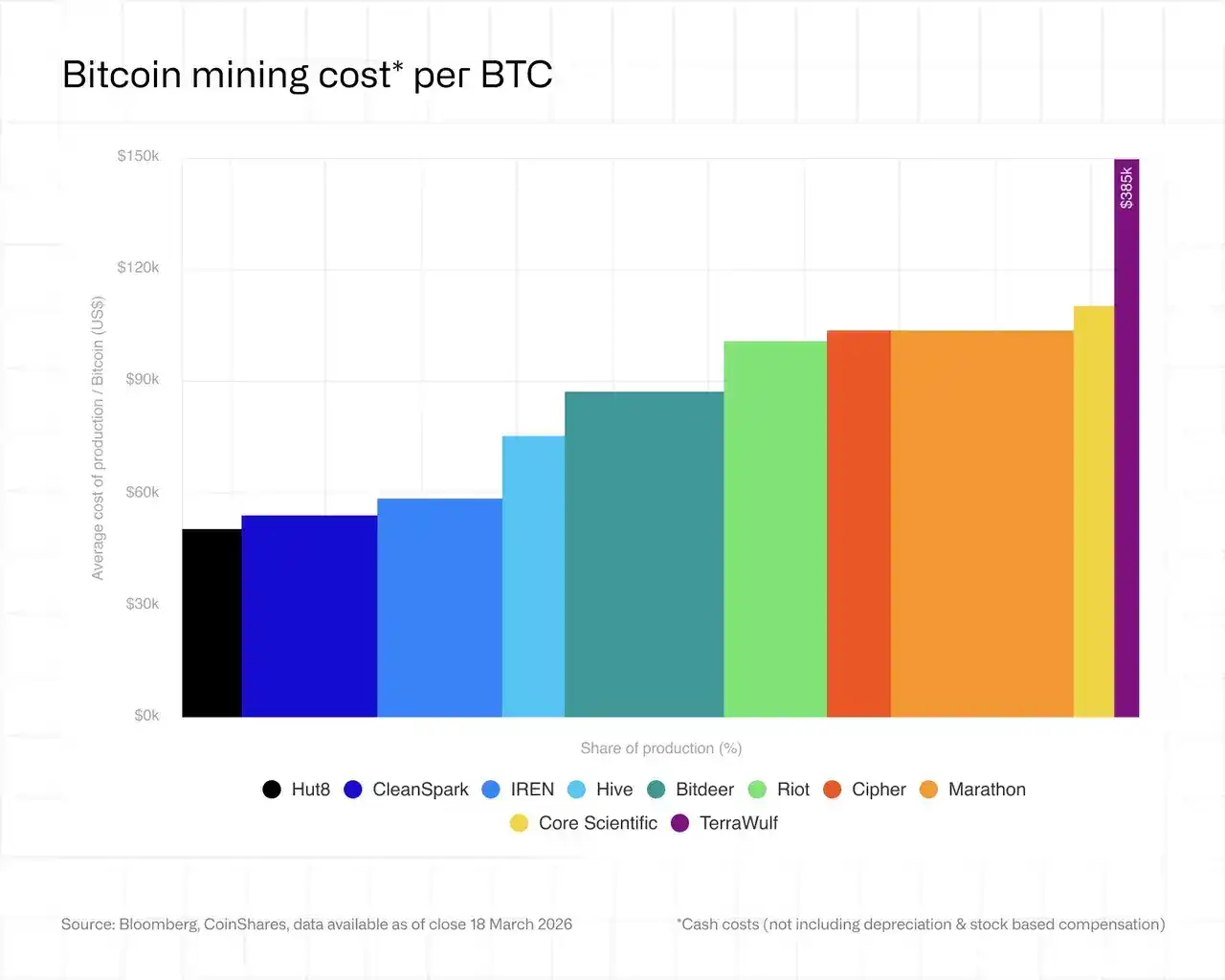
This is no longer just a matter of narrowing profit margins, but a question of whether cash flow can sustain continued mining.

The report also shows that the hash price fell to a historical post-halving low of $28 to $30/PH/day in early March. At this level, most active mining rigs need electricity prices to be压到 below $0.05/kWh to maintain cash profitability. Currently, about 15% to 20% of the network's mining rigs are on the edge of breakeven.

Meanwhile, tensions in the Middle East are pushing up energy prices, putting continuous pressure on electricity costs, an external variable that mining companies themselves have little control over.

QCP Group pointed out in a report that with the bitcoin price significantly below the average mining cost, mining companies are under obvious pressure, and liquidity priority has surpassed the HODL strategy.

Against this background, for some mining companies, selling bitcoin is a practical necessity to maintain operations.

AI Offers a More Stable Revenue Logic

The second motive is more strategic and the most值得深究 part of this sell-off.

Bloomberg analysis pointed out that unlike previous sell-offs to cover costs, the funds from this round are being reallocated to the artificial intelligence sector.

The business logic behind this is clear: mining revenue is highly dependent on coin price, hash rate difficulty, and electricity price, making it extremely volatile. In contrast, AI infrastructure is closer to long-term leases, with CoinShares' report指出其利润率可达 80% to 90%, and revenue is predictably long-term.

More crucially, mining companies already hold ready-made resources—cheap power contracts, built data centers,完善的散热系统, and mature operations teams.

Some analysts point out that the construction cost of Bitcoin mining infrastructure is about $700,000 to $1 million per megawatt, while AI infrastructure costs as much as $8 million to $15 million per megawatt. This huge cost gap is being monetized on a large scale by mining companies.

Notably, behind this transformation stands a group of unexpected drivers—tech giants and traditional financial institutions.

Previously, Google provided credit support for the lease obligations of the AI cloud platform Fluidstack, with disclosed credit support累计 exceeding $5 billion,先后为 TeraWulf, Cipher Mining, Hut 8 and other mining companies' AI transformation提供担保并换取相应股权; Microsoft signed a five-year, $9.7 billion AI cloud services contract with mining company IREN; Morgan Stanley provided a $500 million loan to Core Scientific, with a potential total credit line of $1 billion.

Their entry provides far more solid capital endorsement for this transformation than imagined.

Meanwhile, mining companies like Core Scientific, TeraWulf, Hut 8, and Cipher have successively signed large AI/HPC contracts, with cumulative amounts exceeding $70 billion. The CoinShares report mentioned that mining companies with AI/HPC contracts have valuation multiples approximately twice those of pure mining companies, and the market is rewarding those who complete the transformation first with valuation premiums.

Even the most financially sound mining companies with the lowest leverage, like HIVE, have actively scaled back mining operations and turned to expanding AI data centers. This indicates that the pressure to transform is no longer exclusive to highly indebted mining companies but is a directional choice facing the entire industry.

Actively Using BTC as a Financial Tool

The third logic is relatively精明 and the most proactive.

Some mining companies choose to sell BTC not due to operational pressure but to use it as a tool to optimize their balance sheets, like MARA. The specific operation is: use the proceeds from the sale to repurchase previously issued convertible bonds at a discount below par value, thereby compressing the scale of liabilities and reducing potential equity dilution risks.

For these mining companies, the role of BTC on the balance sheet has quietly changed from a long-term holding象征信仰 to a strategic asset that can be flexibly allocated.

Additionally, a relatively rare type of seller has emerged in this round of sell-offs: sovereign nations.

On-chain data shows that the BTC holdings of the Royal Government of Bhutan have decreased by about 66% from the peak at the end of 2024, with the single transfer size in March rising to $35 million to $45 million, and the pace of selling持续加快.

Unlike most countries that accumulate BTC through market purchases, Bhutan's holdings come from its domestic hydroelectric mining operations. This large-scale reduction may be related to the funding needs of its national development projects. This is also one of the largest government bitcoin reduction actions on record.

The叠加 of three logics—mining losses, AI transformation, debt optimization—plus selling pressure at the sovereign level—means the market is承受 structural supply pressure from multiple directions and of varying nature. The Bitcoin faith of mining companies is being reshaped by more realistic business logic.

II. After Leaving, Each Goes Its Own Way

Of course, selling off does not mean completely liquidating positions. The remaining holdings and subsequent strategies of various mining companies are showing截然不同的分化.

Three Paths, Three Choices

The first path:坚守挖矿.

Represented by CleanSpark and HIVE. They do not chase the AI transformation narrative, do not叠加 debt, and rely on a combination of low electricity prices, new-generation矿机, and low leverage to seek victory in the industry's liquidation process. Their logic is that as high-cost capacity gradually withdraws, the per-unit hash rate收益 for remaining mining companies will increase accordingly.

CleanSpark has publicly stated that继续大规模投入比特币挖矿"在经济上已不太合理" at the current hash price level, but the company still chooses to stick to its main business, betting that the cycle will eventually reverse.

Well-known crypto KOL蓝狐 pointed out that historically, almost every halving has been followed by miner capitulation, and those who remain are often the more efficient players, securing a larger share in the next rebound.

For these companies,坚守挖矿 is not stubbornness but trust in the laws of the cycle.

The second path:两条腿走路.

Represented by MARA, IREN, and Riot. They retain a considerable规模 of BTC holdings while simultaneously布局 AI/HPC, using the relatively stable income from AI business to hedge against the cyclical fluctuations of mining income.

These companies are essentially solving an asset allocation problem. The answers vary by company, but the core logic is that the two business lines support each other,分散单一风险.

The third path:全面转向 AI.

Represented by Core Scientific, TeraWulf, and Cipher. BTC holdings have exited the position of core assets, and mining is gradually becoming an附属部分 of the data center business.

CoinShares predicts that by the end of 2026, the AI revenue share of some mining companies could be as high as 70%, while the mining revenue share may drop from about 85% in early 2025 to less than 20%. These companies are nominally still mining companies, but in essence, they are becoming AI infrastructure operators that started with mining.

The potential risk of this path is that a heavy-asset transformation意味着巨额债务负担. Once AI demand cools down, both businesses will be under pressure.

也有观点指出, the credit guarantee structure provided by Google through Fluidstack actually creates highly concentrated counterparty risk—the entire cash flow chain relies on Fluidstack as an intermediary. Once the AI lease market experiences major changes, this structure could become a single point of failure.

BTC Price Determines Their Fate

No matter which path is chosen, it ultimately points to the same variable: the direction of the BTC price.

CoinShares gives three scenarios:

If BTC recovers to $100,000 by the end of 2026, the hash price will rebound to about $37/PH/day, mining profits will be repaired, and overall industry pressure will ease;

If it remains below $80,000, high-cost miners will accelerate their exit, and the traditional model of mining and HODLing等待牛市 will become increasingly difficult to sustain;

If it breaks through the historical high, the hash price could soar to $59/PH/day, and the industry will enter a new expansion cycle.

Conclusion

Overall, mining companies face two ultimate outcomes: either the coin price recovers, they return to their main business, and everything now is just a cyclical historical footnote; or the price remains low for an extended period, more and more mining companies complete their transformation into AI data centers, and the company model of mining and HODLing等待牛市 becomes increasingly rare in this industry.

However, there is another question worth asking beyond the business logic of this transformation. Mining companies are not ordinary listed companies; the continuous investment in hash rate is itself the security budget of the Bitcoin network.

Sazmining CEO Kent Halliburton once直言, these companies "hold power contracts, land, and infrastructure, yet hand these resources over to Microsoft and Google in exchange for rent checks, transforming from protecting the Bitcoin network to保管机架空间 for hyperscale cloud providers."

When mining no longer generates sufficient economic returns, the rational business decision is naturally to转移资源; but if this trend continues to spread, who will bear the long-term cost of maintaining the security of the Bitcoin network will become a problem that cannot be ignored.

History may have given an answer to this question.

The Bitcoin network has experienced several large-scale miner liquidations, and each time之后, it has operated with higher efficiency.

But this time, the miners who are leaving are not just turning off their machines.

The times have changed.

Пов'язані питання

QWhat are the three main motivations behind the recent large-scale Bitcoin sales by mining companies?

AThe three main motivations are: 1) Mining operations are unprofitable due to high costs and low Bitcoin prices, creating cash flow pressure. 2) A strategic pivot towards the more stable and lucrative AI data center business, backed by major tech firms. 3) Using Bitcoin as a financial tool to optimize balance sheets, such as repurchasing debt.

QWhich major technology companies are backing the mining companies' transition to AI infrastructure, and how?

AGoogle has provided over $5 billion in credit support for AI platform Fluidstack, taking equity in companies like TeraWulf, Cipher Mining, and Hut 8. Microsoft signed a $9.7 billion AI cloud services contract with IREN. Morgan Stanley provided a $500 million loan to Core Scientific, with a potential total of $1 billion.

QAccording to the CoinShares report, what is the current weighted average cash cost for a public miner to produce one Bitcoin, and how does it compare to the market price?

AThe weighted average cash cost for a public miner to produce one Bitcoin is approximately $79,995. With Bitcoin market price fluctuating between $68,000 and $70,000, this results in an average loss of nearly $19,000 per Bitcoin, representing an overall loss-making state of about 21%.

QWhat are the three potential future paths for mining companies as outlined in the article?

AThe three paths are: 1) Staying in mining (e.g., CleanSpark, HIVE), relying on low costs to survive the cycle. 2) A dual-track approach (e.g., MARA, IREN, Riot), maintaining Bitcoin holdings while expanding into AI to hedge risk. 3) A full pivot to AI (e.g., Core Scientific, TeraWulf, Cipher), where Bitcoin mining becomes ancillary to their new core data center business.

QWhat broader concern does the article raise about the long-term health of the Bitcoin network as miners pivot to AI?

AThe article raises the concern that if the economic incentive to mine Bitcoin continues to diminish, the security budget for the Bitcoin network—funded by mining—could be at risk. As miners reallocate their resources (power contracts, land, infrastructure) to rent-seeking AI deals with tech giants, the question of who will bear the long-term cost of securing the Bitcoin network becomes critical.

Пов'язані матеріали

Торгівля

Спот
Ф'ючерси

Популярні статті

Що таке BITCOIN

Розуміння HarryPotterObamaSonic10Inu (ERC-20) та його позиції у крипто-просторі Останніми роками ринок криптовалют спостерігав за зростанням популярності мем-коінів, які привертають інтерес не тільки трейдерів, але й тих, хто шукає спілкування та розважальну цінність. Серед цих унікальних токенів є HarryPotterObamaSonic10Inu (ERC-20), інтригуючий проект, що поєднує культурні посилання з тканинами криптовалюти. Ця стаття досліджує ключові аспекти HarryPotterObamaSonic10Inu, вивчаючи його механізми, спільноту та його взаємодію з ширшим крипто-ландшафтом. Що таке HarryPotterObamaSonic10Inu (ERC-20)? Як випливає з його назви, HarryPotterObamaSonic10Inu є мем-коіном, побудованим на блокчейні Ethereum, класифікованим за стандартом ERC-20. На відміну від традиційних криптовалют, які можуть підкреслювати практичну корисність або інвестиційний потенціал, цей токен процвітає завдяки розважальній цінності та силі своєї спільноти. Проект спрямований на створення середовища, де зацікавлені користувачі можуть об'єднуватися, ділитися ідеями та брати участь у заходах, натхненних різноманітними культурними явищами. Однією з примітних особливостей HarryPotterObamaSonic10Inu є нульовий податок на транзакції. Цей привабливий елемент має на меті заохочувати торгівлю та участь у спільноті, позбавлену додаткових витрат, які можуть відлякувати дрібних трейдерів. Загальна пропозиція монет становить один мільярд токенів, що позначає намір підтримувати суттєву циркуляцію в межах спільноти. Творець HarryPotterObamaSonic10Inu (ERC-20) Походження HarryPotterObamaSonic10Inu дещо окутане таємницею; деталі про творця залишаються невідомими. Розвиток цього токена позбавлений впізнаваної команди або чіткої стратегії, що не є рідкістю в секторі мем-коінів. Натомість проект виник органічно, а його розвиток значною мірою залежить від ентузіазму та участі його спільноти. Інвестори HarryPotterObamaSonic10Inu (ERC-20) Щодо зовнішніх інвестицій та підтримки, HarryPotterObamaSonic10Inu також залишається невизначеним. Токен не зазначає жодних відомих інвестиційних фондів або значної організаційної підтримки. Натомість життєва сила проекту полягає в його базовій спільноті, яка інформує про його зростання та стійкість через колективні дії та залученість у крипто-просторі. Як працює HarryPotterObamaSonic10Inu (ERC-20)? Як мем-коін, HarryPotterObamaSonic10Inu функціонує передусім поза традиційними рамками, що часто регулюють вартість активів. Є кілька відмінних аспектів, що визначають, як працює проект: Транзакції без податку: Завдяки відсутності податкових зборів на транзакції, користувачі можуть вільно купувати та продавати токен, не турбуючись про приховані витрати. Залучення спільноти: Проект процвітає завдяки взаємодії спільноти, використовуючи соціальні медіа для створення шуму та сприяння залученню. Обговорення, обмін контентом та залученість є ключовими елементами, що допомагають розширити його охоплення та зміцнити лояльність серед прихильників. Відсутність практичної корисності: Слід зазначити, що HarryPotterObamaSonic10Inu не пропонує конкретної корисності в рамках фінансової екосистеми. Натомість він класифікується як токен, що призначений в основному для розваги та спільнотних активностей. Культурне посилання: Токен кмітливо вплітає елементи популярної культури, щоб привернути інтерес, зв'язуючи з ентузіастами мемів та крипто-стежками. HarryPotterObamaSonic10Inu ілюструє, як мем-коіни функціонують інакше, ніж традиційні криптовалютні проекти, увійшовши на ринок як інноваційні соціальні конструкти, а не утилітарні активи. Хронологія HarryPotterObamaSonic10Inu (ERC-20) Історія HarryPotterObamaSonic10Inu відзначена кількома значними етапами: Створення: Токен виник з вірусного мему, захопивши уяву багатьох крипто-ентузіастів. Конкретні дати створення недоступні, що підкреслює його органічний розвиток. Лістинг на біржах: HarryPotterObamaSonic10Inu з'явився на різних біржах, дозволяючи зручніший доступ і торгівлю спільноти. Ініціативи залучення спільноти: Ведення діяльності, спрямованої на покращення взаємодії спільноти, включаючи конкурси, кампанії в соціальних мережах та створення контенту від фанатів та прихильників. Плани на майбутнє: Дорожня карта проекту включає запуск колекції NFT, мерчандайзинг та електронну комерцію, пов'язану з його культурними темами, що далі залучає спільноту та намагається додати більше вимірів до його екосистеми. Ключові моменти про HarryPotterObamaSonic10Inu (ERC-20) Спільнотний підхід: Проект надає пріоритет колективному внеску та креативності, забезпечуючи, щоб участь користувачів була в центрі його розвитку. Класифікація як мем-коін: Це є його епігенез розважальної криптовалюти, що відрізняється від традиційних інвестиційних інструментів. Жодного прямого відношення до Bitcoin: Незважаючи на схожість у назві, HarryPotterObamaSonic10Inu є відмінним і не має жодного зв’язку з Bitcoin або іншими усталеними криптовалютами. Зосередженість на співпраці: HarryPotterObamaSonic10Inu створено для того, щоб надати простір для співпраці та обміну історіями серед його власників, забезпечуючи шлях для творчості та спільного зв'язку. Перспективи на майбутнє: Амбіція розширитися за межі початкової концепції в NFT та мерчандайз відкриває шлях для проекту потенційно потрапити в більш мейнстрімні сфери цифрової культури. Оскільки мем-коіни продовжують захоплювати уяву спільноти криптовалют, HarryPotterObamaSonic10Inu (ERC-20) вирізняється своїми культурними зв'язками та орієнтованим на спільноту підходом. Хоча він може не відповідати типовій моделі утилітарного токена, його суть полягає в радощах і товариськості, що підтримуються серед його прихильників, підкреслюючи еволюційну природу криптовалют в усе більш цифрову епоху. Оскільки проект продовжує розвиватися, важливо спостерігати за тим, як динаміка спільноти вплине на його траєкторію в постійно змінюваному ландшафті технології блокчейн.

1.7k переглядів усьогоОпубліковано 2024.04.01Оновлено 2024.12.03

Що таке BITCOIN

Як купити BTC

Ласкаво просимо до HTX.com! Ми зробили покупку Bitcoin (BTC) простою та зручною. Дотримуйтесь нашої покрокової інструкції, щоб розпочати свою криптовалютну подорож.Крок 1: Створіть обліковий запис на HTXВикористовуйте свою електронну пошту або номер телефону, щоб зареєструвати обліковий запис на HTX безплатно. Пройдіть безпроблемну реєстрацію й отримайте доступ до всіх функцій.ЗареєструватисьКрок 2: Перейдіть до розділу Купити крипту і виберіть спосіб оплатиКредитна/дебетова картка: використовуйте вашу картку Visa або Mastercard, щоб миттєво купити Bitcoin (BTC).Баланс: використовуйте кошти з балансу вашого рахунку HTX для безперешкодної торгівлі.Треті особи: ми додали популярні способи оплати, такі як Google Pay та Apple Pay, щоб підвищити зручність.P2P: Торгуйте безпосередньо з іншими користувачами на HTX.Позабіржова торгівля (OTC): ми пропонуємо індивідуальні послуги та конкурентні обмінні курси для трейдерів.Крок 3: Зберігайте свої Bitcoin (BTC)Після придбання Bitcoin (BTC) збережіть його у своєму обліковому записі на HTX. Крім того, ви можете відправити його в інше місце за допомогою блокчейн-переказу або використовувати його для торгівлі іншими криптовалютами.Крок 4: Торгівля Bitcoin (BTC)Легко торгуйте Bitcoin (BTC) на спотовому ринку HTX. Просто увійдіть до свого облікового запису, виберіть торгову пару, укладайте угоди та спостерігайте за ними в режимі реального часу. Ми пропонуємо зручний досвід як для початківців, так і для досвідчених трейдерів.

4.4k переглядів усьогоОпубліковано 2024.12.12Оновлено 2025.03.21

Як купити BTC

Що таке $BITCOIN

ЦИФРОВЕ ЗОЛОТО ($BITCOIN): Комплексний аналіз Вступ до ЦИФРОВОГО ЗОЛОТА ($BITCOIN) ЦИФРОВЕ ЗОЛОТО ($BITCOIN) — це проект на основі блокчейну, що працює в мережі Solana, який має на меті поєднати характеристики традиційних дорогоцінних металів з інноваціями децентралізованих технологій. Хоча він має таку ж назву, як і Bitcoin, який часто називають “цифровим золотом” через його сприйняття як засобу збереження вартості, ЦИФРОВЕ ЗОЛОТО є окремим токеном, розробленим для створення унікальної екосистеми в ландшафті Web3. Його мета — позиціонувати себе як життєздатний альтернативний цифровий актив, хоча деталі щодо його застосувань і функціональностей все ще розробляються. Що таке ЦИФРОВЕ ЗОЛОТО ($BITCOIN)? ЦИФРОВЕ ЗОЛОТО ($BITCOIN) — це токен криптовалюти, спеціально розроблений для використання в блокчейні Solana. На відміну від Bitcoin, який виконує широко визнану роль зберігання вартості, цей токен, здається, зосереджується на більш широких застосуваннях і характеристиках. Помітні аспекти включають: Інфраструктура блокчейну: Токен побудований на блокчейні Solana, відомому своєю здатністю обробляти швидкі та низьковартісні транзакції. Динаміка постачання: ЦИФРОВЕ ЗОЛОТО має максимальне постачання, обмежене 100 квадрильйонами токенів (100P $BITCOIN), хоча деталі щодо його обігового постачання наразі не розголошуються. Утиліта: Хоча точні функціональності не викладені, є вказівки на те, що токен може бути використаний для різних застосувань, потенційно пов'язаних з децентралізованими додатками (dApps) або стратегіями токенізації активів. Хто є творцем ЦИФРОВОГО ЗОЛОТА ($BITCOIN)? На даний момент особа творців і команди розробників, що стоять за ЦИФРОВИМ ЗОЛОТОМ ($BITCOIN), залишається невідомою. Ця ситуація є типовою для багатьох інноваційних проектів у сфері блокчейну, особливо тих, що пов'язані з децентралізованими фінансами та феноменом мем-коінів. Хоча така анонімність може сприяти культурі, орієнтованій на спільноту, вона посилює занепокоєння щодо управління та підзвітності. Хто є інвесторами ЦИФРОВОГО ЗОЛОТА ($BITCOIN)? Доступна інформація вказує на те, що ЦИФРОВЕ ЗОЛОТО ($BITCOIN) не має жодних відомих інституційних спонсорів або помітних венчурних капіталовкладень. Проект, здається, працює за моделлю “рівний до рівного”, зосереджуючись на підтримці та прийнятті спільноти, а не на традиційних шляхах фінансування. Його активність і ліквідність переважно розташовані на децентралізованих біржах (DEX), таких як PumpSwap, а не на встановлених централізованих торгових платформах, що ще більше підкреслює його підхід знизу вгору. Як працює ЦИФРОВЕ ЗОЛОТО ($BITCOIN) Операційні механізми ЦИФРОВОГО ЗОЛОТА ($BITCOIN) можна детальніше розглянути на основі його дизайну блокчейну та характеристик мережі: Механізм консенсусу: Використовуючи унікальний proof-of-history (PoH) Solana в поєднанні з моделлю proof-of-stake (PoS), проект забезпечує ефективну валідацію транзакцій, що сприяє високій продуктивності мережі. Токеноміка: Хоча конкретні дефляційні механізми не були детально описані, велике максимальне постачання токенів вказує на те, що воно може задовольняти мікротранзакції або нішеві випадки використання, які ще потрібно визначити. Інтероперабельність: Існує потенціал для інтеграції з більш широкою екосистемою Solana, включаючи різні платформи децентралізованих фінансів (DeFi). Однак деталі щодо конкретних інтеграцій залишаються невизначеними. Хронологія ключових подій Ось хронологія, яка підкреслює значні віхи, пов'язані з ЦИФРОВИМ ЗОЛОТОМ ($BITCOIN): 2023: Початкове розгортання токена відбувається на блокчейні Solana, позначене його адресою контракту. 2024: ЦИФРОВЕ ЗОЛОТО набуває видимості, оскільки стає доступним для торгівлі на децентралізованих біржах, таких як PumpSwap, що дозволяє користувачам торгувати ним проти SOL. 2025: Проект спостерігає спорадичну торгову активність і потенційний інтерес до ініціатив, очолюваних спільнотою, хоча на даний момент не зафіксовано жодних значних партнерств або технічних досягнень. Критичний аналіз Сильні сторони Масштабованість: Основна інфраструктура Solana підтримує високі обсяги транзакцій, що може підвищити утиліту $BITCOIN у різних сценаріях транзакцій. Доступність: Потенційно низька торгова ціна за токен може привабити роздрібних інвесторів, сприяючи більш широкій участі завдяки можливостям дробового володіння. Ризики Відсутність прозорості: Відсутність публічно відомих спонсорів, розробників або процесу аудиту може викликати скептицизм щодо стійкості та надійності проекту. Волатильність ринку: Торгова активність сильно залежить від спекулятивної поведінки, що може призвести до значної волатильності цін і невизначеності для інвесторів. Висновок ЦИФРОВЕ ЗОЛОТО ($BITCOIN) постає як цікавій, але неоднозначний проект у швидко розвиваючійся екосистемі Solana. Хоча він намагається використати наратив “цифрового золота”, його відхід від встановленої ролі Bitcoin як засобу збереження вартості підкреслює необхідність чіткішого розмежування його передбачуваної утиліти та структури управління. Майбутнє прийняття та адаптація, ймовірно, залежатиме від вирішення поточної непрозорості та більш чіткого визначення його операційних та економічних стратегій. Примітка: Цей звіт охоплює синтезовану інформацію, доступну станом на жовтень 2023 року, і можуть відбутися події, що виходять за межі дослідницького періоду.

75 переглядів усьогоОпубліковано 2025.05.13Оновлено 2025.05.13

Що таке $BITCOIN

Обговорення

Ласкаво просимо до спільноти HTX. Тут ви можете бути в курсі останніх подій розвитку платформи та отримати доступ до професійної ринкової інформації. Нижче представлені думки користувачів щодо ціни BTC (BTC).

活动图片