Bitcoin hunts liquidity as US CPI inflation drops to lowest since 2021

cointelegraphОпубліковано о 2025-12-18Востаннє оновлено о 2025-12-18

Анотація

US CPI inflation dropped to 2.7% year-over-year in November, the lowest level since March 2021, significantly below expectations. This led to increased market volatility, with Bitcoin briefly surpassing $89,000 before retracing. The unexpected decline fuels expectations of Federal Reserve interest rate cuts, with markets pricing in a 26.6% probability of a cut in January. Analysts note Bitcoin's price action resembles early 2025 patterns, suggesting potential further downside toward $75,000. Over $630 million in crypto liquidations occurred amid ongoing volatility and perceived market manipulation.

Bitcoin (BTC) ramped up volatility into Thursday’s Wall Street open as markets reacted to surprise US inflation data.

Key points:

  • Bitcoin traders weather more snap BTC price volatility as CPI surprises to the downside.

  • US inflation unexpectedly drops to multiyear lows, fueling bets of interest-rate cuts.

  • Bitcoin price action continues repeating its early 2025 fractal.

Bitcoin stays erratic after “massive” CPI miss

Data from Cointelegraph Markets Pro and TradingView showed BTC/USD passing $89,000 before reversing lower.
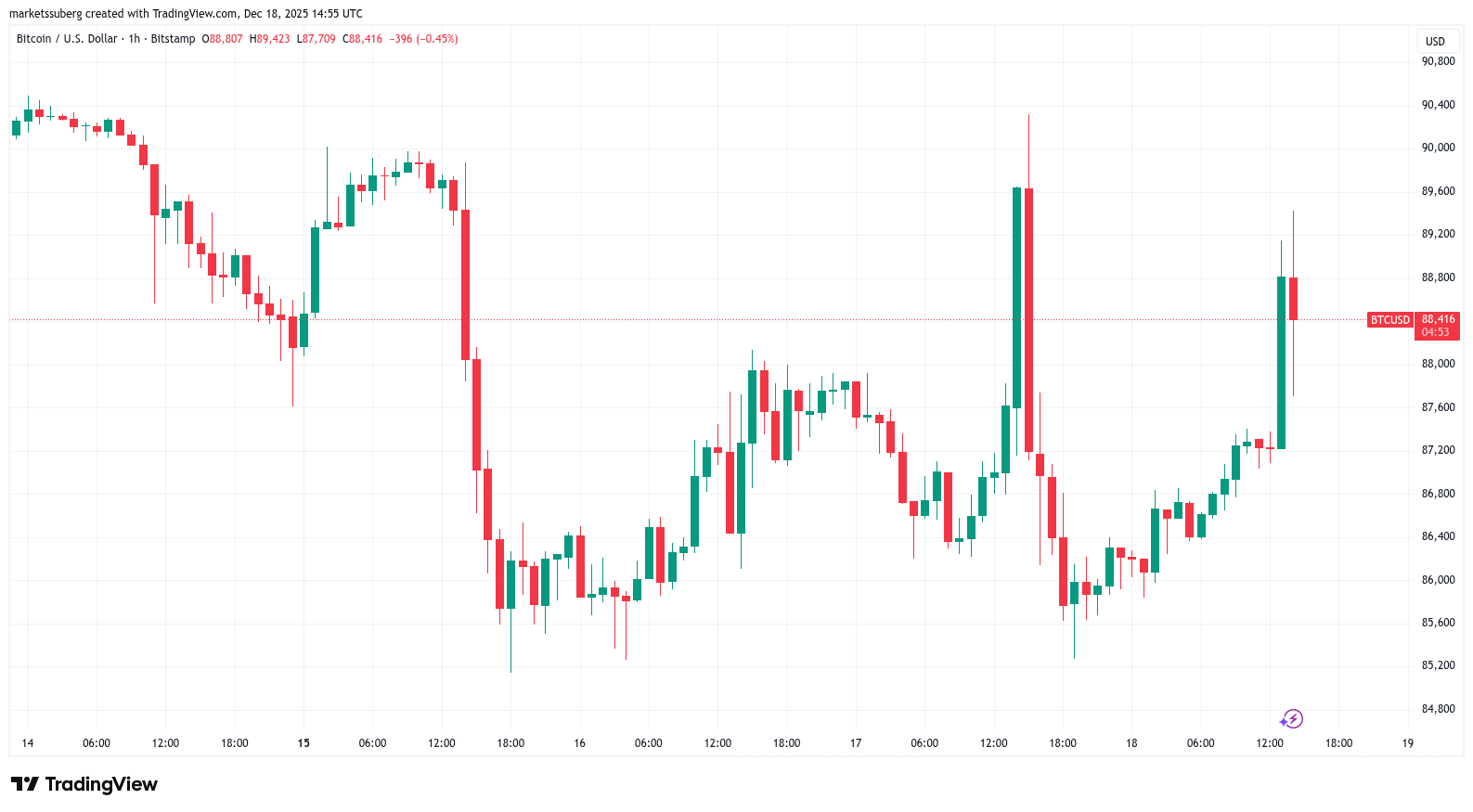
BTC/USD one-hour chart. Source: Cointelegraph/TradingView


The move followed the November release of the Consumer Price Index (CPI), which printed one of its largest monthly declines since 2023 — firmly against expectations.

“The all items index rose 2.7 percent for the 12 months ending November, after rising 3.0 percent over the 12 months ending September,” an official statement from the US Bureau of Labor Statistics (BLS) confirmed.

The BLS noted that October’s CPI report was not issued due to the government shutdown.

Reacting, trading resource The Kobeissi Letter led the surprise, suggesting that contrarian inflation signals could continue into next year.

“This puts Core CPI inflation in the US at its lowest level since March 2021,” it wrote in a post on X.

“According to this data, inflation is now at its closest point to the Fed's 2% target since the pandemic. 2026 is going to be a wild year.”
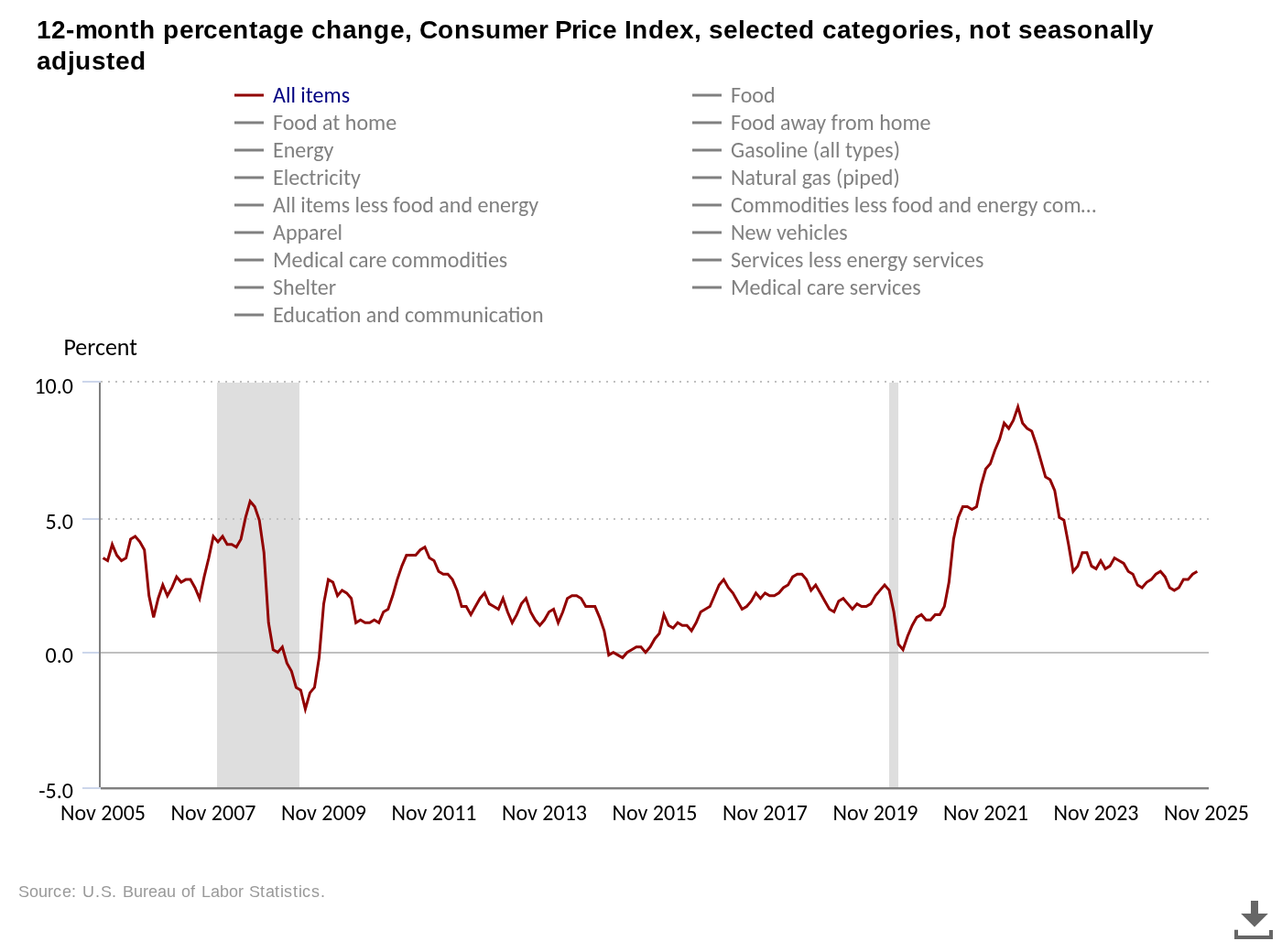
US CPI 12-month % change. Source: BLS


Versus the anticipated 3.1% increase, CPI had come in short by a “massive amount,” crypto trader Daan Crypto Trades continued.

“Risk assets like $BTC are rallying on the back of this, combined with a large fall in the dollar and bond yields,” an X post read.

“The 3 month annualized CPI is now just slightly over 2%. This should be very welcomed by the Fed. More rate cuts are expected to get priced in following this data.”
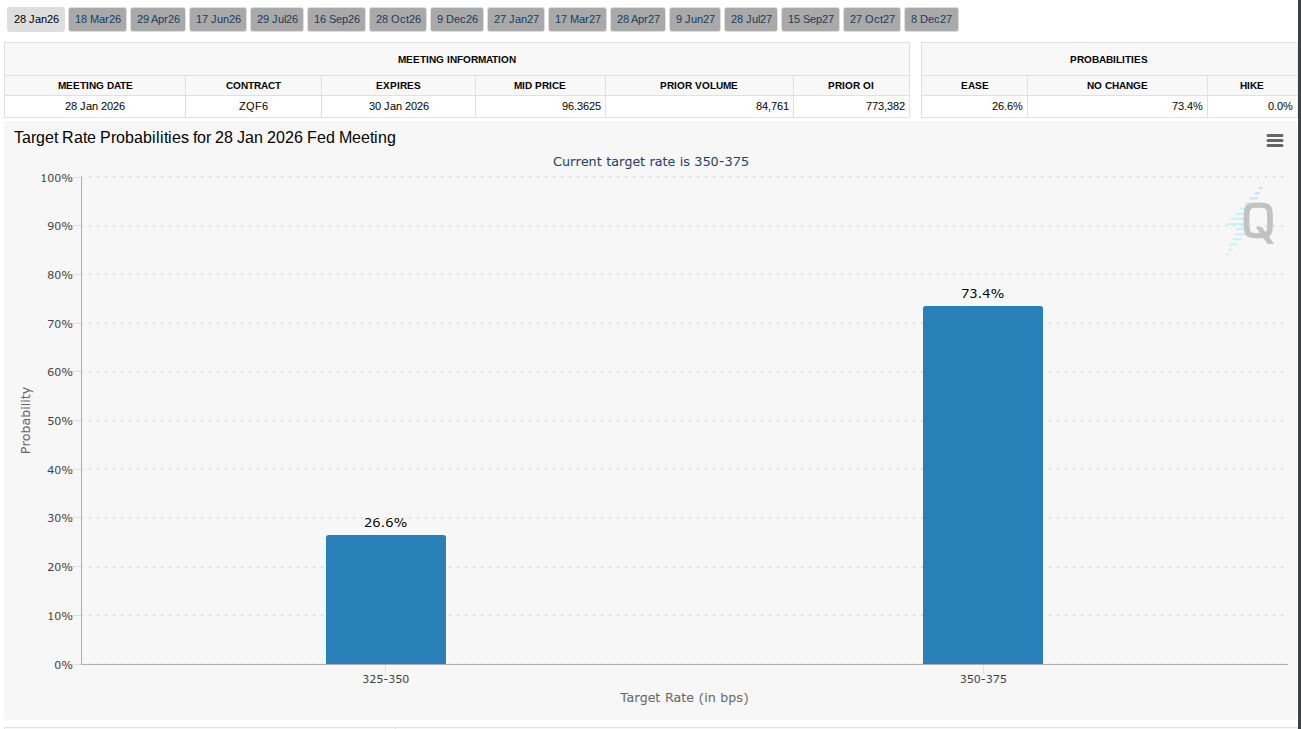
Fed target rate probabilities for January FOMC meeting (screenshot). Source: CME Group


Data from CME Group’s FedWatch Tool put the odds of a fresh interest-rate cut at the Fed’s Jan. 28 meeting at 26.6%.

New long-term BTC price low next?

As Cointelegraph reported, traders were suspicious of Bitcoin price action through this week and last due to “fakeouts” in either direction during US trading sessions.

Related: Bears take over below $90K? 5 things to know in Bitcoin this week

Accusations of market “manipulation” came as BTC/USD hit walls of liquidity both above and below while failing to sustain a new trend.

Total crypto liquidations for the 24 hours to the time of writing were over $630 million, per CoinGlass.
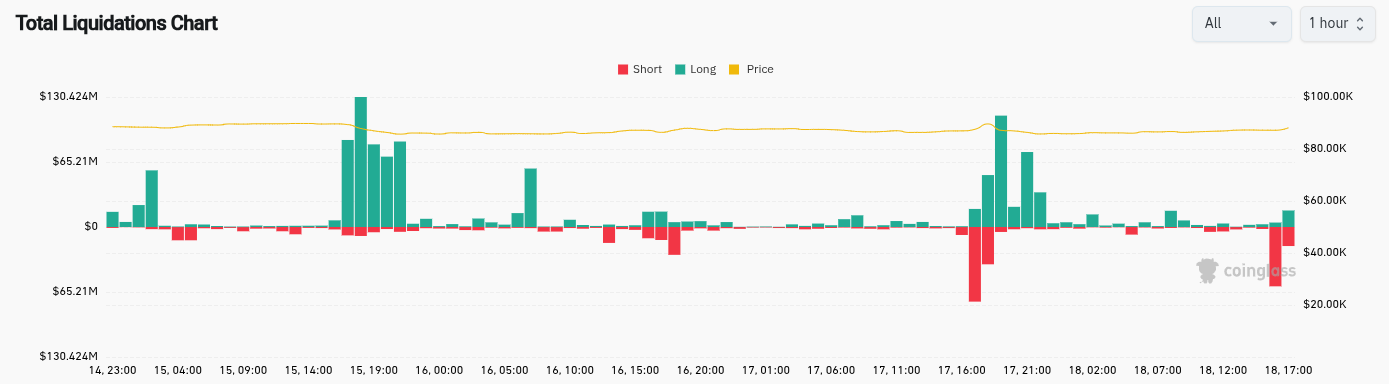
Crypto total liquidations (screenshot). Source: CoinGlass


With the snap moves continuing on the day, crypto trader and entrepreneur Ted Pillows eyed similarities to the start of the year.

“$BTC is mimicking the Q1 2025 fractal. What if this plays out?” he queried alongside a chart of Bitcoin futures.

The chart implied another macro bottom for BTC/USD still to come, similar to that seen in early April when the pair briefly dipped below $75,000.
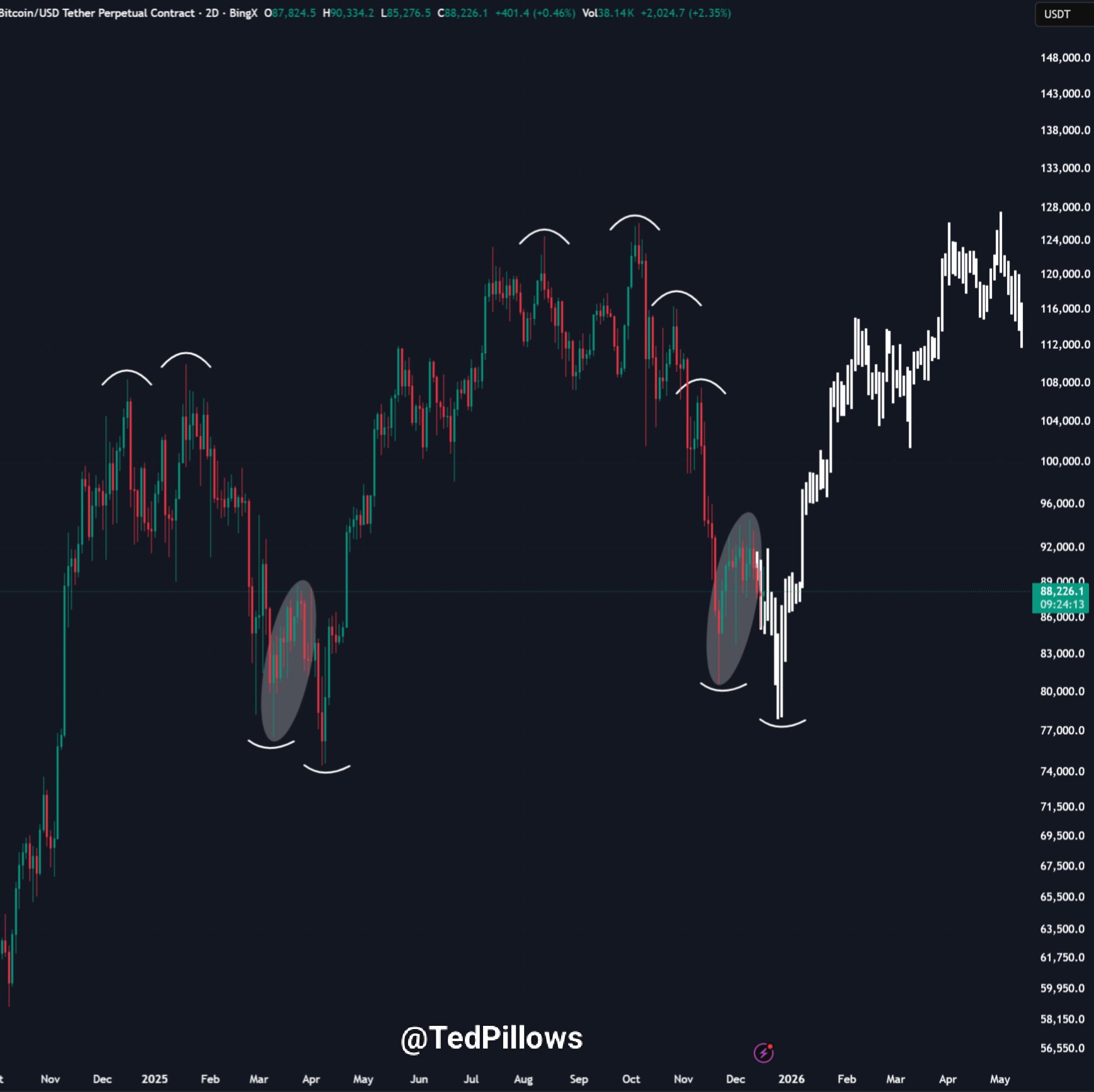
Bitcoin futures chart fractal. Source: Ted Pillows/X

This article does not contain investment advice or recommendations. Every investment and trading move involves risk, and readers should conduct their own research when making a decision. While we strive to provide accurate and timely information, Cointelegraph does not guarantee the accuracy, completeness, or reliability of any information in this article. This article may contain forward-looking statements that are subject to risks and uncertainties. Cointelegraph will not be liable for any loss or damage arising from your reliance on this information.


Пов'язані питання

QWhat was the key economic data released that caused Bitcoin's price volatility?

AThe US Consumer Price Index (CPI) for November, which showed inflation dropping to 2.7% year-over-year, the lowest since March 2021 and a significant miss against expectations.

QHow did the unexpected CPI data impact market expectations for Federal Reserve interest rates?

AThe data fueled bets on interest-rate cuts, with the CME Group's FedWatch Tool indicating a 26.6% probability of a rate cut at the Fed's January 28 meeting.

QAccording to the article, what pattern is Bitcoin's price action repeating?

ABitcoin's price action is repeating its early 2025 fractal, which some traders believe could imply another macro price bottom is still to come.

QWhat was the total value of crypto liquidations in the 24 hours surrounding the CPI news?

ATotal crypto liquidations for the 24 hours to the time of writing were over $630 million.

QWhy was the October CPI report not issued, as noted in the article?

AThe October CPI report was not issued due to the US government shutdown.

Пов'язані матеріали

Super-Rich Hoarded Record Cash in February, Stock Market Hit New Highs Four Months Later: Who's Getting Fooled?

In February, the total assets in US money market funds reached a record high of approximately $8.25 trillion, a trend highlighted by high-net-worth individuals increasing their cash holdings. Notably, Warren Buffett's Berkshire Hathaway amassed a $381.7 billion cash pile ahead of his 2025 retirement, while other prominent figures like Peter Thiel sold tech stocks, fueling narratives of wealthy investors seeking safety. However, by June, the trend reversed. Money market fund assets fell to around $7.87 trillion, indicating a flow of capital back into equities. Concurrently, the S&P 500 and Nasdaq reached all-time highs, with the S&P 500 surpassing 7600 points. This market surge occurred despite the earlier defensive moves, highlighting a potential opportunity cost for those who retreated to cash. Analysis shows that since early 2022, the S&P 500's total return significantly outpaced that of prime money market funds. The capital shifted from equities appears to have been partly reallocated into alternative investments like real estate, art, and private credit, especially among ultra-high-net-worth individuals. Meanwhile, major investment banks like Goldman Sachs and Morgan Stanley have raised their year-end targets for the S&P 500, citing AI-driven earnings growth, while also cautioning about risks including market concentration and economic fragility beneath the surface rally.

marsbit18 хв тому

Super-Rich Hoarded Record Cash in February, Stock Market Hit New Highs Four Months Later: Who's Getting Fooled?

marsbit18 хв тому

Robot Vacuums Have Been Competing for 20 Years, So Why Are 90% of Chinese Households Still Hesitant?

The article explores why over 90% of Chinese households are still hesitant to adopt robotic vacuum cleaners despite two decades of industry development, identifying a core "trust gap" as the primary barrier. The central issue is not a lack of need, but user concerns about reliability in dynamic, real-world home environments. Common anxieties include the robot dragging pet waste, colliding with transparent objects, tangling in cords, scattering cat litter, getting stuck on thresholds, missing corners under furniture, and requiring high-maintenance bases that develop odors. The industry's past focus on competing on technical specs (suction power, mopping functions) has not adequately addressed these practical usability and trust problems. The piece then examines DJI's entry into the market with its ROMO 2 model as a potential new approach. Leveraging its expertise in spatial perception and obstacle avoidance from drones, DJI's solution emphasizes "less intervention" through three key principles: less manual re-cleaning, less user rescue missions, and less maintenance. Specific ROMO 2 features highlighted include advanced obstacle recognition (handling transparent objects and small items), adaptive leg mechanisms for climbing thresholds (up to 8.5cm), an extendable arm for reaching under furniture, AI for identifying and appropriately handling different mess types (e.g., avoiding scattering dry debris), and a self-cleaning base designed to minimize user upkeep. The article argues the next phase of competition should shift from a "parameter race" to a "trust race." It draws a parallel to the iPhone's simplification of the smartphone, suggesting that focusing on a reliable, low-hassle user experience—where people feel confident leaving their floors to the machine—is what's needed to finally convince the vast majority of观望ing families. The ultimate test for products like the ROMO 2 will be long-term user adoption, retention, and口碑, not just technical specifications.

marsbit18 хв тому

Robot Vacuums Have Been Competing for 20 Years, So Why Are 90% of Chinese Households Still Hesitant?

marsbit18 хв тому

The Unclear American Economy: Resilient or Cooling Down?

**U.S. Economic Outlook: Resilient or Cooling Down?** This analysis examines whether the U.S. economy is heading towards a recession. While still growing, the economy shows significant signs of strain. Key data points include Q1 2026 GDP growth of 1.6% and Q1 PCE inflation at 4.5% (annualized), more than double the Fed's target. The labor market remains resilient but is softening, with unemployment at 4.3%. Critical recession indicators present a mixed picture: the yield curve has normalized after a prolonged inversion (historically a late-cycle signal), and the Conference Board's Leading Economic Index has been declining. Current recession probability for 2026 is estimated at 19%, but rises to 41% for 2027, indicating heightened delayed risks. Major pressures are building: a wall of corporate debt refinancing at higher rates, depleted consumer savings, a contracting housing sector, and an energy price shock. The economy exhibits stagflationary characteristics—high inflation alongside slowing growth—which constrains the Federal Reserve's policy options. Historical patterns show recessions are often preceded by Fed tightening and yield curve inversions. If a recession occurs, it is expected to be mild, similar to 2001 rather than 2008. For investors, a defensive portfolio shift toward staples, healthcare, and short-term high-quality bonds may be prudent, while maintaining a long-term, diversified perspective. Key developments to monitor include upcoming GDP, employment, and inflation data, as well as policy signals from the new Fed Chair.

marsbit26 хв тому

The Unclear American Economy: Resilient or Cooling Down?

marsbit26 хв тому

Торгівля

Спот
Ф'ючерси

Популярні статті

Як купити US

Ласкаво просимо до HTX.com! Ми зробили покупку Talus Network (US) простою та зручною. Дотримуйтесь нашої покрокової інструкції, щоб розпочати свою криптовалютну подорож.Крок 1: Створіть обліковий запис на HTXВикористовуйте свою електронну пошту або номер телефону, щоб зареєструвати обліковий запис на HTX безплатно. Пройдіть безпроблемну реєстрацію й отримайте доступ до всіх функцій.ЗареєструватисьКрок 2: Перейдіть до розділу Купити крипту і виберіть спосіб оплатиКредитна/дебетова картка: використовуйте вашу картку Visa або Mastercard, щоб миттєво купити Talus Network (US).Баланс: використовуйте кошти з балансу вашого рахунку HTX для безперешкодної торгівлі.Треті особи: ми додали популярні способи оплати, такі як Google Pay та Apple Pay, щоб підвищити зручність.P2P: Торгуйте безпосередньо з іншими користувачами на HTX.Позабіржова торгівля (OTC): ми пропонуємо індивідуальні послуги та конкурентні обмінні курси для трейдерів.Крок 3: Зберігайте свої Talus Network (US)Після придбання Talus Network (US) збережіть його у своєму обліковому записі на HTX. Крім того, ви можете відправити його в інше місце за допомогою блокчейн-переказу або використовувати його для торгівлі іншими криптовалютами.Крок 4: Торгівля Talus Network (US)Легко торгуйте Talus Network (US) на спотовому ринку HTX. Просто увійдіть до свого облікового запису, виберіть торгову пару, укладайте угоди та спостерігайте за ними в режимі реального часу. Ми пропонуємо зручний досвід як для початківців, так і для досвідчених трейдерів.

1.2k переглядів усьогоОпубліковано 2025.12.11Оновлено 2026.06.02

Як купити US

Обговорення

Ласкаво просимо до спільноти HTX. Тут ви можете бути в курсі останніх подій розвитку платформи та отримати доступ до професійної ринкової інформації. Нижче представлені думки користувачів щодо ціни US (US).

活动图片












