Bitcoin Hits 20-Month Low as Largest Bull Suffers $15 Billion Paper Loss

Foresight NewsОпубліковано о 2026-06-26Востаннє оновлено о 2026-06-26

Анотація

Bitcoin Hits 20-Month Low as Major Bull Loses $15 Billion On June 25th, Bitcoin fell below $60,000, hitting a low of $58,030—its lowest level since October 2024. The sell-off triggered over $1 billion in leveraged liquidations in 24 hours, with longs accounting for $788 million. This marks a more than 53% decline from the October 2025 all-time high of $126,198. A critical factor in the downturn is the weakening position of MicroStrategy, the largest corporate Bitcoin holder. With 847,363 BTC at an average cost of $75,651, the company now faces over $14.6 billion in unrealized losses. Its core financing flywheel—raising capital to buy Bitcoin—is stalling. Its variable-rate preferred shares (STRC), a key fundraising tool, have fallen 25% below their $100 target. This raises doubts about its ability to continue providing steady institutional demand for Bitcoin. Simultaneously, U.S. spot Bitcoin ETFs are experiencing significant outflows, with a single-day net outflow of $469 million on June 24th. This represents the most severe sustained capital flight since their launch. The macroeconomic backdrop remains restrictive, with persistent inflation delaying expected Fed rate cuts. Analysts note a shift in capital allocation, with institutional funds moving away from crypto towards AI infrastructure stocks. Immediate pressure comes from approximately $10 billion worth of Bitcoin options expiring on June 26th, which could increase market volatility. The combined effect of these fa...


By: ChandlerZ, Foresight News


On June 25, Bitcoin officially broke below the $60,000 level, hitting an intraday low of $58,030, marking its lowest point since October 2024. ETH fell in sync to $1,519, SOL traded at $65.99, with major assets across the board under pressure.


Data from Coinglass shows that over $1 billion in leveraged positions were liquidated in the past 24 hours, with long positions accounting for $788 million. The Fear & Greed Index dropped to 15, entering the Extreme Fear zone.
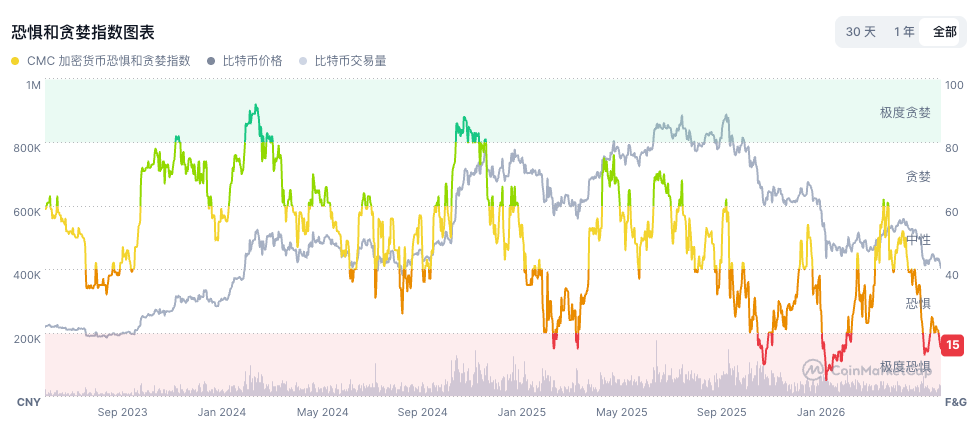


From its all-time high of $126,198 in October 2025, Bitcoin has now retreated more than 53%, with the bear market extending into its 8th month.


The bullish logic for Bitcoin over the past two years rested on two key pillars. First, the flywheel model represented by companies like Strategy continuously buying Bitcoin through securities financing. Second, the influx of large-scale institutional capital following the launch of US spot ETFs. These two channels together built the demand foundation for Bitcoin's last bull run. The current problem is that both pillars are simultaneously weakening.


Strategy's Financing Flywheel Continues to Lose Momentum


The most noteworthy variable in this decline is Strategy, the world's largest corporate holder of Bitcoin.


As of June 21, Strategy holds 847,363 bitcoins with an average cost basis of approximately $75,651, resulting in a paper loss exceeding $14.6 billion at current prices. Over the past few years, the company's core strategy has been to raise funds through issuing equity and preferred shares to continuously purchase Bitcoin. This cycle of "issuing securities, buying Bitcoin, pushing up the price, supporting the stock price, and issuing more securities" made it one of the most stable sources of institutional buying in the Bitcoin market and once propelled MSTR's stock price above $457 in 2024.


However, the key gears of this flywheel are slipping. In July 2025, Strategy completed a $2.5 billion IPO for a variable-rate preferred stock, STRC, designed to trade anchored to its $100 face value, with the company able to adjust the dividend rate monthly to maintain the peg. STRC was positioned as a financing product for the mass market, aiming to attract ordinary investors to participate indirectly in Bitcoin investment with lower volatility.


Since its debut, STRC has been consistently weak, falling to a historic low of about $75 on June 25, a 25% discount to its face value. According to its terms, if STRC falls below $95, it automatically triggers a 0.5% interest rate increase; its current annualized dividend yield has climbed to about 11.5%, increasing annual dividend expenses by approximately $53 million. The company's cash reserve is about $1.4 billion, sufficient to cover just over a year of dividend payments.


Andreja Cobeljic, Head of Derivatives Trading at Amina Bank, analyzed that while the direct cause of Bitcoin's current decline is a weakening market cycle, the deeper driver is the impact on the credibility of Strategy's strategy. If STRC continues to fail to return to its face value, Strategy's ability to raise funds through this channel to buy Bitcoin will be severely weakened, potentially cutting off what has been the most important incremental funding source for the Bitcoin market over the past two years.
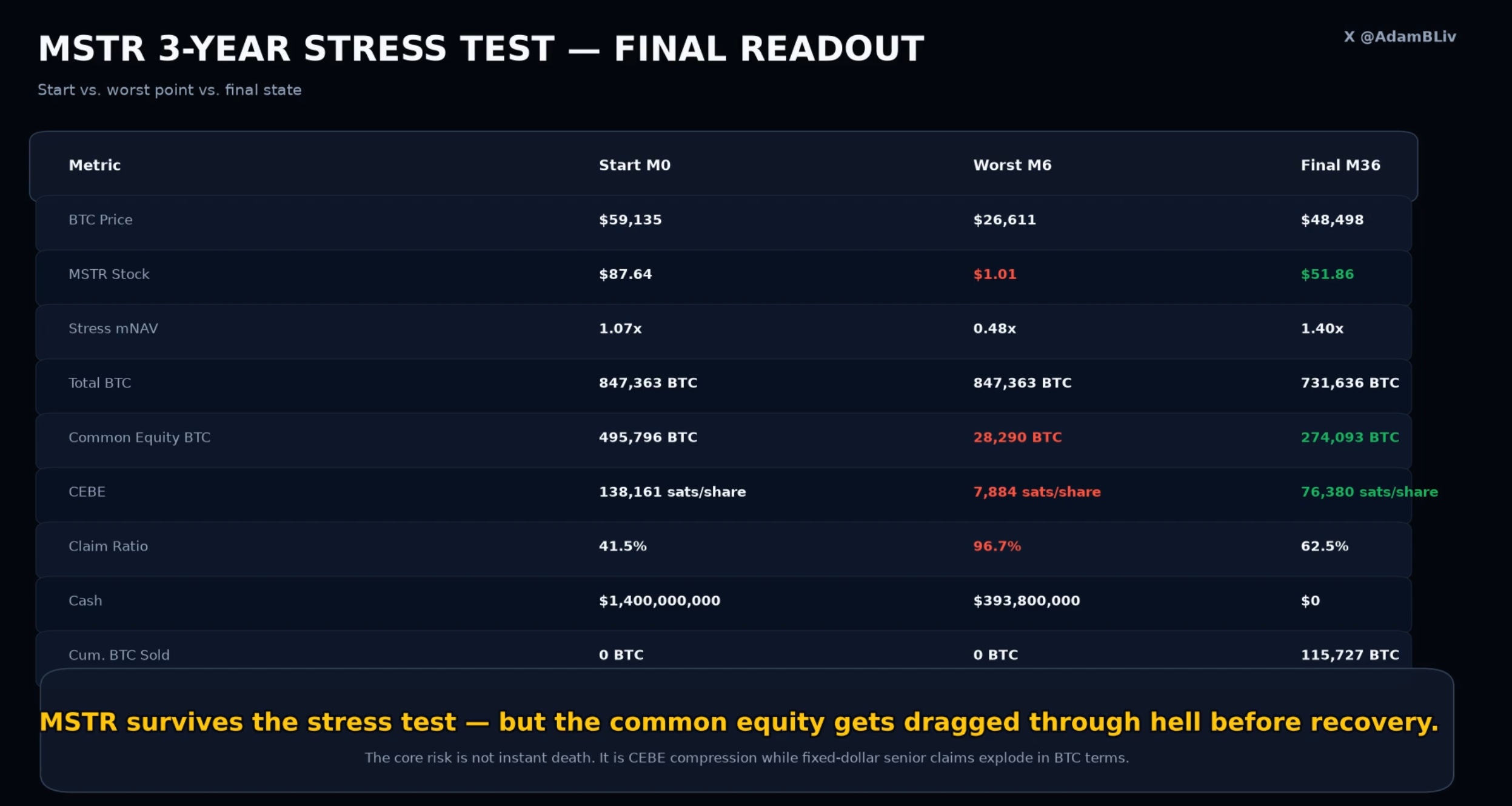


Analyst Adam Livingston conducted a three-year stress test on MSTR starting from current data, simulating an extreme scenario. The model assumes Bitcoin crashes 55% to $26,611 by month 6, while capital markets completely shut down, preventing Strategy from issuing new equity, new debt, or continuing to buy Bitcoin.


In this scenario, Strategy's priority debt structure quickly becomes perilous. Both preferred shares and bonds represent fixed-dollar claims; when the Bitcoin price collapses, their BTC-equivalent claims inflate dramatically. The model shows the BTC-equivalent claims of priority debt surging from 350,000 BTC to 819,000 BTC, accounting for 96.7% of total holdings and almost swallowing the entire Bitcoin inventory. The equity remaining for common shareholders collapses from 496,000 BTC to 28,000 BTC, with the MSTR stock price simulated to fall to $1.01. Meanwhile, monthly fixed expenses of $167.7 million (preferred dividends plus debt interest) continue to deplete cash. By month 9, cash runs out, forcing the company to start selling Bitcoin to service its debt obligations, cumulatively selling about 116,000 BTC over three years.


However, the model's conclusion is that Strategy survives. Assuming Bitcoin recovers to $48,498 in three years, the company would still hold 732,000 BTC, the MSTR stock price would return to $51.86, and the market-adjusted NAV (mNAV) ratio would recover to 1.40x. Livingston's assessment is that the real risk is not the "immediate bankruptcy" shouted by bears, but rather that priority debt, when measured in BTC, temporarily devours almost all common equity value during a price crash. Nevertheless, the model ultimately does not conclude with a "death spiral."


Institutional Retreat, Macro Tightening, Capital Shifts to AI


Strategy's issues are part of a larger picture of capital withdrawal.


US spot Bitcoin ETFs saw a single-day net outflow of $469 million on June 24, with BlackRock's IBIT accounting for $239 million, marking its fifth consecutive day of net outflows. Cumulative outflows for June total approximately $2.8 billion to $3.5 billion, constituting the most severe sustained capital flight since the products were approved in January 2024.


Bloomberg ETF analyst Eric Balchunas recently stated that Bitcoin's excessive reliance on the ETF and Strategy (MSTR) narratives should not be seen as the main value proposition for Bitcoin. He believes they should be the icing on the cake, not the whole cake. When Strategy's buying slows and the ETF channel simultaneously bleeds, Bitcoin's demand side loses its two most critical incremental sources.


Old money is leaving, and new money isn't coming in either, as the macro environment continues to tighten. The May PCE price index released on June 25 showed a year-over-year increase of 4.1%, the fastest pace in over three years. The Fed kept interest rates unchanged at 3.50%-3.75%, with expectations for a rate cut this year pushed further out. On the same day, US stocks initially rose but then fell. Apple announced global price hikes (up to $300) for multiple product lines due to memory chip shortages, causing its stock to plunge 5.1% and dragging the Nasdaq down from a 2.1% intraday gain to a loss of over 1%. Stubbornly high inflation implies persistently high funding costs, directly pressuring crypto assets that rely on liquidity expectations.


Deutsche Bank notes that a key difference in this downturn compared to previous cycles is the near absence of new retail buying, with institutional capital shifting en masse towards AI. On June 25, as Bitcoin fell below $60k and Apple tumbled, memory chip stocks rose across the board. Micron gained 8.6%, SanDisk rose 10.6%, and SK Hynix surged over 10% at one point on plans for a US listing. Capital made a directional choice between AI infrastructure and crypto assets.


Capital outflows, lack of new buy-side demand, and macro pressure all converged in the same week, culminating in a concentrated assault on the $60,000 support level.


~$10 Billion in Options Expire Today, Volatility May Persist


Beyond the aforementioned pressures, there is an immediate catalyst on June 26: Deribit will see approximately $10 billion in notional value of Bitcoin options expire, accounting for about 37% of current open interest. The put-to-call ratio is 0.83, indicating bullish bets still outnumber bearish ones. However, most call options are now out-of-the-money, while put options are concentrated in the $60,000-$65,000 and $70,000-$75,000 strike ranges, meaning bearish bets are more likely to be profitable.


Jean-David Pequignot, Chief Commercial Officer at Deribit, stated that this was an option structure positioned for mid-term higher prices and is now facing the test of declining spot prices.


Adam Haeems, Head of Asset Management at Tesseract Group, pointed out that quarter-end liquidity is typically thin, so prices might initially overshoot in either direction before mean-reverting after market makers hedge and close positions. However, a more significant test will arrive in the first week of July with quarterly contract settlements and leverage reductions.


Трендові криптовалюти

Пов'язані питання

QAccording to the article, what were the two key pillars of Bitcoin's demand base during the last bull market, and why are they now considered to be weakening?

AThe two key pillars were: 1) The flywheel model of companies like MicroStrategy continuously buying Bitcoin through securities financing. 2) Large-scale institutional capital inflows following the launch of U.S. spot ETFs. They are now weakening because MicroStrategy's financing product (STRC) is trading significantly below its target price, threatening its ability to raise new funds for Bitcoin purchases, and U.S. spot Bitcoin ETFs are experiencing their worst sustained outflows since launch in January 2024.

QBased on the analyst's extreme stress test model, what is the main risk MicroStrategy faces in a deep Bitcoin price crash scenario, and what was the model's ultimate conclusion about the company's survival?

AThe main risk is that MicroStrategy's priority debt (fixed-dollar claims from bonds and preferred stock) would balloon in BTC-equivalent terms, temporarily swallowing almost all the equity value for common shareholders. However, the model's ultimate conclusion was that MicroStrategy would survive the scenario, not spiral into bankruptcy, and its share price could eventually recover if Bitcoin's price later rebounded.

QWhat three broader factors does the article identify as contributing to the current concentrated pressure on Bitcoin's price support at $60,000?

AThe three broader factors are: 1) Capital outflows (from ETFs and potential slowdown from MicroStrategy). 2) An absence of new retail buying. 3) Macroeconomic tightening (persistent high inflation leading to high funding costs and delayed Fed rate cuts).

QHow is the current market dynamic regarding capital allocation different from previous cycles, according to Deutsche Bank's analysis cited in the article?

ADeutsche Bank's analysis indicates a key difference: while new retail buying for crypto has almost dried up, institutional capital is now making a directional shift and moving on a large scale towards AI (Artificial Intelligence) infrastructure investments instead.

QWhat immediate market event is noted for June 26th, and what does the put/call ratio suggest about market positioning?

AThe immediate event is the expiry of approximately $100 billion in notional value of Bitcoin options on Deribit, representing about 37% of current open interest. The put/call ratio of 0.83 suggests bullish bets (calls) still slightly outnumber bearish ones (puts), but a significant portion of the call options are now out-of-the-money, while put options are concentrated at strike prices near or above the current spot price, indicating the bearish bets are more likely to be profitable.

Пов'язані матеріали

Domestic First Explosion-Proof Certification, World's First Fueling Brain Solution: How Did They Secure Two 'Firsts'?

China's embodied AI sector is booming, with over ¥37 billion in funding this year. The focus has shifted decisively to real-world application, particularly in hazardous, repetitive tasks humans should avoid. A key, often prohibitive, barrier to entry for robots in environments like gas stations and oil fields is obtaining explosion-proof certification, requiring meticulous hardware and circuit design from the ground up. The article explores three main application areas. At gas stations, the challenge lies in executing a long, precise sequence of actions (opening caps, handling the fuel nozzle) with millimeter accuracy across diverse car models. For facility inspections, robots need sustained autonomous patrols combined with real-time anomaly detection and response. Port scenarios introduce the complexity of multi-robot coordination. Addressing the core challenge of long-horizon tasks, the piece highlights a technical breakthrough: a "world model"-driven approach. This enables predictive planning, allowing the AI to visualize the desired end-state (e.g., nozzle returned, cap closed) and work backward to synthesize intermediate visual frames. This "imagination" of the task trajectory, as implemented in the H-GAR architecture, guides action generation, significantly reducing cumulative error in multi-step operations. The three-step H-GAR process involves generating a coarse action draft, synthesizing target-conditioned observation frames, and then refining actions based on visual context and a memory of past successful motions. The conclusion emphasizes that success in specialized, safety-critical fields requires long-term commitment and deep integration of the "embodied brain" (AI) with a purpose-built, certified physical "body." Mastering this brain-body-data闭环 (closed-loop) is positioned as a crucial competitive advantage for commercialization.

marsbit35 хв тому

Domestic First Explosion-Proof Certification, World's First Fueling Brain Solution: How Did They Secure Two 'Firsts'?

marsbit35 хв тому

Bitcoin Bear Market Triggers Crypto Layoffs, Yet Fuels Industry's Most Aggressive M&A Wave Ever

A prolonged Bitcoin downturn is forcing crypto companies to lay off employees and automate operations, but has simultaneously triggered the industry's most aggressive wave of mergers and acquisitions (M&A). In the first half of 2026, crypto M&A deal value reached $93.7 billion, 26 times higher than the same period last year. This activity is primarily driven by traditional financial institutions—banks, payment processors, and asset managers—who are acquiring compliant crypto infrastructure like custody solutions, payment rails, and regulatory licenses instead of building them internally. Examples include Mastercard's acquisition of stablecoin firm BVNK and Franklin Templeton's launch of a dedicated crypto division via acquisition. This consolidation contrasts sharply with a shrinking crypto labor market, where active job openings have plummeted. Companies like Coinbase are restructuring to become "AI-native," leading to a sharp increase in roles requiring AI skills, while engineering and compliance positions now dominate hiring. Financially pressured crypto firms, such as Messari which was acquired at a fraction of its prior valuation, are becoming prime targets. Capital remains available but is highly selective, flowing overwhelmingly into businesses that bridge digital assets with traditional finance, such as tokenization platforms and regulated trading venues. The trend indicates a market where capital is rewarding compliant, utility-focused infrastructure while weaker models consolidate or downsize.

marsbit36 хв тому

Bitcoin Bear Market Triggers Crypto Layoffs, Yet Fuels Industry's Most Aggressive M&A Wave Ever

marsbit36 хв тому

Trillion-Dollar Pension Fund Entry? Franklin Bitcoin Dividend Reinvestment ETF Comes with a Built-in Selling Pressure Ceiling

Franklin Templeton has filed to launch two ETFs that embed a "default configuration" logic into Bitcoin investment, aiming to tap into massive pension fund flows. These "Bitcoin Dividend Reinvestment Index ETFs" will initially hold 95% equities and 5% Bitcoin, automatically reinvesting stock dividends to buy Bitcoin. However, a quarterly rebalancing rule forces selling of Bitcoin if its allocation exceeds 5%, capping its maximum holding at 20%. While the product cleverly circumvents advisor reluctance and compliance hurdles by labeling itself as a U.S. equity product, its actual Bitcoin buying power is minimal. Given low dividend yields (e.g., ~1% for broad market indices), annual Bitcoin purchases from a fund the size of Franklin's existing Bitcoin ETF would be a mere $3.6 million—negligible against Bitcoin's daily trading volume. Crucially, during bull markets, the fund becomes a programmed, passive *seller* of Bitcoin, potentially creating sustained sell pressure if many similar funds emerge. The strategy leverages investor inertia and automatic enrollment, similar to the success of target-date funds in 401(k) plans. It also uses an offshore Cayman subsidiary for holding Bitcoin and raises a tax complication where investors must pay taxes on dividends they never receive as cash. Although recent U.S. regulatory changes allow crypto in retirement plans, widespread adoption as a default option faces legal hurdles. The core premise remains: the system doesn't need to convince anyone to buy Bitcoin actively; it simply relies on people doing nothing.

marsbit1 год тому

Trillion-Dollar Pension Fund Entry? Franklin Bitcoin Dividend Reinvestment ETF Comes with a Built-in Selling Pressure Ceiling

marsbit1 год тому

Торгівля

Спот
Ф'ючерси

Популярні статті

Що таке BITCOIN

Розуміння HarryPotterObamaSonic10Inu (ERC-20) та його позиції у крипто-просторі Останніми роками ринок криптовалют спостерігав за зростанням популярності мем-коінів, які привертають інтерес не тільки трейдерів, але й тих, хто шукає спілкування та розважальну цінність. Серед цих унікальних токенів є HarryPotterObamaSonic10Inu (ERC-20), інтригуючий проект, що поєднує культурні посилання з тканинами криптовалюти. Ця стаття досліджує ключові аспекти HarryPotterObamaSonic10Inu, вивчаючи його механізми, спільноту та його взаємодію з ширшим крипто-ландшафтом. Що таке HarryPotterObamaSonic10Inu (ERC-20)? Як випливає з його назви, HarryPotterObamaSonic10Inu є мем-коіном, побудованим на блокчейні Ethereum, класифікованим за стандартом ERC-20. На відміну від традиційних криптовалют, які можуть підкреслювати практичну корисність або інвестиційний потенціал, цей токен процвітає завдяки розважальній цінності та силі своєї спільноти. Проект спрямований на створення середовища, де зацікавлені користувачі можуть об'єднуватися, ділитися ідеями та брати участь у заходах, натхненних різноманітними культурними явищами. Однією з примітних особливостей HarryPotterObamaSonic10Inu є нульовий податок на транзакції. Цей привабливий елемент має на меті заохочувати торгівлю та участь у спільноті, позбавлену додаткових витрат, які можуть відлякувати дрібних трейдерів. Загальна пропозиція монет становить один мільярд токенів, що позначає намір підтримувати суттєву циркуляцію в межах спільноти. Творець HarryPotterObamaSonic10Inu (ERC-20) Походження HarryPotterObamaSonic10Inu дещо окутане таємницею; деталі про творця залишаються невідомими. Розвиток цього токена позбавлений впізнаваної команди або чіткої стратегії, що не є рідкістю в секторі мем-коінів. Натомість проект виник органічно, а його розвиток значною мірою залежить від ентузіазму та участі його спільноти. Інвестори HarryPotterObamaSonic10Inu (ERC-20) Щодо зовнішніх інвестицій та підтримки, HarryPotterObamaSonic10Inu також залишається невизначеним. Токен не зазначає жодних відомих інвестиційних фондів або значної організаційної підтримки. Натомість життєва сила проекту полягає в його базовій спільноті, яка інформує про його зростання та стійкість через колективні дії та залученість у крипто-просторі. Як працює HarryPotterObamaSonic10Inu (ERC-20)? Як мем-коін, HarryPotterObamaSonic10Inu функціонує передусім поза традиційними рамками, що часто регулюють вартість активів. Є кілька відмінних аспектів, що визначають, як працює проект: Транзакції без податку: Завдяки відсутності податкових зборів на транзакції, користувачі можуть вільно купувати та продавати токен, не турбуючись про приховані витрати. Залучення спільноти: Проект процвітає завдяки взаємодії спільноти, використовуючи соціальні медіа для створення шуму та сприяння залученню. Обговорення, обмін контентом та залученість є ключовими елементами, що допомагають розширити його охоплення та зміцнити лояльність серед прихильників. Відсутність практичної корисності: Слід зазначити, що HarryPotterObamaSonic10Inu не пропонує конкретної корисності в рамках фінансової екосистеми. Натомість він класифікується як токен, що призначений в основному для розваги та спільнотних активностей. Культурне посилання: Токен кмітливо вплітає елементи популярної культури, щоб привернути інтерес, зв'язуючи з ентузіастами мемів та крипто-стежками. HarryPotterObamaSonic10Inu ілюструє, як мем-коіни функціонують інакше, ніж традиційні криптовалютні проекти, увійшовши на ринок як інноваційні соціальні конструкти, а не утилітарні активи. Хронологія HarryPotterObamaSonic10Inu (ERC-20) Історія HarryPotterObamaSonic10Inu відзначена кількома значними етапами: Створення: Токен виник з вірусного мему, захопивши уяву багатьох крипто-ентузіастів. Конкретні дати створення недоступні, що підкреслює його органічний розвиток. Лістинг на біржах: HarryPotterObamaSonic10Inu з'явився на різних біржах, дозволяючи зручніший доступ і торгівлю спільноти. Ініціативи залучення спільноти: Ведення діяльності, спрямованої на покращення взаємодії спільноти, включаючи конкурси, кампанії в соціальних мережах та створення контенту від фанатів та прихильників. Плани на майбутнє: Дорожня карта проекту включає запуск колекції NFT, мерчандайзинг та електронну комерцію, пов'язану з його культурними темами, що далі залучає спільноту та намагається додати більше вимірів до його екосистеми. Ключові моменти про HarryPotterObamaSonic10Inu (ERC-20) Спільнотний підхід: Проект надає пріоритет колективному внеску та креативності, забезпечуючи, щоб участь користувачів була в центрі його розвитку. Класифікація як мем-коін: Це є його епігенез розважальної криптовалюти, що відрізняється від традиційних інвестиційних інструментів. Жодного прямого відношення до Bitcoin: Незважаючи на схожість у назві, HarryPotterObamaSonic10Inu є відмінним і не має жодного зв’язку з Bitcoin або іншими усталеними криптовалютами. Зосередженість на співпраці: HarryPotterObamaSonic10Inu створено для того, щоб надати простір для співпраці та обміну історіями серед його власників, забезпечуючи шлях для творчості та спільного зв'язку. Перспективи на майбутнє: Амбіція розширитися за межі початкової концепції в NFT та мерчандайз відкриває шлях для проекту потенційно потрапити в більш мейнстрімні сфери цифрової культури. Оскільки мем-коіни продовжують захоплювати уяву спільноти криптовалют, HarryPotterObamaSonic10Inu (ERC-20) вирізняється своїми культурними зв'язками та орієнтованим на спільноту підходом. Хоча він може не відповідати типовій моделі утилітарного токена, його суть полягає в радощах і товариськості, що підтримуються серед його прихильників, підкреслюючи еволюційну природу криптовалют в усе більш цифрову епоху. Оскільки проект продовжує розвиватися, важливо спостерігати за тим, як динаміка спільноти вплине на його траєкторію в постійно змінюваному ландшафті технології блокчейн.

2.1k переглядів усьогоОпубліковано 2024.04.01Оновлено 2024.12.03

Що таке BITCOIN

Як купити BTC

Ласкаво просимо до HTX.com! Ми зробили покупку Bitcoin (BTC) простою та зручною. Дотримуйтесь нашої покрокової інструкції, щоб розпочати свою криптовалютну подорож.Крок 1: Створіть обліковий запис на HTXВикористовуйте свою електронну пошту або номер телефону, щоб зареєструвати обліковий запис на HTX безплатно. Пройдіть безпроблемну реєстрацію й отримайте доступ до всіх функцій.ЗареєструватисьКрок 2: Перейдіть до розділу Купити крипту і виберіть спосіб оплатиКредитна/дебетова картка: використовуйте вашу картку Visa або Mastercard, щоб миттєво купити Bitcoin (BTC).Баланс: використовуйте кошти з балансу вашого рахунку HTX для безперешкодної торгівлі.Треті особи: ми додали популярні способи оплати, такі як Google Pay та Apple Pay, щоб підвищити зручність.P2P: Торгуйте безпосередньо з іншими користувачами на HTX.Позабіржова торгівля (OTC): ми пропонуємо індивідуальні послуги та конкурентні обмінні курси для трейдерів.Крок 3: Зберігайте свої Bitcoin (BTC)Після придбання Bitcoin (BTC) збережіть його у своєму обліковому записі на HTX. Крім того, ви можете відправити його в інше місце за допомогою блокчейн-переказу або використовувати його для торгівлі іншими криптовалютами.Крок 4: Торгівля Bitcoin (BTC)Легко торгуйте Bitcoin (BTC) на спотовому ринку HTX. Просто увійдіть до свого облікового запису, виберіть торгову пару, укладайте угоди та спостерігайте за ними в режимі реального часу. Ми пропонуємо зручний досвід як для початківців, так і для досвідчених трейдерів.

4.9k переглядів усьогоОпубліковано 2024.12.12Оновлено 2026.06.02

Як купити BTC

Що таке $BITCOIN

ЦИФРОВЕ ЗОЛОТО ($BITCOIN): Комплексний аналіз Вступ до ЦИФРОВОГО ЗОЛОТА ($BITCOIN) ЦИФРОВЕ ЗОЛОТО ($BITCOIN) — це проект на основі блокчейну, що працює в мережі Solana, який має на меті поєднати характеристики традиційних дорогоцінних металів з інноваціями децентралізованих технологій. Хоча він має таку ж назву, як і Bitcoin, який часто називають “цифровим золотом” через його сприйняття як засобу збереження вартості, ЦИФРОВЕ ЗОЛОТО є окремим токеном, розробленим для створення унікальної екосистеми в ландшафті Web3. Його мета — позиціонувати себе як життєздатний альтернативний цифровий актив, хоча деталі щодо його застосувань і функціональностей все ще розробляються. Що таке ЦИФРОВЕ ЗОЛОТО ($BITCOIN)? ЦИФРОВЕ ЗОЛОТО ($BITCOIN) — це токен криптовалюти, спеціально розроблений для використання в блокчейні Solana. На відміну від Bitcoin, який виконує широко визнану роль зберігання вартості, цей токен, здається, зосереджується на більш широких застосуваннях і характеристиках. Помітні аспекти включають: Інфраструктура блокчейну: Токен побудований на блокчейні Solana, відомому своєю здатністю обробляти швидкі та низьковартісні транзакції. Динаміка постачання: ЦИФРОВЕ ЗОЛОТО має максимальне постачання, обмежене 100 квадрильйонами токенів (100P $BITCOIN), хоча деталі щодо його обігового постачання наразі не розголошуються. Утиліта: Хоча точні функціональності не викладені, є вказівки на те, що токен може бути використаний для різних застосувань, потенційно пов'язаних з децентралізованими додатками (dApps) або стратегіями токенізації активів. Хто є творцем ЦИФРОВОГО ЗОЛОТА ($BITCOIN)? На даний момент особа творців і команди розробників, що стоять за ЦИФРОВИМ ЗОЛОТОМ ($BITCOIN), залишається невідомою. Ця ситуація є типовою для багатьох інноваційних проектів у сфері блокчейну, особливо тих, що пов'язані з децентралізованими фінансами та феноменом мем-коінів. Хоча така анонімність може сприяти культурі, орієнтованій на спільноту, вона посилює занепокоєння щодо управління та підзвітності. Хто є інвесторами ЦИФРОВОГО ЗОЛОТА ($BITCOIN)? Доступна інформація вказує на те, що ЦИФРОВЕ ЗОЛОТО ($BITCOIN) не має жодних відомих інституційних спонсорів або помітних венчурних капіталовкладень. Проект, здається, працює за моделлю “рівний до рівного”, зосереджуючись на підтримці та прийнятті спільноти, а не на традиційних шляхах фінансування. Його активність і ліквідність переважно розташовані на децентралізованих біржах (DEX), таких як PumpSwap, а не на встановлених централізованих торгових платформах, що ще більше підкреслює його підхід знизу вгору. Як працює ЦИФРОВЕ ЗОЛОТО ($BITCOIN) Операційні механізми ЦИФРОВОГО ЗОЛОТА ($BITCOIN) можна детальніше розглянути на основі його дизайну блокчейну та характеристик мережі: Механізм консенсусу: Використовуючи унікальний proof-of-history (PoH) Solana в поєднанні з моделлю proof-of-stake (PoS), проект забезпечує ефективну валідацію транзакцій, що сприяє високій продуктивності мережі. Токеноміка: Хоча конкретні дефляційні механізми не були детально описані, велике максимальне постачання токенів вказує на те, що воно може задовольняти мікротранзакції або нішеві випадки використання, які ще потрібно визначити. Інтероперабельність: Існує потенціал для інтеграції з більш широкою екосистемою Solana, включаючи різні платформи децентралізованих фінансів (DeFi). Однак деталі щодо конкретних інтеграцій залишаються невизначеними. Хронологія ключових подій Ось хронологія, яка підкреслює значні віхи, пов'язані з ЦИФРОВИМ ЗОЛОТОМ ($BITCOIN): 2023: Початкове розгортання токена відбувається на блокчейні Solana, позначене його адресою контракту. 2024: ЦИФРОВЕ ЗОЛОТО набуває видимості, оскільки стає доступним для торгівлі на децентралізованих біржах, таких як PumpSwap, що дозволяє користувачам торгувати ним проти SOL. 2025: Проект спостерігає спорадичну торгову активність і потенційний інтерес до ініціатив, очолюваних спільнотою, хоча на даний момент не зафіксовано жодних значних партнерств або технічних досягнень. Критичний аналіз Сильні сторони Масштабованість: Основна інфраструктура Solana підтримує високі обсяги транзакцій, що може підвищити утиліту $BITCOIN у різних сценаріях транзакцій. Доступність: Потенційно низька торгова ціна за токен може привабити роздрібних інвесторів, сприяючи більш широкій участі завдяки можливостям дробового володіння. Ризики Відсутність прозорості: Відсутність публічно відомих спонсорів, розробників або процесу аудиту може викликати скептицизм щодо стійкості та надійності проекту. Волатильність ринку: Торгова активність сильно залежить від спекулятивної поведінки, що може призвести до значної волатильності цін і невизначеності для інвесторів. Висновок ЦИФРОВЕ ЗОЛОТО ($BITCOIN) постає як цікавій, але неоднозначний проект у швидко розвиваючійся екосистемі Solana. Хоча він намагається використати наратив “цифрового золота”, його відхід від встановленої ролі Bitcoin як засобу збереження вартості підкреслює необхідність чіткішого розмежування його передбачуваної утиліти та структури управління. Майбутнє прийняття та адаптація, ймовірно, залежатиме від вирішення поточної непрозорості та більш чіткого визначення його операційних та економічних стратегій. Примітка: Цей звіт охоплює синтезовану інформацію, доступну станом на жовтень 2023 року, і можуть відбутися події, що виходять за межі дослідницького періоду.

121 переглядів усьогоОпубліковано 2025.05.13Оновлено 2025.05.13

Що таке $BITCOIN

Обговорення

Ласкаво просимо до спільноти HTX. Тут ви можете бути в курсі останніх подій розвитку платформи та отримати доступ до професійної ринкової інформації. Нижче представлені думки користувачів щодо ціни BTC (BTC).

活动图片