Bitcoin Community Erupts, BIP-110 Sparks Value Dispute Among OG's Attention

marsbitОпубліковано о 2026-02-25Востаннє оновлено о 2026-02-25

Анотація

Bitcoin community is embroiled in a heated debate over BIP-110, a proposal aiming to restrict non-financial data such as Ordinals and Runes inscriptions via a soft fork. The initiative, led by developer Dathon Ohm, represents a push by "minimalists" against what they deem excessive data usage that threatens network performance and decentralization. A key point of contention is the proposal’s 55% activation threshold—significantly lower than Bitcoin’s traditional 95% miner approval requirement for consensus changes. Supporters argue it prevents minority veto power and defends against blockchain "spam," while opponents, including Adam Back and Michael Saylor, warn it risks chain splits, undermines immutability, and sets a dangerous precedent for future governance. The debate also touches on economic concerns: miners fear losing fee revenue from inscription transactions, while proponents claim current SegWit discounts unfairly subsidize non-monetary data. Node operators are already shifting client allegiance, with Bitcoin Knots gaining traction. Ultimately, BIP-110 raises fundamental questions about Bitcoin’s purpose: whether it should remain purely monetary or accommodate broader data use cases, balancing scalability, security, and decentralization.

Author: Jae, PANews

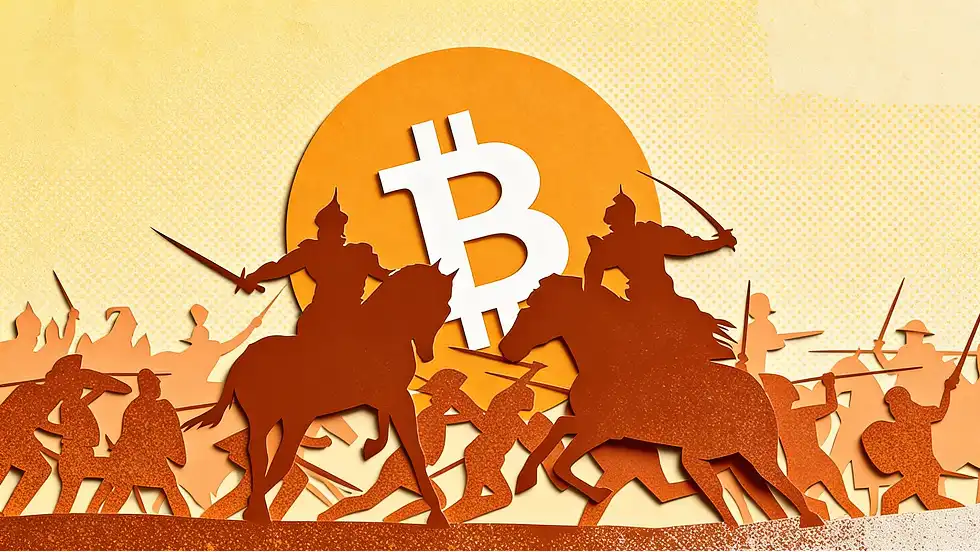
The Bitcoin network is undergoing an ideological debate no less intense than the "Block Size Wars" of 2017.

The catalyst is a technical proposal named BIP-110. It attempts, through a soft fork, to draw a red line on the amount of data that can be stuffed into a Bitcoin block. Simply put, it aims to restrict protocols like Ordinals and Runes from "inscribing" images, videos, and even code onto the chain.

The emergence of BIP-110 marks a counterattack launched by the "minimalist" camp, led by developer Dathon Ohm, against the "libertarian" camp.

Supporters call it "setting things right," while opponents denounce it as "extremely conservative." This debate has spread from technical circles to miners, institutions, major node operators, and even caught the attention of community leaders like Adam Back.

This is more than a debate about bytes; it's a battle over defining Bitcoin's value proposition.

BIP-110, Targeting Inscription Protocols Directly

BIP-110 is not a spur-of-the-moment idea; its雏形 (prototype/chrysalis) can be traced back to BIP-444 proposed by Dathon Ohm in October 2025, aiming to temporarily limit the scale of non-monetary data to observe the network's operation under low load.

The initial idea was just to "temporarily observe for a year." But with Bitcoin Core v30 removing the byte limit on OP_RETURN, the fundamentalists could no longer sit still, viewing this as a betrayal of Bitcoin's "monetary function," tantamount to giving a green light to "blockchain spam."

Thus, Dathon Ohm presented the more stringent BIP-110 last December, with constraints harsher than before.
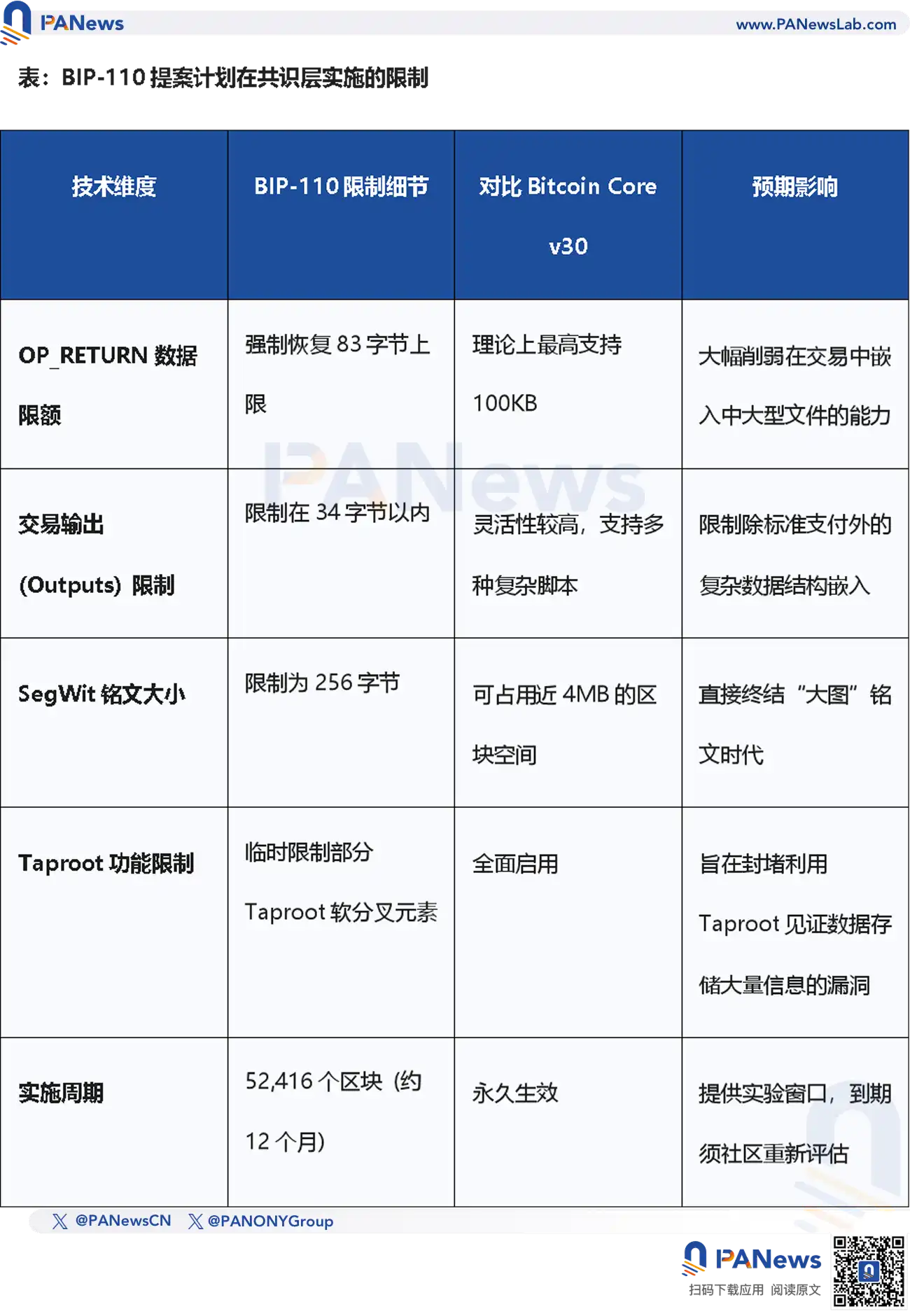
Supporters of BIP-110 believe these limits are not meant to stifle innovation but to restore the technical prudence Bitcoin maintained in its early days. These rules do not affect normal "payment" and "store of value" use cases; their矛头 (spearhead) is pointed directly at non-financial records deemed "data abuse."

55% Activation Threshold Sparks Controversy, Mob Rule or Decentralization?

What truly made the community erupt was BIP-110's activation threshold: support from 55% of the hash rate is sufficient for passage.

In Bitcoin's governance tradition, major consensus changes typically require support from 95% of the miner hash rate to ensure network stability and prevent chain splits. Previously, major upgrades like SegWit and Taproot followed this unwritten rule.

The setting of this threshold has caused significant governance chaos within the community.

The proponent faction argues that the 95% threshold effectively gives a minority a "veto power." The reason spam data can't be cleared is that a minority of stakeholders stubbornly resist. The 55% setting is primarily a "defensive activation" aimed at breaking the deadlock in protocol upgrades.

Opposition leader Adam Back accused this of being "a mob attack on Bitcoin's reputation," attempting to force a rule change without broad consensus.

55% means that a simple majority of miners agreeing forces the remaining 45% of miners and users to accept it. This is holding the entire network hostage with a low threshold, easily leading to chain splits and creating two or even multiple Bitcoin assets.

Even more frightening to contemplate is that once this precedent is set, if data can be limited today, could addresses be frozen tomorrow? Bitcoin's "immutability" would then exist in name only.

Camp Standoff, Minimalism Might Cut Off Miners' Revenue Stream

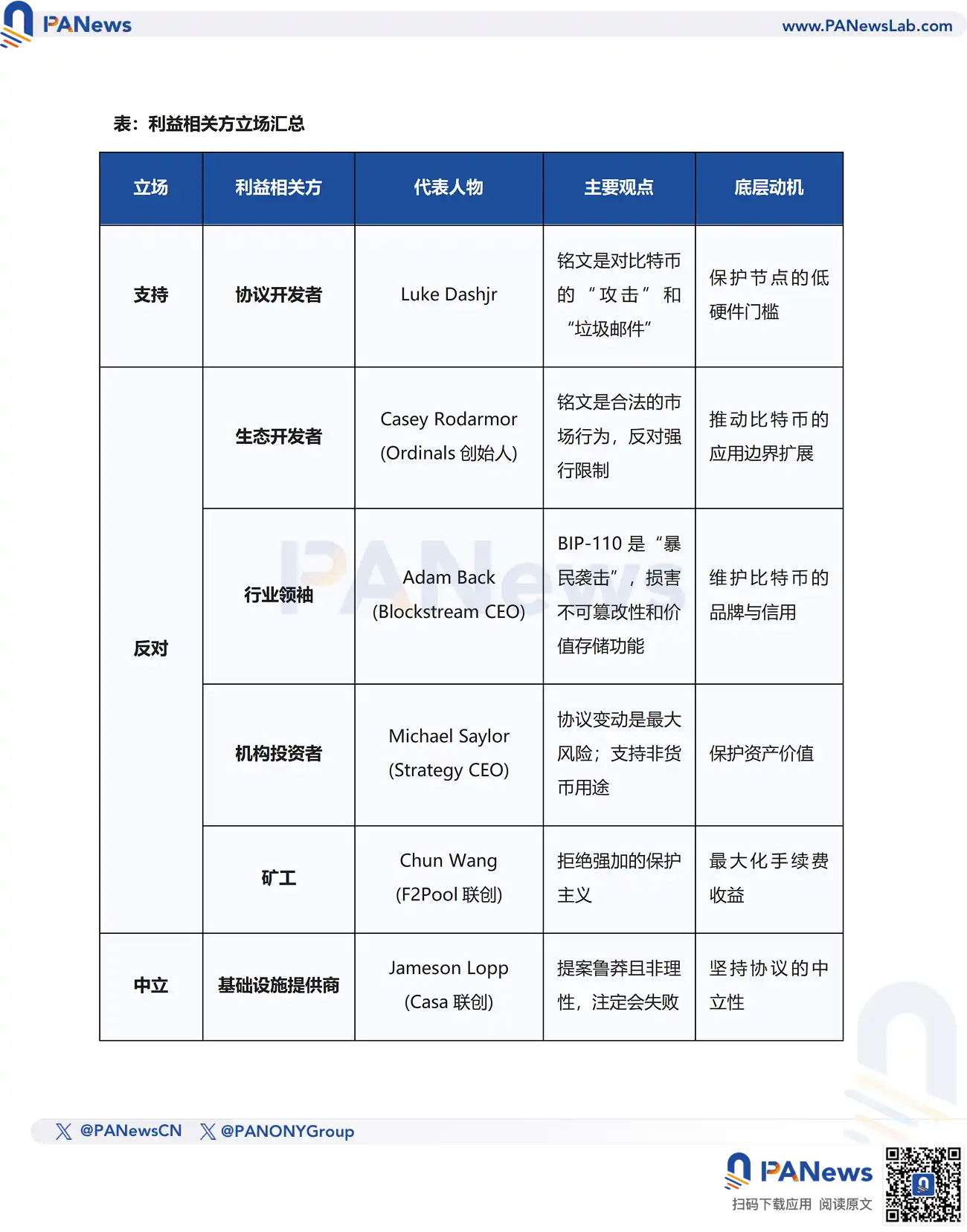
The developer community led by Luke Dashjr and loyal users of the full-node client Bitcoin Knots are the underlying driving force behind BIP-110. Their logic is rooted in concerns about Bitcoin's underlying hardware requirements.

Bitcoin advocate Matthew Kratter compared inscription protocols to ivy, suggesting that while they grow attached to the Bitcoin (tree), they will eventually crush the tree's structure, leading to the death of both.

If block space is filled with images, the blockchain's size will grow exponentially. This means ordinary users will be unable to run full nodes using regular consumer-grade hard drives, leading to the concentration of verification power in the hands of large nodes, undermining Bitcoin's decentralized foundation.

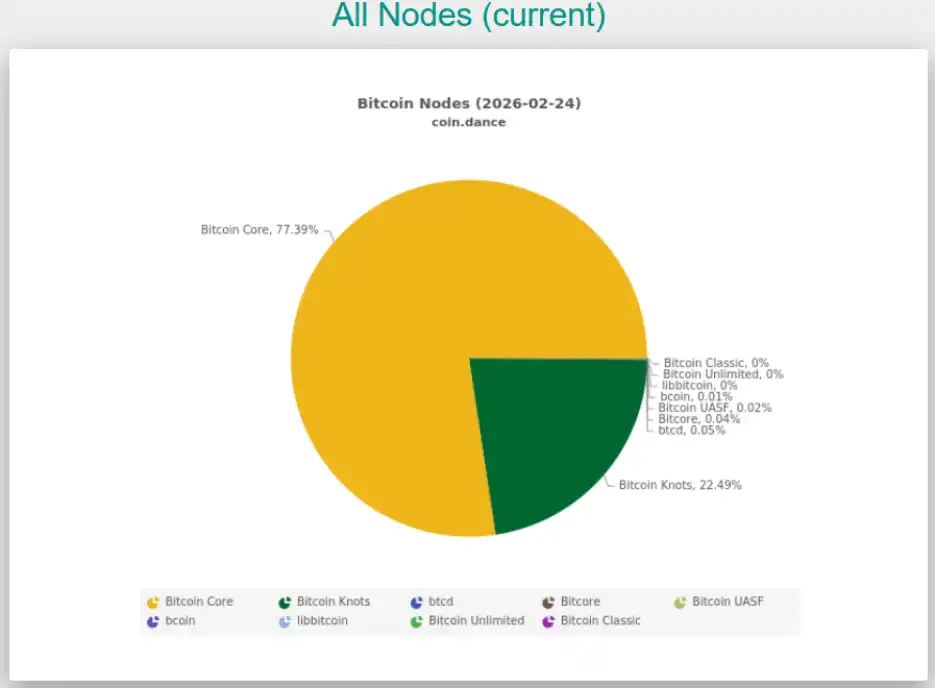
As the controversy fermented, Bitcoin Knots' market share has surged to 22.49%, while the share of the full-node client Bitcoin Core has significantly dropped to 77.39%. This trend indicates that a considerable number of nodes are expressing support for data limits by switching clients.
The opposition camp, consisting of highly influential opinion leaders like Adam Back and miners, has a more star-studded lineup.

MicroStrategy CEO Michael Saylor warned that frequent protocol changes are the biggest threat to Bitcoin.

Blockstream CEO Adam Back also pointed out that Bitcoin's greatest value lies in its immutability. If the rules can be easily changed based on the preferences of a subset of people, then Bitcoin's credibility as "digital gold" will be utterly destroyed.

From an economic perspective, the controversy over BIP-110 also reflects the community's anxiety about Bitcoin's "long-term security budget." As the halving cycles progress, the security of the Bitcoin network will rely increasingly on transaction fees rather than block rewards.

Fee contributions from non-monetary transactions to the Bitcoin network show high volatility. Dune data shows that, as of now, daily fees from inscription protocols have fallen below $10,000, but they contributed nearly ten million dollars in single-day fees in December 2023. Against the backdrop of持续减半 (continuously halving) block rewards, miners do not want to block off any potential revenue stream.
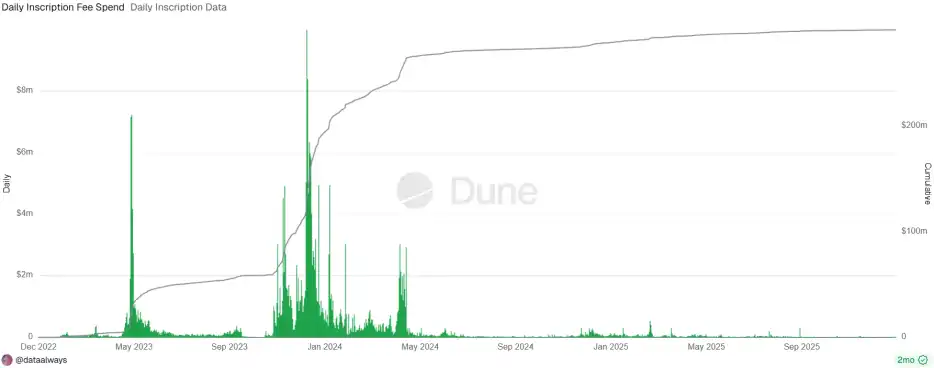
Miners generally believe that the market's cyclical fluctuations should not be a reason to modify the underlying protocol. Once the market recovers, these non-monetary transactions will remain an important source of income for them.
Fee Market Competition is Unfair, Governance Slippery Slope and Legal Risks Coexist

However, the decline in inscription fees has also given the supporting faction ammunition. Since the economic benefits from inscriptions are now minimal, the network optimization brought by cleaning them up (such as reducing UTXO set size, lowering node pressure) seems more cost-effective.

The deeper economic logic supporting BIP-110 lies in: the current SegWit discount mechanism is effectively subsidizing non-monetary transactions. Under the current fee calculation rules, storing 1MB of image data is much cheaper than sending a monetary transaction of the same size.

BIP-110 aims to end this "unfair competition" by setting a data上限 (upper limit) at the consensus layer, forcing these "low-value" data to compete for more expensive non-discounted space, or simply leave the mainnet.

Proponents believe only this can return the fee market to reality, ensuring that monetary transactions truly willing to pay a premium for "global consensus" are prioritized for inclusion.

However, if a proposal like BIP-110, labeled as "temporary + low threshold," is passed, it will break the institutional trust in the Bitcoin network. For institutional investors, the most attractive aspect of Bitcoin is that its rules are immutable.

Once a precedent is set, could asset freezes targeting specific addresses appear in the future? Or mandatory adjustments targeting specific fee rates?

This "governance slippery slope" is the risk most feared by Adam Back and Michael Saylor. For Bitcoin, even a protocol containing垃圾数据 (garbage data) is stronger than a "high-quality protocol" that can be modified at any time. Because the latter is unpredictable, and institutions seek certainty.

Additionally, BIP-110 could render certain existing UTXOs as "dead money," effectively temporarily depriving some users of their property rights. Such behavior, at a legal level, might expose miners to accusations of "interfering with private property."

The emergence of BIP-110 is an inevitable product of Bitcoin's growing pains. Its possibility of activation remains questionable, especially since the 55% threshold traditionally faces huge challenges within the community.

The greatest significance of this debate is: BIP-110 has brought the issue of "data abuse" to the forefront, forcing the community to think, "What exactly should the Bitcoin mainnet carry?"

Bitcoin's greatest value lies not in它永不改变 (it never changes), but in the fact that every change it undergoes has passed the strictest tests. The future Bitcoin might become purer because of this debate, or it might open a new chapter of diversification because of this split.

In this battle to defend the value of digital gold, every user running a node is casting a precious vote about the future with their hard drive and bandwidth.


Трендові криптовалюти

Пов'язані питання

QWhat is the main purpose of the BIP-110 proposal in the Bitcoin network?

AThe BIP-110 proposal aims to impose a strict limit on the amount of non-monetary data, such as images, videos, or code from protocols like Ordinals and Runes, that can be included in Bitcoin blocks through a soft fork. Its goal is to curb what supporters view as 'data abuse' and restore Bitcoin's original technical prudence, focusing on its monetary functions.

QWhy has the 55% activation threshold in BIP-110 caused significant controversy within the Bitcoin community?

AThe 55% activation threshold is controversial because it deviates from Bitcoin's traditional governance norm, which requires 95% miner hash rate support for major consensus changes to ensure network stability and prevent chain splits. Critics, like Adam Back, argue that 55% allows a simple majority to impose changes on the minority, risking chain splits and undermining Bitcoin's immutability and decentralized governance.

QHow do supporters of BIP-110 justify the need for data limits on the Bitcoin blockchain?

ASupporters argue that data limits are necessary to prevent the blockchain from becoming bloated with non-financial data, which could lead to exponential growth in block size. This would make it difficult for average users to run full nodes on consumer hardware, potentially centralizing validation power to large nodes and harming Bitcoin's decentralization. They also claim it addresses unfair fee competition, as non-monetary data currently benefits from SegWit discounts.

QWhat are the economic concerns raised by opponents of BIP-110 regarding miner incentives and network security?

AOpponents highlight that non-monetary transactions, like those from inscription protocols, contribute significantly to miner fees, especially as block rewards diminish post-halving. Restricting these transactions could reduce miner income, threatening network security. They argue that market fluctuations should not justify protocol changes, and fee revenue from such data could rebound, providing crucial long-term security budgets.

QWhat broader implications does BIP-110 have for Bitcoin's value proposition and institutional trust?

ABIP-110 raises concerns about 'governance slippage,' where setting a precedent for easy protocol changes could lead to future modifications, such as asset freezes or fee adjustments, undermining Bitcoin's immutability and predictability. Institutions value Bitcoin for its fixed rules, and any move toward malleability could erode trust. Additionally, it might create 'dead money' by invalidating certain UTXOs, posing legal risks related to property rights.

Пов'язані матеріали

Nearly a Hundred Players Rush into Embodied Data: With 4.47 Billion Yuan in Financing in One Year, Who Can Really Make Money by 'Selling Data'?

The domestic embodied AI data industry has attracted nearly 100 players, with 70 focused on data collection and 27 on data infrastructure. In the past year, 15 independent embodied data service providers raised approximately 4.47 billion yuan. Despite this growth, the sector remains early-stage, fragmented, and faces significant challenges. Data collection methods are diverse, categorized into four main routes: teleoperation of real robots, human demonstration without a robot (using motion capture, exoskeletons, etc.), simulation synthesis, and distillation from internet videos. Most companies (43%) adopt hybrid approaches, combining multiple routes, as no single method can meet all training needs. Teleoperation alone is pursued by 31% of players, often by state-owned platforms and robot companies, while newer firms favor asset-light, no-hardware human demonstration. Independent data service providers now form the largest player group (40%), indicating the emergence of a distinct industry segment rather than just a subsidiary function for robot makers. Two-thirds of all players are "embodied-native" startups, while one-third are companies that pivoted from fields like AI data annotation, which are more prevalent in the data infrastructure layer. Current annual industry capacity is estimated at 1.6-1.8 million hours plus 70-80 million data points, with a short-term goal to increase this 15-20 fold within 1-3 years. Data collection factories are spread across 20 provinces in China, concentrated in the Yangtze River Delta, Beijing-Tianjin-Hebei, and Pearl River Delta regions. Financially, the 4.47 billion yuan raised in the past year pales compared to the 43.8 billion yuan raised by the broader embodied intelligence sector in just the first half of 2026, highlighting that data remains a less "sexy" bet for investors. The 15 funded independent providers show clear stratification: a top tier led by a unicorn (Lightwheel Intelligence, 3.1 billion yuan), a middle tier of 11 firms raising tens to hundreds of millions, and an early-stage tier of 3 companies. Sixty-nine investment institutions have participated, but none have made concentrated bets, reflecting uncertainty about viable business models. Over half of these funded companies are less than a year old, most are at pre-A or A rounds, and profitability remains largely unproven. In summary, the embodied data industry has become an independent track creating jobs and local economic activity. However, it is still nascent, with unformed consensus, unsolved problems, and unproven business models. The coming 1-2 years will be a critical validation window to see if companies can build sustainable, profitable businesses purely by "selling data."

marsbit2 год тому

Nearly a Hundred Players Rush into Embodied Data: With 4.47 Billion Yuan in Financing in One Year, Who Can Really Make Money by 'Selling Data'?

marsbit2 год тому

Dialogue with Multicoin Partner: The Crypto Market Has Bottomed Out, Favoring Three Cryptocurrencies in This Cycle

In a recent interview, Multicoin Capital managing partner Tushar Jain shared his views on the crypto market. He believes the market has bottomed and is at an inflection point, citing that negative news no longer causes significant price declines and application adoption continues to grow. Jain remains highly bullish on Solana, viewing it as the correct architectural choice for internet capital markets, particularly for spot and tokenized security trading. He is also positive on Hyperliquid, noting its leadership in decentralized derivatives trading. His investment approach focuses on concentrating capital in top convictions rather than equal allocation. A distinct opportunity he highlights is Zcash (ZEC), which he sees as a return to the industry's cypherpunk ethos and a potential top-five asset by market cap. For assets like Zcash without cash flows, his valuation framework is based on relative market cap ranking. Regarding investment strategy, Jain employs a "three-part" entry method to avoid timing pitfalls and emphasizes long-term "active management" over "active trading." He outlines four sources of investment edge: informational, analytical, behavioral/psychological, and structural. On portfolio management, the fund uses Bitcoin as its "cash," selling assets into Bitcoin during market euphoria to reduce beta risk and using Bitcoin to buy dips. Sales occur only if a better opportunity arises, the investment thesis breaks, or valuations become excessively overheated. While respectful of Ethereum's resilience, he questions its unclear scaling roadmap. Finally, Jain reaffirms his commitment to the thesis that blockchains will form the foundational architecture for future capital markets.

marsbit2 год тому

Dialogue with Multicoin Partner: The Crypto Market Has Bottomed Out, Favoring Three Cryptocurrencies in This Cycle

marsbit2 год тому

Торгівля

Спот

Популярні статті

Що таке $S$

Розуміння SPERO: Комплексний огляд Вступ до SPERO Оскільки ландшафт інновацій продовжує еволюціонувати, виникнення технологій web3 та криптовалютних проектів відіграє ключову роль у формуванні цифрового майбутнього. Один з проектів, який привернув увагу в цій динамічній сфері, — це SPERO, позначений як SPERO,$$s$. Ця стаття має на меті зібрати та представити детальну інформацію про SPERO, щоб допомогти ентузіастам та інвесторам зрозуміти його основи, цілі та інновації в рамках web3 та крипто-сектору. Що таке SPERO,$$s$? SPERO,$$s$ — це унікальний проект у криптопросторі, який прагне використати принципи децентралізації та технології блокчейн для створення екосистеми, що сприяє залученню, корисності та фінансовій інклюзії. Проект розроблений для полегшення взаємодії між користувачами новими способами, надаючи їм інноваційні фінансові рішення та послуги. У своїй основі SPERO,$$s$ прагне надати можливості індивідам, забезпечуючи інструменти та платформи, які покращують користувацький досвід у криптовалютному просторі. Це включає в себе можливість більш гнучких методів транзакцій, сприяння ініціативам, що підтримуються спільнотою, та створення шляхів для фінансових можливостей через децентралізовані додатки (dApps). Основна концепція SPERO,$$s$ обертається навколо інклюзивності, прагнучи зменшити розриви в традиційній фінансовій системі, використовуючи переваги технології блокчейн. Хто є творцем SPERO,$$s$? Особистість творця SPERO,$$s$ залишається дещо невідомою, оскільки є обмежені публічно доступні ресурси, що надають детальну інформацію про його засновників. Ця відсутність прозорості може бути наслідком зобов'язання проекту до децентралізації — етики, яку багато проектів web3 поділяють, ставлячи колективні внески вище за індивідуальне визнання. Зосереджуючи обговорення навколо спільноти та її колективних цілей, SPERO,$$s$ втілює суть наділення без виділення конкретних осіб. Таким чином, розуміння етики та місії SPERO є більш важливим, ніж ідентифікація єдиного творця. Хто є інвесторами SPERO,$$s$? SPERO,$$s$ підтримується різноманітними інвесторами, починаючи від венчурних капіталістів до ангельських інвесторів, які прагнуть сприяти інноваціям у крипто-секторі. Зосередження цих інвесторів зазвичай узгоджується з місією SPERO — пріоритет надається проектам, які обіцяють технологічний прогрес у суспільстві, фінансову інклюзію та децентралізоване управління. Ці інвесторські фонди зазвичай зацікавлені в проектах, які не лише пропонують інноваційні продукти, але й позитивно впливають на спільноту блокчейн та її екосистеми. Підтримка з боку цих інвесторів підкріплює SPERO,$$s$ як значного конкурента в швидко змінюваній сфері крипто-проектів. Як працює SPERO,$$s$? SPERO,$$s$ використовує багатогранну структуру, яка відрізняє його від традиційних криптовалютних проектів. Ось деякі ключові особливості, які підкреслюють його унікальність та інноваційність: Децентралізоване управління: SPERO,$$s$ інтегрує моделі децентралізованого управління, надаючи користувачам можливість активно брати участь у процесах прийняття рішень щодо майбутнього проекту. Цей підхід сприяє відчуттю власності та відповідальності серед членів спільноти. Корисність токена: SPERO,$$s$ використовує свій власний криптовалютний токен, розроблений для виконання різних функцій в екосистемі. Ці токени дозволяють здійснювати транзакції, отримувати винагороди та полегшувати послуги, що пропонуються на платформі, підвищуючи загальну залученість та корисність. Шарова архітектура: Технічна архітектура SPERO,$$s$ підтримує модульність та масштабованість, що дозволяє безперешкодно інтегрувати додаткові функції та додатки в міру розвитку проекту. Ця адаптивність є надзвичайно важливою для збереження актуальності в постійно змінюваному крипто-ландшафті. Залучення спільноти: Проект підкреслює ініціативи, що підтримуються спільнотою, використовуючи механізми, які стимулюють співпрацю та зворотний зв'язок. Підтримуючи сильну спільноту, SPERO,$$s$ може краще задовольняти потреби користувачів та адаптуватися до ринкових тенденцій. Фокус на інклюзію: Пропонуючи низькі комісії за транзакції та зручні інтерфейси, SPERO,$$s$ прагне залучити різноманітну базу користувачів, включаючи осіб, які раніше не брали участі в крипто-просторі. Це зобов'язання до інклюзії узгоджується з його загальною місією наділення через доступність. Хронологія SPERO,$$s$ Розуміння історії проекту надає важливі уявлення про його розвиток та етапи. Нижче наведено пропоновану хронологію, що відображає значні події в еволюції SPERO,$$s$: Етап концептуалізації та ідеації: Початкові ідеї, що стали основою SPERO,$$s$, були сформовані, тісно пов'язані з принципами децентралізації та фокусом на спільноті в індустрії блокчейн. Запуск білого паперу проекту: Після концептуального етапу був випущений комплексний білий папір, що детально описує бачення, цілі та технологічну інфраструктуру SPERO,$$s$, щоб залучити інтерес та зворотний зв'язок від спільноти. Створення спільноти та ранні залучення: Активні зусилля були спрямовані на створення спільноти ранніх прихильників та потенційних інвесторів, що полегшило обговорення цілей проекту та отримання підтримки. Подія генерації токенів: SPERO,$$s$ провів подію генерації токенів (TGE) для розподілу своїх рідних токенів серед ранніх прихильників та встановлення початкової ліквідності в екосистемі. Запуск початкового dApp: Перший децентралізований додаток (dApp), пов'язаний з SPERO,$$s$, став доступним, дозволяючи користувачам взаємодіяти з основними функціями платформи. Постійний розвиток та партнерства: Безперервні оновлення та вдосконалення пропозицій проекту, включаючи стратегічні партнерства з іншими учасниками блокчейн-простору, сформували SPERO,$$s$ у конкурентоспроможного та еволюціонуючого гравця на крипто-ринку. Висновок SPERO,$$s$ є свідченням потенціалу web3 та криптовалют для революціонізації фінансових систем та наділення індивідів. Завдяки зобов'язанню до децентралізованого управління, залучення спільноти та інноваційно спроектованих функцій, він прокладає шлях до більш інклюзивного фінансового ландшафту. Як і з будь-якими інвестиціями в швидко змінюваному крипто-просторі, потенційним інвесторам та користувачам рекомендується ретельно досліджувати та обдумано взаємодіяти з поточними подіями в SPERO,$$s$. Проект демонструє інноваційний дух крипто-індустрії, запрошуючи до подальшого дослідження його численних можливостей. Хоча подорож SPERO,$$s$ ще триває, його основні принципи можуть справді вплинути на майбутнє того, як ми взаємодіємо з технологією, фінансами та один з одним у взаємопов'язаних цифрових екосистемах.

122 переглядів усьогоОпубліковано 2024.12.17Оновлено 2024.12.17

Що таке $S$

Що таке AGENT S

Агент S: Майбутнє автономної взаємодії в Web3 Вступ У постійно змінюваному ландшафті Web3 та криптовалюти інновації постійно переосмислюють, як люди взаємодіють з цифровими платформами. Один з таких новаторських проектів, Агент S, обіцяє революціонізувати взаємодію людини з комп'ютером через свою відкриту агентну структуру. Прокладаючи шлях для автономних взаємодій, Агент S прагне спростити складні завдання, пропонуючи трансформаційні застосування в штучному інтелекті (ШІ). Це детальне дослідження заглиблюється в складності проекту, його унікальні особливості та наслідки для сфери криптовалюти. Що таке Агент S? Агент S є революційною відкритою агентною структурою, спеціально розробленою для вирішення трьох основних викликів в автоматизації комп'ютерних завдань: Набуття специфічних знань у галузі: Структура інтелектуально навчається з різних зовнішніх джерел знань та внутрішнього досвіду. Цей подвійний підхід дозволяє їй створити багатий репозиторій специфічних знань у галузі, покращуючи її продуктивність у виконанні завдань. Планування на довгих горизонтах завдань: Агент S використовує планування з підкріпленням досвіду, стратегічний підхід, який полегшує ефективний розподіл та виконання складних завдань. Ця функція значно підвищує її здатність ефективно та результативно управляти кількома підзавданнями. Обробка динамічних, неоднорідних інтерфейсів: Проект представляє Інтерфейс Агент-Комп'ютер (ACI), інноваційне рішення, яке покращує взаємодію між агентами та користувачами. Використовуючи багатомодальні великі мовні моделі (MLLMs), Агент S може безперешкодно орієнтуватися та маніпулювати різноманітними графічними інтерфейсами користувача. Завдяки цим новаторським функціям Агент S надає надійну структуру, яка вирішує складнощі, пов'язані з автоматизацією людської взаємодії з машинами, прокладаючи шлях для численних застосувань у ШІ та за його межами. Хто є творцем Агент S? Хоча концепція Агент S є фундаментально новаторською, конкретна інформація про його творця залишається невідомою. Творець наразі невідомий, що підкреслює або початкову стадію проекту, або стратегічний вибір зберегти засновників у таємниці. Незважаючи на анонімність, акцент залишається на можливостях та потенціалі структури. Хто є інвесторами Агент S? Оскільки Агент S є відносно новим у криптографічній екосистемі, детальна інформація про його інвесторів та фінансових спонсорів не задокументована. Відсутність публічно доступних відомостей про інвестиційні фонди або організації, що підтримують проект, викликає питання щодо його фінансової структури та дорожньої карти розвитку. Розуміння підтримки є критично важливим для оцінки стійкості проекту та потенційного впливу на ринок. Як працює Агент S? В основі Агент S лежить передова технологія, яка дозволяє йому ефективно функціонувати в різних умовах. Його операційна модель побудована навколо кількох ключових функцій: Взаємодія з комп'ютером, подібна до людської: Структура пропонує розширене планування ШІ, прагнучи зробити взаємодії з комп'ютерами більш інтуїтивними. Імітуючи людську поведінку при виконанні завдань, вона обіцяє підвищити досвід користувачів. Наративна пам'ять: Використовується для використання високорівневого досвіду, Агент S використовує наративну пам'ять для відстеження історій завдань, тим самим покращуючи свої процеси прийняття рішень. Епізодична пам'ять: Ця функція надає користувачам покрокові інструкції, дозволяючи структурі пропонувати контекстуальну підтримку в міру виконання завдань. Підтримка OpenACI: Завдяки можливості працювати локально, Агент S дозволяє користувачам зберігати контроль над своїми взаємодіями та робочими процесами, узгоджуючи з децентралізованою етикою Web3. Легка інтеграція з зовнішніми API: Його універсальність і сумісність з різними платформами ШІ забезпечують те, що Агент S може безперешкодно вписатися в існуючі технологічні екосистеми, роблячи його привабливим вибором для розробників та організацій. Ці функціональні можливості колективно сприяють унікальному положенню Агент S у крипто-просторі, оскільки він автоматизує складні, багатоступеневі завдання з мінімальним втручанням людини. У міру розвитку проекту його потенційні застосування в Web3 можуть переосмислити, як відбуваються цифрові взаємодії. Хронологія Агент S Розробка та етапи Агент S можуть бути узагальнені в хронології, яка підкреслює його значні події: 27 вересня 2024 року: Концепція Агент S була представлена в комплексній науковій статті під назвою “Відкрита агентна структура, яка використовує комп'ютери як людина”, що демонструє основи проекту. 10 жовтня 2024 року: Наукова стаття була опублікована на arXiv, пропонуючи детальне дослідження структури та її оцінки продуктивності на основі бенчмарку OSWorld. 12 жовтня 2024 року: Було випущено відеопрезентацію, що надає візуальне уявлення про можливості та особливості Агент S, ще більше залучаючи потенційних користувачів та інвесторів. Ці маркери в хронології не лише ілюструють прогрес Агент S, але й вказують на його прихильність до прозорості та залучення громади. Ключові моменти про Агент S У міру розвитку структури Агент S кілька ключових характеристик виділяються, підкреслюючи її новаторський характер та потенціал: Інноваційна структура: Розроблена для забезпечення інтуїтивного використання комп'ютерів, подібного до людської взаємодії, Агент S пропонує новий підхід до автоматизації завдань. Автономна взаємодія: Здатність автономно взаємодіяти з комп'ютерами через GUI означає стрибок до більш інтелектуальних та ефективних обчислювальних рішень. Автоматизація складних завдань: Завдяки своїй надійній методології він може автоматизувати складні, багатоступеневі завдання, роблячи процеси швидшими та менш схильними до помилок. Безперервне вдосконалення: Механізми навчання дозволяють Агенту S покращуватися на основі минулого досвіду, постійно підвищуючи свою продуктивність та ефективність. Універсальність: Його адаптивність до різних операційних середовищ, таких як OSWorld та WindowsAgentArena, забезпечує його здатність служити широкому спектру застосувань. Оскільки Агент S займає своє місце в ландшафті Web3 та криптовалюти, його потенціал покращити можливості взаємодії та автоматизувати процеси означає значний прогрес у технологіях ШІ. Завдяки своїй інноваційній структурі Агент S є прикладом майбутнього цифрових взаємодій, обіцяючи більш безперешкодний та ефективний досвід для користувачів у різних галузях. Висновок Агент S представляє собою сміливий крок вперед у поєднанні ШІ та Web3, з можливістю переосмислити, як ми взаємодіємо з технологією. Хоча проект все ще на ранніх стадіях, можливості для його застосування є величезними та переконливими. Завдяки своїй комплексній структурі, що вирішує критичні виклики, Агент S прагне вивести автономні взаємодії на передній план цифрового досвіду. У міру того, як ми заглиблюємося в сфери криптовалюти та децентралізації, проекти, подібні до Агент S, безсумнівно, відіграватимуть ключову роль у формуванні майбутнього технологій та співпраці людини з комп'ютером.

751 переглядів усьогоОпубліковано 2025.01.14Оновлено 2025.01.14

Що таке AGENT S

Як купити S

Ласкаво просимо до HTX.com! Ми зробили покупку Sonic (S) простою та зручною. Дотримуйтесь нашої покрокової інструкції, щоб розпочати свою криптовалютну подорож.Крок 1: Створіть обліковий запис на HTXВикористовуйте свою електронну пошту або номер телефону, щоб зареєструвати обліковий запис на HTX безплатно. Пройдіть безпроблемну реєстрацію й отримайте доступ до всіх функцій.ЗареєструватисьКрок 2: Перейдіть до розділу Купити крипту і виберіть спосіб оплатиКредитна/дебетова картка: використовуйте вашу картку Visa або Mastercard, щоб миттєво купити Sonic (S).Баланс: використовуйте кошти з балансу вашого рахунку HTX для безперешкодної торгівлі.Треті особи: ми додали популярні способи оплати, такі як Google Pay та Apple Pay, щоб підвищити зручність.P2P: Торгуйте безпосередньо з іншими користувачами на HTX.Позабіржова торгівля (OTC): ми пропонуємо індивідуальні послуги та конкурентні обмінні курси для трейдерів.Крок 3: Зберігайте свої Sonic (S)Після придбання Sonic (S) збережіть його у своєму обліковому записі на HTX. Крім того, ви можете відправити його в інше місце за допомогою блокчейн-переказу або використовувати його для торгівлі іншими криптовалютами.Крок 4: Торгівля Sonic (S)Легко торгуйте Sonic (S) на спотовому ринку HTX. Просто увійдіть до свого облікового запису, виберіть торгову пару, укладайте угоди та спостерігайте за ними в режимі реального часу. Ми пропонуємо зручний досвід як для початківців, так і для досвідчених трейдерів.

1.6k переглядів усьогоОпубліковано 2025.01.15Оновлено 2026.06.02

Як купити S

Обговорення

Ласкаво просимо до спільноти HTX. Тут ви можете бути в курсі останніх подій розвитку платформи та отримати доступ до професійної ринкової інформації. Нижче представлені думки користувачів щодо ціни S (S).

活动图片