Behind OpenAI's $110 Billion Financing: The Game Between Amazon and Microsoft

Odaily星球日报Опубліковано о 2026-02-28Востаннє оновлено о 2026-02-28

Анотація

OpenAI has secured $110 billion in new funding at a $730 billion pre-money valuation, with major investments from Amazon ($50 billion), Nvidia ($30 billion), and SoftBank ($30 billion). Notably, CEO Sam Altman’s public acknowledgment included Microsoft—an existing investor and partner—immediately after Amazon, signaling strategic alignment shifts. A key insight lies in two technical distinctions: “Stateless API” and “Stateful Runtime Environment.” Stateless API, the current mainstream model, handles single-request tasks without retaining context, but faces commoditization and margin pressure. In contrast, Stateful Runtime Environment supports persistent, autonomous AI agents capable of complex multi-step workflows, representing the future of enterprise AI adoption. Microsoft’s existing agreement ensures Azure remains the exclusive cloud provider for OpenAI’s Stateless API, securing present-day revenue streams. Meanwhile, Amazon’s expanded $100 billion partnership with OpenAI focuses on co-developing Stateful Runtime Environments via AWS Bedrock, positioning AWS as the infrastructure backbone for next-generation AI agents. This dual-cloud strategy enhances OpenAI’s leverage, reducing dependency on Microsoft while pitting Amazon and Microsoft in competition for future AI dominance. OpenAI gains negotiating power by diversifying its infrastructure partnerships and aligning each cloud giant with distinct—yet complementary—AI futures.

Original | Odaily Planet Daily (@OdailyChina)

Author | Azuma (@azuma_eth)

On the evening of February 27, OpenAI announced the completion of its latest funding round of $110 billion at a pre-money valuation of $730 billion.

The funding for this round came from three giants: Amazon invested $50 billion (an initial investment of $15 billion, with the remaining $35 billion to be delivered over the coming months upon meeting specific conditions), NVIDIA invested $30 billion (which will be recouped through the procurement of a total of 5 GW of computing power), and SoftBank also invested $30 billion.

After the funding was completed, OpenAI founder Sam Altman expressed his thanks to the three investors on his personal X account. Notably, Sam Altman's order of thanks was Amazon, Microsoft, NVIDIA, SoftBank — the name of Microsoft, the "old" shareholder and important partner who did not contribute in this round, was mentioned immediately after Amazon, which committed the most funding.
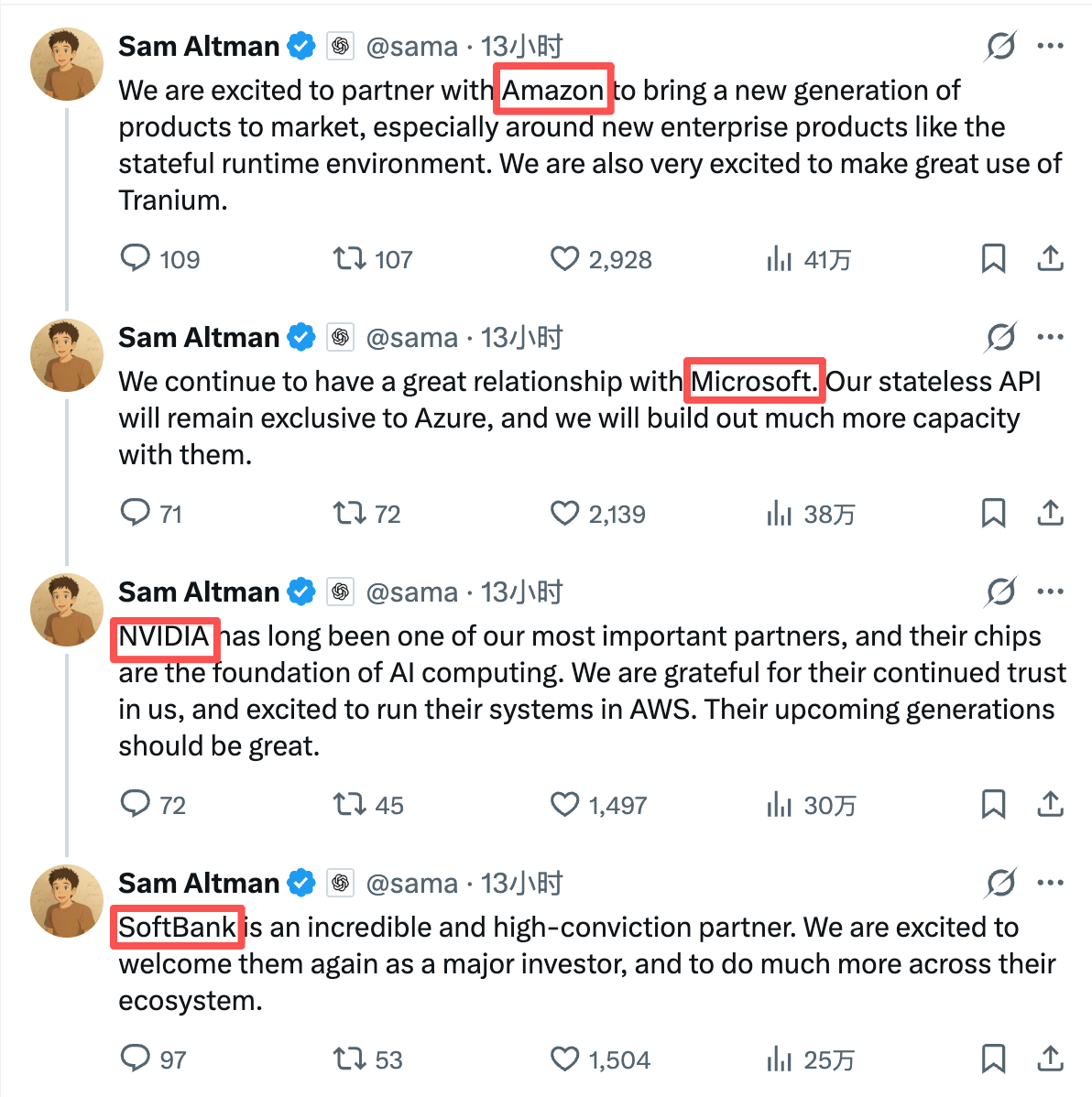
Aakash Gupta, an overseas blogger who has long followed the AI sector, pointed out that while most people are focused on the astronomical figure of $110 billion, the most critical piece of information in Sam Altman's statement lies in two overlooked technical terms: "Stateless API" and "Stateful Runtime Environment," which were attributed to Microsoft and Amazon, respectively.

Behind the Technical Terms: The Present and Future of AI

The core difference between Stateless API and Stateful Runtime Environment lies in the two words: "Stateless" and "Stateful".

The "Stateless" nature of a Stateless API means that the server does not maintain persistent state across requests — one call completes one inference; you ask a question, the AI answers, and after the lifecycle of this request ends, the system does not retain context or continue running. The "Stateful" nature of a Runtime Environment, on the other hand, implies a persistent execution environment — the Agent has historical memory, can persist, collaborate across tasks, and perform tasks over the long term.

Stateless API is currently the mainstream form of LLM commercialization. Industries such as finance, retail, manufacturing, and healthcare mostly integrate AI in this form to embed it into existing systems (e.g., various Q&A assistants, document summarization, search enhancement, etc.). The advantage of this model is that enterprises can quickly overlay AI capabilities into their existing architecture with minimal friction, achieving functional optimization without significant restructuring of organization and processes. However, as model capabilities converge, computing power costs continue to decrease, and price competition intensifies, the token-based billing of Stateless APIs is more likely to become standardized and commoditized, with marginal profits facing ongoing compression.

In contrast, Stateful Runtime Environment currently has limited commercial scale, but it represents not just simple "functional optimization" but a shift in business paradigm — it is not only able to answer questions but can also be seen as a digital workforce to concretely execute tasks. This means that the budget it touches will extend from mere interface call fees to automation, process management, and even part of the labor costs. Because of this, the market's expectations for Stateful Runtime Environment are far higher than its current scale.

Aakash Gupta also stated on this matter that in 2026 and 2027, almost all enterprise roadmaps will revolve around "autonomous agent workflows," not one-off API calls. Companies that invest heavily in AI in the future will increasingly tend to purchase systems that can run sustainably, collaborate across tools, and maintain context over the long term.

To put it in the simplest terms: Stateless API represents the present, while Stateful Runtime Environment represents the future.

What Did Microsoft and Amazon Take, Respectively?

On the day the funding was completed, Microsoft and Amazon each announced their latest cooperation agreements with OpenAI.

Microsoft stated in its announcement that the terms of the partnership jointly announced by Microsoft and OpenAI in October 2025 would remain unchanged (the terms include OpenAI purchasing $250 billion worth of Azure services). Azure remains the exclusive cloud provider for OpenAI's Stateless API; any Stateless API calls to OpenAI models generated through cooperation with any third party (including Amazon) will be hosted on Azure; OpenAI's first-party products, including Frontier, will also continue to be hosted on Azure.

Amazon stated in its announcement that AWS and OpenAI will jointly build a Stateful Runtime Environment powered by OpenAI models and provide services to AWS customers through Amazon Bedrock, helping enterprises build generative AI applications and Agents at production scale; AWS will also become the exclusive third-party cloud distribution service provider for OpenAI Frontier; the existing $38 billion multi-year cooperation agreement between AWS and OpenAI will be expanded to $100 billion, with a term of 8 years. OpenAI will consume 2 GW of Trainium computing power through AWS infrastructure to support the needs of Stateful Runtime Environment, Frontier, and other advanced workloads; OpenAI and Amazon will also develop customized models that can be used to support Amazon's customer-facing applications.

Comparing the two announcements, the current situation becomes clear.

Microsoft, with its $250 billion agreement and exclusive service rights, has locked in the current traffic engine. As long as OpenAI's Stateless API is called, Azure will bill behind the scenes — regardless of who the customer is or where the channel is, the traffic will ultimately return to Azure. This is a highly certain cash flow, but the problem lies in the trend of shrinking profit margins for Stateless APIs; call volume may continue to grow, but actual profits may not necessarily remain stable in the long run.

On the other hand, Amazon, with its $50 billion in real money and a $100 billion expanded agreement, has secured the underlying hosting rights for the AI Agent era for AWS. Once Agents become the core carriers of enterprise productivity, the resources that are truly consumed over the long term — computing power, storage, scheduling systems, workflow orchestration, and cross-tool collaboration — will all be deposited on AWS's runtime environment.

One controls the current cash flow; the other bets on the future structure of productivity.

OpenAI's Diversified Bet

Before the future truly arrives, no one knows whether Microsoft's or Amazon's choice is correct. But what is certain is that under these two clearly defined cooperation agreements with explicit interest divisions, OpenAI's initiative is significantly increasing.

Over the past few years, OpenAI has been highly dependent on Microsoft for cloud infrastructure. Microsoft is not only a major shareholder holding 27% of the shares but also the controller of the infrastructure. This binding brought effective early-stage resource advantages to OpenAI, but it also meant that the balance of bargaining power would naturally tilt toward Microsoft. With Amazon's strong entry, it and Microsoft are bound to engage in direct competition to seize the future service rights of OpenAI.

For OpenAI, this is a typical diversified betting strategy — not deeply binding with any single cloud service provider, not letting future growth be entirely constrained by one party, and using future business as a bargaining chip to obtain better terms.

Neither Microsoft nor Amazon can afford to give up OpenAI at present. When neither can leave the table, bargaining power naturally returns to OpenAI's hands.


Пов'язані питання

QWhat is the core difference between Stateless API and Stateful Runtime Environment in the context of AI?

AStateless API refers to a server-side service that does not retain persistent state across requests—each call completes one inference, and the system does not retain context or continue running after the request lifecycle ends. Stateful Runtime Environment, on the other hand, involves a persistent execution environment where AI agents have historical memory, can exist continuously, collaborate across tasks, and perform long-term tasks.

QWhich companies invested in OpenAI's latest $110 billion funding round, and what were their respective contributions?

AAmazon invested $50 billion ($15 billion initially, with the remaining $35 billion to be delivered over the coming months upon meeting specific conditions), Nvidia invested $30 billion (which will be recouped through the procurement of a total of 5 GW of computing power), and SoftBank also invested $30 billion.

QWhat did Microsoft secure in its agreement with OpenAI regarding Stateless API?

AMicrosoft secured Azure as the exclusive cloud provider for OpenAI's Stateless API. Any Stateless API calls to OpenAI models generated through cooperation with any third party, including Amazon, will be hosted on Azure. OpenAI's first-party products, including Frontier, will also continue to be hosted on Azure.

QWhat did Amazon obtain through its expanded agreement with OpenAI, particularly in relation to Stateful Runtime Environment?

AAmazon obtained a partnership with OpenAI to jointly build a Stateful Runtime Environment powered by OpenAI models, which will be provided to AWS customers via Amazon Bedrock. AWS also became the exclusive third-party cloud distribution service provider for OpenAI Frontier. The existing $38 billion multi-year cooperation agreement was expanded to $100 billion over 8 years, with OpenAI consuming 2 GW of Trainium computing power through AWS infrastructure to support Stateful Runtime Environment, Frontier, and other advanced workloads.

QHow does OpenAI's strategy of engaging with both Microsoft and Amazon reflect its approach to future growth and bargaining power?

AOpenAI's strategy reflects a分散押注 (diversified betting) approach. By not deeply binding with any single cloud service provider and avoiding complete dependence on one party for future growth, OpenAI uses its future business as a bargaining chip to secure more favorable terms. As both Microsoft and Amazon are unwilling to withdraw from the partnership, bargaining power naturally returns to OpenAI.

Пов'язані матеріали

Breaking: Google Earth Urgently Pulls Back Nano Banana 2 Image Generation Feature!

Google Earth's newly launched "Create image" feature, powered by the Nano Banana 2 AI image generation model, was abruptly withdrawn shortly after its release due to being "played" by users. The feature allowed users to generate and overlay AI-created visuals directly onto real-world satellite and 3D maps in Google Earth. The tool enabled creative applications like historical recreations (e.g., visualizing ancient Pompeii), generating informational graphics for landmarks, and envisioning architectural projects or futuristic cityscapes on real terrain. It operated under "geospatial grounding," meaning the AI respected the underlying geography, topography, and perspective of the chosen map view. The model also integrated with Gemini to retrieve relevant factual information. However, upon release, users quickly tested its limits. A prominent example involved reimagining Philadelphia's historic Independence Hall as a post-apocalyptic ruin overrun by "happy" zombies, evil clowns, and giant alien mechs. This highlighted both the feature's playful potential and its risks regarding the generation of inappropriate or misleading content on realistic maps, leading to its swift temporary removal. Google stated it would re-release the feature after implementing "enhanced guardrails." Analysts note this move strategically leverages Google's vast proprietary geospatial data, positioning its AI not just for artistic generation but for spatially accurate world visualization—a unique advantage in the competitive AI image generation landscape.

marsbit12 хв тому

Breaking: Google Earth Urgently Pulls Back Nano Banana 2 Image Generation Feature!

marsbit12 хв тому

Altman Admits: Overestimated AI Snatching Jobs! Huang Renxun: The Unemployment Narrative Is Completely Backwards

Sam Altman has revised his earlier predictions about AI rapidly replacing jobs, admitting he overestimated the speed at which AI would eliminate entry-level white-collar roles. Speaking on the "Invest Like the Best" podcast, he stated that people do not truly want an AI CEO, as accountability and human connection remain critical. He found that individuals prefer interacting with people who can be held responsible for decisions. Similarly, NVIDIA's Jensen Huang argued that the narrative of AI destroying jobs is misguided. He distinguishes between tasks and jobs, noting that while AI can automate specific tasks, entire jobs—encompassing communication, judgment, coordination, and accountability—are not eliminated. He cited examples like radiologists and software engineers, where demand for these roles has increased as AI handles repetitive tasks, allowing for business expansion and the creation of more positions. Data from a University of Maryland and LinkUp study supports this, showing that U.S. job postings for new graduates have actually risen, countering the fear of vanishing entry-level roles. However, a significant shift is occurring: the traditional entry-level tasks that help newcomers gain experience are being automated, making initial career access more challenging. The key insight is that as AI takes over standardized tasks, the enduring value of human work shifts toward areas of responsibility, trust-building, and final decision-making—aspects that AI cannot replicate. The real "moat" for professionals lies in these irreplaceable human elements.

marsbit18 хв тому

Altman Admits: Overestimated AI Snatching Jobs! Huang Renxun: The Unemployment Narrative Is Completely Backwards

marsbit18 хв тому

Weekly Editor's Picks (0725-0731)

Weekly Editor's Picks (0725-0731) provides a curated selection of deep analysis, filtering out market noise. Key themes from this week include: **Macro & Policy:** The Federal Reserve's upcoming meeting is marked by high uncertainty, balancing cooling inflation data against persistent price pressures. Meanwhile, the U.S. crypto regulatory Clarity Act faces critical political hurdles, with its 2026 passage probability seen as low. **Investing & Crypto:** Analysis suggests long-term crypto success depends on conviction through volatile cycles, focusing on assets like Bitcoin and core smart contract platforms. A trend noted is the increasing similarity between global equity markets (especially tech) and crypto, driven by narrative and leverage. Several major crypto protocols show strong revenue growth, but this isn't always translating to token price appreciation due to sell pressure and structural factors. **AI & Semiconductors:** Nvidia's rising credit default swap rates signal market concern over AI infrastructure financing risks. The storage sector experienced volatility as markets began pricing in potential 2027 oversupply. Despite a record profitable quarter, SK Hynix's results were deemed "below expectations," reflecting heightened investor demands for future growth visibility. **Markets & DeFi:** TradeXYZ demonstrated remarkable accuracy in pre-market pricing for a major A股 listing. The token ONDO saw gains, linked to its growing role in the on-chain tokenized stock ecosystem. **Ethereum:** Post-Pectra upgrade, a major structural shift is underway as Lido begins migrating millions of ETH to new validator architectures designed for capital efficiency. **Also Highlighted:** Butian's bullish stock market move; OpenAI's Altman promising major advances; Samsung and SK Hynix securing large AI chip deals; Apple reaching a $5T market cap; and ongoing discussions around exchange security following Poolin's bankruptcy case.

marsbit52 хв тому

Weekly Editor's Picks (0725-0731)

marsbit52 хв тому

Low Investment Isn't Apple's Immunity Pass

While Meta and Google face investor scrutiny over ballooning AI capital expenditures, Apple's minimal AI investment has paradoxically become a strength. Its market cap recently reclaimed the global top spot, surpassing $5 trillion. The irony is deep: Apple's own AI efforts have lagged, with "Apple Intelligence" delayed and core talent lost, forcing reliance on partners like Google Gemini and Alibaba's Qianwen. Its Q3 FY2026 (Q2 CY) earnings initially seemed stellar. Revenue hit $109.4B (up 16% YoY), with iPhone and Mac sales, growing 22% and 29% respectively, driving most of the growth. However, the stock fell over 8% post-earnings. The primary concern was a weaker Q4 revenue growth forecast of 9-11%, below expectations, due to looming supply chain constraints. Apple is feeling the indirect cost of the AI boom. Soaring memory and chip prices, fueled by massive data center investments from Microsoft, Amazon, and others, are forcing Apple to raise Mac and iPad prices significantly. The upcoming iPhone launch is also expected to see substantial price hikes. Despite avoiding heavy AI infrastructure spending—its capital expenditures are actually down 28%—Apple cannot escape the industry-wide supply and cost pressures. While Apple's operating cash flow remains robust, its substantial R&D spending (up 32% YoY) has yet to yield major AI breakthroughs. As Tim Cook prepares to step down as CEO, Apple faces a challenging transition: balancing its premium hardware success against the strategic and cost pressures of the AI era it has so far cautiously navigated.

marsbit1 год тому

Low Investment Isn't Apple's Immunity Pass

marsbit1 год тому

Торгівля

Спот
活动图片




