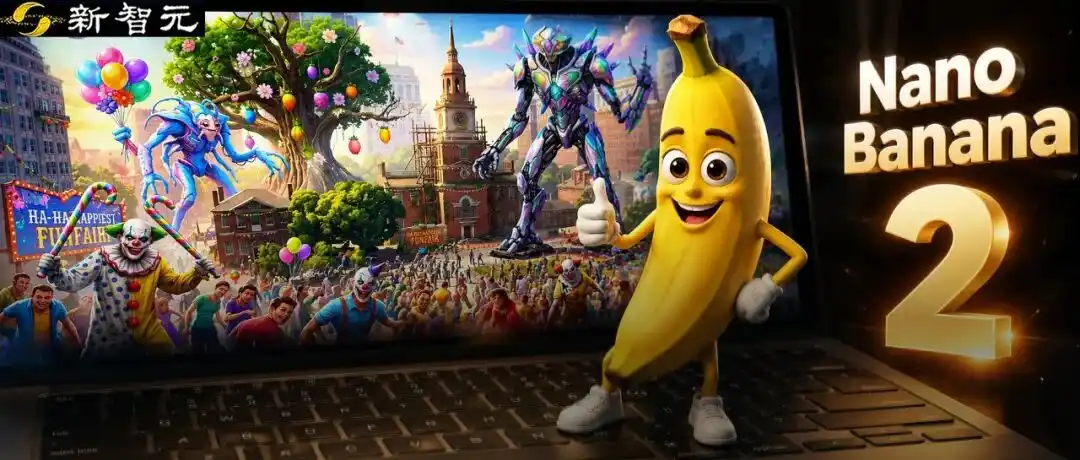
Breaking: Google Earth Urgently Pulls Back Nano Banana 2 Image Generation Feature!

marsbitОпубліковано о 2026-08-01Востаннє оновлено о 2026-08-01

Анотація

Google Earth's newly launched "Create image" feature, powered by the Nano Banana 2 AI image generation model, was abruptly withdrawn shortly after its release due to being "played" by users. The feature allowed users to generate and overlay AI-created visuals directly onto real-world satellite and 3D maps in Google Earth. The tool enabled creative applications like historical recreations (e.g., visualizing ancient Pompeii), generating informational graphics for landmarks, and envisioning architectural projects or futuristic cityscapes on real terrain. It operated under "geospatial grounding," meaning the AI respected the underlying geography, topography, and perspective of the chosen map view. The model also integrated with Gemini to retrieve relevant factual information. However, upon release, users quickly tested its limits. A prominent example involved reimagining Philadelphia's historic Independence Hall as a post-apocalyptic ruin overrun by "happy" zombies, evil clowns, and giant alien mechs. This highlighted both the feature's playful potential and its risks regarding the generation of inappropriate or misleading content on realistic maps, leading to its swift temporary removal. Google stated it would re-release the feature after implementing "enhanced guardrails." Analysts note this move strategically leverages Google's vast proprietary geospatial data, positioning its AI not just for artistic generation but for spatially accurate world visualization—a unique advant...

Cyber 'Words as Law' has reached a whole new level!

Yesterday, Google officially integrated the latest image generation model, Nano Banana 2, into the web version of Google Earth.
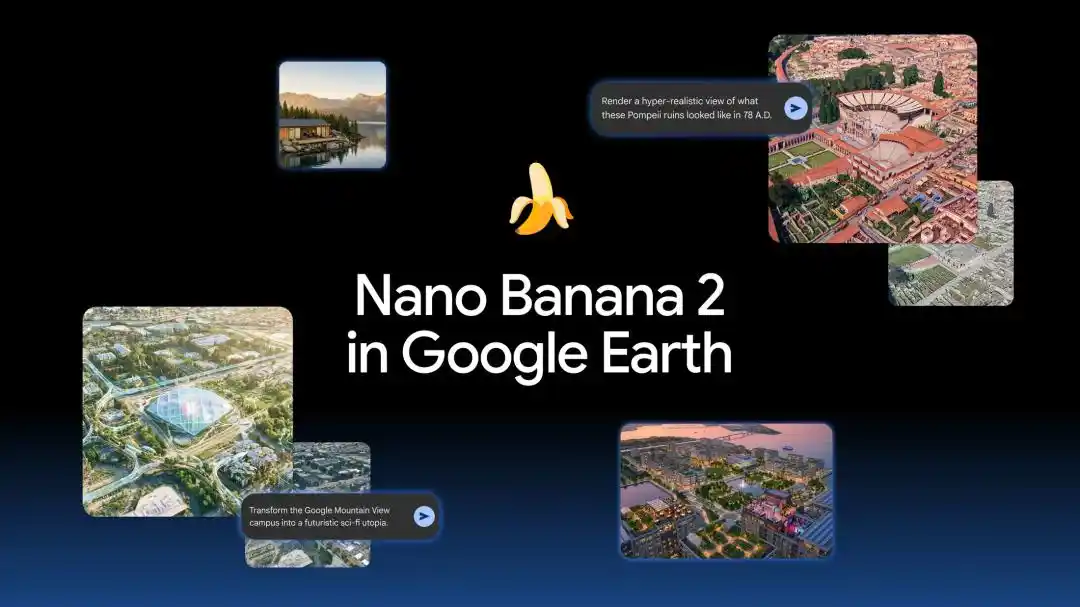
Who would have thought that overnight, the new feature got out of hand, and Google urgently pulled it back!
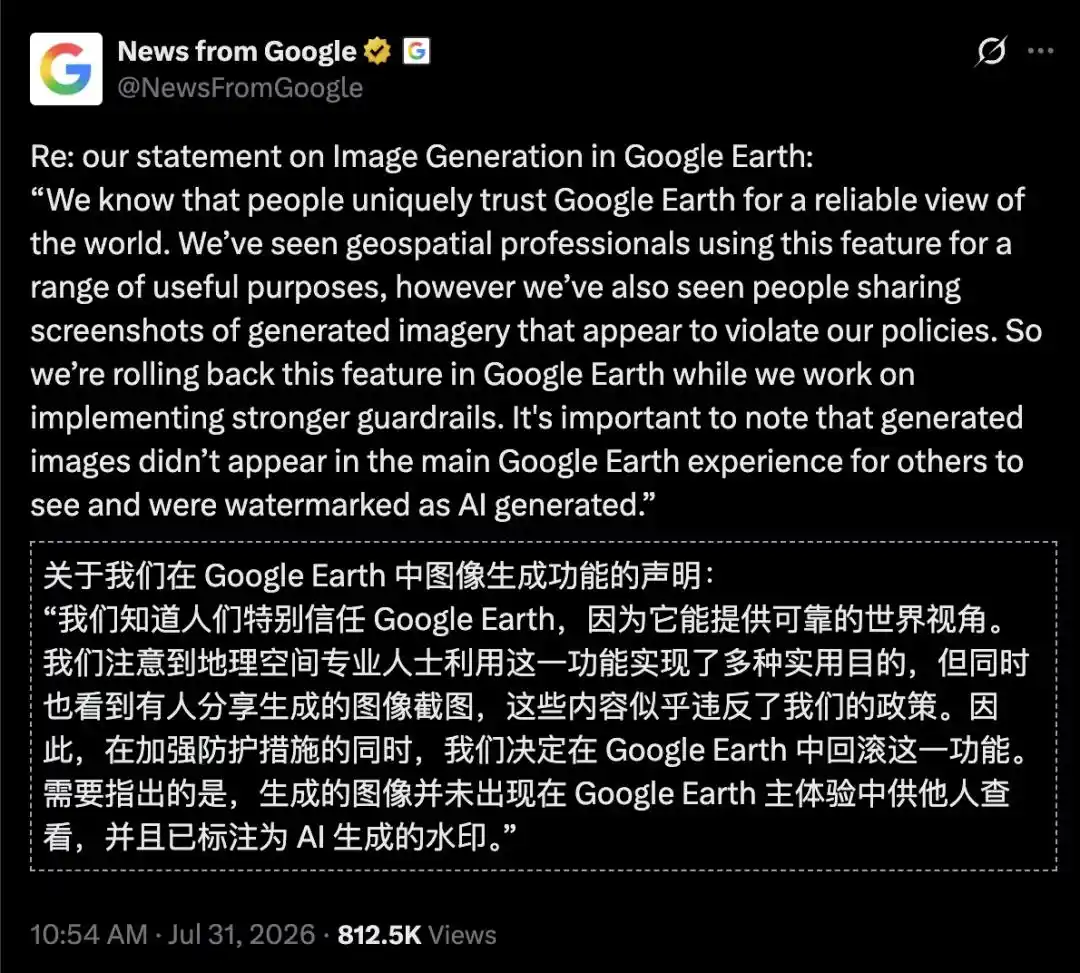
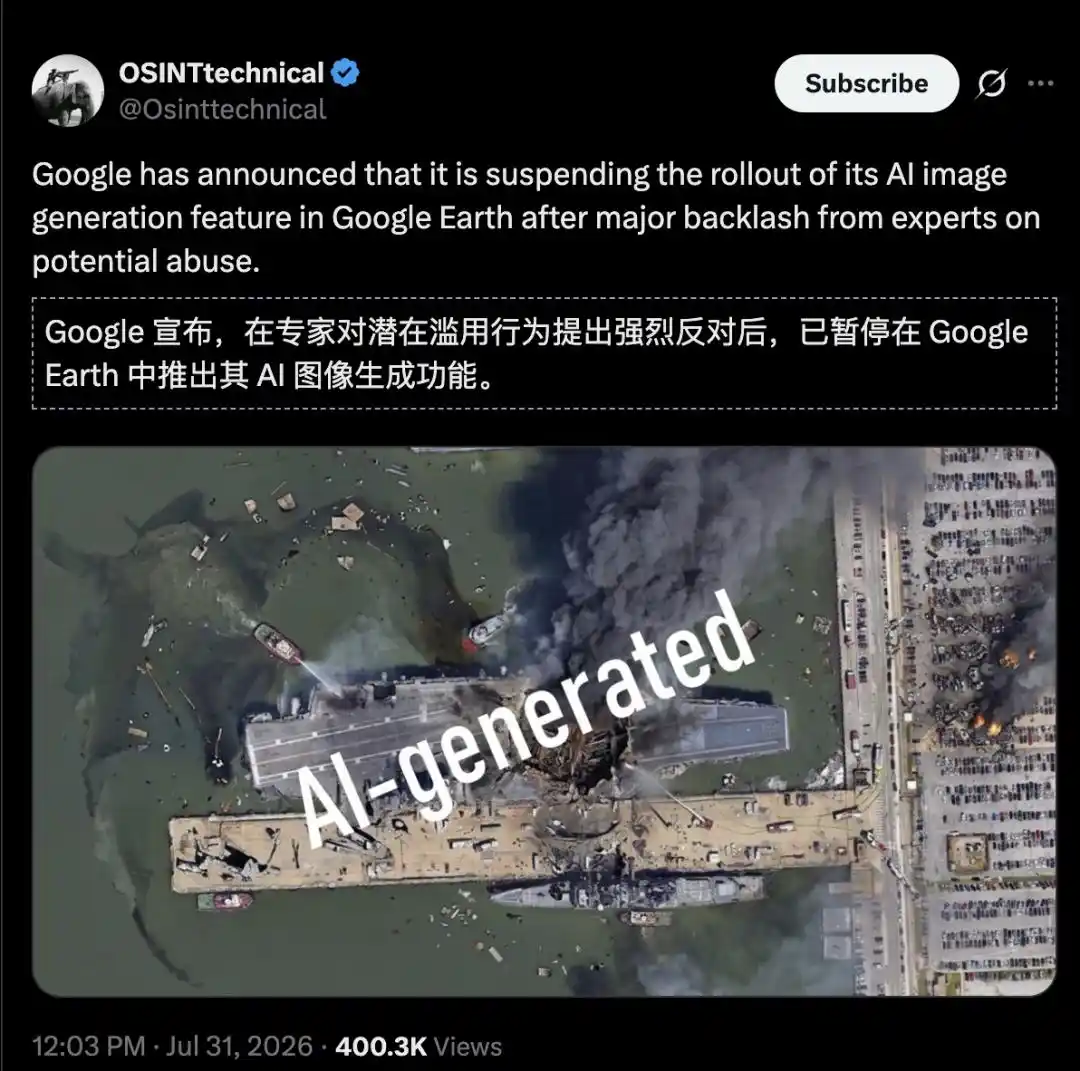
As a result, the effects were too realistic. After strong opposition from experts, Google urgently withdrew the new feature, and then re-released it after "strengthening protective measures."
New Ways to Play with Nano Banana 2: A Visual Feast for Netizens

You open Google Earth in your browser and skillfully zoom down to the old street where you played as a child. You don't open complex Photoshop, nor do you copy a screenshot to another AI chat tool.

You simply click the brand-new, slightly glowing 'Create image' button in the upper right corner.
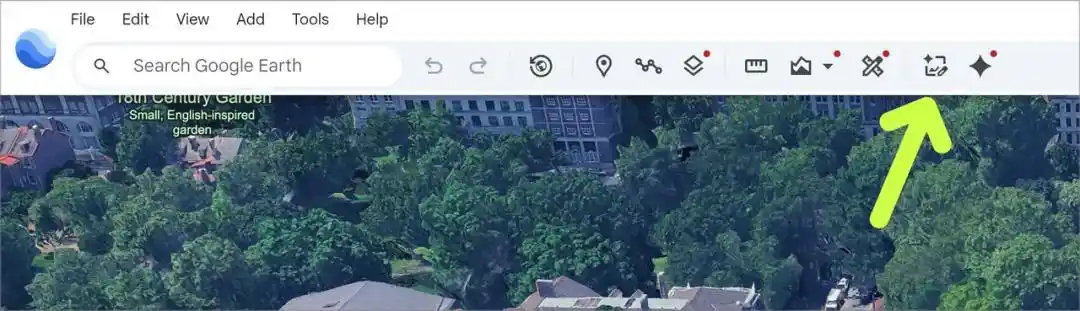
First, look at a few examples from Google.

Turn Back Time, Recreate History

Helping students not just read about history, but truly "see" the past.

Teachers can display a historical site in the classroom, then input: "Generate a photorealistic image showing the original appearance of the Pompeii archaeological site in AD 78."

The modern ruins instantly transform into a bustling, colorful ancient Roman street scene, allowing students to visually see the world from two thousand years ago.

Virtual Tour Guide: Explore and Learn Deeply

Create customized infographics to gain a deeper understanding of a place without leaving Google Earth.

Input: "Create an easy-to-understand infographic about the Statue of Liberty, labeling key historical facts."

In the background, Gemini retrieves relevant historical information, and Nano Banana generates the corresponding visual chart within seconds.

'Dream City Transformer': Create Professional Real Estate Planning Proposals

Presenting real estate projects becomes much simpler when clients can see the final outcome directly.

Architects and urban planners can now present design plans with a single sentence: "Reimagine this vacant lot in Tokyo as a vibrant shopping and commercial district, featuring open public spaces."

The originally barren concrete lot is replaced with a high-quality 3D rendered modern urban oasis, helping clients see future possibilities.

Visualize Project Results Before Construction Begins

Whether it's a dream backyard studio or a lakeside home, it's often hard to imagine what it will look like when completed.

Now, you can quickly turn it into a reality preview.

Zoom in on an empty plot of land, then input: "Add a modern lakeside cabin built using locally sourced sustainable materials."

The system generates a photorealistic rendering, perfectly integrating the future home into the actual terrain.

Give Your Favorite Place a Future Makeover

Sometimes, letting your imagination run wild is its own kind of fun.

If you want to see what a place might look like a hundred years from now, input: "Transform the Google Mountain View campus into a futuristic sci-fi utopia, with glowing walkways, glass eco-domes, flying transit pods, and trees growing around the buildings."

Soon, the entire area gradually morphs into a cinematic cyberpunk metropolis.

Users Exclaim 'Oh My God'

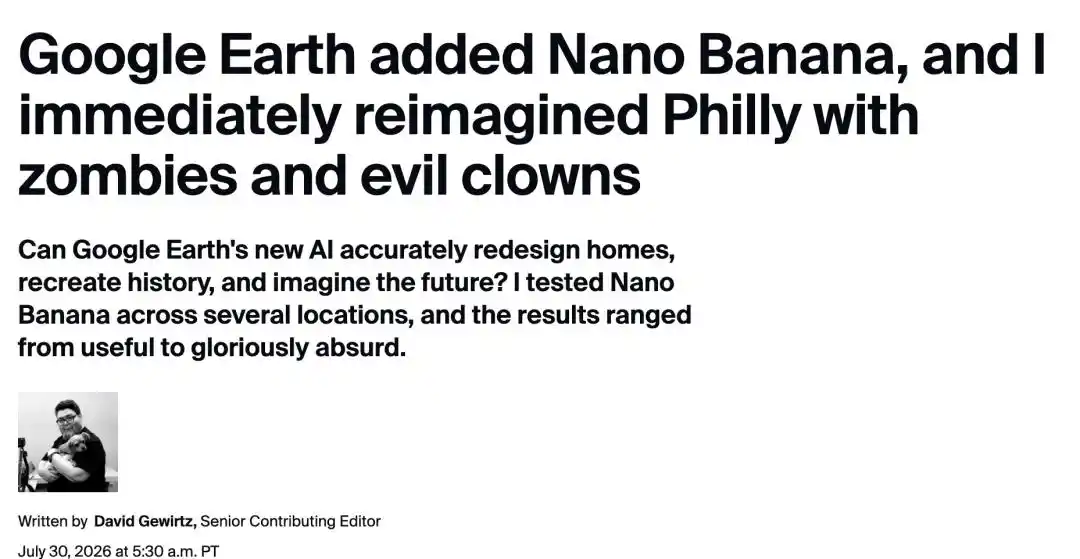
Technology editor David Gewirtz once spent hours exploring on Google Earth, captivated by its ability to travel the world without leaving home. Street View, though somewhat intrusive, also fascinated him, and still does to this day.

Upon hearing the news, he immediately tested the new feature, resulting in "a lot of laughs."
Independence Hall is a U.S. National Historic Landmark and a UNESCO World Heritage Site. On July 4, 1776, the Declaration of Independence was adopted there.
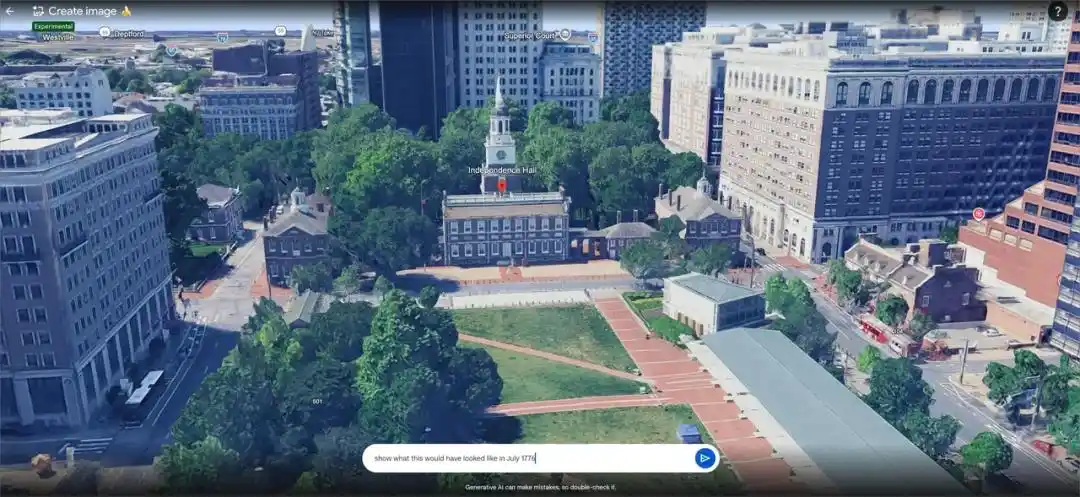
Undoubtedly, this holds significant historical and cultural value for the United States.

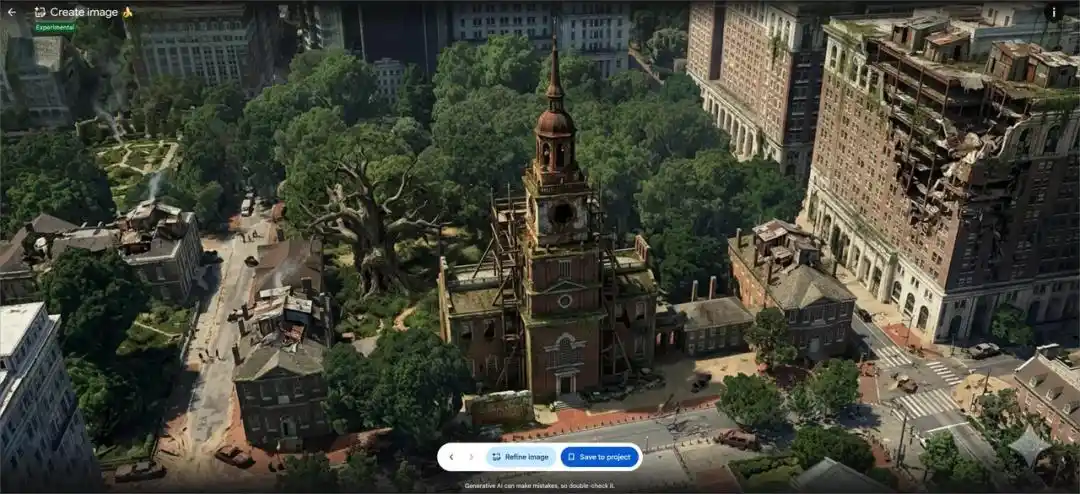
But David Gewirtz had a wild idea: "Imagine this in a post-apocalyptic dystopian future, 500 years from now."

With that one prompt, the former hall was directly transformed into a "post-apocalyptic ruin."
One of Philadelphia's most iconic traditions is the annual Mummers Parade, the oldest folk parade in the U.S., a New Year's tradition since 1901.

This got him thinking: Philadelphia in the future would need a post-apocalyptic dystopian Mummers Parade.

So, he added the prompt, "Now, have it overrun by zombies, evil clowns, and giant alien mechs."
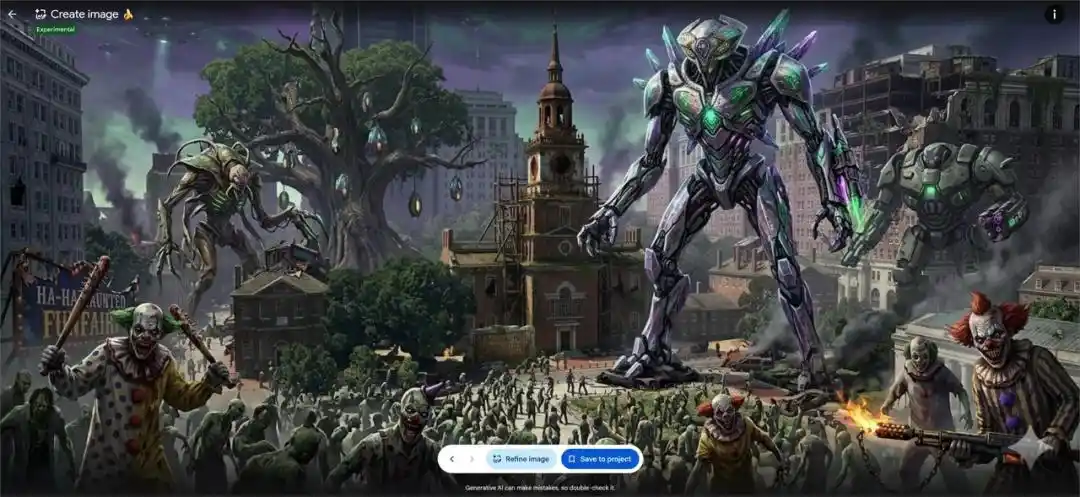
Zombies, evil clowns, and giant alien mechs, oh my!

The zombies, evil clowns, and giant alien mechs seemed a bit tense, the atmosphere off. But one more prompt would make it perfect. He told the AI, "Make them all cheerful."
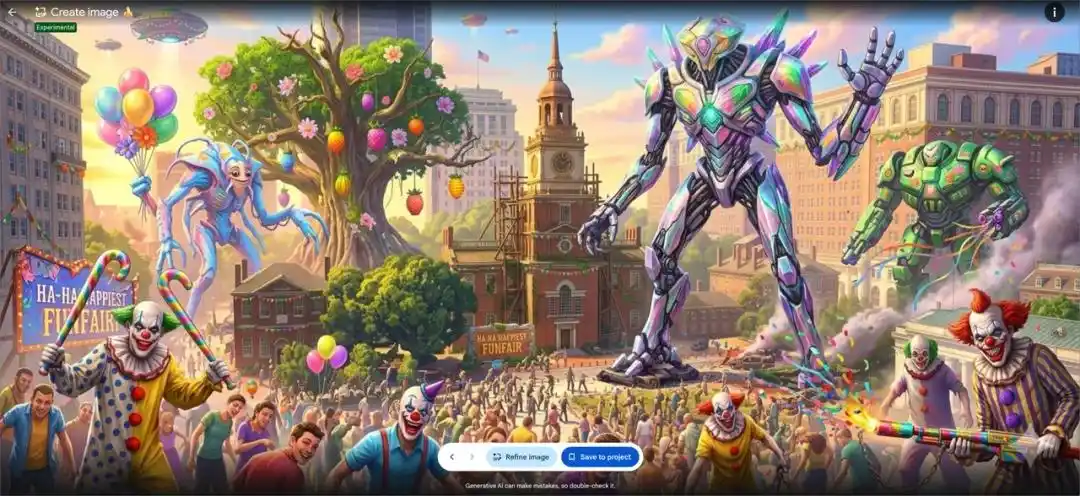
Now, he thinks: "This is a believable future Philadelphia, especially on January 1st."

Note, he also cautioned: "While this can lead to some fun experiments, it's clearly not yet a reliable and practical tool."
Currently, the new feature does not support direct use in "Street View" at all, directly reducing both practicality and fun, which is regrettable.

Some media outlets have mercilessly criticized it: For professional developers or architects, this kind of painting that cannot guarantee spatial geometric rigor and is purely stitched together by probability is nothing more than a refined "AI Slop."

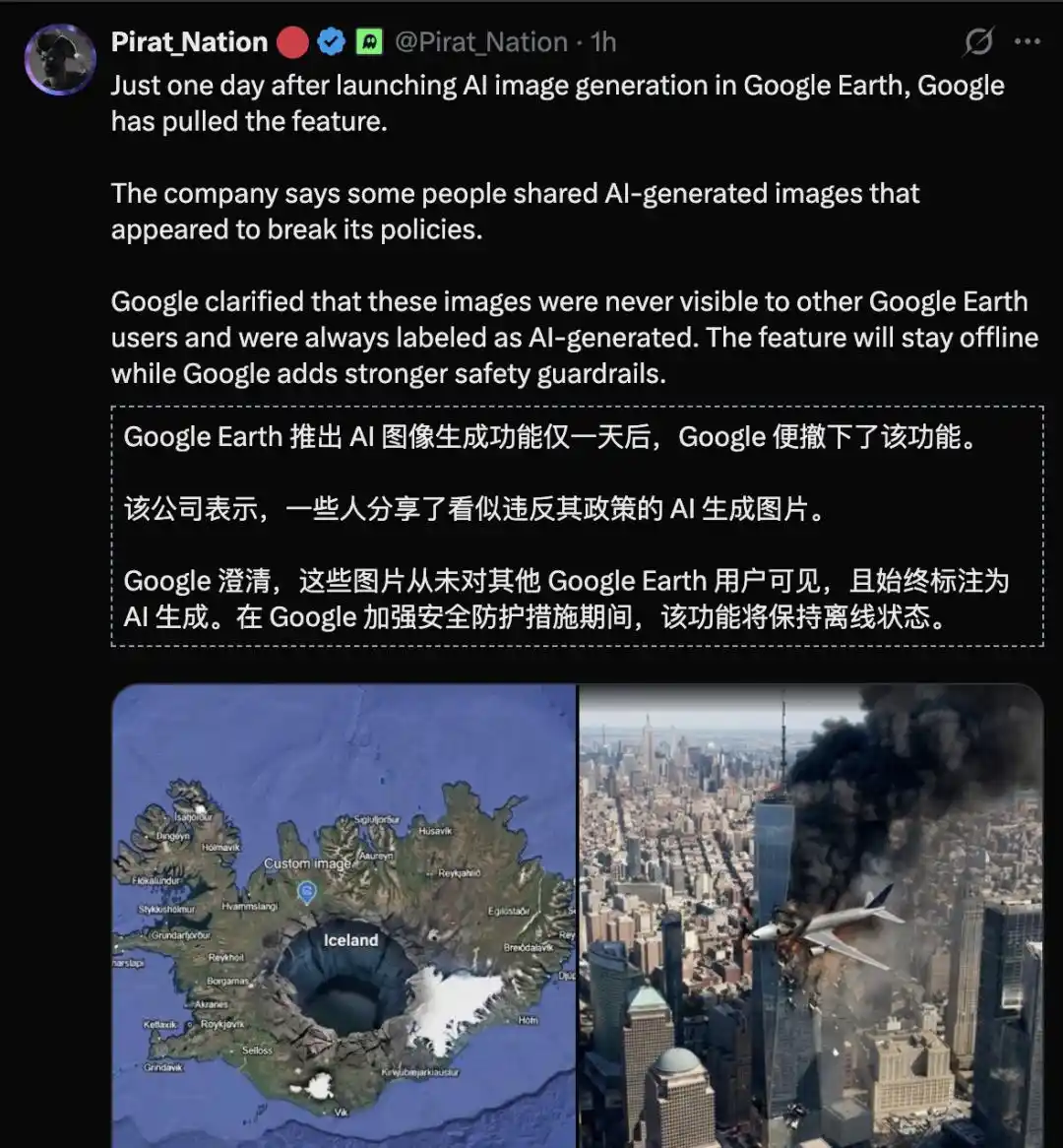
It was taken down by netizens in less than a day! Google urgently pulls back the new feature!
Technical Decryption

From "Creating from Nothing" to "Geospatial Grounding"

In the early logic of AI drawing, AI played with pixels like a game.

You give it a prompt, and it pieces together a picture from a vast probability distribution. It doesn't care about gravity, let alone whether the building in the image actually exists in reality.

But Nano Banana 2, integrated into Google Earth, has completely changed the game. This is a brand-new attempt called "Geospatial Grounding."

At the technical core, it relies on Gemini's powerful multimodal and retrieval-augmented (Search Grounding) capabilities:

First, real-time capture of the physical base map.

The underlying input Nano Banana 2 receives is not just an ordinary top-down view; it's a composite constraint matrix of "the current viewport's satellite/aerial original image + 3D elevation and terrain mesh + spatial camera parameters."

It is speculated that its generation tasks are strictly anchored:

Terrain cannot be altered: The folds of mountains, the baseline of lake edges, the precise location and scale of building foundations must strictly conform to geographical facts.

Perspective and spatial relationships must match: Newly generated buildings, vegetation, or scene elements must be nested into the real 3D terrain and existing structures, not float in mid-air.

Subject consistency: Nano Banana 2 supports powerful consistency rendering for up to 5 main subjects and 14 objects, ensuring new cities or communities don't suffer obvious visual collapse when switching perspectives.

This is conditioned generation under real geographic constraints. The cost is that each image in Google Earth takes up to two minutes to generate.

Second, real-time retrieval from a world knowledge base.

Nano Banana 2 is not just an image generator; it's connected to Google's vast search engine and geographic knowledge base. When you try to "restore history" or "label landmarks," it actively retrieves the cultural background and geographic knowledge of that landmark.

For example, a user requests to generate a "Statue of Liberty infographic."
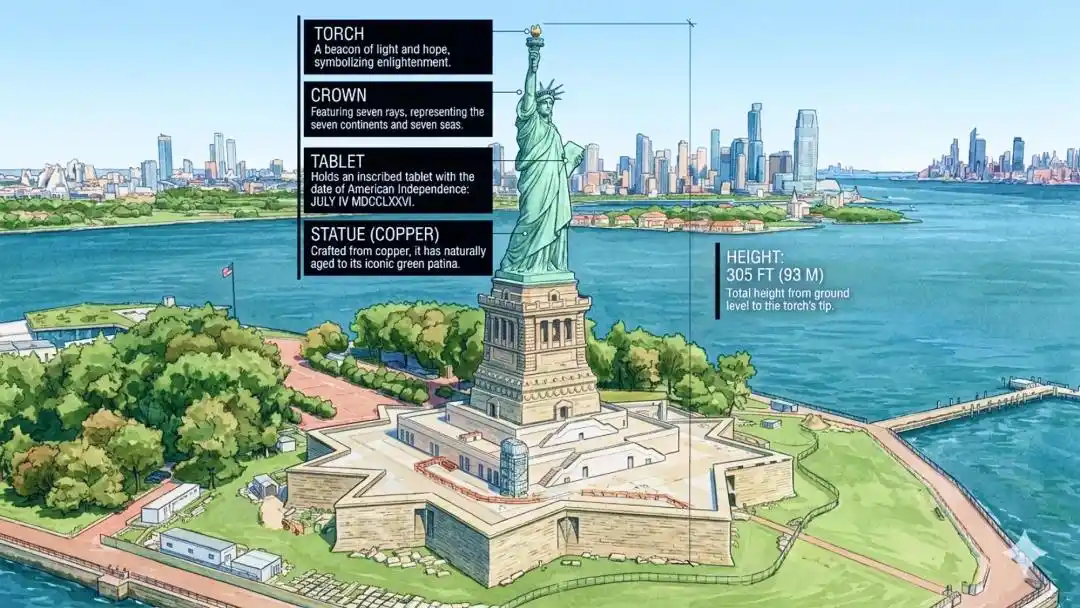
The model not only draws the image but also calls upon Gemini's world knowledge base to automatically populate: year of construction, materials used, architectural dimensions, historical information, etc.

However, whether the retrieved information is completely accurate is another issue that requires careful consideration.

The fact that AI can generate seemingly professional infographics does not mean all facts are absolutely reliable.

Third, high-fidelity detail and precise text.

Nano Banana 2 supports high-fidelity 2K or even 4K image output and possesses powerful text rendering capabilities. This means you can directly see clearly laid-out, non-garbled text signs or informational explanations within the generated scenes. You can even "hand-draw" an infographic with real historical facts directly onto a landmark.

At the operational level, Google has compressed this complex technology to the extreme: During generation, you can go forward/backward to see changes, click "Refine image" to add prompts for further iteration, and the interface provides an intuitive before/after experience.

This directly eliminates the cumbersome workflow for the average person of "screenshot - export - input to another AI - re-paste," enabling the seamless, native fusion of "creativity" and "real-world geography."

After you're satisfied, click "Save to Project." The generated image is permanently pinned to your personal project layer as a Placemark, preserving the camera view. Anyone who clicks on this coordinate can see your "alternate possibility."

Will the Virtual Earth Help Google Gemini Break Through the Crowd?

The significance of Nano Banana entering Google Earth likely goes far beyond a new feature.

The AI image generator track is in a state of intense competition.

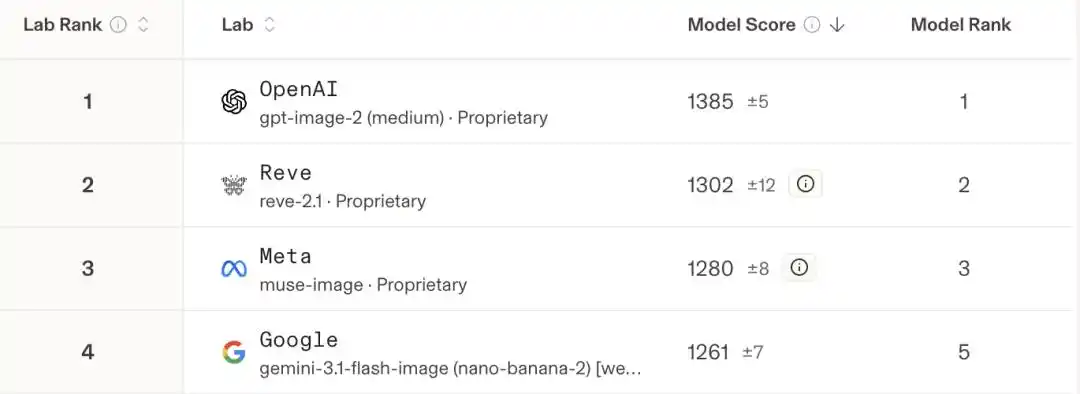
OpenAI's GPT-image-2 leads the Arena rankings, while Nano Banana 2 Lite ranks fifth. Adobe Firefly, Midjourney, and others are all vying for the same pool of users.
Google has taken a completely different path.

Its ace card isn't the algorithm; it's the data. Two decades of accumulated satellite imagery, aerial photos, plus 3D terrain modeling covering hundreds of cities in over 40 countries—this proprietary spatial dataset is a moat that any purely text-based model will never reach.

By grafting Nano Banana 2 onto this dataset, Google has created a brand-new category: AI visualization based on real geographic coordinates, possessing spatial credibility.

It's not competing with Midjourney over who can paint more beautifully, but over who can paint more "realistically"—real enough to have latitude, longitude, altitude, and physical perspective.

Kevin Kelly once predicted that the physical world would have a strictly corresponding "Mirrorworld" in the digital world. Today, Google is using Nano Banana 2 to lightly apply a layer of "digital skin that can be arbitrarily rewritten by prompts" onto this mirror world.

Google has directly shifted the battlefield from "painting beautifully" to "transforming the Earth." In this war, others don't even have a ticket to get in.

References:

https://blog.google/products-and-platforms/products/earth/nano-banana-google-earth-image-generation/

https://www.zdnet.com/article/google-earth-added-nano-banana-and-i-immediately-reimagined-philly-with-zombies-and-evil-clowns/

https://www.techtimes.com/articles/322272/20260730/google-earth-gets-ai-image-generator-grounded-satellite-data-web-only.htm

https://x.com/googleearth/status/2082818165503902043

https://x.com/Google/status/2082834786310123787

Editor: David

This article is from the WeChat public account "New Zhiyuan", author: ASI启示录

Трендові криптовалюти

Пов'язані питання

QWhat is the main news announced in the article?

AGoogle Earth urgently rolled back its newly integrated image generation feature powered by the Nano Banana 2 model after users 'broke' it with creative prompts, leading to concerns. Google plans to re-release it with 'enhanced protective measures'.

QWhat are some of the key new functionalities introduced by the Nano Banana 2 feature in Google Earth?

AKey functionalities include visualizing historical scenes (e.g., reconstructing ancient Pompeii), creating virtual information guides for landmarks, generating professional architectural and urban planning previews, and allowing users to imagine future transformations of real-world locations.

QWhat is 'Geospatial Grounding' as mentioned in the article's technical explanation?

A'Geospatial Grounding' is a technical approach where the AI image generation (Nano Banana 2) is constrained by real geographic data. This includes the satellite/ aerial base map, 3D elevation and terrain mesh, and spatial camera parameters, ensuring generated elements adhere to real-world topography, perspective, and spatial relationships.

QWhy did Google Earth's new feature face criticism according to the article?

AThe feature faced criticism for being an 'AI Slop'—a term used to describe visually polished but spatially and geometrically inaccurate AI-generated content, making it unreliable for professional architects or developers. It also lacks support for the Street View perspective, limiting its utility.

QHow does Google's integration of Nano Banana 2 into Google Earth differ from competitors like Midjourney, according to the article?

AGoogle's strategy differs by leveraging its unique asset: two decades of proprietary satellite imagery, aerial photos, and 3D terrain data. Instead of competing on artistic beauty alone, it focuses on creating spatially credible visualizations anchored to real geographic coordinates, essentially aiming to 'remodel the Earth' in a way competitors cannot easily replicate.

Пов'язані матеріали

Altman Admits: Overestimated AI Snatching Jobs! Huang Renxun: The Unemployment Narrative Is Completely Backwards

Sam Altman has revised his earlier predictions about AI rapidly replacing jobs, admitting he overestimated the speed at which AI would eliminate entry-level white-collar roles. Speaking on the "Invest Like the Best" podcast, he stated that people do not truly want an AI CEO, as accountability and human connection remain critical. He found that individuals prefer interacting with people who can be held responsible for decisions. Similarly, NVIDIA's Jensen Huang argued that the narrative of AI destroying jobs is misguided. He distinguishes between tasks and jobs, noting that while AI can automate specific tasks, entire jobs—encompassing communication, judgment, coordination, and accountability—are not eliminated. He cited examples like radiologists and software engineers, where demand for these roles has increased as AI handles repetitive tasks, allowing for business expansion and the creation of more positions. Data from a University of Maryland and LinkUp study supports this, showing that U.S. job postings for new graduates have actually risen, countering the fear of vanishing entry-level roles. However, a significant shift is occurring: the traditional entry-level tasks that help newcomers gain experience are being automated, making initial career access more challenging. The key insight is that as AI takes over standardized tasks, the enduring value of human work shifts toward areas of responsibility, trust-building, and final decision-making—aspects that AI cannot replicate. The real "moat" for professionals lies in these irreplaceable human elements.

marsbit1 год тому

Altman Admits: Overestimated AI Snatching Jobs! Huang Renxun: The Unemployment Narrative Is Completely Backwards

marsbit1 год тому

Weekly Editor's Picks (0725-0731)

Weekly Editor's Picks (0725-0731) provides a curated selection of deep analysis, filtering out market noise. Key themes from this week include: **Macro & Policy:** The Federal Reserve's upcoming meeting is marked by high uncertainty, balancing cooling inflation data against persistent price pressures. Meanwhile, the U.S. crypto regulatory Clarity Act faces critical political hurdles, with its 2026 passage probability seen as low. **Investing & Crypto:** Analysis suggests long-term crypto success depends on conviction through volatile cycles, focusing on assets like Bitcoin and core smart contract platforms. A trend noted is the increasing similarity between global equity markets (especially tech) and crypto, driven by narrative and leverage. Several major crypto protocols show strong revenue growth, but this isn't always translating to token price appreciation due to sell pressure and structural factors. **AI & Semiconductors:** Nvidia's rising credit default swap rates signal market concern over AI infrastructure financing risks. The storage sector experienced volatility as markets began pricing in potential 2027 oversupply. Despite a record profitable quarter, SK Hynix's results were deemed "below expectations," reflecting heightened investor demands for future growth visibility. **Markets & DeFi:** TradeXYZ demonstrated remarkable accuracy in pre-market pricing for a major A股 listing. The token ONDO saw gains, linked to its growing role in the on-chain tokenized stock ecosystem. **Ethereum:** Post-Pectra upgrade, a major structural shift is underway as Lido begins migrating millions of ETH to new validator architectures designed for capital efficiency. **Also Highlighted:** Butian's bullish stock market move; OpenAI's Altman promising major advances; Samsung and SK Hynix securing large AI chip deals; Apple reaching a $5T market cap; and ongoing discussions around exchange security following Poolin's bankruptcy case.

marsbit2 год тому

Weekly Editor's Picks (0725-0731)

marsbit2 год тому

Low Investment Isn't Apple's Immunity Pass

While Meta and Google face investor scrutiny over ballooning AI capital expenditures, Apple's minimal AI investment has paradoxically become a strength. Its market cap recently reclaimed the global top spot, surpassing $5 trillion. The irony is deep: Apple's own AI efforts have lagged, with "Apple Intelligence" delayed and core talent lost, forcing reliance on partners like Google Gemini and Alibaba's Qianwen. Its Q3 FY2026 (Q2 CY) earnings initially seemed stellar. Revenue hit $109.4B (up 16% YoY), with iPhone and Mac sales, growing 22% and 29% respectively, driving most of the growth. However, the stock fell over 8% post-earnings. The primary concern was a weaker Q4 revenue growth forecast of 9-11%, below expectations, due to looming supply chain constraints. Apple is feeling the indirect cost of the AI boom. Soaring memory and chip prices, fueled by massive data center investments from Microsoft, Amazon, and others, are forcing Apple to raise Mac and iPad prices significantly. The upcoming iPhone launch is also expected to see substantial price hikes. Despite avoiding heavy AI infrastructure spending—its capital expenditures are actually down 28%—Apple cannot escape the industry-wide supply and cost pressures. While Apple's operating cash flow remains robust, its substantial R&D spending (up 32% YoY) has yet to yield major AI breakthroughs. As Tim Cook prepares to step down as CEO, Apple faces a challenging transition: balancing its premium hardware success against the strategic and cost pressures of the AI era it has so far cautiously navigated.

marsbit2 год тому

Low Investment Isn't Apple's Immunity Pass

marsbit2 год тому

PA Graphics Explanation | One Chart to Understand the Major Web3 Events in August 2026

**PANews Crypto Calendar: Key Web3 Events in August 2026** PANews introduces its revamped crypto calendar, featuring comprehensive coverage, flexible filtering, and easy export options. The market in August will be shaped by multiple key events across macroeconomics, regulation, tokenomics, and project developments: * **Macro & Policy:** Key US economic data releases (July Non-Farm Payrolls, CPI), the Federal Reserve meeting minutes, and the Jackson Hole Economic Symposium will be in focus. On the regulatory front, the US Senate plans to release a new draft of the *CLARITY Act*, while the EU's expanded crypto ban against Belarus comes into effect. * **Token Unlocks:** Significant token unlocks are scheduled for assets including ENA, AVAX, CONX, ZRO, and KAITO, which may influence market volatility. * **Project Updates & Shutdowns:** Several services, including Exchange Art, Ctrl Wallet, Zapper, NFTfi, and Summer.fi, are set to cease operations or undergo major adjustments. Users are advised to manage their assets accordingly. * **Corporate Activity:** Q2 earnings reports from companies like SpaceX, Circle, and Nvidia are due. Unitree Robotics will initiate its IPO subscription on the STAR Market, and Moonshot AI plans to begin a Pre-IPO financing round. * **Industry Events:** Major conferences such as Bitcoin Asia 2026 and the 2026 Digital Expo will take place. The overarching market narrative for August will revolve around macroeconomic expectations, regulatory developments, token unlock schedules, and ongoing industry consolidation.

marsbit3 год тому

PA Graphics Explanation | One Chart to Understand the Major Web3 Events in August 2026

marsbit3 год тому

Торгівля

Спот

Популярні статті

Як купити BANANA

Ласкаво просимо до HTX.com! Ми зробили покупку Banana Gun (BANANA) простою та зручною. Дотримуйтесь нашої покрокової інструкції, щоб розпочати свою криптовалютну подорож.Крок 1: Створіть обліковий запис на HTXВикористовуйте свою електронну пошту або номер телефону, щоб зареєструвати обліковий запис на HTX безплатно. Пройдіть безпроблемну реєстрацію й отримайте доступ до всіх функцій.ЗареєструватисьКрок 2: Перейдіть до розділу Купити крипту і виберіть спосіб оплатиКредитна/дебетова картка: використовуйте вашу картку Visa або Mastercard, щоб миттєво купити Banana Gun (BANANA).Баланс: використовуйте кошти з балансу вашого рахунку HTX для безперешкодної торгівлі.Треті особи: ми додали популярні способи оплати, такі як Google Pay та Apple Pay, щоб підвищити зручність.P2P: Торгуйте безпосередньо з іншими користувачами на HTX.Позабіржова торгівля (OTC): ми пропонуємо індивідуальні послуги та конкурентні обмінні курси для трейдерів.Крок 3: Зберігайте свої Banana Gun (BANANA)Після придбання Banana Gun (BANANA) збережіть його у своєму обліковому записі на HTX. Крім того, ви можете відправити його в інше місце за допомогою блокчейн-переказу або використовувати його для торгівлі іншими криптовалютами.Крок 4: Торгівля Banana Gun (BANANA)Легко торгуйте Banana Gun (BANANA) на спотовому ринку HTX. Просто увійдіть до свого облікового запису, виберіть торгову пару, укладайте угоди та спостерігайте за ними в режимі реального часу. Ми пропонуємо зручний досвід як для початківців, так і для досвідчених трейдерів.

187 переглядів усьогоОпубліковано 2024.12.11Оновлено 2026.06.02

Як купити BANANA

Обговорення

Ласкаво просимо до спільноти HTX. Тут ви можете бути в курсі останніх подій розвитку платформи та отримати доступ до професійної ринкової інформації. Нижче представлені думки користувачів щодо ціни BANANA (BANANA).

活动图片













