Banking Giant JPMorgan Debuts Coin On Public Blockchain, But It’s Not XRP

bitcoinistОпубліковано о 2026-01-08Востаннє оновлено о 2026-01-08

Анотація

JPMorgan has advanced its blockchain strategy by deploying its proprietary digital dollar token, JPM Coin, on a public blockchain. This USD-backed deposit token, designed for institutional wholesale payments and settlements, will operate on the Cronos network. The move reflects growing institutional comfort with public blockchains that meet regulatory standards. JPMorgan selected Cronos for its compatibility with smart contracts and established tooling. The integration, planned through 2026, aims to enable fast, regulated, and interoperable digital money movement. This development coincides with JPMorgan's internal evaluation of potentially offering cryptocurrency trading services to institutional clients.

JPMorgan has moved its blockchain strategy into a new phase after confirming plans to deploy its proprietary digital dollar token on a public blockchain network. The development is part of how major banks are increasingly comfortable using public blockchain infrastructure, provided it can be adapted to meet institutional and regulatory requirements.

Although the XRP Ledger ticks all the boxes required, JPMorgan’s leadership has gravitated toward Cronos as the environment best suited for expanding the real-world use of its in-house digital asset.

JPM Coin Steps Onto Public Blockchain Infrastructure

Digital Asset and Kinexys by J.P. Morgan, the global banking heavyweight, disclosed that its USD-backed deposit token, known as JPM Coin, will now be deployed on a public blockchain framework.

JPM Coin is the first bank-issued USD-denominated deposit token fully backed by US dollar deposits held at the bank. The coin is designed for wholesale payments and settlements between institutional clients, and this provides the ability for transfers to be completed far faster than traditional banking rails.

Moving JPM Coin onto a public blockchain means that JPMorgan sees long-term value in shared infrastructure, especially as tokenized assets and on-chain settlement gain traction across global markets. The bank’s approach centers on efficiency and interoperability while still preserving strict controls around who can access and use the token.

Interestingly, J.P. Morgan’s leadership aligned around Cronos as the most suitable option for the deployment of JPM Coin on a public blockchain. Cronos offers compatibility with existing smart contract standards, established tooling, and an ecosystem already familiar to institutions experimenting with tokenized assets and payments.

According to the press release, by bringing JPM Coin natively to Canton, Digital Asset and Kinexys by J.P. Morgan are laying the foundation for regulated, interoperable digital money that can move quickly across financial markets.

Under the terms of the collaboration, Digital Asset and JPMorgan plan a phased integration through 2026, starting with the technical and operational groundwork needed to support the issuance, transfer, and near-instant redemption of JPM Coin directly on Canton. Later phases may include introducing additional products, including J.P. Morgan’s Blockchain Deposit Accounts, to expand the offerings.

Direction Of Bank-Led Blockchain Adoption

JPMorgan’s recent move shows how major financial institutions are selectively embracing public blockchains, and this is a reflection of the growth of the entire crypto ecosystem. Interestingly, this blockchain expansion comes against the backdrop of growing internal discussions at JPMorgan about deeper involvement in digital assets.

Recent reports show that the bank is already evaluating whether its markets division should begin offering cryptocurrency trading services to institutional clients.

The internal review reportedly includes potential spot trading as well as derivatives exposure tied to digital assets, pointing to a wider reassessment of how crypto fits into JPMorgan’s business. Although the company is already involved in crypto-related initiatives, this would be the first time it will be directly involved.

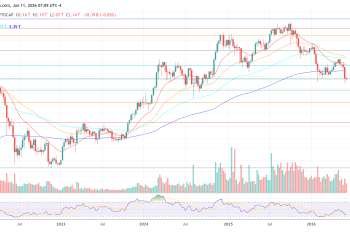
XRP trading at $2.11 on the 1D chart | Source: XRPUSDT on Tradingview.com

Пов'язані питання

QWhat is the name of JPMorgan's USD-backed deposit token and on which public blockchain will it be deployed?

AThe token is called JPM Coin and it will be deployed on the Cronos public blockchain.

QWhat is the primary purpose of JPM Coin as described in the article?

AJPM Coin is designed for wholesale payments and settlements between institutional clients, enabling transfers than traditional banking systems.

QAccording to the article, why did JPMorgan choose the Cronos network for its JPM Coin deployment?

AJPMorgan chose Cronos because it offers compatibility with existing smart contract standards, established tooling, and an ecosystem already familiar to institutions experimenting with tokenized assets.

QWhat broader trend in the banking industry does JPMorgan's move to a public blockchain represent?

AIt represents a trend of major financial institutions selectively embracing public blockchain infrastructure as tokenized assets and on-chain settlement gain traction.

QWhat additional crypto-related service is JPMorgan reportedly evaluating for its institutional clients, according to the article?

AJPMorgan is reportedly evaluating whether its markets division should begin offering cryptocurrency trading services, including potential spot trading and derivatives exposure tied to digital assets.

Пов'язані матеріали

Can Generative Models Finally Be Trained End-to-End? The Core Is a For Loop

This article introduces a novel training paradigm for generative models called Explorative Modeling (XM), which enables true end-to-end training. Traditionally, powerful generative models like autoregressive and diffusion models are not trained end-to-end. They are trained to predict a single small step but require iterative multi-step sampling for inference. This "exposure bias" leads to error accumulation and limits performance. The core challenge XM addresses is "mode blurring." In generative tasks, a single input (e.g., "generate a dog") corresponds to many valid outputs (multiple modes). Standard training objectives like reconstruction loss force the model to average these modes, producing unrealistic, blurry outputs. To avoid this, existing models break generation into many small, almost deterministic steps, sacrificing end-to-end training. XM tackles this by restructuring the training loop itself. Its key insight is to amplify "generative expressivity." For each training input, instead of generating one sample, the model generates K candidate outputs. Only the candidate closest to the real data is used for computing the loss and updating the model via backpropagation. This simple "best-of-K" mechanism is implemented as a short for-loop. By exploring multiple possibilities, the model learns to distribute its guesses across different modes rather than collapsing to their uninformative average. The paper demonstrates that "exploration" acts as a new, powerful scaling axis. Gains from XM increase with model size, data scale, and compute. Experiments show improvements in FID scores for image generation and significant efficiency gains, sometimes outperforming larger models without exploration. When pushed to the limit, XM enables fully single-step, end-to-end generative models. In robotics tasks, an "Explorative Policy" matched the performance of a 100-step Diffusion Policy with a single forward pass, drastically improving inference speed. While the best-of-K concept is not entirely new, the authors' contribution lies in formally understanding it as a direct method to boost generative expressivity without fragmenting the generation process. This work suggests that as models scale, enhancing exploration during training may become crucial for overcoming fundamental performance bottlenecks.

marsbit50 хв тому

Can Generative Models Finally Be Trained End-to-End? The Core Is a For Loop

marsbit50 хв тому

Annual Salary of Millions Competing for Electricians, Meta Rushes to Open Its Own Technical School

The AI boom is facing an unexpected bottleneck: a severe shortage of skilled construction workers and electricians. As tech giants like Meta, OpenAI, and Alphabet race to build massive data centers—such as OpenAI's $16 billion "Stargate" project—they are hitting a critical labor wall. The U.S. needs an estimated 130,000 more electricians, 240,000 construction workers, and 150,000 supervisors by 2030 for AI infrastructure alone, but tens of thousands of electrician jobs go unfilled each year. While AI companies offer high premiums, with electricians earning up to $280,000 annually, worker scarcity still causes massive losses—delays on a single project can cost $14.2 million per month. The complexity of building AI data centers, which require immense power (equivalent to powering hundreds of thousands of homes), sophisticated electrical systems, and advanced liquid cooling solutions, demands highly skilled technicians who are in short supply. To combat this, companies are investing heavily in training. Meta has committed $115 million to a free training school offering tuition, housing, and stipends, targeting 5,000 new workers. OpenAI is partnering with unions to secure skilled labor. These efforts are paying off, with a significant rise in Gen Z interest in trade schools over college. However, the power demands are staggering. AI data centers are driving a rapid surge in electricity consumption, projected to account for up to 12% of U.S. power use by 2028 and raising costs for consumers. Furthermore, the construction boom is project-based, leading to a potential future glut of trained workers once building peaks, which could depress wages industry-wide. The race for AI supremacy now depends as much on skilled hands as on advanced chips.

marsbit2 год тому

Annual Salary of Millions Competing for Electricians, Meta Rushes to Open Its Own Technical School

marsbit2 год тому

Торгівля

Спот
活动图片