Attracting Global Capital, Asia's New 'Super Cycle' Is Unfolding

marsbitОпубліковано о 2026-05-11Востаннє оновлено о 2026-05-11

Анотація

Investors are turning to Asia as the next frontier for global equity growth, with a new "super cycle" unfolding across the region. Driven by the AI revolution, Asian markets, particularly South Korea, have seen significant rallies. According to Morgan Stanley analysis, the underlying drivers of Asia's industrial cycle are shifting from traditional sectors like real estate and manufacturing to massive investments in AI infrastructure, energy security and transition, and supply chain resilience. Fixed asset investment in Asia is projected to grow from around $11 trillion in 2025 to $16 trillion by 2030, with a 7% annual growth rate from 2026-2030. The AI wave is a primary catalyst, driving immense capital expenditure for chips, servers, data centers, and power systems. Asia is central to this hardware supply chain. In China, AI investment is focused on building a full-system domestic capability, with the local AI chip market potentially reaching $86 billion by 2030. Beyond AI, China's export story is expanding from EVs and batteries to robotics. The country already captures about half of new global industrial robot demand and over 90% of humanoid robot shipments. This growth phase mirrors the early stages of China's EV export boom. Simultaneously, energy security investments, spurred by AI's massive power needs, are rising, with China benefiting from its leadership in solar, batteries, and EVs. Regional defense spending is also increasing structurally, supporting demand for a...

Author: Bao Yilong

Investors are turning their eyes to Asia, searching for the next breakthrough in the global stock market rally.

Driven by the AI wave, South Korea's stock market led the world in gains this month, attracting a large influx of capital. The implied volatility in the options market has climbed to extreme levels, with derivatives strategists competing to recommend long structures.

All these signals point to the same conclusion: Asia's upward trend may have just begun.

According to Wind Trading Desk, Morgan Stanley's Asia-Pacific team has recently repeatedly emphasized that the underlying drivers of Asia's industrial cycle are shifting from traditional real estate and general manufacturing inventory replenishment to AI and its infrastructure, energy security and transition, defense, and supply chain resilience investments.
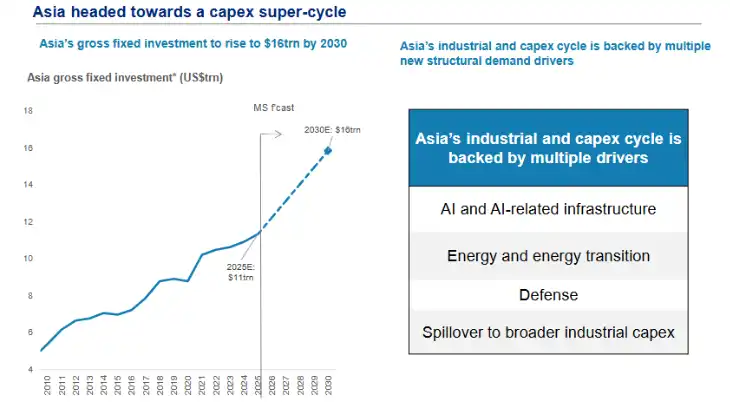
(Asia's total fixed investment is set to grow to $16 trillion by 2030)

Morgan Stanley expects Asia's fixed asset investment scale to rise from about $11 trillion in 2025 to $16 trillion in 2030, with a nominal compound annual growth rate (CAGR) of about 7% from 2026 to 2030, significantly higher than recent levels.
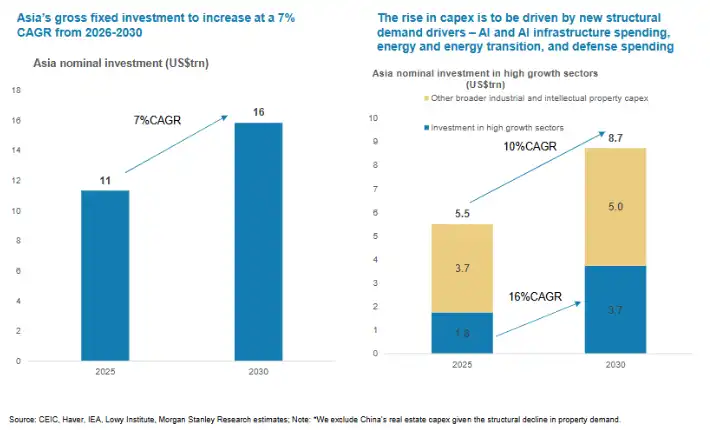
(Asia's total fixed capital investment will maintain a 7% CAGR between 2026 and 2030)

The Underlying Logic of the 'Super Cycle': Asia's Capital Expenditure Is Set to Accelerate Significantly

The most core difference in this round of Asia's industrial cycle is that AI has pushed capital expenditure back to the forefront.

Over the past two years, market discussions on AI focused more on models, applications, and the US 'Magnificent Seven.' However, from an Asian perspective, the real meaning of AI is: the comprehensive expansion of chips, memory, servers, optical modules, data centers, power systems, and cloud infrastructure.

Morgan Stanley mentioned that the proportion of global CIOs listing AI as their top priority has risen to 39%. Correspondingly, global AI data center investment is expected to reach about $2.8 trillion from 2026 to 2028, with an annual growth rate of about 33%.
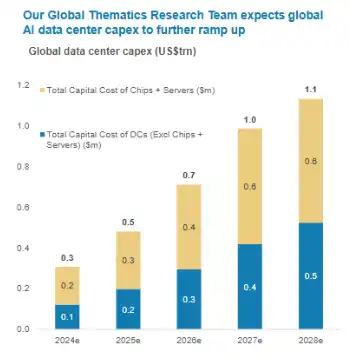
(Capital expenditure related to data centers in the global AI field will increase further)

Asia is at the center of the AI hardware supply chain: from TSMC, Samsung, SK Hynix to semiconductor, server, optical communication, and cloud infrastructure companies in Mainland China, all will benefit from this investment cycle.

The report also expects capital expenditure by major chip companies to potentially rise from about $105 billion in 2025 to about $250 billion annually by 2028. This means AI is a capital-intensive race.

China's role is particularly noteworthy.

Morgan Stanley believes China's AI competition is about complete system capabilities: computing power determines speed, cloud platforms determine scale, token usage determines cost-effectiveness, and application scenarios determine value capture.

Amid ongoing external chip restrictions, the linkage between domestic AI chips, local cloud platforms, and the large model ecosystem is becoming a new investment theme in Chinese technology.
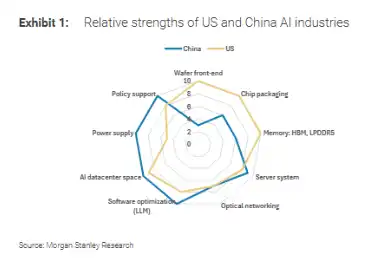
(The relative advantages of the AI industry in China and the US)

Their analysis shows that China's AI chip market could reach $67 billion by 2030, with domestic self-sufficiency potentially rising to 86%.

Whether this prediction materializes fully remains to be seen, but the direction is clear: domestic computing power has gradually shifted from a policy imperative to a commercial one.

The Export Story of 'Made in China' Is Expanding from the 'EV Trio' to Robotics

In recent years, the brightest spots in China's export structure were the 'new three'—electric vehicles, lithium batteries, and photovoltaic products.

The report suggests that the new growth driver for Chinese manufacturing in the next stage could come from robotics, especially industrial robots and humanoid robots.

Morgan Stanley points out that China has already captured about half of the incremental global demand for industrial robots. Global humanoid robot shipments in 2025 are estimated at about 13,000 to 16,000 units, with about 90% coming from Chinese manufacturers. In contrast, markets like the US and Japan remain more in the prototype or early validation stages.

More interestingly, the report draws an analogy between current Chinese robotics exports and electric vehicle exports around 2019: back then, EV exports hadn't entered an explosive growth phase, but the supply chain, policy support, and manufacturing capabilities were largely in place.
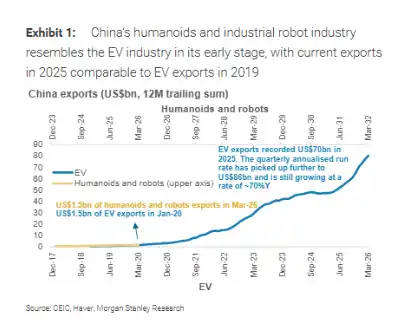
(China's humanoid and industrial robotics industry is at a development stage similar to the early phase of the electric vehicle industry)

Today, the robotics industry exhibits similar characteristics—the market size is still not large, but the industrial chain is expanding rapidly.

Looking at the data, China's 12-month rolling scale of humanoid robot and robotics-related exports reached about $1.5 billion in March 2026, similar to the level of Chinese EV exports in early 2020.

In the following years, EV exports expanded rapidly, reaching about $70 billion for the full year 2025, with the quarterly annualized run rate further rising to about $86 billion.

Of course, whether robotics can replicate the EV curve depends on cost reductions, application scenarios opening up, and overseas regulatory environments. But China's advantages in components, complete machine manufacturing, supply chain synergy, and rapid iteration are beginning to show.

Energy Security and Defense Spending Are Providing the Second and Third Growth Engines

The flip side of AI data center expansion is the enormous demand for power and energy infrastructure. The more intensive the computing power, the greater the importance of electricity, cooling, grid, and energy storage.

Morgan Stanley believes energy shocks will catalyze Asia's investment in energy security, and the share of renewable energy in Asia's primary energy consumption remains low, meaning significant room for subsequent investment.
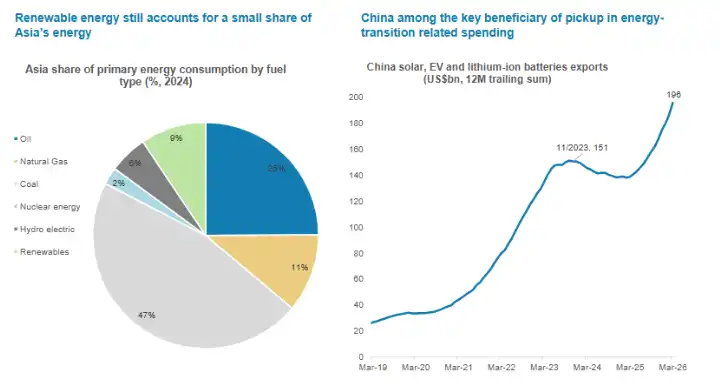
(The proportion of renewable energy in Asia's energy mix remains small, and China benefits significantly from increased spending related to the energy transition)

China has industrial advantages in areas like photovoltaics, electric vehicles, and lithium batteries. The 12-month rolling scale of its related exports has approached the $200 billion level, making it a key beneficiary in this round of energy transition capital expenditure.

Meanwhile, defense spending is also showing a structural upward trend in multiple Asian economies.

The share of defense expenditure in GDP has risen in Japan, South Korea, India, and other places. China and South Korea are also among the world's top ten defense exporters.
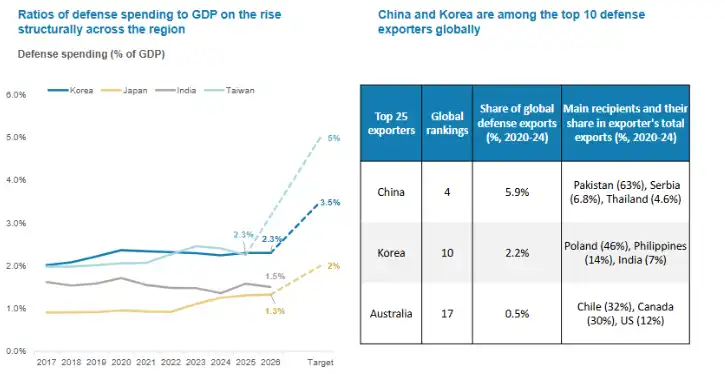
(Across the region, the ratio of defense spending to GDP is trending upward)

For capital markets, this means that demand in industrial chains like high-end manufacturing, materials, electronic components, and precision equipment may receive longer-term support.

In other words, AI provides computing power demand, energy provides infrastructure constraints, and defense and supply chain security provide 'resilience investment' under the backdrop of geopolitics. The combination of the three constitutes the foundation of Asia's super cycle.

Who Benefits Most? China, South Korea, and Japan Are at the Core of the Value Chain

In terms of regional beneficiary order, Morgan Stanley highlights China, South Korea, and Japan.

Mainland China excels in industrial chain completeness, manufacturing scale, engineering capabilities, and emerging export categories like new energy and robotics.

South Korea holds advantages in memory, HBM, batteries, and some equipment materials; Japan still possesses deep accumulation in semiconductor equipment, materials, precision manufacturing, and industrial automation.

The proportion of capital goods exports also illustrates the point. The report shows: Thailand ~38%, China ~36%, Japan ~35%, South Korea ~30%. This means that when the global economy enters a new round of equipment investment cycles, the external demand elasticity of these economies will be more pronounced.

Finally, from a capital market structure perspective, these markets have higher weightings in industrial, tech hardware, and materials-related sectors, making it easier for macro capital expenditure cycles to be reflected in stock market performance.

This also means the pricing logic of Asian markets may change in the coming years, focusing on which companies in the capital expenditure chain have orders, technological barriers, and profit elasticity.

Risks That Cannot Be Ignored: Overcapacity, Profit Margins, and Geopolitical Friction

The super cycle narrative is attractive but does not mean all industries and companies will benefit simultaneously.

First, capital expenditure expansion may bring temporary supply pressure.

China's new energy industry has proven that scale advantages can quickly open global markets but may also be accompanied by price competition and profit margin volatility. Industries like robotics, AI hardware, photovoltaics, and energy storage may face similar issues in the future.

Second, technology restrictions and export controls remain variables.

The space for AI chip localization is vast, but gaps still exist in advanced process nodes, HBM, EDA, equipment, and materials. The report also notes that while there is still a gap between domestic chips and top-tier US chips, competitiveness can be enhanced through system optimization, advanced packaging, and software adaptation.

Third, employment structures will also be affected by AI.

Morgan Stanley's 'Future of Work' research estimates that about 90% of occupations will be affected to varying degrees by AI automation and augmentation. In its sample of companies, early AI adoption has brought over 11% productivity gains but also accompanied an average net job reduction of about 4%, with significant differences across countries and industries.

For China, advancing retraining and job transitions while improving efficiency will be a crucial medium- to long-term policy and corporate management challenge.

Fourth, market volatility may increase. The report also cautions that the widening gap between bull and bear scenarios in regional markets means investor divergence over expectations for AI capital expenditure, export orders, and profit realization will persist.


Пов'язані питання

QWhat is the core reason that investors are turning their attention to Asian markets according to the article?

AThe core reason is the emergence of a new 'super-cycle' in Asia, primarily driven by AI and its infrastructure demands. This has shifted the underlying drivers of Asia's industrial cycle from traditional real estate and general manufacturing inventory restocking to investments in AI infrastructure, energy security and transition, defense, and supply chain resilience.

QWhat are the projected figures for Asia's fixed asset investment from 2025 to 2030 according to Morgan Stanley's analysis?

AMorgan Stanley projects that Asia's fixed asset investment scale will rise from approximately $11 trillion in 2025 to $16 trillion in 2030. The nominal investment compound annual growth rate from 2026 to 2030 is expected to be about 7%, significantly higher than recent levels.

QWhich new export sector is highlighted as a potential major growth driver for Chinese manufacturing, following electric vehicles and batteries?

AThe article highlights robotics, particularly industrial robots and humanoid robots, as the next potential major growth driver for Chinese manufacturing exports. China already accounts for about half of the global incremental demand for industrial robots and an estimated 90% of global humanoid robot shipments in 2025.

QBesides AI, what are the other two key growth pillars identified for Asia's 'super-cycle'?

ABesides AI, the other two key growth pillars for Asia's 'super-cycle' are energy security (including investment in power, renewables, and grid infrastructure to support AI and general growth) and defense spending (driven by geopolitical factors and supply chain resilience needs).

QWhat are some of the major risks associated with this predicted Asian 'super-cycle'?

AMajor risks include potential overcapacity and profit margin pressure in sectors like robotics and AI hardware, similar to what happened in the new energy sector. Other risks are technological restrictions and export controls, the impact of AI on employment structures requiring significant re-skilling, and increased market volatility due to diverging investor expectations.

Пов'язані матеріали

War Trade Unwinding | TradeXYZ Weekend Observations

Weekend markets saw a clear return of risk appetite. Major indices rose broadly, with significant gains in tech and precious metals, while energy sectors fell sharply on the "end of war" narrative. On June 14, oil prices initially rose on reports Iran had not yet finalized a memorandum of understanding. Later, YNET reported Trump might immediately lift the maritime blockade on Iran and the Strait of Hormuz. At 21:30, Trump confirmed on Truth Terminal that a deal with Iran was done, authorizing an immediate end to the US blockade and toll-free opening of the Strait. Iran's deputy foreign minister simultaneously announced an immediate and permanent halt to military actions on multiple fronts. Oil prices had already fallen to weekend boundaries, pre-pricing the news. The S&P 500 subsequently touched 7530. Markets will likely remain in a waiting period until the formal peace deal signing on June 19. At the moment of the deal announcement, gold jumped from ~4,221 to a high of 4,337, and silver from ~67.85 to 70.83, before stabilizing at higher levels. Individual stocks and ETFs like NBIS, RKLB, and LITE performed strongly. NBIS, added to the Nasdaq index, saw a target price increase due to strong AI cloud growth. RKLB, also added to the index, benefited from positive SpaceX valuation sentiment. LITE received a $1,130 target from JPMorgan. SPCX rose quickly after Musk tweeted SpaceX could potentially reach ~$1 trillion in revenue by 2030. In summary, the market shock from the multi-month war is beginning to dissipate. Israel's actions remain the key variable before the June 19 signing. Upcoming events like Fed Chair Warsh's debut and BoJ rate hike expectations will also significantly impact markets this week.

marsbit4 хв тому

War Trade Unwinding | TradeXYZ Weekend Observations

marsbit4 хв тому

Will the Next Crypto Bull Run Start with On-Chain Trading of SpaceX?

This article presents a scenario-based forecast for the crypto industry from 2026 to 2029, arguing that the next major cycle will be driven not by technological narratives but by legal access to real-world assets. The author predicts that by mid-2026, pre-IPO perpetual contracts for top private companies like SpaceX, OpenAI, and Anthropic on platforms like Hyperliquid will become the primary gateway for accessing quality assets, as most crypto-native tokens fail to capture real value. The much-hyped AI x Crypto intersection largely fails except for prediction markets, which thrive on betting on AI model supremacy. By 2027, public blockchain foundations are forced to choose between catering to retail speculation or building compliant infrastructure for institutions, with many opting for the latter. Growth in stablecoins and tokenized private credit/equity hits a "triple ceiling" due to regulatory and political uncertainty rather than market demand. The pivotal shift is forecast for 2028. A major liquidation event in pre-IPO perpetuals exposes the structural flaw of synthetic markets lacking a real underlying asset anchor. In response, regulatory changes finally allow the public solicitation of private securities resales to verified accredited investors. This creates a legitimate secondary market for real company equity, which then becomes the core asset class of the new bull market, relegating synthetic perps to a niche role. By 2029, the industry becomes "boring" but foundational. Tokens without claims on real cash flows or assets cease trading. Stablecoin growth is steady but politically capped. Crypto infrastructure fades from view as it gets absorbed into traditional finance backends. The article's central thesis is that the key bottleneck for crypto's next phase is legal and regulatory channels for real asset ownership, not technology.

marsbit1 год тому

Will the Next Crypto Bull Run Start with On-Chain Trading of SpaceX?

marsbit1 год тому

The Value Distribution of Stablecoins

**Summary: The Value Distribution of Stablecoins** The article argues that stablecoins are evolving from mere trading tools into broader channels for dollar access. It divides the stablecoin ecosystem into four layers to analyze how value is distributed: 1. **Issuance Layer:** Mints stablecoins, holds reserve assets, and captures the spread between reserve yield and user costs (e.g., Tether, Circle). This layer currently earns the largest profit margin. 2. **Infrastructure Layer:** Connects stablecoins to the traditional financial system, handling fiat on/off-ramps, banking integration, compliance (KYC/AML), and asset management (e.g., Bridge, BVNK). This is the "unglamorous" but critical work, building the essential bridges between crypto and real-world finance. 3. **Acquiring/Distribution Layer:** Integrates stablecoins into merchant systems, manages payment flows, and provides enterprise financial software (e.g., Stripe, Coinbase). They act as the access point for businesses. 4. **Application Layer:** The end-users and businesses that ultimately use stablecoins for payments, settlements, or as a store of value. They benefit from convenience but have little pricing power. The core thesis is that while the issuance layer currently dominates profits, the often-overlooked **infrastructure layer holds significant long-term potential**. The real challenge and barrier to mass adoption is not the on-chain transfer of stablecoins (which is simple), but the complex "last mile" integration into existing business workflows, banking systems, and regulatory frameworks across different countries. Companies in this layer are currently in a "land grab" phase, investing heavily to build networks, secure bank partnerships, and establish compliance pathways. While their position is currently pressured by the profitable issuers above and distribution platforms below, the article suggests that if stablecoins become a default financial rail for businesses, the infrastructure providers who have done the hard work of integration will ultimately gain strong pricing power and become entrenched, essential players.

marsbit8 год тому

The Value Distribution of Stablecoins

marsbit8 год тому

The Value Distribution of Stablecoins

The Value Distribution of Stablecoins The article argues that stablecoins are evolving from a mere trading tool into a broad "dollar channel." It analyzes the industry's value chain through four layers: 1. **Issuance Layer (e.g., Tether, Circle):** The top layer that mints stablecoins, holds reserve assets, and captures the thickest interest rate spread. 2. **Infrastructure Layer (e.g., Bridge, BVNK):** Connects stablecoins to the traditional financial system, handling critical but complex "dirty work" like fiat on/off-ramps, banking integration, compliance (KYC/AML), and cross-border settlement. 3. **Acquiring/Distribution Layer (e.g., Stripe, Coinbase):** Embeds stablecoins into merchant systems, manages payment flows, and integrates with enterprise software. 4. **Application Layer:** End-users and businesses that ultimately use stablecoins for payments, settlement, or storing value. The author posits that while the issuance layer currently captures the most profit, the most overlooked and potentially critical layer is infrastructure. The core challenge for stablecoin adoption isn't the on-chain transfer (which is simple), but bridging the gap between blockchain and the real-world financial system. This involves solving practical problems for businesses: fiat conversion, reconciliation, tax handling, and user onboarding. Infrastructure companies are currently in a difficult "land-grab" phase—building networks, securing banking relationships, and achieving compliance country-by-country. They face pressure from both the profitable issuance layer above and distribution platforms below. However, the author suggests this layer is building a crucial moat. Once stablecoins become a default business rail, the infrastructure players who have done the hard work of integration may gain significant, durable value and pricing power.

链捕手8 год тому

The Value Distribution of Stablecoins

链捕手8 год тому

Торгівля

Спот
Ф'ючерси
活动图片