Atkins' First Year at the Helm of the SEC: A Comprehensive Shift in Crypto Regulation

marsbitОпубліковано о 2026-04-21Востаннє оновлено о 2026-04-21

Анотація

Paul Atkins marked his one-year anniversary as Chair of the U.S. Securities and Exchange Commission (SEC) on April 21, 2025, overseeing a significant shift in the agency’s approach to cryptocurrency regulation. Under his leadership, the SEC dropped multiple enforcement actions against crypto firms, approved several crypto-linked ETFs, and issued guidance clarifying that most cryptocurrencies are not considered securities under federal law. The SEC also signed a memorandum with the CFTC to improve regulatory coordination. These actions reversed the aggressive enforcement stance of his predecessor, Gary Gensler, and aligned with Trump administration promises to support the crypto industry. However, Atkins has faced criticism from Democratic lawmakers, including Senator Elizabeth Warren, who raised concerns over potential conflicts of interest, particularly regarding dropped cases linked to Trump-affiliated companies. While regulatory clarity has improved, the SEC still awaits congressional action to formally define its jurisdiction over digital assets.

Author: Turner Wright

Compiled by: Deep Tide TechFlow

Deep Tide Guide: On April 21, 2025, Paul Atkins was sworn in as Chairman of the SEC, marking exactly one year today. Over this year, the SEC has dismissed multiple lawsuits against crypto companies, approved several crypto ETFs, and signed a memorandum of understanding with the CFTC on coordinating digital asset regulation. However, allegations of conflicts of interest against Atkins by Democratic lawmakers are heating up, and the SEC is still awaiting Congress to pass a market structure bill to clarify its jurisdiction over crypto assets.

On April 21, 2025, Paul Atkins was sworn in as Chairman of the U.S. Securities and Exchange Commission (SEC). As of today, it has been exactly one year.

This year, the SEC has undergone a fundamental shift in its regulatory and enforcement stance on digital assets, in stark contrast to the approach during the tenure of former Chairman Gary Gensler.

During the 2024 election campaign, Trump made several promises to the crypto industry: replacing Gensler, establishing a national Bitcoin (BTC) reserve, and opposing the issuance of a U.S. central bank digital currency. After winning the election in November 2024, Gensler resigned in January 2025, and SEC Commissioner Mark Uyeda served as acting chairman until the Senate confirmed Atkins' nomination.
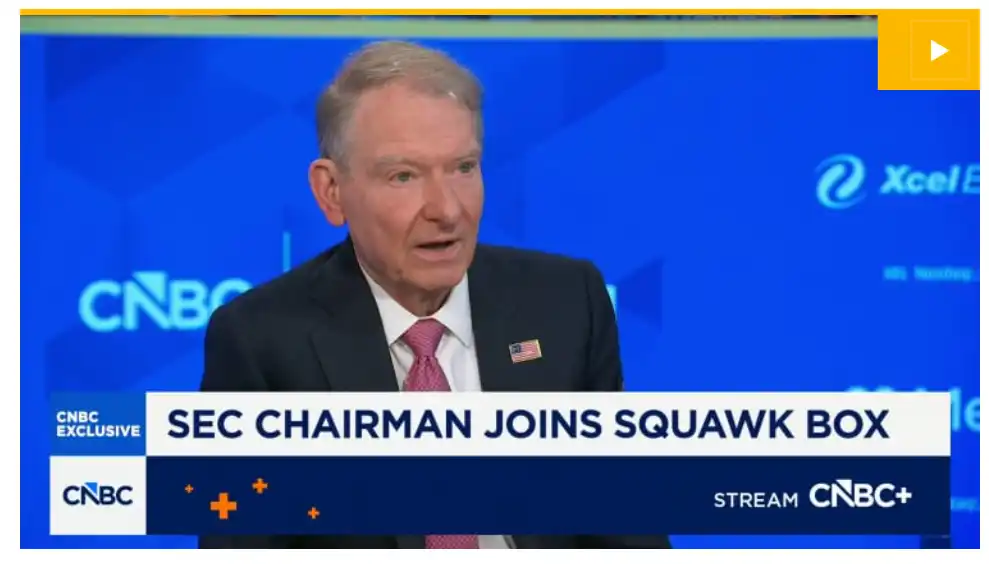
Caption: SEC Chairman Paul Atkins being interviewed on CNBC's Squawk Box on April 20, 2026

Source:CNBC

Even Before Atkins Took Office, the SEC Was Already Shifting

Even before Atkins officially assumed his role, the SEC began sending signals. During Uyeda's acting tenure, the SEC established a crypto working group led by Commissioner Hester Peirce and, starting in February 2025, began dismissing civil enforcement actions and investigations against crypto companies, with Coinbase being the first.

In the 12 months since Atkins officially took office, the SEC has introduced a series of policies widely seen as favorable by the industry:

  • Terminated multiple enforcement actions against crypto companies
  • Approved several exchange-traded funds (ETFs) linked to various crypto assets
  • Signed a memorandum of understanding with the Commodity Futures Trading Commission (CFTC) on coordinating digital asset regulation
  • Issued an interpretive notice clarifying that most cryptocurrencies do not constitute securities under federal law

Atkins himself said in an interview with CNBC on April 21: "The year has passed quickly, but I feel we have made significant progress. When I took office, I promised a new day for the SEC, and we have delivered. We have moved away from the past approach of regulating through enforcement and operating opaquely, and the crypto space is the best example of this."
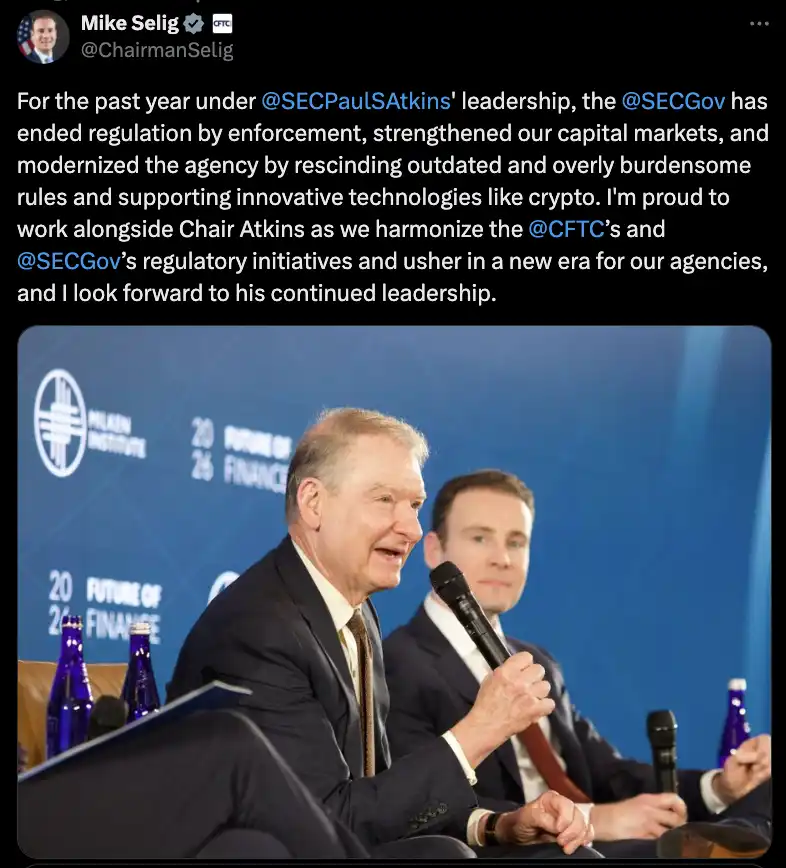
Source:CFTC Chairman Michael Selig

Democratic Lawmakers Focus Fire on Conflicts of Interest

While the crypto industry largely welcomes Atkins' approach, criticism from Congressional Democrats is escalating. The focus is on potential conflicts of interest, as some of the dismissed investigations and enforcement actions involved companies linked to Trump and his family.

Last week, Massachusetts Senator Elizabeth Warren accused Atkins of misleading lawmakers during his Congressional testimony. In a letter dated April 15, Warren pointed out that the SEC's own fiscal year 2025 data shows the number of enforcement actions has dropped to the lowest in a decade.

Despite the clear direction of case dismissals and regulatory relaxation, the SEC is still awaiting Congress to pass a market structure bill to formally clarify the boundaries of its regulatory authority over crypto assets. Until the bill is enacted, the SEC's crypto regulatory framework remains in a transitional state of "administrative guidance + case-by-case handling."


Пов'язані питання

QWhat major changes did the SEC undergo under Paul Atkins' leadership in his first year as chairman?

AUnder Paul Atkins' leadership, the SEC underwent a fundamental shift in its regulatory and enforcement stance on digital assets. This included dropping multiple enforcement actions against crypto companies, approving various crypto-linked ETFs, signing a memorandum of understanding with the CFTC for regulatory coordination, and issuing interpretive guidance clarifying that most cryptocurrencies are not securities under federal law.

QWho was the SEC chairman before Paul Atkins and what was the industry's perception of that leadership?

AGary Gensler was the SEC chairman before Paul Atkins. His tenure was characterized by a starkly different approach, which the crypto industry largely viewed as aggressive enforcement and regulatory uncertainty. This contrasted with the more industry-friendly policies implemented under Atkins.

QWhat is the primary criticism from Democratic lawmakers regarding Chairman Atkins' actions?

AThe primary criticism from Democratic lawmakers, such as Senator Elizabeth Warren, focuses on potential conflicts of interest. They allege that the SEC dropped certain investigations and enforcement actions that involved companies linked to former President Trump and his family, and that Chairman Atkins misled Congress in his testimony about these actions.

QWhat significant action did the SEC take regarding crypto ETFs during Atkins' first year?

AA significant action the SEC took was the approval of multiple exchange-traded funds (ETFs) linked to various crypto assets. This was a major policy shift from the previous administration and was widely seen as a positive development for the industry.

QWhat is the current status of the SEC's regulatory framework for crypto assets, according to the article?

AAccording to the article, the SEC's regulatory framework for crypto assets is currently in a transitional state, operating on a basis of 'administrative guidance + case-by-case handling.' The agency is still waiting for Congress to pass a market structure bill to formally clarify the boundaries of its jurisdiction over crypto assets.

Пов'язані матеріали

Can Generative Models Finally Be Trained End-to-End? The Core Is a For Loop

This article introduces a novel training paradigm for generative models called Explorative Modeling (XM), which enables true end-to-end training. Traditionally, powerful generative models like autoregressive and diffusion models are not trained end-to-end. They are trained to predict a single small step but require iterative multi-step sampling for inference. This "exposure bias" leads to error accumulation and limits performance. The core challenge XM addresses is "mode blurring." In generative tasks, a single input (e.g., "generate a dog") corresponds to many valid outputs (multiple modes). Standard training objectives like reconstruction loss force the model to average these modes, producing unrealistic, blurry outputs. To avoid this, existing models break generation into many small, almost deterministic steps, sacrificing end-to-end training. XM tackles this by restructuring the training loop itself. Its key insight is to amplify "generative expressivity." For each training input, instead of generating one sample, the model generates K candidate outputs. Only the candidate closest to the real data is used for computing the loss and updating the model via backpropagation. This simple "best-of-K" mechanism is implemented as a short for-loop. By exploring multiple possibilities, the model learns to distribute its guesses across different modes rather than collapsing to their uninformative average. The paper demonstrates that "exploration" acts as a new, powerful scaling axis. Gains from XM increase with model size, data scale, and compute. Experiments show improvements in FID scores for image generation and significant efficiency gains, sometimes outperforming larger models without exploration. When pushed to the limit, XM enables fully single-step, end-to-end generative models. In robotics tasks, an "Explorative Policy" matched the performance of a 100-step Diffusion Policy with a single forward pass, drastically improving inference speed. While the best-of-K concept is not entirely new, the authors' contribution lies in formally understanding it as a direct method to boost generative expressivity without fragmenting the generation process. This work suggests that as models scale, enhancing exploration during training may become crucial for overcoming fundamental performance bottlenecks.

marsbit50 хв тому

Can Generative Models Finally Be Trained End-to-End? The Core Is a For Loop

marsbit50 хв тому

Annual Salary of Millions Competing for Electricians, Meta Rushes to Open Its Own Technical School

The AI boom is facing an unexpected bottleneck: a severe shortage of skilled construction workers and electricians. As tech giants like Meta, OpenAI, and Alphabet race to build massive data centers—such as OpenAI's $16 billion "Stargate" project—they are hitting a critical labor wall. The U.S. needs an estimated 130,000 more electricians, 240,000 construction workers, and 150,000 supervisors by 2030 for AI infrastructure alone, but tens of thousands of electrician jobs go unfilled each year. While AI companies offer high premiums, with electricians earning up to $280,000 annually, worker scarcity still causes massive losses—delays on a single project can cost $14.2 million per month. The complexity of building AI data centers, which require immense power (equivalent to powering hundreds of thousands of homes), sophisticated electrical systems, and advanced liquid cooling solutions, demands highly skilled technicians who are in short supply. To combat this, companies are investing heavily in training. Meta has committed $115 million to a free training school offering tuition, housing, and stipends, targeting 5,000 new workers. OpenAI is partnering with unions to secure skilled labor. These efforts are paying off, with a significant rise in Gen Z interest in trade schools over college. However, the power demands are staggering. AI data centers are driving a rapid surge in electricity consumption, projected to account for up to 12% of U.S. power use by 2028 and raising costs for consumers. Furthermore, the construction boom is project-based, leading to a potential future glut of trained workers once building peaks, which could depress wages industry-wide. The race for AI supremacy now depends as much on skilled hands as on advanced chips.

marsbit2 год тому

Annual Salary of Millions Competing for Electricians, Meta Rushes to Open Its Own Technical School

marsbit2 год тому

Торгівля

Спот
活动图片