ArkInvest Allocates $32.7M to Robinhood as Bitcoin Hyper Pumps

bitcoinistОпубліковано о 2026-02-03Востаннє оновлено о 2026-02-03

Анотація

Ark Invest has acquired $32.7 million worth of Robinhood (HOOD) shares, signaling a strategic bet on increased retail market participation, which historically precedes crypto activity surges. This influx could cause Bitcoin network congestion, driving interest in scalability solutions. Bitcoin Hyper ($HYPER) is highlighted as a key infrastructure project merging Solana's speed with Bitcoin's security via the Solana Virtual Machine, enabling fast, low-cost transactions. With over $32 million raised in its presale and immediate staking options, it aims to attract developers and handle high-frequency BTC use cases, positioning itself as a solution to upcoming liquidity and scalability challenges.

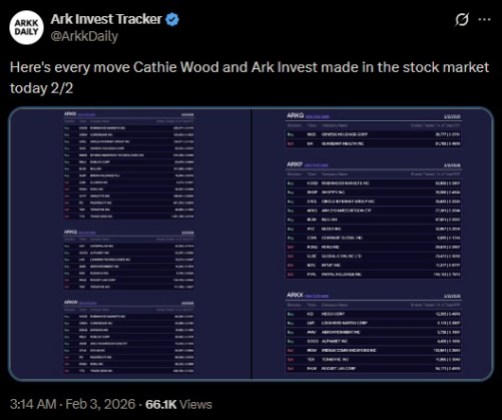
Ark Invest’s latest filing reveals a chunky $32.7M acquisition of Robinhood (HOOD) shares.

On the surface, it’s an equity play, but dig deeper, and it looks like a derivative bet on the resurgence of crypto market participation. Historically, Robinhood’s volume spikes act as a canary in the coal mine for retail capital, typically preceding major on-chain activity by 3-5 weeks.
The timing feels deliberate. As the Federal Reserve signals potential rate pauses, risk-on assets are re-pricing. But buying HOOD is just the surface trade. The inevitable second-order effect of a retail influx? Massive Bitcoin network congestion. When millions of new users try to move $BTC, fees don’t just rise; they skyrocket, making the base layer practically unusable for anyone moving less than six figures.

That bottleneck is exactly why institutional eyes are drifting toward infrastructure that can handle the coming liquidity shock. While Wall Street buys exchange stocks, on-chain capital is positioning into scalability protocols.

Specifically, smart money appears to be front-running the congestion narrative by accumulating Bitcoin Hyper ($HYPER), the first protocol to weld the Solana Virtual Machine (SVM) directly onto a Bitcoin Layer 2.

Buy $HYPER here.

Solving the Velocity Problem: Bitcoin Meets SVM Speed

The thesis here is simple mechanics. Bitcoin is secure but slow; Solana is fast but has faced centralization headaches. By fusing these architectures, Bitcoin Hyper ($HYPER) attempts a ‘best of both worlds’ environment to solve the trilemma plaguing current Layer 2s.

Most existing Bitcoin L2s still feel sluggish compared to modern DeFi standards. Bitcoin Hyper bypasses the lag by using the Solana Virtual Machine (SVM) for execution. The result? Sub-second transaction finality and costs that are fractions of a cent, all while anchoring state to the Bitcoin L1.
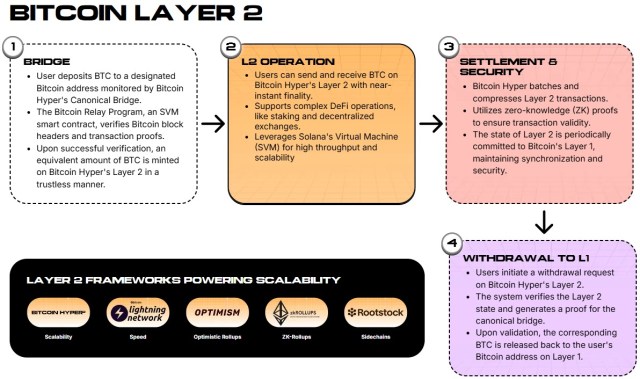
That matters because it finally unlocks high-frequency use cases for $BTC, think gaming, real-time payments, and complex DeFi swaps, that were previously impossible (or just too expensive) on the base layer.

Developers are eyeing the Rust-based environment too. The protocol offers a Developer SDK and API in Rust, meaning the massive pool of Solana devs can port their dApps to the Bitcoin ecosystem without rewriting their codebase. This isn’t just about building a chain; it’s about importing an entire developer economy.

You can buy $HYPER here.

Presale Data Signals Institutional Accumulation

The market’s appetite for high-performance infrastructure shows up in the hard numbers. According to the official presale page, Bitcoin Hyper ($HYPER) has raised over $32M, a figure that frankly outpaces most comparable infrastructure rounds this cycle. The token sits at $0.013675, a valuation that looks modest relative to the utility proposition.
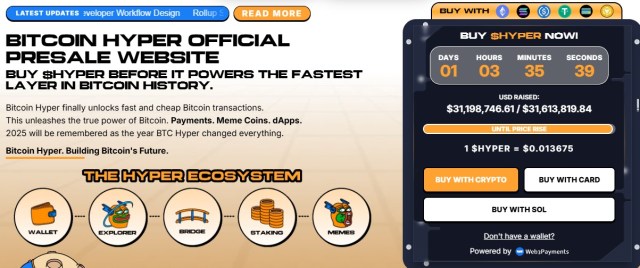
The incentives seem structured to keep that liquidity sticky. Staking opens immediately after the Token Generation Event (TGE), with a 7-day vesting period for presale participants. That lock-up mechanism helps prevent immediate sell-offs, aiming to create a stable floor at launch.

For investors watching Ark Invest buy the ‘shovels’ (Robinhood), Bitcoin Hyper represents the ‘ground’ where the actual digging happens.

Visit the official $HYPER presale here.

The content provided in this article is for informational purposes only and does not constitute financial advice. Cryptocurrency investments, including presales and stocks like Robinhood, carry high risks. Always conduct your own due diligence before investing.


Пов'язані питання

QWhat is the significance of Ark Invest's $32.7M acquisition of Robinhood shares according to the article?

AThe article suggests that while it appears to be an equity play on the surface, it is actually a derivative bet on the resurgence of crypto market participation. Historically, Robinhood's trading volume spikes act as an early indicator (a 'canary in the coal mine') for retail capital entering the market, typically preceding major on-chain activity by 3-5 weeks.

QWhat problem does the Bitcoin Hyper ($HYPER) protocol aim to solve?

ABitcoin Hyper aims to solve the blockchain trilemma for Bitcoin Layer 2s by combining the security of Bitcoin with the speed of Solana. It welds the Solana Virtual Machine (SVM) directly onto a Bitcoin L2 to provide sub-second transaction finality and extremely low costs, thereby solving the 'velocity problem' and enabling high-frequency use cases like gaming and real-time payments on Bitcoin.

QHow does the article connect a potential influx of retail users to Bitcoin network congestion?

AThe article states that an influx of retail users, signaled by increased activity on platforms like Robinhood, leads to massive Bitcoin network congestion. When millions of new users try to move BTC, transaction fees don't just rise but 'skyrocket,' making the base layer practically unusable for transactions under six figures.

QWhat advantage does Bitcoin Hyper's Rust-based development environment provide?

ABy offering a Developer SDK and API in Rust, Bitcoin Hyper allows the massive existing pool of Solana developers to easily port their decentralized applications (dApps) to the Bitcoin ecosystem without having to rewrite their entire codebase, effectively importing an entire developer economy.

QWhat does the presale data for Bitcoin Hyper ($HYPER) indicate, as mentioned in the article?

AThe presale data indicates strong institutional accumulation, having raised over $32 million, which the article states outpaces most comparable infrastructure rounds in the current market cycle. The token's valuation is considered modest relative to its utility, and its staking and vesting mechanisms are designed to create liquidity stability post-launch.

Пов'язані матеріали

The Changing Landscape: What Are Crypto VCs Experiencing?

Title: The Shifting Landscape of Crypto Venture Capital The era of dedicated crypto venture capital funds is undergoing a significant transformation. Once essential for navigating the sector's complexity and high risk, these specialized funds are now facing an identity crisis as the market matures. This shift mirrors historical patterns in other specialized investment classes like cleantech and SPACs, where initial information advantages dissipate as technologies become mainstream and integrated into existing industry frameworks. The article argues that crypto is reaching a critical inflection point, transitioning from a "building phase" to an "integration phase." Major players like Stripe, BlackRock, and Visa now engage with crypto not for its novel mechanics but as a foundational financial infrastructure. Their needs—regulatory compliance, banking partnerships, distribution channels—align with traditional fintech, a domain easily understood by large, generalist funds like Sequoia and Founders Fund. This evolution creates a "barbell effect" within the VC landscape. On one end are massive, diversified platforms that can incorporate crypto as one vertical among many. On the other are small, nimble funds focused on niche, experimental projects. The middle ground—medium-sized dedicated crypto funds—is being squeezed out. Their typical fund size makes it impossible to generate sufficient returns solely from early-stage crypto bets, yet they cannot compete with giants for later-stage deals. Consequently, leading crypto-native firms like Paradigm and Framework Ventures are expanding into AI, robotics, and other sectors, driven partly by LP pressure for better returns amid a broader VC DPI crisis. Others, like Dragonfly and a16z, have narrowed their crypto focus predominantly to financial infrastructure like stablecoins, reframing the sector's core narrative. For crypto entrepreneurs, this consolidation presents challenges. While generalist funds offer larger checks and broader resources, crypto projects now compete fiercely with AI for attention and capital within these firms. Furthermore, the long-term, non-commercial foundational work that built the ecosystem—funded by dedicated crypto VCs—is less likely to attract generalist capital focused on direct returns. The conclusion is that "crypto investor" as a standalone category is becoming obsolete, akin to "internet investor." Crypto is becoming a baseline infrastructure layer. The future will see a barbell structure: large-scale growth financing handled by generalist funds, while pioneering, speculative projects are funded by small, specialized vehicles. The dedicated crypto funds of the 2017-2021 boom, which incubated core infrastructure, are giving way to this new, bifurcated reality.

Foresight News6 хв тому

The Changing Landscape: What Are Crypto VCs Experiencing?

Foresight News6 хв тому

As Consensus Accelerates, What Are Young Investors Betting On?

Title: As Consensus Forms Faster, What Are Young Investors Betting On? In the rapid evolution of tech investment, a new generation of young investors is navigating a landscape where AI, robotics, commercial aerospace, and quantum computing are advancing simultaneously. Traditional investment logic based on financial models is giving way to a need for deep technical understanding and the ability to act before industry consensus forms. An analysis of trends from the "WAIC FUTURE TECH" list of young investment leaders reveals key shifts in focus. The first major trend is the movement of AI from the digital screen into the physical world. Investment is shifting from large language models and chatbots towards embodied AI, robotics, AI hardware, and edge computing. While demonstrations generate excitement, the real challenge lies in achieving scalable, reliable, and cost-effective delivery in complex real-world environments like factories and logistics. Success depends not just on algorithms but on the integration of sensors, actuators, and control systems. Second, the competitive focus for large models is moving beyond raw capability toward building an "intelligence flywheel." The goal is to create self-reinforcing systems where user interaction generates data, improving the model, which in turn enhances the user experience and attracts more engagement. Companies that successfully embed AI into workflows to create these closed-loop systems can build lasting value that isn't easily erased by the next model upgrade. Third, facing a potential bottleneck in high-quality human-generated data, investors are looking at new underlying technologies. Reinforcement learning and self-play, as demonstrated by AlphaGo Zero, offer paths for AI to generate its own experience. Scientific foundation models, which aim to build general AI capabilities for fields like life sciences and materials discovery, represent a non-consensus direction that could unlock new frontiers of knowledge and data. Finally, in deep-tech areas like quantum computing, commercial aerospace, and space-based infrastructure, patient capital is essential. These fields have long, uncertain development and validation cycles involving complex engineering, supply chains, and regulations. Investment here requires a long-term view, focusing on foundational team capabilities and the eventual emergence of market demand, even if commercial returns are distant. Collectively, these trends illustrate how young investors are adapting to a new era. They are learning to make earlier, technically-informed judgments, balance hype with real-world viability, and provide the patient capital needed to build the deep-tech foundations of the future.

marsbit34 хв тому

As Consensus Accelerates, What Are Young Investors Betting On?

marsbit34 хв тому

Can Japan Buy Growth with AI? Will the Bond Market Believe It?

Japan's cabinet has introduced the 2026 Basic Policy on Economic and Fiscal Management and Reform, shifting its primary fiscal target. The new framework moves away from the traditional annual primary balance goal and instead prioritizes a stable reduction of the debt-to-GDP ratio. This change is tied to a strategy of increased "responsible proactive fiscal" spending, aiming to boost long-term growth through investments in strategic sectors like AI, semiconductors, energy, and robotics. The government estimates total public and private investment in 62 key technologies could exceed 370 trillion yen by 2040. The market reaction has been mixed and cautious. While equity markets may respond to policy signals, bond markets are focused on fiscal credibility. Concerns center on whether the weakening of the clear primary balance anchor could lead to looser fiscal discipline. If investors doubt that these strategic investments will generate sufficient productivity gains, tax revenue, and nominal growth to outpace rising interest costs, they may demand higher yields on Japanese Government Bonds (JGBs). Recent volatility in the yen and JGB yields, with the 10-year yield briefly reaching 2.9%, reflects this skepticism. The success of this new framework hinges on two factors: whether Japan can achieve a nominal growth rate consistently higher than its long-term interest rates, and whether future budgets demonstrate disciplined control over bond issuance. The government's narrative is that strategic investment is essential to break Japan's cycle of low growth, aging, and labor shortages. However, the bond market will continuously assess the credibility of this plan, pricing the risk that it may represent fiscal expansion rather than a viable growth strategy.

marsbit1 год тому

Can Japan Buy Growth with AI? Will the Bond Market Believe It?

marsbit1 год тому

Торгівля

Спот
活动图片




