Argentina court orders nationwide block of Polymarket over gambling

cointelegraphОпубліковано о 2026-03-17Востаннє оновлено о 2026-03-17

Анотація

An Argentine court has ordered a nationwide block of the crypto-based prediction market platform Polymarket, citing unauthorized gambling operations. The ruling, issued by a Buenos Aires court on March 11, instructed the national communications regulator ENACOM to restrict access to the platform and its variants across the country. The investigation was initiated following a complaint by the Buenos Aires City Lottery (LOTBA), which raised concerns over insufficient identity and age verification, potentially allowing minors to gamble. The court also directed Apple and Google to remove Polymarket’s mobile apps in Argentina. This action follows earlier scrutiny of the platform, particularly regarding its inflation prediction markets, which closely mirrored official data and sparked insider trading concerns. Similar restrictions have been implemented in other countries, including Colombia in Latin America.

A court in Argentina has ordered a nationwide block of major crypto-based prediction market platform Polymarket over unauthorized gambling.

Argentina’s national communications and media regulator, Ente Nacional de Comunicaciones (ENACOM), received a court order to block access to Polymarket website and its variants across the country, according to a ruling dated March 11.

The order was issued by the Buenos Aires Court of First Instance in Criminal, Contravention and Minor Offenses No. 31, which is investigating Polymarket under Argentina’s Criminal Code for allegedly offering gambling services without authorization.

The judge asked ENACOM to carry out the measure either directly or through internet service providers (ISPs) and to promptly inform the court or the specialized gambling prosecutor’s office if technical or other obstacles prevent full compliance.

Buenos Aires regulator initiated the case

According to local media reports, the case was brought by the Buenos Aires City Lottery (LOTBA), the state-owned company that regulates gambling activities in the city.

After receiving a complaint from LOTBA about Polymarket’s alleged operation without authorization, prosecutor Juan Rozas, in charge of the City’s Specialized Gaming Prosecutor’s Office (FEJA), opened the investigation that led to the court order.

Authorities argued that Polymarket allowed users to place bets without sufficient identity and age verification, raising concerns that minors could access the platform.

“In practice, this meant that anyone — including children and adolescents — could access and start betting without any control,” the authorities reportedly said.

Inflation bets deepen scrutiny

In addition to instructing ENACOM to block access to Polymarket, the court reportedly ordered Google and Apple to remove and restrict the platform’s mobile applications on Android and iOS throughout Argentina, including for existing users.

Social media reports indicate users are discussing workarounds such as VPNs, while observers note that the order comes from a Buenos Aires city court rather than the national government.
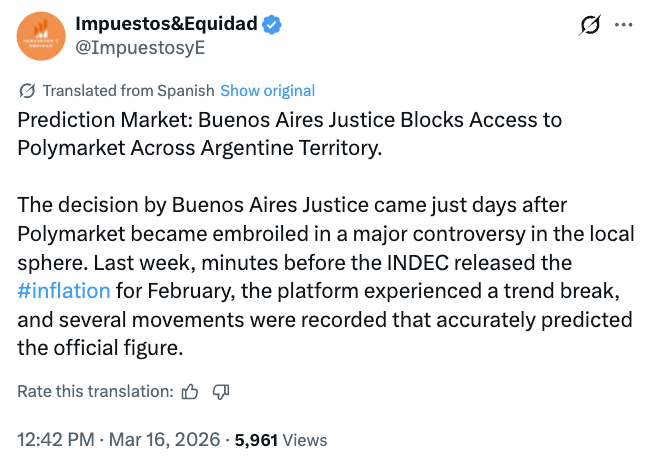
Source: ImpuestosyE (translated by Grok)

The action adds to earlier Polymarket’s scrutiny after its inflation-related prediction markets closely mirrored official data from Argentina’s statistics agency, reigniting controversy over potential insider trading, according to local reports.

Polymarket did not immediately respond to a request for comment from Cointelegraph.

Related: CFTC chair backs blockchain-based prediction markets as ‘truth machines’

Argentina’s action is the latest example of moves against prediction markets globally, with countries including the Netherlands, Hungary, Portugal and Ukraine taking similar steps to restrict access.

In Latin America, Colombia was among the first to take action, with its gambling regulator reportedly warning about Polymarket’s unauthorized operations in September 2025.

Magazine: How crypto laws changed in 2025 — and how they’ll change in 2026

Пов'язані питання

QWhy did the Argentina court order a nationwide block of Polymarket?

AThe court ordered the block because Polymarket was allegedly offering unauthorized gambling services, violating Argentina's Criminal Code.

QWhich regulatory body in Argentina is responsible for implementing the block on Polymarket?

AEnte Nacional de Comunicaciones (ENACOM), the national communications and media regulator, is responsible for implementing the block.

QWhat concerns did authorities raise about Polymarket's operations that led to the investigation?

AAuthorities were concerned that Polymarket allowed users to bet without proper identity and age verification, potentially enabling minors to access the platform.

QBesides blocking the website, what additional actions did the court order against Polymarket?

AThe court also ordered Google and Apple to remove and restrict Polymarket's mobile applications on Android and iOS throughout Argentina.

QWhich other countries have taken similar actions to restrict prediction markets like Polymarket?

ACountries including the Netherlands, Hungary, Portugal, Ukraine, and Colombia have taken similar steps to restrict access to such prediction markets.

Пов'язані матеріали

Web3 Payments Track Research Report (Part 1): A Panoramic Deconstruction of Industry Background, Protocol Standards, Major Player Positioning, and Global Regulatory Dynamics

Web3 Payments: Industry Transformation, Key Players, and Regulatory Evolution (Part 1) This report provides a panoramic analysis of the Web3 payments sector, marking its transition from narrative-driven to infrastructure-focused growth. The 2025-2026 period is characterized by stablecoins surpassing the combined transaction volume of Visa and Mastercard, reaching approximately $33 trillion in on-chain settlements. This surge is fueled by their structural advantages in cost, speed, and accessibility for cross-border and B2B payments, addressing pain points in traditional finance. Stablecoins, primarily USD-pegged and dominated by USDT and USDC, have become core payment infrastructure. Their use cases are expanding beyond crypto exchanges into real-world commerce, global payroll, and remittances. User experience is evolving through two parallel paths: **account abstraction** (via standards like ERC-4337 and EIP-7702) abstracts gas and key management for self-custody users, while **payment rail integration** by giants like Stripe, PayPal, Visa, and Mastercard embeds stablecoins seamlessly into familiar checkout flows for mainstream users. Concurrently, the rise of dedicated **"stablechains"** (e.g., Stable) aims to optimize infrastructure specifically for stablecoin payments, using them as native gas tokens to ensure cost predictability and priority. Major payment processors are aggressively entering the space through acquisitions, partnerships, and proprietary stablecoins (e.g., PYUSD), strategically positioning themselves at this new infrastructure layer. This infrastructure shift coincides with clarifying global regulation. Key developments include the U.S. GENIUS Act establishing a federal framework, the EU's MiCA regime coming into full effect, and Hong Kong positioning itself as a compliant testing ground in Asia-Pacific. The convergence of scalable infrastructure, clear regulations, and the emerging demand from AI Agents for machine-to-machine micropayments is defining the next phase of competition over protocol standards, value accumulation layers, and market definition.

marsbit2 хв тому

Web3 Payments Track Research Report (Part 1): A Panoramic Deconstruction of Industry Background, Protocol Standards, Major Player Positioning, and Global Regulatory Dynamics

marsbit2 хв тому

Warsh Has Only Two Paths Ahead: Either Trigger "Financial Crisis 2.0" or Ignite "Dollar Crisis 1.0"?

In a critical analysis, economist aka Shan argues that incoming Fed Chair Kevin Warsh faces two stark policy choices, either of which could lead to a severe economic crisis comparable to the Great Depression. Warsh has publicly committed to bringing inflation down to 2%, but with the US CPI averaging over 3% for the past decade, the task is monumental. Shan outlines two potential paths: First, maintaining a hawkish stance with continued rate hikes, quantitative tightening, and fiscal consolidation would pop the simultaneous and dangerously large AI, real estate, and private credit bubbles, triggering a "Global Financial Crisis 2.0" more severe than 2008. Second, caving to political pressure and reverting to zero-interest-rate policy and quantitative easing would accelerate the collapse of the dollar's purchasing power, leading to a "Global Currency Crisis 1.0." Shan emphasizes there is no middle ground. The analysis highlights the role of Cantillon Effects, explaining how money created from 2008-2020 flowed unevenly into financial assets, suppressing commodity prices. A critical shift occurred in 2022 as commodities began to catch up, locking in high inflation pressure for years. Given this backdrop and immense political pressure during a future "Lehman moment," Shan concludes the probability of Warsh sticking to a truly hawkish policy is "extremely low, close to zero." The more politically expedient path of renewed monetary easing, despite its long-term consequences for the dollar, is seen as the likely outcome.

marsbit3 хв тому

Warsh Has Only Two Paths Ahead: Either Trigger "Financial Crisis 2.0" or Ignite "Dollar Crisis 1.0"?

marsbit3 хв тому

Торгівля

Спот
活动图片