Ansem: Why I Believe Token Buybacks Don't Solve Anything?

marsbitОпубліковано о 2026-07-17Востаннє оновлено о 2026-07-17

Анотація

Crypto trader Ansem argues that token buybacks alone do not create value. Instead, a project's valuation multiple is driven by "trust premium" built between the team and its community. He compares two high-revenue Solana protocols: Hyperliquid (estimated $800M annualized revenue, ~$650B FDV) and pump.fun (estimated $440M annualized revenue, ~$14B FDV). Both aggressively use most protocol revenue for buybacks, yet their valuation multiples differ by nearly 50x. Ansem attributes Hyperliquid's high valuation to the trust earned by its founder Jeff and team through consistent execution, transparent community rewards, and a dedicated user base. In contrast, he criticizes pump.fun for failing to fulfill a promised airdrop of 24% of its token supply for over a year since its July 2025 ICO, despite generating over $1B in revenue and raising $1B in the ICO. He suggests that honoring its commitments could significantly boost its token price and platform metrics. The core thesis is that trust, not just financial mechanics, is the key driver of crypto asset valuations.

Author: Claude, Deep Tide TechFlow

Deep Tide Introduction: Famous Solana trader Ansem posted that the buyback mechanism itself does not create value, and what determines the token valuation multiple is the "trust premium" between the team and the community. Using Hyperliquid (annualized revenue approx. $8 billion, FDV approx. $65 billion) and pump.fun (annualized revenue approx. $440 million, FDV only approx. $1.4 billion) as a comparison, he pointed out that both are conducting large-scale buybacks, but their valuation multiples differ by nearly 50 times.
One of the most enduring narratives in the crypto market is being challenged: dumping protocol revenue into buybacks will make the token price rise.

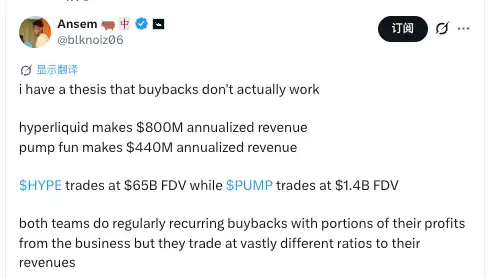
On July 16, famous Solana trader Ansem (@blknoiz06) posted a long thread on platform X, proposing a counterintuitive argument: the buyback mechanism itself does not create value; what truly determines the token trading multiple is the "trust premium" between the team and the community. This post quickly gained over 469,000 views, 3,240 likes, and 509 reposts.

Ansem selected two of the crypto industry's highest-earning protocols for comparison. Hyperliquid's annualized revenue is approximately $8 billion, HYPE's FDV is approximately $65 billion; pump.fun's annualized revenue is approximately $440 million, PUMP's FDV is only about $1.4 billion. Both teams are using the vast majority of their revenue for buybacks, but their valuation multiples differ by nearly 50 times.

Ansem's conclusion is: the gap is not in the scale of revenue, but in the trust accumulated through the team's actions.

Both Spending Heavily on Buybacks, Why Do Hyperliquid and pump.fun Have Such Widely Different Valuations?

Ansem deconstructed the buyback strategies of the two platforms in his post.

Hyperliquid directs 97% to 99% of protocol fees directly into HYPE buyback and burn. According to CryptoNews data, as of June 30, Hyperliquid's cumulative protocol revenue had exceeded $1 billion, with an annualized run rate close to $840 million. The platform has burned over 41 million HYPE tokens, worth over $1 billion, reducing the circulating supply by approximately 4.2%. At the time of writing, HYPE is quoted around $60 to $67, with an FDV of approximately $57 to $62 billion.

pump.fun is similarly aggressive. In 2025, the platform's total revenue was approximately $970 million, and it invested close to 100% of revenue into PUMP buybacks, accumulating about $213 million in buybacks. In April 2026, the team executed a one-time burn of PUMP tokens worth $370 million (about 36% of the circulating supply) and locked 50% of subsequent revenue for continuous burns. However, PUMP is currently quoted around $0.0016, with an FDV of approximately $1.4 to $1.7 billion.

pump.fun's annualized revenue is a bit more than half of Hyperliquid's, but its FDV is less than 3% of Hyperliquid's. If the buyback mechanism were the core driver of valuation, this multiple gap would be unexplainable.

Ansem's Explanation: Trust Premium is the Core of Pricing

Ansem believes the high valuation the market gives Hyperliquid stems from the trust established by Jeff (Hyperliquid founder) and his team.

He listed several points in his post: Hyperliquid has never overpromised; the team focuses solely on shipping products; user rewards are strictly distributed based on pre-determined on-chain metrics without opaque operations; the core user base has an extremely high trust rating for Jeff and the team. Ansem's original words stated that this trust premium "is one of the main reasons the token is trading so well."

Hyperliquid's historical actions support this judgment. The project did not accept VC investment, allocating 70% of the total supply to the community; the massive airdrop at launch in November 2024 fulfilled early promises; the platform showed resilience during the market sell-off in February 2026, indicating its user base includes many serious traders who rely on the platform for daily trading.

The pump.fun Problem: $1 Billion in Revenue, Promised Airdrop Unfulfilled for a Year

Ansem's criticism of pump.fun is more direct.

He pointed out that pump.fun has accumulated over $1 billion in revenue, raised another $1 billion in its ICO, but the airdrop promised to users has never been delivered. According to a Protos report, pump.fun clearly stated "airdrop coming soon" when announcing the PUMP token ICO on July 9, 2025, promising to allocate 24% of the supply to the community. By mid-July 2026, this promise has been outstanding for a full year, with no airdrop in sight.

Ansem had previously criticized this on June 25: "pump.fun is the only application in crypto that has sustained attention for several years, not even OpenSea achieved that. But people are angry because they promised a 24% airdrop and never delivered, just sitting on the cash now."

The $370 million token burn in April 2026 was intended to repair trust, but the community reaction backfired. Some users believed the burned tokens should have been used for the airdrop allocation, and burning them directly eliminated the community's deserved share. According to a Cryptopolitan report, the widespread community interpretation of this move was that it "deepened distrust."

In his latest post, Ansem made a hypothetical scenario: if pump.fun seriously fulfilled its airdrop promise and addressed the concerns of its core users, the token price could potentially increase 10 to 15 times, while trading volume, attention, and platform revenue would also see substantial growth.


Трендові криптовалюти

Пов'язані питання

QWhat is the core argument presented by Ansem regarding token buybacks?

AAnsem argues that token buyback mechanisms themselves do not create value. He believes the key driver of a token's valuation multiple is the 'trust premium' established between the project team and its community.

QAccording to the article, what is the significant valuation difference between Hyperliquid and pump.fun despite both engaging in buybacks?

ADespite both platforms aggressively using protocol revenue for buybacks, Hyperliquid's FDV is approximately $650 billion while pump.fun's FDV is only about $14 billion, representing a nearly 50x difference in valuation multiples.

QWhat reasons does Ansem give for the high 'trust premium' enjoyed by Hyperliquid?

AAnsem attributes Hyperliquid's trust premium to the team's focus on product delivery without overpromising, transparent and rule-based user reward distribution, and a core user base with high trust in founder Jeff and the team's execution.

QWhat is the specific criticism Ansem levels against pump.fun regarding community commitments?

AAnsem criticizes pump.fun for failing to fulfill its promise of a community airdrop allocating 24% of the token supply, a commitment made during its July 2025 ICO announcement that remained unfulfilled a year later.

QWhat was the community's reaction to pump.fun's $370 million token burn in April 2026, and why?

AThe community reaction was largely negative and deepened distrust. Many users perceived that the burned tokens should have been allocated for the promised airdrop, viewing the burn as destroying the community's rightful share.

Пов'язані матеріали

Stripe's $53.4 Billion Acquisition of PayPal: The Final Piece of the Stablecoin Empire Puzzle

Stripe has reportedly made a $53.4 billion acquisition offer for PayPal, a move that could signal a major shift in the stablecoin landscape from a "technology race" to a "customer war." Over recent years, Stripe has been quietly building nearly every layer of a stablecoin empire: acquiring the issuance platform Bridge, wallet provider Privy, co-incubating the payments-focused Layer 1 network Tempo with Paradigm, and joining the Open USD (OUSD) alliance stablecoin initiative. What it lacks, however, is a massive direct consumer user base. PayPal, with its hundreds of millions of active accounts, the Venmo app, and its own PYUSD stablecoin, would provide exactly that. The acquisition could create a closed-loop system where Stripe handles the merchant side, PayPal/Venmo serve consumers, and transactions are settled via stablecoins on a blockchain like Tempo, potentially bypassing traditional card networks and their fees. While the deal is not yet finalized and may face hurdles—including potential resistance from PayPal's board or a higher bid—the mere offer suggests Stripe's strategic focus may have evolved. It indicates that having superior infrastructure alone may not be enough; distribution and user access are critical battlegrounds. Questions remain about how PYUSD, OUSD, and Venmo would integrate with Stripe's stack, and whether private equity co-investor Advent International would prioritize such crypto experiments. If successful, this acquisition could significantly boost Tempo's position in the competitive public blockchain space and further push crypto-based payments into the mainstream, potentially fulfilling PayPal's original vision of an internet-native currency through a new, crypto-native infrastructure.

marsbit9 хв тому

Stripe's $53.4 Billion Acquisition of PayPal: The Final Piece of the Stablecoin Empire Puzzle

marsbit9 хв тому

Hyperliquid's "Stock Price" for ChangXin Memory Tech Hits $8.64: How Was This Price Determined Before the IPO?

Title: Hyperliquid's "Stock Price" for CXMT Hits $8.64: How is This Pre-IPO Price Determined? Summary: On Hyperliquid, a derivative contract tracking the pre-IPO value of Chinese chipmaker Changxin Xinqiao (CXMT) has been trading, with its price reaching $8.64. This price is not a real stock price or a direct IPO valuation, but the result of a specific market mechanism. Trade.xyz deployed this "Pre-IPO Perpetual" (IPOP) contract via Hyperliquid's HIP-3 framework. It tracks the expected USD value of one Changxin A-share post-listing. The contract started with an artificial "discretionary reference price" of $5 set by Trade.xyz. Subsequent trading prices are primarily determined by supply and demand on Hyperliquid's on-chain order book. Since there's no tradable现货 before the IPO, the contract price isn't forced to align with the official IPO price of 8.66 RMB (~$1.28). Key mechanics shape the price: 1. **Order Book-Driven**: The actual成交价 comes from limit orders matched on-chain. 2. **Internal Oracle & Smoothing**: An internal oracle, run by Trade.xyz, calculates a smoothed price based on the order book's "impact price" using a 30-minute exponential moving average (EWMA). This oracle price influences funding rates. 3. **Mark Price for Risk**: A separate Mark Price, derived from the median of the internal oracle and other inputs, is used for calculating profit/loss and liquidation. 4. **Discovery Bound (Price护栏)**: A 20% "Discovery Bound" limits how far the price can move from the current reference point. However, if the price hits the bound, the reference price can be re-anchored upward (or downward) up to 7 times. This explains the阶梯状 jumps to $6, $7.2, and $8.64. 5. **Low Funding Rate**: A minimal funding rate (0.005 multiplier) allows positions to be held with low cost before the IPO, but it provides a weak anchor. Post-IPO, the contract is expected to convert to a standard stock perpetual, with its oracle switching to the actual A-share price converted to USD. This transition could cause price jumps and potential liquidations if there's a significant gap between the pre-IPO contract price and the real market price. In essence, the $8.64 price is a composite of: a人为设定的起点 + on-chain order book supply/demand +内部 oracle 平滑 + low funding rate damping + a moving price护栏. It represents a collective bet by specific market participants on the future public market valuation, not the company's current or official IPO price.

marsbit10 хв тому

Hyperliquid's "Stock Price" for ChangXin Memory Tech Hits $8.64: How Was This Price Determined Before the IPO?

marsbit10 хв тому

Prices From the Future Fool the Oracle, Ostium Drained of $24 Million in Five Minutes

Ostium, a perpetual trading platform, suffered a security incident on July 15, resulting in significant losses from its public liquidity vault. Initial analyses from Blockaid, Cyvers, and PeckShield estimate losses of up to $24 million. The exploit occurred over a five-minute window. According to security firms, the core issue was not a missing signature, but a data integrity failure: a registered price oracle (PriceUpKeep) submitted authorized price reports with manipulated future timestamps, creating false trading profits. The protocol’s verification process confirmed the signatures as authorized but did not enforce price sanity checks or timestamp boundaries, allowing the manipulated data to be accepted for settlement. This caused the liquidity vault to pay out on these fraudulent profits. Ostium’s co-founder confirmed the team paused trading within an hour and is collaborating with law enforcement and security experts. The extracted funds were reportedly swapped for ETH, with a portion moved to Tornado Cash. The incident highlights risks in DeFi oracle designs where cryptographic signature verification is insufficient without additional safeguards for data validity, timestamp freshness, and price reasonableness. Ostium's response and planned fixes—including stricter timestamp validation, independent price checks, and circuit breakers—will be critical to preventing similar exploits.

marsbit31 хв тому

Prices From the Future Fool the Oracle, Ostium Drained of $24 Million in Five Minutes

marsbit31 хв тому

Торгівля

Спот

Популярні статті

Як купити ANSEM

Ласкаво просимо до HTX.com! Ми зробили покупку The Black Bull (ANSEM) простою та зручною. Дотримуйтесь нашої покрокової інструкції, щоб розпочати свою криптовалютну подорож.Крок 1: Створіть обліковий запис на HTXВикористовуйте свою електронну пошту або номер телефону, щоб зареєструвати обліковий запис на HTX безплатно. Пройдіть безпроблемну реєстрацію й отримайте доступ до всіх функцій.ЗареєструватисьКрок 2: Перейдіть до розділу Купити крипту і виберіть спосіб оплатиКредитна/дебетова картка: використовуйте вашу картку Visa або Mastercard, щоб миттєво купити The Black Bull (ANSEM).Баланс: використовуйте кошти з балансу вашого рахунку HTX для безперешкодної торгівлі.Треті особи: ми додали популярні способи оплати, такі як Google Pay та Apple Pay, щоб підвищити зручність.P2P: Торгуйте безпосередньо з іншими користувачами на HTX.Позабіржова торгівля (OTC): ми пропонуємо індивідуальні послуги та конкурентні обмінні курси для трейдерів.Крок 3: Зберігайте свої The Black Bull (ANSEM)Після придбання The Black Bull (ANSEM) збережіть його у своєму обліковому записі на HTX. Крім того, ви можете відправити його в інше місце за допомогою блокчейн-переказу або використовувати його для торгівлі іншими криптовалютами.Крок 4: Торгівля The Black Bull (ANSEM)Легко торгуйте The Black Bull (ANSEM) на спотовому ринку HTX. Просто увійдіть до свого облікового запису, виберіть торгову пару, укладайте угоди та спостерігайте за ними в режимі реального часу. Ми пропонуємо зручний досвід як для початківців, так і для досвідчених трейдерів.

74 переглядів усьогоОпубліковано 2026.07.01Оновлено 2026.07.01

Як купити ANSEM

Обговорення

Ласкаво просимо до спільноти HTX. Тут ви можете бути в курсі останніх подій розвитку платформи та отримати доступ до професійної ринкової інформації. Нижче представлені думки користувачів щодо ціни ANSEM (ANSEM).

活动图片