‘Overly bearish and simplistic’ – Ark Invest fires back after a16z says TradFi wants blockchain, not DeFi

ambcryptoОпубліковано о 2026-07-17Востаннє оновлено о 2026-07-17

Анотація

In a debate over the convergence of decentralized finance (DeFi) and traditional finance (TradFi), Ark Invest has criticized venture firm Andreessen Horowitz (a16z) for being "overly bearish and simplistic." a16z argued that TradFi institutions are selectively adopting blockchain technology for cost efficiency and improved operations—like Circle's Arc Chain, Canton Network, and SWIFT's initiatives—rather than embracing DeFi's decentralized ethos. It contends TradFi will integrate viable innovations into its controlled environments. Ark Invest's Lorenzo Valente countered that public, permissionless chains remain crucial, citing the success of BlackRock's BUIDL fund and dominant stablecoins (USDT, USDC) on public networks like Ethereum and Tron. He and Securitize CEO Carlos Domingo view private chains as transitional, akin to "intranet," and believe open access will ultimately prevail. Data shows public chains dominate stablecoin settlements (~75% share), while corporate chains like Canton lead the tokenized assets segment (~85% share). The article concludes both perspectives hold merit: TradFi is selectively adopting DeFi components, but public chains retain significant, validated roles in the evolving financial landscape.

Asset manager Ark Invest has dismissed claims made by venture firm a16z that “TradFi does want DeFi, only blockchain.” According to Lorenzo Valente, Director of crypto research at Ark Invest, the VC firm’s arguments are “overly bearish.”

I think a16z Crypto is top-notch out there, but this is overly bearish and simplistic in my opinion.
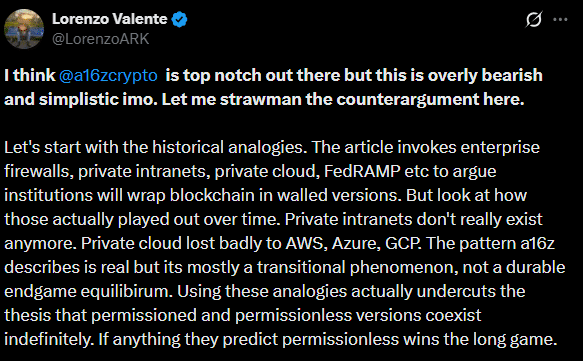
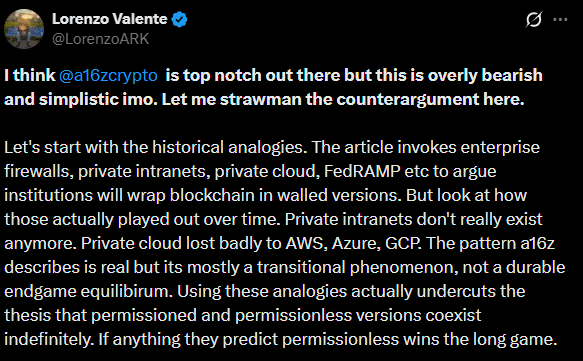
Source: X

For a16z, the vision of DeFi and traditional finance (TradFi) convergence is a “comforting story” which is “mostly wrong.” The firm argued that businesses will embrace DeFi not for decentralization, but for cost reduction and improved efficiency where applicable.

Here’s the more honest version: where TradFi can use a blockchain to make its existing business better, it will. Not because it has embraced decentralization, but because it’s a compelling COGS story.

The venture firm cited Circle’s push for Arc Chain for institutional stablecoin payments. Additionally, it mentioned Canton, which advances privacy for institutional players dealing with tokenization. SWIFT is also advancing its blockchain for tokenization and payments. It concluded by stating,

TradFi isn’t adopting DeFi. It’s selectively adopting parts that fit its model.

For the a16z analysts, TradFi will pick viable innovations from DeFi and public chains and adopt it within its controlled environment.

DeFi vs TradFi: Will they converge or diverge?

However, this is not the whole picture, according to Ark Invest’s Valente. He also mentioned the success of BlackRock’s BUIDL and other tokenized treasury money markets that are live on public chains.

Additionally, Valente argued that the success of stablecoins like USDT and USDC shows that the market “keeps voting for open access.”

For him, private chains will continue to die in isolation unless they join permissionless public chains. Carlos Domingo, CEO of tokenization issuer Securitize, echoed Valente’s sentiment.

Private chains or pseudo ones are the intranet and private clouds of this era, a transitional step into a truly open and permissionless innovation model.

Here, it’s worth pointing out that several private chains have since debuted or are in the pipeline, like Stripe’s Tempo or Google Cloud Universal Ledger (GCUL). They are all eyeing payments and tokenization.

In fact, even Mastercard, Stripe, Visa, and PayPal have adopted stablecoins, which validates some part of a16z’s claim.
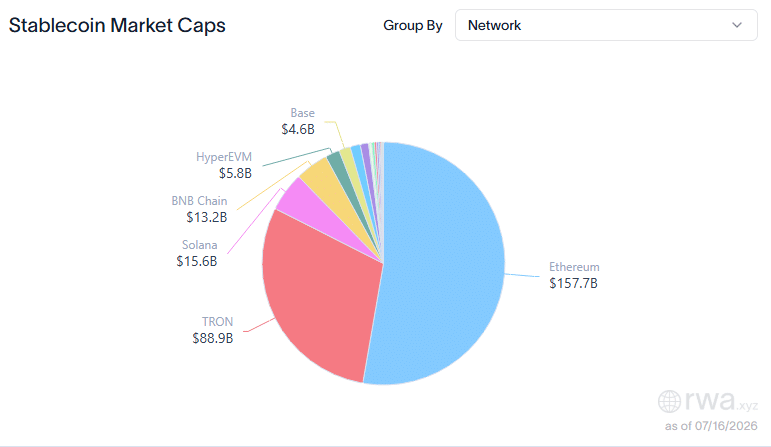
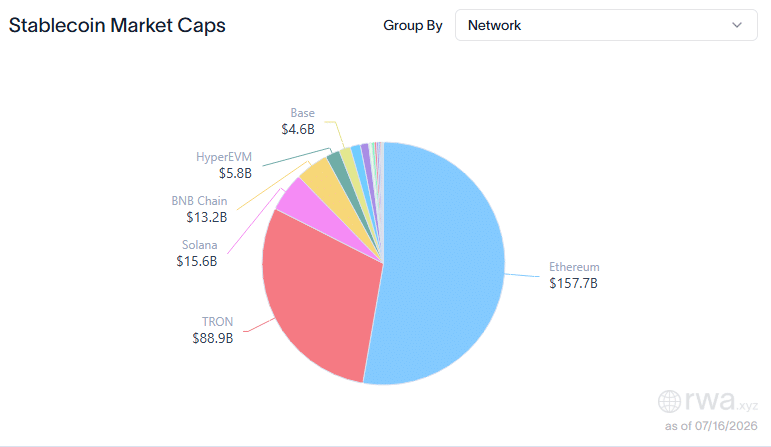
Source: RWA

Still, the dominance of public chains in the stablecoin and tokenization settlement market segment also validates Ark Invest’s argument. Notably, Ethereum and Tron control nearly 75% of the stablecoin sector.

For tokenization, corporate chains Canton and Provenance control 85% market share while Ethereum comes in third at about 4%.
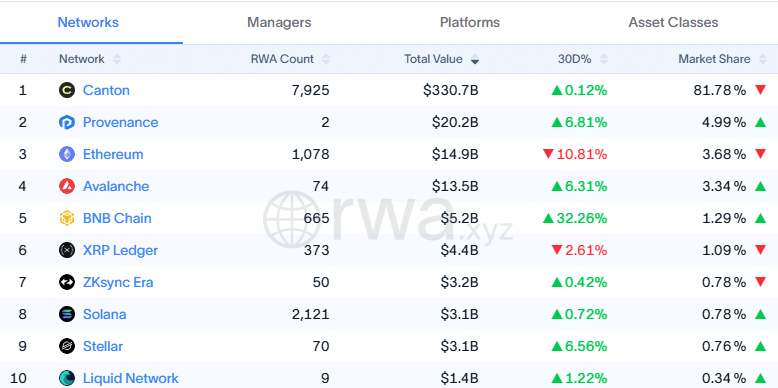
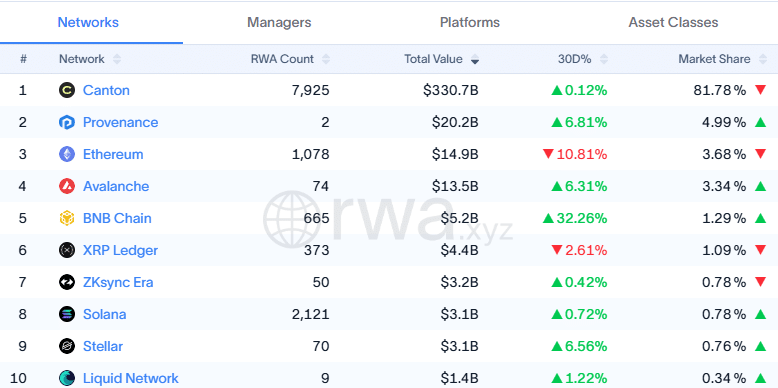
Source: RWA

As it stands, based on the aforementioned data, public chains dominate stablecoin payments.

However, corporate chains still have a massive moat in the tokenized assets segment. This means that both sides are right. Meaning, TradFi is selective in its DeFi push, but that does not overwrite the importance of public chains.


Final Summary

  • Ark Invest believes public chains and DeFi will emerge winners in the long run.
  • Ethereum dominated stablecoins, but ‘corporate chains’ locked the tokenization segment.

Пов'язані питання

QWhat is Ark Invest's main criticism of a16z's argument about TradFi and DeFi?

AArk Invest, through its Director of crypto research Lorenzo Valente, criticizes a16z's argument as 'overly bearish and simplistic,' dismissing the claim that TradFi only wants blockchain technology, not DeFi.

QWhat does a16z argue is the primary reason TradFi will adopt blockchain technology?

Aa16z argues that TradFi will adopt blockchain technology not because it embraces decentralization, but primarily to reduce costs and improve efficiency where applicable, framing it as a compelling 'COGS story' (Cost of Goods Sold).

QAccording to the article, what two points does Ark Invest use to counter a16z's view?

AArk Invest counters a16z's view by pointing to: 1) The success of initiatives like BlackRock's BUIDL and tokenized treasury money markets on public chains, and 2) The market preference for open access as demonstrated by the success of stablecoins like USDT and USDC.

QBased on the provided data, which type of chain dominates the stablecoin payments sector, and which dominates the tokenized assets segment?

ABased on the data, public chains (notably Ethereum and Tron) dominate the stablecoin payments sector with nearly 75% control. In contrast, 'corporate chains' like Canton and Provenance dominate the tokenized assets segment with an 85% market share.

QWhat is the overall conclusion the article draws about the arguments from both Ark Invest and a16z?

AThe article concludes that both sides have valid points: a16z is correct that TradFi is selectively adopting parts of DeFi/blockchain that fit its model, but this does not negate the importance and dominance of public chains in areas like stablecoin payments, validating Ark Invest's broader perspective.

Пов'язані матеріали

The Price of DeFi Mass Adoption: Understanding the Profit Distribution and Hidden Risks of Aave Stable Vaults

**Title:** The Price of DeFi Mass Adoption: Understanding Aave Stable Vaults' Profit Distribution and Hidden Risks **Summary:** Aave Labs' new "Stable Vaults" product aims to simplify DeFi for mainstream users by offering fixed yields, a rarity in crypto. The model inserts a middleman layer between users and Aave's underlying lending pools. This layer, often a fintech app or digital bank, absorbs interest rate volatility, guaranteeing users a pre-set stable return while capturing any excess yield from Aave's underlying pools. In exchange for this predictable "peace of mind" and services like customer support and simplified onboarding, users sacrifice potential higher yields and take on new counterparty risks from the operating entity and its infrastructure. The article illustrates this with the example of payroll provider Rise, which transparently passes through most Aave yield, versus the higher profit margins possible through Stable Vaults. While a rational trade-off for many non-expert users prioritizing simplicity and security, the system centralizes risk and obfuscates true market yields. Aave benefits by attracting sticky, non-speculative capital crucial for its long-term economic model, highlighting the industry's shift towards catering to fundamental human preferences for convenience over complex, self-managed financial systems.

Foresight News49 хв тому

The Price of DeFi Mass Adoption: Understanding the Profit Distribution and Hidden Risks of Aave Stable Vaults

Foresight News49 хв тому

Stripe's $53.4 Billion Acquisition of PayPal: The Final Piece of the Stablecoin Empire Puzzle

Stripe has reportedly made a $53.4 billion acquisition offer for PayPal, a move that could signal a major shift in the stablecoin landscape from a "technology race" to a "customer war." Over recent years, Stripe has been quietly building nearly every layer of a stablecoin empire: acquiring the issuance platform Bridge, wallet provider Privy, co-incubating the payments-focused Layer 1 network Tempo with Paradigm, and joining the Open USD (OUSD) alliance stablecoin initiative. What it lacks, however, is a massive direct consumer user base. PayPal, with its hundreds of millions of active accounts, the Venmo app, and its own PYUSD stablecoin, would provide exactly that. The acquisition could create a closed-loop system where Stripe handles the merchant side, PayPal/Venmo serve consumers, and transactions are settled via stablecoins on a blockchain like Tempo, potentially bypassing traditional card networks and their fees. While the deal is not yet finalized and may face hurdles—including potential resistance from PayPal's board or a higher bid—the mere offer suggests Stripe's strategic focus may have evolved. It indicates that having superior infrastructure alone may not be enough; distribution and user access are critical battlegrounds. Questions remain about how PYUSD, OUSD, and Venmo would integrate with Stripe's stack, and whether private equity co-investor Advent International would prioritize such crypto experiments. If successful, this acquisition could significantly boost Tempo's position in the competitive public blockchain space and further push crypto-based payments into the mainstream, potentially fulfilling PayPal's original vision of an internet-native currency through a new, crypto-native infrastructure.

marsbit1 год тому

Stripe's $53.4 Billion Acquisition of PayPal: The Final Piece of the Stablecoin Empire Puzzle

marsbit1 год тому

Hyperliquid's "Stock Price" for ChangXin Memory Tech Hits $8.64: How Was This Price Determined Before the IPO?

Title: Hyperliquid's "Stock Price" for CXMT Hits $8.64: How is This Pre-IPO Price Determined? Summary: On Hyperliquid, a derivative contract tracking the pre-IPO value of Chinese chipmaker Changxin Xinqiao (CXMT) has been trading, with its price reaching $8.64. This price is not a real stock price or a direct IPO valuation, but the result of a specific market mechanism. Trade.xyz deployed this "Pre-IPO Perpetual" (IPOP) contract via Hyperliquid's HIP-3 framework. It tracks the expected USD value of one Changxin A-share post-listing. The contract started with an artificial "discretionary reference price" of $5 set by Trade.xyz. Subsequent trading prices are primarily determined by supply and demand on Hyperliquid's on-chain order book. Since there's no tradable现货 before the IPO, the contract price isn't forced to align with the official IPO price of 8.66 RMB (~$1.28). Key mechanics shape the price: 1. **Order Book-Driven**: The actual成交价 comes from limit orders matched on-chain. 2. **Internal Oracle & Smoothing**: An internal oracle, run by Trade.xyz, calculates a smoothed price based on the order book's "impact price" using a 30-minute exponential moving average (EWMA). This oracle price influences funding rates. 3. **Mark Price for Risk**: A separate Mark Price, derived from the median of the internal oracle and other inputs, is used for calculating profit/loss and liquidation. 4. **Discovery Bound (Price护栏)**: A 20% "Discovery Bound" limits how far the price can move from the current reference point. However, if the price hits the bound, the reference price can be re-anchored upward (or downward) up to 7 times. This explains the阶梯状 jumps to $6, $7.2, and $8.64. 5. **Low Funding Rate**: A minimal funding rate (0.005 multiplier) allows positions to be held with low cost before the IPO, but it provides a weak anchor. Post-IPO, the contract is expected to convert to a standard stock perpetual, with its oracle switching to the actual A-share price converted to USD. This transition could cause price jumps and potential liquidations if there's a significant gap between the pre-IPO contract price and the real market price. In essence, the $8.64 price is a composite of: a人为设定的起点 + on-chain order book supply/demand +内部 oracle 平滑 + low funding rate damping + a moving price护栏. It represents a collective bet by specific market participants on the future public market valuation, not the company's current or official IPO price.

marsbit1 год тому

Hyperliquid's "Stock Price" for ChangXin Memory Tech Hits $8.64: How Was This Price Determined Before the IPO?

marsbit1 год тому

Prices From the Future Fool the Oracle, Ostium Drained of $24 Million in Five Minutes

Ostium, a perpetual trading platform, suffered a security incident on July 15, resulting in significant losses from its public liquidity vault. Initial analyses from Blockaid, Cyvers, and PeckShield estimate losses of up to $24 million. The exploit occurred over a five-minute window. According to security firms, the core issue was not a missing signature, but a data integrity failure: a registered price oracle (PriceUpKeep) submitted authorized price reports with manipulated future timestamps, creating false trading profits. The protocol’s verification process confirmed the signatures as authorized but did not enforce price sanity checks or timestamp boundaries, allowing the manipulated data to be accepted for settlement. This caused the liquidity vault to pay out on these fraudulent profits. Ostium’s co-founder confirmed the team paused trading within an hour and is collaborating with law enforcement and security experts. The extracted funds were reportedly swapped for ETH, with a portion moved to Tornado Cash. The incident highlights risks in DeFi oracle designs where cryptographic signature verification is insufficient without additional safeguards for data validity, timestamp freshness, and price reasonableness. Ostium's response and planned fixes—including stricter timestamp validation, independent price checks, and circuit breakers—will be critical to preventing similar exploits.

marsbit1 год тому

Prices From the Future Fool the Oracle, Ostium Drained of $24 Million in Five Minutes

marsbit1 год тому

Торгівля

Спот
活动图片