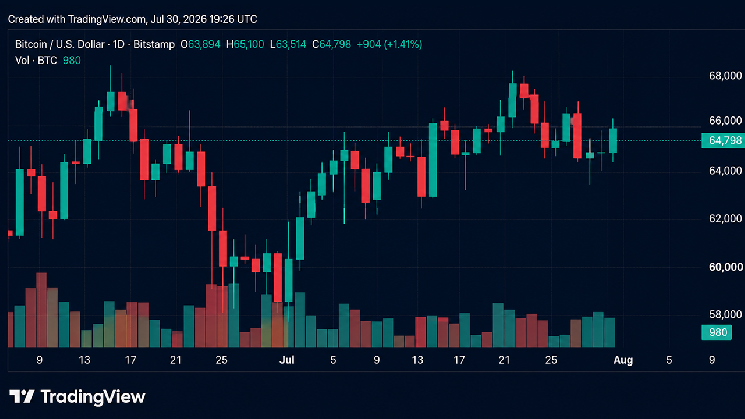
Analyzing 10 Key BTC Top Indicators: Why Is the Current Bull Market Different from Previous Ones?

深潮Опубліковано о 2025-12-22Востаннє оновлено о 2025-12-22

Анотація

"Analysis of 10 Key Bitcoin Top Indicators: Why the Current Bull Run Differs from the Past" This analysis examines 10 classic on-chain and technical indicators to assess whether Bitcoin has reached its cycle top. Historically, market peaks were marked by multiple indicators flashing extreme overbought signals simultaneously. However, the current bull run (as of Q4 2025) shows notably divergent, more moderate readings. Key findings include: The Pi Cycle Top indicator has not yet triggered a crossover signal. The Puell Multiple remains in a moderate 1-2 range, indicating miner selling pressure is not extreme. The Bitcoin Rainbow Chart shows price is in the yellow-orange zone, not the red "sell" bubble territory. The MVRV Z-Score sits in a neutral 2-4 range, far from previous cycle peaks of 7-10. The Altcoin Season Index remains low (30-40), showing no major capital rotation from BTC to altcoins. Long-Term Holder (LTH) supply shows a slow distribution, but Short-Term Holder (STH) supply, while rising, did not peak concurrently with the price high on October 6th. Net Unrealized Profit/Loss (NUPL) has declined to 0.34 from a high of 0.64 in March 2024. The analysis concludes that the market's structure has fundamentally changed. The explosive, retail-driven peaks of 2017 and 2021 are being replaced by a more gradual, institutional-led market, largely attributed to Bitcoin ETF inflows providing stability. This suggests Bitcoin is transitioning from a cyclical asset to a mainstr...

Author: WEEX Labs

In past Bitcoin bull market cycles, the price peak has often been accompanied by signs of market overheating. However, this bull market appears to have undergone some significant changes—many previously reliable indicators have not yet signaled a top, while the price of Bitcoin has been in a steady decline since hitting a new high on October 6th, further driving several indicators to turn bearish.

Below, we will examine 10 classic indicators, evaluate their characteristics and limitations, and outline the underlying changes in Bitcoin and the broader crypto market.

1. Pi Cycle Top Indicator: Has the Cycle Peak Been Reached?

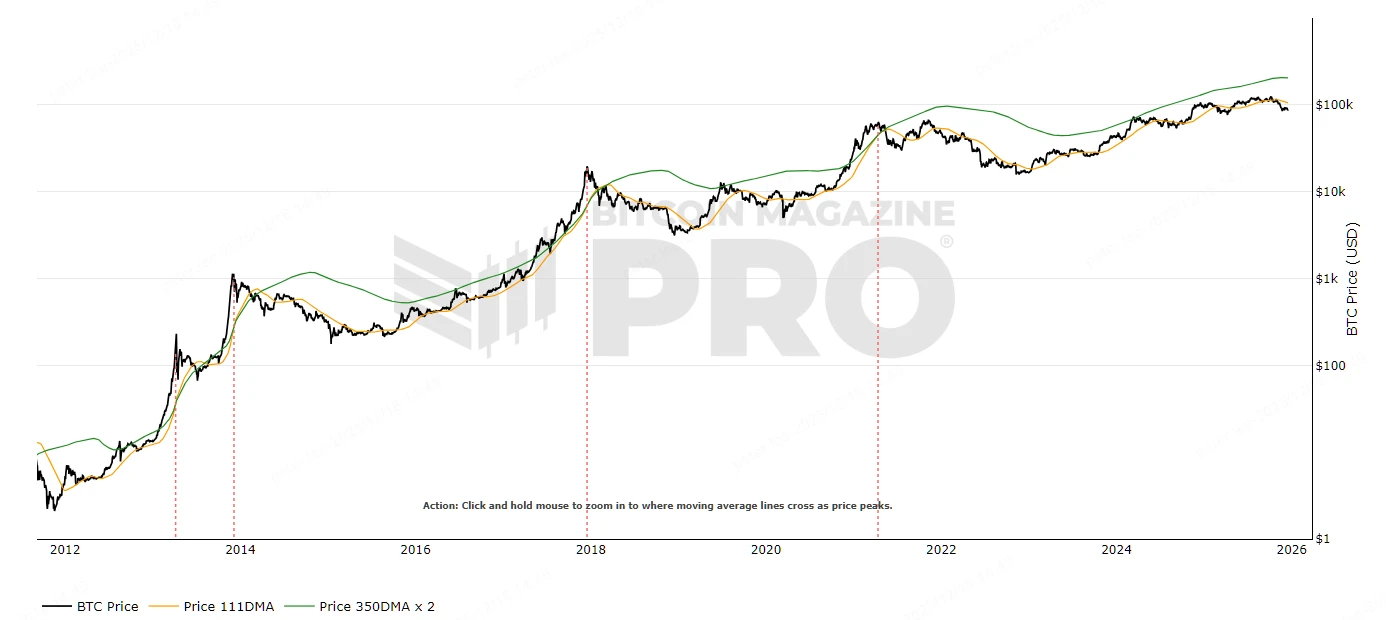
The Pi Cycle indicator is a classic tool for identifying Bitcoin price tops using the 111-day moving average (111DMA) and the 350-day moving average multiplied by 2 (350DMA x 2).

Typically, when the short-term line crosses above the long-term line, it often signals a market top, as it indicates that the price is rising too quickly and detaching from fundamental support.

Historically, the Pi Cycle Top Indicator has shown crossover behavior before each bull market peak:

2017 peak: The 111DMA crossed above the 350DMA x 2, marking the subsequent bubble burst;

2021 double top: A similar crossover occurred before the first top, followed by a rapid market correction;

Currently (Q4 2025), as shown in the chart below, the two lines have not yet crossed.
Source: https://www.bitcoinmagazinepro.com/charts/pi-cycle-top-indicator

2. Puell Multiple: Are Miner Profits Excessive?

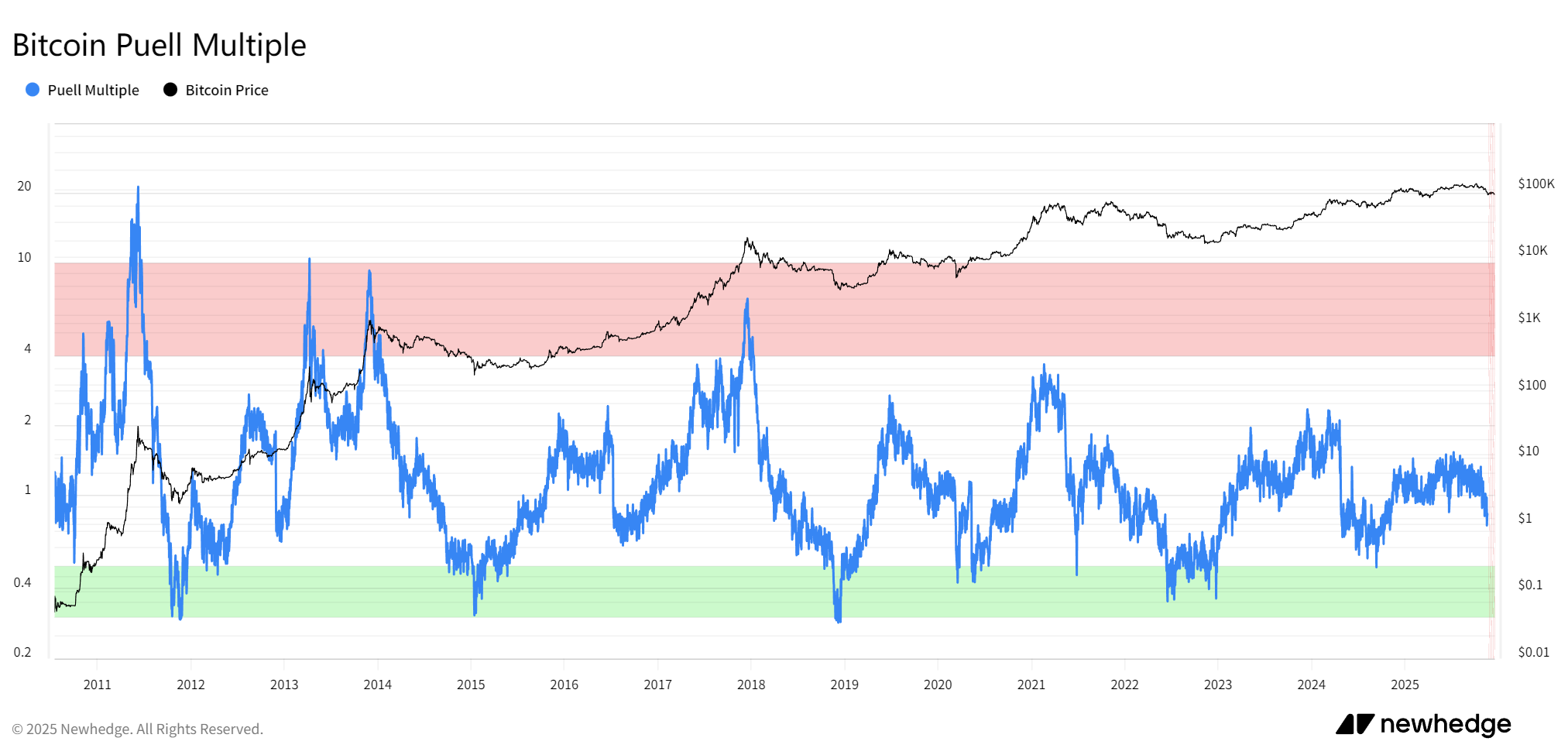
The Puell Multiple measures the ratio of miners' daily revenue to its 365-day moving average, used to assess miner profitability and market cycles.

Its principle is based on miner behavior: when the ratio is too high, miners are highly profitable and may increase selling pressure, forming a top; when it is too low, it indicates miner capitulation, signaling a bottom. In other words, a high Puell Multiple reflects that "miners are making too much money," accumulating supply pressure.

Historically, the Puell Multiple has also shown extreme spikes before each bull market peak:

2017 peak: Exceeded 7, a historical high;

2021 double top: Exceeded 3, followed by a crash;

Currently (Q4 2025), the Puell Multiple is in the 1~2 range, indicating moderate miner pressure.
Source: https://newhedge.io/bitcoin/puell-multiple

3. Bitcoin Rainbow Chart: Has the Price Entered the "Sell" Zone?

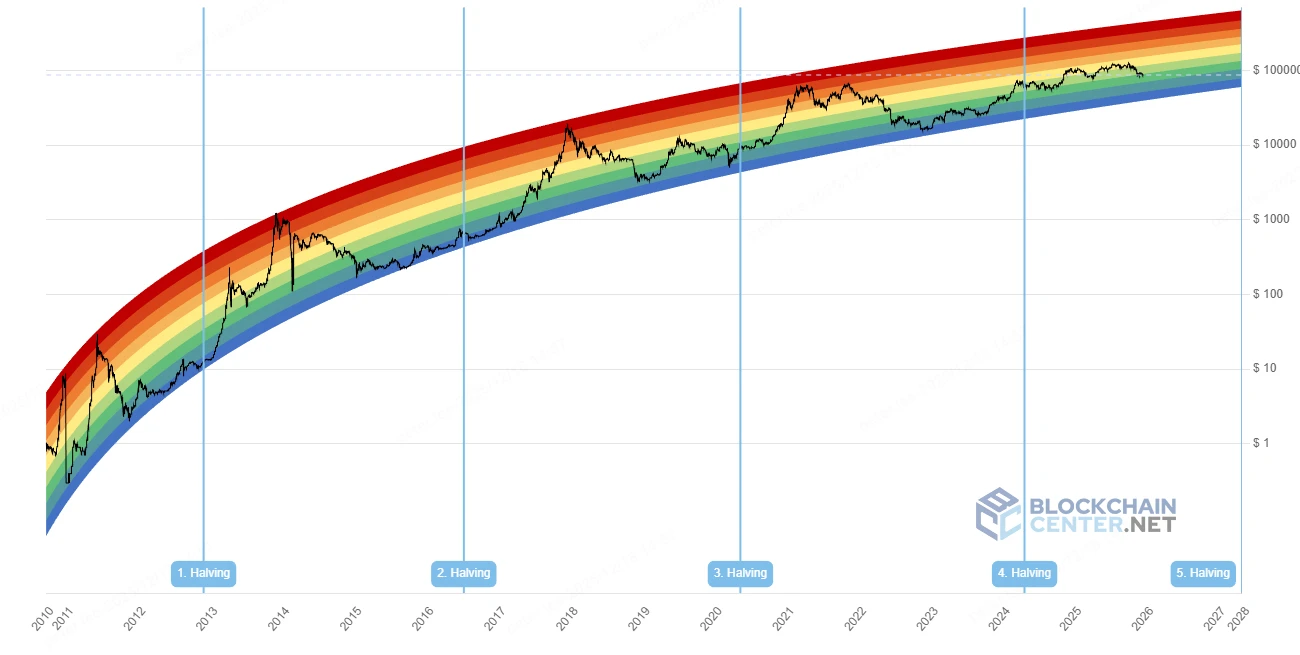
The Bitcoin Rainbow Chart uses a logarithmic growth curve overlaid with rainbow-colored bands to evaluate Bitcoin's long-term valuation levels.

Its principle maps prices to color bands: the blue zone indicates undervaluation (buy), and the red zone indicates overvaluation (sell). The bands are based on historical growth curves, helping to identify extreme market sentiment.

Historically, the Bitcoin Rainbow Chart has entered the red zone before each bull market peak:

2017 peak: Deep red zone, bubble peak;

2021 double top: Orange-red zone, followed by a correction;

Currently (Q4 2025), the price is in the yellow to orange range, not yet reaching the red bubble zone. We have also seen many analysts adjust this indicator, but regardless of the adjustments, the price has indeed not reached the red bubble area based on past historical experience.
Source: https://www.blockchaincenter.net/en/bitcoin-rainbow-chart/

4. 2-Year MA Multiplier: Has the Multiple Peaked?

The 2-Year MA Multiplier (also known as the Golden Ratio Multiplier) identifies price resistance zones by multiplying the 2-year moving average by Fibonacci ratios.

Its principle combines the golden ratio (1.6) and Fibonacci sequences to evaluate the multiple of the price relative to the long-term average: a high multiple indicates overheating, signaling a correction. In other words, a high multiple means the price has "deviated too far from the long-term trend," accumulating risk.

Historically, the 2-Year MA Multiplier has shown extreme multiples before each bull market peak:

2017 peak: The indicator differed from the price by up to 10 times, with the price crossing above 2 Yr MA *5 one month before the peak;

2021 double top: Exceeded 5 times, with the price just touching 2 Yr MA *5 before the first top;

Currently (Q4 2025), the multiple is in the 2~3 range, not yet entering the high multiple zone.
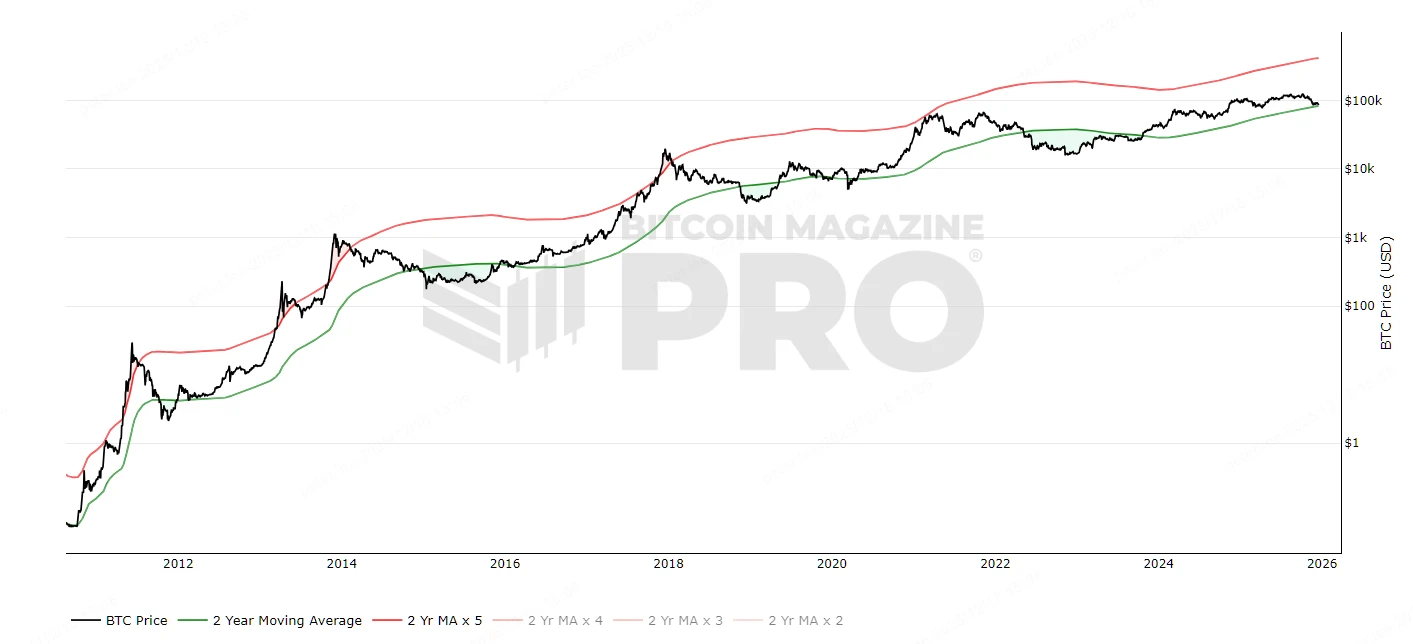
Source: https://www.bitcoinmagazinepro.com/charts/bitcoin-investor-tool/

5. Bitcoin 4-Year Moving Average: Is the Price Far Above the Long-Term Average?

The Bitcoin 4-Year Moving Average calculates the 4-year price average to assess Bitcoin's macro trend.

Its principle smooths out cyclical fluctuations: a price far above the average indicates overheating; closeness to the average indicates equilibrium. In other words, a large deviation means a "cyclical bubble," accumulating risk.

Historically, the Bitcoin 4-Year Moving Average has shown extreme price deviations before each bull market peak:

2017 peak: The indicator reached 16;

2021 double top: Reached 6 at the first top, followed by a crash;

Currently (Q4 2025), the price reached a maximum of 2.3, showing a decreasing peak trend.
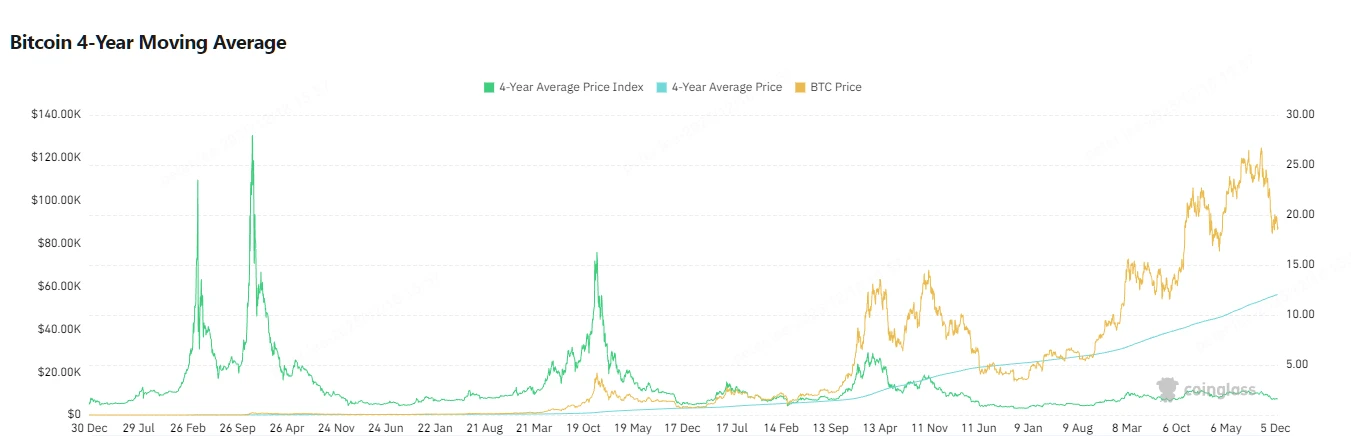
Source: https://www.coinglass.com/pro/i/four-year-moving-average

6. Bitcoin MVRV Z-Score: Has Valuation Entered the Risk Zone?

The MVRV Z-Score is a classic on-chain indicator for judging whether Bitcoin's valuation has "deviated from its true value."

Its principle compares Bitcoin's current market cap to its "realized cap" (the total cost basis of all coins) and calculates the standard deviation of the difference. In other words: a higher Z-Score means most people are in a state of unrealized profits, the market is "making too much money," and risk is accumulating.

Historically, the MVRV Z-Score has shown extreme spikes before each bull market peak:

2017 peak: Approached 10, a historical extreme;

2021 double top: Exceeded 7 at the first top, followed by a market crash;

Currently (Q4 2025), the Z-Score is in the 2~4 range, indicating neutral valuation.
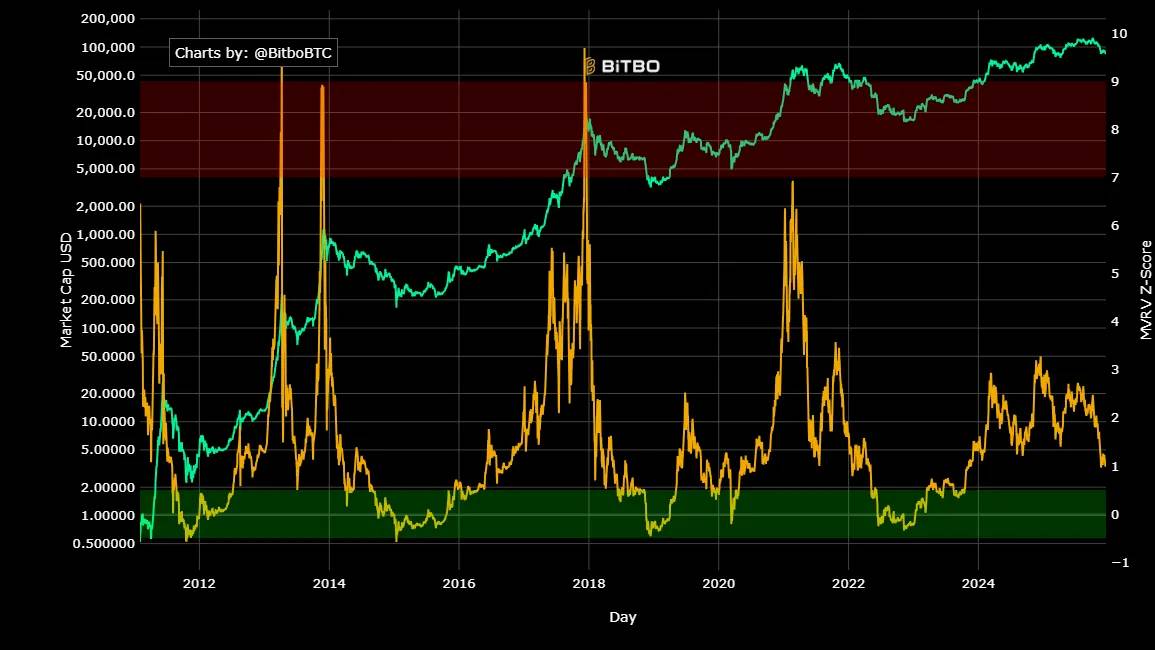
Source: https://charts.bitbo.io/mvrv-z-score

It is worth mentioning that the MVRV Rate adds statistical analysis to MVRV, measuring the standard deviation between the current MVRV and its historical average. This standardization helps identify when Bitcoin is trading above or below "fair value." However, as shown below, the peak values of this indicator at each bull market top have shown a decreasing trend, and the price has even diverged from the peaks, greatly increasing the difficulty of using this indicator to predict tops.
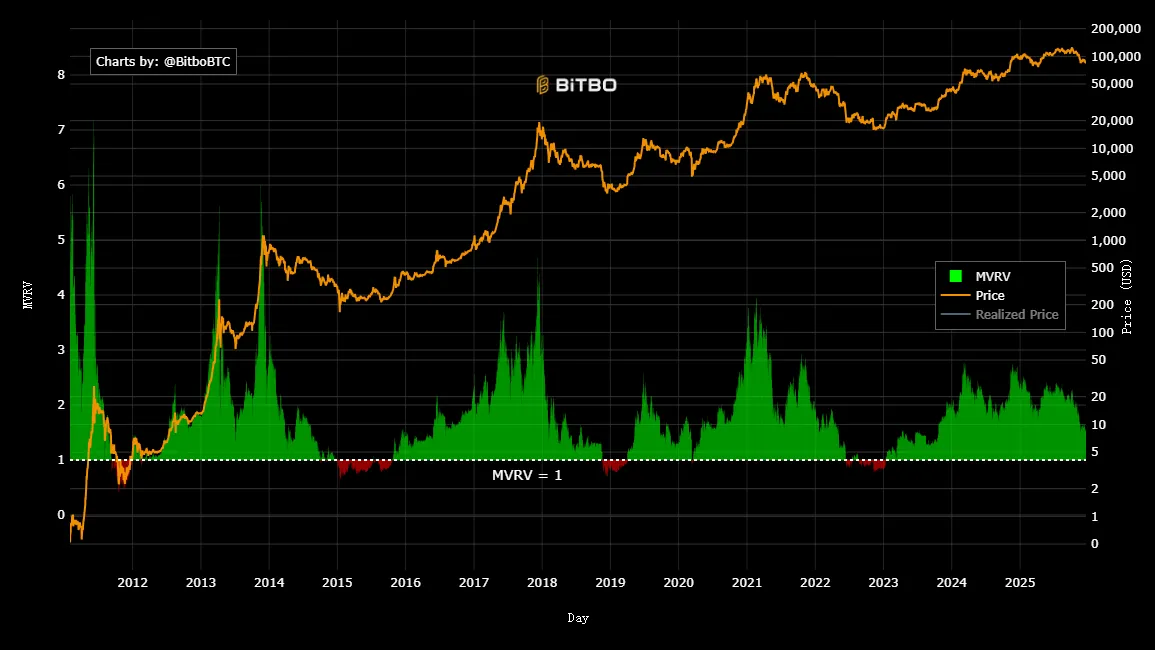
Source: https://charts.bitbo.io/mvrv

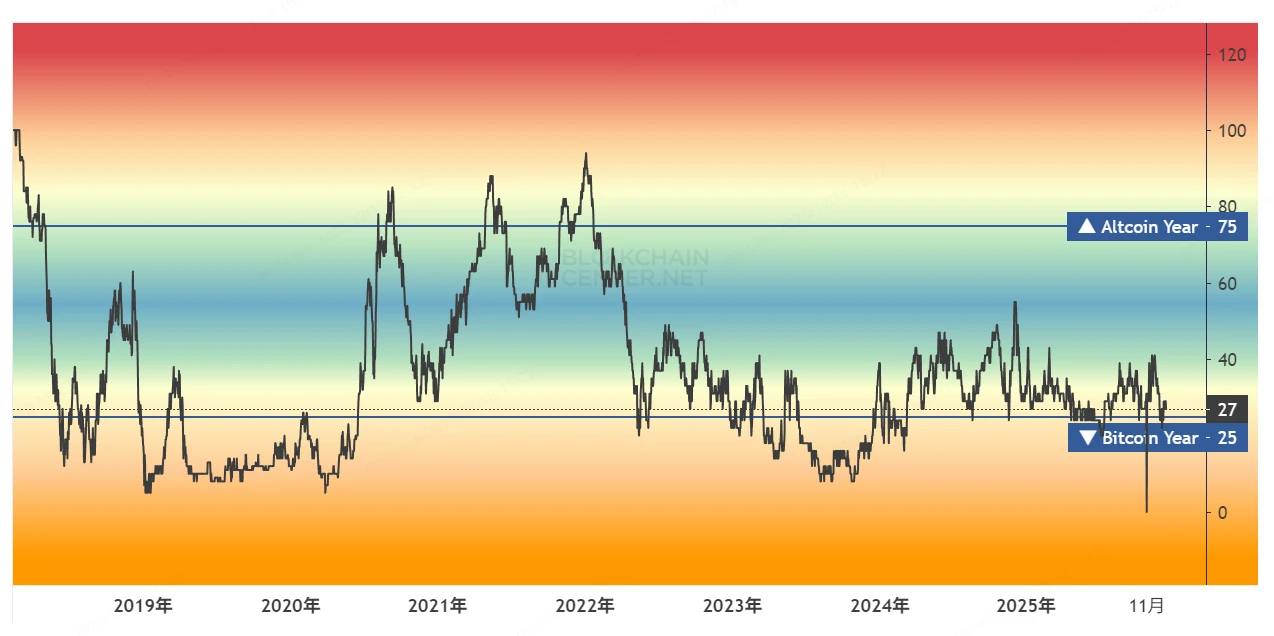
7. Altcoin Season Index: Has Altcoin Season Started?

The Altcoin Season Index tracks the performance of the top 100 altcoins relative to Bitcoin to assess whether an "alt season" has begun.

Its principle is based on relative performance: an index above 75 indicates the start of an alt season, often occurring after a BTC top, as funds flow from BTC to alts. In other words, a high index means BTC's dominance is weakening, and market risk is accumulating through diversification.

Historically, each bull market peak has ended with the狂欢 (狂欢) of an alt season as a closing signal:

2017 peak: Exceeded 90, alt season erupted;

2021 double top: Exceeded 80, followed by a BTC correction;

Currently (Q4 2025), the index is in the 30~40 range, with the altcoin sector performing sluggishly. In fact, since the start of this BTC bull run, this indicator has not even reached 60 at its highest, possibly due to insufficient liquidity and an oversupply of new coins.
Source: https://www.blockchaincenter.net/en/altcoin-season-index

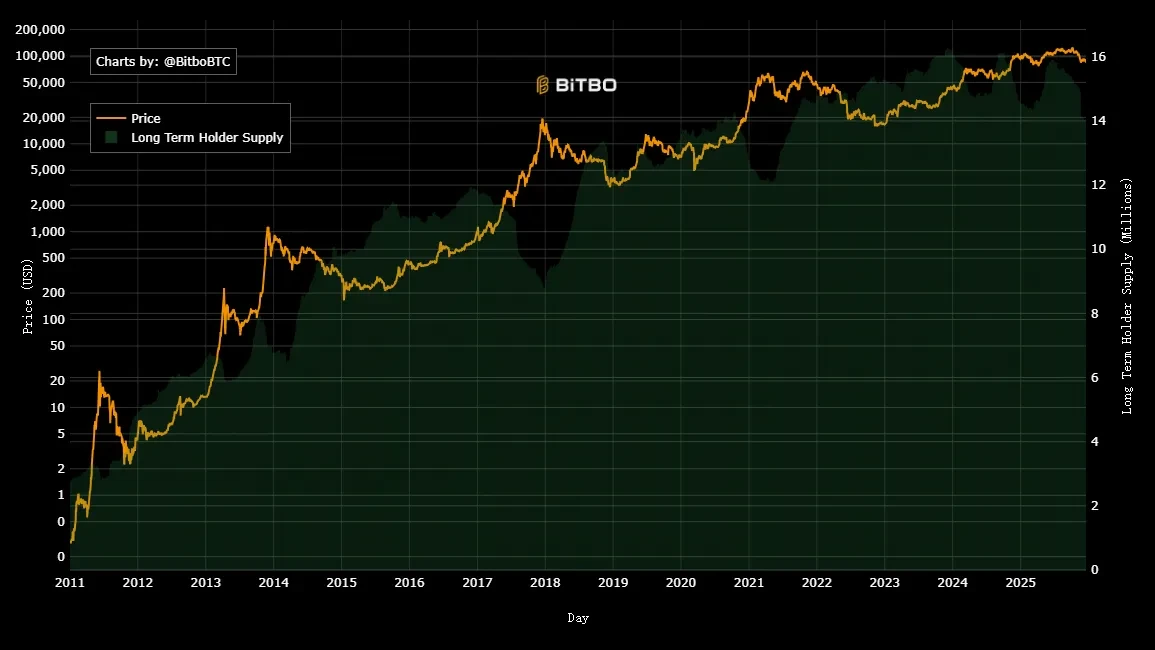
8. Bitcoin Long Term Holder Supply (LTH): Is Long-Term Holder Supply Decreasing?

Bitcoin Long Term Holder Supply (LTH) tracks the supply of Bitcoin held for more than 155 days, reflecting HODLer behavior.

Its principle observes supply changes: at tops, LTHs often sell to realize profits; at bottoms, they accumulate. In other words, a decrease in LTH supply means "smart money" is exiting, indicating high risk.

Historically, LTH has also shown significant decreases before each bull market peak:

2017 peak: The selling period lasted a year, reaching a selling climax at the top;

2021 double top: The first top followed a trend of continuous selling for half a year, but the accumulation at the second top reached a historical high;

Currently (Q4 2025), slow selling has been ongoing for half a year, but the top in October does not align with historical patterns.
Source: https://charts.bitbo.io/long-term-holder-supply

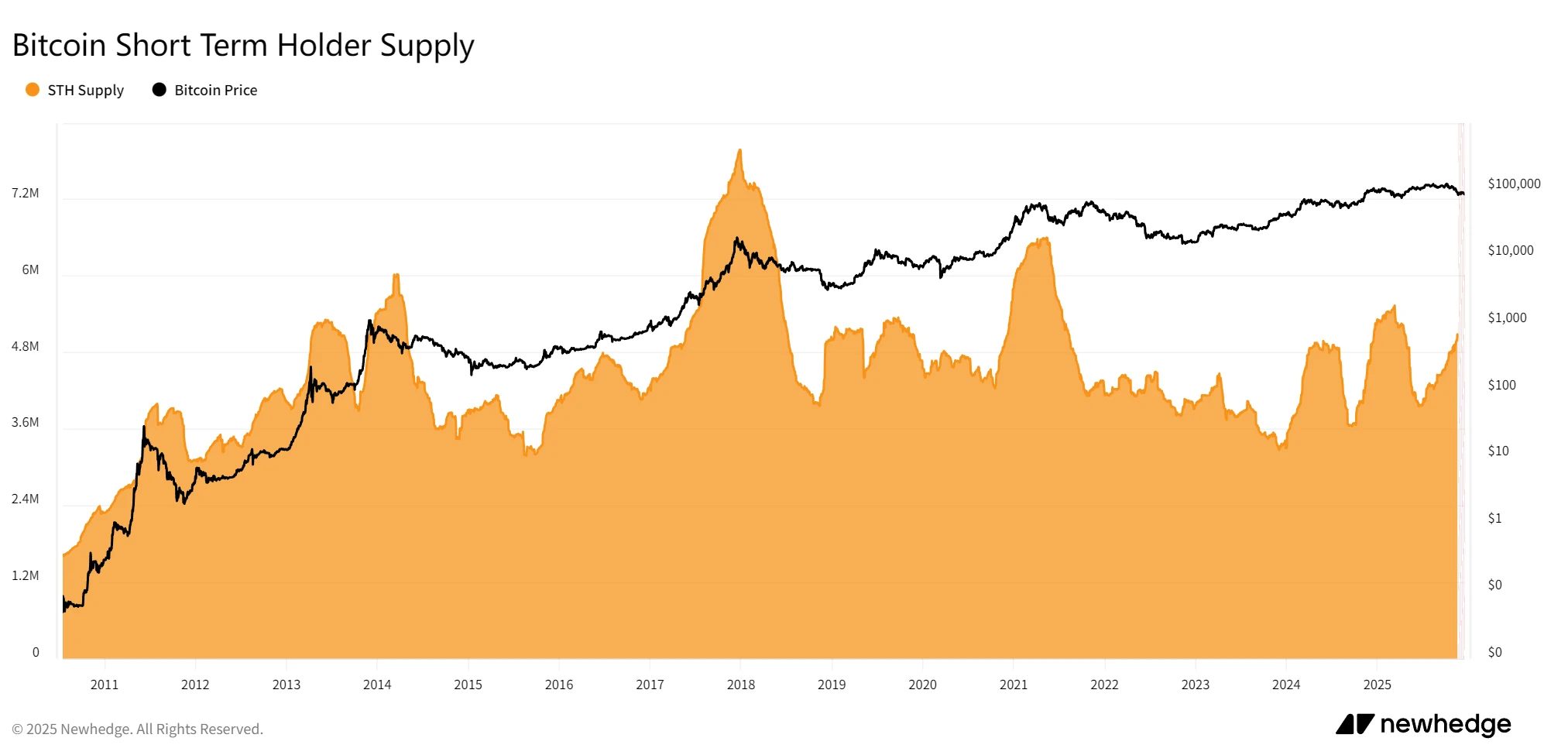
9. Bitcoin Short Term Holder Supply (STH): Has Short-Term Holder Supply Surged?

Bitcoin Short Term Holder Supply (STH) tracks the proportion of Bitcoin held for less than 155 days, assessing novice speculation.

Its principle captures new capital inflows: a high proportion indicates rampant speculation, often signaling a top; a low proportion indicates market maturity. In other words, high STH means "too many newcomers," making the bubble prone to bursting.

Historically, STH has shown surges before each bull market peak:

2017 peak: Nearly 8M BTC, peak speculation;

2021 double top: Nearly 6.5M BTC at the first top; the selling at the second absolute top did not reach a peak;

Currently, STH is continuously climbing, approaching 5.5M BTC, but the price peak was on October 6th, unlike the previous two bull markets where the STH peak and price top were closely aligned in time.
Source: https://newhedge.io/bitcoin/short-term-holder-supply

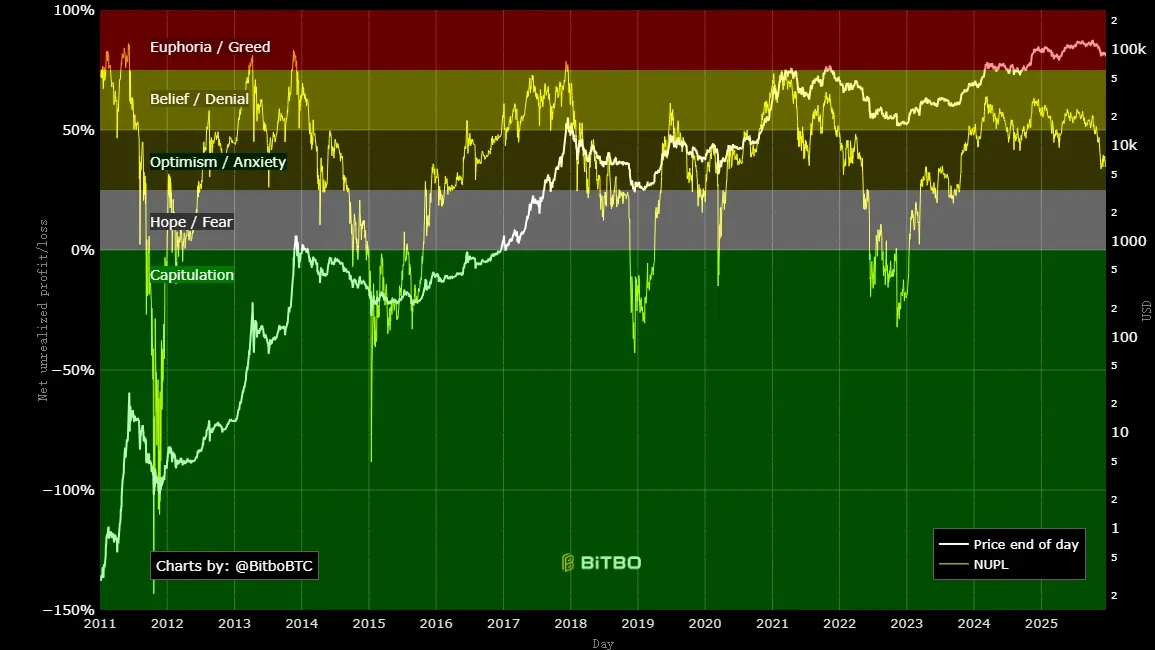
10. Bitcoin Net Unrealized Profit/Loss (NUPL): Has Unrealized Profit/Loss Entered the Greed Zone?

Bitcoin NUPL measures the overall network's ratio of unrealized profit to loss, assessing market sentiment.

Its principle is: calculate market cap minus realized cap, then divide by market cap: above 0.75 indicates greed (top signal); below 0 indicates fear (bottom). In other words, high NUPL means "everyone is in profit," indicating high selling risk.

Historically, Bitcoin NUPL has shown extremely high values before each bull market peak:

2017 peak: Exceeded 0.8, a historical extreme;

2021 double top: Exceeded 0.7, followed by a crash;

Currently (Q4 2025), NUPL reached a high of 0.64 in early March 2024 and has been fluctuating since, now falling to 0.34.
Source: https://charts.bitbo.io/net-unrealized-profit-loss

Conclusion: Structural Changes in This Bitcoin Bull Market

Judging from the above indicators, the current Bitcoin market trend does not highly align with the extreme performances seen at past bull market tops. Historical tops were often accompanied by multiple indicators overheating simultaneously, such as high Z-Score, high Puell Multiple, NUPL entering the greed zone, accompanied by LTH selling and STH surges. However, the performance of these indicators now is quite moderate.

This does not mean that the current Bitcoin price has not yet peaked; these indicators are all based on spatial judgment. The following schematic, which uses a 3-year time cycle to predict price tops,似乎 (seems to) indicate that Bitcoin has already peaked.
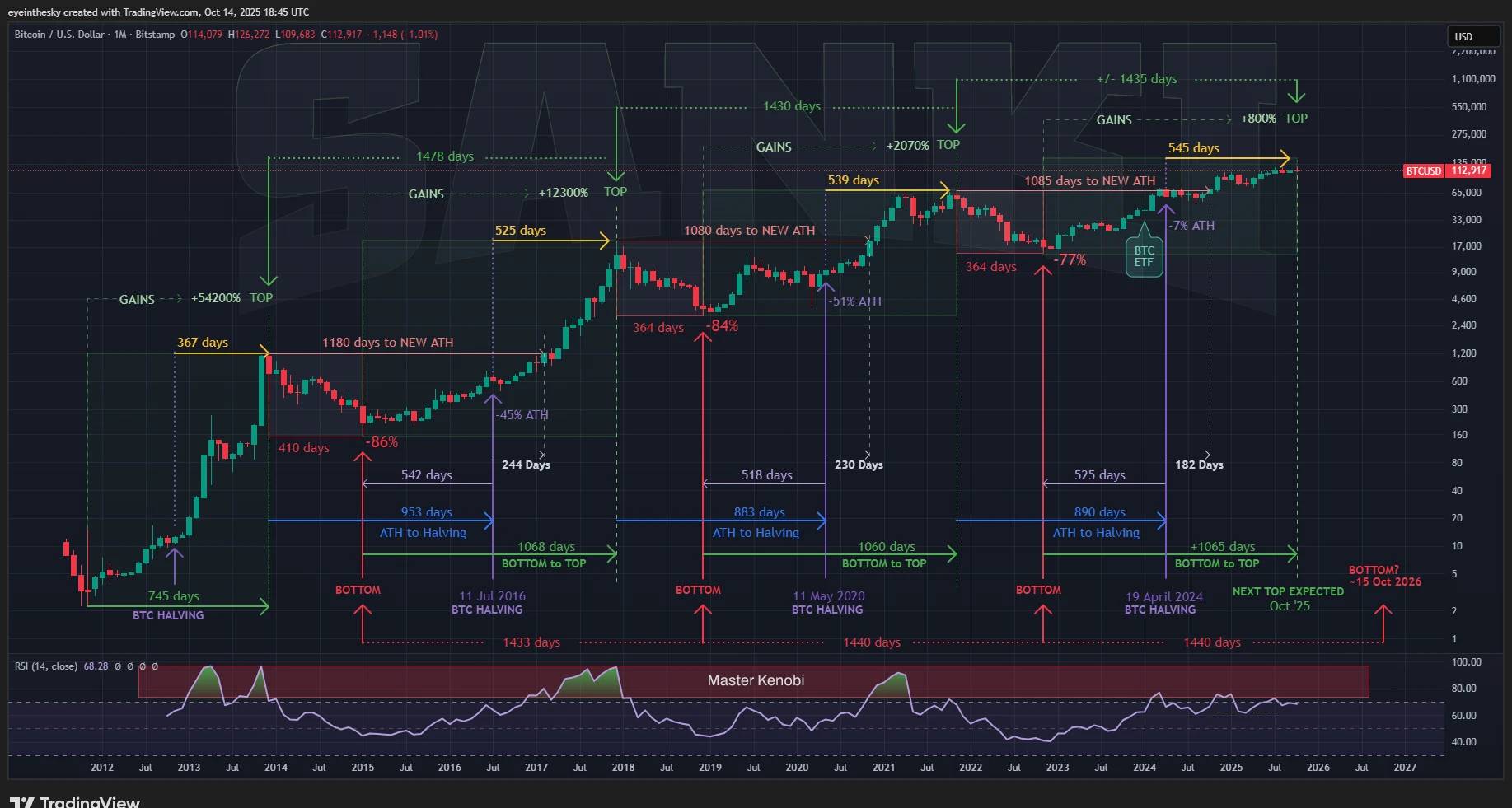
Source: https://x.com/btc_MasterPlan/status/1978180632410042828/photo/1

Of course, while analyzing the above indicators, we also found that these tools, based on linear price predictions, have already shown signs of decay in predicting top regions, exhibiting a characteristic of marginal diminishment. For example, the peak MVRV values at the 2017, 2021, and 2025 bull market tops were 10, 7, and 3 respectively. We can obviously no longer expect the MVRV to reach 7 in this bull run, and it is also not easy to predict a reliable numerical value corresponding to the top of this bull run from MVRV.

In other words, while these indicators show the market is in a neutral or moderate range, they do not confirm that the bull market is still ongoing or that a bear market has arrived. Instead, they suggest that the growth of the current Bitcoin market has become more gradual rather than explosive, which may be attributed to:

• Firstly, the introduction of Bitcoin ETFs has attracted a large amount of long-term capital, stabilizing supply dynamics. This contrasts with past retail-driven bubbles, slowing down the pace of overheating.

• Secondly, changes in global liquidity in 2025 (Fed rate cuts VS BOJ rate hikes) and geopolitical changes have repeatedly disturbed BTC's price, and the平稳 (steady) changes in various indicators恰恰 (precisely) show a more mature market.

In summary, whether the recent high on October 6th is the peak of this bull market or not, we need to acknowledge that Bitcoin price fluctuations may have broken through past historical frameworks and experiences. It seems to be undergoing a structural transformation from a "cyclical asset" to a "mainstream reserve." It is important to remind investors that these indicators may need adjusted thresholds or to be used in combination with each other to be more effective for investment decisions.

About Us

WEEX Labs is the research department under WEEX Exchange, dedicated to tracking and analyzing cryptocurrencies, blockchain technology, and emerging market trends, providing professional assessments.

The team adheres to the principles of objective, independent, and comprehensive analysis, aiming to explore cutting-edge trends and investment opportunities through rigorous research methods and前沿 (frontier) data analysis, outputting comprehensive, rigorous, and clear insights for the industry, and providing全方位 (all-round) construction and investment guidance for Web3 startups and investors.

Disclaimer

The views expressed in this article are for reference only and do not constitute an endorsement of any products or services discussed, nor do they constitute any investment, financial, or trading advice. Readers should consult qualified professionals before making financial decisions. Please note that WEEX Labs may restrict or prohibit all or part of the services from restricted areas.


Пов'язані питання

QWhat is the Pi Cycle Top Indicator and what does it currently indicate about the Bitcoin market?

AThe Pi Cycle Top Indicator uses the 111-day moving average (111DMA) and the 350-day moving average multiplied by 2 (350DMA x 2) to identify market tops. Historically, a crossover where the 111DMA moves above the 350DMA x 2 has signaled a market peak. As of Q4 2025, the lines have not yet crossed, suggesting this classic top signal has not been triggered.

QHow does the Puell Multiple gauge market cycles and what is its current reading?

AThe Puell Multiple measures the ratio of miners' daily revenue to its 365-day moving average. A high ratio indicates miners are highly profitable and may increase selling pressure, often preceding a market top. As of Q4 2025, the Puell Multiple is in the 1-2 range, indicating moderate miner pressure and not the extreme levels seen at past cycle tops.

QAccording to the article, what is a key structural change making the current Bitcoin bull market different from previous ones?

AA key structural change is the introduction of Bitcoin ETFs, which has attracted substantial long-term institutional capital. This has stabilized supply dynamics and created a more gradual, mature market growth pattern, contrasting with the retail-driven, explosive bubbles of the past.

QWhat does the MVRV Z-Score measure and what trend has been observed in its peak values over the last three bull markets?

AThe MVRV Z-Score measures how far Bitcoin's market value deviates from its 'realized value' (the total cost basis of all coins) in terms of standard deviation. It identifies when the market is 'too profitable.' A clear trend of diminishing peaks has been observed: the Z-Score peaked at around 10 in 2017, over 7 in 2021, and only reached approximately 3 in the current cycle, indicating its predictive power for absolute tops may be weakening.

QWhy has the Altcoin Season Index remained relatively low during this bull run, according to the analysis?

AThe Altcoin Season Index, which tracks the performance of top altcoins relative to Bitcoin, has remained in the 30-40 range and has not exceeded 60 in this cycle. The analysis suggests this is likely due to insufficient liquidity and the market being flooded with too many newly issued tokens, which has suppressed altcoin performance and delayed a classic 'altseason'.

Пов'язані матеріали

North Korean Hackers Loot $500 Million in a Single Month, Becoming the Top Threat to Crypto Security

North Korean hackers, particularly the notorious Lazarus Group and its subgroup TraderTraitor, have stolen over $500 million from cryptocurrency DeFi platforms in less than three weeks, bringing their total theft for the year to over $700 million. Recent major attacks on Drift Protocol and KelpDAO, resulting in losses of approximately $286 million and $290 million respectively, highlight a strategic shift: instead of targeting core smart contracts, attackers are now exploiting vulnerabilities in peripheral infrastructure. For instance, the KelpDAO attack involved compromising downstream RPC infrastructure used by LayerZero's decentralized validation network (DVN), allowing manipulation without breaching core cryptography. This sophisticated approach mirrors advanced corporate cyber-espionage. Additionally, North Korea has systematically infiltrated the global crypto workforce, with an estimated 100 operatives using fake identities to gain employment at blockchain companies, enabling long-term access to sensitive systems and facilitating large-scale thefts. According to Chainalysis, North Korean-linked hackers stole a record $2 billion in 2025, accounting for 60% of all global crypto theft that year. Their total historical crypto theft has reached $6.75 billion. Post-theft, they employ specialized money laundering methods, heavily relying on Chinese OTC brokers and cross-chain mixing services rather than standard decentralized exchanges. Security experts, while acknowledging the increased sophistication, emphasize that many attacks still exploit fundamental weaknesses like poor access controls and centralized operational risks. Strengthening private key management, limiting privileged access, and enhancing coordination among exchanges, analysts, and law enforcement immediately after an attack are critical to improving defense and fund recovery chances. The industry's challenge now extends beyond secure smart contracts to safeguarding operational security at the infrastructure level.

marsbit54 хв тому

North Korean Hackers Loot $500 Million in a Single Month, Becoming the Top Threat to Crypto Security

marsbit54 хв тому

Circle CEO's Seoul Visit: No Korean Won Stablecoin Issuance, But Met All Major Korean Banks

Circle CEO Jeremy Allaire's recent activities in Seoul indicate a strategic shift for the company, moving away from issuing a Korean won-backed stablecoin and instead focusing on embedding itself as a key infrastructure provider within Korea’s financial and crypto ecosystem. Despite Korea accounting for nearly 30% of global crypto trading volume—with a market characterized by high retail participation and altcoin dominance—Circle has chosen not to compete for the role of stablecoin issuer. Instead, Allaire met with major Korean banks (including Shinhan, KB, and Woori), financial groups, leading exchanges (Upbit, Bithumb, Coinone), and tech firms like Kakao. This approach reflects a broader industry transition: the core of stablecoin competition is shifting from issuance rights to systemic positioning. With Korean regulators still debating whether banks or tech companies should issue stablecoins, Circle is avoiding regulatory uncertainty by strengthening its role as a service and technology partner. The company is deepening integration with trading platforms, building connections, and promoting stablecoin infrastructure. This positions Circle to benefit regardless of which entity eventually issues a won stablecoin. Allaire also noted the potential for a Chinese yuan stablecoin in the next 3–5 years, underscoring a regional trend of stablecoins becoming more regulated and integrated with traditional finance. Ultimately, Circle’s strategy highlights that future influence in the stablecoin market will belong not necessarily to the issuers, but to the foundational infrastructure layers that enable cross-system transactions.

marsbit1 год тому

Circle CEO's Seoul Visit: No Korean Won Stablecoin Issuance, But Met All Major Korean Banks

marsbit1 год тому

SpaceX Ties Up with Cursor: A High-Stakes AI Gambit of 'Lock First, Acquire Later'

SpaceX has secured an option to acquire AI programming company Cursor for $60 billion, with an alternative clause requiring a $10 billion collaboration fee if the acquisition does not proceed. This structure is not merely a potential acquisition but a strategic move to control core access points in the AI era. The deal is designed as a flexible, dual-path arrangement, allowing SpaceX to either fully acquire Cursor or maintain a binding partnership through high-cost collaboration. This "option-style" approach minimizes immediate regulatory and integration risks while ensuring long-term alignment between the two companies. At its core, the transaction exchanges critical AI-era resources: SpaceX provides its Colossus supercomputing cluster—one of the world’s most powerful AI training infrastructures—while Cursor contributes its AI-native developer environment and strong product adoption. This synergy connects compute power, models, and application layers, forming a closed-loop AI capability stack. Cursor, founded in 2022, has achieved rapid growth with over $1 billion in annual revenue and widespread enterprise adoption. Its value lies in transforming software development through AI agents capable of coding, debugging, and system design—positioning it as a gateway to future software production. For SpaceX, this move is part of a broader strategy to evolve from a aerospace company into an AI infrastructure empire, integrating xAI, supercomputing, and chip manufacturing. Controlling Cursor fills a gap in its developer tooling layer, strengthening its AI narrative ahead of a potential IPO. The deal reflects a shift in AI competition from model superiority to ecosystem and entry-point control. With programming tools as a key battleground, securing developer loyalty becomes crucial for dominating the software production landscape. Risks include questions around Cursor’s valuation, technical integration challenges, and potential regulatory scrutiny. Nevertheless, the deal underscores a strategic bet: controlling both compute and software development access may redefine power dynamics in the AI-driven future.

marsbit2 год тому

SpaceX Ties Up with Cursor: A High-Stakes AI Gambit of 'Lock First, Acquire Later'

marsbit2 год тому

Торгівля

Спот
Ф'ючерси

Популярні статті

Що таке BITCOIN

Розуміння HarryPotterObamaSonic10Inu (ERC-20) та його позиції у крипто-просторі Останніми роками ринок криптовалют спостерігав за зростанням популярності мем-коінів, які привертають інтерес не тільки трейдерів, але й тих, хто шукає спілкування та розважальну цінність. Серед цих унікальних токенів є HarryPotterObamaSonic10Inu (ERC-20), інтригуючий проект, що поєднує культурні посилання з тканинами криптовалюти. Ця стаття досліджує ключові аспекти HarryPotterObamaSonic10Inu, вивчаючи його механізми, спільноту та його взаємодію з ширшим крипто-ландшафтом. Що таке HarryPotterObamaSonic10Inu (ERC-20)? Як випливає з його назви, HarryPotterObamaSonic10Inu є мем-коіном, побудованим на блокчейні Ethereum, класифікованим за стандартом ERC-20. На відміну від традиційних криптовалют, які можуть підкреслювати практичну корисність або інвестиційний потенціал, цей токен процвітає завдяки розважальній цінності та силі своєї спільноти. Проект спрямований на створення середовища, де зацікавлені користувачі можуть об'єднуватися, ділитися ідеями та брати участь у заходах, натхненних різноманітними культурними явищами. Однією з примітних особливостей HarryPotterObamaSonic10Inu є нульовий податок на транзакції. Цей привабливий елемент має на меті заохочувати торгівлю та участь у спільноті, позбавлену додаткових витрат, які можуть відлякувати дрібних трейдерів. Загальна пропозиція монет становить один мільярд токенів, що позначає намір підтримувати суттєву циркуляцію в межах спільноти. Творець HarryPotterObamaSonic10Inu (ERC-20) Походження HarryPotterObamaSonic10Inu дещо окутане таємницею; деталі про творця залишаються невідомими. Розвиток цього токена позбавлений впізнаваної команди або чіткої стратегії, що не є рідкістю в секторі мем-коінів. Натомість проект виник органічно, а його розвиток значною мірою залежить від ентузіазму та участі його спільноти. Інвестори HarryPotterObamaSonic10Inu (ERC-20) Щодо зовнішніх інвестицій та підтримки, HarryPotterObamaSonic10Inu також залишається невизначеним. Токен не зазначає жодних відомих інвестиційних фондів або значної організаційної підтримки. Натомість життєва сила проекту полягає в його базовій спільноті, яка інформує про його зростання та стійкість через колективні дії та залученість у крипто-просторі. Як працює HarryPotterObamaSonic10Inu (ERC-20)? Як мем-коін, HarryPotterObamaSonic10Inu функціонує передусім поза традиційними рамками, що часто регулюють вартість активів. Є кілька відмінних аспектів, що визначають, як працює проект: Транзакції без податку: Завдяки відсутності податкових зборів на транзакції, користувачі можуть вільно купувати та продавати токен, не турбуючись про приховані витрати. Залучення спільноти: Проект процвітає завдяки взаємодії спільноти, використовуючи соціальні медіа для створення шуму та сприяння залученню. Обговорення, обмін контентом та залученість є ключовими елементами, що допомагають розширити його охоплення та зміцнити лояльність серед прихильників. Відсутність практичної корисності: Слід зазначити, що HarryPotterObamaSonic10Inu не пропонує конкретної корисності в рамках фінансової екосистеми. Натомість він класифікується як токен, що призначений в основному для розваги та спільнотних активностей. Культурне посилання: Токен кмітливо вплітає елементи популярної культури, щоб привернути інтерес, зв'язуючи з ентузіастами мемів та крипто-стежками. HarryPotterObamaSonic10Inu ілюструє, як мем-коіни функціонують інакше, ніж традиційні криптовалютні проекти, увійшовши на ринок як інноваційні соціальні конструкти, а не утилітарні активи. Хронологія HarryPotterObamaSonic10Inu (ERC-20) Історія HarryPotterObamaSonic10Inu відзначена кількома значними етапами: Створення: Токен виник з вірусного мему, захопивши уяву багатьох крипто-ентузіастів. Конкретні дати створення недоступні, що підкреслює його органічний розвиток. Лістинг на біржах: HarryPotterObamaSonic10Inu з'явився на різних біржах, дозволяючи зручніший доступ і торгівлю спільноти. Ініціативи залучення спільноти: Ведення діяльності, спрямованої на покращення взаємодії спільноти, включаючи конкурси, кампанії в соціальних мережах та створення контенту від фанатів та прихильників. Плани на майбутнє: Дорожня карта проекту включає запуск колекції NFT, мерчандайзинг та електронну комерцію, пов'язану з його культурними темами, що далі залучає спільноту та намагається додати більше вимірів до його екосистеми. Ключові моменти про HarryPotterObamaSonic10Inu (ERC-20) Спільнотний підхід: Проект надає пріоритет колективному внеску та креативності, забезпечуючи, щоб участь користувачів була в центрі його розвитку. Класифікація як мем-коін: Це є його епігенез розважальної криптовалюти, що відрізняється від традиційних інвестиційних інструментів. Жодного прямого відношення до Bitcoin: Незважаючи на схожість у назві, HarryPotterObamaSonic10Inu є відмінним і не має жодного зв’язку з Bitcoin або іншими усталеними криптовалютами. Зосередженість на співпраці: HarryPotterObamaSonic10Inu створено для того, щоб надати простір для співпраці та обміну історіями серед його власників, забезпечуючи шлях для творчості та спільного зв'язку. Перспективи на майбутнє: Амбіція розширитися за межі початкової концепції в NFT та мерчандайз відкриває шлях для проекту потенційно потрапити в більш мейнстрімні сфери цифрової культури. Оскільки мем-коіни продовжують захоплювати уяву спільноти криптовалют, HarryPotterObamaSonic10Inu (ERC-20) вирізняється своїми культурними зв'язками та орієнтованим на спільноту підходом. Хоча він може не відповідати типовій моделі утилітарного токена, його суть полягає в радощах і товариськості, що підтримуються серед його прихильників, підкреслюючи еволюційну природу криптовалют в усе більш цифрову епоху. Оскільки проект продовжує розвиватися, важливо спостерігати за тим, як динаміка спільноти вплине на його траєкторію в постійно змінюваному ландшафті технології блокчейн.

1.7k переглядів усьогоОпубліковано 2024.04.01Оновлено 2024.12.03

Що таке BITCOIN

Як купити BTC

Ласкаво просимо до HTX.com! Ми зробили покупку Bitcoin (BTC) простою та зручною. Дотримуйтесь нашої покрокової інструкції, щоб розпочати свою криптовалютну подорож.Крок 1: Створіть обліковий запис на HTXВикористовуйте свою електронну пошту або номер телефону, щоб зареєструвати обліковий запис на HTX безплатно. Пройдіть безпроблемну реєстрацію й отримайте доступ до всіх функцій.ЗареєструватисьКрок 2: Перейдіть до розділу Купити крипту і виберіть спосіб оплатиКредитна/дебетова картка: використовуйте вашу картку Visa або Mastercard, щоб миттєво купити Bitcoin (BTC).Баланс: використовуйте кошти з балансу вашого рахунку HTX для безперешкодної торгівлі.Треті особи: ми додали популярні способи оплати, такі як Google Pay та Apple Pay, щоб підвищити зручність.P2P: Торгуйте безпосередньо з іншими користувачами на HTX.Позабіржова торгівля (OTC): ми пропонуємо індивідуальні послуги та конкурентні обмінні курси для трейдерів.Крок 3: Зберігайте свої Bitcoin (BTC)Після придбання Bitcoin (BTC) збережіть його у своєму обліковому записі на HTX. Крім того, ви можете відправити його в інше місце за допомогою блокчейн-переказу або використовувати його для торгівлі іншими криптовалютами.Крок 4: Торгівля Bitcoin (BTC)Легко торгуйте Bitcoin (BTC) на спотовому ринку HTX. Просто увійдіть до свого облікового запису, виберіть торгову пару, укладайте угоди та спостерігайте за ними в режимі реального часу. Ми пропонуємо зручний досвід як для початківців, так і для досвідчених трейдерів.

4.3k переглядів усьогоОпубліковано 2024.12.12Оновлено 2025.03.21

Як купити BTC

Що таке $BITCOIN

ЦИФРОВЕ ЗОЛОТО ($BITCOIN): Комплексний аналіз Вступ до ЦИФРОВОГО ЗОЛОТА ($BITCOIN) ЦИФРОВЕ ЗОЛОТО ($BITCOIN) — це проект на основі блокчейну, що працює в мережі Solana, який має на меті поєднати характеристики традиційних дорогоцінних металів з інноваціями децентралізованих технологій. Хоча він має таку ж назву, як і Bitcoin, який часто називають “цифровим золотом” через його сприйняття як засобу збереження вартості, ЦИФРОВЕ ЗОЛОТО є окремим токеном, розробленим для створення унікальної екосистеми в ландшафті Web3. Його мета — позиціонувати себе як життєздатний альтернативний цифровий актив, хоча деталі щодо його застосувань і функціональностей все ще розробляються. Що таке ЦИФРОВЕ ЗОЛОТО ($BITCOIN)? ЦИФРОВЕ ЗОЛОТО ($BITCOIN) — це токен криптовалюти, спеціально розроблений для використання в блокчейні Solana. На відміну від Bitcoin, який виконує широко визнану роль зберігання вартості, цей токен, здається, зосереджується на більш широких застосуваннях і характеристиках. Помітні аспекти включають: Інфраструктура блокчейну: Токен побудований на блокчейні Solana, відомому своєю здатністю обробляти швидкі та низьковартісні транзакції. Динаміка постачання: ЦИФРОВЕ ЗОЛОТО має максимальне постачання, обмежене 100 квадрильйонами токенів (100P $BITCOIN), хоча деталі щодо його обігового постачання наразі не розголошуються. Утиліта: Хоча точні функціональності не викладені, є вказівки на те, що токен може бути використаний для різних застосувань, потенційно пов'язаних з децентралізованими додатками (dApps) або стратегіями токенізації активів. Хто є творцем ЦИФРОВОГО ЗОЛОТА ($BITCOIN)? На даний момент особа творців і команди розробників, що стоять за ЦИФРОВИМ ЗОЛОТОМ ($BITCOIN), залишається невідомою. Ця ситуація є типовою для багатьох інноваційних проектів у сфері блокчейну, особливо тих, що пов'язані з децентралізованими фінансами та феноменом мем-коінів. Хоча така анонімність може сприяти культурі, орієнтованій на спільноту, вона посилює занепокоєння щодо управління та підзвітності. Хто є інвесторами ЦИФРОВОГО ЗОЛОТА ($BITCOIN)? Доступна інформація вказує на те, що ЦИФРОВЕ ЗОЛОТО ($BITCOIN) не має жодних відомих інституційних спонсорів або помітних венчурних капіталовкладень. Проект, здається, працює за моделлю “рівний до рівного”, зосереджуючись на підтримці та прийнятті спільноти, а не на традиційних шляхах фінансування. Його активність і ліквідність переважно розташовані на децентралізованих біржах (DEX), таких як PumpSwap, а не на встановлених централізованих торгових платформах, що ще більше підкреслює його підхід знизу вгору. Як працює ЦИФРОВЕ ЗОЛОТО ($BITCOIN) Операційні механізми ЦИФРОВОГО ЗОЛОТА ($BITCOIN) можна детальніше розглянути на основі його дизайну блокчейну та характеристик мережі: Механізм консенсусу: Використовуючи унікальний proof-of-history (PoH) Solana в поєднанні з моделлю proof-of-stake (PoS), проект забезпечує ефективну валідацію транзакцій, що сприяє високій продуктивності мережі. Токеноміка: Хоча конкретні дефляційні механізми не були детально описані, велике максимальне постачання токенів вказує на те, що воно може задовольняти мікротранзакції або нішеві випадки використання, які ще потрібно визначити. Інтероперабельність: Існує потенціал для інтеграції з більш широкою екосистемою Solana, включаючи різні платформи децентралізованих фінансів (DeFi). Однак деталі щодо конкретних інтеграцій залишаються невизначеними. Хронологія ключових подій Ось хронологія, яка підкреслює значні віхи, пов'язані з ЦИФРОВИМ ЗОЛОТОМ ($BITCOIN): 2023: Початкове розгортання токена відбувається на блокчейні Solana, позначене його адресою контракту. 2024: ЦИФРОВЕ ЗОЛОТО набуває видимості, оскільки стає доступним для торгівлі на децентралізованих біржах, таких як PumpSwap, що дозволяє користувачам торгувати ним проти SOL. 2025: Проект спостерігає спорадичну торгову активність і потенційний інтерес до ініціатив, очолюваних спільнотою, хоча на даний момент не зафіксовано жодних значних партнерств або технічних досягнень. Критичний аналіз Сильні сторони Масштабованість: Основна інфраструктура Solana підтримує високі обсяги транзакцій, що може підвищити утиліту $BITCOIN у різних сценаріях транзакцій. Доступність: Потенційно низька торгова ціна за токен може привабити роздрібних інвесторів, сприяючи більш широкій участі завдяки можливостям дробового володіння. Ризики Відсутність прозорості: Відсутність публічно відомих спонсорів, розробників або процесу аудиту може викликати скептицизм щодо стійкості та надійності проекту. Волатильність ринку: Торгова активність сильно залежить від спекулятивної поведінки, що може призвести до значної волатильності цін і невизначеності для інвесторів. Висновок ЦИФРОВЕ ЗОЛОТО ($BITCOIN) постає як цікавій, але неоднозначний проект у швидко розвиваючійся екосистемі Solana. Хоча він намагається використати наратив “цифрового золота”, його відхід від встановленої ролі Bitcoin як засобу збереження вартості підкреслює необхідність чіткішого розмежування його передбачуваної утиліти та структури управління. Майбутнє прийняття та адаптація, ймовірно, залежатиме від вирішення поточної непрозорості та більш чіткого визначення його операційних та економічних стратегій. Примітка: Цей звіт охоплює синтезовану інформацію, доступну станом на жовтень 2023 року, і можуть відбутися події, що виходять за межі дослідницького періоду.

75 переглядів усьогоОпубліковано 2025.05.13Оновлено 2025.05.13

Що таке $BITCOIN

Обговорення

Ласкаво просимо до спільноти HTX. Тут ви можете бути в курсі останніх подій розвитку платформи та отримати доступ до професійної ринкової інформації. Нижче представлені думки користувачів щодо ціни BTC (BTC).

活动图片