Altcoin season never ended, traders just missed the winners: Hayes

cointelegraphОпубліковано о 2025-12-20Востаннє оновлено о 2025-12-20

Анотація

Arthur Hayes, co-founder of BitMEX, argues that the altcoin season is already here and never truly stopped, contrary to traders who are still waiting for it to begin. He states that many are mistakenly expecting a repeat of previous cycles, hoping the same cryptocurrencies and narratives will surge again. Hayes warns traders to adjust their strategies and focus on new market developments instead of relying on past patterns. He cites Hyperliquid (HYPE) and Solana (SOL) as examples of assets that have already experienced massive rallies in this cycle. However, not everyone agrees; some industry experts, like CoinQuant CEO Maen Ftoui, believe the next altcoin season will be dominated by older cryptocurrencies with or expecting an ETF. The debate continues on how and when the next altcoin season will fully unfold.

While many crypto traders are still waiting for the next altcoin season to begin, BitMEX co-founder Arthur Hayes said it’s been underway all along.

“There is always an altcoin season happening... and [if you’re] always saying altcoin season isn’t there, [it’s] because you didn’t own what went up,” Hayes said during a podcast interview published to YouTube on Thursday.

Hayes said many traders are still expecting the altcoin season to play out the same way it did in previous years, assuming the same cryptocurrencies and narratives will repeat. “You wanted it to be like last altcoin season, because then you felt like you knew what you had to do,” Hayes said.

Hayes warns that traders should “adjust” and not look at the past

“Oh, I gotta buy these things because that is what pumped in the last season,” he added.

Arthur Hayes (right) spoke to Kyle Chasse (left) on his podcast on Thursday. Source: Kyle Chasse

Hayes said that crypto traders should rethink their approach and pay attention to what’s new in the market, rather than relying on history. “This is a new season, new things pump,” he emphasized.

Hayes pointed to Hyperliquid (HYPE) as being the “best story” of this crypto cycle so far, pointing to launching at “two or three bucks,” before “ripping all the way to $60.”

He also cited Solana (SOL), which shed most of its gains in 2022 down to almost “seven bucks,” before surging to nearly $300 at the beginning of this year.
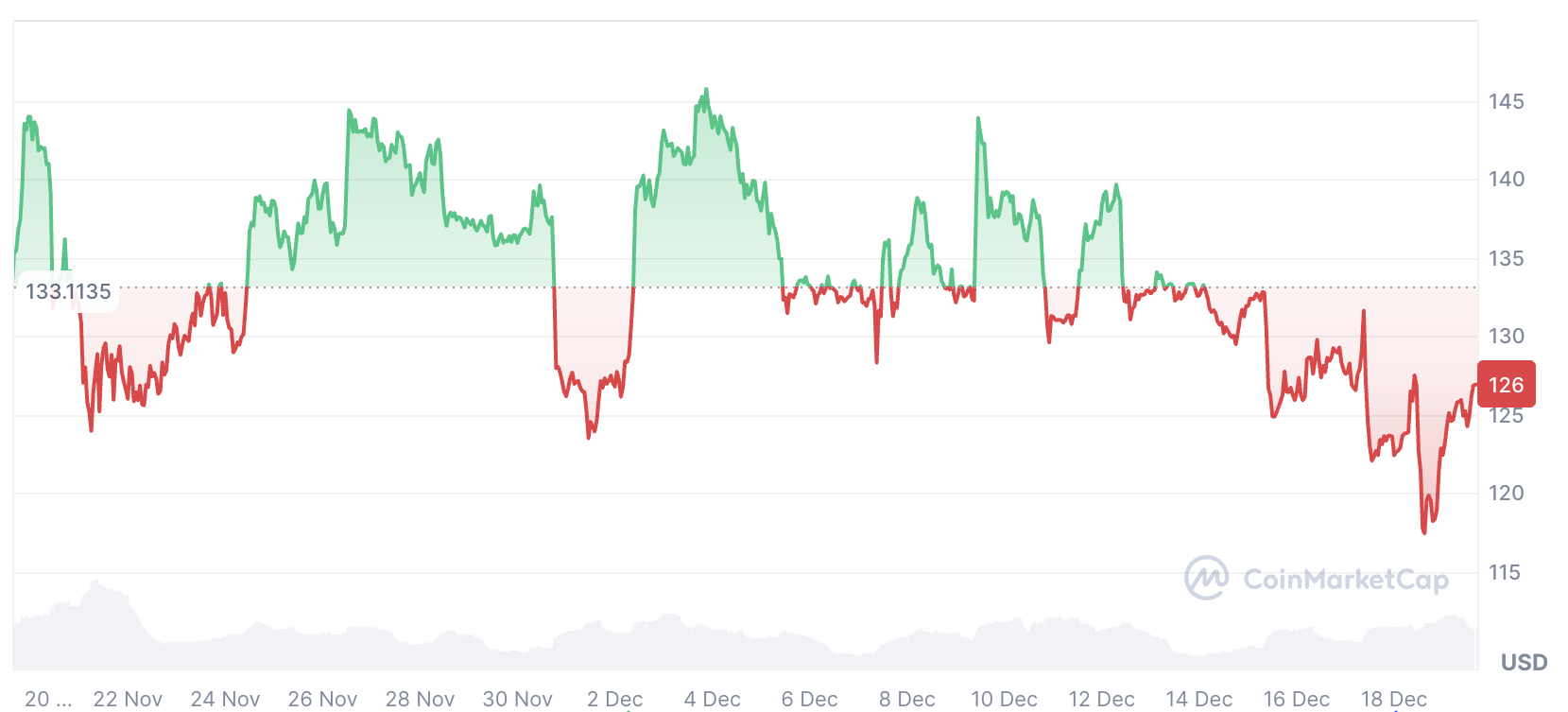
Solana is down 6.27% over the past 30 days. Source: CoinMarketCap

“Again, there’s been altcoin season. You just didn’t participate in it,” he said.

Not everyone agrees with Hayes, however. CoinQuant CEO Maen Ftoui recently told Cointelegraph that older cryptocurrencies with an exchange-traded fund (ETF) or expected to receive an ETF will soak up much of the capital deployed during the next altcoin season.

Industry debates what the next altcoin season will look like

Many in the industry have differing views on how and when the next altcoin season will unfold.

Related: Bitwise exec says 2026 will be crypto’s real bull year; here’s why

Some traders are still waiting for the traditional rotation, starting with Bitcoin (BTC) reaching new highs before capital rotates into Ether (ETH) and then into smaller altcoins.

Meanwhile, Bitfinex analysts said in August that altcoins are unlikely to see a broad, outsized rally until ETFs offering exposure beyond the largest cryptocurrencies are approved.

Magazine: Big questions: Would Bitcoin survive a 10-year power outage?

Пов'язані питання

QAccording to Arthur Hayes, why do some traders believe that altcoin season hasn't happened?

ABecause they didn't own the cryptocurrencies that actually went up in value.

QWhat does Arthur Hayes suggest traders should do instead of relying on past market patterns?

AHe suggests traders should adjust their approach and pay attention to what's new in the market.

QWhich two cryptocurrencies does Hayes specifically mention as examples of this cycle's winners?

AHyperliquid (HYPE) and Solana (SOL).

QWhat alternative view does CoinQuant CEO Maen Ftoui present regarding the next altcoin season?

AHe believes older cryptocurrencies with an ETF or expected to receive an ETF will soak up much of the capital deployed during the next altcoin season.

QAccording to Bitfinex analysts, what needs to happen before altcoins see a broad, outsized rally?

AETFs offering exposure beyond the largest cryptocurrencies need to be approved.

Пов'язані матеріали

CPU Makes a Comeback to the Table, A $170 Billion "Power Seizure" Drama Begins

A new era is dawning for the server CPU (Central Processing Unit), driven by the shift from AI model training to large-scale reasoning and the rise of Agentic AI. This article explores how the CPU is reclaiming a central role in the AI data center. For years, the focus has been on the GPU (Graphics Processing Unit) for AI training. However, as AI moves to the inference and Agent phase—where tasks involve complex, multi-step reasoning, tool calls, and data management—the workload balance is flipping. Studies show CPUs now handle over 70% of the workload in Agentic AI, up from 10-30% in training. This is because Agent tasks generate massive intermediate data (KV Cache) that exceeds GPU memory, forcing it to be offloaded to the CPU's larger, more scalable memory pools. This increased importance is translating into market changes. Major players are taking note: NVIDIA launched its first standalone CPU line, Vera, based on ARM architecture and optimized for Agent performance. AMD doubled its server CPU market forecast to over $1200 billion by 2030. Analyst reports project the total server CPU market could reach $1700 billion by 2030, with AI-driven demand being a primary driver. Furthermore, the classic ratio of CPUs to GPUs in AI servers is rapidly changing, converging from 1:8 toward 1:1 for Agent deployments. This surge in demand has led to a rare industry-wide price increase of 10-15% for server CPUs from Intel and AMD, breaking a decade-long trend of "more performance for the same price." Demand is bifurcating into high-core-count CPUs for in-rack GPU support and moderate-core CPUs for standalone Agent task orchestration. In China, this global trend presents an opportunity for domestic CPU manufacturers like Hygon (海光信息) and Huawei Kunpeng, who are bolstered by both growing AI infrastructure needs and national policies promoting technological self-reliance ("xin chuang"). The maturity of their software ecosystems is also accelerating, evidenced by faster adaptation to new AI models. In conclusion, the narrative is shifting from a GPU-centric view to one where CPU-GPU synergy is critical. The CPU is no longer a peripheral component but a performance-defining bottleneck and a key growth driver in the AI hardware stack, opening a massive new market estimated in the hundreds of billions of dollars.

marsbit1 год тому

CPU Makes a Comeback to the Table, A $170 Billion "Power Seizure" Drama Begins

marsbit1 год тому

TechFlow Intelligence: AMD AI Director Publicly Criticizes Claude Code for "Becoming Dumber and Lazier", Trump Claims Full Ceasefire in Hormuz But Strait Still Has 80 Unexploded Mines

TechFlow Intelligence Report: This daily digest covers key developments in AI, crypto, hardware, and geopolitics. In AI, SK Telecom faces US export control scrutiny over its partnership with Anthropic, while a Gemini user reports being misled in a scam scenario, sparking safety debates. China's Z.AI launches the GLM-5.2 model, rivaling Claude Opus without NVIDIA chips. In crypto, Bithumb lists ReProtocol, and Upbit delists KernelDAO. On the hardware front, MIT researchers build a custom OS to study chips, ASML denies US claims its advanced lithography machines are in China, and Amazon considers selling its in-house AI chips. Apple's future A21 Pro chip may use TSMC's latest N2P process. Major tech issues include 10,000 GitHub repositories distributing malware and Apple patching a critical eavesdropping flaw in Beats earbuds. US stocks rise, led by semiconductors, with Intel surging 10.6%, while SpaceX falls 3.5%. Geopolitically, despite a US-Iran deal, the Strait of Hormuz remains risky with ~80 uncleared mines, stalling 80M barrels of oil on standby tankers. Iran postpones Switzerland talks, and Trump calls the agreement an "unconditional surrender." The report highlights a contrast: temporary geopolitical calm versus the ongoing, fundamental restructuring of tech supply chains and chip independence.

marsbit1 год тому

TechFlow Intelligence: AMD AI Director Publicly Criticizes Claude Code for "Becoming Dumber and Lazier", Trump Claims Full Ceasefire in Hormuz But Strait Still Has 80 Unexploded Mines

marsbit1 год тому

Торгівля

Спот
Ф'ючерси
活动图片