A Major XRP Ledger Win That Most Investors Might Have Missed

bitcoinistОпубліковано о 2026-02-06Востаннє оновлено о 2026-02-06

Анотація

The XRP Ledger has activated the Permissioned Domains amendment after it achieved 91.19% validator approval and a mandatory two-week consensus period. This upgrade, introduced in v2.4.0, enables institutions, enterprises, and regulated entities to operate in controlled environments on the same public blockchain. It allows for known and compliant participants within defined domains while maintaining the ledger's core benefits of speed, low cost, and finality. This addresses a key limitation for banks and governments that require regulatory compliance, identity checks, and accountability, which are difficult on fully open networks. By allowing both permissioned and permissionless use, the upgrade removes a significant barrier to institutional adoption, positioning XRPL as shared financial infrastructure that meets regulatory expectations. Its impact may grow gradually as organizations begin utilizing these new capabilities.

The XRP Ledger quietly crossed an important milestone this week. After weeks of waiting, the Permissioned Domains amendment has finally gone live. Validators reached the required 80% yes vote back in January, but as protocol rules demand, that consensus had to hold for two consecutive weeks before activation.

On February 4, the waiting period ended, and the amendment officially became part of the XRP Ledger with a 91.19% approval. The moment passed with little noise, but investors might have missed its implications, which extend far deeper than a routine technical update.

Quiet Upgrade Changes How Institutions Can Use The XRP Ledger

Permissioned domains were introduced to the XRP Ledger on the v2.4.0 update. The rollout followed the standard governance process on the Ledger, which requires both a supermajority vote and sustained agreement over time to prevent rushed or unstable changes. In this case, validators voted yes early, locking in more than 80% approval in January.

According to Stern Drew, an XRP analyst on the social media platform X, the importance of Permissioned Domains lies in how they reshape what is possible on a public ledger. In simple terms, it makes the Ledger far more usable for institutions, enterprises, and regulated applications.

The upgrade allows controlled environments to exist on the same shared blockchain. Institutions can now operate inside clearly defined domains where participants are known, approved, and compliant, without giving up the speed, finality, and low-cost settlement XRPL is known for.
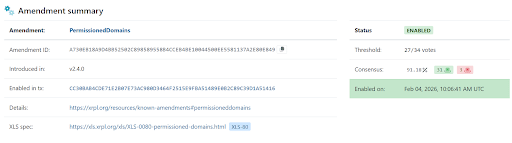
Source: Chart from XRPScan

This addresses a limitation in public blockchains, which are known for their openness. Public blockchains like the Ledger are great for openness, but the openness is unrealistic for banks, governments, and enterprises that must enforce rules, accountability, and identity checks.

Permissioned Domains resolve that tension by letting both models coexist. Sensitive or regulated activity can happen inside restricted domains, while the broader ledger is open and permissionless for everyone else.

Why This Matters For The Altcoin Going Forward

The most favorable outcome for XRP is the broad adoption of the Ledger by banks and financial institutions in their day-to-day operations. Therefore, the activation of permissioned domains on the Ledger removes one of the last structural barriers to real-world adoption.

XRPL can now serve as shared financial infrastructure, offering the guardrails regulators expect without sacrificing the benefits of a global public ledger. A bank can settle payments, a government can run regulated flows, and an enterprise can move large value, all without exposing sensitive operations to the entire public network.

This is why the Permissioned Domains upgrade carries more weight than its quiet rollout. It might be overlooked for now, but this kind of change tends to show its impact gradually, especially when institutions start creating domains on the Ledger.

Permissioned Domains is one of several amendments introduced by developers to strengthen the overall utility of the Ledger ecosystem. Another notable example is the lending feature, which is currently in the validator voting phase.

XRP trading at $1.29 on the 1D chart | Source: XRPUSDT on Tradingview.com

Трендові криптовалюти

Пов'язані питання

QWhat is the Permissioned Domains amendment and why is it significant for the XRP Ledger?

AThe Permissioned Domains amendment is an upgrade that allows controlled environments to exist on the XRP Ledger, enabling institutions to operate in defined domains with known and compliant participants. Its significance lies in removing a key structural barrier to adoption by banks and financial institutions, as it provides the regulatory guardrails they require while maintaining the speed, finality, and low-cost settlement of the public ledger.

QWhat was the final approval percentage for the Permissioned Domains amendment and when did it go live?

AThe Permissioned Domains amendment received a 91.19% approval from validators and officially went live on February 4, after a mandatory two-week waiting period following the achievement of the required 80% consensus in January.

QHow does the Permissioned Domains feature address a key limitation of public blockchains for enterprise use?

AIt addresses the limitation of excessive openness in public blockchains by allowing both permissioned and permissionless models to coexist. Sensitive or regulated activities can occur within restricted domains where participants are known and approved, while the broader ledger remains open to everyone else.

QAccording to the article, what is the most favorable outcome for XRP and how does this upgrade contribute to it?

AThe most favorable outcome for XRP is the broad adoption of the XRP Ledger by banks and financial institutions in their day-to-day operations. This upgrade contributes directly to that outcome by making the ledger far more usable for institutions, enterprises, and regulated applications that require enforced rules, accountability, and identity checks.

QBesides Permissioned Domains, what is another notable amendment mentioned that is currently in development for the XRP Ledger?

AAnother notable amendment mentioned is a lending feature, which is currently in the validator voting phase and is being developed to further strengthen the overall utility of the XRP Ledger ecosystem.

Пов'язані матеріали

Apple and the Power Rebalancing with 'The Microns': Dissecting the Profit Ledger Behind the iPhone

The article analyzes the shifting profit dynamics and power balance between Apple and memory suppliers like Micron within the iPhone supply chain. It highlights a social media post criticizing Apple for raising iPhone prices while blaming memory chip cost increases, despite historically paying suppliers like Micron very little. An estimated iPhone 18 cost breakdown is referenced. Historically, memory was a minor cost component. In 2017's iPhone X, memory accounted for only about 1.6-2.3% of the price, with Apple capturing nearly 50% net profit. Over time, memory's share of the Bill-of-Materials (BOM) cost has grown significantly, reaching an estimated 12-15% for the iPhone 17 series. The core driver of this change is soaring demand for memory from the AI industry, particularly for High Bandwidth Memory (HBM) and AI servers, which is diverting production capacity and squeezing supply for consumer electronics. Memory manufacturers, after enduring periods of low profits, now hold greater pricing power. This is reflected in their recent strong financials, like Micron's 84.6% gross margin. Apple CEO Tim Cook initially described the memory price pressure as unprecedented in his 40-year career, later calling it a "once-in-a-century flood," before Apple announced price hikes across several product lines, causing a significant stock drop. Elon Musk echoed Cook's sentiment about the dramatic cost surge. The article concludes that the era of memory suppliers being at the mercy of Apple's pricing power has temporarily reversed, thanks to AI-driven demand. It notes Apple is reportedly seeking to diversify its supply chain, including exploring chips from China's CXMT.

Odaily星球日报1 год тому

Apple and the Power Rebalancing with 'The Microns': Dissecting the Profit Ledger Behind the iPhone

Odaily星球日报1 год тому

Conversation with the Founder of 42 Macro: The Fed's 'Boiling the Frog Slowly' and the K-Shaped Economy

In a conversation with Anthony Pompliano, Darius Dale, founder of 42 Macro, discusses the Federal Reserve's monetary policy and the K-shaped U.S. economy. Dale characterizes new Fed Chair Kevin Warsh as a "dove in hawk's clothing," expecting the Fed to signal or enact policy tightening in the coming quarters to create room for later easing. He argues current economic signals, including high deficit spending, debt monetization, and credit growth, strongly indicate inflation is not on a credible path back to 2%, forcing the Fed to act. The discussion highlights the stark "K-shaped" economic reality. While top earners, buoyed by massive cash savings (up ~$8 trillion since pre-pandemic), continue robust spending, those at the bottom face severe financial strain, with delinquency rates on consumer loans reaching crisis-era highs. Dale attributes much of the current social and political anxiety to this divergence, driven by the "Cantillon effects" of monetary expansion, which disproportionately benefits asset owners. He emphasizes that in this environment of "financial repression," individuals must participate in asset markets to avoid being left behind. On equities, Dale notes a rotation from the "Magnificent Seven" tech giants into broader AI-exposed companies, while warning that the tech giants' massive capital expenditure cycles could eventually puncture over-optimistic cash flow projections. Dale concludes by stressing that the core desire across all economic strata is simply the dignity to provide for one's family, a goal currently undermined by systemic policies that act as a "wealth siphon" from the bottom to the top.

marsbit2 год тому

Conversation with the Founder of 42 Macro: The Fed's 'Boiling the Frog Slowly' and the K-Shaped Economy

marsbit2 год тому

The Eight Fathers of Transformer: Where Are They Now?

The founding authors of the seminal 2017 paper "Attention Is All You Need," which introduced the Transformer architecture, have all departed from Google and are now pioneering diverse ventures across the AI landscape. Their current paths highlight the field's evolution and fragmentation. Ashish Vaswani co-founded Essential AI after a stint at Adept, but recent reports suggest he and his team are being recruited by Nvidia. Noam Shazeer left Google twice, first to found Character.AI—later acquired by Google—before recently joining OpenAI. Niki Parmar, after co-founding both Adept and Essential AI with Vaswani, is now at Anthropic. Jakob Uszkoreit is the CEO of Inceptive, applying AI to RNA and drug design. Llion Jones co-founded Sakana AI in Tokyo, exploring collective intelligence from smaller models. Aidan N. Gomez is the CEO of Cohere, focusing on enterprise AI solutions. Łukasz Kaiser remains in research at OpenAI, contributing to models like GPT-4 and o1. Illia Polosukhin co-founded the NEAR Protocol blockchain, positioning it for an AI-agent economy. Despite their divergent paths—spanning biotech, enterprise software, blockchain, and foundational research—a shared sentiment persists: the Transformer is not the final answer. Each founder continues to seek the next significant architectural breakthrough, driven by the same innovative spirit that created the modern AI era.

marsbit2 год тому

The Eight Fathers of Transformer: Where Are They Now?

marsbit2 год тому

The Domestic Answer to Space Computing Power: Photonics Are More Efficient, Musk and Huang's Approaches Are Too Roundabout

The Space Computing Race: A Photonic Advantage The competition for space-based computing has intensified, with figures like Elon Musk and NVIDIA's Jensen Huang highlighting its potential. Musk predicts solar-powered AI satellites could offer the most cost-effective computing by 2032. However, space presents extreme challenges for traditional electronic chips: radiation from cosmic particles can cause errors, the vacuum environment hinders heat dissipation, and limited solar power constrains energy-hungry systems. Photonic computing, using light instead of electrons, offers a promising solution. Its core advantages for space are threefold: 1) **Radiation Resistance**: Photons are charge-neutral, making them inherently immune to particle interference. 2) **Low Heat Generation**: Light propagation in waveguides generates minimal heat, bypassing critical thermal management issues. 3) **Low Power Consumption**: Photonic chips have near-zero static power draw, aligning perfectly with the energy constraints of satellites. Furthermore, for a given payload weight and volume, photonic systems can potentially deliver higher total compute density. Since they require less bulky cooling and power infrastructure, more space can be allocated to the compute units themselves. While photonic computing holds great promise, current industry approaches face hurdles like the memory-compute bottleneck (separate storage and processing) and challenges in large-scale integration. Engineering for space—withstanding launch vibrations and validating full system operation in orbit—remains a critical step. The path forward resembles the evolution from single GPUs to computing clusters, but via a photonic route. As electronic chips approach physical limits in miniaturization, photonic computing and optical interconnects (光算光联) may provide a key alternative to bypass these constraints and define the next generation of space-based computing capabilities.

marsbit3 год тому

The Domestic Answer to Space Computing Power: Photonics Are More Efficient, Musk and Huang's Approaches Are Too Roundabout

marsbit3 год тому

Торгівля

Спот

Популярні статті

Що таке XRP 2.0

XRP 2.0: Нова межа в світі криптовалют Вступ до XRP 2.0 У постійно змінюючомуся світі криптовалют нові проекти постійно з'являються, змагаючись за увагу та прийняття. Однією з таких обіцяючих ініціатив є XRP 2.0, новий криптовалютний проект, що має на меті використання сучасних технологій блокчейн та надійних методів шифрування. Хоча назва нагадує про XRP від Ripple, важливо зазначити, що XRP 2.0 функціонує автономно, концентруючи увагу на підвищенні безпеки транзакцій, конфіденційності та масштабованості. Оскільки цифровий фінансовий ландшафт все більше приймає децентралізовані рішення, XRP 2.0 прагне значно сприяти веб3 та загальному розширенню крипто проектів. Що таке XRP 2.0? У своїй основі XRP 2.0 є криптовалютним проектом, що має на меті створення безпечної та децентралізованої екосистеми цифрової валюти. Його фундаментальна технологія інтегрує складні принципи блокчейну з передовими техніками шифрування. Загальною метою XRP 2.0 є встановлення себе як надійної та ефективної платформи, що дозволяє швидко виконувати транзакції, при цьому надаючи пріоритет підвищеним захистам конфіденційності для своїх користувачів. Проект позиціонується як рішення багатьох обмежень, з якими стикаються існуючі криптовалюти, пропонуючи систему, яка може обробляти вищий обсяг транзакцій з покращеною швидкістю та конфіденційністю. Ця універсальність позиціонує XRP 2.0 як значного гравця на ринку, наповненому різними цифровими валютами. Хто творець XRP 2.0? Особистість творця XRP 2.0 була позначена як «Вілбур». Проте, вичерпні деталі про Вілбура або пов'язану з ним організацію залишаються недоступними. Анонімність багатьох творців криптовалют не є незвичним явищем в індустрії, часто запроваджена для збереження певного рівня конфіденційності та безпеки. Хто інвестори XRP 2.0? На даний момент конкретна інформація про інвестиційні фонди або організації, що підтримують XRP 2.0, не є публічно доступною. У секторі криптовалют підтримка від визнаних інвесторів може значно вплинути на кредитоспроможність і успіх проекту, але прозорість щодо фінансових підтримувачів XRP 2.0 не була встановлена. Як працює XRP 2.0? XRP 2.0 вирізняється використанням комбінації технології блокчейн та просунутих алгоритмів шифрування, що забезпечують безпечні та децентралізовані транзакції. Його інноваційна структура включає унікальні функції, спрямовані на залучення користувачів та розширення функціональності за межами традиційних транзакцій криптовалюти. Серед цих функцій, XRP 2.0 включає можливості на базі ШІ, такі як текст в зображення та текст в мову. Ці нововведення розроблені для покращення інтерактивного досвіду для користувачів, сприяючи ширшій застосовності в різних секторах. Завдяки поєднанню технологічних досягнень з орієнтованим на користувача дизайном, XRP 2.0 прагне привернути увагу різноманітних осіб і підприємств, які шукають способи інтеграції рішень криптовалют у свої операційні структури. Хронологія XRP 2.0 Розуміння XRP 2.0 вимагає вивчення основних етапів, які визначили його подорож до теперішнього часу: 23 липня 2023 року: XRP 2.0 представлено як новий криптовалютний проект, що має на меті революціонізувати безпечні та децентралізовані можливості транзакцій у галузі блокчейн. 8 вересня 2023 року: Запускається інший проект, XRP20, що відзначає виникнення токена ERC-20 на блокчейні Ethereum, який не пов'язаний з XRP 2.0. 13 листопада 2023 року: XRP Ledger зазнає значного оновлення з виходом програмного забезпечення rippled server версії 2.0.0. Важливо зазначити, що цей розвиток не пов'язаний з криптовалютним проектом XRP 2.0. Ключові моменти про XRP 2.0 Щоб узагальнити суть XRP 2.0, кілька критично важливих факторів emerge: Унікальні функції: Включення функцій, таких як текст в зображення і текст в мову на базі ШІ, ще більше розширює потенційні застосування XRP 2.0. Технологія блокчейн: Архітектура використовує сучасні механізми блокчейн і протоколи шифрування, забезпечуючи безпечне та децентралізоване середовище для транзакцій. Масштабованість і конфіденційність: XRP 2.0 надає пріоритет підвищеним захистам конфіденційності в процесах транзакцій і масштабованості, необхідній для задоволення зростаючої бази користувачів. Відсутність зв'язку з Ripple: Важливо, що, незважаючи на свою назву, XRP 2.0 не має жодної прив'язки чи співпраці з XRP від Ripple, що відрізняє його операційну структуру та цілі в рамках криптовалютної екосистеми. Висновок XRP 2.0 представляє амбітну ініціативу у світі криптовалют, прагнучи запропонувати поєднання безпеки, конфіденційності та ефективності у цифрових транзакціях. Інтегруючи складні технології та дружні до користувача функції, проект ставить за мету розширити горизонти того, що криптовалюта може досягти в сучасній цифровій економіці. Хоча анонімність його творця та відсутність розкритих інвесторів можуть викликати запитання у деяких, фокус XRP 2.0 на передових функціональностях і децентралізації підвищує його привабливість на дедалі більшому ринку криптовалют. Оскільки ландшафт криптовалют продовжує еволюціонувати, XRP 2.0 може ще стати важливим гравцем у розширенні безпечних і масштабованих рішень блокчейн.

170 переглядів усьогоОпубліковано 2024.04.05Оновлено 2024.12.03

Що таке XRP 2.0

Як купити XRP

Ласкаво просимо до HTX.com! Ми зробили покупку XRP (XRP) простою та зручною. Дотримуйтесь нашої покрокової інструкції, щоб розпочати свою криптовалютну подорож.Крок 1: Створіть обліковий запис на HTXВикористовуйте свою електронну пошту або номер телефону, щоб зареєструвати обліковий запис на HTX безплатно. Пройдіть безпроблемну реєстрацію й отримайте доступ до всіх функцій.ЗареєструватисьКрок 2: Перейдіть до розділу Купити крипту і виберіть спосіб оплатиКредитна/дебетова картка: використовуйте вашу картку Visa або Mastercard, щоб миттєво купити XRP (XRP).Баланс: використовуйте кошти з балансу вашого рахунку HTX для безперешкодної торгівлі.Треті особи: ми додали популярні способи оплати, такі як Google Pay та Apple Pay, щоб підвищити зручність.P2P: Торгуйте безпосередньо з іншими користувачами на HTX.Позабіржова торгівля (OTC): ми пропонуємо індивідуальні послуги та конкурентні обмінні курси для трейдерів.Крок 3: Зберігайте свої XRP (XRP)Після придбання XRP (XRP) збережіть його у своєму обліковому записі на HTX. Крім того, ви можете відправити його в інше місце за допомогою блокчейн-переказу або використовувати його для торгівлі іншими криптовалютами.Крок 4: Торгівля XRP (XRP)Легко торгуйте XRP (XRP) на спотовому ринку HTX. Просто увійдіть до свого облікового запису, виберіть торгову пару, укладайте угоди та спостерігайте за ними в режимі реального часу. Ми пропонуємо зручний досвід як для початківців, так і для досвідчених трейдерів.

1.6k переглядів усьогоОпубліковано 2024.12.10Оновлено 2026.06.02

Як купити XRP

Обговорення

Ласкаво просимо до спільноти HTX. Тут ви можете бути в курсі останніх подій розвитку платформи та отримати доступ до професійної ринкової інформації. Нижче представлені думки користувачів щодо ціни XRP (XRP).

活动图片