A Hair Dryer Blows Away $34,000 from Polymarket

marsbitОпубліковано о 2026-04-23Востаннє оновлено о 2026-04-23

Анотація

A hairdryer was used to manipulate a temperature sensor at Paris Charles de Gaulle Airport (LFPG) on April 6 and 15, 2026, causing short-lived artificial temperature spikes. These false readings were used to exploit a prediction market on Polymarket, where users bet on Paris’s daily maximum temperature. The attacker targeted low-probability high-temperature outcomes, which settled as "Yes" based on the corrupted data, netting a total of $34,000 in profit. The attacker’s a newly created anonymous account funded just two days before the first incident. After the successful manipulations, the funds were quickly moved through mixers and decentralized exchanges to avoid tracing. French meteorological experts and authorities confirmed the anomalies were inconsistent with actual weather conditions and nearby station data, pointing to physical intervention. Legal action was initiated for "disrupting automated data processing systems," which carries severe penalties under French law. Polymarket’s market rules relied solely on a single, publicly accessible sensor and did not account for subsequent data revisions, making the system vulnerable to such physical oracle attacks. In response, Polymarket silently switched its data source to Paris-Le Bourget Airport (LFPB) without public explanation or refunding the exploited funds. The incident highlights the risks of single-point data dependencies in prediction markets and the low-cost, high-reward potential of real-world manipulation.

Author: 0x2333, The BlockBeats

A hair dryer, an unattended weather sensor, and two meticulously calculated operations.

On April 6 and April 15, 2026, a weather probe at the Météo-France station at Paris Charles de Gaulle Airport was heated with a portable heating device, causing the temperature readings to spike abnormally within a short period. The actual temperature at Charles de Gaulle Airport did not experience such fluctuations, but the prediction market betting on "Paris Daily Maximum Temperature" on Polymarket settled as usual. In two operations, a total of $34,000 in rewards was transferred from the platform to an anonymous account opened just two days before the incident.
This was not a typical crypto attack. It did not exploit any smart contract vulnerabilities, nor did it target any decentralized governance processes. The entire attack tool was just a hair dryer.

Temperature Spikes 4°C in 12 Minutes, How Did a Single Probe Deceive the Global Prediction Market?

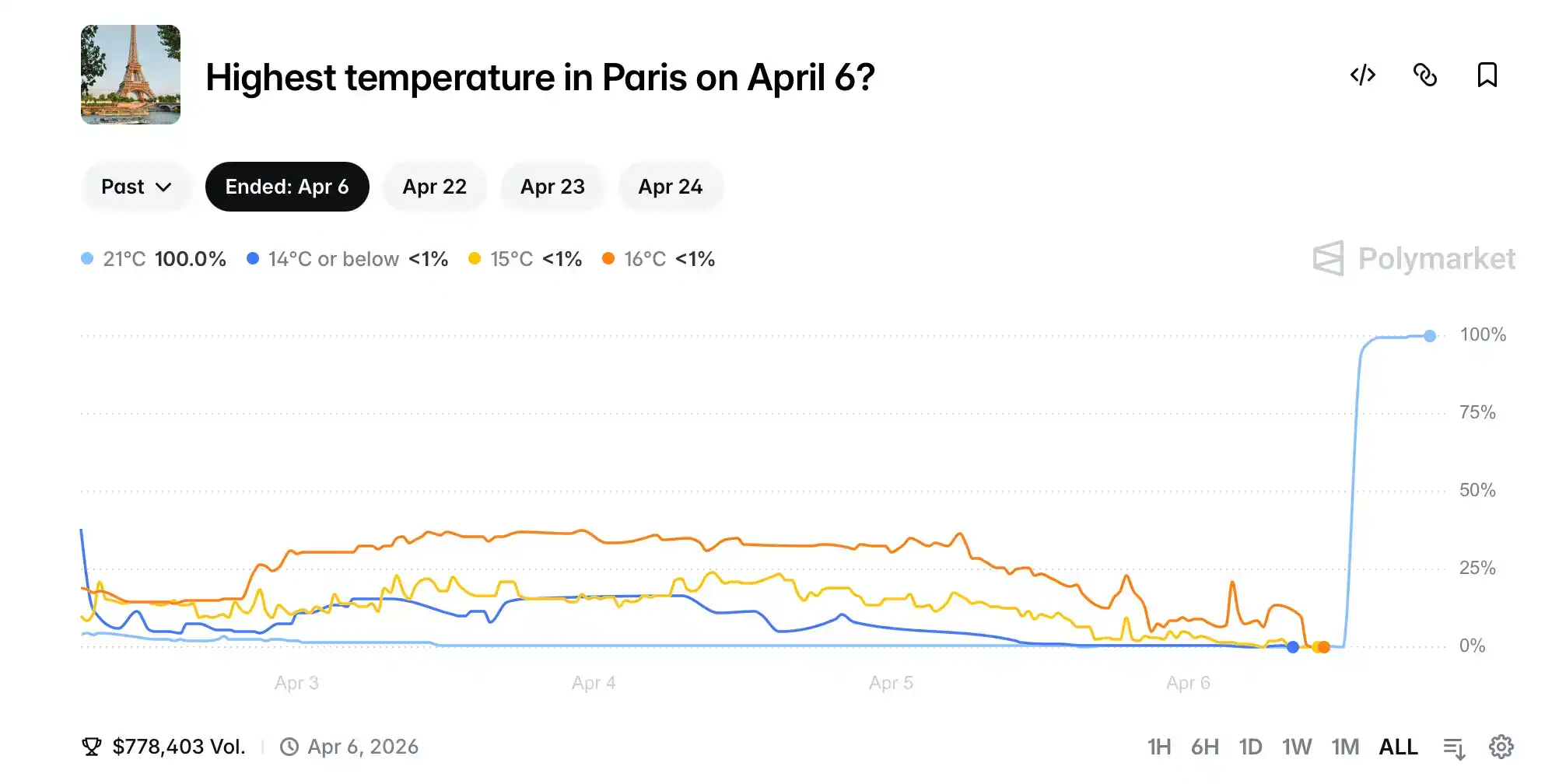
Between 6:30 PM and 6:42 PM on April 6, the temperature reading at the Charles de Gaulle Airport weather station climbed 4°C in 12 minutes, peaking at 22.5°C, before rapidly dropping back within 5 minutes. The actual temperature in Paris that day did not show such drastic fluctuations, and no similar anomalies were recorded at other nearby weather stations.

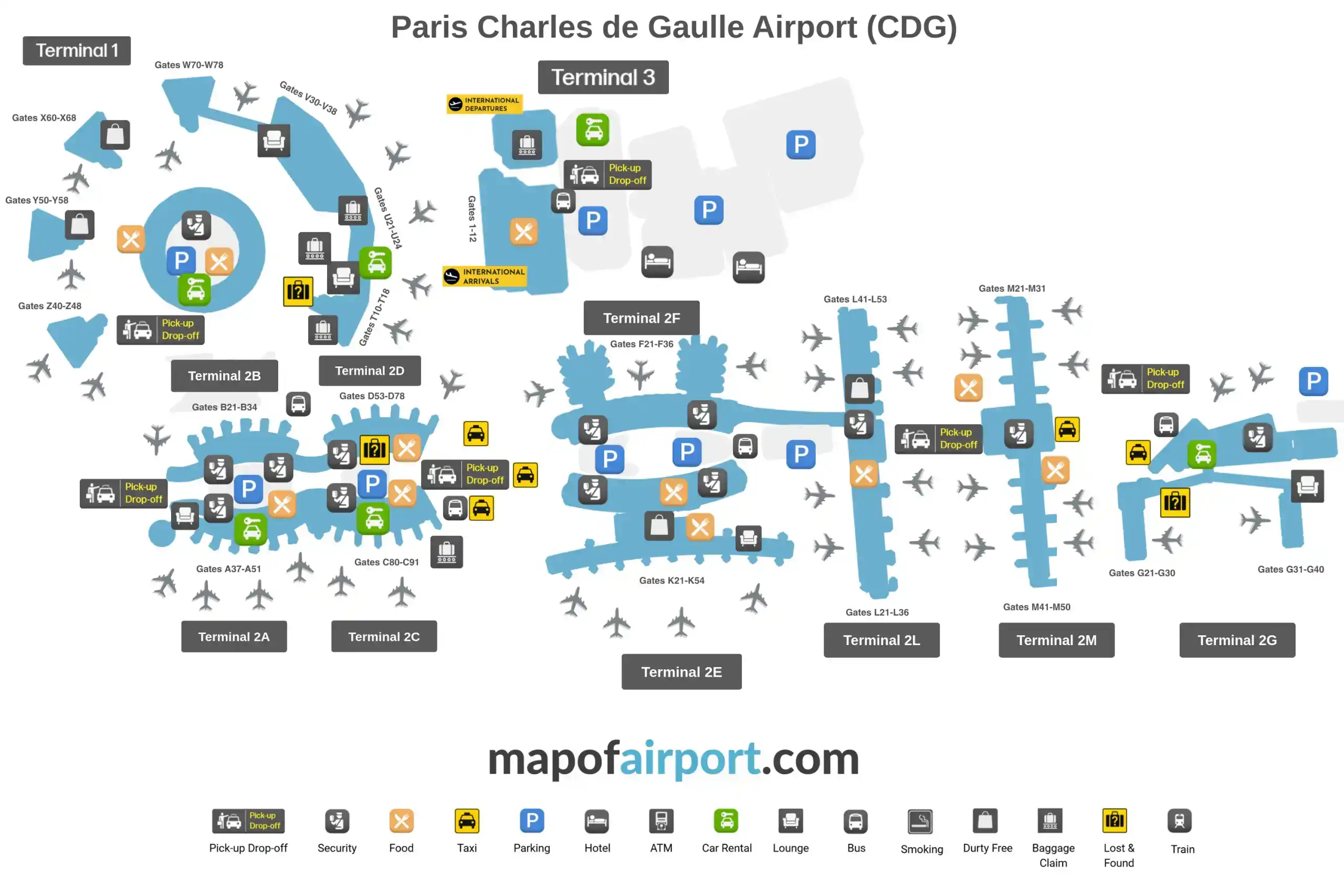
This weather station (code: LFPG) is located at the edge of the Charles de Gaulle Airport runway, near a public area adjacent to a road. Its relatively open physical location made it possible for the suspect to approach the sensor and perform physical intervention.
This brief period of "high temperature"恰好 hit the "21°C" option on Polymarket, a previously almost ignored outcome. After the abnormal data was accepted by the platform as the day's maximum temperature, it settled to Yes. An account behind it took away approximately $14,000.

Nine days later, around 9:30 PM on April 15, almost the exact same script played out again. On a cloudy, windless night, the temperature reading at Charles de Gaulle Airport bizarrely climbed to 22°C. The probability of the "22°C" option on Polymarket soared from 0.1% to 95% in just 30 minutes. A second prize of over $20,000 flowed into the same account.

Paul Marquis, founder of French E-Meteo Service and a meteorologist, provided a technically almost irrefutable judgment: "There was no change in wind direction or relative humidity at the time, and no anomalies were recorded at other surrounding weather stations. Physical intervention is the most reasonable explanation, such as placing a heating device near the sensor probe."

Météo-France subsequently conducted a physical inspection of the sensor, found evidence of tampering, and formally filed a criminal complaint with the Roissy Air Transport Gendarmerie. The charge is "disrupting the operation of an automated data processing system." Under French law, this offense carries a maximum penalty of 7 years imprisonment and a fine of 300,000 euros.

The profile of the involved account is also questionable. It was created on April 4, 2026, just 48 hours before the first operation. The initial funds were only a few dozen dollars, transferred via a cryptocurrency exchange. It almost exclusively participated in the "Paris weather" market, specifically buying extremely low-probability "high temperature" options. After two successful attempts, the funds were quickly transferred through mixers and decentralized exchanges, making on-chain tracking significantly more difficult.

On one side is a common household hair dryer, retailing for less than 30 euros. On the other side is a global climate prediction market with a daily trading volume exceeding $2 million. The extreme asymmetry between the cost of the attack and the potential gain.

The abnormal data was first discovered by local French weather enthusiasts on the Infoclimat forum. The event was subsequently spread to the English-speaking crypto community, followed by reports from French media such as Le Monde, Le Figaro, and BFMTV. Polymarket officials have not issued any public statement on the matter, nor have they revoked the already paid $34,000 reward.

Rule Vulnerability, How Does a Single Sensor Reading Decide Six-Figure Prizes?

The true protagonist of this incident is not the hair dryer, but rather the settlement rules of Polymarket's weather market.

Polymarket's weather markets have grown rapidly in recent years, with the number of active markets now reaching 173, covering temperature, precipitation, hurricanes, tornadoes, earthquakes, volcanoes, and even pandemics. Among them, the "Paris Daily Maximum Temperature" market uses an extremely simple settlement mechanism, locking the data source to the readings from one specific weather station hosted on the Wunderground website.

Before this incident, this station was the Charles de Gaulle Airport weather station (code LFPG), with temperature rounded to the nearest whole degree Celsius. Most crucially, the market settles immediately after the data is finalized, and "does not consider any subsequent data revisions."

This last point means that even if Météo-France later discovers data anomalies and revises the historical records, Polymarket will still pay out rewards based on the contaminated original reading. The rules are written clearly and executed without ambiguity.

The vulnerability thus clearly presents itself in three points:

First, a single point of failure. The settlement of the entire six-figure prize pool relies entirely on the reading from one sensor. Polymarket did not design mechanisms for multi-station weighting, redundant comparison, or anomaly熔断. The so-called "data source" is that single metal probe by the runway at Charles de Gaulle Airport.

Second, physical accessibility. The Charles de Gaulle Airport weather station is located near the edge of the runway, adjacent to a public area next to a road, allowing any ordinary person to approach within meters of the probe. This geographical detail lowers the barrier to "physical intervention" from theoretical possibility to an almost zero-cost practical operation.

Third, the rigidity of the settlement mechanism. The invalidity of post-hoc revisions means that once an attack is successful, there is no possibility of "reversal." The rules ensure the certainty of settlement on one hand, but also guarantee that manipulation, once successful, is irreversible.

Fibo Crypto analyst Victor gave this technique a technically elegant name: "Physical Oracle Attack." Unlike previous "Digital Oracle Attacks" that targeted UMA governance votes and relied on large-scale token voting to manipulate oracle results, physical oracle attacks bypass the entire on-chain logic, acting directly on the first mile of the data pipeline—the metal probe in the real world.

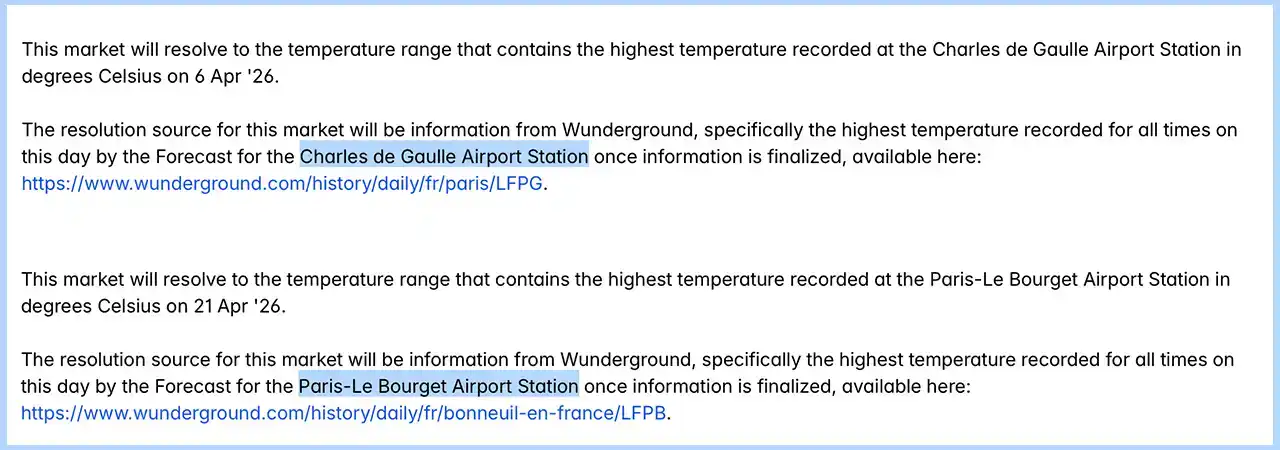
On April 17, two days after the incident was exposed, Polymarket quietly completed a rule change, switching the settlement data source for the Paris weather market from Charles de Gaulle Airport (LFPG) to Paris-Le Bourget Airport (LFPB). The switch was not accompanied by any official announcement, public technical explanation, or any response to the two manipulations that had already occurred.
Changing a probe is much easier than publicly admitting a vulnerability. Polymarket's weather market was initially designed as a mirror, reflecting the market's collective judgment about the future. But when the image in the mirror is valuable enough, the odds steep enough, and the probe accessible enough, someone will always walk over with a 30-euro hair dryer and blow their desired result into it.

Пов'язані питання

QWhat was the method used to manipulate the temperature readings at Charles de Gaulle Airport?

AA portable heating device, such as a hairdryer, was used to artificially heat the meteorological sensor, causing a temporary spike in temperature readings.

QHow much money was stolen from Polymarket through this manipulation attacks?

AA total of $34,000 was stolen from the platform across two separate attacks.

QWhat specific vulnerability in Polymarket's system did this attack exploit?

AThe attack exploited a single point of failure in the settlement mechanism, which relied solely on the temperature reading from one specific, physically accessible weather station (LFPG) without any redundancy checks or mechanisms to account for data revisions.

QWhat action did Polymarket take after the attacks were discovered?

APolymarket quietly changed the data source for its Paris weather market from the Charles de Gaulle Airport station (LFPG) to the Paris-Le Bourget Airport station (LFPB) without making any public announcement or addressing the prior manipulations.

QWhat is the term used to describe this type of attack that targets the physical data source?

AThis type of attack is called a 'physical oracle attack,' which manipulates the real-world data source feeding into the prediction market, rather than exploiting a smart contract or governance vulnerability.

Пов'язані матеріали

The Value Distribution of Stablecoins

**Summary: The Value Distribution of Stablecoins** The article argues that stablecoins are evolving from mere trading tools into broader channels for dollar access. It divides the stablecoin ecosystem into four layers to analyze how value is distributed: 1. **Issuance Layer:** Mints stablecoins, holds reserve assets, and captures the spread between reserve yield and user costs (e.g., Tether, Circle). This layer currently earns the largest profit margin. 2. **Infrastructure Layer:** Connects stablecoins to the traditional financial system, handling fiat on/off-ramps, banking integration, compliance (KYC/AML), and asset management (e.g., Bridge, BVNK). This is the "unglamorous" but critical work, building the essential bridges between crypto and real-world finance. 3. **Acquiring/Distribution Layer:** Integrates stablecoins into merchant systems, manages payment flows, and provides enterprise financial software (e.g., Stripe, Coinbase). They act as the access point for businesses. 4. **Application Layer:** The end-users and businesses that ultimately use stablecoins for payments, settlements, or as a store of value. They benefit from convenience but have little pricing power. The core thesis is that while the issuance layer currently dominates profits, the often-overlooked **infrastructure layer holds significant long-term potential**. The real challenge and barrier to mass adoption is not the on-chain transfer of stablecoins (which is simple), but the complex "last mile" integration into existing business workflows, banking systems, and regulatory frameworks across different countries. Companies in this layer are currently in a "land grab" phase, investing heavily to build networks, secure bank partnerships, and establish compliance pathways. While their position is currently pressured by the profitable issuers above and distribution platforms below, the article suggests that if stablecoins become a default financial rail for businesses, the infrastructure providers who have done the hard work of integration will ultimately gain strong pricing power and become entrenched, essential players.

marsbit6 год тому

The Value Distribution of Stablecoins

marsbit6 год тому

The Value Distribution of Stablecoins

The Value Distribution of Stablecoins The article argues that stablecoins are evolving from a mere trading tool into a broad "dollar channel." It analyzes the industry's value chain through four layers: 1. **Issuance Layer (e.g., Tether, Circle):** The top layer that mints stablecoins, holds reserve assets, and captures the thickest interest rate spread. 2. **Infrastructure Layer (e.g., Bridge, BVNK):** Connects stablecoins to the traditional financial system, handling critical but complex "dirty work" like fiat on/off-ramps, banking integration, compliance (KYC/AML), and cross-border settlement. 3. **Acquiring/Distribution Layer (e.g., Stripe, Coinbase):** Embeds stablecoins into merchant systems, manages payment flows, and integrates with enterprise software. 4. **Application Layer:** End-users and businesses that ultimately use stablecoins for payments, settlement, or storing value. The author posits that while the issuance layer currently captures the most profit, the most overlooked and potentially critical layer is infrastructure. The core challenge for stablecoin adoption isn't the on-chain transfer (which is simple), but bridging the gap between blockchain and the real-world financial system. This involves solving practical problems for businesses: fiat conversion, reconciliation, tax handling, and user onboarding. Infrastructure companies are currently in a difficult "land-grab" phase—building networks, securing banking relationships, and achieving compliance country-by-country. They face pressure from both the profitable issuance layer above and distribution platforms below. However, the author suggests this layer is building a crucial moat. Once stablecoins become a default business rail, the infrastructure players who have done the hard work of integration may gain significant, durable value and pricing power.

链捕手6 год тому

The Value Distribution of Stablecoins

链捕手6 год тому

Торгівля

Спот
Ф'ючерси

Популярні статті

Як купити T

Ласкаво просимо до HTX.com! Ми зробили покупку Threshold Network Token (T) простою та зручною. Дотримуйтесь нашої покрокової інструкції, щоб розпочати свою криптовалютну подорож.Крок 1: Створіть обліковий запис на HTXВикористовуйте свою електронну пошту або номер телефону, щоб зареєструвати обліковий запис на HTX безплатно. Пройдіть безпроблемну реєстрацію й отримайте доступ до всіх функцій.ЗареєструватисьКрок 2: Перейдіть до розділу Купити крипту і виберіть спосіб оплатиКредитна/дебетова картка: використовуйте вашу картку Visa або Mastercard, щоб миттєво купити Threshold Network Token (T).Баланс: використовуйте кошти з балансу вашого рахунку HTX для безперешкодної торгівлі.Треті особи: ми додали популярні способи оплати, такі як Google Pay та Apple Pay, щоб підвищити зручність.P2P: Торгуйте безпосередньо з іншими користувачами на HTX.Позабіржова торгівля (OTC): ми пропонуємо індивідуальні послуги та конкурентні обмінні курси для трейдерів.Крок 3: Зберігайте свої Threshold Network Token (T)Після придбання Threshold Network Token (T) збережіть його у своєму обліковому записі на HTX. Крім того, ви можете відправити його в інше місце за допомогою блокчейн-переказу або використовувати його для торгівлі іншими криптовалютами.Крок 4: Торгівля Threshold Network Token (T)Легко торгуйте Threshold Network Token (T) на спотовому ринку HTX. Просто увійдіть до свого облікового запису, виберіть торгову пару, укладайте угоди та спостерігайте за ними в режимі реального часу. Ми пропонуємо зручний досвід як для початківців, так і для досвідчених трейдерів.

455 переглядів усьогоОпубліковано 2024.12.10Оновлено 2026.06.02

Як купити T

Обговорення

Ласкаво просимо до спільноти HTX. Тут ви можете бути в курсі останніх подій розвитку платформи та отримати доступ до професійної ринкової інформації. Нижче представлені думки користувачів щодо ціни T (T).

活动图片