A Critical Review of Base Co-founder's "Letter of Self-Criticism"

marsbitОпубліковано о 2026-07-17Востаннє оновлено о 2026-07-17

Анотація

Yesterday, Base co-founder Jesse Pollak published a self-critical post on X, reflecting on Base's successes and failures over the past two years. While his candor is commendable, the author argues his analysis still misses key points. Jesse admitted his primary mistake was heavily betting that onchain social platforms (like Farcaster) and creator tokens would drive mainstream crypto adoption. The author harshly criticizes this strategy, giving it a "0/100" score. They argue onchain social offers no superior user experience, and creator tokens, like Jesse's own $JESSE, fail to solve fundamental issues about value and creator adoption, unlike successful memecoins on other chains. The author is more forgiving regarding Base lagging in areas like perpetual DEXs and prediction markets, giving this an "80/100". They note strong competitors like Hyperliquid had unique advantages, and Base has found significant success in other narratives like AI and RWA. The author gives Jesse's overall reflection a "60/100" or passing grade. While Jesse now correctly sees multiple paths to adoption (stablecoins, payments, AI Agents) beyond just social, he, along with other industry leaders like Toly and Vitalik, still underestimates the powerful role of memecoins in driving mainstream awareness and adoption. The critique concludes that leaders often leverage memes for user acquisition but fail to genuinely embrace or thoughtfully develop the space, revealing a retreat from idealism and a disconn...

Early yesterday morning, Base co-founder Jesse Pollak posted a long thread on X, reviewing what Base's development strategy had done well and poorly over the past two years.

It was a rather candid post, both to himself and the public. It's not easy for anyone to admit they've made mistakes. Jesse believes it was a mistake for him and the Base team to place their bet on the social field, expecting on-chain native social experiences to drive mass adoption of Base and even cryptocurrency as a whole. However, the other bet—that application developers on Base would also drive mass adoption by producing great applications—was correct.

Now, he has handed over Base App (Base's super app, not the Base chain) to Cobie and has returned to focus on developing the Base chain. From the perspective of an on-chain player, looking back at some of Jesse's actions over the past two years, while I highly commend the candor of this "letter of self-criticism," I also feel there are debatable points in his reflections.

Betting on Social: 0 points

Native on-chain social does not enhance the social experience for the masses at all; it even makes social interactions more complicated. In fact, I wish Jesse had thoroughly analyzed in his "letter of self-criticism" what exactly users could gain from building a brand-new social app like Farcaster—what new social enjoyment they could experience, what new forms of social content they could access, or what novel paths for social network formation the app itself provides—that led him and the entire Base team to think this thing could drive Base's mass adoption by challenging the traditional social media market...

If it were for the ideal of decentralized social, this move might score some points. But thinking this could drive mass adoption? That's a pure 0.

Let's continue. On the social front, Jesse also mentioned creator tokens, referencing the recently popular $ANSEM on Solana. He indicated he wasn't entirely sure whether he promoted Zora at the wrong time or whether the idea of creator tokens was wrong from the start.

This understanding also gets 0 points. First, pushing the concept of "creator tokens" is itself strange. From the debate between Jesse and Toly back then, it was clear: Jesse believes "content" has value, and creators as personal brands have value. Therefore, unlike meme coins, this has fundamentals, so he wanted to promote something with fundamentals.

But who could this logic convince? In any case, Jesse himself led by example and issued $JESSE. Nearly 240 days later, the situation is as follows:
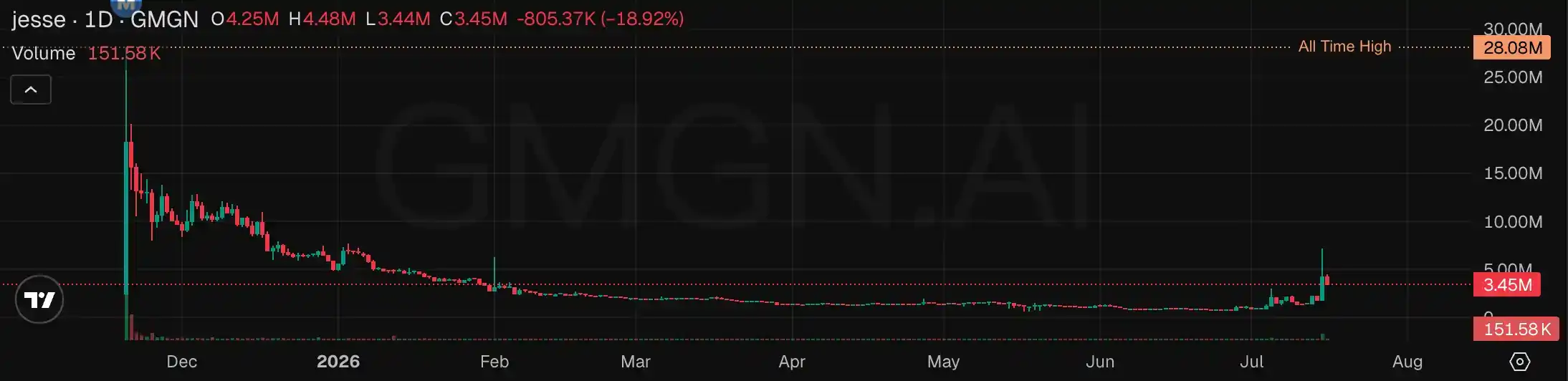
Content and personal IP do have value, but is issuing a token some uniquely effective monetization channel? What caliber of creators can you attract? How do you ensure the value you emphasize has a logical chain of reasoning? There are too many problems to solve in between. But Base gave people the feeling of, "The stage is set, and people will naturally perform."

In this regard, Jesse's understanding is completely defeated by Toly's. At least Toly could say something like, "Meme coins have no value, but mobile game items and skins also have no value, yet people worldwide are still willing to spend hundreds of billions of dollars a year on worthless things."

$ANSEM isn't the kind of "creator token" Jesse was pushing at all. First, it wasn't issued by Ansem himself, nor was it created to monetize his personal IP. It's a mismatch in every way.

In short, Jesse, regarding the social bet, you were really wrong, but you haven't fully figured it out yet. In fact, the best reference case in Crypto + social so far should be the social trading app FOMO.

Lagging Behind in Perp DEX and Other Areas: 80 points

The score could actually be even higher. Looking horizontally, Solana hasn't shown much stronger competitiveness in the Perp DEX and prediction market fields compared to Hyperliquid and Polymarket either, not significantly better than Base.

The reason Jesse feels quite regretful is, "Because we over-invested in social, we didn't keep up in these two areas." This is setting the bar a bit too high for oneself. After all, this is hindsight from a god's perspective. Hyperliquid is a competitor that completely figured out this sector. Without its emergence, Perp DEX would likely have remained at the level of GMX, dYdX. As for prediction markets, Polymarket has first-mover advantage; it's not a major competitive failure.

Moreover, Base has been quite successful in AI. It not only has a presentable but also a leading on-chain narrative sector in the entire market. In terms of specific tokens, there are major ones like $vvv that attracted market-wide attention, and launchpads like Virtuals. The x402 protocol is leading in Agent payments and has also made USDC the dominant stablecoin for inter-agent payments.

Base's success in the AI narrative has also spilled over into some tech narratives related to AI. For example, among the tokens performing well in the robotics sector, quite a few have appeared on Base. In RWA, before Solana dominated on-chain U.S. stock token spot trading with $SPCX, on-chain players would also think of Base more often, such as $LFI, which previously worked on on-chain real estate tax lien trading.

If Jesse did anything less than ideal in this regard, I think it goes back to the beginning of the article, where he mentioned "betting that Base's application developers would also drive mass adoption by producing great applications." In fact, Base's support for its on-chain developers isn't as good as he suggests. From the perspective of an on-chain player, when selecting tokens on Base, checking whether project founders have some connection with the Base team is crucial—you have to play within the "circle." The scenario where a developer has a flash of inspiration, creates a hot project outside Base's prioritized sectors, and quickly receives Base's support is really rare.

Developers complained about this earlier this year, "the three years a developer wasted on Base." I believe that not being sufficiently engaged with the developer community and the market, perhaps as much as overemphasizing the social sector, is a reason for the relative weakness in innovation competition within new narrative sectors.

Jesse's Reflection: 60 points

Does cryptocurrency need social to drive mass adoption on the scale of a billion people? Jesse previously thought it definitely did and was the only path. Now he believes stablecoins, prediction markets, Perp DEX, and RWA can all drive adoption; social isn't the only path to mass adoption.

Therefore, he stated that Base will now focus on winning the competition in three areas: trading, payments, and AI Agents. Base aims to become an indispensable part of the global on-chain financial system.

Jesse has realized one thing—exhausting oneself to pull in users directly and spending heavily to be the vanguard of cryptocurrency evangelism is less effective than overnight policy friendliness or even support for sectors like stablecoins, RWA, and prediction markets. No matter how much you promote Bitcoin/stablecoins for real-world payments, perhaps only users with real inflation-hedging needs, like those in Venezuela or Africa, are easily won over. This is a matter of national-level direction, not something easily done by companies.

But I only give a passing grade because, whether it's Jesse, Solana's Toly, Ethereum's Vitalik, or others, none have realized that for many years, meme coins have been an important path to driving mass adoption.

They have regressed from "I have a mission to actively promote cryptocurrency's conquest of the world" to "National-level forces have already become friendly, we just need to go with the flow." Jesse says he now thinks social is no longer the only path to mass adoption. He still doesn't understand—of course, cryptocurrency still needs word-of-mouth and active discussion among billions of people worldwide. But this isn't something you can achieve by providing an on-chain social platform.

People using Polymarket to bet on World Cup match outcomes won't discuss what stablecoins are. Similarly, people using Agent payments or trading U.S. stocks on-chain also won't care about stablecoins or blockchain. After all these years, the extent to which concepts like NFTs and the metaverse became mainstream topics is now only matched by the most disliked pump.fun, which persists in promoting lottery-like meme coin get-rich-quick stories to once again capture the public's mind.

Whether it's Jesse, Toly, or Robinhood's Vlad recently, everyone knows meme coins are a great user acquisition tool, but they are basically used and discarded. Everyone says nice things about liking memes, but no one steps up to guide the meme coin industry toward becoming more standardized.

Very smart and rational business cognition and choices, but the retreat in idealism and the insufficiently down-to-earth thinking about mass adoption lead me, from the perspective of a small on-chain shrimp, to ultimately give Jesse's reflection on the past two years only a passing grade.


Трендові криптовалюти

Пов'язані питання

QWhat was Jesse Pollak's main admission regarding Base's past strategy, and which specific bet did he acknowledge as a mistake?

AJesse Pollak's main admission was that Base's past strategic focus was flawed. He specifically acknowledged that betting on on-chain native social experiences (like Farcaster) to drive mainstream adoption of Base and crypto was a mistake. He gave this bet a score of 0.

QAccording to the article, why did the author give Jesse's reflection on 'creator tokens' a score of 0?

AThe author gave a score of 0 because they found the logic behind promoting 'creator tokens' flawed. The idea that a creator's personal brand or content inherently provides fundamental value to a token was unconvincing. The poor performance of Jesse's own $JESSE token was cited as evidence. Furthermore, the author argued that successful examples like $ANSEM on Solana were not true 'creator tokens' in the sense Jesse promoted, making his understanding incorrect.

QIn which areas did the article state that Base has been successful, partially offsetting its failures in social and perp DEXes?

AThe article stated that Base has been particularly successful in the AI narrative. It has leading projects like $vvv and launchpads like Virtuals. The x402 protocol is leading in Agent payments and helped make USDC the dominant stablecoin for such transactions. Success in AI also spilled over into related tech narratives like robotics. Base was also previously strong in RWA (Real World Assets) narratives before Solana gained dominance in that area.

QWhat criticism did the article level against Base's support for its on-chain developers?

AThe article criticized that Base's support for its on-chain developers was not as good as Jesse claimed. From a user's perspective, it was crucial for a project to have some connection to the 'inner circle' of the Base team to receive support. The ecosystem lacked the agility to quickly support promising projects from developers outside its predefined focus areas, as evidenced by a developer's complaint about 'wasting three years on Base.' This lack of grassroots developer engagement was seen as a weakness.

QWhy did the author only give Jesse's overall reflection a passing score of 60, despite praising its honesty?

AThe author gave a score of 60 because while Jesse correctly realized that crypto adoption doesn't rely solely on social apps and can be driven by stablecoins, DeFi, and RWA, he missed a key point. The author argues that Jesse, along with other leaders like Toly and Vitalik, fails to recognize meme coins as a crucial, grassroots-driven path to mainstream adoption. They have retreated from idealistic, proactive mission-driven promotion to a more passive, policy-following stance. The author believes true mass adoption requires organic, word-of-mouth discussion, which an on-chain social platform cannot engineer, but meme culture potentially can.

Пов'язані матеріали

1inch Co-founder Anton Bukov Leaves, Launches New Project Second Tier

Anton Bukov, co-founder of the decentralized exchange aggregator protocol 1inch, has announced his departure from the company's daily operations. Bukov, who was instrumental in designing core 1inch architectures like the Router, Fusion, and cross-chain Swap, ceased involvement in November 2025 due to strategic and leadership disagreements, though he retains his co-founder title and 50% equity stake. Concurrently, Bukov unveiled his new venture, Second Tier (tier.xyz), describing it as infrastructure to "shorten the distance between economic intent and on-chain execution." He explicitly stated it is not a DEX or aggregator. The project's public-facing material is currently a manifesto criticizing systemic financial friction and advocating for building new architectural categories rather than competing within existing ones. No product details, team, or funding have been disclosed. The split highlights a strategic divergence within 1inch. While CEO Sergej Kunz has steered the company toward traditional finance integration—evidenced by a 2025 brand refresh and a major Coinbase partnership—Bukov emphasized a commitment to decentralized, permissionless DeFi principles. Bukov's exit coincides with a challenging period for 1inch. Q1 2026 data shows a 60.3% quarterly drop in its daily average trading volume to $97.1 million, underperforming the broader DEX aggregator market decline. Its market share fell from 25.2% to 17.0%, dropping it to fourth place among competitors. Key questions remain regarding Bukov's future role as a major 1inch shareholder, the timeline for Second Tier's product development, and whether 1inch's institutional-focused strategy can reverse its declining trading metrics.

Foresight News6 хв тому

1inch Co-founder Anton Bukov Leaves, Launches New Project Second Tier

Foresight News6 хв тому

Meituan Leads Investment, New Unicorn in Dexterous Hands Born

Xynova, a full-stack provider of dexterous hand solutions for embodied intelligence, has officially become a unicorn after securing a 500 million yuan Series A+ round led by Meituan. This marks the company's third major funding in 2024, bringing the total raised in four months to approximately 1.5 billion yuan. The investment lineup features a prominent group of industrial and internet giants, including repeat investors like Xiaomi and new backers such as NIO Capital and China Merchants Capital. With total market capitalization of its industrial shareholders exceeding 5 trillion yuan, the backing represents a strategic positioning across the new energy manufacturing, smart logistics, and last-mile delivery sectors. Founded in 2024 by CEO Xia Yuxuan, Xynova focuses on the critical "last centimeter" of robot interaction—the dexterous hand. Moving beyond traditional technical debates, the company adopts a full-stack, self-developed approach, integrating hardware and algorithms. Its flagship product, the Flex 2, is a hybrid tendon-and-direct-drive hand with 23 degrees of freedom, weighing under 400 grams and boasting a key component lifespan of over 1.5 million cycles. The industry narrative is shifting from robot mobility to practical utility, making reliable, mass-producible components crucial. Xynova has established a 5,400-square-meter factory in Hangzhou, with annual capacity expected to reach 10,000 units by year-end. The company believes embodied robots will see large-scale real-world adoption within three years, potentially as soon as 18 months.

marsbit15 хв тому

Meituan Leads Investment, New Unicorn in Dexterous Hands Born

marsbit15 хв тому

Understanding the Stablecoin Industry Chain in One Article: The Real Profits Are Not in the Issuance

Understanding the Stablecoin Industry Value Chain: The Real Profits Are Not in Issuance The article argues that while industry discussion focuses on stablecoin issuers like Tether and Circle, the real profit opportunities lie further down the value chain. It breaks the stablecoin ecosystem into five key segments: issuance, on/off-ramps, on-chain transfers, payments, and yield generation/asset growth. Issuance is dominated by a few giants with massive scale and trust advantages, making direct competition difficult. New entrants are advised to focus on specialized infrastructure roles within this segment instead. The on/off-ramp sector faces intense competition and margin pressure on basic transaction fees, pushing service providers to expand into adjacent services for recurring revenue. The on-chain transfer segment, particularly for cross-border payments and payroll, offers significant cost advantages over traditional systems. Profits are not in the transfer itself but in the surrounding compliance, FX services, and leveraging idle funds. In payments, the core profitability lies not in consumer-facing card brands but in the backend infrastructure for issuing, clearing, and settlement. This allows players to capture reserve interest and improve capital efficiency through real-time, on-chain clearing. Finally, the asset growth/yield segment has evolved into a full-fledged on-chain asset management industry. It features layered models with specialized risk managers and offers products ranging from tokenized treasuries (RWA) to yield-bearing synthetic dollars. The future direction points towards integrating stablecoin advantages (24/7 clearing, low-cost transfers, programmable yield) into existing traditional financial infrastructure, as seen in recent acquisitions. Value is shifting downstream to the clearing/payments layer and towards compliant integration with traditional finance, including the rise of regional non-USD stablecoins.

Foresight News29 хв тому

Understanding the Stablecoin Industry Chain in One Article: The Real Profits Are Not in the Issuance

Foresight News29 хв тому

Stock Price Falls Below IPO Price, First Launch After IPO Hits a Snag, Where Will SpaceX Go From Here?

SpaceX Faces Post-IPO Pressure as Starship Launch Aborted, Stock Slumps SpaceX's highly anticipated 13th test flight of its Starship rocket was aborted during the final ignition sequence on July 17th due to issues with some Raptor engines failing to start as expected. CEO Elon Musk stated the company will replace two engines and aims for another launch attempt early next week. This setback comes at a critical time for SpaceX. Following its historic IPO last month, the company's stock (SPCX) has recently fallen below its offering price, down nearly 40% from its peak. The market had hoped a successful test would bolster the declining share price, but the abort triggered further after-hours selling. The article highlights a shift in investor perspective post-IPO. While previous Starship test failures were often viewed within SpaceX's "fail fast, iterate" Silicon Valley engineering culture as valuable data points, public market investors are now more focused on timelines, commercialization prospects, and their impact on valuation and future cash flows. Each delay or issue is now quickly factored into the stock price. While public listing provides crucial capital for ambitious projects like Starlink and Starship, it also brings increased scrutiny and pressure for predictable progress. The upcoming launch attempt is now seen as more than a technical milestone; its success or failure is likely to significantly influence market sentiment and the stock's near-term trajectory as SpaceX navigates the new realities of being a publicly traded company.

Odaily星球日报1 год тому

Stock Price Falls Below IPO Price, First Launch After IPO Hits a Snag, Where Will SpaceX Go From Here?

Odaily星球日报1 год тому

Торгівля

Спот

Популярні статті

Що таке $S$

Розуміння SPERO: Комплексний огляд Вступ до SPERO Оскільки ландшафт інновацій продовжує еволюціонувати, виникнення технологій web3 та криптовалютних проектів відіграє ключову роль у формуванні цифрового майбутнього. Один з проектів, який привернув увагу в цій динамічній сфері, — це SPERO, позначений як SPERO,$$s$. Ця стаття має на меті зібрати та представити детальну інформацію про SPERO, щоб допомогти ентузіастам та інвесторам зрозуміти його основи, цілі та інновації в рамках web3 та крипто-сектору. Що таке SPERO,$$s$? SPERO,$$s$ — це унікальний проект у криптопросторі, який прагне використати принципи децентралізації та технології блокчейн для створення екосистеми, що сприяє залученню, корисності та фінансовій інклюзії. Проект розроблений для полегшення взаємодії між користувачами новими способами, надаючи їм інноваційні фінансові рішення та послуги. У своїй основі SPERO,$$s$ прагне надати можливості індивідам, забезпечуючи інструменти та платформи, які покращують користувацький досвід у криптовалютному просторі. Це включає в себе можливість більш гнучких методів транзакцій, сприяння ініціативам, що підтримуються спільнотою, та створення шляхів для фінансових можливостей через децентралізовані додатки (dApps). Основна концепція SPERO,$$s$ обертається навколо інклюзивності, прагнучи зменшити розриви в традиційній фінансовій системі, використовуючи переваги технології блокчейн. Хто є творцем SPERO,$$s$? Особистість творця SPERO,$$s$ залишається дещо невідомою, оскільки є обмежені публічно доступні ресурси, що надають детальну інформацію про його засновників. Ця відсутність прозорості може бути наслідком зобов'язання проекту до децентралізації — етики, яку багато проектів web3 поділяють, ставлячи колективні внески вище за індивідуальне визнання. Зосереджуючи обговорення навколо спільноти та її колективних цілей, SPERO,$$s$ втілює суть наділення без виділення конкретних осіб. Таким чином, розуміння етики та місії SPERO є більш важливим, ніж ідентифікація єдиного творця. Хто є інвесторами SPERO,$$s$? SPERO,$$s$ підтримується різноманітними інвесторами, починаючи від венчурних капіталістів до ангельських інвесторів, які прагнуть сприяти інноваціям у крипто-секторі. Зосередження цих інвесторів зазвичай узгоджується з місією SPERO — пріоритет надається проектам, які обіцяють технологічний прогрес у суспільстві, фінансову інклюзію та децентралізоване управління. Ці інвесторські фонди зазвичай зацікавлені в проектах, які не лише пропонують інноваційні продукти, але й позитивно впливають на спільноту блокчейн та її екосистеми. Підтримка з боку цих інвесторів підкріплює SPERO,$$s$ як значного конкурента в швидко змінюваній сфері крипто-проектів. Як працює SPERO,$$s$? SPERO,$$s$ використовує багатогранну структуру, яка відрізняє його від традиційних криптовалютних проектів. Ось деякі ключові особливості, які підкреслюють його унікальність та інноваційність: Децентралізоване управління: SPERO,$$s$ інтегрує моделі децентралізованого управління, надаючи користувачам можливість активно брати участь у процесах прийняття рішень щодо майбутнього проекту. Цей підхід сприяє відчуттю власності та відповідальності серед членів спільноти. Корисність токена: SPERO,$$s$ використовує свій власний криптовалютний токен, розроблений для виконання різних функцій в екосистемі. Ці токени дозволяють здійснювати транзакції, отримувати винагороди та полегшувати послуги, що пропонуються на платформі, підвищуючи загальну залученість та корисність. Шарова архітектура: Технічна архітектура SPERO,$$s$ підтримує модульність та масштабованість, що дозволяє безперешкодно інтегрувати додаткові функції та додатки в міру розвитку проекту. Ця адаптивність є надзвичайно важливою для збереження актуальності в постійно змінюваному крипто-ландшафті. Залучення спільноти: Проект підкреслює ініціативи, що підтримуються спільнотою, використовуючи механізми, які стимулюють співпрацю та зворотний зв'язок. Підтримуючи сильну спільноту, SPERO,$$s$ може краще задовольняти потреби користувачів та адаптуватися до ринкових тенденцій. Фокус на інклюзію: Пропонуючи низькі комісії за транзакції та зручні інтерфейси, SPERO,$$s$ прагне залучити різноманітну базу користувачів, включаючи осіб, які раніше не брали участі в крипто-просторі. Це зобов'язання до інклюзії узгоджується з його загальною місією наділення через доступність. Хронологія SPERO,$$s$ Розуміння історії проекту надає важливі уявлення про його розвиток та етапи. Нижче наведено пропоновану хронологію, що відображає значні події в еволюції SPERO,$$s$: Етап концептуалізації та ідеації: Початкові ідеї, що стали основою SPERO,$$s$, були сформовані, тісно пов'язані з принципами децентралізації та фокусом на спільноті в індустрії блокчейн. Запуск білого паперу проекту: Після концептуального етапу був випущений комплексний білий папір, що детально описує бачення, цілі та технологічну інфраструктуру SPERO,$$s$, щоб залучити інтерес та зворотний зв'язок від спільноти. Створення спільноти та ранні залучення: Активні зусилля були спрямовані на створення спільноти ранніх прихильників та потенційних інвесторів, що полегшило обговорення цілей проекту та отримання підтримки. Подія генерації токенів: SPERO,$$s$ провів подію генерації токенів (TGE) для розподілу своїх рідних токенів серед ранніх прихильників та встановлення початкової ліквідності в екосистемі. Запуск початкового dApp: Перший децентралізований додаток (dApp), пов'язаний з SPERO,$$s$, став доступним, дозволяючи користувачам взаємодіяти з основними функціями платформи. Постійний розвиток та партнерства: Безперервні оновлення та вдосконалення пропозицій проекту, включаючи стратегічні партнерства з іншими учасниками блокчейн-простору, сформували SPERO,$$s$ у конкурентоспроможного та еволюціонуючого гравця на крипто-ринку. Висновок SPERO,$$s$ є свідченням потенціалу web3 та криптовалют для революціонізації фінансових систем та наділення індивідів. Завдяки зобов'язанню до децентралізованого управління, залучення спільноти та інноваційно спроектованих функцій, він прокладає шлях до більш інклюзивного фінансового ландшафту. Як і з будь-якими інвестиціями в швидко змінюваному крипто-просторі, потенційним інвесторам та користувачам рекомендується ретельно досліджувати та обдумано взаємодіяти з поточними подіями в SPERO,$$s$. Проект демонструє інноваційний дух крипто-індустрії, запрошуючи до подальшого дослідження його численних можливостей. Хоча подорож SPERO,$$s$ ще триває, його основні принципи можуть справді вплинути на майбутнє того, як ми взаємодіємо з технологією, фінансами та один з одним у взаємопов'язаних цифрових екосистемах.

131 переглядів усьогоОпубліковано 2024.12.17Оновлено 2024.12.17

Що таке $S$

Що таке AGENT S

Агент S: Майбутнє автономної взаємодії в Web3 Вступ У постійно змінюваному ландшафті Web3 та криптовалюти інновації постійно переосмислюють, як люди взаємодіють з цифровими платформами. Один з таких новаторських проектів, Агент S, обіцяє революціонізувати взаємодію людини з комп'ютером через свою відкриту агентну структуру. Прокладаючи шлях для автономних взаємодій, Агент S прагне спростити складні завдання, пропонуючи трансформаційні застосування в штучному інтелекті (ШІ). Це детальне дослідження заглиблюється в складності проекту, його унікальні особливості та наслідки для сфери криптовалюти. Що таке Агент S? Агент S є революційною відкритою агентною структурою, спеціально розробленою для вирішення трьох основних викликів в автоматизації комп'ютерних завдань: Набуття специфічних знань у галузі: Структура інтелектуально навчається з різних зовнішніх джерел знань та внутрішнього досвіду. Цей подвійний підхід дозволяє їй створити багатий репозиторій специфічних знань у галузі, покращуючи її продуктивність у виконанні завдань. Планування на довгих горизонтах завдань: Агент S використовує планування з підкріпленням досвіду, стратегічний підхід, який полегшує ефективний розподіл та виконання складних завдань. Ця функція значно підвищує її здатність ефективно та результативно управляти кількома підзавданнями. Обробка динамічних, неоднорідних інтерфейсів: Проект представляє Інтерфейс Агент-Комп'ютер (ACI), інноваційне рішення, яке покращує взаємодію між агентами та користувачами. Використовуючи багатомодальні великі мовні моделі (MLLMs), Агент S може безперешкодно орієнтуватися та маніпулювати різноманітними графічними інтерфейсами користувача. Завдяки цим новаторським функціям Агент S надає надійну структуру, яка вирішує складнощі, пов'язані з автоматизацією людської взаємодії з машинами, прокладаючи шлях для численних застосувань у ШІ та за його межами. Хто є творцем Агент S? Хоча концепція Агент S є фундаментально новаторською, конкретна інформація про його творця залишається невідомою. Творець наразі невідомий, що підкреслює або початкову стадію проекту, або стратегічний вибір зберегти засновників у таємниці. Незважаючи на анонімність, акцент залишається на можливостях та потенціалі структури. Хто є інвесторами Агент S? Оскільки Агент S є відносно новим у криптографічній екосистемі, детальна інформація про його інвесторів та фінансових спонсорів не задокументована. Відсутність публічно доступних відомостей про інвестиційні фонди або організації, що підтримують проект, викликає питання щодо його фінансової структури та дорожньої карти розвитку. Розуміння підтримки є критично важливим для оцінки стійкості проекту та потенційного впливу на ринок. Як працює Агент S? В основі Агент S лежить передова технологія, яка дозволяє йому ефективно функціонувати в різних умовах. Його операційна модель побудована навколо кількох ключових функцій: Взаємодія з комп'ютером, подібна до людської: Структура пропонує розширене планування ШІ, прагнучи зробити взаємодії з комп'ютерами більш інтуїтивними. Імітуючи людську поведінку при виконанні завдань, вона обіцяє підвищити досвід користувачів. Наративна пам'ять: Використовується для використання високорівневого досвіду, Агент S використовує наративну пам'ять для відстеження історій завдань, тим самим покращуючи свої процеси прийняття рішень. Епізодична пам'ять: Ця функція надає користувачам покрокові інструкції, дозволяючи структурі пропонувати контекстуальну підтримку в міру виконання завдань. Підтримка OpenACI: Завдяки можливості працювати локально, Агент S дозволяє користувачам зберігати контроль над своїми взаємодіями та робочими процесами, узгоджуючи з децентралізованою етикою Web3. Легка інтеграція з зовнішніми API: Його універсальність і сумісність з різними платформами ШІ забезпечують те, що Агент S може безперешкодно вписатися в існуючі технологічні екосистеми, роблячи його привабливим вибором для розробників та організацій. Ці функціональні можливості колективно сприяють унікальному положенню Агент S у крипто-просторі, оскільки він автоматизує складні, багатоступеневі завдання з мінімальним втручанням людини. У міру розвитку проекту його потенційні застосування в Web3 можуть переосмислити, як відбуваються цифрові взаємодії. Хронологія Агент S Розробка та етапи Агент S можуть бути узагальнені в хронології, яка підкреслює його значні події: 27 вересня 2024 року: Концепція Агент S була представлена в комплексній науковій статті під назвою “Відкрита агентна структура, яка використовує комп'ютери як людина”, що демонструє основи проекту. 10 жовтня 2024 року: Наукова стаття була опублікована на arXiv, пропонуючи детальне дослідження структури та її оцінки продуктивності на основі бенчмарку OSWorld. 12 жовтня 2024 року: Було випущено відеопрезентацію, що надає візуальне уявлення про можливості та особливості Агент S, ще більше залучаючи потенційних користувачів та інвесторів. Ці маркери в хронології не лише ілюструють прогрес Агент S, але й вказують на його прихильність до прозорості та залучення громади. Ключові моменти про Агент S У міру розвитку структури Агент S кілька ключових характеристик виділяються, підкреслюючи її новаторський характер та потенціал: Інноваційна структура: Розроблена для забезпечення інтуїтивного використання комп'ютерів, подібного до людської взаємодії, Агент S пропонує новий підхід до автоматизації завдань. Автономна взаємодія: Здатність автономно взаємодіяти з комп'ютерами через GUI означає стрибок до більш інтелектуальних та ефективних обчислювальних рішень. Автоматизація складних завдань: Завдяки своїй надійній методології він може автоматизувати складні, багатоступеневі завдання, роблячи процеси швидшими та менш схильними до помилок. Безперервне вдосконалення: Механізми навчання дозволяють Агенту S покращуватися на основі минулого досвіду, постійно підвищуючи свою продуктивність та ефективність. Універсальність: Його адаптивність до різних операційних середовищ, таких як OSWorld та WindowsAgentArena, забезпечує його здатність служити широкому спектру застосувань. Оскільки Агент S займає своє місце в ландшафті Web3 та криптовалюти, його потенціал покращити можливості взаємодії та автоматизувати процеси означає значний прогрес у технологіях ШІ. Завдяки своїй інноваційній структурі Агент S є прикладом майбутнього цифрових взаємодій, обіцяючи більш безперешкодний та ефективний досвід для користувачів у різних галузях. Висновок Агент S представляє собою сміливий крок вперед у поєднанні ШІ та Web3, з можливістю переосмислити, як ми взаємодіємо з технологією. Хоча проект все ще на ранніх стадіях, можливості для його застосування є величезними та переконливими. Завдяки своїй комплексній структурі, що вирішує критичні виклики, Агент S прагне вивести автономні взаємодії на передній план цифрового досвіду. У міру того, як ми заглиблюємося в сфери криптовалюти та децентралізації, проекти, подібні до Агент S, безсумнівно, відіграватимуть ключову роль у формуванні майбутнього технологій та співпраці людини з комп'ютером.

754 переглядів усьогоОпубліковано 2025.01.14Оновлено 2025.01.14

Що таке AGENT S

Як купити S

Ласкаво просимо до HTX.com! Ми зробили покупку Sonic (S) простою та зручною. Дотримуйтесь нашої покрокової інструкції, щоб розпочати свою криптовалютну подорож.Крок 1: Створіть обліковий запис на HTXВикористовуйте свою електронну пошту або номер телефону, щоб зареєструвати обліковий запис на HTX безплатно. Пройдіть безпроблемну реєстрацію й отримайте доступ до всіх функцій.ЗареєструватисьКрок 2: Перейдіть до розділу Купити крипту і виберіть спосіб оплатиКредитна/дебетова картка: використовуйте вашу картку Visa або Mastercard, щоб миттєво купити Sonic (S).Баланс: використовуйте кошти з балансу вашого рахунку HTX для безперешкодної торгівлі.Треті особи: ми додали популярні способи оплати, такі як Google Pay та Apple Pay, щоб підвищити зручність.P2P: Торгуйте безпосередньо з іншими користувачами на HTX.Позабіржова торгівля (OTC): ми пропонуємо індивідуальні послуги та конкурентні обмінні курси для трейдерів.Крок 3: Зберігайте свої Sonic (S)Після придбання Sonic (S) збережіть його у своєму обліковому записі на HTX. Крім того, ви можете відправити його в інше місце за допомогою блокчейн-переказу або використовувати його для торгівлі іншими криптовалютами.Крок 4: Торгівля Sonic (S)Легко торгуйте Sonic (S) на спотовому ринку HTX. Просто увійдіть до свого облікового запису, виберіть торгову пару, укладайте угоди та спостерігайте за ними в режимі реального часу. Ми пропонуємо зручний досвід як для початківців, так і для досвідчених трейдерів.

1.6k переглядів усьогоОпубліковано 2025.01.15Оновлено 2026.06.02

Як купити S

Обговорення

Ласкаво просимо до спільноти HTX. Тут ви можете бути в курсі останніх подій розвитку платформи та отримати доступ до професійної ринкової інформації. Нижче представлені думки користувачів щодо ціни S (S).

活动图片