
A $20 Million Loss Lesson: For Buying the Dip in U.S. Stocks, Just Remember These 'Three Dos and Three Don'ts'

marsbitОпубліковано о 2026-02-14Востаннє оновлено о 2026-02-14

Анотація

"Losing 20 Million: A Painful Lesson on Bottom-Fishing in the U.S. Stock Market — Remember the 'Three Dos and Three Don'ts'" The author shares hard-earned insights after significant losses, concluding that while timing the peak is crucial for A-shares, bottom-fishing is key for U.S. stocks. The U.S. market's long-term upward trend makes buying the dip a core strategy, though it is psychologically challenging for many investors accustomed to A-shares' volatility. The article defines market corrections into three levels based on decline magnitude and duration: daily (5%+ drop or 2+ weeks), weekly (10%+ or 4+ weeks), and monthly (15%+ or 4+ months). Only 7 monthly corrections occurred in the S&P 500 over 20 years, each driven by macro events like rate hikes or crises. The core of U.S. stock bottom-fishing is a disciplined, batched approach. The "Three Dos and Three Don'ts" are: 1. Do plan batched entries; don’t make impulsive trades. 2. Prioritize "buying enough" over "buying cheap." 3. Use time-based batches (e.g., buying every few weeks) over price-based batches. For weekly corrections, a three-batch plan over ~10 weeks is suggested. For rarer monthly corrections, a 6-month plan with decreasing batch sizes (1/2, 1/3, 1/6) is advised. The strategy assumes the market’s long-term growth and relatively low volatility. The article also categorizes downturns: natural pullbacks, valuation-driven adjustments, and systemic crises (e.g., 2008, 2020). While black swan events are unp...

Author: SOL, the Unfathomable

After losing $20 million, I finally understood the probabilities of investing: for A-shares, the most important thing is to exit at the top; for U.S. stocks, the most important thing is to buy the dip.

Exiting the top in A-shares, especially a major top, is both the easiest and the most difficult. It's easy because the top of A-shares is typically a peak of euphoria; in hindsight, the word "major top" is almost written on the chart.

It's difficult because A-shares only make money when going long, and the stock market generally rises over the long term. Exiting the top locks in profits but doesn't make money by itself, and human nature is inherently greedy.

In contrast, the most important thing for U.S. stocks is to buy the dip. Looking at the market over the past 20 years, buying on every dip has been the most important investment rule.

One could say that for money already invested, it's simply a matter of holding on; the key is when to buy the dip with new money? And for investing in U.S. stocks, the easiest and most difficult thing is also buying the dip.

It's easy because buying the dip in U.S. stocks means "buy a little on small dips, buy a lot on big dips, don't buy when there's no dip."
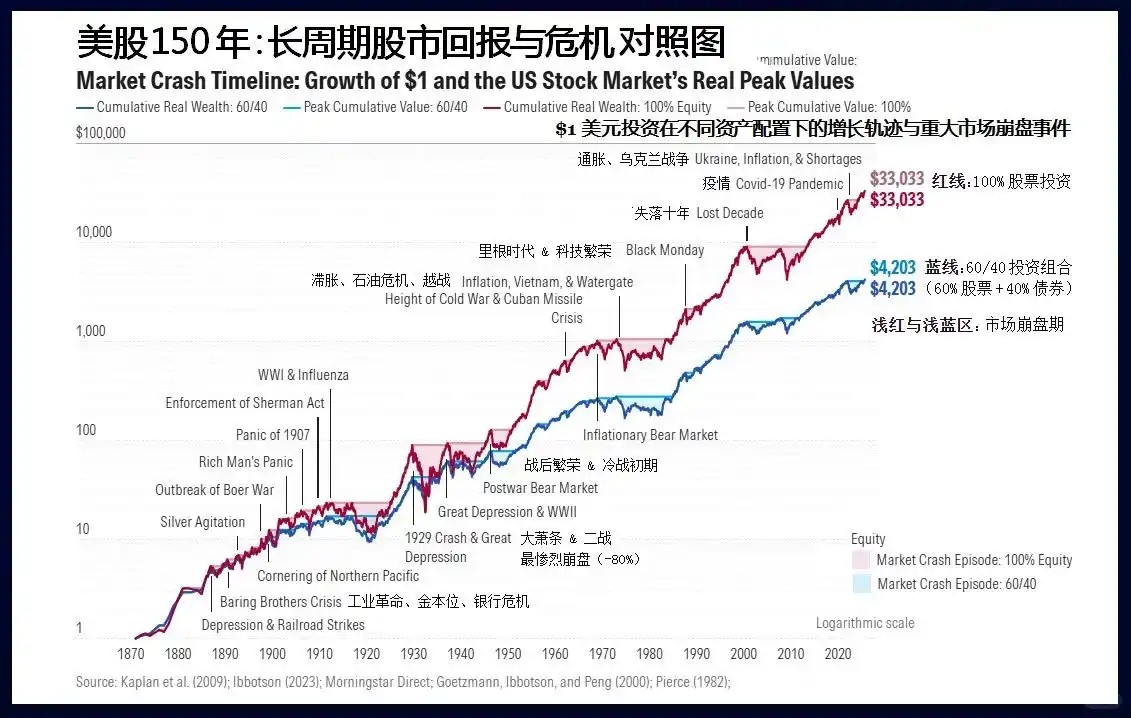
Since 1776, everyone who has bet against America has ultimately ended in their own miserable failure.

It's most difficult because most people come from A-shares, where they've experienced "buying the dip halfway down the mountain," suffering from "dip-buying PTSD syndrome." They always want to buy lower to give themselves some safety cushion, resulting in not daring to buy during the dip and then chasing the rebound.

Therefore, when a dip-buying opportunity arises in U.S. stocks, everyone must clarify two questions:

1. Under normal circumstances, how much does a typical U.S. stock correction fall?

2. If a black swan event occurs and the fall seems endless, what should be done?

1. How deep are U.S. stock corrections? First, let's define what a "correction" is.

Corrections are usually divided into three levels: daily, weekly, and monthly. A round of decline must meet one of two conditions: magnitude or duration (everyone's definition may differ; this article only represents my standard).

  • Daily level: A drop of 5% or more from the highest point, or a duration of more than two weeks (referring to the time span from the highest to the lowest point);
  • Weekly level: A drop of 10% or more from the highest point, or a duration of more than 4 weeks;
  • Monthly level: A drop of 15% or more from the highest point, or a duration of more than 4 months.

Meeting one of the two conditions is sufficient. Some corrections are not deep in magnitude but drag on for a long time; others are the opposite. After clarifying the definition, buying the dip essentially has two goals:

  • Goal one: Buy all the positions you want
  • Goal two: Buy as cheaply as possible

Market trends are always clear in hindsight but confusing in real-time. When a correction is happening, we can only be sure of two things—how much it has fallen from the previous high to today, and how many days it has been falling?

It could continue to fall, consolidate, or start rising again.

So these two goals conflict. Buying too quickly might achieve goal one but at a higher price;

But if you only focus on buying cheap, you might miss out and the price could rise without you.

This requires us to have a probabilistic understanding of the magnitude of corrections in the historical trends of U.S. stocks to set a reasonable goal.
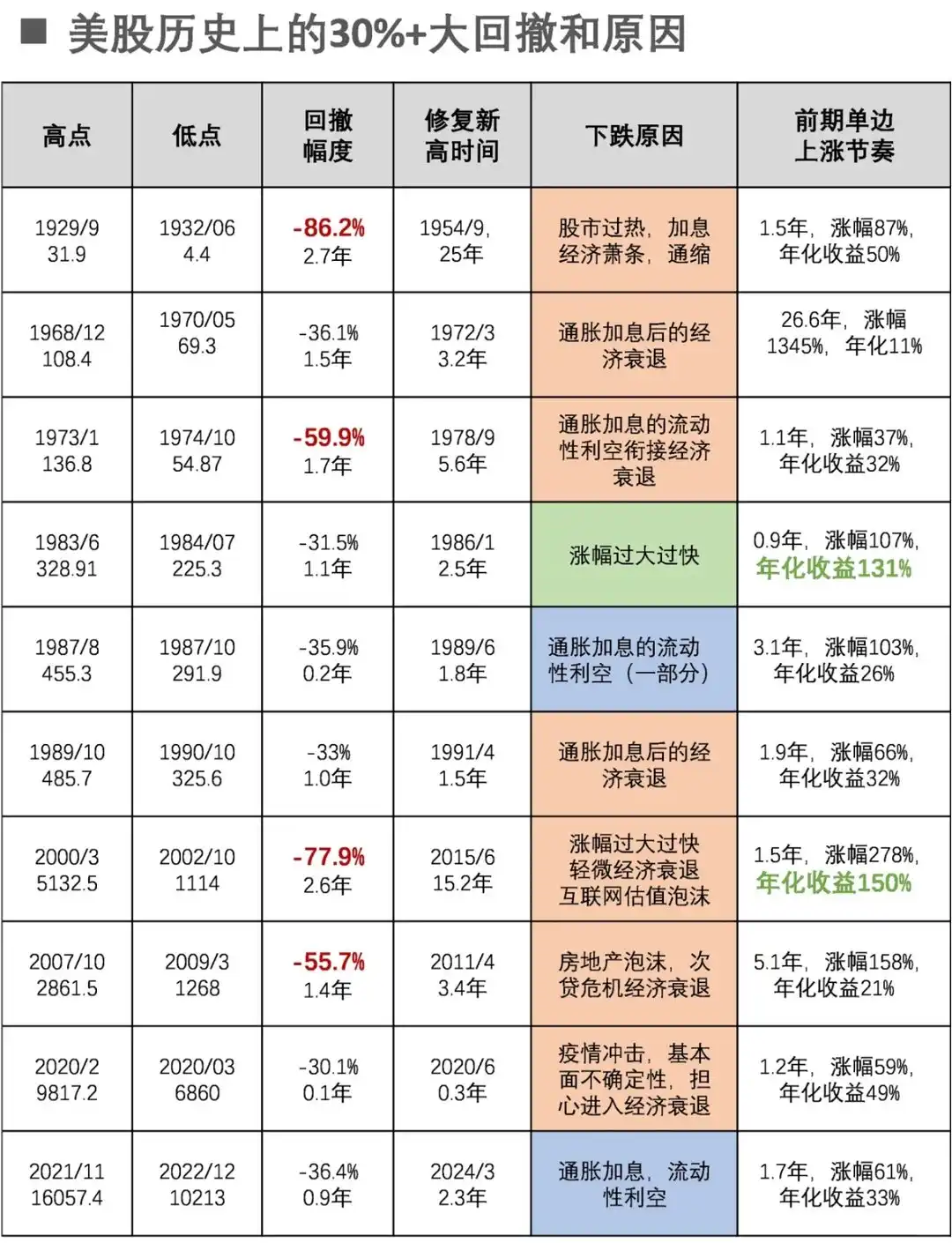
Major Drawdowns of 30%+ in U.S. Stock History and Their Causes

Taking the S&P 500 Index as an example, there have been only 7 monthly-level corrections in the past 20 years since 2004, with reasons分别为:

  • Jan-Oct 2022: The most aggressive interest rate hike cycle in 40 years
  • Feb-Mar 2020: Global public health event
  • Sep-Dec 2018: Trade war combined with interest rate hikes
  • Jul 2015 - Feb 2016: Chinese economic slowdown combined with interest rate hike expectations
  • Apr-Sep 2011: Deepening European debt crisis
  • Apr-Jun 2010: European debt crisis and Goldman Sachs fraud scandal
  • Oct 2007 - Mar 2009: Subprime mortgage crisis

So monthly-level corrections in U.S. stocks are still very rare, occurring on average once every three years, each with macro-fundamental reasons. From September 2011 to July 2015, there was a 44-month period without one, a proper long bull market.

Weekly-level corrections are more frequent, happening 2-3 times a year, and don't necessarily require fundamental reasons; just rising too much can lead to a correction.

Therefore, when buying the dip, the first thing to judge is whether this is a weekly-level or a monthly-level correction?

But stock movements are influenced by various new pieces of information, making accurate prediction difficult. The Fed isn't your family's business; negative and positive news won't arrive according to your plan—fortunately, you can still decide your own goal.

You need to think about a question, imagine it's haggling with a vendor: if you can only choose one goal between "buying" and "buying cheaply," which do you choose?

If it's the former, you should assume the correction is weekly-level and plan accordingly. This way, even if it turns out to be a monthly-level correction, you can still complete your first goal. Similarly, if your goal is "buying cheaply," you should prepare a dip-buying plan for a monthly-level correction.

However, generally, I recommend making "buying" the primary goal, especially when you have idle cash. First, because monthly-level corrections occur only every three years, the probability is indeed low. Second, with idle cash, if you don't buy U.S. stocks, you might end up buying other high-risk products.

With a goal, the plan becomes much simpler.

2. Time Plan vs. Price Plan: The First Question in Buying U.S. Stock Dips—When to Start the Plan?

Taking a weekly-level correction's dip-buying as an example, as long as it doesn't hit a new high for two weeks, a daily-level correction is already happening, and you should prepare a dip-buying plan for a weekly-level correction.

The core of buying U.S. stock dips is two words—scale in.
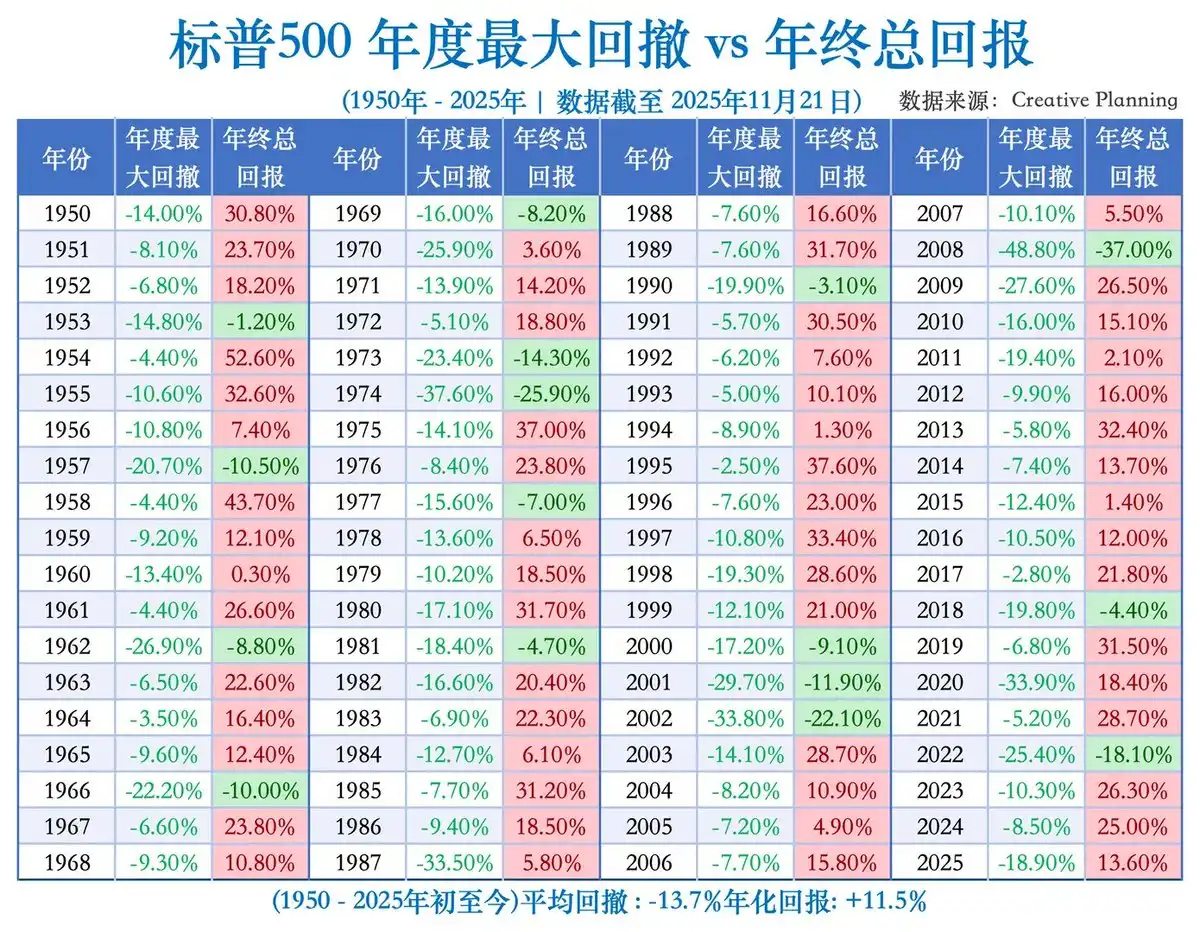
There are two types of scaling-in plans: one is time-based scaling, buying at fixed time intervals; the other is price-based scaling, buying when the price falls to certain levels. Based on the trends of the past 20 years, for weekly-level corrections (excluding monthly-level ones), the average time from high to bottom is 10 weeks. Thus, time-based scaling can be divided into three batches: starting from the high, buy the dip every three weeks afterward, with a longer interval between the second and first batches.

Price-based scaling can also be divided into three batches, buying one batch at a 3% drop from the high. If the maximum drop is 10%, the entire dip-buying plan can be completed.

The completion probabilities of these two plans differ. The time plan can generally be completed unless it's only a daily-level correction that quickly hits new highs—which isn't regrettable, as you've at least seized a daily-level correction opportunity to add positions.

But the price-based plan might not be completed. Many weekly-level corrections in U.S. stocks only last longer without reaching a 10% drop.

For weekly-level corrections, with "completing the dip buy" as the primary goal, "time-based scaling" should be prioritized. Even if the drop hasn't reached the target, once the correction time arrives, execute the scaling-in plan.

Now, considering a dip-buying plan targeting monthly-level corrections: the average time to bottom is 6.5 months, but it varies greatly. So, adopt the mindset of "probably won't complete the buy" and buy as much as possible.

Don't average the position sizes; instead, use a front-heavy approach: three batches at 1/2, 1/3, and 1/6 of the total plan.

The time plan can be batched as: first month, third month, sixth month. The price plan can be batched as: 3% drop, 8% drop, 15% drop. Often, when you target a "monthly-level" correction, you end up completing a weekly-level correction's dip-buying plan but with insufficient volume. Hence, I initially suggest focusing on the weekly-level correction plan as much as possible.

Buying U.S. stock dips can be simply summarized as three dos and three don'ts:

1. Do make a scaling-in plan; don't make random decisions or trade impulsively during the session;

2. Prioritize "buying enough" over "buying cheaply";

3. Prioritize "time-based scaling" over "price-based scaling." Buying U.S. stock dips is a very mechanical plan, and the premise of this plan is the long-term upward and relatively low-volatility trend of U.S. stocks.

But the stock market is ultimately a place of human博弈, and economic operations themselves are unpredictable. Black swan events can happen at any time and will inevitably happen.

If the correction's duration or depth exceeds the plan, how should you respond? If a black swan event occurs, what should be done?

3. Black Swan Events

The above corrections are divided into monthly and weekly levels, which has the advantage of clear standards. But even among monthly-level corrections, differences are significant. For instance, 2008 and 2020 were actually economic crises, not mere stock market corrections.

Thus, market adjustments can also be categorized into three types based on causes:
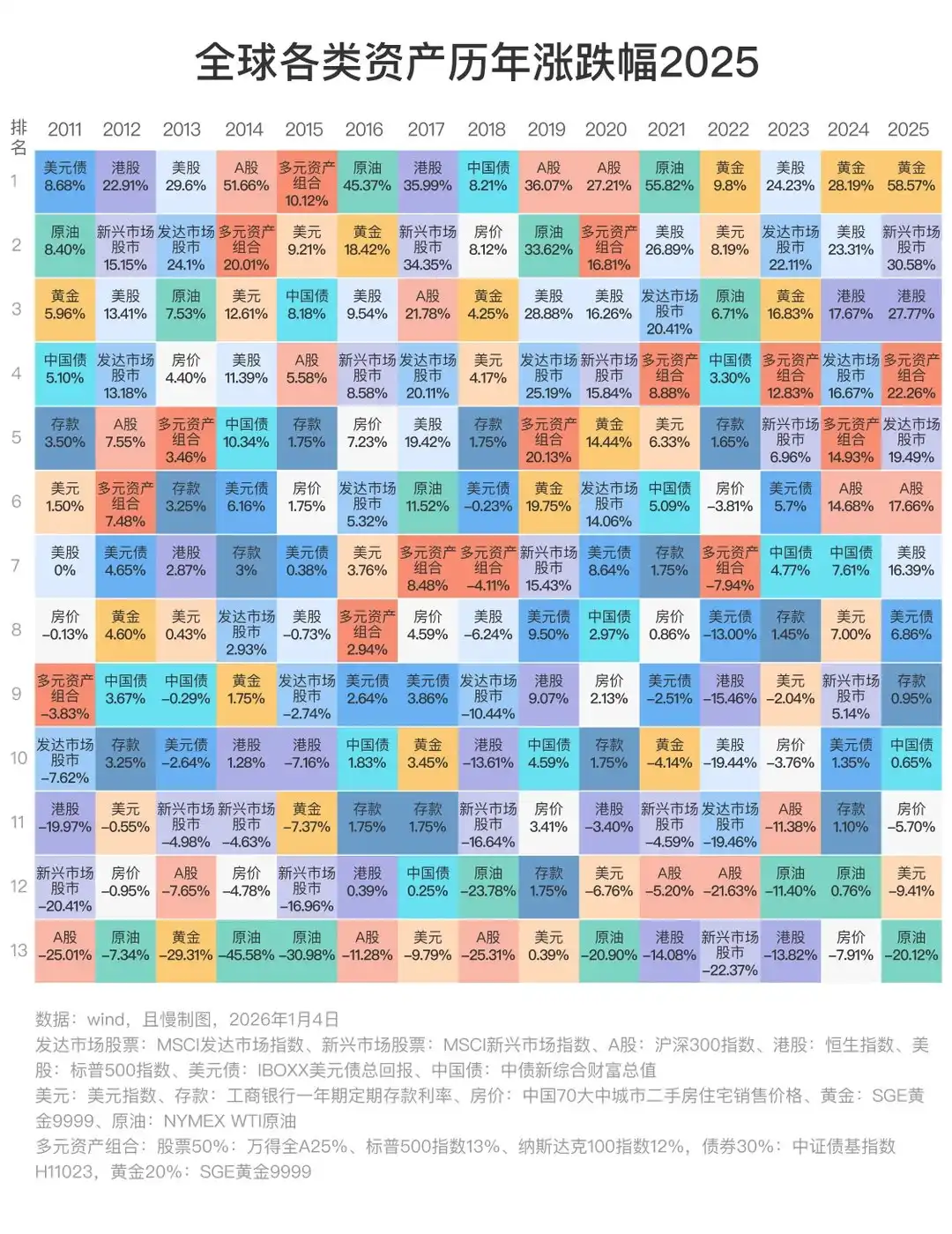
1. Natural correction due to excessive cumulative gains, but macro fundamentals are generally positive—Most daily and weekly-level corrections fall into this category.

2. Correction due to overvaluation combined with economic recession or a shift to hawkish monetary policy—A minority of weekly and most monthly-level corrections belong here.

3. Economic crisis or major recession caused by systemic risk—A minority of monthly-level corrections or long-term bear markets fall into this category.

In the past 20 years, the 2008 subprime crisis and the 2020 public health event belong to the third type. The former fell 58% in over a year; the latter fell 35% in two months. So the third situation exceeds our dip-buying plan and requires separate analysis.

However, crises and corrections are indistinguishable at the beginning. When U.S. stocks started falling in 2007, the market thought it was an economic recession. After the Fed began cutting rates, the market rebounded. By early 2008, investors were already buying the dip aggressively.

Therefore, during the dip-buying process, continuously observe whether new events have occurred initially or whether the initial causes of the decline have worsened.

Taking recent deep declines as examples: A standard bear market like the 27% drop in 2022 is actually the easiest to judge. It's driven by standard macro logic; everyone is discussing rate hikes; all prices are soaring; every month, data tells you it's worse than the last. At most, you might have losses at the initial confirmation of the dip buy; later, you'll naturally know it's a protracted battle, requiring an extended dip-buying timeline.

A "once-in-a-lifetime" crash like the 36% drop in one month during the 2020 public health event, triggered by non-economic black swan factors, is indeed panic-inducing short-term, but once it's over, it's over. In this case, you can only endure.

The most difficult was the 58% drop during the 2008 financial crisis, which was a mix of the above two situations. A crisis event during an ordinary recession triggered a deep recessionary bear market. It couldn't be predicted, only responded to.

Going further back, the 2000 dot-com bubble burst was a rare暴跌 caused by excessive valuation, which in turn dragged down the economy. But the valuation levels then were much, much higher than now. It was a discernible gray rhino event, but no one wanted to "get off first."

Synthesizing these types of U.S. stock declines, you'll find that it's best not to predict U.S. stock declines in advance. The most important thing is to face reality and respond after it happens; the sky won't fall.

Of course, having no expectations and making timely and correct responses after the fact requires you to pay attention to the market. You can't just allocate like wealth management without management. You still need to assess, after a certain stage of decline, whether it might evolve into a crisis.


Трендові криптовалюти

Пов'язані питання

QWhat are the 'three dos and three don'ts' for bottom-fishing in the U.S. stock market as summarized in the article?

AThe three dos and three don'ts are: 1. Do make a batch plan; don't make random decisions or emotional trades during the session. 2. Prioritize 'buying enough' over 'buying cheap'. 3. Prioritize 'time-based batching' over 'price-based batching'.

QAccording to the author, what is the most important rule for investing in U.S. stocks over the past 20 years?

AThe most important investment rule for U.S. stocks over the past 20 years is to buy on every dip.

QHow does the article define a monthly-level correction for the U.S. stock market?

AA monthly-level correction is defined as a drop of 15% or more from the highest point, or a time span lasting 4 months or more from the peak to the trough.

QWhat are the only two things one can be sure of during a market correction, as stated in the article?

ADuring a market correction, the only two things one can be sure of are how much it has fallen from the previous high to the present day and how many days it has been falling.

QWhat are the three types of market adjustments classified by cause in the article?

AThe three types are: 1. Natural adjustments due to excessive cumulative gains, with macro fundamentals generally sound. 2. Adjustments caused by overvaluation combined with an economic recession or a shift to hawkish monetary policy. 3. Economic crises or major recessions caused by systemic risks.

Пов'язані матеріали

After Three Consecutive Quarters of Decline, Can the Crypto Market Find a Window for Stabilization in Q3?

The cryptocurrency market has just concluded its worst-performing quarter since 2022, with total capitalization dropping 12.6% to $2.1 trillion. All core metrics indicate capital is leaving the sector, not just rotating within it. Bitcoin fell 14.2% and Ethereum dropped 25.4% in Q2, breaking their previous correlation with US tech stocks. A key driver is the reversal in US spot Bitcoin ETF flows, which saw a net outflow of approximately $4.67 billion in Q2, including a record monthly outflow near $4.5 billion in June. While recent data suggests long-term holders are accumulating again, sustained ETF outflows mean continued selling pressure. Market focus is now singularly on the Federal Reserve. The upcoming July FOMC meeting is seen as the most critical event for Q3. A dovish signal could support Bitcoin reclaiming a $68,000-$84,000 range, while a hawkish stance might establish a new trading band around $50,000-$56,000. Additionally, regulatory uncertainty persists, with the progress of the crucial *CLARITY Act* stalling in the Senate, reducing its perceived 2026 passage probability to 40-45%. Despite the broad downturn, a few sectors showed growth. Prediction markets saw nominal volume surge 48.7% year-over-year to $113.8 billion, and tokenized collectibles transaction volume rose 143% quarterly to $1.4 billion. The Real-World Asset (RWA) tokenization sector also continued steady growth, now representing ~$28.1 billion in on-chain value. The market's foundation for an extreme crash appears limited, with Bitcoin price hovering near its 200-week moving average. However, the trading paradigm has shifted from narrative-driven speculation to decisions based on price action, policy developments, and interest rate expectations, making a broad sentiment-driven rally unlikely in the near term.

marsbit13 год тому

After Three Consecutive Quarters of Decline, Can the Crypto Market Find a Window for Stabilization in Q3?

marsbit13 год тому

BIT Trading Moment: BTC Still Suppressed by Weekly 200 EMA, Rejection May Restart Decline; Storage and Semiconductors that Surged Last Night Begin Falling in Evening Trading

**Crypto & Stock Market Wrap: Bitcoin Tests Resistance, Stocks Retreat After AI Surge** Bitcoin consolidates around $66,000, facing key resistance near $68,000—an area seen as a major psychological and technical hurdle where previous rallies have failed. Analysts note the cryptocurrency is caught between its 200-week moving average (~$63,333) and 200-week EMA (~$68,328). A clear break above $68k is needed to signal a stronger bullish trend, while a rejection could lead to a retest of $63k support. Market sentiment remains cautious, with low futures open interest pointing to a low-liquidity rebound rather than a full bull market. Bitcoin spot ETFs saw another $203 million inflow. US stock futures pointed lower after a strong Tuesday session led by a massive rebound in semiconductors and memory stocks. The rally was fueled by renewed optimism about AI-driven hardware demand, with Micron, SanDisk, and SK Hynix surging. However, those gains reversed in pre-market trading. Super Micro Computer (SMCI) soared over 20% after hours on strong guidance and a record backlog. Other standouts included Rocket Lab and nuclear energy plays Oklo and X-Energy. Rising oil prices (Brent above $91) and climbing Treasury yields (10-year near 4.64%), however, are reigniting inflation concerns and acting as a headwind for equities. In Asia, markets were mixed. South Korea's KOSPI pared early gains to close slightly higher as semiconductor stocks like SK Hynix gave back initial surges. Japan's Nikkei edged lower as the yen hit a fresh 38-year low against the dollar, raising fears of potential market intervention. Key events to watch include the Samsung Galaxy launch, AMD's AI event, and a slew of major tech earnings from Alphabet, Tesla, and IBM after the close on Wednesday, followed by the ECB meeting and Intel's earnings on Thursday.

marsbit13 год тому

BIT Trading Moment: BTC Still Suppressed by Weekly 200 EMA, Rejection May Restart Decline; Storage and Semiconductors that Surged Last Night Begin Falling in Evening Trading

marsbit13 год тому

Former CFTC Chairman, Circle President Tarbert: Preaching Long-Termism While Cashing Out $30 Million Himself

Former CFTC Chairman and Circle President Heath Tarbert has consistently advocated for a long-term vision in public, urging patience from investors as Circle’s stock price has fallen significantly from its peak. However, it has been revealed that since Circle’s IPO, Tarbert has continuously sold his CRCL shares through pre-arranged trading plans, cashing out approximately $30 million, without making any public market purchases. This contrast between his public messaging and personal actions has drawn criticism. Tarbert joined Circle in July 2023 as Chief Legal Officer, leveraging his regulatory experience to help guide the company through its IPO and expansion. Despite promoting stablecoins as long-term infrastructure, he established a 10b5-1 trading plan just before Circle went public, leading to substantial stock sales over the following year. In March 2026, he initiated another plan to sell more shares. His career trajectory highlights a pattern of moving between high-level regulatory roles and influential positions in the financial sector. After resigning as CFTC Chairman in early 2021, he joined Citadel Securities as Chief Legal Officer just 27 days later, during a period of intense regulatory scrutiny for the firm. He later joined Circle, aiding its efforts to navigate regulatory challenges for its public listing. While Tarbert's expertise in policy and compliance is valuable to companies like Circle, his actions—advocating long-term confidence while personally divesting—raise questions about the alignment between his public statements and his private financial decisions, leaving investors who followed his advice to bear the market risks.

marsbit13 год тому

Former CFTC Chairman, Circle President Tarbert: Preaching Long-Termism While Cashing Out $30 Million Himself

marsbit13 год тому

Gate Research Institute: The 'Wall Street-ization' Wave of Crypto Financial Products – Competition or Integration?

The article titled "Gate Research Institute: Are Crypto Financial Products Sparking a 'Wall Street' Wave—Competition or Convergence?" explores the evolving relationship between the crypto ecosystem and traditional finance (TradFi). The piece begins by reflecting on Bitcoin's original 2009 vision of decentralization, disintermediation, and moving away from banks. It then contrasts this with the 2024 landscape, where key crypto assets like Bitcoin are increasingly held through Wall Street products like ETFs issued by giants like BlackRock. The article questions whether this signifies that TradFi is systematically taking over the rights to issue, price, custody, and distribute crypto financial assets. The core argument is that this is not a zero-sum takeover but rather a bidirectional convergence where each side addresses the other's weaknesses. Crypto offers 24/7 global markets, programmable settlement, and open access but lacks compliant channels, institutional-grade custody, deep fiat liquidity, and mainstream distribution. TradFi possesses these but is constrained by legacy systems, limited operating hours, and slow settlement. Two primary convergence paths are highlighted: * **Path A (CEX to TradFi):** Exemplified by Gate, which has progressed from offering tokenized stocks and CFDs to providing direct, real stock trading (US, Hong Kong, South Korea) within its platform, using USDT. * **Path B (TradFi to Crypto):** Exemplified by Robinhood, which has integrated crypto trading, acquired exchanges like Bitstamp, and is moving traditional assets like stocks onto the blockchain via tokenization and its own Layer 2. Both paths are ultimately competing to become the next-generation, unified financial account—a "super account" where users can seamlessly trade cryptocurrencies, stocks, ETFs, RWA (Real World Assets), and tokenized treasury products in one interface. The growth of RWA and tokenized treasuries (e.g., BlackRock's BUIDL) is presented as the asset-layer fusion, providing stable, yield-bearing assets on-chain and acting as a bridge between the two worlds. In conclusion, the "Wall Street-ization" of crypto is framed as a mutual transformation. Decentralized ideals persist in the protocol layer, while at the application layer, a more efficient, global, and accessible unified capital market is emerging from this convergence. The future competition lies not between crypto exchanges and stockbrokers, but between platforms vying to offer the most comprehensive asset coverage, liquidity, and user experience within a single account.

marsbit13 год тому

Gate Research Institute: The 'Wall Street-ization' Wave of Crypto Financial Products – Competition or Integration?

marsbit13 год тому

Торгівля

Спот

Популярні статті

Що таке SOLANA

HarryPotterWifHatMyroWynn10Inu,$solana: Занурення у модний проект мем-койнів Вступ У постійно змінюваному світі криптовалют інноваційні проекти постійно з’являються, привертаючи уяву інвесторів та ентузіастів. Один з таких проектів – це HarryPotterWifHatMyroWynn10Inu,$solana, мем-койн, який почав займати свою нішу в криптоспільноті. Метою цієї статті є надати вам всебічний огляд проекту, пояснивши його мету, архітектуру, творця, інвесторів та значні досягнення на шляху. Що таке HarryPotterWifHatMyroWynn10Inu,$solana? Огляд HarryPotterWifHatMyroWynn10Inu,$solana – це проект мем-койну, структурований на блокчейні Solana – платформі, відомій своєю масштабованістю та швидкістю. Метою проекту є приносити радість і креативність у криптопростір, він не тільки слугує торговим токеном, а й каталітиком для генерації та поширення мем-контенту. Спільнота в його основі заохочується до активної участі, створюючи динамічну екосистему, де процвітає креативність і співпраця. Цілі та завдання Суть проекту полягає в сприянні середовищу, де ентузіасти мемів можуть збиратися, ділитися та створювати новий мем-контент. Цей наративно орієнтований підхід надає енергії спільноті, стимулюючи залученість, у той же час висвітлюючи міцні функції, притаманні блокчейну Solana. Визначаючи проект, орієнтований на спільноту, HarryPotterWifHatMyroWynn10Inu,$solana також бажає досліджувати соціальний вплив цифрових валют як засобу вираження. Хто є творцем HarryPotterWifHatMyroWynn10Inu,$solana? Ідентичність творця HarryPotterWifHatMyroWynn10Inu,$solana залишається загадкою. Проект структуровано таким чином, що право власності було відмовлено; тому він розвивається як ініціатива, що очолюється спільнотою. Ця децентралізація сприяє прозорості та демократичній участі всіх залучених сторін. Такий підхід стає дедалі популярнішим у світі мем-койнів, де активна участь спільноти є найвищою цінністю. Хто є інвесторами HarryPotterWifHatMyroWynn10Inu,$solana? На цей момент немає публічно доступної інформації про конкретних інвесторів або фонди, що підтримують HarryPotterWifHatMyroWynn10Inu,$solana. Відсутність відомих інвесторів ще більше підкреслює орієнтований на громаду дух проекту, оскільки він існує незалежно від традиційних фінансових структур. Ця незалежність дозволяє проекту розвивати свою ідентичність без зовнішнього тиску, покладаючись замість цього на колективний інтерес своєї бази користувачів. Як працює HarryPotterWifHatMyroWynn10Inu,$solana? Економічна модель Проект використовує унікальну економічну модель, що підкріплює його функціональність і залучення користувачів. Транзакції в межах HarryPotterWifHatMyroWynn10Inu,$solana призначені для того, щоб бути вигідними для всіх учасників. Кожна угода передбачає комісію, яка потім перераспреділяється серед поточних власників, одночасно підвищуючи ліквідність. Основні компоненти цієї моделі включають: Механізм відображення: Частина транзакційних зборів повертається власникам, сприяючи довгостроковим інвестиціям у токен. Придбання ліквідності: Кошти розподіляються для підвищення ліквідності, забезпечуючи, щоб угоди купівлі-продажу могли виконуватись гладко. Механізми спалювання: Частина токенів може бути спалена для створення дефіциту, потенційно підвищуючи вартість, оскільки попит зрештою зростає. Такий дизайн сприяє самодостатній екосистемі, яка процвітає завдяки взаємодіям спільноти та інвестиціям. Залучення спільноти В основі HarryPotterWifHatMyroWynn10Inu,$solana лежить цінність, дана залученню спільноти. Дозволяючи користувачам брати участь у розвитку проекту через різні активності, такі як створення мемів та промоції, проект сприяє розвитку вітальної екосистеми, де креативність може розквітати. Хронологія HarryPotterWifHatMyroWynn10Inu,$solana Шлях HarryPotterWifHatMyroWynn10Inu,$solana має кілька значущих подій, які визначили його поточну позицію в крипто спільноті: Створення: Конкретна дата створення залишається невідомою, але початок проекту корениться в культурі мемів, що пронизує цифрову епоху. Перехід до спільноти: Після відмови від права власності його творцем проект перейшов на модель, що очолюється спільнотою, що дозволяє усім учасникам мати частку в його успіху. Аудит і колекція NFT: Щоб підвищити свою довіру, проект завершив ретельний аудит, одночасно запустивши колекцію NFT, яка слугує втіленням його мемоцентричного духу. Партнерства та розробка: Проект наразі перебуває в процесі пошуку потенційних партнерств з іншими токенами та організації розробки унікального веб-сайту та мерчендайзингових опцій на основі його легендарних мемів. Ключові моменти Отже, HarryPotterWifHatMyroWynn10Inu,$solana постає як помітний гравець у секторі мем-койнів криптовалюти. Ось деякі ключові висновки: Ініціатива, що керується спільнотою: Проект процвітає як колективний зусилля, заохочуючи активні внески від його членів спільноти, при цьому відокремлюючись від претензій на власність. Інноваційна економічна модель: Використовуючи механізми відображення, придбання ліквідності та спалювання, він створює міцне та захоплююче фінансове середовище для користувачів. Залучення NFT та мерчандайзу: Запуск колекції NFT має на меті поглибити залученість у громаді, підкреслюючи зв’язок між культурою мемів і цифровою валютою. Дослідження партнерств: Ініціатива не стоїть на місці – постійна розробка та потенційні партнерства вказують на прогресивний підхід, спрямований на сталий розвиток. Висновок У міру того як HarryPotterWifHatMyroWynn10Inu,$solana продовжує здобувати популярність у світі криптовалют, його унікальне поєднання залучення спільноти, інноваційних економічних структур та інтеграції культури мемів окреслює його потенційний шлях вперед. Попри таємницю навколо його витоків та зв’язків з інвесторами, проект втілює цікаву історію, що говорить про суть децентралізованих інновацій. У світі, де криптовалюти часто розглядаються виключно з фінансової точки зору, HarryPotterWifHatMyroWynn10Inu,$solana демонструє, що крипторух включає креативність, спільноту та співпрацю. Чи ви досвідчений інвестор, чи новачок, розгортання цього проекту мем-койнів безсумнівно служить захоплюючим випадком, що заслуговує на увагу.

654 переглядів усьогоОпубліковано 2024.04.04Оновлено 2024.12.03

Що таке SOLANA

Що таке SOLANA 2.0

BarbieCrashBandicootRFK777Inu, $SOLANA 2.0: Новий гравець на крипто-ландшафті Вступ до BarbieCrashBandicootRFK777Inu, $SOLANA 2.0 У постійно змінюваному світі криптовалют нові учасники постійно привертають увагу інвесторів та ентузіастів. Серед цих нових проектів — BarbieCrashBandicootRFK777Inu, представлений криптовалютою з символом $SOLANA 2.0. Ця унікальна ініціатива поєднує елементи гламуру, пригод та культури мемів, прагнучи перевершити очікування в надзвичайно конкурентному середовищі. З амбіціями зростання та інновацій, цей проект втілює дух аутсайдера, що бореться з усталеними гігантами. Що таке BarbieCrashBandicootRFK777Inu, $SOLANA 2.0? У своїй основі BarbieCrashBandicootRFK777Inu — це криптовалютний проект, що черпає натхнення з різних культових культурних посилань. Включаючи елегантність і чарівність Барбі, динамічну енергію Crash Bandicoot та невтомну рішучість, що представлена RFK, проект прагне запропонувати багатогранний досвід у світі криптовалют. Основною метою проекту BarbieCrashBandicootRFK777Inu є об'єднання цих різноманітних елементів у єдину екосистему, що приваблює широку аудиторію. Приймаючи капризність культури мемів, залишаючись при цьому в рамках принципів децентралізації та фінансової підтримки, проект зарекомендував себе як приваблива альтернатива для як досвідчених інвесторів, так і новачків у криптовалютному світі. Хто є творцем BarbieCrashBandicootRFK777Inu, $SOLANA 2.0? Попри зростаючий інтерес до BarbieCrashBandicootRFK777Inu, інформація щодо його творця залишається в значній мірі невідомою. Анонімність засновника або команди розробників викликає питання щодо структури та управління проектом. У світі криптовалют не рідкість, коли проекти працюють без публічних творців. Ця відсутність інформації може відлякати деяких потенційних інвесторів, тоді як інші можуть сприймати це як можливість embrace духу децентралізації, що лежить в основі багатьох ініціатив у криптовалютній сфері. Хто є інвесторами BarbieCrashBandicootRFK777Inu, $SOLANA 2.0? На даний момент доступна обмежена інформація про інвестиційні фонди або організації, що підтримують BarbieCrashBandicootRFK777Inu. Відсутність детального інвестиційного фінансування проекту підкреслює незалежний характер численних криптовалют. У цьому випадку ще належить з'ясувати, чи буде фінансування проекту походити від широкої підтримки спільноти або від підтримки більших фінансових установ. Як працює BarbieCrashBandicootRFK777Inu, $SOLANA 2.0? BarbieCrashBandicootRFK777Inu розроблено з низкою характеристик, які сприяють його унікальності в переповненому крипто-просторі. Хоча конкретні технічні деталі залишаються під покриттям, проект, як очікується, інтегрує функціональність, спрямовану на покращення залученості користувачів і сприяння зростанню спільноти. Поєднання різноманітних впливів — від моди та пригод до ігор — сприяє створенню інклюзивної атмосфери, що відповідає різним інтересам. Крім того, зв’язки проекту з екосистемою $SOLANA 2.0 передбачають потенційні технологічні переваги. Це може включати інноваційні швидкості транзакцій, масштабованість та ефективність витрат, що відповідає технічним можливостям блокчейну Solana. Засновники проекту, здається, намагаються спиратися на цю технологічну основу для створення тривалого досвіду спільноти та значної пропозиції продукції. Хронологія BarbieCrashBandicootRFK777Inu, $SOLANA 2.0 Шлях BarbieCrashBandicootRFK777Inu містить кілька ключових етапів, що дають уявлення про розвиток проекту на сьогоднішній день: Концептуалізація проекту: Початкові ідеї виникли навколо об'єднання гламуру, пригод та культури мемів, що надало основу для унікальної концепції проекту. Створення токена: Символічний токен $SOLANA 2.0 був встановлений, розроблений для втілення амбіцій проекту та залучення інтересу потенційних інвесторів. Розвиток проекту: Наразі проект проходить подальший розвиток, з акцентом на виклики для великих гравців у крипто-просторі та пропонуючи інноваційні рішення. Ці етапи відображають траєкторію зростання проекту, підкреслюючи його прагнення до розробки інноваційного досвіду криптовалюти. Ключові моменти про BarbieCrashBandicootRFK777Inu, $SOLANA 2.0 Унікальна концепція: BarbieCrashBandicootRFK777Inu виділяється завдяки поєднанню елементів гламуру, пригод і культури мемів в єдиному криптовалютному проекті. Дух аутсайдера: Проект приймає образ аутсайдера, прагнучи кинути виклик усталеним криптовалютним проектам і створити нішу в індустрії. Фаза розвитку: Активні зусилля з розвитку тривають з метою надання нових та інноваційних рішень, що відповідають очікуванням спільноти та інвесторів. Висновок BarbieCrashBandicootRFK777Inu, представлений символом $SOLANA 2.0, є цікавим новим учасником на ринку криптовалют. Його унікальне поєднання культурних посилань та амбітна візія можуть відгукнутися на запити тих, хто шукає альтернативні цінності проекту в крипто-ландшафті. Хоча невідомий статус його творця та інвесторів може викликати запитання, акцент проекту на чарівності і пригодах представляє захопливу історію, що розширює межі того, що можуть втілювати криптовалюти. У процесі розвитку проекту буде цікаво спостерігати його еволюцію в більш широкій крипто-індустрії та те, як він позиціонує себе серед своїх конкурентів. Для тих, хто залучений, BarbieCrashBandicootRFK777Inu, можливо, відкриє несподівані досвіди, які перевизначать залученість до цифрових активів. Поки що, коли проект рухається вперед, його шлях є нагадуванням про те, що інновації в крипто-просторі не знають меж, пропонуючи все — від захоплення і розваг до потенціалу фінансової підтримки.

208 переглядів усьогоОпубліковано 2024.04.05Оновлено 2024.12.03

Що таке SOLANA 2.0

Як купити SOL

Ласкаво просимо до HTX.com! Ми зробили покупку Solana (SOL) простою та зручною. Дотримуйтесь нашої покрокової інструкції, щоб розпочати свою криптовалютну подорож.Крок 1: Створіть обліковий запис на HTXВикористовуйте свою електронну пошту або номер телефону, щоб зареєструвати обліковий запис на HTX безплатно. Пройдіть безпроблемну реєстрацію й отримайте доступ до всіх функцій.ЗареєструватисьКрок 2: Перейдіть до розділу Купити крипту і виберіть спосіб оплатиКредитна/дебетова картка: використовуйте вашу картку Visa або Mastercard, щоб миттєво купити Solana (SOL).Баланс: використовуйте кошти з балансу вашого рахунку HTX для безперешкодної торгівлі.Треті особи: ми додали популярні способи оплати, такі як Google Pay та Apple Pay, щоб підвищити зручність.P2P: Торгуйте безпосередньо з іншими користувачами на HTX.Позабіржова торгівля (OTC): ми пропонуємо індивідуальні послуги та конкурентні обмінні курси для трейдерів.Крок 3: Зберігайте свої Solana (SOL)Після придбання Solana (SOL) збережіть його у своєму обліковому записі на HTX. Крім того, ви можете відправити його в інше місце за допомогою блокчейн-переказу або використовувати його для торгівлі іншими криптовалютами.Крок 4: Торгівля Solana (SOL)Легко торгуйте Solana (SOL) на спотовому ринку HTX. Просто увійдіть до свого облікового запису, виберіть торгову пару, укладайте угоди та спостерігайте за ними в режимі реального часу. Ми пропонуємо зручний досвід як для початківців, так і для досвідчених трейдерів.

1.4k переглядів усьогоОпубліковано 2024.12.12Оновлено 2026.06.02

Як купити SOL

Обговорення

Ласкаво просимо до спільноти HTX. Тут ви можете бути в курсі останніх подій розвитку платформи та отримати доступ до професійної ринкової інформації. Нижче представлені думки користувачів щодо ціни SOL (SOL).

活动图片













