I Tested with $10,000: Zero Wear, 8% APY, and Earn Points (Full Tutorial + Screenshots Included)

链捕手Опубліковано о 2026-05-22Востаннє оновлено о 2026-05-22

Анотація

**Title:** My $10,000 Real-World Test: Zero Wear-and-Tear, ~8% APY, Plus Earning Points (Full Guide + Screenshots Included) **Summary:** This article details a personal experiment with $10,000 on the StandX platform to verify its advertised ~8% APY for its stablecoin, DUSD, while earning trading points. The author created two accounts, each depositing $5,000 worth of DUSD, and used StandX's unique "Block Trade" feature to open perfectly offsetting long and short BTC positions (2x leverage each). This neutralized directional market risk. **Key Results (Over 8 Days):** * **Total Profit:** $16.91 (~7.8% annualized). * **Zero Net Directional P&L:** BTC price movements canceled out. * **Zero Wear-and-Tear:** No losses from fees, slippage, or gas from frequent trading. * **Points Earned:** 380+ trading points. **Source of the ~8.46% APY:** The yield is composed of three layers, all paid in DUSD (real USD value, not governance tokens): 1. **DUSD Base (~1.27%):** Derived from funding rates (similar to Ethena's USDe). 2. **SIP-2 Position Boost (~2.27%):** A protocol revenue-sharing mechanism. Users providing liquidity (via open positions) earn a share of platform trading fees. Leverage acts as a multiplier on this yield. 3. **SIP-3 Universal Fee Share (~4.92%):** A portion of all platform trading fees is distributed to *every* DUSD holder, regardless of whether they trade. **Sustainability Claim:** The author argues this yield is more sustainable than pure funding-rate...

Author:fiona.stand

The day the Dow hit 50,000, NVIDIA's market cap soared past $5.7 trillion, and the Nasdaq reached a new high. Wall Street seemed to have rediscovered the printing press. At the same time, BTC failed for the fourth time to break through 82,000, falling below 80,000.

U.S. stocks are celebrating, while the crypto market is bottoming out.

Over the past few years, crypto users have been conditioned by two things: one is 30% APY, but upon clicking, you find it's all governance token emissions, and the token price drops 90% before the rewards even arrive; the other is 3% stablecoin yield, safe but like a lukewarm cup of water handed over at a bank counter—not bad, but not exciting either.

By 2026, yields for mainstream stablecoins were mostly compressed into the narrow range of 3-4%. Coinbase 3.35%, Aave 3.31%, Ethena 3.60%—everyone is queuing under the same interest rate ceiling.

So, when I first saw DUSD showing around 8.46% APY, and with rewards settled in DUSD and not reliant on token subsidies, my reaction was likely the same as yours—is this number real?

After joining StandX, I decided to verify in the simplest and most honest way possible: test it with my own money. $10,000, two accounts, one set of BTC long/short hedging positions—no directional bets, no chasing trends, just to see if DUSD could really generate money on its own.

8 days later, the answer is here.

Test Result: $10,000 Principal, 8 Days, $17 Profit with Zero Directional Risk

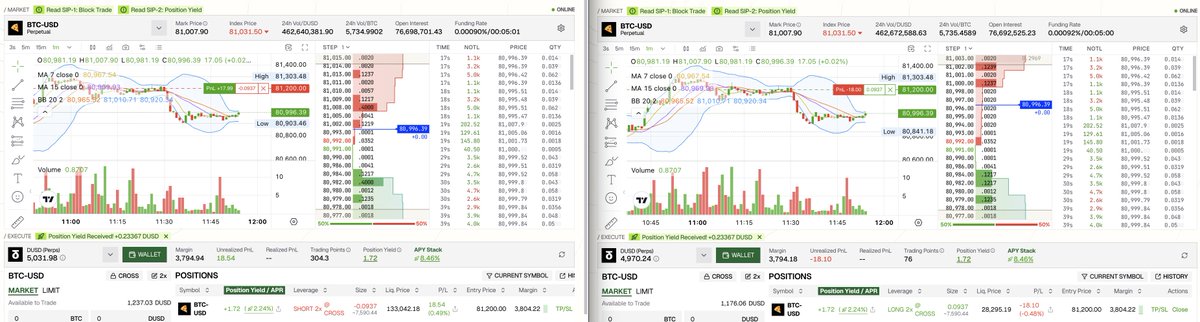
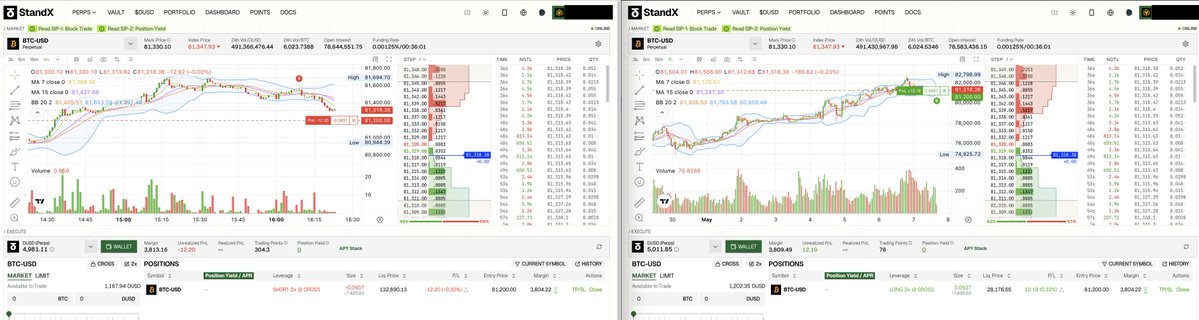
Last week, I created two accounts on StandX, each depositing 5,000 DUSD. I used the unique Block Trade feature to hedge them against each other (one long, one short). The net directional risk is zero—BTC price movements are irrelevant to me.
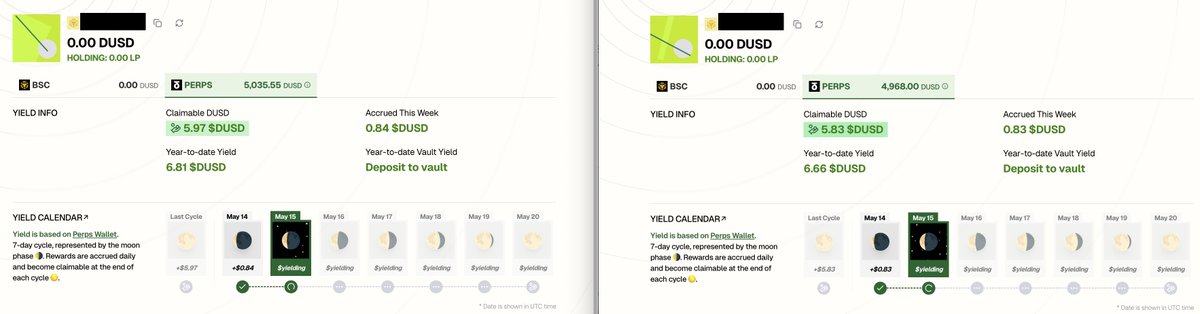
Current Account Summary (Two accounts combined):

  • 💰 DUSD Yield Earnings (Base + SIP-3):$13.47($6.81 + $6.66)

  • 💰 Position Yield Earnings (SIP-2):$3.44($1.72 \times 2)

  • 📊 Total Earnings:$16.91, annualized approximately 7.8%

  • 🎯 Trading Points: 380+ points

  • Directional Risk: Zero

  • 🔥 Wear and Tear: Zero

APY Stack is currently showing 8.46%, and earnings are still growing daily.

📌 Note: The total earnings of $16.91 translate to an annualized rate of about 7.8%, which differs from the APY Stack showing 8.46%. This is because 7.8% is the historical average for the 8-day period from May 7th to May 15th, whereas 8.46% is today's real-time snapshot—recent increases in platform trading volume have driven up fee income, so the current APY is higher than the average of the past 8 days. Over a longer timeframe, the two figures will converge.

Earnings Breakdown — Where Does the 8.46% APY Come From?
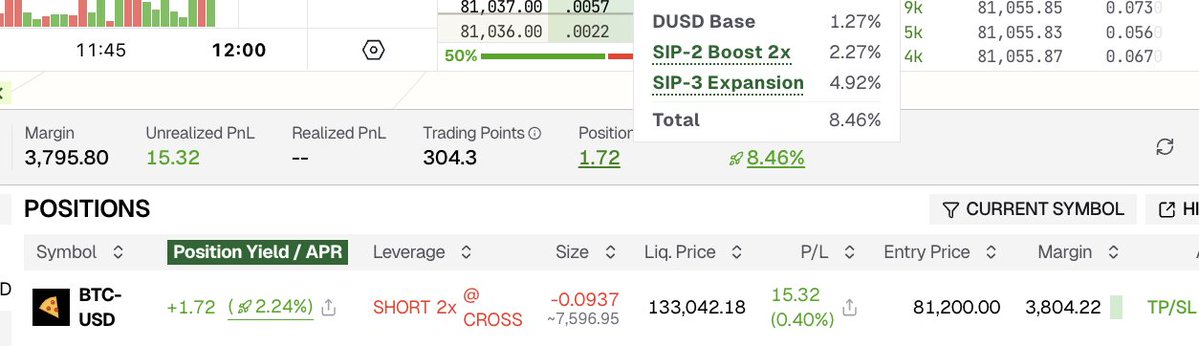
  • First Layer: DUSD Base — 1.27%

    The base yield that all DUSD holders receive, sourced from Funding Rate (similar to Ethena's USDe strategy).

  • Second Layer: SIP-2 Position Yield Boost — 2.27%

    This is a mechanism unique to StandX. Many people's first reaction is, "Isn't this just a subsidy?"—it's not. Behind SIP-2 lies a carefully designed flywheel logic:

    You Open a Position → Platform Liquidity Increases → Trading Volume Increases → Fee Income Increases → SIP-2 Earnings Increase → Attracts More Users to Open Positions

    Why does this flywheel work? Opening a position—whether long or short—provides the foundational liquidity for the platform. The essence of SIP-2 is protocol revenue sharing ( Protocol Revenue Sharing ): the platform shares real transaction fees back with users who provide liquidity, following the same logical framework as Hyperliquid's fee distribution.

    💡 Leverage = Earnings Amplifier: 2x leverage corresponds to 2x boost—you use 1,000 DUSD to open a 2x position, taking on a 2,000 DUSD risk exposure, and earnings are calculated based on risk exposure, not principal. Higher risk, higher reward. Logically fair—bigger waves bring bigger fish.

  • Third Layer: SIP-3 Universal Fee Distribution — 4.92%

    This is currently the largest source of earnings and also the most generous layer. A portion of the transaction fees generated by StandX is distributed directly to every DUSD holder—regardless of whether you have open positions, trade, or even log into the platform. As long as you have DUSD in your wallet, you automatically get a share. A true universal sunshine bonus.

Key Point: All three layers of earnings are settled in DUSD (a USD stablecoin). Every cent you earn is real, hard U, with no inflated governance token incentives.

In a World of 3% Yields, How Can 8% Be Sustainable?
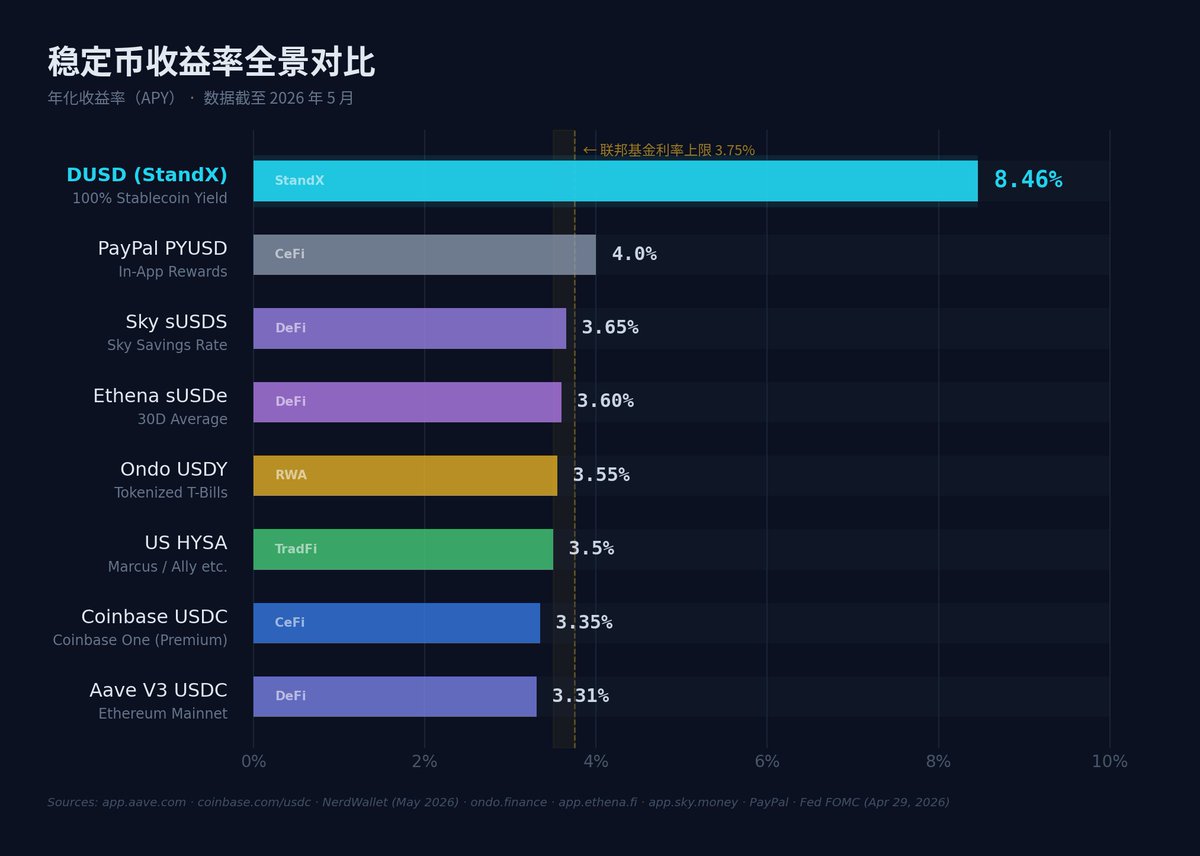
Just compare horizontally. After the Federal Reserve cut rates three times in a row by the end of 2025, the federal funds rate settled at 3.50–3.75%, pushing down the ceiling for "safe returns" across the market. From Aave's 3.31% to Ethena's 3.60%, all mainstream stablecoin yield products are squeezed into an extremely narrow range. DUSD's 8.46% is more than double that.

Moreover, this yield is sustainable, not cyclical. Most yield-bearing stablecoins (including Ethena sUSDe) heavily rely on funding rates—look good in bull markets, but get compressed in bear markets. DUSD is different: over 7% of its 8.46% comes from transaction fees ( SIP-2 + SIP-3 ), which is independent of market direction. As long as people trade, there is fee income, and there is yield. The introduction of SIP-3 is a structural upgrade that transcends bull and bear cycles—it transforms DUSD from "relying solely on funding rates" to being "driven by a dual-engine of fees + funding rates." This is unique among all yield-bearing stablecoins.

Replicate My Strategy in 3 Steps with Zero Wear and Tear

The whole process takes less than five minutes. You need two wallets, 5,000 USDT each, and a small amount of BNB for Gas.

  1. Obtain DUSD and Deposit into Perps Wallet

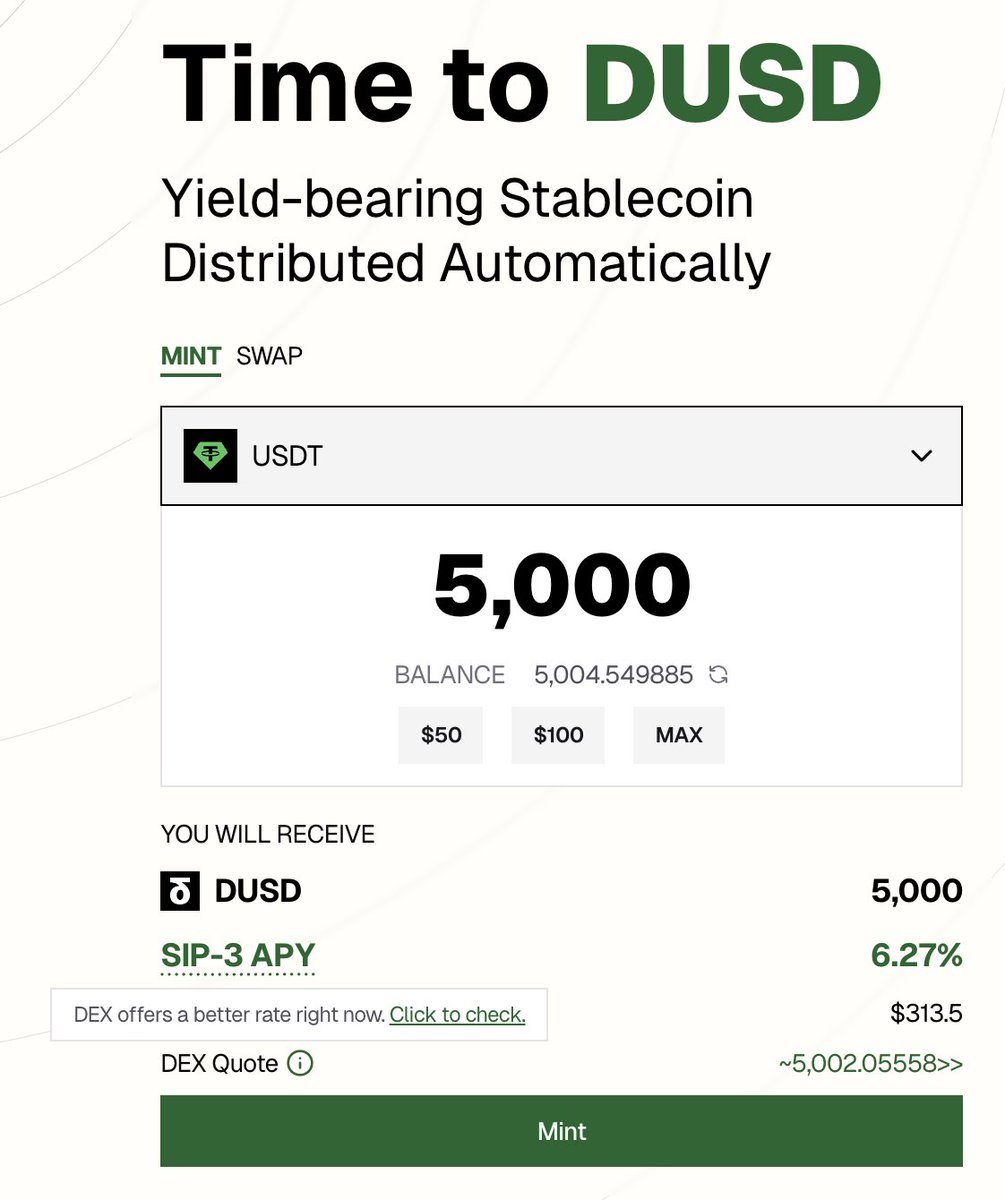
    Log in to both wallets at standx.com $DUSD page Select Swap (gets you a few extra dollars compared to Mint) Swap 5,000 USDT for approximately 5,002 DUSD. Note the prompt at the bottom of the page; our system helpfully informs you when the DEX quote is more favorable.
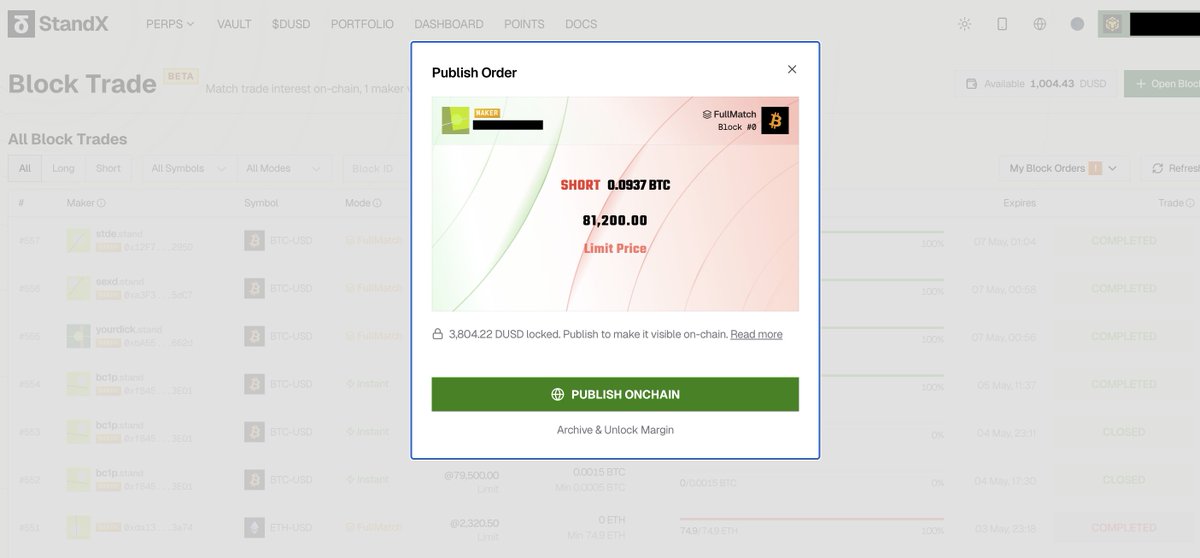
  1. Account A Creates a Block Trade Long Position

    PERPS Block Trade + Open Block Select BTC-USD, CROSS · 2X, Limit Price, FullMatch Click LONG PUBLISH ONCHAIN. After publishing, copy the share link and send it to the other wallet.
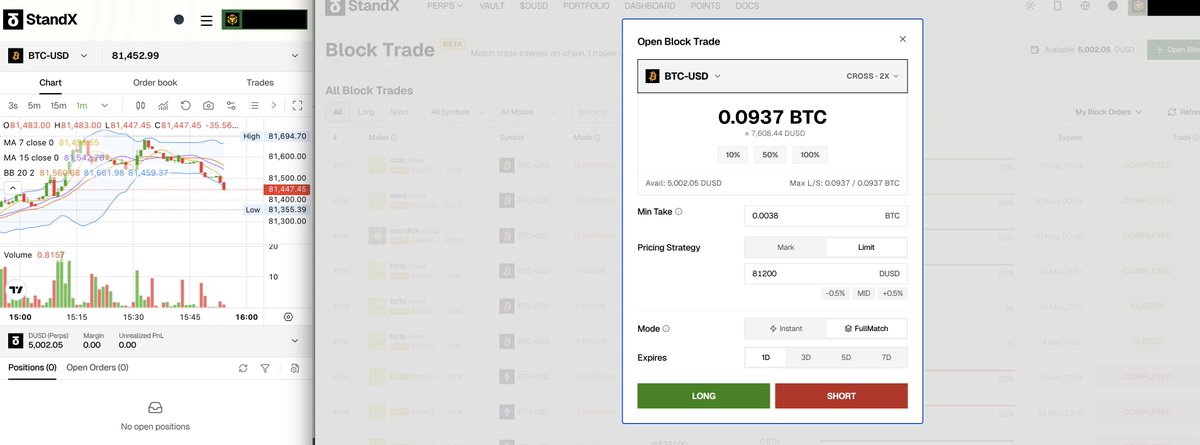
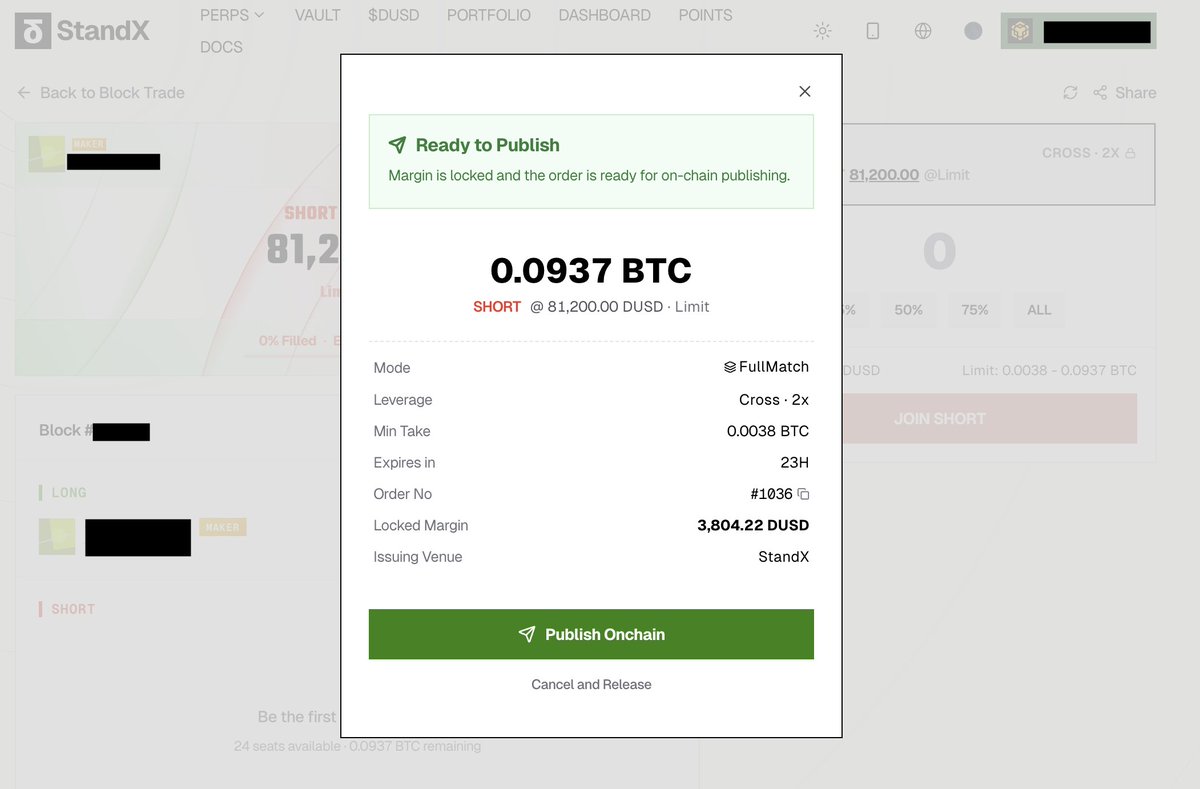
  1. Account B Accepts the Block Trade Short Position

    Switch to Wallet B Go to Block Trade Change the leverage to CROSS · 2X (default might be 10X) Click JOIN SHORT Confirm Publish Onchain.
Done! The two accounts are perfectly hedged. On the left -$12.20, on the right +$12.19, net PnL is nearly $0.
Why is this strategy "zero wear and tear"?

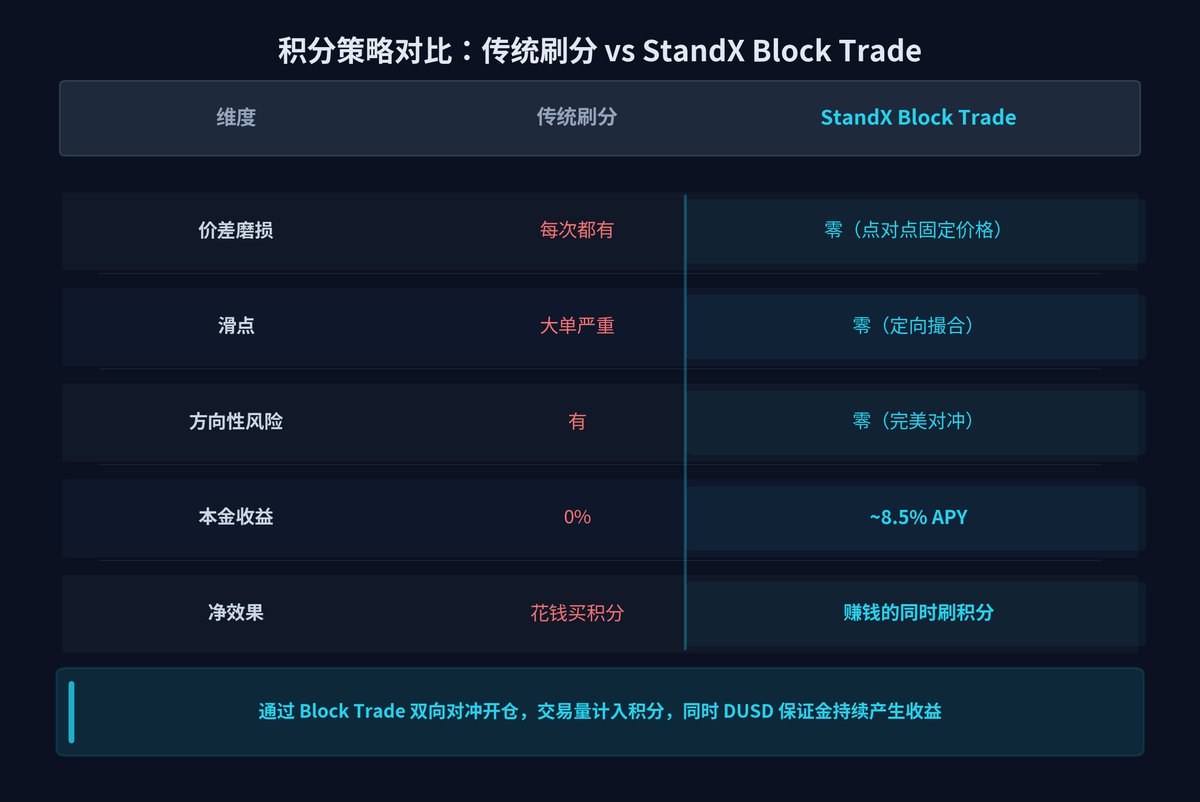
Airdrop farming used to be like factory work. You repeatedly open and close positions, trade volume, check in, transfer funds, twisting your wallet addresses into the machines designed by project teams like an assembly line worker. Finally, the airdrop arrives, and the project says: Thanks for participating, but this batch of addresses has low weighting. Worse, you didn't work for free—spreads, slippage, fees, Gas, all slowly wear down your principal. Block Trade is completely different—not only does it accumulate points with zero loss, but your principal also steadily generates earnings.
Risk Disclosure

  1. Smart Contract Risk: This is the underlying risk of all DeFi. StandX contracts are audited, but no protocol can guarantee 100% security.

  2. Yield Volatility: 8.46% is not a fixed yield. The Base layer fluctuates with funding rates; the SIP-2/3 layers depend on platform trading volume. However, the fee-driven structure offers better cyclical resilience than a pure funding rate model.

Preview of Next Article

I'd like to talk about StandX from a different angle. As someone who used to evaluate projects from the VC side and now works on Growth inside a project, I increasingly feel that this team has some severely underrated qualities. For instance, why some DEXes ranked higher than us on DefiLlama have price differences on BTC perpetual contracts that are $20-30 larger compared to StandX (high trading volume ≠ good trading experience), or the design logic behind each product proposal from SIP-1 to SIP-3. Having a great product but being unknown might be the most common and unfortunate thing in this sector. The next article will try to bridge that information gap.

If you try this strategy, feel free to share your earnings screenshots in the comments.

Disclaimer: I am responsible for Growth work at StandX. This article contains personal test data and industry analysis, and does not constitute investment advice. DeFi protocol risks include but are not limited to smart contract vulnerabilities, liquidity risk, funding rate volatility, etc. DYOR.

Data Source: StandX platform test data (May 7-15, 2026). All APY data is time-sensitive; please refer to real-time data.


Пов'язані питання

QAccording to the article, what is the main reason why the author decided to personally test the DUSD strategy on StandX?

AThe author's main reason was to verify the claimed yield, specifically whether DUSD could genuinely generate money with an APY of around 8.46% that is settled in DUSD and not reliant on token subsidies. Doubting the number's validity, they decided to use a direct, honest method of depositing $10,000 into two accounts to test it out.

QWhat are the three layers that make up the approximately 8.46% APY for DUSD, as explained in the article?

AThe three layers are: 1) DUSD Base (approx. 1.27%), derived from funding rates. 2) SIP-2 Position Yield Boost (approx. 2.27%), which is protocol revenue sharing for providing liquidity. 3) SIP-3 Universal Fee Distribution (approx. 4.92%), where trading fees are distributed to all DUSD holders, regardless of their trading activity.

QHow does the author's tested strategy achieve "zero directional risk"?

AThe strategy achieves zero directional risk by using two accounts to create offsetting positions. One account opens a LONG position on BTC-USD via Block Trade, while the second account uses the same Block Trade to open a SHORT position on BTC-USD with the same parameters. This creates a perfectly hedged pair where gains and losses from BTC price movements cancel each other out, leaving only the yield earnings from holding DUSD.

QWhy does the article argue that DUSD's yield is more sustainable and resilient across market cycles compared to other yield-bearing stablecoins like Ethena?

AThe article argues DUSD's yield is more sustainable because over 7% of its ~8.46% APY comes from trading fees (SIP-2 and SIP-3), which are not dependent on market direction or funding rates. This contrasts with models like Ethena's USDe, which are highly reliant on funding rates that can be strong in bull markets but compress in bear markets. The fee-based structure provides a more consistent revenue stream as long as there is trading activity on the platform.

QWhat are the two main risks mentioned by the author regarding the DUSD strategy on StandX?

AThe two main risks mentioned are: 1) Smart contract risk, which is the fundamental risk for all DeFi protocols. 2) Yield volatility, meaning the 8.46% APY is not a fixed return. The Base layer fluctuates with funding rates, and the SIP-2/SIP-3 layers depend on the platform's trading volume. However, the article notes the fee-driven model offers better cyclical resilience than pure funding rate models.

Пов'язані матеріали

GitHub Empire on the Brink of Collapse: Source Code Leak, 18-Year Veteran Leaves, Microsoft Loses 1.5 Billion Developers

GitHub is facing an unprecedented crisis, marked by a massive exodus of developers and severe operational failures. The tipping point came when Mitchell Hashimoto, creator of Ghostty and an 18-year GitHub user, publicly severed ties, citing persistent platform outages that made serious work impossible. This departure highlights a broader pattern of user frustration. The platform's instability has drawn complaints from major corporate clients like Citibank and Intel, forcing Microsoft to issue substantial service credits. A critical incident last month saw an accidentally triggered, unreleased feature cause widespread repository rollbacks, erasing recent code changes and pushing enterprises to migrate. Security has catastrophically breached. In May 2026, hackers infiltrated over 3,800 of GitHub's internal repositories via a poisoned VS Code extension installed by a developer, leading to the attempted sale of core source code for $50,000. This follows the discovery of a critical zero-day vulnerability in March that threatened access to millions of repositories. Internally, GitHub's autonomy has collapsed. After the resignation of CEO Thomas Dohmke in mid-2025, Microsoft eliminated the CEO role, folding GitHub into its CoreAI division under the unpopular leadership of Jay Parikh. This triggered a talent drain, with key executives and engineers leaving. A disruptive migration of GitHub's infrastructure to Azure servers, pushed by CTO Vladimir Fedorov, is blamed for the recurring outages. Competitively, GitHub Copilot is under "existential threat" from superior AI coding tools like Cursor (now owned by SpaceX) and Claude Code, which offer more advanced contextual coding and automation. Ironically, Microsoft's own engineers reportedly preferred Claude Code, forcing management to revoke licenses. Financially, GitHub is a loss leader. Despite Copilot surpassing 4.7 million paid users and $3 billion in annual revenue, the AI inference costs for free services massively outstrip subscription income, hurting Microsoft's cloud margins. The recent shift from a flat fee to a pay-as-you-go model for Copilot has further alienated developers. The core question for Microsoft is whether a centralized code repository remains essential in the AI agent era. The erosion of trust, developer culture, and platform reliability threatens the very ecosystem Microsoft spent decades building.

marsbit1 год тому

GitHub Empire on the Brink of Collapse: Source Code Leak, 18-Year Veteran Leaves, Microsoft Loses 1.5 Billion Developers

marsbit1 год тому

SEC Promotes Tokenized Stocks, Is the Traditional Finance Industry Starting to Worry?

The U.S. Securities and Exchange Commission (SEC) is preparing to formally release an "innovation exemption" framework this week. This framework would allow third parties to tokenize U.S. stocks like Apple and Tesla without approval from the listed companies. The move, rooted in a deregulatory vision proposed by pro-crypto commissioners earlier this year, could accelerate the migration of traditional stock markets to blockchain. This development poses a structural threat of "fragmentation" to traditional finance. Core concerns are liquidity fragmentation—where trading volume disperses across multiple blockchains and platforms, leading to price disparities and reduced market efficiency—and revenue fragmentation—where trading fees and intermediary income shift away from domestic exchanges to overseas or competing platforms. The report compares the traditional stock market to a monopolistic "supermarket." Tokenization enables countless "street stalls" to operate outside this system, threatening the exchange's dominance, diluting liquidity for large orders, and slicing into revenue streams. Evidence of this capital fragmentation is already emerging. On the same day the SEC signaled the framework, decentralized platform Hyperliquid saw its RWA (real-world asset) open interest hit a record $2.6 billion, driven by demand for 24/7 on-chain trading of traditional assets. Traditional institutions face a dilemma: either collaborate to build tokenization infrastructure proactively or lobby regulators to block innovation. Regulators must balance controlling the pace of innovation with preventing domestic revenue from being captured by offshore platforms. Key future battles will revolve around defining shareholder rights for tokenized assets and regulating platforms that have grown in regulatory gray areas. In the digital asset era, inaction risks the permanent loss of long-held fee monopolies and financial leadership as capital continues to disperse.

marsbit1 год тому

SEC Promotes Tokenized Stocks, Is the Traditional Finance Industry Starting to Worry?

marsbit1 год тому

A Comprehensive Analysis of On-Chain Pre-IPO: Why is the Pricing Power of SpaceX and OpenAI Moving On-Chain?

This podcast episode explores the rise of on-chain pre-IPO price discovery and trading, focusing on companies like SpaceX, OpenAI, and Anthropic. Key trends include the recent launch of a SpaceX pre-IPO perpetual contract on Hyperliquid, the secondary market trading of AI company shares, and a new partnership between Nasdaq Private Market and Polymarket. Dio Casares explains why AI companies like OpenAI and Anthropic actively deny the legitimacy of secondary trades. Primary reasons are to protect their primary funding rounds (as secondary trades don't provide cash to the company) and to avoid complex legal and administrative responsibilities associated with settling these transactions. He argues that on-chain **derivatives** (like perpetuals) are a more viable solution than **tokenized spot markets**, as they better navigate U.S. regulatory holding period requirements, provide effective hedging, and avoid antagonizing the companies themselves by competing with their primary raises. The discussion covers the risks and methods of gaining pre-IPO exposure, from direct investments and SPVs to riskier, layered structures that can lead to legal complications and settlement issues. Casares also maps the landscape of key players, differentiating between traditional secondary brokers (like Forge, Hiive, and Setter) and on-chain derivatives protocols (like Trade.xyz/Ventuals on Hyperliquid) and tokenization platforms (often on Solana). He positions Patagon as a facilitator for access to private market deals but clarifies it avoids on-chain tokenization to maintain good relations with portfolio companies. Looking ahead, the convergence of a historic IPO pipeline (with potential trillion-dollar valuations), the 24/7 nature of crypto markets, and the strategic use of pre-market perpetuals as a "loss leader" suggest continued growth and competition in the on-chain pre-IPO space.

marsbit2 год тому

A Comprehensive Analysis of On-Chain Pre-IPO: Why is the Pricing Power of SpaceX and OpenAI Moving On-Chain?

marsbit2 год тому

Token Packages Are Here, Are Telecom Operators in a Hurry?

Major Chinese telecom operators are launching token-based AI computing packages, sparking public debate and highlighting a strategic shift amid slowing traditional revenue growth. In May, Shanghai Telecom introduced token plans (e.g., 9.9 RMB for 10 million tokens), quickly followed by nationwide offerings from China Telecom, China Mobile, and China Unicom. While priced higher than major AI firms like DeepSeek, these packages allow users to access multiple AI models via API using their phone bills, similar to purchasing universal mobile data. The move reflects operators' anxiety as traditional voice, SMS, and data services stagnate. With revenue growth hitting multi-year lows in 2025, AI and computing power represent a critical new frontier. However, current C端 offerings, such as AI photo editing or virtual pets, are seen as non-essential and highlight operators' role as "pipes" or integrators rather than creators of compelling AI products. Beyond consumer packages, operators aim to become key infrastructure players in China’s national computing power network. They position themselves as the "power grid" delivering AI算力, leveraging their vast network of base stations to ensure low-latency, reliable coverage, especially for applications like autonomous driving. This infrastructure role, coupled with unified national调度, could make算力 a ubiquitous utility, driving new consumption scenarios even if mass adoption of token packages remains uncertain.

marsbit2 год тому

Token Packages Are Here, Are Telecom Operators in a Hurry?

marsbit2 год тому

Торгівля

Спот
Ф'ючерси
活动图片