Bridging Traditional Funds and DeFi: Who Will Capture the Next Decade's RWA Dividends?

Foresight NewsОпубліковано о 2026-07-08Востаннє оновлено о 2026-07-08

Анотація

Bridging Traditional Funds and DeFi: Who Will Capture the RWA Decade's Value? Tokenization of real-world assets (RWA) is merging the 24/7, permissionless world of DeFi with the time-bound, regulated world of traditional finance. While the complexity is immense, the infrastructure layer enabling this fusion holds significant value. The total value of on-chain tokenized real-world assets now exceeds $33 billion. While tokenized U.S. Treasuries dominate, their share has fallen from 55% to under 45% in a year as other assets like institutional and private credit grow. The key differentiator for on-chain assets is *composability*, allowing capital to be recycled across multiple yield-generating strategies simultaneously. However, tokenized funds remain regulated products with daily NAV updates, KYC requirements, and redemption windows. Bridging these to DeFi requires solving core conflicts: pricing assets between NAV updates, enforcing compliance without stifling DeFi activity, and maintaining accurate accounting during cross-chain transfers. Solutions like the Centrifuge V3 architecture, in collaboration with LayerZero, propose a hub-and-spoke model. A single authoritative hub chain manages NAV, compliance, and accounting, while LayerZero's messaging layer syncs this data to spokechains where tokens can be freely composed in DeFi. This creates a high-barrier, essential middleware layer. The major incentive for institutions is the potential for recursive yield strategies—for ...


Author: Prathik Desai

Translation: Chopper, Foresight News


Asset tokenization is merging two distinct financial systems: one is the permissionless, 24/7, and highly volatile world of DeFi; the other is the traditional fund industry, which operates on fixed settlement periods and is only accessible to vetted, accredited investors.


The process of bridging these two worlds is extremely complex. However, whoever builds this critical infrastructure layer stands to capture immense industry value. This article deconstructs who is building this connective layer between on-chain and traditional finance and where the ultimate value will flow.


RWA Scale Continues to Expand


The total value of tokenized real-world assets on-chain has surpassed $33 billion, with tokenized U.S. Treasury bonds accounting for approximately $15 billion. Interestingly, in just one year, the share of U.S. Treasuries within the total RWA pie has shrunk from 55% to less than 45%. Newer forms of tokenized funds, such as institutional credit (e.g., ACRED by Apollo) and private credit (e.g., JAAA by Janus Henderson), are experiencing rapid growth.


The maturation of asset tokenization provides corporate treasurers and CFOs with tools for layered risk allocation. Institutions seeking low volatility, high liquidity, and modest returns can opt for Treasury-backed token products. Entities pursuing higher yields and programmability can allocate to higher-risk categories. Today, these underlying Treasury token products are backed by reports from the Big Four auditing firms, meaning security of yield is no longer the primary concern.


If someone asks me what the difference is between on-chain assets and traditional assets, the answer is composability. Leveraging this composability, the same dollar can circulate across multiple channels to generate value, achieving compounded returns. Instant redemptions and multi-channel capital reuse make tokenized funds akin to traditional asset management products with added leverage.


In the traditional financial system, it is difficult to simultaneously achieve high yield, liquidity, and capital turnover speed. A well-operated tokenized product can excel in all three aspects. However, the barrier for "well-operated" is exceedingly high. Bridging the composability between traditional funds and on-chain DeFi presents numerous engineering and regulatory challenges.


Stitching Together Two Distinct Worlds


Blockchain brings the advantages of rapid settlement and low costs to tokenized real-world assets. However, the essence of a tokenized money market fund remains that of a regulated asset management product, not a stablecoin.


It still requires updating its net asset value (NAV) once per business day, according to the fund manager's schedule. It still needs to maintain a KYC-verified holder base. For example, BlackRock's BUIDL has a minimum investment threshold of $5 million, while Circle's USYC is restricted to non-U.S. persons. It still must adhere to redemption cutoff times because the settlement of its underlying Treasury securities relies on off-chain infrastructure, which typically has a cut-off time of 5:00 PM Eastern Time.


These are hard requirements that cannot be circumvented. Removing daily NAV pricing would strip the product of its classification as a money market fund. Opening up permissionless trading would invite immediate regulatory scrutiny from the SEC.


So, how can fund share tokens achieve internet-speed transferability while the fund itself retains its fixed NAV update cycle, accredited investor restrictions, and redemption time windows? The industry requires dedicated infrastructure to handle periodic NAV accounting, phased settlements, and strict cross-chain compliance isolation. A joint report by LayerZero and Centrifuge outlines such a solution.


Three Core Conflict Points Are Key to Successful Integration


The middle orchestration layer must resolve three fundamental conflicts to enable high-speed circulation of fund assets without crossing regulatory red lines.


The first is price.


How should tokens be priced during the interval between daily NAV updates? Some issuers simply freeze the previous day's NAV, a model prone to arbitrage during intraday interest rate fluctuations. Real-time dynamic pricing better reflects the market but is difficult to reconcile with the traditional fund's daily accounting.


The second is compliance.


Should whitelist verification occur at every transaction step, or be consolidated at the vault layer? If every transfer requires identity verification, tokens cannot be integrated into open DeFi. If a vault wrapping model is adopted—where a vault holds the compliant fund shares and only KYC-ed users can mint circulating receipt tokens—compliance checks are performed once, and the receipt tokens can freely participate in various DeFi protocols. Centrifuge's deRWA framework follows this logic.


The third conflict arises during cross-chain asset transfers.


When a fund is deployed across multiple public blockchains, a single authoritative data source is needed to track holders and asset valuations. While on-chain data can be updated in real-time, synchronizing accounting across nine different chains is highly error-prone. More points of failure increase the probability of errors.


LayerZero and Centrifuge address this with a hub-and-spoke architecture. In this model, one authoritative chain (the hub) is responsible for managing NAV, accounting, and compliance. A messaging layer (in this case, coordinated by LayerZero) propagates these updates to the spoke chains where the tokens are actually used.
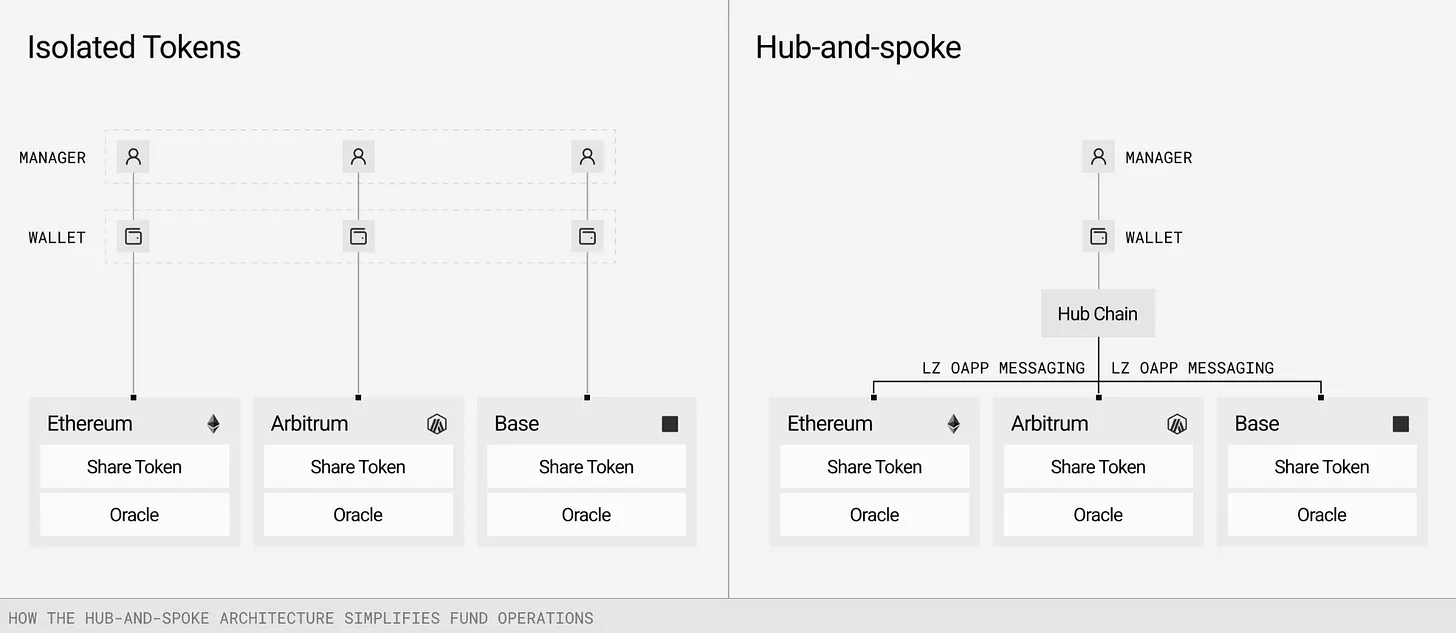


Centrifuge's V3 architecture is built on this model. Each asset pool selects a hub chain as its single source of truth. The spoke chains act merely as deposit/withdrawal and distribution nodes while also offering DeFi composability. LayerZero is responsible for cross-chain synchronization of NAV, compliance instructions, and user position data.


This cross-chain orchestration system establishes a significant industry barrier. A fund's authoritative ledger is maintained by a single set of infrastructure, making it highly irreplaceable. Asset managers handle offline NAV and compliance rules. Blockchains provide on-chain composability. The middle orchestration layer is indispensable, and its value is highly concentrated.


The accounting for assets in transit during cross-chain transfers is the weakest link. When assets move across chains, they briefly fall outside the visible scope of the fund's balance sheet. Centrifuge V3 introduces a mechanism for in-transit asset certificates, ensuring accounting continuity during cross-chain transfers—analogous to the general ledger principle in traditional finance. This seemingly basic feature is essential for institutional adoption.


Despite these conflicts, why would institutional investors consider tokenized funds?


The core advantage is recursive staking arbitrage. A corporate treasury deposits into a tokenized Treasury fund and pledges the shares as collateral to borrow stablecoins. If the borrowing rate is lower than the Treasury fund's yield, the position naturally generates a positive carry. The borrowed stablecoins can then be deployed into another yield-bearing asset, creating a potentially infinite loop to amplify cash flow returns.
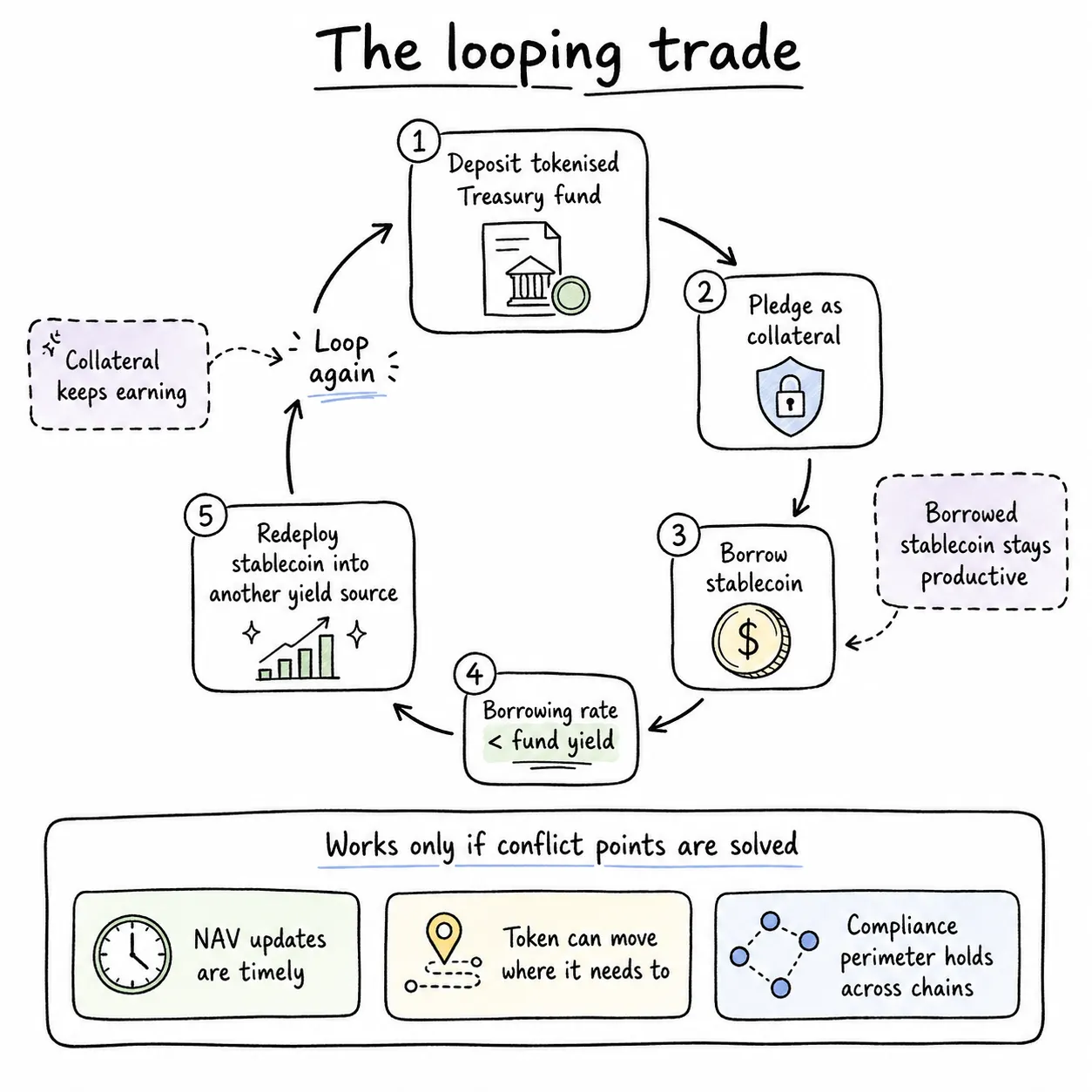


The entire recursive arbitrage loop is only viable if the three major conflict points mentioned earlier are properly resolved. In the past, the industry saw significant arbitrage opportunities due to mechanism flaws: small tokenized products had NAV updates delayed by 2-4 hours, allowing carry traders to front-run the difference. Redemption conflict risks are equally significant. If the off-chain underlying assets hit redemption limits while the on-chain smart contract continues to process instant redemptions, it creates a large number of unfilled orders.


Currently, large private credit funds and business development companies are facing this scenario. Two weeks ago, Apollo's $26 billion private credit fund, ADS, faced a wave of redemptions, with investors requesting withdrawals totaling 16.8% of the fund's shares. The platform was forced to cap daily redemptions at 5%. If this product had simultaneously issued tokens, the conflict between on-chain instant redemptions and off-chain redemption limits would have been direct. In Q2 of this year, redemption requests for large private credit funds reached $15.6 billion, up from $13.9 billion the previous quarter.


Cross-chain messaging failures mid-transaction and partially settled assets are also high-frequency risks. For each type of failure in this system, licensed entities must bear regulatory accountability to earn the trust of institutional capital.


Tokenization is not simply about putting Treasuries on-chain or adding a new digital asset class. Infrastructure builders must break traditional constraints, allowing investors not to choose between yield, liquidity, and capital turnover. If a tokenized system can uphold regulatory risk controls while enabling multi-purpose value generation from a single pool of capital, institutions holding trillions in cash will inevitably deploy at scale.


As mentioned in last week's article, SWIFT, as an orchestration layer, holds far greater value than the banks at either end. Similarly, the Visa network's profitability nearly surpasses that of all its partner banks except JPMorgan Chase. In the evolution of the financial industry, whoever controls the middle orchestration layer will lock in the capital market dividends of the next decade. Centrifuge is deeply focused on fund-side infrastructure, while LayerZero is building the cross-chain communication foundation. Together, they are positioning themselves at the core of this critical sector.

Трендові криптовалюти

Пов'язані питання

QWhat is the core advantage of tokenized real-world assets (RWAs) over traditional assets, according to the article?

AThe core advantage is composability. It allows the same pool of capital to be leveraged and reused across multiple on-chain strategies, enabling compound returns, instant redemption, and enhanced capital efficiency compared to traditional systems where yield, liquidity, and speed are often trade-offs.

QWhat are the three core conflicts that must be solved by a middleware layer to successfully bridge traditional funds and DeFi?

AThe three core conflicts are: 1) Pricing: how to price tokens between daily net asset value (NAV) updates. 2) Compliance: where and how to enforce KYC/whitelist checks without crippling DeFi composability. 3) Cross-chain accounting: how to maintain a single source of truth for holder records and valuations across multiple blockchains.

QHow does the Centrifuge V3 architecture, in collaboration with LayerZero, address the cross-chain accounting problem?

AIt uses a hub-and-spoke model. One authoritative chain (the hub) serves as the single source of truth for NAV, accounting, and compliance. A messaging layer (LayerZero) propagates these updates to the spoke chains where the tokens are actually used, ensuring data consistency and reducing errors from multi-chain synchronization.

QWhat major risk example does the article give to illustrate the conflict between on-chain and off-chain redemption processes?

AThe article cites Apollo's $26 billion private credit fund (ADS) facing redemptions of 16.8% of its shares. The fund had to impose a 5% daily redemption limit. If this fund had an on-chain token, the conflict would arise between the smart contract allowing instant redemptions and the off-fund's imposed limits, potentially creating unsettled orders.

QAccording to the article, who is positioned to capture the future value in the RWA tokenization space, and why?

AThe value will be captured by the entities that build and control the critical middleware scheduling layer—the infrastructure that bridges traditional funds and on-chain DeFi. The article draws an analogy to SWIFT and Visa, whose central coordination roles are more valuable than the endpoints. Specifically, it mentions Centrifuge (fund-side infrastructure) and LayerZero (cross-chain communication) as occupying this core position.

Пов'язані матеріали

Weng Li's New Blog Proposes 'Self-Evolution Should Start from Harness', DeepSeek's Cui Tianyi Endorses with Repost

Lilian Weng, former OpenAI security VP and co-founder of Thinking Machines Lab, has published a new blog post titled "Harness Engineering for Self-Improvement," proposing a pragmatic path for AI self-evolution. She argues that Recursive Self-Improvement (RSI) may practically begin at the "Harness" layer—the external runtime system governing how models use tools, manage context, and execute tasks—rather than directly from the model rewriting its own weights. The blog outlines a progression from optimizing prompts (Context Engineering) to designing workflows, and ultimately to Self-Improving Harness systems. These systems can identify their own weaknesses, propose targeted, verifiable modifications to the harness code, and validate improvements. Works like Self-Harness and Darwin Gödel Machine (DGM) demonstrate significant performance gains on benchmarks like SWE-bench through such automated harness evolution, rivaling handcrafted agents. DeepSeek researcher Tianyi Cui endorsed the view, noting harness-based self-evolution is as promising as model-based approaches. Weng emphasizes this is complementary to model training, with both reinforcing each other. However, key challenges remain: weak evaluators for subjective tasks, reward hacking, diversity collapse, managing long-term system health versus short-term success, and defining the human oversight role. The consensus is growing: the harness is a critical variable, as the same model can exhibit vastly different capabilities within different harness systems.

marsbit17 хв тому

Weng Li's New Blog Proposes 'Self-Evolution Should Start from Harness', DeepSeek's Cui Tianyi Endorses with Repost

marsbit17 хв тому

Odaily Editorial Department Tea Party (July 8)

Odaily Editorial Team Casual Chat (July 8) This is an informal column from Odaily's editorial team, sharing immediate thoughts on industry news, data, and hot topics from various angles. It presents investment ideas and opportunity hypotheses still under verification—which may not be direct wealth codes but questions in themselves—alongside observations from industry interactions and materials that genuinely enhance the team's understanding. The content is based on real investment and observation experiences, carries no advertising, and does not constitute investment advice. Its purpose is to broaden perspectives and supplement information sources, not to create consensus. Team Member Shares: * **Wenser (@wenser2010):** Noted a deeper correction (nearly 30%) in US and Korean stocks, including memory stocks, but remains bullish on DRAM due to perceived supply shortages. In prediction markets, personal small bets outperformed blind copying; favors France to win the World Cup. Views crypto-related stocks like STRK as bearish for now, while seeing Circle and Coinbase as potential rebound plays. Observes recent strength in software stocks like Microsoft but is unsure if it's a sustained recovery. * **Bcxiongdi (@bcxiongdi):** Discusses the recent "recovery training" in meme coin markets on Solana and BSC, characterized by small-scale PVP opportunities, admitting to having sold many assets too early. Suggests also watching the Robinhood chain. Found World Cup prediction markets challenging, advising to consider buying during matches rather than only before. * **Azuma (@azuma_eth):** Focuses on the US stock market, particularly the significant semiconductor correction. Believes demand fundamentals remain and considers buying the dip in DRAM stocks. Notes a potential rotation signal as hedge funds have recently concentrated buying in tech stocks. Plans to continue adding to RKLB (Rocket Lab) stock, seeing limited downside and high upside potential at current levels after its founder's share sale window closed.

Odaily星球日报33 хв тому

Odaily Editorial Department Tea Party (July 8)

Odaily星球日报33 хв тому

Former Huawei 'Genius Teen' Who Questioned DeepSeek Interview Lands in 'Crossfire' from Web3 Investor

Former Huawei "Genius Youth" Li Bojie recently drew public attention by criticizing his interview experience with DeepSeek. The controversy escalated when Du Jun, co-founder of Web3 investment firm ABCDE Capital, publicly accused Li of being "the founder with the least sense of contractual spirit" he had ever cooperated with, sparking a dispute over Li's startup project, Metagent. Li detailed a frustrating DeepSeek interview where he was accused of potential plagiarism, leading him to end the session. The spotlight then shifted to his venture, Metagent, a Web3+AI project aiming to tokenize AI agents. ABCDE invested $1.5 million, with an initial $500k disbursed. Du Jun claimed the project's progress was severely lacking, with a poor-quality demo and minimal social media activity. He alleged Li stopped communicating, deleted his Telegram, and failed to provide proper financial reporting. In response, Li argued the remaining $1 million was never received, crippling operations and forcing salary cuts. He stated he left Metagent in October 2024 due to family reasons and Web3 compliance concerns, with board approval. He claimed to have fulfilled disclosure duties and that his subsequent projects avoided conflicting fields. Other investors, including ArkStream Capital, shared negative due diligence experiences, citing unprofessional contracts and evasive answers on tokenomics. Metagent's social media went silent in June 2024, effectively stalling. Li has since moved to a new consumer AI agent platform, Pine AI (formerly Logenic AI), which has raised $25 million in Series A funding. He served as its Chief Scientist but recently left, clarifying he was not the founder and departed due to a shift in research interests.

Foresight News1 год тому

Former Huawei 'Genius Teen' Who Questioned DeepSeek Interview Lands in 'Crossfire' from Web3 Investor

Foresight News1 год тому

Торгівля

Спот

Популярні статті

Що таке $S$

Розуміння SPERO: Комплексний огляд Вступ до SPERO Оскільки ландшафт інновацій продовжує еволюціонувати, виникнення технологій web3 та криптовалютних проектів відіграє ключову роль у формуванні цифрового майбутнього. Один з проектів, який привернув увагу в цій динамічній сфері, — це SPERO, позначений як SPERO,$$s$. Ця стаття має на меті зібрати та представити детальну інформацію про SPERO, щоб допомогти ентузіастам та інвесторам зрозуміти його основи, цілі та інновації в рамках web3 та крипто-сектору. Що таке SPERO,$$s$? SPERO,$$s$ — це унікальний проект у криптопросторі, який прагне використати принципи децентралізації та технології блокчейн для створення екосистеми, що сприяє залученню, корисності та фінансовій інклюзії. Проект розроблений для полегшення взаємодії між користувачами новими способами, надаючи їм інноваційні фінансові рішення та послуги. У своїй основі SPERO,$$s$ прагне надати можливості індивідам, забезпечуючи інструменти та платформи, які покращують користувацький досвід у криптовалютному просторі. Це включає в себе можливість більш гнучких методів транзакцій, сприяння ініціативам, що підтримуються спільнотою, та створення шляхів для фінансових можливостей через децентралізовані додатки (dApps). Основна концепція SPERO,$$s$ обертається навколо інклюзивності, прагнучи зменшити розриви в традиційній фінансовій системі, використовуючи переваги технології блокчейн. Хто є творцем SPERO,$$s$? Особистість творця SPERO,$$s$ залишається дещо невідомою, оскільки є обмежені публічно доступні ресурси, що надають детальну інформацію про його засновників. Ця відсутність прозорості може бути наслідком зобов'язання проекту до децентралізації — етики, яку багато проектів web3 поділяють, ставлячи колективні внески вище за індивідуальне визнання. Зосереджуючи обговорення навколо спільноти та її колективних цілей, SPERO,$$s$ втілює суть наділення без виділення конкретних осіб. Таким чином, розуміння етики та місії SPERO є більш важливим, ніж ідентифікація єдиного творця. Хто є інвесторами SPERO,$$s$? SPERO,$$s$ підтримується різноманітними інвесторами, починаючи від венчурних капіталістів до ангельських інвесторів, які прагнуть сприяти інноваціям у крипто-секторі. Зосередження цих інвесторів зазвичай узгоджується з місією SPERO — пріоритет надається проектам, які обіцяють технологічний прогрес у суспільстві, фінансову інклюзію та децентралізоване управління. Ці інвесторські фонди зазвичай зацікавлені в проектах, які не лише пропонують інноваційні продукти, але й позитивно впливають на спільноту блокчейн та її екосистеми. Підтримка з боку цих інвесторів підкріплює SPERO,$$s$ як значного конкурента в швидко змінюваній сфері крипто-проектів. Як працює SPERO,$$s$? SPERO,$$s$ використовує багатогранну структуру, яка відрізняє його від традиційних криптовалютних проектів. Ось деякі ключові особливості, які підкреслюють його унікальність та інноваційність: Децентралізоване управління: SPERO,$$s$ інтегрує моделі децентралізованого управління, надаючи користувачам можливість активно брати участь у процесах прийняття рішень щодо майбутнього проекту. Цей підхід сприяє відчуттю власності та відповідальності серед членів спільноти. Корисність токена: SPERO,$$s$ використовує свій власний криптовалютний токен, розроблений для виконання різних функцій в екосистемі. Ці токени дозволяють здійснювати транзакції, отримувати винагороди та полегшувати послуги, що пропонуються на платформі, підвищуючи загальну залученість та корисність. Шарова архітектура: Технічна архітектура SPERO,$$s$ підтримує модульність та масштабованість, що дозволяє безперешкодно інтегрувати додаткові функції та додатки в міру розвитку проекту. Ця адаптивність є надзвичайно важливою для збереження актуальності в постійно змінюваному крипто-ландшафті. Залучення спільноти: Проект підкреслює ініціативи, що підтримуються спільнотою, використовуючи механізми, які стимулюють співпрацю та зворотний зв'язок. Підтримуючи сильну спільноту, SPERO,$$s$ може краще задовольняти потреби користувачів та адаптуватися до ринкових тенденцій. Фокус на інклюзію: Пропонуючи низькі комісії за транзакції та зручні інтерфейси, SPERO,$$s$ прагне залучити різноманітну базу користувачів, включаючи осіб, які раніше не брали участі в крипто-просторі. Це зобов'язання до інклюзії узгоджується з його загальною місією наділення через доступність. Хронологія SPERO,$$s$ Розуміння історії проекту надає важливі уявлення про його розвиток та етапи. Нижче наведено пропоновану хронологію, що відображає значні події в еволюції SPERO,$$s$: Етап концептуалізації та ідеації: Початкові ідеї, що стали основою SPERO,$$s$, були сформовані, тісно пов'язані з принципами децентралізації та фокусом на спільноті в індустрії блокчейн. Запуск білого паперу проекту: Після концептуального етапу був випущений комплексний білий папір, що детально описує бачення, цілі та технологічну інфраструктуру SPERO,$$s$, щоб залучити інтерес та зворотний зв'язок від спільноти. Створення спільноти та ранні залучення: Активні зусилля були спрямовані на створення спільноти ранніх прихильників та потенційних інвесторів, що полегшило обговорення цілей проекту та отримання підтримки. Подія генерації токенів: SPERO,$$s$ провів подію генерації токенів (TGE) для розподілу своїх рідних токенів серед ранніх прихильників та встановлення початкової ліквідності в екосистемі. Запуск початкового dApp: Перший децентралізований додаток (dApp), пов'язаний з SPERO,$$s$, став доступним, дозволяючи користувачам взаємодіяти з основними функціями платформи. Постійний розвиток та партнерства: Безперервні оновлення та вдосконалення пропозицій проекту, включаючи стратегічні партнерства з іншими учасниками блокчейн-простору, сформували SPERO,$$s$ у конкурентоспроможного та еволюціонуючого гравця на крипто-ринку. Висновок SPERO,$$s$ є свідченням потенціалу web3 та криптовалют для революціонізації фінансових систем та наділення індивідів. Завдяки зобов'язанню до децентралізованого управління, залучення спільноти та інноваційно спроектованих функцій, він прокладає шлях до більш інклюзивного фінансового ландшафту. Як і з будь-якими інвестиціями в швидко змінюваному крипто-просторі, потенційним інвесторам та користувачам рекомендується ретельно досліджувати та обдумано взаємодіяти з поточними подіями в SPERO,$$s$. Проект демонструє інноваційний дух крипто-індустрії, запрошуючи до подальшого дослідження його численних можливостей. Хоча подорож SPERO,$$s$ ще триває, його основні принципи можуть справді вплинути на майбутнє того, як ми взаємодіємо з технологією, фінансами та один з одним у взаємопов'язаних цифрових екосистемах.

121 переглядів усьогоОпубліковано 2024.12.17Оновлено 2024.12.17

Що таке $S$

Що таке AGENT S

Агент S: Майбутнє автономної взаємодії в Web3 Вступ У постійно змінюваному ландшафті Web3 та криптовалюти інновації постійно переосмислюють, як люди взаємодіють з цифровими платформами. Один з таких новаторських проектів, Агент S, обіцяє революціонізувати взаємодію людини з комп'ютером через свою відкриту агентну структуру. Прокладаючи шлях для автономних взаємодій, Агент S прагне спростити складні завдання, пропонуючи трансформаційні застосування в штучному інтелекті (ШІ). Це детальне дослідження заглиблюється в складності проекту, його унікальні особливості та наслідки для сфери криптовалюти. Що таке Агент S? Агент S є революційною відкритою агентною структурою, спеціально розробленою для вирішення трьох основних викликів в автоматизації комп'ютерних завдань: Набуття специфічних знань у галузі: Структура інтелектуально навчається з різних зовнішніх джерел знань та внутрішнього досвіду. Цей подвійний підхід дозволяє їй створити багатий репозиторій специфічних знань у галузі, покращуючи її продуктивність у виконанні завдань. Планування на довгих горизонтах завдань: Агент S використовує планування з підкріпленням досвіду, стратегічний підхід, який полегшує ефективний розподіл та виконання складних завдань. Ця функція значно підвищує її здатність ефективно та результативно управляти кількома підзавданнями. Обробка динамічних, неоднорідних інтерфейсів: Проект представляє Інтерфейс Агент-Комп'ютер (ACI), інноваційне рішення, яке покращує взаємодію між агентами та користувачами. Використовуючи багатомодальні великі мовні моделі (MLLMs), Агент S може безперешкодно орієнтуватися та маніпулювати різноманітними графічними інтерфейсами користувача. Завдяки цим новаторським функціям Агент S надає надійну структуру, яка вирішує складнощі, пов'язані з автоматизацією людської взаємодії з машинами, прокладаючи шлях для численних застосувань у ШІ та за його межами. Хто є творцем Агент S? Хоча концепція Агент S є фундаментально новаторською, конкретна інформація про його творця залишається невідомою. Творець наразі невідомий, що підкреслює або початкову стадію проекту, або стратегічний вибір зберегти засновників у таємниці. Незважаючи на анонімність, акцент залишається на можливостях та потенціалі структури. Хто є інвесторами Агент S? Оскільки Агент S є відносно новим у криптографічній екосистемі, детальна інформація про його інвесторів та фінансових спонсорів не задокументована. Відсутність публічно доступних відомостей про інвестиційні фонди або організації, що підтримують проект, викликає питання щодо його фінансової структури та дорожньої карти розвитку. Розуміння підтримки є критично важливим для оцінки стійкості проекту та потенційного впливу на ринок. Як працює Агент S? В основі Агент S лежить передова технологія, яка дозволяє йому ефективно функціонувати в різних умовах. Його операційна модель побудована навколо кількох ключових функцій: Взаємодія з комп'ютером, подібна до людської: Структура пропонує розширене планування ШІ, прагнучи зробити взаємодії з комп'ютерами більш інтуїтивними. Імітуючи людську поведінку при виконанні завдань, вона обіцяє підвищити досвід користувачів. Наративна пам'ять: Використовується для використання високорівневого досвіду, Агент S використовує наративну пам'ять для відстеження історій завдань, тим самим покращуючи свої процеси прийняття рішень. Епізодична пам'ять: Ця функція надає користувачам покрокові інструкції, дозволяючи структурі пропонувати контекстуальну підтримку в міру виконання завдань. Підтримка OpenACI: Завдяки можливості працювати локально, Агент S дозволяє користувачам зберігати контроль над своїми взаємодіями та робочими процесами, узгоджуючи з децентралізованою етикою Web3. Легка інтеграція з зовнішніми API: Його універсальність і сумісність з різними платформами ШІ забезпечують те, що Агент S може безперешкодно вписатися в існуючі технологічні екосистеми, роблячи його привабливим вибором для розробників та організацій. Ці функціональні можливості колективно сприяють унікальному положенню Агент S у крипто-просторі, оскільки він автоматизує складні, багатоступеневі завдання з мінімальним втручанням людини. У міру розвитку проекту його потенційні застосування в Web3 можуть переосмислити, як відбуваються цифрові взаємодії. Хронологія Агент S Розробка та етапи Агент S можуть бути узагальнені в хронології, яка підкреслює його значні події: 27 вересня 2024 року: Концепція Агент S була представлена в комплексній науковій статті під назвою “Відкрита агентна структура, яка використовує комп'ютери як людина”, що демонструє основи проекту. 10 жовтня 2024 року: Наукова стаття була опублікована на arXiv, пропонуючи детальне дослідження структури та її оцінки продуктивності на основі бенчмарку OSWorld. 12 жовтня 2024 року: Було випущено відеопрезентацію, що надає візуальне уявлення про можливості та особливості Агент S, ще більше залучаючи потенційних користувачів та інвесторів. Ці маркери в хронології не лише ілюструють прогрес Агент S, але й вказують на його прихильність до прозорості та залучення громади. Ключові моменти про Агент S У міру розвитку структури Агент S кілька ключових характеристик виділяються, підкреслюючи її новаторський характер та потенціал: Інноваційна структура: Розроблена для забезпечення інтуїтивного використання комп'ютерів, подібного до людської взаємодії, Агент S пропонує новий підхід до автоматизації завдань. Автономна взаємодія: Здатність автономно взаємодіяти з комп'ютерами через GUI означає стрибок до більш інтелектуальних та ефективних обчислювальних рішень. Автоматизація складних завдань: Завдяки своїй надійній методології він може автоматизувати складні, багатоступеневі завдання, роблячи процеси швидшими та менш схильними до помилок. Безперервне вдосконалення: Механізми навчання дозволяють Агенту S покращуватися на основі минулого досвіду, постійно підвищуючи свою продуктивність та ефективність. Універсальність: Його адаптивність до різних операційних середовищ, таких як OSWorld та WindowsAgentArena, забезпечує його здатність служити широкому спектру застосувань. Оскільки Агент S займає своє місце в ландшафті Web3 та криптовалюти, його потенціал покращити можливості взаємодії та автоматизувати процеси означає значний прогрес у технологіях ШІ. Завдяки своїй інноваційній структурі Агент S є прикладом майбутнього цифрових взаємодій, обіцяючи більш безперешкодний та ефективний досвід для користувачів у різних галузях. Висновок Агент S представляє собою сміливий крок вперед у поєднанні ШІ та Web3, з можливістю переосмислити, як ми взаємодіємо з технологією. Хоча проект все ще на ранніх стадіях, можливості для його застосування є величезними та переконливими. Завдяки своїй комплексній структурі, що вирішує критичні виклики, Агент S прагне вивести автономні взаємодії на передній план цифрового досвіду. У міру того, як ми заглиблюємося в сфери криптовалюти та децентралізації, проекти, подібні до Агент S, безсумнівно, відіграватимуть ключову роль у формуванні майбутнього технологій та співпраці людини з комп'ютером.

748 переглядів усьогоОпубліковано 2025.01.14Оновлено 2025.01.14

Що таке AGENT S

Як купити S

Ласкаво просимо до HTX.com! Ми зробили покупку Sonic (S) простою та зручною. Дотримуйтесь нашої покрокової інструкції, щоб розпочати свою криптовалютну подорож.Крок 1: Створіть обліковий запис на HTXВикористовуйте свою електронну пошту або номер телефону, щоб зареєструвати обліковий запис на HTX безплатно. Пройдіть безпроблемну реєстрацію й отримайте доступ до всіх функцій.ЗареєструватисьКрок 2: Перейдіть до розділу Купити крипту і виберіть спосіб оплатиКредитна/дебетова картка: використовуйте вашу картку Visa або Mastercard, щоб миттєво купити Sonic (S).Баланс: використовуйте кошти з балансу вашого рахунку HTX для безперешкодної торгівлі.Треті особи: ми додали популярні способи оплати, такі як Google Pay та Apple Pay, щоб підвищити зручність.P2P: Торгуйте безпосередньо з іншими користувачами на HTX.Позабіржова торгівля (OTC): ми пропонуємо індивідуальні послуги та конкурентні обмінні курси для трейдерів.Крок 3: Зберігайте свої Sonic (S)Після придбання Sonic (S) збережіть його у своєму обліковому записі на HTX. Крім того, ви можете відправити його в інше місце за допомогою блокчейн-переказу або використовувати його для торгівлі іншими криптовалютами.Крок 4: Торгівля Sonic (S)Легко торгуйте Sonic (S) на спотовому ринку HTX. Просто увійдіть до свого облікового запису, виберіть торгову пару, укладайте угоди та спостерігайте за ними в режимі реального часу. Ми пропонуємо зручний досвід як для початківців, так і для досвідчених трейдерів.

1.6k переглядів усьогоОпубліковано 2025.01.15Оновлено 2026.06.02

Як купити S

Обговорення

Ласкаво просимо до спільноти HTX. Тут ви можете бути в курсі останніх подій розвитку платформи та отримати доступ до професійної ринкової інформації. Нижче представлені думки користувачів щодо ціни S (S).

活动图片