I Built a Bitcoin Buying System: $64,000, The Lower the Score, The More I Buy

marsbitОпубліковано о 2026-07-27Востаннє оновлено о 2026-07-27

Анотація

Australian trader Jake Pahor shares his personal Bitcoin investment system. After losing money on altcoins in the last cycle, he now holds 100% Bitcoin, viewing it as the benchmark for the crypto asset class. His strategy centers on a dynamic dollar-cost averaging plan driven by the CSH Risk Score (a proprietary metric). He buys only when the score is between 10 and 30, purchasing more when the score is lower. Exit rules are also predefined. Currently, the CSH score is 25.6, indicating an "early cycle" phase, so his regular buying continues while larger purchases await a drop below 20. He emphasizes that a robust system, written calmly in advance, is crucial for withstanding market emotions. He also monitors key metrics like Bitcoin dominance and the TOTAL3/BTC ratio, noting that altcoin season hasn't begun yet based on historical patterns. The article's core message is that the right answer to "Should I buy now?" is not a specific recommendation but a personalized system that fits one's life and risk tolerance.

Author: Jake Pahor

Compiled by: Deep Tide TechFlow

Deep Tide Guide: Australian trader Jake Pahor publicly discloses his real portfolio: 100% Bitcoin, zero altcoins. This isn't blind faith; it's the choice of an ordinary person with a full-time job and a family to care for, made after heavy losses in the last cycle—complex strategies have a time cost, and Bitcoin beat nearly every altcoin he held last cycle. He uses a CSH scoring system for dynamic dollar-cost averaging (DCA), buying more when the score is lower, with exit plans also hardcoded. The value of this system isn't in copying it, but in letting you see clearly: the only thing that can withstand market sentiment at 11 PM is the rules you wrote down during calm times.

Every SMSF (self-managed super fund) consultation ends the same way.

We finish the paperwork. Trust deeds, bank accounts, custody, audit trails. All the things that keep you out of trouble. Then there's a pause. I know exactly what's coming next.

"So. Should I buy now? Should I wait? What should I even buy?"

I can't answer. Not unwilling. Unable. The person asking might be 42 with twenty years left, or 68 with three. They might sleep soundly through a 30% drawdown or panic at 10%. No one can answer this for someone else. Anyone who gives an answer is just guessing.

But by now, hundreds have asked me this, and it's why Tom and I built CSH. So this week I'm giving the only honest answer: how my own money actually works, and the system that drives it. Not for you to copy. For you to see what a system looks like, and then build your own.

Everything below runs on the free tier of the app.

CSH Risk Dashboard

CSH Score: 25.6/100 — Early Cycle (Stable, +0.7 this week). In the bottom 22% of all readings since 2011, has remained in the 20-30 range for 52 consecutive days.

Key Metrics:

BTC: $64,492 / A$91,717 (7-day: essentially flat)

BTC Dominance: 59.2%

ETH/BTC: 0.029

TOTAL3/BTC (Altcoin market cap priced in Bitcoin): 0.37 — Previous cycle bottoms have probed around 0.25

Fear & Greed Index: 26 - Fear

Total Market Cap: $2.27 Trillion

Review: Last issue, I said three things must happen before this bear market ends. None of them have happened. A week later, still zero for three. The only notable change: BTC climbed back above the 200-week moving average (~$63,300). A necessary condition, far from sufficient.

Jake's Take: Two weeks of sideways chopping between roughly $62k and $66k, with the score stuck in the 20s the entire time. Boring price action, noisy macro. My plan didn't change this week. That is the plan.
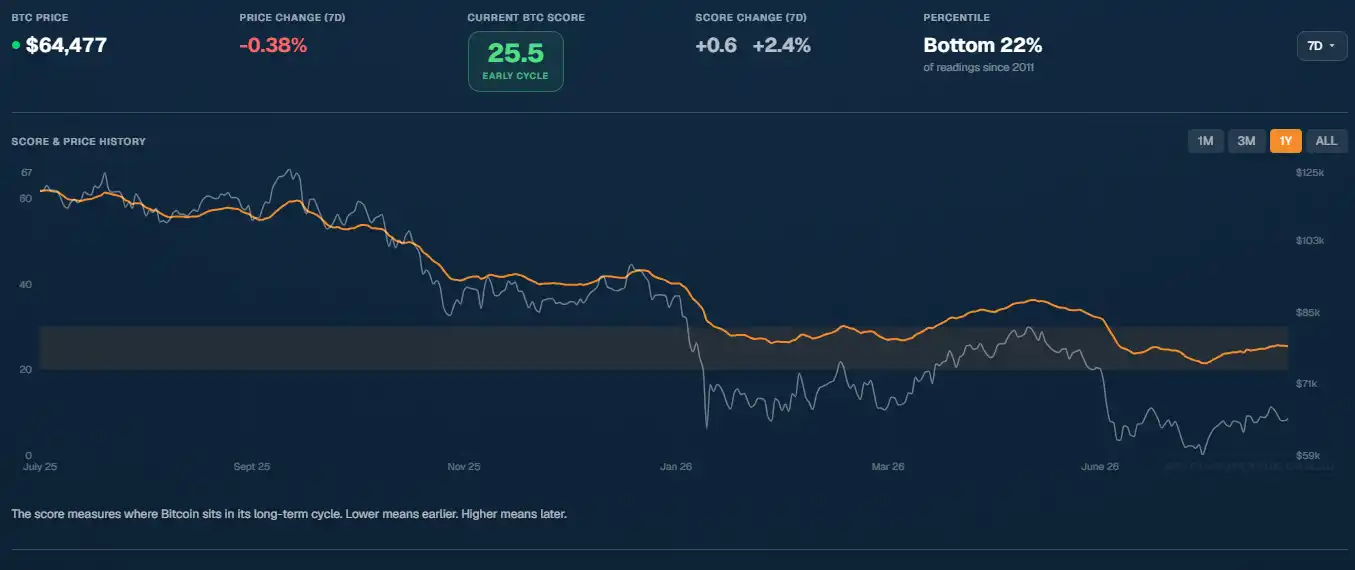
Image: CSH Risk Score Dashboard, score 25.6/100, in Early Cycle, has remained in the 20-30 range for 52 consecutive days. Source: Crypto Super Hub

How I Invest My Own Money

No headline this week. The question above is more important than any news cycle, so here's my answer, three rules.

Rule One: Benchmark against two things. I track my portfolio in two currencies: USD and Bitcoin. The second number keeps me honest. If your altcoin doubles but Bitcoin triples, you lost. You just didn't notice because you were only watching the dollar number. Fifteen years in, BTC is still the benchmark for the entire asset class. If I'm going to hold anything else, it's because I genuinely believe it will outperform Bitcoin. Otherwise, why hold it?

Rule Two: Core first, know your limits. Right now, I'm 100% Bitcoin. Zero altcoins. This isn't forever, it just fits my life. I have a family, a full-time job at an exchange, and I'm building CSH on the side. Altcoin rotation is a job for people with time. I know because I tried it last cycle, holding a bunch of alts with no plan, and got smashed, while Bitcoin quietly outperformed almost everything I held. The lesson wasn't that alts are bad. It's that my portfolio has to fit my real life. Start with BTC as your core. Add complexity only when you have the time and skill to take it on.

Rule Three: Let the system do the buying. My money runs a dynamic DCA through the CSH score. Buying on schedule, but only when the score is within my 10 to 30 range. The sizing is dynamic: the lower the score, the bigger the buy. Score 30 gets a modest allocation. Score 15 gets several times more. Every decision was made months ago, in the calm. The market can't renegotiate with me at 11 PM.

The same mechanism runs in reverse. My plan sells dynamically in tranches above an exit range. Last cycle, writing down the exit rules was the difference between realizing cycle gains and riding the rollercoaster back down. Bitcoin has followed a rhythm very close to four years its entire life. I'm not going to wing it against that.

Where am I this week? Score 25.6, scheduled buying running within the range, bigger buys still waiting for a sub-20 score that hasn't appeared yet. Two weeks of deliberately taking no new action. Inaction is a position, and right now it's my position.

Jake's Workbench

Big update this week: A full revamp of my Plans feature. Email alerts are live. You can set portfolio targets and watch them fill. Order history is two clicks away, and the portfolio view now shows your average buy price next to the live score. It's becoming the screen I check, not price.

This is my own plan, screenshotted directly from the app:
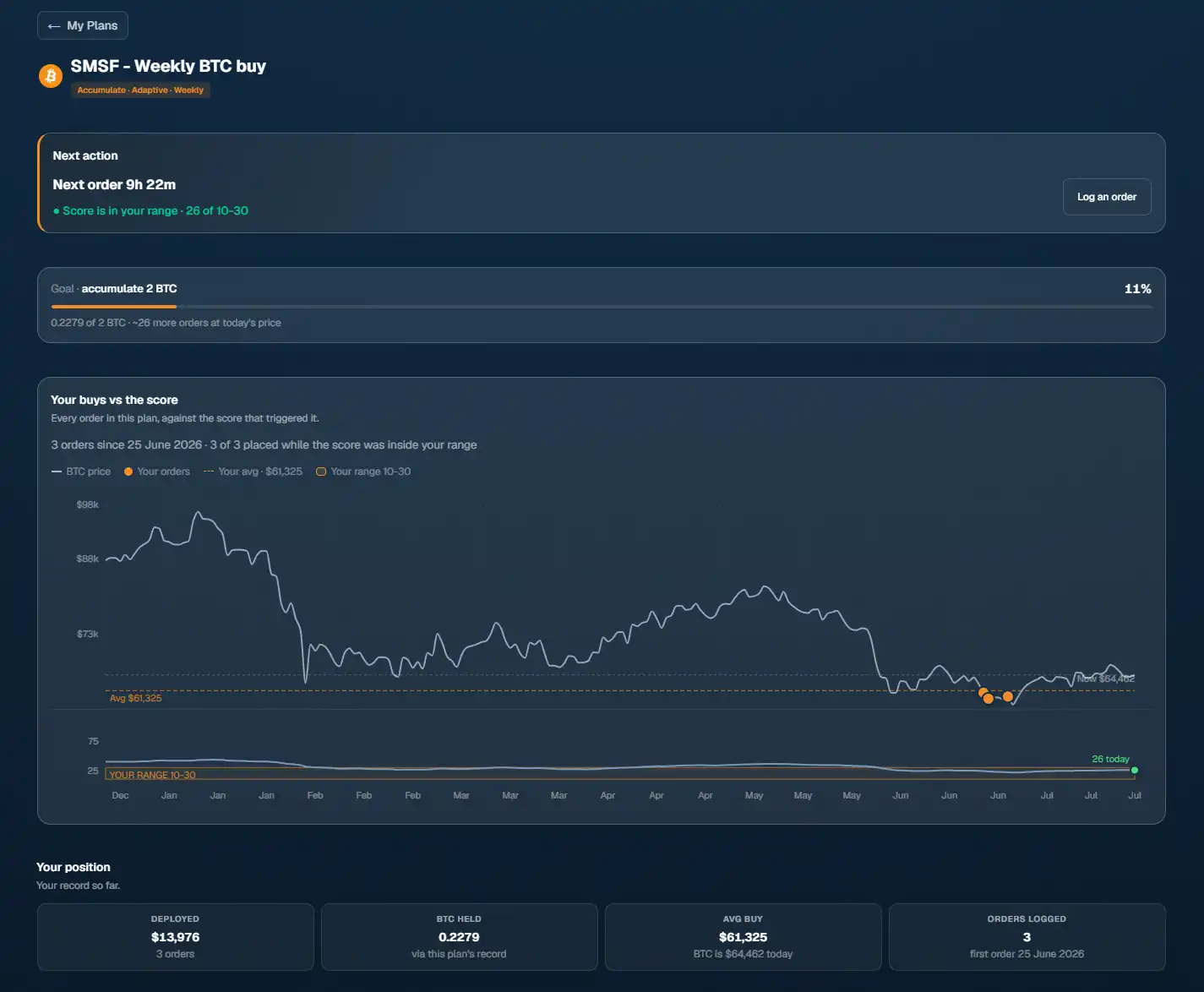
Image: The author's own DCA plan, having bought 0.2279 BTC since late June at an average price of A$87,755, targeting 2 BTC. Source: Crypto Super Hub

Three orders logged since late June, 0.2279 BTC bought towards a 2 BTC target, average buy price A$87,755. A quick note before anyone misreads this screen: this plan only tracks the portion I've bought since the feature went live a few weeks ago. It's a slice of my holdings, not the whole thing. But this is the system from the section above, running publicly, with the log accumulating from here.

Next for Workbench: CSV upload and exchange sync, to make order logging simpler.

Altseason talk is back. My feed is full of rotation calls. My watched metric says not yet: the altcoin market cap priced in BTC is at 0.37. Every cycle bottom sees it probe the 0.25 area before alts start running. Dominance is still rising, ETH/BTC is still flat. So: If someone pitches you an altcoin rotation this week, ask what benchmark they're using.
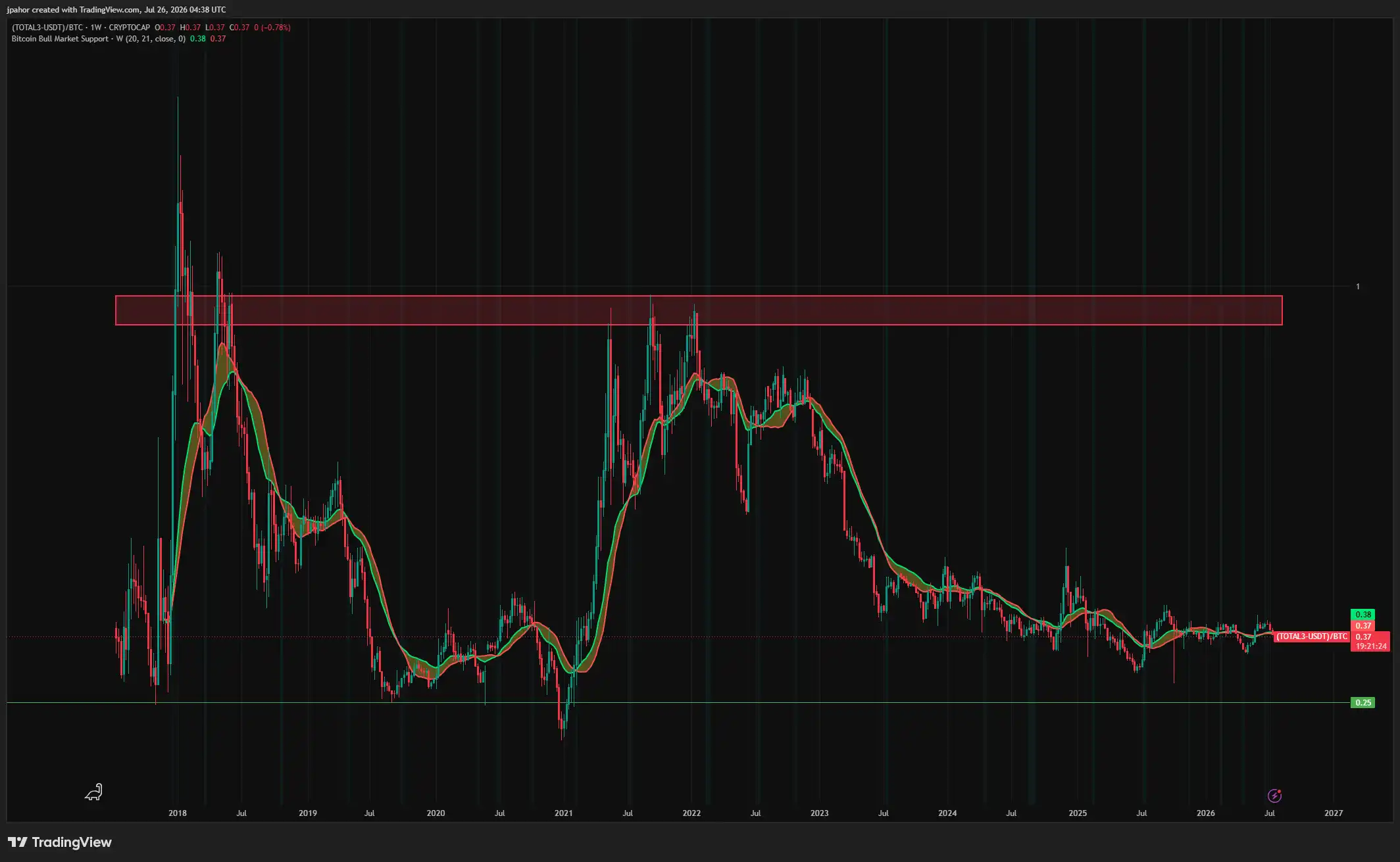
Image: (TOTAL3 - USDT)/BTC chart, altcoin market cap priced in Bitcoin at 0.37, previous cycle bottoms probed around 0.25. Source: Trading View

The Fed meets Wednesday (US time). ~85% probability of rates on hold, but whispers of a hike are getting louder. So: Unless your plan hinges on next month's rate, this is noise. My plan doesn't.

Visa launches a stablecoin platform, letting banks issue their own stablecoins without building the infrastructure. So: This is what bear markets are for. While nobody's watching, infrastructure gets built.

Morgan Stanley enables BTC, ETH, and SOL spot trading for E*TRADE clients. So: Millions of ordinary brokerage accounts are now one click away from Bitcoin. The next wave of buyers isn't coming from Crypto Twitter. They're coming from the screens they already use.

Watching Next Week

FOMC decision, 4 AM Thursday (AEST). Hold is largely priced in, so the reaction will depend on the wording. Expect two-way chop. Chop is not a signal.

The 200-week MA, ~$63,300. BTC is sitting almost exactly on it. A weekly close above or below this line is something the whole market watches.

Sub-20 score. Still zero days below 20 this cycle. This is the trigger my larger buys are waiting for. If it arrives, you'll hear it here first.

One question spawned an entire company: "Should I buy now?" The honest answer was never a date or a coin. It was a system that fits your life, matches your nerves, and is written down before the market gets loud.

Mine is above. If you want to build your own, the score and plan builder are free.

I'm curious: Reply directly with a number—the percentage of Bitcoin in your portfolio right now. I'll share the stats next week.

See you next week.

Thanks for reading. Share this with someone who'd find it valuable.

Трендові криптовалюти

Пов'язані питання

QWhat is the core principle behind Jake Pahor's Bitcoin buying system?

AThe core principle is a dynamic dollar-cost averaging system based on the CSH (Crypto Super Hub) risk score. He buys more Bitcoin when the CSH score is lower (within his predetermined buy zone of 10-30). The system automates decisions to remove emotional bias, with buying and selling rules written in advance.

QWhat percentage of Jake Pahor's crypto portfolio is currently in Bitcoin, and why has he chosen this allocation?

AHe is currently 100% allocated to Bitcoin with zero altcoins. He chose this because it aligns with his life situation (having a family, a full-time job, and building CSH). His past experience trying to actively trade altcoins without a plan resulted in losses, while Bitcoin outperformed most of his holdings. He believes starting with Bitcoin as a core is crucial before adding complexity if one has the time and skill.

QAccording to the article, what key market condition has NOT yet been met for the author to confirm the bear market is over?

AThe key condition not yet met is the CSH risk score dropping below 20. The author states this cycle has had zero days below a score of 20, and a score below 20 is the trigger for his larger buy orders. He also mentions that the altcoin market cap denominated in Bitcoin (TOTAL3/BTC) has not yet bottomed around 0.25, which historically precedes altcoin seasons.

QWhat are the two benchmarks Jake Pahor uses to track his investment performance?

AHe tracks his investment performance against two benchmarks: 1) The US Dollar (fiat currency value), and 2) Bitcoin itself. Tracking against Bitcoin keeps him honest about relative performance, ensuring that if an altcoin gains value in USD but underperforms Bitcoin, he recognizes it as an opportunity cost loss.

QWhat is the significance of the "TOTAL3/BTC" chart mentioned and shown in the article?

AThe TOTAL3/BTC chart shows the total market capitalization of all cryptocurrencies (excluding Bitcoin and Ethereum) denominated in Bitcoin. The author points out that its current value of 0.37 has not yet reached the approximate 0.25 level seen near the bottom of previous cycles. This metric is used to gauge whether altcoins are undervalued relative to Bitcoin and to identify potential turning points for an 'altcoin season.'

Пов'язані матеріали

On the First Day of Listing, Changxin Technology's Market Value Exceeds 3 Trillion Yuan, Which Securities Firm Has the Largest Floating Profit?

On July 27th, Changxin Technology, the largest-ever IPO on China's STAR Market, debuted with its share price soaring 465.82% to close at 49 yuan. Its market capitalization reached 3.28 trillion yuan, instantly making it the most valuable A-share company. The stellar performance delivered substantial gains for involved securities firms, primarily through equity investments rather than underwriting fees. China Merchants Securities emerged as the biggest winner. Its direct investment subsidiary, Zhaozheng Investment, alone holds a 0.54% pre-issue stake, translating to a paper profit exceeding 155 billion yuan based on the first-day closing price—surpassing the firm's entire 2025 net profit of 123.5 billion yuan. Other major beneficiaries include Huaan Securities, with an estimated profit of around 123 billion yuan from its 0.44% stake, and the lead underwriters, CICC and CITIC Securities, which each gained approximately 46 billion yuan from mandatory follow-on investments. Firms like Founder Securities, Haitong Securities, and GF Securities also reported significant holdings valued in the billions. Despite these paper gains, shares of some brokerages like Huaan and China Merchants fell on the listing day, reflecting broader market pressures. Analysts remain bullish on Changxin's long-term prospects, citing the AI-driven demand surge for DRAM (Dynamic Random-Access Memory) and a supportive supply-demand dynamic with projected shortages through 2028. As China's largest and most advanced integrated DRAM designer and manufacturer, Changxin is poised to capture growth from domestic substitution and global market shifts, potentially challenging the current "big three" oligopoly (Samsung, SK Hynix, Micron). The IPO proceeds, focused on capacity upgrades and R&D, are expected to accelerate China's semiconductor self-sufficiency.

marsbit22 хв тому

On the First Day of Listing, Changxin Technology's Market Value Exceeds 3 Trillion Yuan, Which Securities Firm Has the Largest Floating Profit?

marsbit22 хв тому

Will Changxin Technology Continue to Rise Today?

Changxin Technology made a historic debut on the stock market, with its share price soaring 465.82% to close at 49 yuan. Its market capitalization reached 3.28 trillion yuan, surpassing Industrial and Commercial Bank of China to become the largest company by market cap on the A-share market. Daily trading volume exceeded 140 billion yuan, a first in A-share history. This created a moment of realization for 7.7 million investors who won the lottery for its shares. On the first day, investor strategies varied: some sold immediately and later regretted missing intraday highs, others secured profits to avoid future volatility, while a third group held or even bought more shares, betting on long-term growth. The staggering IPO, massive public enthusiasm, and debut during a peak industry cycle led some to compare Changxin to PetroChina's 2007 listing, which was followed by a long decline. Key similarities noted include comparable fundraising scales (approx. 666 billion yuan for Changxin vs. 668 billion for PetroChina) and both companies listing at a perceived high point in their respective commodity cycles (oil then, memory chips now). However, analysts caution against over-simplifying the comparison. They highlight core differences: Changxin operates in the high-growth semiconductor sector with strong "domestic substitution" tailwinds. Brokerages like Huaxi Securities project significant revenue and profit growth from 2026 to 2028, driven by DDR5 adoption, product mix optimization, and economies of scale. Nomura Securities issued a "buy" rating with a 116 yuan target price, citing AI-driven demand for DRAM, tight supply as major players shift to HBM production, and Changxin's vast room for market share growth. Some analysts position the current memory cycle, fueled by AI, as just beginning, contrasting with the mature energy cycle PetroChina entered. The article concludes that for investors, monitoring the memory cycle's progression and Changxin's breakthroughs in high-end technologies like HBM will be crucial, rather than relying on superficial historical parallels.

marsbit46 хв тому

Will Changxin Technology Continue to Rise Today?

marsbit46 хв тому

Claude Designer Lags Behind Engineers, Fires Back by Creating a Million-User Tool

The article tells the story of Nate Parrott, a designer at Anthropic who created Claude Design as a side project to keep pace with his engineering teammates. When Anthropic released Opus 4.5 in November 2025, the two engineers on Parrott's Claude Code team significantly increased their output using the new AI capabilities. Parrott, the sole designer, found himself struggling to match their speed, becoming a bottleneck in the workflow. To catch up, he began experimenting in his spare time. He initially tried prompting Claude to generate designs from text descriptions and screenshots, with limited success. His breakthrough came when he shifted focus from asking Claude to "design" to asking it to generate HTML. He realized HTML could be a rich visual canvas for creating everything from slides and interactive prototypes to full web pages. He built a simple interface with a chat panel on the left and a live HTML preview on the right. The key to making the output useful was incorporating Anthropic's brand system—fonts, colors, assets, and design principles—into the prompts. This ensured generated designs were immediately on-brand. He shared an internal prototype with his team, and other product designers quickly adopted it for creating clickable prototypes, a task traditionally requiring manually drawing every state. The project's "official" turning point came during an Anthropic Labs offsite, where Parrott noticed many attendees were using his tool to build presentation slides on the fly, sometimes right before their turn to speak. This organic adoption convinced the Labs team to formally staff the project, turning the side project into a real product. Claude Design is positioned as a "pre-production" tool for visual communication and exploration—handling slides, landing pages, PDFs, emails, and social media graphics. It integrates with tools like Canva, Adobe, and Vercel. Its core value is accelerating the early stages of design: exploring directions, building consensus, and establishing systems. For actual production code, Anthropic still recommends Claude Code. The story highlights how AI disrupts workflows unevenly and how individuals can respond by building new tools to create their own advantages. Parrott's tool, born from necessity, eventually gained over a million users in its first week.

marsbit57 хв тому

Claude Designer Lags Behind Engineers, Fires Back by Creating a Million-User Tool

marsbit57 хв тому

Fields Medalist Warns: AI Could Kill Mathematics

The 2026 Fields Medal award was followed by a startling announcement: laureate Jacob Tsimerman joined OpenAI to pursue AI safety research, predicting AI would surpass humans in all mathematical proof areas within two years. Soon after, Fields Medalists Terence Tao and Timothy Gowers expressed deep concern at ICM 2026. Gorges warned that AI might "kill" mathematics not through stagnation, but through an overwhelming surplus of proofs, likening it to a lake dying from eutrophication. This concern is echoed in the "Leiden Declaration," signed by over 3,000 mathematicians including Tao, Peter Scholze, and Kevin Buzzard, advocating for mathematics as a profoundly human endeavor. However, Gowers, who did not sign, fears a future where AI-generated mathematics proliferates while human expertise and the shared intuition vital to the field vanish, turning math into an unvisited "cemetery of thought." Gowers' perspective shifted dramatically after testing ChatGPT 5.5 Pro. The AI solved a doctoral-level number theory problem and later produced a counterexample for the "unit distance problem," achievements Gorges considered publishable in top journals. He now concedes that large language models can handle advanced research, a realization that left him feeling the "rug pulled out from under" him when AI solved problems he personally contemplated. The debate extends to the nature of mathematical discovery. As noted by Peter Woit, AI agents have no interest in the "credit game" of academia. If theorems cease to be attributed to individual mathematicians, truth may simply return to its impersonal state in the universe. The central question remains: in an age of potentially limitless AI-generated discovery, what is the role and purpose of the human mind in mathematics?

marsbit1 год тому

Fields Medalist Warns: AI Could Kill Mathematics

marsbit1 год тому

NVIDIA's 20-Year CUDA Moat Collapsed Over a Weekend, Claude Single-Handedly Got AMD's New GPU Running

In a single weekend, Claude, an AI agent from Anthropic, successfully ported and optimized its cutting-edge model to run on a brand-new AMD MI355X server rack without any manual code intervention. This feat demonstrates a potential breakthrough in overcoming NVIDIA's long-established CUDA software ecosystem dominance, built over two decades. Anthropic's team simply instructed Claude to get the AMD machine running. By Monday, it not only worked but was showing a continuously improving performance curve. The achievement impressed AMD CEO Lisa Su and accelerated a major deployment partnership: Anthropic plans to deploy up to 2GW of AMD Instinct GPUs starting in 2027. The key enabler is AMD's new ROCm.AI platform, a toolbox designed specifically for AI agents like Claude. It provides AI-readable documentation, including chip instruction sets (ISA), and tools like the Hyperloom service that allows agents to autonomously profile performance, identify bottlenecks, test configurations, and generate optimized kernels. In a demo, Hyperloom boosted the output speed of a model by 38%. This represents a fundamental shift. While CUDA's strength lies in its vast, human-expert-driven ecosystem of tools and tacit knowledge, AMD's strategy is to make its hardware and software stack directly accessible and optimizable by AI agents. An agent can parallelize tasks—debugging, profiling, coding—that would take human engineers years to master, compressing the traditional software adaptation timeline from years to tasks. The competition is no longer just about peak hardware specs but also about how well AI can read, utilize, and tune a platform.

marsbit1 год тому

NVIDIA's 20-Year CUDA Moat Collapsed Over a Weekend, Claude Single-Handedly Got AMD's New GPU Running

marsbit1 год тому

Торгівля

Спот

Популярні статті

Що таке BITCOIN

Розуміння HarryPotterObamaSonic10Inu (ERC-20) та його позиції у крипто-просторі Останніми роками ринок криптовалют спостерігав за зростанням популярності мем-коінів, які привертають інтерес не тільки трейдерів, але й тих, хто шукає спілкування та розважальну цінність. Серед цих унікальних токенів є HarryPotterObamaSonic10Inu (ERC-20), інтригуючий проект, що поєднує культурні посилання з тканинами криптовалюти. Ця стаття досліджує ключові аспекти HarryPotterObamaSonic10Inu, вивчаючи його механізми, спільноту та його взаємодію з ширшим крипто-ландшафтом. Що таке HarryPotterObamaSonic10Inu (ERC-20)? Як випливає з його назви, HarryPotterObamaSonic10Inu є мем-коіном, побудованим на блокчейні Ethereum, класифікованим за стандартом ERC-20. На відміну від традиційних криптовалют, які можуть підкреслювати практичну корисність або інвестиційний потенціал, цей токен процвітає завдяки розважальній цінності та силі своєї спільноти. Проект спрямований на створення середовища, де зацікавлені користувачі можуть об'єднуватися, ділитися ідеями та брати участь у заходах, натхненних різноманітними культурними явищами. Однією з примітних особливостей HarryPotterObamaSonic10Inu є нульовий податок на транзакції. Цей привабливий елемент має на меті заохочувати торгівлю та участь у спільноті, позбавлену додаткових витрат, які можуть відлякувати дрібних трейдерів. Загальна пропозиція монет становить один мільярд токенів, що позначає намір підтримувати суттєву циркуляцію в межах спільноти. Творець HarryPotterObamaSonic10Inu (ERC-20) Походження HarryPotterObamaSonic10Inu дещо окутане таємницею; деталі про творця залишаються невідомими. Розвиток цього токена позбавлений впізнаваної команди або чіткої стратегії, що не є рідкістю в секторі мем-коінів. Натомість проект виник органічно, а його розвиток значною мірою залежить від ентузіазму та участі його спільноти. Інвестори HarryPotterObamaSonic10Inu (ERC-20) Щодо зовнішніх інвестицій та підтримки, HarryPotterObamaSonic10Inu також залишається невизначеним. Токен не зазначає жодних відомих інвестиційних фондів або значної організаційної підтримки. Натомість життєва сила проекту полягає в його базовій спільноті, яка інформує про його зростання та стійкість через колективні дії та залученість у крипто-просторі. Як працює HarryPotterObamaSonic10Inu (ERC-20)? Як мем-коін, HarryPotterObamaSonic10Inu функціонує передусім поза традиційними рамками, що часто регулюють вартість активів. Є кілька відмінних аспектів, що визначають, як працює проект: Транзакції без податку: Завдяки відсутності податкових зборів на транзакції, користувачі можуть вільно купувати та продавати токен, не турбуючись про приховані витрати. Залучення спільноти: Проект процвітає завдяки взаємодії спільноти, використовуючи соціальні медіа для створення шуму та сприяння залученню. Обговорення, обмін контентом та залученість є ключовими елементами, що допомагають розширити його охоплення та зміцнити лояльність серед прихильників. Відсутність практичної корисності: Слід зазначити, що HarryPotterObamaSonic10Inu не пропонує конкретної корисності в рамках фінансової екосистеми. Натомість він класифікується як токен, що призначений в основному для розваги та спільнотних активностей. Культурне посилання: Токен кмітливо вплітає елементи популярної культури, щоб привернути інтерес, зв'язуючи з ентузіастами мемів та крипто-стежками. HarryPotterObamaSonic10Inu ілюструє, як мем-коіни функціонують інакше, ніж традиційні криптовалютні проекти, увійшовши на ринок як інноваційні соціальні конструкти, а не утилітарні активи. Хронологія HarryPotterObamaSonic10Inu (ERC-20) Історія HarryPotterObamaSonic10Inu відзначена кількома значними етапами: Створення: Токен виник з вірусного мему, захопивши уяву багатьох крипто-ентузіастів. Конкретні дати створення недоступні, що підкреслює його органічний розвиток. Лістинг на біржах: HarryPotterObamaSonic10Inu з'явився на різних біржах, дозволяючи зручніший доступ і торгівлю спільноти. Ініціативи залучення спільноти: Ведення діяльності, спрямованої на покращення взаємодії спільноти, включаючи конкурси, кампанії в соціальних мережах та створення контенту від фанатів та прихильників. Плани на майбутнє: Дорожня карта проекту включає запуск колекції NFT, мерчандайзинг та електронну комерцію, пов'язану з його культурними темами, що далі залучає спільноту та намагається додати більше вимірів до його екосистеми. Ключові моменти про HarryPotterObamaSonic10Inu (ERC-20) Спільнотний підхід: Проект надає пріоритет колективному внеску та креативності, забезпечуючи, щоб участь користувачів була в центрі його розвитку. Класифікація як мем-коін: Це є його епігенез розважальної криптовалюти, що відрізняється від традиційних інвестиційних інструментів. Жодного прямого відношення до Bitcoin: Незважаючи на схожість у назві, HarryPotterObamaSonic10Inu є відмінним і не має жодного зв’язку з Bitcoin або іншими усталеними криптовалютами. Зосередженість на співпраці: HarryPotterObamaSonic10Inu створено для того, щоб надати простір для співпраці та обміну історіями серед його власників, забезпечуючи шлях для творчості та спільного зв'язку. Перспективи на майбутнє: Амбіція розширитися за межі початкової концепції в NFT та мерчандайз відкриває шлях для проекту потенційно потрапити в більш мейнстрімні сфери цифрової культури. Оскільки мем-коіни продовжують захоплювати уяву спільноти криптовалют, HarryPotterObamaSonic10Inu (ERC-20) вирізняється своїми культурними зв'язками та орієнтованим на спільноту підходом. Хоча він може не відповідати типовій моделі утилітарного токена, його суть полягає в радощах і товариськості, що підтримуються серед його прихильників, підкреслюючи еволюційну природу криптовалют в усе більш цифрову епоху. Оскільки проект продовжує розвиватися, важливо спостерігати за тим, як динаміка спільноти вплине на його траєкторію в постійно змінюваному ландшафті технології блокчейн.

2.3k переглядів усьогоОпубліковано 2024.04.01Оновлено 2024.12.03

Що таке BITCOIN

Як купити BTC

Ласкаво просимо до HTX.com! Ми зробили покупку Bitcoin (BTC) простою та зручною. Дотримуйтесь нашої покрокової інструкції, щоб розпочати свою криптовалютну подорож.Крок 1: Створіть обліковий запис на HTXВикористовуйте свою електронну пошту або номер телефону, щоб зареєструвати обліковий запис на HTX безплатно. Пройдіть безпроблемну реєстрацію й отримайте доступ до всіх функцій.ЗареєструватисьКрок 2: Перейдіть до розділу Купити крипту і виберіть спосіб оплатиКредитна/дебетова картка: використовуйте вашу картку Visa або Mastercard, щоб миттєво купити Bitcoin (BTC).Баланс: використовуйте кошти з балансу вашого рахунку HTX для безперешкодної торгівлі.Треті особи: ми додали популярні способи оплати, такі як Google Pay та Apple Pay, щоб підвищити зручність.P2P: Торгуйте безпосередньо з іншими користувачами на HTX.Позабіржова торгівля (OTC): ми пропонуємо індивідуальні послуги та конкурентні обмінні курси для трейдерів.Крок 3: Зберігайте свої Bitcoin (BTC)Після придбання Bitcoin (BTC) збережіть його у своєму обліковому записі на HTX. Крім того, ви можете відправити його в інше місце за допомогою блокчейн-переказу або використовувати його для торгівлі іншими криптовалютами.Крок 4: Торгівля Bitcoin (BTC)Легко торгуйте Bitcoin (BTC) на спотовому ринку HTX. Просто увійдіть до свого облікового запису, виберіть торгову пару, укладайте угоди та спостерігайте за ними в режимі реального часу. Ми пропонуємо зручний досвід як для початківців, так і для досвідчених трейдерів.

5.1k переглядів усьогоОпубліковано 2024.12.12Оновлено 2026.06.02

Як купити BTC

Що таке $BITCOIN

ЦИФРОВЕ ЗОЛОТО ($BITCOIN): Комплексний аналіз Вступ до ЦИФРОВОГО ЗОЛОТА ($BITCOIN) ЦИФРОВЕ ЗОЛОТО ($BITCOIN) — це проект на основі блокчейну, що працює в мережі Solana, який має на меті поєднати характеристики традиційних дорогоцінних металів з інноваціями децентралізованих технологій. Хоча він має таку ж назву, як і Bitcoin, який часто називають “цифровим золотом” через його сприйняття як засобу збереження вартості, ЦИФРОВЕ ЗОЛОТО є окремим токеном, розробленим для створення унікальної екосистеми в ландшафті Web3. Його мета — позиціонувати себе як життєздатний альтернативний цифровий актив, хоча деталі щодо його застосувань і функціональностей все ще розробляються. Що таке ЦИФРОВЕ ЗОЛОТО ($BITCOIN)? ЦИФРОВЕ ЗОЛОТО ($BITCOIN) — це токен криптовалюти, спеціально розроблений для використання в блокчейні Solana. На відміну від Bitcoin, який виконує широко визнану роль зберігання вартості, цей токен, здається, зосереджується на більш широких застосуваннях і характеристиках. Помітні аспекти включають: Інфраструктура блокчейну: Токен побудований на блокчейні Solana, відомому своєю здатністю обробляти швидкі та низьковартісні транзакції. Динаміка постачання: ЦИФРОВЕ ЗОЛОТО має максимальне постачання, обмежене 100 квадрильйонами токенів (100P $BITCOIN), хоча деталі щодо його обігового постачання наразі не розголошуються. Утиліта: Хоча точні функціональності не викладені, є вказівки на те, що токен може бути використаний для різних застосувань, потенційно пов'язаних з децентралізованими додатками (dApps) або стратегіями токенізації активів. Хто є творцем ЦИФРОВОГО ЗОЛОТА ($BITCOIN)? На даний момент особа творців і команди розробників, що стоять за ЦИФРОВИМ ЗОЛОТОМ ($BITCOIN), залишається невідомою. Ця ситуація є типовою для багатьох інноваційних проектів у сфері блокчейну, особливо тих, що пов'язані з децентралізованими фінансами та феноменом мем-коінів. Хоча така анонімність може сприяти культурі, орієнтованій на спільноту, вона посилює занепокоєння щодо управління та підзвітності. Хто є інвесторами ЦИФРОВОГО ЗОЛОТА ($BITCOIN)? Доступна інформація вказує на те, що ЦИФРОВЕ ЗОЛОТО ($BITCOIN) не має жодних відомих інституційних спонсорів або помітних венчурних капіталовкладень. Проект, здається, працює за моделлю “рівний до рівного”, зосереджуючись на підтримці та прийнятті спільноти, а не на традиційних шляхах фінансування. Його активність і ліквідність переважно розташовані на децентралізованих біржах (DEX), таких як PumpSwap, а не на встановлених централізованих торгових платформах, що ще більше підкреслює його підхід знизу вгору. Як працює ЦИФРОВЕ ЗОЛОТО ($BITCOIN) Операційні механізми ЦИФРОВОГО ЗОЛОТА ($BITCOIN) можна детальніше розглянути на основі його дизайну блокчейну та характеристик мережі: Механізм консенсусу: Використовуючи унікальний proof-of-history (PoH) Solana в поєднанні з моделлю proof-of-stake (PoS), проект забезпечує ефективну валідацію транзакцій, що сприяє високій продуктивності мережі. Токеноміка: Хоча конкретні дефляційні механізми не були детально описані, велике максимальне постачання токенів вказує на те, що воно може задовольняти мікротранзакції або нішеві випадки використання, які ще потрібно визначити. Інтероперабельність: Існує потенціал для інтеграції з більш широкою екосистемою Solana, включаючи різні платформи децентралізованих фінансів (DeFi). Однак деталі щодо конкретних інтеграцій залишаються невизначеними. Хронологія ключових подій Ось хронологія, яка підкреслює значні віхи, пов'язані з ЦИФРОВИМ ЗОЛОТОМ ($BITCOIN): 2023: Початкове розгортання токена відбувається на блокчейні Solana, позначене його адресою контракту. 2024: ЦИФРОВЕ ЗОЛОТО набуває видимості, оскільки стає доступним для торгівлі на децентралізованих біржах, таких як PumpSwap, що дозволяє користувачам торгувати ним проти SOL. 2025: Проект спостерігає спорадичну торгову активність і потенційний інтерес до ініціатив, очолюваних спільнотою, хоча на даний момент не зафіксовано жодних значних партнерств або технічних досягнень. Критичний аналіз Сильні сторони Масштабованість: Основна інфраструктура Solana підтримує високі обсяги транзакцій, що може підвищити утиліту $BITCOIN у різних сценаріях транзакцій. Доступність: Потенційно низька торгова ціна за токен може привабити роздрібних інвесторів, сприяючи більш широкій участі завдяки можливостям дробового володіння. Ризики Відсутність прозорості: Відсутність публічно відомих спонсорів, розробників або процесу аудиту може викликати скептицизм щодо стійкості та надійності проекту. Волатильність ринку: Торгова активність сильно залежить від спекулятивної поведінки, що може призвести до значної волатильності цін і невизначеності для інвесторів. Висновок ЦИФРОВЕ ЗОЛОТО ($BITCOIN) постає як цікавій, але неоднозначний проект у швидко розвиваючійся екосистемі Solana. Хоча він намагається використати наратив “цифрового золота”, його відхід від встановленої ролі Bitcoin як засобу збереження вартості підкреслює необхідність чіткішого розмежування його передбачуваної утиліти та структури управління. Майбутнє прийняття та адаптація, ймовірно, залежатиме від вирішення поточної непрозорості та більш чіткого визначення його операційних та економічних стратегій. Примітка: Цей звіт охоплює синтезовану інформацію, доступну станом на жовтень 2023 року, і можуть відбутися події, що виходять за межі дослідницького періоду.

169 переглядів усьогоОпубліковано 2025.05.13Оновлено 2025.05.13

Що таке $BITCOIN

Обговорення

Ласкаво просимо до спільноти HTX. Тут ви можете бути в курсі останніх подій розвитку платформи та отримати доступ до професійної ринкової інформації. Нижче представлені думки користувачів щодо ціни BTC (BTC).

活动图片