Apple Sues OpenAI Sparking Feud, Musk Slams Altman for Fraud, Altman Retorts with 'Space Data Center' Boast

marsbitОпубліковано о 2026-07-12Востаннє оновлено о 2026-07-12

Анотація

Apple Sues OpenAI as Musk-Altman Feud Escalates The public feud between Elon Musk and OpenAI CEO Sam Altman intensified, coinciding with their respective AI companies launching flagship models in the same week, highlighting fierce competition. On July 11, Musk posted on X, accusing Altman of taking "fraud to the next level" regarding OpenAI's commercial practices. Altman fired back, sarcastically suggesting Musk was the one selling "short-term space datacenter" concepts to public market investors. Musk countered with allegations that Altman "stole an open-source AI charity" and, amid Apple's recent lawsuit, "stole all of Apple's phone tech." He mockingly referenced Altman needing a "parole officer's" approval to travel. This exchange occurred against the backdrop of a significant legal development: Apple filed a lawsuit against OpenAI in a California federal court, alleging the AI company deliberately solicited Apple employees to leak confidential information on unreleased products to aid its own hardware plans. Apple demands OpenAI cease this activity, destroy proprietary materials, and redesign upcoming products. OpenAI responded, stating it has no interest in other companies' trade secrets and remains focused on innovation. This lawsuit could profoundly impact their two-year partnership where OpenAI provides key tech for Apple Intelligence and Siri. The rivalry extended to product releases. OpenAI launched GPT-5.6, while Musk's SpaceXAI unveiled Grok 4.5. Both are posi...

By: Bao Yilong

The war of words between Elon Musk and Sam Altman has escalated once again, coinciding with the release of flagship new models by their respective AI companies in the same week, heightening the competitive tension.

On July 11, Musk posted on platform X, accusing OpenAI CEO Sam Altman of 'taking fraud to a whole new level,' targeting OpenAI's commercial practices with users and customers.

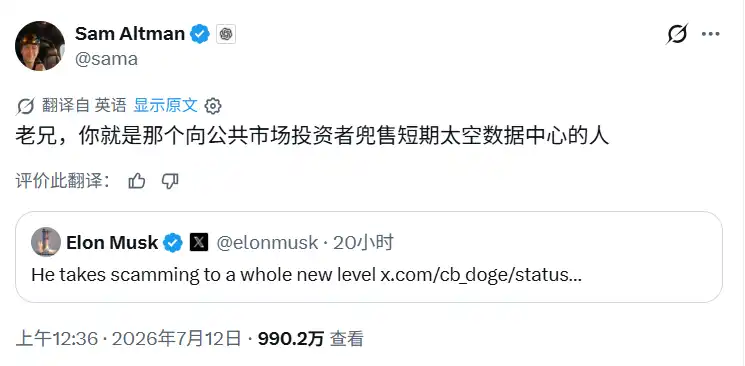
Altman promptly fired back, implying that Musk has been pitching the concept of 'short-term space data centers' to public market investors.
Musk countered, claiming Altman not only 'stole an open-source AI charity,' but is also accused of 'stealing Apple's mobile phone technology' amidst the Apple vs. OpenAI lawsuit, and sarcastically remarked that Altman needs to check with his parole officer for travel.

This exchange occurred in the same week that OpenAI launched GPT-5.6 and SpaceXAI released Grok 4.5, with the two products directly competing in the AI agent arena, making the spat more market-worthy.

Musk Fires, Altman Retorts with Space Data Center

According to Musk's post on platform X on July 11, he directly targeted Altman with blunt and strong language. Altman reposted it and responded:

Dude, you're the one pitching short-term space data centers to public market investors.

Musk immediately countered again, stating these space data centers 'start flying next year,' and snidely suggested that perhaps Altman could visit if his 'parole officer' approves.

Musk further accused Altman of 'first stealing an open-source AI charity, then stealing all of Apple's phone technology,' and questioned:

What next? This will be hard to top.
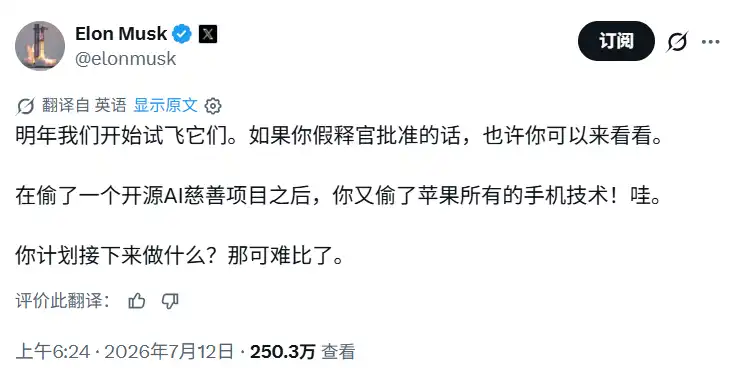
Musk's reference to 'Apple technology' is directly related to the recent lawsuit Apple filed against OpenAI.

As reported by Wall Street News, Apple filed a lawsuit on Friday in the U.S. District Court for the Northern District of California, accusing OpenAI of deliberately orchestrating the leak of unreleased product information, components, schematics, and other materials by Apple employees to serve its own plans for developing hardware devices.

Apple demands OpenAI immediately cease these actions, destroy all relevant proprietary materials, and redesign upcoming products to ensure they contain no Apple technology.

OpenAI responded, stating it has no interest in other companies' trade secrets and remains focused on building innovative technology.

This lawsuit will profoundly impact the trajectory of cooperation between the two companies. OpenAI has long provided key technical support for Apple's Apple Intelligence platform and Siri voice assistant, a partnership officially announced two years ago at Apple's Worldwide Developers Conference.

GPT-5.6 vs. Grok 4.5: Two Flagship Models Go Head-to-Head

This week, OpenAI and SpaceXAI successively released their latest flagship models, creating a direct confrontation.

OpenAI launched GPT-5.6, while SpaceXAI released Grok 4.5. Both products are positioned as AI agents, meaning they are agentic models capable of autonomously handling multi-step tasks. In terms of performance focus, the two products have different strengths:

  • GPT-5.6 excels in broad reasoning, business workflows, and cybersecurity;
  • Grok 4.5 is more efficient in autonomous programming and developer workflows, and its usage cost is lower than GPT-5.6.

However, in certain capability dimensions like abstract reasoning, OpenAI's model still leads over Grok.

For investors and enterprise users, the differentiated positioning of the two products means the choice depends on specific use cases. Enterprises seeking versatile reasoning capabilities may lean towards GPT-5.6, while developers prioritizing cost-effectiveness and code automation might prefer Grok 4.5.

Трендові криптовалюти

Пов'язані питання

QWhat triggered the recent public dispute between Elon Musk and Sam Altman?

AElon Musk accused Sam Altman on X (formerly Twitter) of taking 'fraud to a new level,' targeting OpenAI's commercial practices. Altman retaliated by mocking Musk for pitching 'short-term space datacenters' to public market investors.

QWhat new AI models did OpenAI and SpaceXAI release, and how do they compete?

AOpenAI released GPT-5.6 and SpaceXAI released Grok 4.5. Both are AI agents for multi-step tasks. GPT-5.6 excels in broad reasoning, business workflows, and cybersecurity. Grok 4.5 is more efficient in autonomous programming/developer workflows and has a lower cost, though OpenAI's model still leads in some areas like abstract reasoning.

QWhat is the core allegation in Apple's lawsuit against OpenAI mentioned in the article?

AApple has sued OpenAI, alleging that OpenAI intentionally induced Apple employees to leak confidential information about unreleased products, components, drawings, and materials to advance its own plans for developing hardware devices.

QHow did Musk connect his criticism of Altman to the Apple lawsuit?

AMusk accused Altman of 'stealing Apple's entire phone technology,' directly linking his criticism to the allegations in Apple's recent lawsuit against OpenAI.

QWhat was the broader context of the Musk-Altman argument according to the article?

AThe public argument occurred in the same week that their respective AI companies, OpenAI and SpaceXAI, launched their flagship new models (GPT-5.6 and Grok 4.5), directly competing in the AI agent market, which added competitive tension to the exchange.

Пов'язані матеріали

Tether Completes Full Audit by KPMG U.S., 150 Tons of Gold and 100,000 BTC Reserves Verified

Tether Announces Completion of Full Financial Audit by KPMG US, Confirming Gold and BTC Reserves Tether CEO Paolo Ardoino announced that the company has completed its first-ever full financial audit by the "Big Four" accounting firm KPMG US. The audit covers the financial statements of Tether International, S.A. de C.V. as of December 31, 2025. Ardoino stated that Tether's delay in obtaining a full audit was primarily due to the previous US administration's hostile stance towards the digital asset industry. With a more favorable regulatory environment, the company engaged KPMG US for the rigorous review. Ardoino emphasized the audit confirmed the strength of Tether's reserves, including over $6 billion in excess equity. He also revealed the company holds substantial physical assets: approximately 150 tons of gold and over 100,000 Bitcoin (BTC). The audit process reportedly involved physically verifying each gold bar. Addressing past criticism and ongoing skepticism, Ardoino pointed to Tether's ability to handle large-scale redemptions, citing the processing of around $7 billion within 48 hours during market stress in 2022. He stated the company plans to undergo annual full financial audits alongside its ongoing quarterly attestation reports. Regarding a potential private equity round, Ardoino clarified that Tether, as a highly profitable company, does not require external capital but acknowledges significant market interest in its shares. The company remains private and mission-focused, aiming to serve users outside the traditional financial system. Looking ahead, Ardoino expressed Tether's interest in potentially funding initiatives like the "Bitcoin Red Team," which uses AI to audit Bitcoin's code and wallet security for vulnerabilities.

marsbit19 хв тому

Tether Completes Full Audit by KPMG U.S., 150 Tons of Gold and 100,000 BTC Reserves Verified

marsbit19 хв тому

Wall Street's Imagination Can't Keep Up with Nvidia's 'Speed'

NVIDIA once again delivered stellar earnings, with revenue, operating profit, and EPS all hitting record highs for Q2 FY2027 (ended July 26, 2026). Revenue reached $96.221 billion, a 106% YoY increase, while net profit surged 126% to $59.688 billion. The core driver remained the Data Center segment, which grew 117% YoY to $89.023 billion, fueled by ongoing global AI infrastructure investments. The company segmented its Data Center revenue into Hyperscale (large cloud providers) and ACIE (AI cloud, enterprise, industrial, and sovereign AI) categories, with the latter showing faster growth. Notably, shipments of Hopper architecture products to mainland China accounted for less than 1% of Data Center revenue this quarter, and future guidance excludes contributions from China's Data Center compute market. CEO Jensen Huang stated that AI has reached a "tipping point," directly generating productivity and revenue. Financially, NVIDIA maintained robust profitability with a gross margin of 75%. The company also returned approximately $26 billion to shareholders via buybacks and dividends. Looking ahead, product transitions are key. The Blackwell Ultra platform is now in large-scale deployment, while the next-generation Vera Rubin platform, including NVIDIA's first CPU designed for AI agents, has entered full production. The company is also expanding its software ecosystem with tools like the DSX platform for building AI factories. However, NVIDIA's role is evolving beyond chip supplier. It is increasingly involved in financing and facilitating massive AI infrastructure projects, exemplified by its credit support for the SB Energy project in Ohio intended for OpenAI. The company aims to mobilize over $500 billion in third-party capital for such builds, though this raises questions about future capital intensity. For Q3 FY2027, NVIDIA forecasts revenue of approximately $108 billion, signaling continued growth but at a potentially moderated pace. While still dominant, the competitive landscape is intensifying with rivals like AMD and in-house chips from major cloud customers. Key challenges include maintaining growth through the Blackwell-to-Rubin transition, sustaining the pace of AI infrastructure investment, and defending market share as inference workloads grow and competition increases.

marsbit19 хв тому

Wall Street's Imagination Can't Keep Up with Nvidia's 'Speed'

marsbit19 хв тому

MiniMax Starts Earning Money by Relying on Others

MiniMax, a Chinese AI company known initially for its consumer-facing products like Conch AI, has undergone a significant business shift according to its first post-IPO semi-annual report. While overall revenue grew to $117 million (surpassing its full-year 2025 projection), the revenue structure flipped dramatically. Revenue from its open platform and enterprise AI services surged 703.1% to $73.93 million, now constituting 63.4% of total income. In contrast, revenue from its own AI-native products, though doubling to $42.64 million, dropped from 69.7% to 36.6% of the total. This indicates MiniMax is transitioning from a product-centric to a platform-centric model, embedding its AI capabilities into other companies' workflows and developer applications rather than solely relying on its own apps. The company is now monetizing its core model technology as a service. However, profitability remains a challenge. Despite revenue growth of 283.1%, R&D expenses were $297 million—2.55 times revenue—leading to an adjusted net loss of $293 million. A positive sign is improving gross margin, which rose from 12.1% to 17.9%, suggesting initial progress toward scaling efficiently. Geographically, MiniMax demonstrates a "developed in China, monetized globally" model, with 60.8% of its revenue coming from outside mainland China. The report highlights that MiniMax has successfully moved past proving demand and model capability. The critical next phase is demonstrating that its growing enterprise and developer customer base can generate sufficient, sustainable profit to offset the high inherent costs of AI model training and inference.

marsbit29 хв тому

MiniMax Starts Earning Money by Relying on Others

marsbit29 хв тому

He Personally Built o1 and o3, but Suddenly Announced: Humans Can Retire Forever

AI researcher Jerry Tworek, former lead of OpenAI's reasoning models (o1/o3), predicts human AI researchers will be largely obsolete within two years. He argues that while AI agents currently excel at execution (reducing experiment cycles from a month to a day), their creative idea generation remains low-quality. True frontier AI development, he claims, is driven by only 30-50 people globally, with everyone else in supporting roles. A core bottleneck is the Transformer architecture, which he believes is suboptimal but has seen only 3-4 serious replacement attempts at OpenAI in seven years due to massive computational and validation hurdles. He highlights a key paradox: you need significant compute to prove a new direction, but you need proof to get the compute. A breakthrough came when he received dedicated GPU resources, leading to scaling reinforcement learning and the o1 model. Now, through his company Core Automation, he uses AI agents to automate costly R&D tasks. In one case, a $100k AI effort optimized a GPU kernel by 60x, matching rare expert-level performance. This acceleration, he argues, will soon automate even the remaining creative and architectural work of the few top researchers. Looking ahead, Tworek envisions a post-work future where humans pursue excellence for its own sake—like ancient philosophers or dedicated athletes—free from the necessity of labor for societal function. He acknowledges the personal challenge of deriving self-worth from work but is actively building the tools that will make his own expert role, and those of his peers, redundant. The prevailing sentiment among researchers, he notes, is a mix of exhaustion and exhilaration in what may be the final, pivotal chapter of human-led AI advancement.

marsbit34 хв тому

He Personally Built o1 and o3, but Suddenly Announced: Humans Can Retire Forever

marsbit34 хв тому

Торгівля

Спот

Популярні статті

Як купити DATA

Ласкаво просимо до HTX.com! Ми зробили покупку DATA Network (DATA) простою та зручною. Дотримуйтесь нашої покрокової інструкції, щоб розпочати свою криптовалютну подорож.Крок 1: Створіть обліковий запис на HTXВикористовуйте свою електронну пошту або номер телефону, щоб зареєструвати обліковий запис на HTX безплатно. Пройдіть безпроблемну реєстрацію й отримайте доступ до всіх функцій.ЗареєструватисьКрок 2: Перейдіть до розділу Купити крипту і виберіть спосіб оплатиКредитна/дебетова картка: використовуйте вашу картку Visa або Mastercard, щоб миттєво купити DATA Network (DATA).Баланс: використовуйте кошти з балансу вашого рахунку HTX для безперешкодної торгівлі.Треті особи: ми додали популярні способи оплати, такі як Google Pay та Apple Pay, щоб підвищити зручність.P2P: Торгуйте безпосередньо з іншими користувачами на HTX.Позабіржова торгівля (OTC): ми пропонуємо індивідуальні послуги та конкурентні обмінні курси для трейдерів.Крок 3: Зберігайте свої DATA Network (DATA)Після придбання DATA Network (DATA) збережіть його у своєму обліковому записі на HTX. Крім того, ви можете відправити його в інше місце за допомогою блокчейн-переказу або використовувати його для торгівлі іншими криптовалютами.Крок 4: Торгівля DATA Network (DATA)Легко торгуйте DATA Network (DATA) на спотовому ринку HTX. Просто увійдіть до свого облікового запису, виберіть торгову пару, укладайте угоди та спостерігайте за ними в режимі реального часу. Ми пропонуємо зручний досвід як для початківців, так і для досвідчених трейдерів.

597 переглядів усьогоОпубліковано 2026.07.01Оновлено 2026.07.01

Як купити DATA

Обговорення

Ласкаво просимо до спільноти HTX. Тут ви можете бути в курсі останніх подій розвитку платформи та отримати доступ до професійної ринкової інформації. Нижче представлені думки користувачів щодо ціни DATA (DATA).

活动图片