Goldman Sachs Report Deconstructs the Competitive Landscape of China's AI Large Models: Who Will Be the Long-Term Winner?

marsbitОпубліковано о 2026-07-11Востаннє оновлено о 2026-07-11

Анотація

Goldman Sachs analyzes China's AI large language model (LLM) landscape, identifying key players and a strategic shift towards efficiency and global expansion. The report highlights that Chinese open-source/open-weight models are closing the performance gap with top global proprietary models at significantly lower cost, driven by architectural innovations like MoE. This enables a "two-tier" market: a high-end segment (e.g., GLM5.2, Qwen3.7 Max) with pricing at ~$1 per million tokens, and a low-end, price-sensitive global segment. Open-source strategies aid adoption but limit monetization, as deployments via third-party platforms (e.g., AWS Bedrock, Alibaba Cloud) may not generate direct revenue for model creators. The industry is thus moving towards "open-weight + community license" models with revenue-sharing to improve unit economics. Internationally, the focus is shifting from "token maximization" to ROI-driven enterprise adoption, particularly in non-U.S. markets. Major cloud platforms are integrating Chinese models (e.g., DeepSeek, MiniMax). Using a competitive framework based on pricing power, cost advantage, and financial strength, Goldman Sachs identifies **Zhipu AI** and **DeepSeek** as leaders in foundational text models, and **ByteDance** (with Seedance) leading in multimodal/video generation. **MiniMax** and **Kuaishou** are also rated favorably. The firm forecasts China's AI model API/subscription revenue growing from ~RMB 35bn (2026E) to RMB 879bn by 2030.

Author: Wall Street Insights, Bu Shuqing

Original Title: Goldman Sachs In-Depth Report: Who Will Be the Long-Term Winner in China's AI Large Model Industry?

China's AI large models are standing at a historic inflection point. Goldman Sachs believes that the intelligence performance of China's open-source/open-weight large models is approaching that of the world's top proprietary models, and adoption scale by domestic enterprises and global SMEs is rapidly expanding, thereby forming a data flywheel effect that will further drive model iteration and upgrades.

According to Zhui Feng Trading Desk, the latest Goldman Sachs report points out that this evolution trajectory can be summarized as 'from DeepSeek's cost-efficiency moment last year to Zhipu GLM's model intelligence moment this year'. The team led by Goldman Sachs analyst Ronald Keung systematically evaluates four core questions in this 50-page report: how Chinese AI models achieve high performance at low cost, why they choose the open-source route and how to monetize, where the core addressable market is, and who will be the long-term winners.

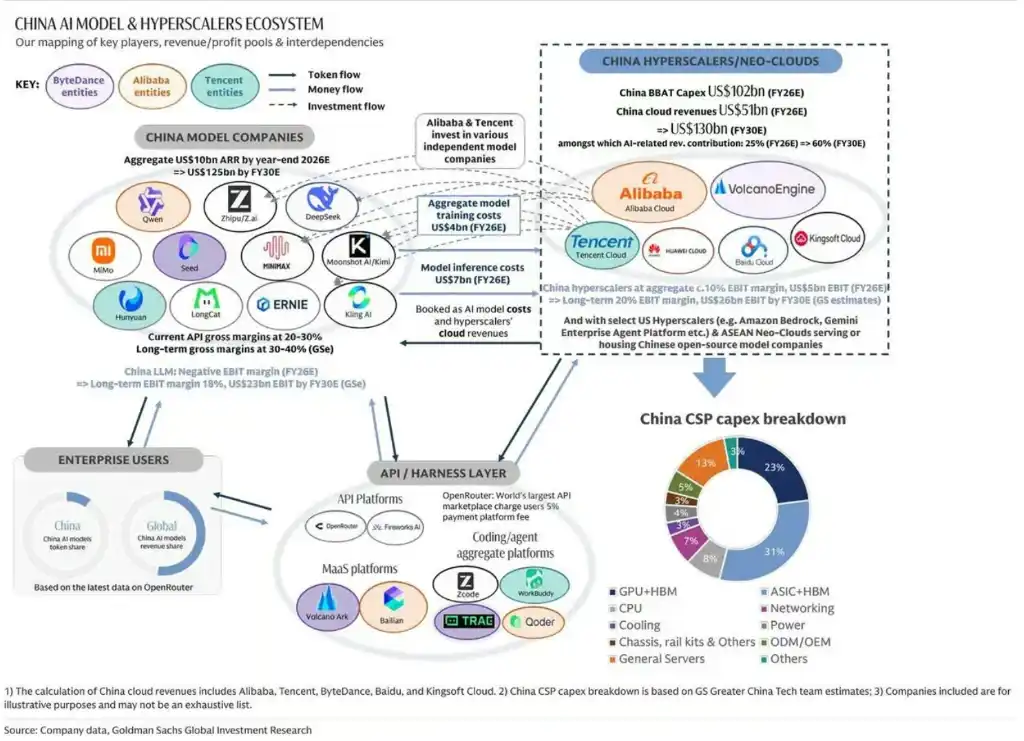
In assessing the competitive landscape, Goldman Sachs introduced a "competitive positioning framework" based on pricing power, cost advantage, and financial strength. Based on this, it determines that in the foundational text model field, Zhipu (initially covered) and DeepSeek (unlisted) have the strongest positioning; in the multimodal field, ByteDance (unlisted) is leading. Goldman Sachs also maintains Buy ratings on MiniMax and Kuaishou.
Small but Mighty, Efficiency Wins

The core reason Chinese large models can achieve performance close to their US counterparts at significantly lower cost lies in dual breakthroughs in architectural innovation and parameter efficiency.

The Goldman Sachs report points out that the parameter scale of Chinese open-source models is generally between 200 billion and 1.6 trillion, only 2% to 10% of the world's top models, primarily due to limited access to high-end computing power. Meanwhile, innovations like Mixture of Experts (MoE) architecture and sparse attention mechanisms have reduced the proportion of actually activated parameters to total parameters to only 3% to 5%, significantly lowering training and inference costs.

At the specific model level, DeepSeek V4 Pro has 1.6 trillion parameters, Zhipu GLM5.2 has 0.7 trillion, and MiniMax M3 has 0.4 trillion.

Goldman Sachs attributes the recent leap in Chinese models' coding capabilities to the synergistic effects of data curation, reinforcement learning fine-tuning, and other factors. On June 27th, DeepSeek launched the speculative decoding framework DSpark, already deployed in the online services of V4-Flash and V4 Pro, boosting per-user generation speed by 60% to 85% (V4-Flash) and 57% to 78% (V4 Pro) without altering model weights or output quality.

Meituan's LongCat 2.0 released on June 30th is viewed by Goldman Sachs as a major milestone in the localization of China's AI infrastructure—this is China's first fully open-source 1.6-trillion-parameter MoE model trained and deployed entirely on 50,000 domestic compute cards. Goldman Sachs believes this proves the feasibility of a localized hardware stack during the compute-intensive pre-training phase, holding profound significance for China's AI models to reduce dependence on foreign high-end chips.

A Two-Tiered Market, the Strong Get Stronger

Goldman Sachs describes the Chinese AI model market as an emerging "two-tiered structure" and identifies two ARR-maximizing quadrants.

In the high-end market, top models represented by Zhipu GLM5.2 and Alibaba's Qwen3.7 Max are priced at approximately $1 per million tokens, five times that of low-end models, with an estimated inference gross margin of about 10% to 20% (Goldman Sachs estimate). In comparison, top US models are priced at $4 to $8 per million tokens. Chinese high-end models are only 10% to 25% of that price, but can still maintain positive gross margins due to their lower activated parameter ratio.

In the low-end market, models targeting agent tasks are priced as low as $0.06 to $0.2 per million tokens, opening up markets for price-sensitive global SMEs and individual users. MiniMax derives 60% to 70% of its revenue from overseas. Notably, DeepSeek has announced the introduction of peak/off-peak pricing for its V4 series from mid-July, with peak rates being twice the off-peak rate, resulting in a blended price of approximately $0.35 per million tokens (V4 Pro) and $0.12 per million tokens (V4 Flash).

Goldman Sachs predicts that API and subscription revenue from Chinese AI models will grow from an estimated 35 billion RMB in 2026 to 879 billion RMB in 2030, corresponding to daily token consumption increasing from 350 trillion to 4.6 quadrillion tokens, a roughly 25-fold increase.

Open-Source Strategy: Broad Penetration, Monetization Paths Await Upgrade

The Goldman Sachs report details the strategic logic behind the prevalent open-source/open-weight approach among Chinese AI models and its monetization limitations.

The core advantages of the open-source strategy are deployment flexibility and community ecosystem. Alibaba's Qwen series, DeepSeek, Zhipu GLM, and MiniMax M3 all adopt open-source or open-weight approaches, with ByteDance's Seed model being a major exception, taking a fully closed, proprietary route. The open-source model allows flexible deployment both within and outside mainland China and accelerates iteration through community feedback.

However, Goldman Sachs points out that the ARR numbers disclosed by open-source model companies likely severely underestimate the actual deployment scale and revenue potential. Taking Zhipu as an example, its ARR target for the end of 2026 is $1 billion, but the actual global deployment volume of GLM5.2 will far exceed the token volume and revenue from Zhipu's own API channels—Alibaba Cloud's Bailian MaaS platform can directly host the GLM5.2 open-source model without paying any fees to Zhipu.

Goldman Sachs expects the industry to gradually migrate from pure open-source (MIT license, completely free) to an "open-weight + community license" model—where commercial use requires signing a revenue-sharing agreement with the model company. The MiniMax M series has already adopted this model. Goldman Sachs believes this shift will significantly improve the unit economics for AI model companies, as they can benefit from revenue-sharing agreements with platforms like AWS Bedrock and Alibaba Cloud Bailian without bearing the inference compute costs themselves.

From "Token Maximization" to ROI Priority

Goldman Sachs characterizes international market expansion as the most important upside for Chinese AI models, especially in non-US markets.

Goldman Sachs' US research team estimates that by 2030, agent AI will drive a 24-fold increase in global token consumption to 120 quintillion tokens per month, with enterprise agents contributing a 55-fold increase and consumer agents a 12-fold increase. In global (non-China) markets, Chinese AI models have already achieved significant token share growth leveraging performance improvements and price advantages.

The Goldman Sachs report notes that the AI usage paradigm for global enterprises is undergoing a fundamental shift from "token maximization" to "ROI priority." The former prevailed from late 2025 to early 2026, where companies equated high token consumption with organizational productivity; the latter focuses more on clear task boundaries, daily active agent count, backend process automation, and tangible output. Data from a Jellyfish AI Engineering Trends study shows that heavy AI users in enterprises consume 10x the tokens but only achieve a 2x increase in output.

On the channel front, Alphabet's Gemini Enterprise Agent Platform and Amazon's AWS Bedrock already offer hosting services for Chinese AI models like DeepSeek, MiniMax, Moonshot, GLM, and Qwen. According to The Wall Street Journal, Microsoft's CEO recently stated that Microsoft is considering hosting a version of DeepSeek on Copilot as an optional low-cost model, emphasizing that if DeepSeek were hosted, the model would run within Microsoft's cloud ecosystem, ensuring customer data remains within Azure.

Who Are the Long-Term Winners?

Goldman Sachs constructed a three-dimensional competitive positioning framework, using quantitative metrics to assess each player's long-term winning probability. The core formula is: ARR Scale × Gross Margin Advantage + Financial Strength.

The pricing power dimension examines release speed (compared to previous generation and peer models), LMArena Arena ranking (based on large-scale blind user evaluation), and blended price per million tokens.

The cost advantage dimension examines throughput (tokens per second), cache hit rate, activated parameter ratio, and inference gross margin. The financial strength dimension examines cash on hand, net cash as a percentage of total assets, and valuation multiples.

In the foundational text model field, Goldman Sachs identifies Zhipu (initially covered, Neutral rating, target valuation $110 billion) and DeepSeek (unlisted) as having the strongest positioning, with both showing outstanding performance in pricing power and cost advantage. The aggregate implied valuation of independent AI model companies exceeds $200 billion.

In the multimodal/video generation field, ByteDance leads with Seedance. According to LatePost and 36Kr reports, Seedance has a gross margin as high as 70%, and its ARR run rate already exceeds $2 billion. Kuaishou's Kling and MiniMax's Hailuo/upcoming H3 model are also viewed favorably by Goldman Sachs, expected to benefit in the second half of 2026 from functional breakthroughs in video generation and LLM integration, as well as healthy pricing driven by supply tightness.

Goldman Sachs maintains a Buy rating on MiniMax with a target price of HK$860, citing its M3 model's position in the ARR-maximizing quadrant of high token volume and attractive pricing, and its current valuation of only 13x 2026 year-end ARR, representing a significant discount compared to valuation multiples of Chinese and global peers, with a risk-reward skewed to the upside.


Трендові криптовалюти

Пов'язані питання

QAccording to Goldman Sachs' report, what is the core competitive advantage of Chinese AI models in terms of cost and performance?

AThe core advantage is achieving performance close to global top-tier models at significantly lower cost. This stems from architectural innovations (like Mixture of Experts - MoE) and parameter efficiency, which result in a low parameter activation ratio (3%-5%). Chinese models typically have 2%-10% the parameter count of top global models but maintain competitive performance.

QHow does Goldman Sachs describe the evolving pricing structure in the Chinese AI model market?

AGoldman Sachs describes a forming 'two-layer structure' with two ARR maximization quadrants. The high-end market (e.g., GLM5.2, Qwen3.7 Max) prices around $1 per million tokens. The low-end market, targeting price-sensitive users, sees prices as low as $0.06-$0.2 per million tokens for agent-focused models.

QWhat is a key strategic limitation of the open-source/open-weight approach adopted by many Chinese AI model companies, as highlighted by Goldman Sachs?

AA key limitation is that reported ARR figures likely 'materially understate' actual deployment scale and revenue potential. For example, GLM5.2 can be directly hosted on platforms like Alibaba Cloud's Bailian MaaS without the model creator (e.g., Zhipu AI) receiving any revenue, as the model is fully open-source under a permissive license.

QWhich companies does Goldman Sachs identify as having the strongest positioning in the foundational text model and multimodal/video generation sectors respectively?

AFor foundational text models, Goldman Sachs identifies Zhipu AI (GLM) and DeepSeek as having the strongest positioning. In the multimodal/video generation sector, ByteDance (with its Seed model) is identified as the leader.

QWhat global market shift in AI usage paradigm does the Goldman Sachs report discuss, and what does it entail?

AThe report discusses a shift from 'Token Maximization' to 'ROI First.' The earlier 'Token Maximization' phase equated high token consumption with productivity. The emerging 'ROI First' paradigm focuses more on defined task boundaries, daily active agents, backend process automation, and tangible output, prioritizing return on investment over sheer token volume.

Пов'язані матеріали

Tiger Research: Zuckerberg Begins Betting on Prediction Markets, While Asian Nations Still View Them as Gambling

This article examines the rise of prediction markets, contrasting their growing institutional acceptance in the West with their restrictive regulation in Asia. It details how prediction markets, which originated from informal political betting and academic experiments like the Iowa Electronic Market, aggregate crowd wisdom into probabilistic prices through binary contracts. Their growth accelerated around 2020, reaching over $14 billion in monthly volume. A key driver is the "skin in the game" principle, where users risk their own capital, leading to high accuracy in predicting events like Fed rate decisions and elections, as demonstrated by platforms like Polymarket. Meta's entry, with Mark Zuckerberg reportedly leading the development of the Arena app, signals the market's maturation. In the U.S., court rulings have distinguished prediction markets from gambling, facilitating entry by traditional financial institutions. However, most Asian jurisdictions still classify them as gambling, focusing on social control rather than financial innovation. The article argues this stance creates three problems for Asia: 1) regulatory arbitrage pushes users to riskier offshore platforms, 2) loss of sovereign information infrastructure as valuable social sentiment data accumulates abroad, and 3) abandonment of user protection. It concludes that Asia needs a policy shift from prohibition to constructive regulation, integrating these markets into the formal system to harness their data as a national asset, as initiatives like Limitless Research are beginning to do.

marsbit7 хв тому

Tiger Research: Zuckerberg Begins Betting on Prediction Markets, While Asian Nations Still View Them as Gambling

marsbit7 хв тому

Ethereum's Next Decade in the Eyes of Vitalik

"Lean Ethereum" Long-Term Roadmap Unveiled by Vitalik Buterin On July 5, 2026, Vitalik Buterin published the "Lean Ethereum" roadmap, positioning it as Ethereum's third major evolution following the Merge. This multi-year, multi-phase upgrade aims to fundamentally transform Ethereum's core protocol through staged network upgrades extending to 2029. Key goals include achieving 1 gigagas per second L1 throughput (a massive increase from the current ~32 TPS), near-instant finality, and quantum-resistant cryptography. The plan involves transitioning Ethereum's security model from full transaction re-execution by all nodes to native verification via recursive STARK proofs. A major proposed change is replacing the EVM with a proof-friendly architecture like RISC-V or leanISA, though this remains a point of contention, especially with L2s like Arbitrum favoring alternatives like WASM. Other planned upgrades include a restructured state model with a large, cheap "warehouse" storage layer to drastically reduce fees for migrated applications, multi-dimensional gas pricing, and a new focus on making privacy a first-class, native protocol feature. While the roadmap significantly raises Ethereum's long-term technical ceiling, analysts note it does not directly address ETH's mid-term token economics or value capture. The plan's multi-year timeline means near-term price impact will likely depend on observable progress milestones, such as the successful deployment of the upcoming Glamsterdam gas limit increase, growth in L2 activity and blob usage, and trends in L1 fee revenue and ETH burn.

链捕手1 год тому

Ethereum's Next Decade in the Eyes of Vitalik

链捕手1 год тому

In Just 11 Days, Claude Rewrote Millions of Lines of Code, an Epic AI Engineering Feat Sparks Fury

In just 11 days, Bun's founder Jarred Sumner used Anthropic's Claude AI models to rewrite its million lines of code from Zig to Rust. This move sparked significant controversy, particularly from Zig's creator, Andrew Kelley, who publicly criticized Sumner's engineering practices and the decision to use AI for such a massive rewrite. Bun, a high-performance JavaScript/TypeScript runtime and rival to Node.js, was originally written in Zig. After Anthropic acquired Bun, the team encountered persistent stability and memory safety bugs in the Zig codebase. These issues, combined with Zig's strict policy against LLM-generated code, led to the decision to rewrite in Rust. The rewrite was executed using Claude AI tools at an estimated API cost of $165,000, dramatically reducing the expected time and financial cost. Andrew Kelley's response was scathing. He blamed the original bugs on poor engineering habits, calling Bun's Zig code a collection of "hacks on top of hacks." He expressed relief that Bun was no longer associated with Zig, fearing it would misrepresent the language and attract low-quality, AI-generated contributions. The tech community is divided; some view Kelley's critique as unprofessional, while others see it as a defense of engineering integrity. A major concern about the AI-driven rewrite is the resulting code quality. The translation from Zig left approximately 27,000 lines of unsafe Rust code, raising fears about long-term maintainability and technical debt. The debate centers on whether this project is a milestone in AI-assisted development or a future maintenance nightmare.

marsbit2 год тому

In Just 11 Days, Claude Rewrote Millions of Lines of Code, an Epic AI Engineering Feat Sparks Fury

marsbit2 год тому

From Auto Finance to Bitcoin to AI Engines: An Analysis of Cango's 'What Not to Do' Strategy

From Auto Finance to Bitcoin and Now AI: Cango's "What Not to Do" Strategy Cango, a Chinese auto finance platform that went public on the NYSE in 2018, is undergoing its third major transformation. After selling its entire auto business in 2024, it pivoted to become a large-scale Bitcoin miner, acquiring 50 exahash of mining rigs from Bitmain. However, its true goal was never Bitcoin, but owning and controlling energy infrastructure. Now, Cango is pivoting again. While most listed Bitcoin miners are leasing power to giant hyperscalers for AI training clusters, Cango is taking the opposite path. It has launched an AI inference subsidiary called EcoHash, focusing not on training but on distributed inference. The company's strategy hinges on the insight that over 70% of mining industry power is controlled by small, independent sites (10-50 MW), which are too small for hyperscalers but ideal for low-latency AI inference. Cango aims to partner with these small operators, providing the AI technology, customers, and financing through its EcoLink software layer, which can distribute workloads across sites for reliability. Cango maintains a hybrid model, running roughly 31.7 EH/s of Bitcoin mining for cash flow while aggressively cleaning its balance sheet—slashing long-term debt by 94.5% to $30.6 million and raising $75 million for its AI venture. Its first AI deployment will be at a 50 MW site in Georgia. The strategy faces skepticism, given the high costs of converting mining sites and the potential for an AI bubble. However, Cango's leadership believes discipline around "what not to do"—avoiding direct competition with hyperscalers in training—positions it to capture the long-tail demand for distributed AI inference power.

Foresight News2 год тому

From Auto Finance to Bitcoin to AI Engines: An Analysis of Cango's 'What Not to Do' Strategy

Foresight News2 год тому

Торгівля

Спот

Популярні статті

Що таке $S$

Розуміння SPERO: Комплексний огляд Вступ до SPERO Оскільки ландшафт інновацій продовжує еволюціонувати, виникнення технологій web3 та криптовалютних проектів відіграє ключову роль у формуванні цифрового майбутнього. Один з проектів, який привернув увагу в цій динамічній сфері, — це SPERO, позначений як SPERO,$$s$. Ця стаття має на меті зібрати та представити детальну інформацію про SPERO, щоб допомогти ентузіастам та інвесторам зрозуміти його основи, цілі та інновації в рамках web3 та крипто-сектору. Що таке SPERO,$$s$? SPERO,$$s$ — це унікальний проект у криптопросторі, який прагне використати принципи децентралізації та технології блокчейн для створення екосистеми, що сприяє залученню, корисності та фінансовій інклюзії. Проект розроблений для полегшення взаємодії між користувачами новими способами, надаючи їм інноваційні фінансові рішення та послуги. У своїй основі SPERO,$$s$ прагне надати можливості індивідам, забезпечуючи інструменти та платформи, які покращують користувацький досвід у криптовалютному просторі. Це включає в себе можливість більш гнучких методів транзакцій, сприяння ініціативам, що підтримуються спільнотою, та створення шляхів для фінансових можливостей через децентралізовані додатки (dApps). Основна концепція SPERO,$$s$ обертається навколо інклюзивності, прагнучи зменшити розриви в традиційній фінансовій системі, використовуючи переваги технології блокчейн. Хто є творцем SPERO,$$s$? Особистість творця SPERO,$$s$ залишається дещо невідомою, оскільки є обмежені публічно доступні ресурси, що надають детальну інформацію про його засновників. Ця відсутність прозорості може бути наслідком зобов'язання проекту до децентралізації — етики, яку багато проектів web3 поділяють, ставлячи колективні внески вище за індивідуальне визнання. Зосереджуючи обговорення навколо спільноти та її колективних цілей, SPERO,$$s$ втілює суть наділення без виділення конкретних осіб. Таким чином, розуміння етики та місії SPERO є більш важливим, ніж ідентифікація єдиного творця. Хто є інвесторами SPERO,$$s$? SPERO,$$s$ підтримується різноманітними інвесторами, починаючи від венчурних капіталістів до ангельських інвесторів, які прагнуть сприяти інноваціям у крипто-секторі. Зосередження цих інвесторів зазвичай узгоджується з місією SPERO — пріоритет надається проектам, які обіцяють технологічний прогрес у суспільстві, фінансову інклюзію та децентралізоване управління. Ці інвесторські фонди зазвичай зацікавлені в проектах, які не лише пропонують інноваційні продукти, але й позитивно впливають на спільноту блокчейн та її екосистеми. Підтримка з боку цих інвесторів підкріплює SPERO,$$s$ як значного конкурента в швидко змінюваній сфері крипто-проектів. Як працює SPERO,$$s$? SPERO,$$s$ використовує багатогранну структуру, яка відрізняє його від традиційних криптовалютних проектів. Ось деякі ключові особливості, які підкреслюють його унікальність та інноваційність: Децентралізоване управління: SPERO,$$s$ інтегрує моделі децентралізованого управління, надаючи користувачам можливість активно брати участь у процесах прийняття рішень щодо майбутнього проекту. Цей підхід сприяє відчуттю власності та відповідальності серед членів спільноти. Корисність токена: SPERO,$$s$ використовує свій власний криптовалютний токен, розроблений для виконання різних функцій в екосистемі. Ці токени дозволяють здійснювати транзакції, отримувати винагороди та полегшувати послуги, що пропонуються на платформі, підвищуючи загальну залученість та корисність. Шарова архітектура: Технічна архітектура SPERO,$$s$ підтримує модульність та масштабованість, що дозволяє безперешкодно інтегрувати додаткові функції та додатки в міру розвитку проекту. Ця адаптивність є надзвичайно важливою для збереження актуальності в постійно змінюваному крипто-ландшафті. Залучення спільноти: Проект підкреслює ініціативи, що підтримуються спільнотою, використовуючи механізми, які стимулюють співпрацю та зворотний зв'язок. Підтримуючи сильну спільноту, SPERO,$$s$ може краще задовольняти потреби користувачів та адаптуватися до ринкових тенденцій. Фокус на інклюзію: Пропонуючи низькі комісії за транзакції та зручні інтерфейси, SPERO,$$s$ прагне залучити різноманітну базу користувачів, включаючи осіб, які раніше не брали участі в крипто-просторі. Це зобов'язання до інклюзії узгоджується з його загальною місією наділення через доступність. Хронологія SPERO,$$s$ Розуміння історії проекту надає важливі уявлення про його розвиток та етапи. Нижче наведено пропоновану хронологію, що відображає значні події в еволюції SPERO,$$s$: Етап концептуалізації та ідеації: Початкові ідеї, що стали основою SPERO,$$s$, були сформовані, тісно пов'язані з принципами децентралізації та фокусом на спільноті в індустрії блокчейн. Запуск білого паперу проекту: Після концептуального етапу був випущений комплексний білий папір, що детально описує бачення, цілі та технологічну інфраструктуру SPERO,$$s$, щоб залучити інтерес та зворотний зв'язок від спільноти. Створення спільноти та ранні залучення: Активні зусилля були спрямовані на створення спільноти ранніх прихильників та потенційних інвесторів, що полегшило обговорення цілей проекту та отримання підтримки. Подія генерації токенів: SPERO,$$s$ провів подію генерації токенів (TGE) для розподілу своїх рідних токенів серед ранніх прихильників та встановлення початкової ліквідності в екосистемі. Запуск початкового dApp: Перший децентралізований додаток (dApp), пов'язаний з SPERO,$$s$, став доступним, дозволяючи користувачам взаємодіяти з основними функціями платформи. Постійний розвиток та партнерства: Безперервні оновлення та вдосконалення пропозицій проекту, включаючи стратегічні партнерства з іншими учасниками блокчейн-простору, сформували SPERO,$$s$ у конкурентоспроможного та еволюціонуючого гравця на крипто-ринку. Висновок SPERO,$$s$ є свідченням потенціалу web3 та криптовалют для революціонізації фінансових систем та наділення індивідів. Завдяки зобов'язанню до децентралізованого управління, залучення спільноти та інноваційно спроектованих функцій, він прокладає шлях до більш інклюзивного фінансового ландшафту. Як і з будь-якими інвестиціями в швидко змінюваному крипто-просторі, потенційним інвесторам та користувачам рекомендується ретельно досліджувати та обдумано взаємодіяти з поточними подіями в SPERO,$$s$. Проект демонструє інноваційний дух крипто-індустрії, запрошуючи до подальшого дослідження його численних можливостей. Хоча подорож SPERO,$$s$ ще триває, його основні принципи можуть справді вплинути на майбутнє того, як ми взаємодіємо з технологією, фінансами та один з одним у взаємопов'язаних цифрових екосистемах.

122 переглядів усьогоОпубліковано 2024.12.17Оновлено 2024.12.17

Що таке $S$

Що таке AGENT S

Агент S: Майбутнє автономної взаємодії в Web3 Вступ У постійно змінюваному ландшафті Web3 та криптовалюти інновації постійно переосмислюють, як люди взаємодіють з цифровими платформами. Один з таких новаторських проектів, Агент S, обіцяє революціонізувати взаємодію людини з комп'ютером через свою відкриту агентну структуру. Прокладаючи шлях для автономних взаємодій, Агент S прагне спростити складні завдання, пропонуючи трансформаційні застосування в штучному інтелекті (ШІ). Це детальне дослідження заглиблюється в складності проекту, його унікальні особливості та наслідки для сфери криптовалюти. Що таке Агент S? Агент S є революційною відкритою агентною структурою, спеціально розробленою для вирішення трьох основних викликів в автоматизації комп'ютерних завдань: Набуття специфічних знань у галузі: Структура інтелектуально навчається з різних зовнішніх джерел знань та внутрішнього досвіду. Цей подвійний підхід дозволяє їй створити багатий репозиторій специфічних знань у галузі, покращуючи її продуктивність у виконанні завдань. Планування на довгих горизонтах завдань: Агент S використовує планування з підкріпленням досвіду, стратегічний підхід, який полегшує ефективний розподіл та виконання складних завдань. Ця функція значно підвищує її здатність ефективно та результативно управляти кількома підзавданнями. Обробка динамічних, неоднорідних інтерфейсів: Проект представляє Інтерфейс Агент-Комп'ютер (ACI), інноваційне рішення, яке покращує взаємодію між агентами та користувачами. Використовуючи багатомодальні великі мовні моделі (MLLMs), Агент S може безперешкодно орієнтуватися та маніпулювати різноманітними графічними інтерфейсами користувача. Завдяки цим новаторським функціям Агент S надає надійну структуру, яка вирішує складнощі, пов'язані з автоматизацією людської взаємодії з машинами, прокладаючи шлях для численних застосувань у ШІ та за його межами. Хто є творцем Агент S? Хоча концепція Агент S є фундаментально новаторською, конкретна інформація про його творця залишається невідомою. Творець наразі невідомий, що підкреслює або початкову стадію проекту, або стратегічний вибір зберегти засновників у таємниці. Незважаючи на анонімність, акцент залишається на можливостях та потенціалі структури. Хто є інвесторами Агент S? Оскільки Агент S є відносно новим у криптографічній екосистемі, детальна інформація про його інвесторів та фінансових спонсорів не задокументована. Відсутність публічно доступних відомостей про інвестиційні фонди або організації, що підтримують проект, викликає питання щодо його фінансової структури та дорожньої карти розвитку. Розуміння підтримки є критично важливим для оцінки стійкості проекту та потенційного впливу на ринок. Як працює Агент S? В основі Агент S лежить передова технологія, яка дозволяє йому ефективно функціонувати в різних умовах. Його операційна модель побудована навколо кількох ключових функцій: Взаємодія з комп'ютером, подібна до людської: Структура пропонує розширене планування ШІ, прагнучи зробити взаємодії з комп'ютерами більш інтуїтивними. Імітуючи людську поведінку при виконанні завдань, вона обіцяє підвищити досвід користувачів. Наративна пам'ять: Використовується для використання високорівневого досвіду, Агент S використовує наративну пам'ять для відстеження історій завдань, тим самим покращуючи свої процеси прийняття рішень. Епізодична пам'ять: Ця функція надає користувачам покрокові інструкції, дозволяючи структурі пропонувати контекстуальну підтримку в міру виконання завдань. Підтримка OpenACI: Завдяки можливості працювати локально, Агент S дозволяє користувачам зберігати контроль над своїми взаємодіями та робочими процесами, узгоджуючи з децентралізованою етикою Web3. Легка інтеграція з зовнішніми API: Його універсальність і сумісність з різними платформами ШІ забезпечують те, що Агент S може безперешкодно вписатися в існуючі технологічні екосистеми, роблячи його привабливим вибором для розробників та організацій. Ці функціональні можливості колективно сприяють унікальному положенню Агент S у крипто-просторі, оскільки він автоматизує складні, багатоступеневі завдання з мінімальним втручанням людини. У міру розвитку проекту його потенційні застосування в Web3 можуть переосмислити, як відбуваються цифрові взаємодії. Хронологія Агент S Розробка та етапи Агент S можуть бути узагальнені в хронології, яка підкреслює його значні події: 27 вересня 2024 року: Концепція Агент S була представлена в комплексній науковій статті під назвою “Відкрита агентна структура, яка використовує комп'ютери як людина”, що демонструє основи проекту. 10 жовтня 2024 року: Наукова стаття була опублікована на arXiv, пропонуючи детальне дослідження структури та її оцінки продуктивності на основі бенчмарку OSWorld. 12 жовтня 2024 року: Було випущено відеопрезентацію, що надає візуальне уявлення про можливості та особливості Агент S, ще більше залучаючи потенційних користувачів та інвесторів. Ці маркери в хронології не лише ілюструють прогрес Агент S, але й вказують на його прихильність до прозорості та залучення громади. Ключові моменти про Агент S У міру розвитку структури Агент S кілька ключових характеристик виділяються, підкреслюючи її новаторський характер та потенціал: Інноваційна структура: Розроблена для забезпечення інтуїтивного використання комп'ютерів, подібного до людської взаємодії, Агент S пропонує новий підхід до автоматизації завдань. Автономна взаємодія: Здатність автономно взаємодіяти з комп'ютерами через GUI означає стрибок до більш інтелектуальних та ефективних обчислювальних рішень. Автоматизація складних завдань: Завдяки своїй надійній методології він може автоматизувати складні, багатоступеневі завдання, роблячи процеси швидшими та менш схильними до помилок. Безперервне вдосконалення: Механізми навчання дозволяють Агенту S покращуватися на основі минулого досвіду, постійно підвищуючи свою продуктивність та ефективність. Універсальність: Його адаптивність до різних операційних середовищ, таких як OSWorld та WindowsAgentArena, забезпечує його здатність служити широкому спектру застосувань. Оскільки Агент S займає своє місце в ландшафті Web3 та криптовалюти, його потенціал покращити можливості взаємодії та автоматизувати процеси означає значний прогрес у технологіях ШІ. Завдяки своїй інноваційній структурі Агент S є прикладом майбутнього цифрових взаємодій, обіцяючи більш безперешкодний та ефективний досвід для користувачів у різних галузях. Висновок Агент S представляє собою сміливий крок вперед у поєднанні ШІ та Web3, з можливістю переосмислити, як ми взаємодіємо з технологією. Хоча проект все ще на ранніх стадіях, можливості для його застосування є величезними та переконливими. Завдяки своїй комплексній структурі, що вирішує критичні виклики, Агент S прагне вивести автономні взаємодії на передній план цифрового досвіду. У міру того, як ми заглиблюємося в сфери криптовалюти та децентралізації, проекти, подібні до Агент S, безсумнівно, відіграватимуть ключову роль у формуванні майбутнього технологій та співпраці людини з комп'ютером.

751 переглядів усьогоОпубліковано 2025.01.14Оновлено 2025.01.14

Що таке AGENT S

Як купити S

Ласкаво просимо до HTX.com! Ми зробили покупку Sonic (S) простою та зручною. Дотримуйтесь нашої покрокової інструкції, щоб розпочати свою криптовалютну подорож.Крок 1: Створіть обліковий запис на HTXВикористовуйте свою електронну пошту або номер телефону, щоб зареєструвати обліковий запис на HTX безплатно. Пройдіть безпроблемну реєстрацію й отримайте доступ до всіх функцій.ЗареєструватисьКрок 2: Перейдіть до розділу Купити крипту і виберіть спосіб оплатиКредитна/дебетова картка: використовуйте вашу картку Visa або Mastercard, щоб миттєво купити Sonic (S).Баланс: використовуйте кошти з балансу вашого рахунку HTX для безперешкодної торгівлі.Треті особи: ми додали популярні способи оплати, такі як Google Pay та Apple Pay, щоб підвищити зручність.P2P: Торгуйте безпосередньо з іншими користувачами на HTX.Позабіржова торгівля (OTC): ми пропонуємо індивідуальні послуги та конкурентні обмінні курси для трейдерів.Крок 3: Зберігайте свої Sonic (S)Після придбання Sonic (S) збережіть його у своєму обліковому записі на HTX. Крім того, ви можете відправити його в інше місце за допомогою блокчейн-переказу або використовувати його для торгівлі іншими криптовалютами.Крок 4: Торгівля Sonic (S)Легко торгуйте Sonic (S) на спотовому ринку HTX. Просто увійдіть до свого облікового запису, виберіть торгову пару, укладайте угоди та спостерігайте за ними в режимі реального часу. Ми пропонуємо зручний досвід як для початківців, так і для досвідчених трейдерів.

1.6k переглядів усьогоОпубліковано 2025.01.15Оновлено 2026.06.02

Як купити S

Обговорення

Ласкаво просимо до спільноти HTX. Тут ви можете бути в курсі останніх подій розвитку платформи та отримати доступ до професійної ринкової інформації. Нижче представлені думки користувачів щодо ціни S (S).

活动图片