POAP Shuts Down: The Conclusion of an On-Chain Commemorative Badge Experiment

marsbitОпубліковано о 2026-08-04Востаннє оновлено о 2026-08-04

Анотація

On August 3rd, POAP co-founder Isabel Gonzalez announced the platform's shutdown after over five years of operation. The service, which began phasing out in March by entering maintenance mode, will now cease entirely, though previously minted POAP badges remain viewable on-chain. POAP originated at the 2019 ETHDenver hackathon, where founder Patricio Worthalter distributed the first digital badges as on-chain proof of attendance. It gained significant traction during the 2021 NFT boom, becoming a staple for community events, conferences, and AMAs. POAPs evolved into a form of digital resume, used for gating access, airdrop whitelisting, and measuring DAO contributions. Major brands like Adidas and Porsche also adopted it for marketing. Despite securing a $10 million seed round in 2022 and amassing over 6.7 million minted badges by mid-2023, POAP struggled post-bull market. A shift to charging commercial clients in 2023 failed to ensure long-term sustainability. Gonzalez acknowledged the platform found a clear niche but no viable business model within it. POAP joins other discontinued NFT experiments, such as Starbucks' Odyssey, Meta's Instagram NFT features, and Reddit's Collectible Avatars. These projects shared a common flaw: treating blockchain as an end rather than a tool for genuinely needed solutions. POAP's story is particularly poignant—it wasn't speculative but faced a ceiling; the demand for digital mementos proved too niche to support a venture-backed company. T...

Original author: Eric, Foresight News

On the evening of August 3, Beijing time, POAP co-founder Isabel Gonzalez announced that after more than five years of operation, POAP will officially shut down its services.
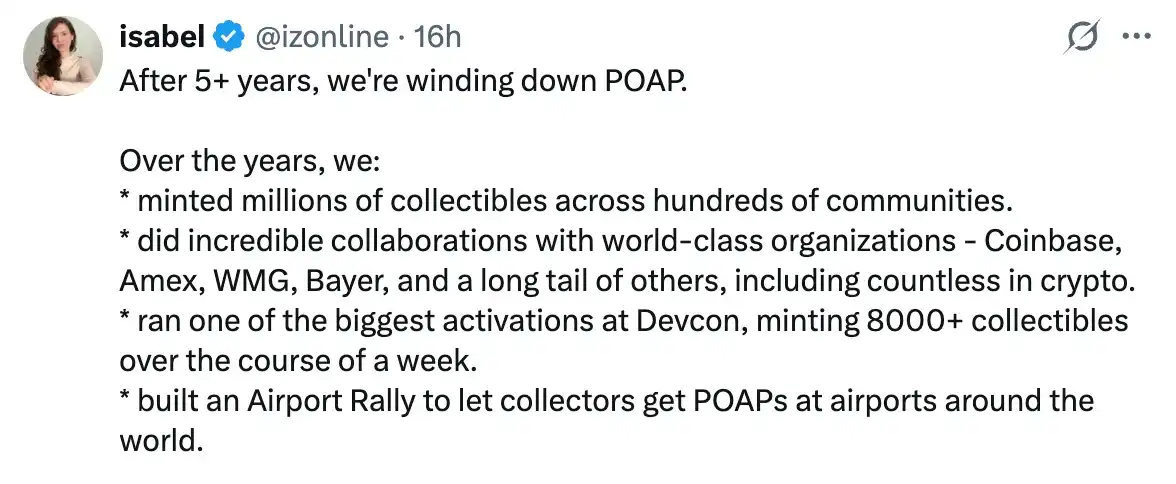
In fact, this farewell began as early as March of this year when POAP announced it would enter maintenance mode starting March 16. New issuers could no longer create new badges through the platform's interface, and existing functions were only maintained without active development. Months later, maintenance mode turned into a permanent closure. The already minted POAP badges will remain on the chain, and users can still view them via wallets and block explorers, but the platform itself, which carried the on-chain memories of countless people, will officially come to an end.

The story of POAP began at the ETHDenver hackathon in February 2019. Back then, founder Patricio Worthalter distributed the first batch of digital badges to attendees, who could claim an ERC-721 token via links distributed on-site as proof of their attendance on the chain. This idea became a "business" in 2021. That year, the NFT market heated up completely, and POAP happened to ride the wave of community operations. Offline conferences, online AMAs, and Discord community events, both large and small, began issuing their own POAPs. Collecting badges became an identity game for crypto-natives for a time, with one's POAP list in their wallet serving as an on-chain resume.
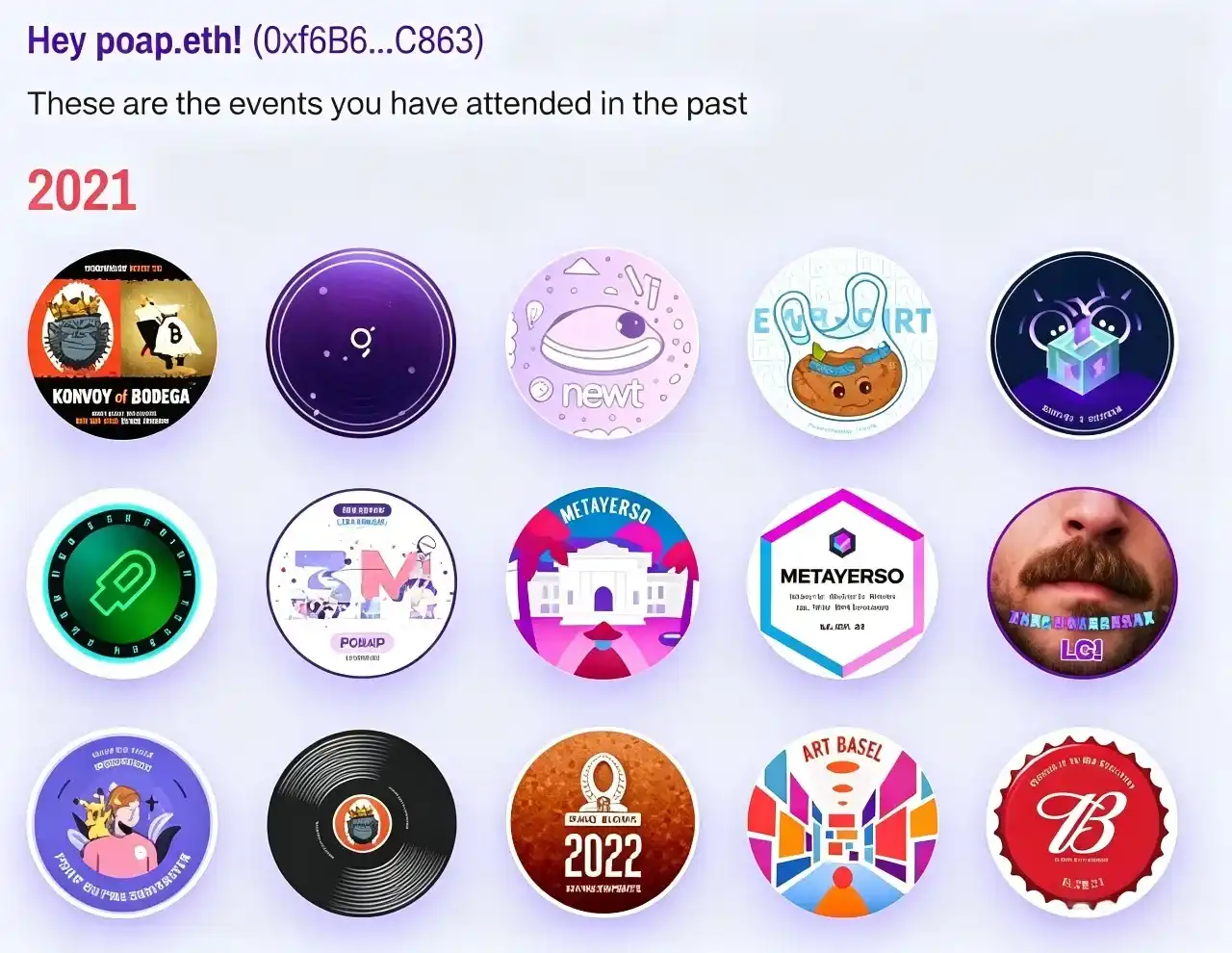
Around this resume, a plethora of use cases emerged within the industry. Some events made holding specific POAPs an entry requirement—without the corresponding badge, one couldn't enter the venue or private channels. Some project teams included users holding a particular event's POAP on their airdrop whitelists to filter for genuine participants rather than airdrop hunters. In DAO governance, some attempted to use POAPs to measure community contributions, giving badge holders greater voting weight. At the peak of its popularity, even brands outside the crypto circle participated. Adidas, Porsche, Johnnie Walker, and Time Magazine all used POAPs for marketing campaigns.

In May 2021, BanklessDAO's BANK token airdrop listed the POAP NFTs previously issued by Bankless as one of its main criteria. In January 2022, the anti-MEV DEX Cow Swap included users holding CoW POAPs in its token airdrop list.

In 2022, POAP raised $10 million in a seed round led by Archetype, with participation from Sapphire Sport, Collab+Currency, Protocol Labs, and others. By mid-2023, over 6.7 million POAPs had been minted by more than 37,000 issuers on the platform.

Not long after completing the fundraising, starting in the second half of 2022, NFT trading volume and floor prices began a sustained decline. While POAPs existed as commemorative credentials rather than speculative assets, they similarly lost the soil for community expansion. POAP had long offered free minting to all users, which was an advantage during the growth phase but became a burden during the contraction phase. In April 2023, the platform announced it would start charging commercial clients, with Isabel Gonzalez stating frankly that this was for the platform's long-term sustainability.

However, judging by the outcome, this shift to a paid model failed to turn the tide. In the March announcement, Gonzalez acknowledged that the platform had found a clear niche market but ultimately failed to find a viable way to survive within it. And just one month before POAP decided to enter maintenance mode, Espresso, with total funding nearing $60 million, included users who had obtained POAPs at various Espresso online and offline events in its airdrop recipients.

At the time, the team mentioned pivoting towards building an underlying standard for open collectibles, but the decision to shut down the current service itself speaks volumes about how low the ceiling of this niche market is.

POAP is not the only "NFT experiment" to fall in recent years. In March 2024, Starbucks shut down its Odyssey membership program, which had run for less than a year and a half. This project, which issued Journey Stamp NFTs on Polygon, remained in closed beta from start to finish. Its first series, priced at $100, didn't even sell out. Participant complaints were blunt: they had to watch a 20-minute video and take a quiz to collect the badges, while all they wanted was a cheaper cup of coffee.

Meta was earlier, ending support for NFT features on Instagram and Facebook in March 2023. Reddit's Collectible Avatars were once seen as the most successful case of NFTs from a major company, with over 33 million cumulative mints. However, by 2024, monthly secondary market trading volume had fallen to around one hundred thousand dollars, and the project lead left in early 2025. In September of the same year, Reddit announced the termination of its creator program, closed the avatar store in November, and completely removed the built-in Vault wallet before New Year's Day 2026.

The issues with these projects are strikingly similar. They were all launched when market sentiment was at its peak, treating NFTs as an end goal rather than a tool, using the concept of on-chain credentials to package things that could have been done without blockchain. Starbucks' loyalty program could easily be implemented with traditional points; Reddit's avatar collection wouldn't lose much user experience without NFTs. When market hype could no longer support operating costs, and when symbolic value couldn't be converted into real cash flow, shutdown was only a matter of time.

POAP's departure is particularly poignant because it was the least speculative of these projects. Its problem was never a bubble, but a ceiling. Digital commemorative badges represent a real but extremely niche demand, too small to support the future of a company that had raised millions in funding. The on-chain badges remain, but the people who issued them have left the stage. This is perhaps one of the most common outcomes in the crypto industry in recent years.

Пов'язані питання

QWhat was POAP and why is its shutdown significant?

APOAP (Proof of Attendance Protocol) was a platform for issuing and collecting blockchain-based digital badges as proof of participation in events. Its shutdown is significant because it marks the end of a prominent experiment in using NFTs for non-speculative purposes like digital memorabilia and community credentials, highlighting the challenges of sustaining such business models.

QWhat were some of the major use cases for POAP mentioned in the article?

AMajor use cases included: serving as entry passes for events or private channels, acting as criteria for airdrop whitelists (e.g., BanklessDAO, Cow Swap), measuring community contribution in DAO governance with voting weight, and being used by mainstream brands like Adidas and Porsche for marketing campaigns.

QAccording to the article, what were the key reasons for POAP's failure to survive?

AKey reasons were: a shrinking NFT market post-2022 bull run which reduced community expansion, the financial burden of its free-to-mint model in a downturn, an unsuccessful pivot to charging commercial clients, and ultimately, the realization that the niche market for digital commemorative badges was too small to support a venture-backed company's growth.

QWhat other major company NFT initiatives failed, as cited for comparison?

AOther failed initiatives include: Starbucks shutting down its Odyssey loyalty program (NFT stamps) in March 2024, Meta ending NFT support on Instagram/Facebook in March 2023, and Reddit winding down its Collectible Avatars program (closing the avatar shop in 2024 and removing its Vault wallet in 2026).

QWhat common problem does the article identify among these failed NFT projects like POAP, Starbucks Odyssey, and Reddit Avatars?

AThe common problem is that these projects treated NFT technology as an end goal rather than a tool. They used blockchain to execute tasks (loyalty programs, digital collectibles) that could be done effectively without it, failing to demonstrate essential utility or create sustainable cash flow once market hype faded.

Пов'язані матеріали

After Memes, Solana Foundation's 'Survival Roadmap'

**Title:** After Memes, Solana Foundation's "Survival Roadmap" **Summary:** Solana Foundation's recent hiring spree for senior roles in stablecoins, AI, Asian institutional growth, and DeFi signals a strategic pivot away from its meme-driven past. This move comes as the blockchain faces a 43% quarterly drop in real economic value and declining application revenue, despite maintaining high network activity. While meme platforms like Pump.fun still dominate fee generation, new demand is emerging in tokenized equities (with $5.8B volume in Q2, a 114% increase) and institutional adoption (7 global systemically important banks are now active on Solana). The foundation's new hires aim to bridge a critical gap: transforming this growing non-speculative demand into sustainable, fee-generating activity. The stablecoin lead seeks "step-change growth" for a sector lagging behind competitors. The Asia-focused roles aim to convert institutional interest into concrete pipelines, leveraging upcoming network upgrades for millisecond settlement. The AI ecosystem role is tied to new stablecoin payment channels for AI agents, a nascent but promising revenue stream. The core challenge is clear: reduce reliance on volatile meme trading income and successfully monetize the rising institutional and real-world asset activity. The success of this "survival roadmap" will be measured by whether projects from these new focus areas can break into Solana's top revenue rankings, displacing the current meme-centric leaders.

marsbit13 хв тому

After Memes, Solana Foundation's 'Survival Roadmap'

marsbit13 хв тому

Anchorage Unveils Plan to Protect Against Quantum Threats

Regulated crypto bank Anchorage Digital has presented a strategy for preparing institutional assets for the post-quantum era, including implementing hybrid protection for internal TLS connections. The bank highlights that for cryptocurrencies, the main quantum risk lies in digital signatures, as Shor's algorithm could theoretically derive a private key from a public one. To mitigate this, Anchorage uses Bitcoin addresses based on a hash of the public key, which keeps the key hidden until a transaction is sent, and practices minimal address reuse. Internally, the company has deployed post-quantum key encapsulation for employee devices on ChromeOS and is implementing post-quantum cryptography within its hardware security modules (HSMs). A key proposal is the "Post-Quantum Turnstile" mechanism, which uses STARK zero-knowledge proofs to allow users to migrate signing rights to a post-quantum key without exposing their old private or public key. This could help secure an estimated two-thirds of circulating coins that might otherwise become inaccessible if the network phases out classical signatures. Furthermore, Anchorage open-sourced its Rust implementation of the SQIsign digital signature scheme, which it claims offers signatures about seven times smaller than the Falcon algorithm. This comes amid warnings that around 6 million BTC in addresses with exposed public keys could be vulnerable to future quantum attacks.

cryptonews.ru45 хв тому

Anchorage Unveils Plan to Protect Against Quantum Threats

cryptonews.ru45 хв тому

Торгівля

Спот
活动图片