The GRAM token experienced a sharp drop in the moment after Telegram's removal from the App Store

cryptonews.ruОпубліковано о 2026-08-04Востаннє оновлено о 2026-08-04

Анотація

The GRAM token (formerly Toncoin/TON) experienced a sharp decline of nearly 6% early on August 4th following the temporary removal of Telegram from the App Store. Apple removed the app for approximately one hour due to user-posted content violating its policies against child sexual exploitation material. After Telegram promptly removed the content and blocked the user, the app was reinstated. Following Telegram's return to the App Store, the GRAM price partially recovered. It had been trading around $1.41 before the news, dropped to $1.32, and was around $1.38 later that day. The token's reaction to Telegram-related news is often mixed. While it surged 20% on the heels of a June rebranding and rose 7% after an announcement about a major non-custodial wallet launch, it showed little sustained movement in response to legal issues involving Telegram founder Pavel Durov. GRAM reached its all-time high of $8.24 in the summer of 2024, meaning its current price represents a decline of roughly 83% from that peak.

The Gram token ($GRAM, formerly Toncoin/TON) showed a sharp decline overnight on August 4 following the temporary removal of Telegram from the App Store. The native token of the TON ecosystem, closely linked to Pavel Durov's messenger, momentarily plummeted by almost 6%.

Telegram was unavailable in the App Store for about an hour. Apple explained the removal by stating it had discovered content on the platform that violated its prohibition on materials related to child sexual exploitation. After the developer promptly removed the prohibited content and blocked the user who posted it, the messenger was fully restored.

After Telegram's return to the Apple App Store, the price of $GRAM partially recovered. Before the news, it was fluctuating around $1.41 and subsequently dropped to $1.32. As of 12:30 Moscow time on August 4, the token is trading around $1.38. The 24-hour drop is 1%.

Telegram commented on the situation briefly. The messenger's team responded with a paraphrase of a Mark Twain quote — "Reports of my demise are greatly exaggerated."

$GRAM does not react to all news about Telegram or Durov, even though after the rebranding, he made the messenger the driving force and main validator of the TON blockchain. Amid the renaming in June, the token increased in price by 20%, but it failed to consolidate at the new level and quickly retreated to the prices at which it traded before the event.

When it became known about charges being brought against Durov in Russia for allegedly aiding terrorism, as well as his potential international wanted status, the price of $GRAM hardly changed. At the moment the news appeared, the token briefly fell by approximately 2%, but recovered within a few minutes.

The recent announcement by Durov that the "largest deployment in human history" of a non-custodial crypto wallet would take place in the TON ecosystem this summer saw $GRAM react with a 7% increase. According to the founder of the messenger, the native wallet for the token will become available in all Telegram applications.

Gram reached its all-time high in the summer of 2024 at $8.24 — the decline since then is about 83%. The current price level of the token coincides with levels observed in 2021–2023.

"RBC-Crypto" does not provide investment advice; the material is published for informational purposes only. Cryptocurrency is a volatile asset that can lead to financial losses.

end-content

Трендові криптовалюти

Пов'язані питання

QWhat happened to the GRAM token on the night of August 4th, and what was the immediate cause?

AThe GRAM token (formerly Toncoin/TON) experienced a sharp drop of nearly 6% after the temporary removal of Telegram from the App Store.

QWhat was Apple's reason for temporarily removing Telegram from the App Store?

AApple removed Telegram because it discovered content on the platform that violated its prohibition of material related to child sexual exploitation.

QWhat was Telegram's official response to the removal from the App Store?

ATelegram's team paraphrased a quote from Mark Twain: 'Reports of my demise are greatly exaggerated.'

QHow did the GRAM token price react to Pavel Durov's announcement about the 'largest in human history' deployment of a non-custodial wallet in the TON ecosystem?

AThe GRAM token price reacted positively, rising by 7% on that news.

QAccording to the article, what is the percentage decline of the GRAM token from its all-time high in summer 2024 to the price discussed in the article?

AThe GRAM token has fallen approximately 83% from its all-time high of $8.24 in summer 2024.

Пов'язані матеріали

Meme Coins Peak in 17.2 Days on Average: Ephemeral Fervor and the Great Capital Migration

Meme Coins' Average Peak: 17.2 Days - A Fleeting Frenzy and a Capital Exodus A Bloomberg analysis reveals the stark reality behind meme coin mania: extreme short-term speculation. On average, a new meme coin reaches its all-time high (ATH) a mere 17.2 days after its first trade. Alarmingly, 25% of projects peak within just 38.4 hours. The subsequent decline is brutal, with the median time to drop 95% from the peak and enter dormancy being 370 days. Only about 3% ever break their previous ATH again. This drastic compression of the speculative lifecycle is driven by zero-barrier token creation on platforms like Pump.fun and automated trading tools like sniper bots, which enable instant deployment and rapid pump-and-dump schemes. The market is saturated, diluting liquidity and forcing a predatory, player-versus-player environment where early holders quickly exit with minimal gains. As the odds of success in traditional meme coins diminish, speculative capital is migrating. Decentralized prediction markets like Polymarket, offering transparent, event-driven betting, are attracting significant liquidity. Concurrently, AI agent tokens are drawing funds with their combination of high volatility and long-term narrative tied to artificial intelligence. This capital shift marks a move away from simplistic "greater fool" assets toward platforms with clearer mechanisms or dynamic technological themes.

marsbit21 хв тому

Meme Coins Peak in 17.2 Days on Average: Ephemeral Fervor and the Great Capital Migration

marsbit21 хв тому

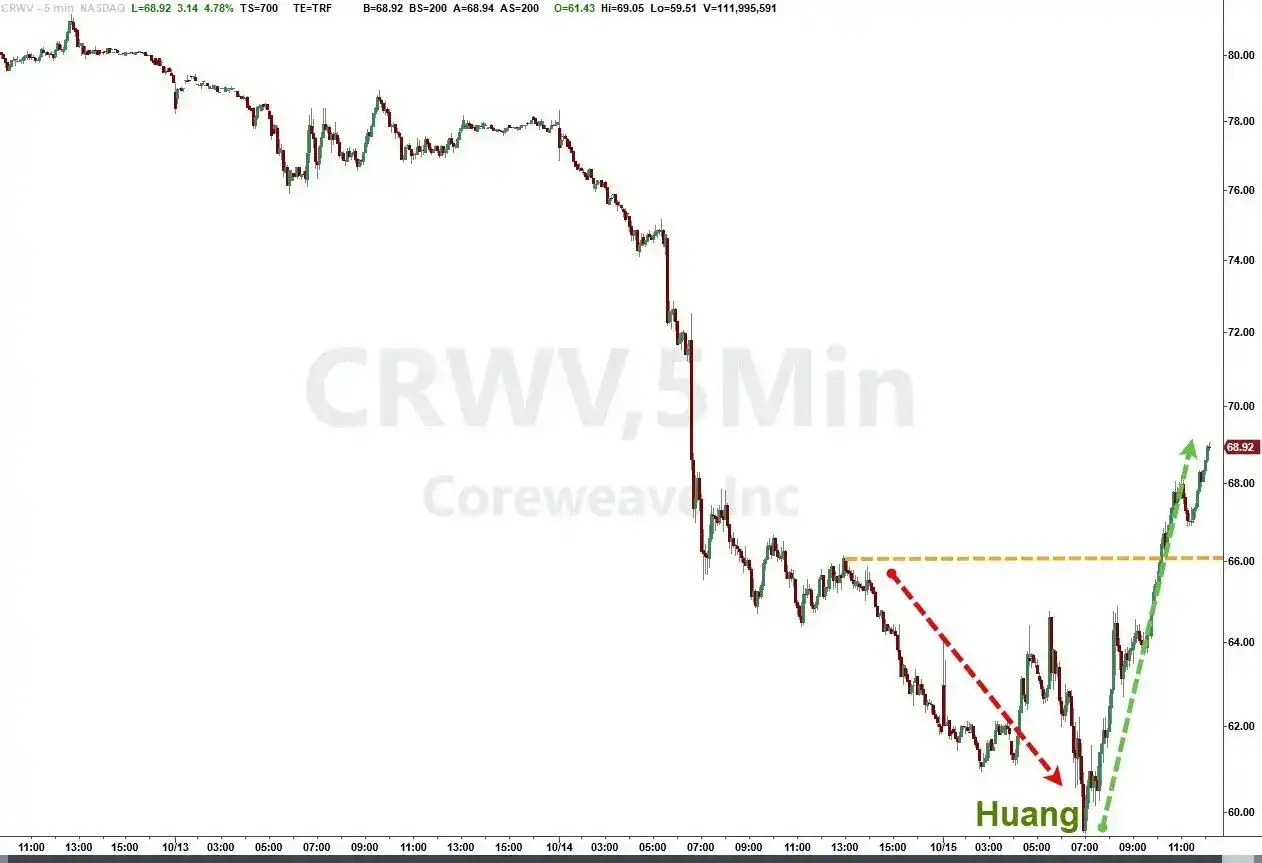
CoreWeave Default Probability Exceeds 60%! Huang Renxun 'Puts Out Fire': Financing Costs Declining, No Need for NVIDIA to Provide Backstop

CoreWeave, a major AI cloud service provider and key NVIDIA customer, is facing heightened credit market concerns. Its five-year credit default swap (CDS) spreads soared to a record high of over 1190 basis points, implying a perceived default probability exceeding 60%. Concurrently, its bond prices plummeted, with yields surging above 15-16%, reflecting intense investor worries about its ability to service nearly $50 billion in debt while remaining unprofitable. This stress is spreading within the AI infrastructure sector. CDS spreads for companies like Oracle, SoftBank, NVIDIA, and others also widened significantly, indicating a broader market reassessment of the debt risks behind massive AI capital expenditures. In response, NVIDIA CEO Jensen Huang publicly expressed confidence in CoreWeave, stating its "financial strength is growing daily" and its cost of capital is declining. He explicitly stated NVIDIA sees no need to provide a financial backstop for CoreWeave, in which it holds a roughly 10% stake. His comments helped CoreWeave's stock recover from early losses. The core issue under scrutiny is whether the future cash flows from AI investments can cover the enormous upfront costs and interest burdens, especially as financing becomes more expensive. The situation highlights a critical shift in market focus: from purely evaluating AI compute demand to questioning the sustainability of the debt-fueled expansion models used to build that capacity.

marsbit40 хв тому

CoreWeave Default Probability Exceeds 60%! Huang Renxun 'Puts Out Fire': Financing Costs Declining, No Need for NVIDIA to Provide Backstop

marsbit40 хв тому

Farcaster Changes Hands Again: The Hottest Potato in the Decentralized World

The decentralized social protocol Farcaster has changed ownership for the third time in nine months, being described as a "hot potato" in the decentralized world. On October 15, 2026, Rish, co-founder of Neynar, announced that Network School, founded by Balaji Srinivasan, would take over Farcaster, including its application, protocol codebase, and related products. This followed Neynar's acquisition of Farcaster from its original creator, Merkle Manufactory, in January 2026. Farcaster, which achieved a $1 billion valuation after a $150 million Series A round in 2024, saw its user activity and revenue decline sharply post-2025. Daily active users (DAU) dropped 40% from its peak of nearly 100,000, and monthly revenue fell to around $10,000. After taking over, Neynar pivoted Farcaster toward developers, but protocol revenue (including from Clanker) plummeted by 99% from Q1 to Q3 2026, leading to the search for a new owner. Network School, Balaji Srinivasan's venture practicing his "network state" theory and recently valued at $2 billion, plans to rebrand Farcaster as the "Network State Protocol." Significant rule changes include requiring users to accept a "social smart contract" to mint an NFT for full access, implementing content moderation based on Singaporean public conduct codes, and introducing AI-assisted review with potential human verification. These changes, particularly the centralized control over content and access via the dominant official app (formerly Warpcast), have sparked community debate. The repeated ownership transfers highlight a core tension in decentralized social networking: while the protocol layer is technically decentralized, control over the primary user application grants centralized power over the entire network's experience and direction. Each new owner brings a different vision, but all face the fundamental challenge of reviving a platform with declining users and revenue.

marsbit41 хв тому

Farcaster Changes Hands Again: The Hottest Potato in the Decentralized World

marsbit41 хв тому

US Stock Market Trends (October 16): Dow Surges Over 550 Points, TSMC's Net Profit Rises Nearly 70% but Stock Closes Lower

**U.S. Market Trends (October 16): Dow Jumps Over 550 Points, TSMC Falls Despite 69% Net Profit Surge** U.S. stocks reversed early losses on Thursday. The Dow Jones surged over 550 points (1.08%), while the Nasdaq Composite edged up 0.08%. The Philadelphia Semiconductor Index fell for a seventh consecutive session, closing down 0.88%. The S&P 500 rose 0.33%, with healthcare, materials, and financials leading gains. Energy and tech sectors declined. Major tech stocks were mixed. Microsoft and Alphabet gained, while Nvidia and Tesla fell. Server stocks like Dell and Hewlett Packard Enterprise dropped sharply. Despite reporting strong Q3 results—a 69% year-on-year jump in net profit and raising its full-year revenue growth forecast to ~44%—TSMC's U.S.-listed shares fell 1.80%. Investor concerns persist about funding for massive AI/data center expansions and their eventual returns. CoreWeave's stock rebounded to close nearly 6% higher after Nvidia CEO Jensen Huang stated the AI cloud provider was strengthening and did not need rescue, easing equity investor worries. However, its bonds remained under pressure due to high leverage and funding needs. Economic data showed mixed signals. September PPI surged 1.3% month-on-month (the highest since March 2022), driven by energy prices. Retail sales grew 0.8%, largely fueled by gasoline spending. Excluding autos and gas, growth was minimal. Despite hot inflation prints, Treasury yields retreated, with the 10-year near 5.09%. Oil (WTI) rose over 3%, while gold gained 2%. Bitcoin traded around $82,300. Focus turns to upcoming remarks from Fed officials ahead of the quiet period and key data like industrial production, as investors weigh inflation against growth concerns and tech sector volatility.

marsbit57 хв тому

US Stock Market Trends (October 16): Dow Surges Over 550 Points, TSMC's Net Profit Rises Nearly 70% but Stock Closes Lower

marsbit57 хв тому

Торгівля

Спот

Популярні статті

Як купити GRAM

Ласкаво просимо до HTX.com! Ми зробили покупку prev. Toncoin (GRAM) простою та зручною. Дотримуйтесь нашої покрокової інструкції, щоб розпочати свою криптовалютну подорож.Крок 1: Створіть обліковий запис на HTXВикористовуйте свою електронну пошту або номер телефону, щоб зареєструвати обліковий запис на HTX безплатно. Пройдіть безпроблемну реєстрацію й отримайте доступ до всіх функцій.ЗареєструватисьКрок 2: Перейдіть до розділу Купити крипту і виберіть спосіб оплатиКредитна/дебетова картка: використовуйте вашу картку Visa або Mastercard, щоб миттєво купити prev. Toncoin (GRAM).Баланс: використовуйте кошти з балансу вашого рахунку HTX для безперешкодної торгівлі.Треті особи: ми додали популярні способи оплати, такі як Google Pay та Apple Pay, щоб підвищити зручність.P2P: Торгуйте безпосередньо з іншими користувачами на HTX.Позабіржова торгівля (OTC): ми пропонуємо індивідуальні послуги та конкурентні обмінні курси для трейдерів.Крок 3: Зберігайте свої prev. Toncoin (GRAM)Після придбання prev. Toncoin (GRAM) збережіть його у своєму обліковому записі на HTX. Крім того, ви можете відправити його в інше місце за допомогою блокчейн-переказу або використовувати його для торгівлі іншими криптовалютами.Крок 4: Торгівля prev. Toncoin (GRAM)Легко торгуйте prev. Toncoin (GRAM) на спотовому ринку HTX. Просто увійдіть до свого облікового запису, виберіть торгову пару, укладайте угоди та спостерігайте за ними в режимі реального часу. Ми пропонуємо зручний досвід як для початківців, так і для досвідчених трейдерів.

576 переглядів усьогоОпубліковано 2026.06.15Оновлено 2026.08.20

Як купити GRAM

Обговорення

Ласкаво просимо до спільноти HTX. Тут ви можете бути в курсі останніх подій розвитку платформи та отримати доступ до професійної ринкової інформації. Нижче представлені думки користувачів щодо ціни GRAM (GRAM).

活动图片