Lei Jun Reports Xiaomi's Q2 Performance, Phone Premiumization Takes Effect, While Automotive and AI Continue 'Burning Cash'

marsbitОпубліковано о 2026-08-18Востаннє оновлено о 2026-08-18

Анотація

Xiaomi released its Q2 2026 financial results, showing mixed performance. Total revenue was approximately 108.9 billion yuan, down 6.1% year-over-year, while adjusted net profit fell 42.6% to about 6.2 billion yuan. The company's core smartphone business saw a 7.5% decline in revenue to 42.1 billion yuan, primarily due to lower shipment volumes, partially offset by a record high average selling price (ASP) which rose 25.9%. Xiaomi's global smartphone market share held steady at third place. Its AIoT platform connected over 1.16 billion devices, a 17.4% increase. Despite pressures on traditional revenue streams, Xiaomi continues heavy investment in new growth areas. Its innovation segment, encompassing smart electric vehicles and AI, generated 24.9 billion yuan in revenue (up 17.1%), but reported an operating loss of 2.6 billion yuan. Capital expenditure for these businesses reached 2.4 billion yuan in Q2. Vehicle deliveries grew 28.2% to 104,199 units, with cumulative deliveries for the SU7 series surpassing 500,000 units by mid-August. The company also highlighted significant R&D spending of 9.2 billion yuan for the quarter. On the technology front, Xiaomi announced several AI and software developments, including the new Xiaomi HyperOS 4, the "Super Xiaoai 2.0" assistant, and advancements in its MiMo large language model and robotics platform. The company noted its first-generation self-developed chip, the Xuangjie O1, has surpassed one million units shipped across three p...

Zhixiangxi, August 18th - Today, Xiaomi released its performance report for the second quarter (Q2) of 2026, showing a slight recovery in revenue and net profit. Lei Jun posted on Weibo to report the performance data to netizens. Lu Weibing, Partner and President of Xiaomi Group, revealed during the earnings call that the self-developed Xuanjie O1 chip launched last year has achieved cumulative shipments exceeding one million units across three device models, and a new generation of Xiaomi Xuanjie chip is about to be released.
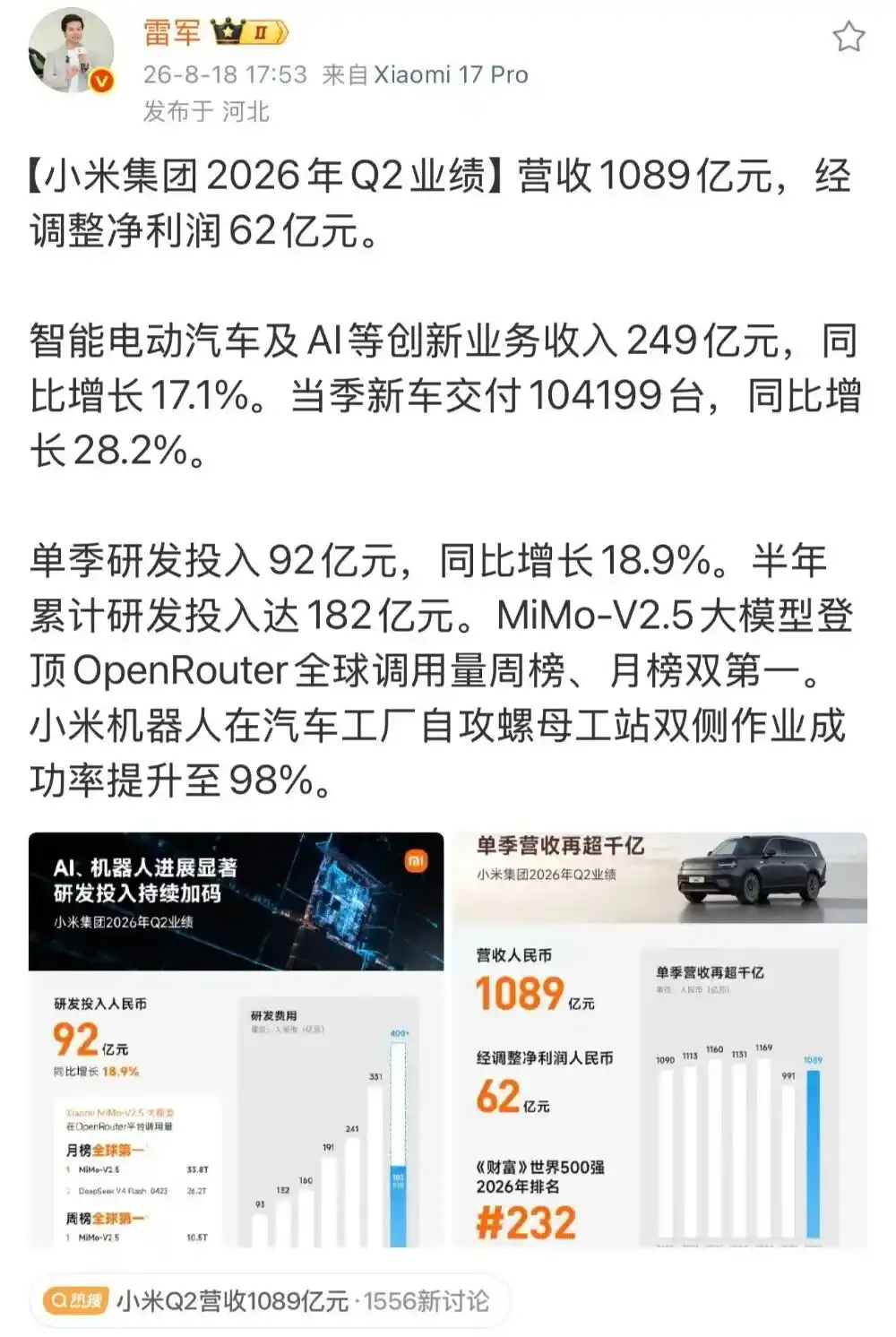
Lei Jun posted on Weibo to report performance (Source: Weibo)

The performance report shows that Xiaomi's Q2 revenue was approximately 108.9 billion yuan, a year-on-year decrease of 6.1%; adjusted net profit was about 6.2 billion yuan, a year-on-year decrease of 42.6%.
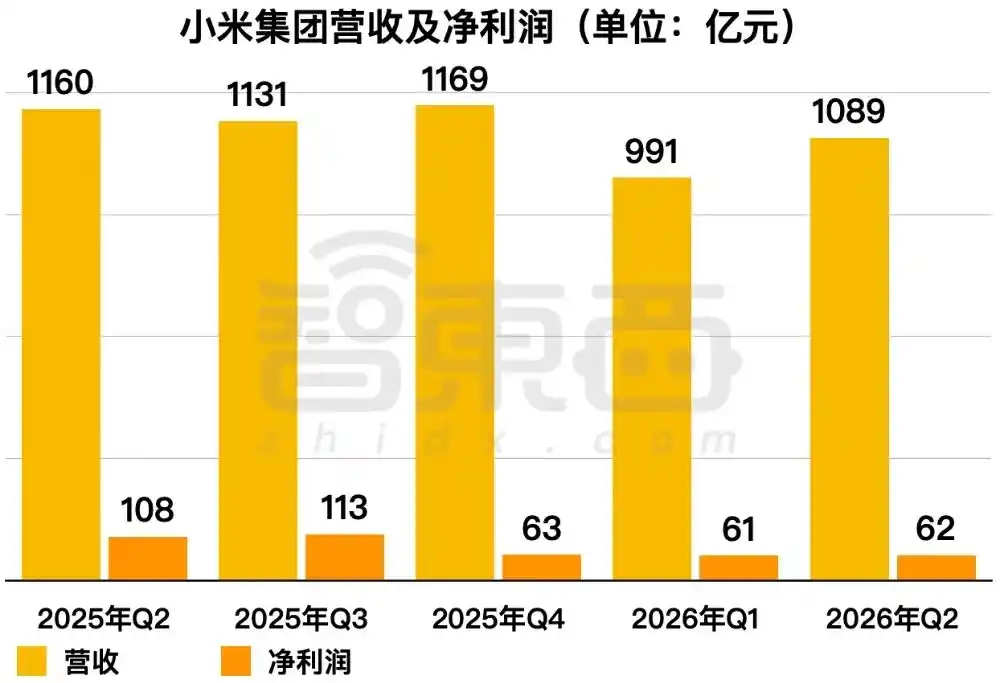
Xiaomi Group Revenue and Net Profit (Data Range: Q2 2025 - Q2 2026, Chart by Zhixiangxi)

In Q2, Xiaomi's capital expenditures were approximately 3.6 billion yuan, of which capital expenditures for the Smart Electric Vehicles and AI and other innovative businesses segment were 2.4 billion yuan, accounting for about 67% of total capital expenditures; R&D expenses were about 9.2 billion yuan, a year-on-year increase of nearly 19%, with cumulative R&D investment in the first half of the year reaching 18.2 billion yuan.
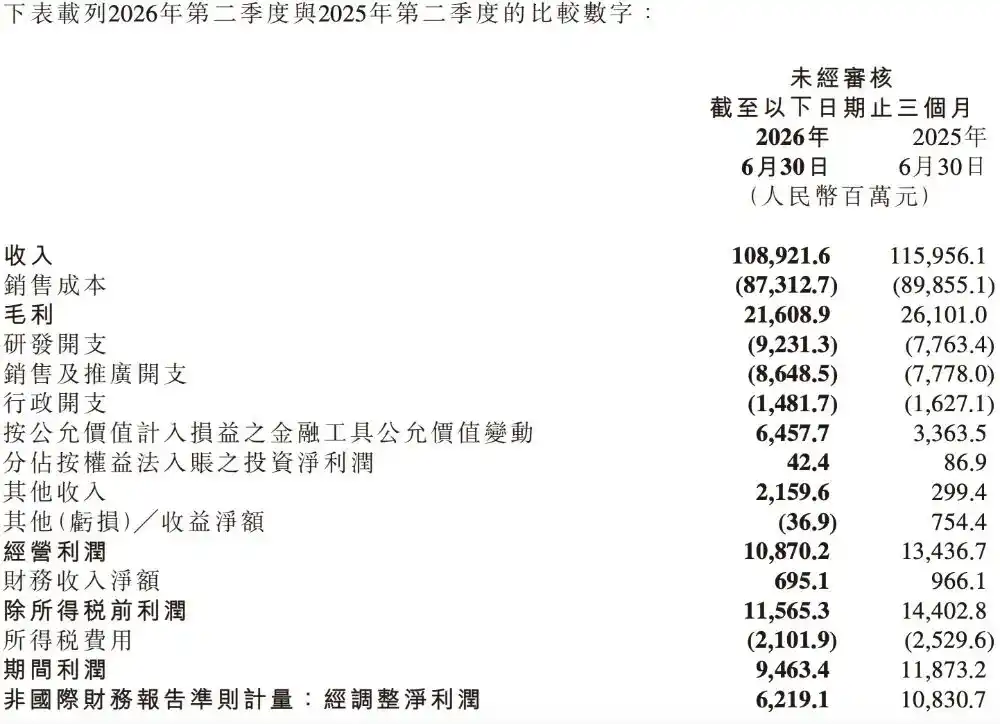
The financial report shows that in Q2, revenue from Xiaomi's "Smartphone × AIoT" business reached 84 billion yuan, with gross profit margin stable at 20%.

Lu Weibing disclosed during the earnings call that the increase in memory prices exceeded Xiaomi's expectations. From a sales perspective, rising memory prices had the most significant impact on low-end and entry-level models. Lu Weibing predicted that the upward trend in memory prices is expected to slow down in the middle of Q3, maintain a moderate increase in Q4, and overall will gradually become more controllable.

In terms of innovative businesses, overall revenue from the smart electric vehicles and AI segments increased by 17.1% year-on-year to 24.9 billion yuan. Among this, smart electric vehicles contributed 23.9 billion yuan in revenue, while AI and other emerging businesses contributed about 1 billion yuan in revenue, including income from the commercialization of the Xiaomi MiMo large model.

However, innovative businesses are still in a period of strategic investment. This quarter, the operating loss for this segment was 2.6 billion yuan.

Explaining this loss, Lin Shiwei, CFO of Xiaomi Group, stated that Xiaomi's AI is currently still in a phase of large-scale investment and will continue to promote the restructuring of business through AI. The previously launched Token Plan has already generated some revenue, but monetization is not the primary goal.
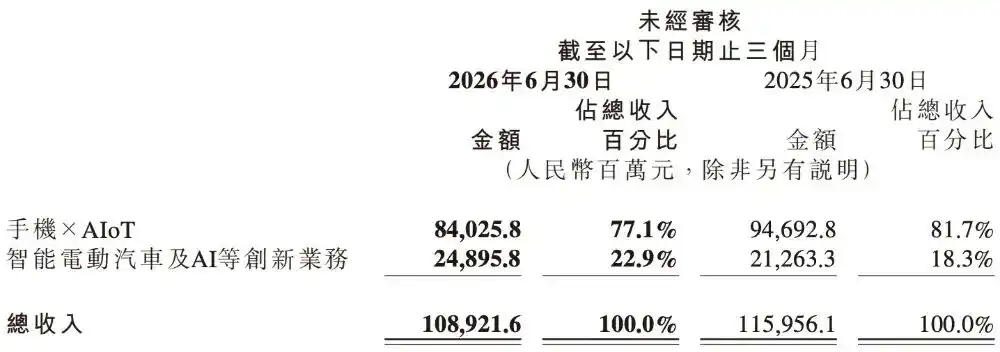
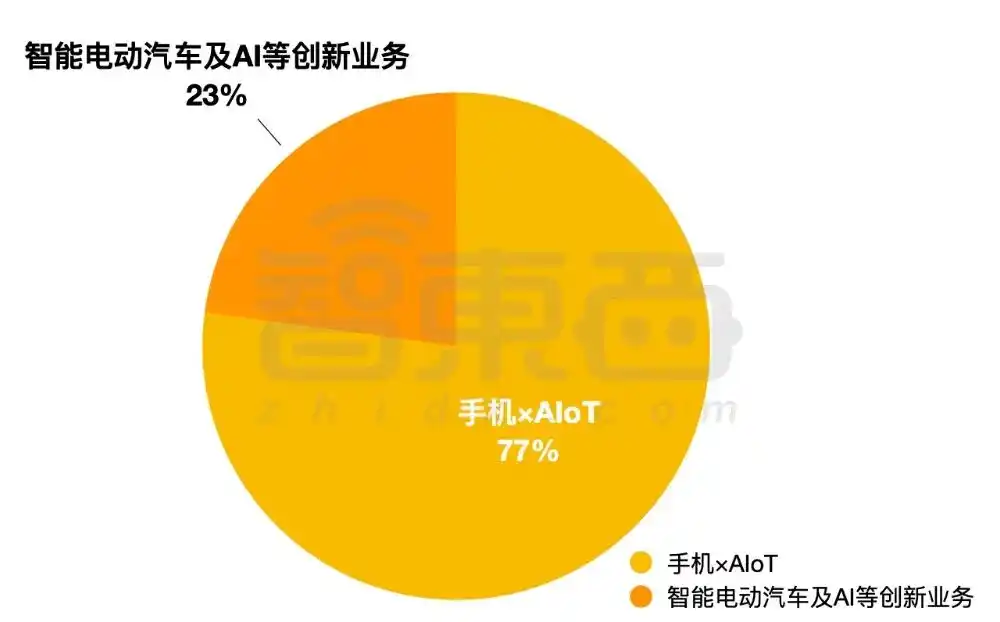
Revenue Proportion of Xiaomi Business Segments (Chart by Zhixiangxi)

01. Unveiling Multiple 'Tech Bombs': HyperOS 4, Super Little Love 2.0 Debut

Ever since recruiting former DeepSeek researcher Luo Fuli, hailed as a "genius girl" in the industry, Xiaomi's every move in AI has been placed under the spotlight.

On June 9th, the Xiaomi MiMo team and the inference systems team TileRT jointly announced that the UltraSpeed mode of the flagship large model Xiaomi MiMo-V2.5-Pro, released in April, has achieved a breakthrough, reaching over 1000 tokens/s output speed for the first time for a flagship trillion-parameter (1T) model.

In the same month, the Xiaomi MiMo team released and open-sourced the AI programming assistant MiMoCode V0.1.0. This product is based on secondary development of the open-source project OpenCode, with its core capability using "model-Agent collaboration + engineering memory" to solve issues like forgetfulness, deviation, and frequent rework in traditional Coding Agents.

The official version of Xiaomi MiMo Claw also launched in June. Positioned as a cloud-hosted, locally-deployment-free, out-of-the-box personal Agent, it is built on the MiMo-V2.5-Pro large model and integrates with the Kingsoft Office ecosystem.

On June 18th, Xiaomi also released and open-sourced the Whole-Home Smart AI Open Source Solution Xiaomi Miloco 2.0, currently the industry's first smart home solution capable of providing AI proactive services and possessing household memory.
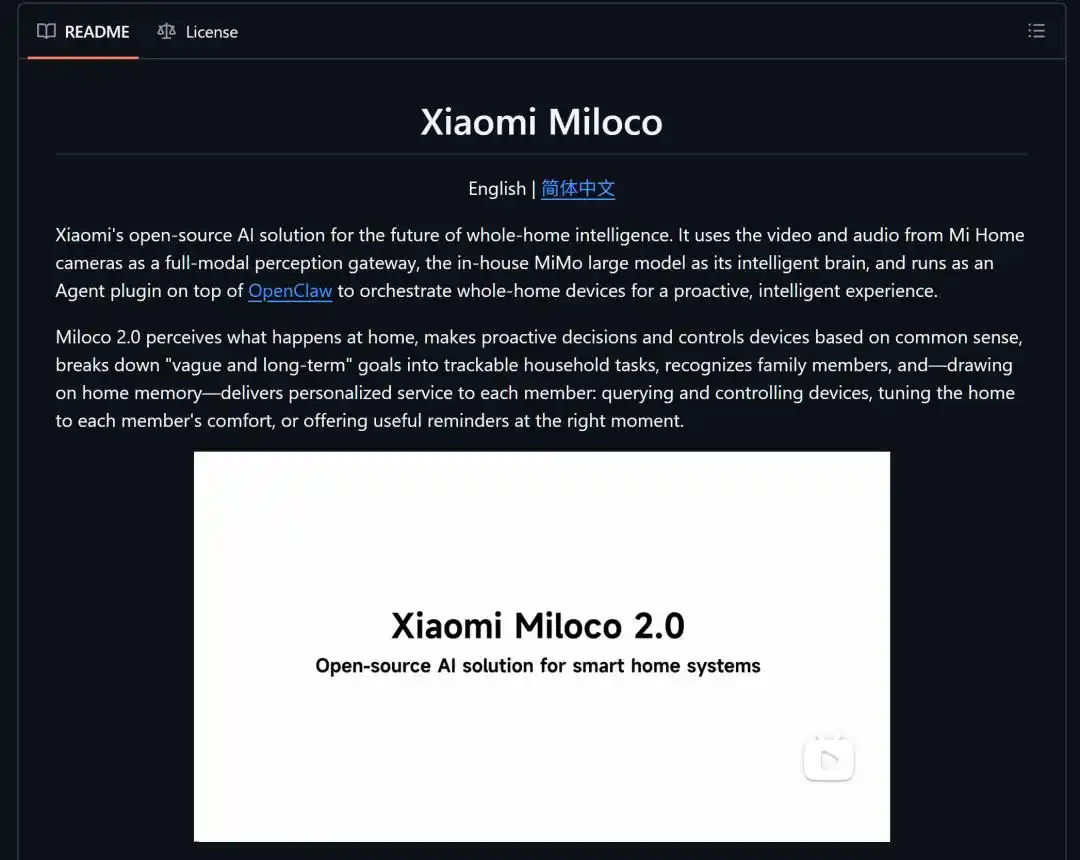
Xiaomi Miloco 2.0 GitHub Homepage (Source: GitHub)

In August, Xiaomi officially released the Beta version of the new-generation operating system Xiaomi HyperOS 4. It introduced workload precision calculation and memory preloading technologies to the Xiaomi HyperCore self-developed kernel and constructed the Xiaomi HyperOS application runtime environment.

Additionally, Xiaomi released "Super Little Love 2.0". Through improvements in AI architecture and integration with the Xiaomi MiMo large model, it now possesses better task orchestration and content generation capabilities, with specialized optimizations for cross-application and cross-device scenarios.

In terms of embodied intelligence, on July 15th, Xiaomi launched Xiaomi-Robotics-U0. This is a 38B-parameter autoregressive world foundation model and is also the first unified embodied generation model that combines an image generation foundation model with embodied world modeling.

Multi-view prediction for robot interaction video generation (Source: Xiaomi Technology)

On July 14th, Xiaomi also revealed the latest progress on Xiaomi Robots. Earlier this year, Xiaomi Robots were deployed to perform tasks at the self-tapping nut feeding station in the Xiaomi car factory, where their success rate for bilateral operations at the self-tapping nut feeding station has increased to 98%. Meanwhile, the robots also achieved success rates of 90% in tasks like sorting center console side panels and folding/retrieving material boxes.

When asked about the positioning of the robot business within Xiaomi, Lu Weibing replied that humanoid robots still have a long cycle before large-scale commercialization. Xiaomi's first priority is to streamline its existing businesses, landing them in scenarios like smart factories and smart homes. In the future, many of Xiaomi's core capabilities will synergize with robots, and robot technology development will also feed back into existing businesses.

02. Smartphone ASP Hits Record High, AIoT Connected Devices Exceed 1.16 Billion

The financial report shows that in Q2, Xiaomi's smartphone revenue was 42.1 billion yuan, a year-on-year decrease of 7.5%, mainly due to a decrease in smartphone shipment volume, partially offset by an increase in average selling price (ASP).
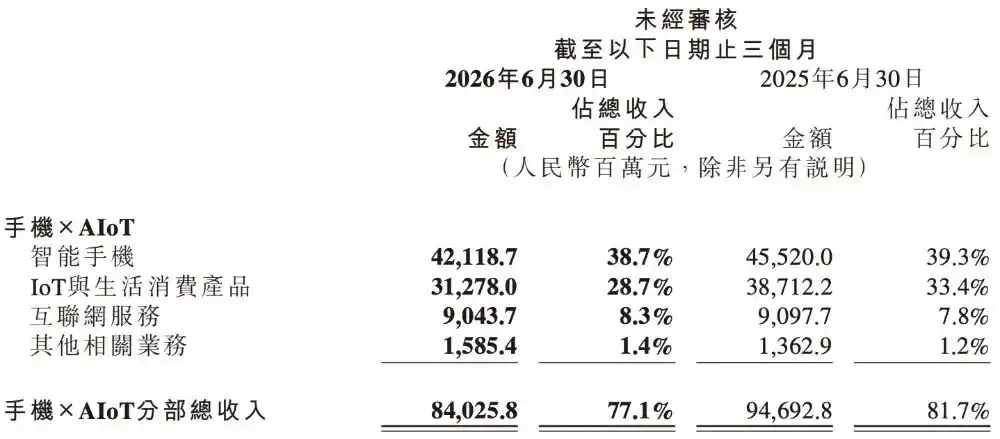
According to Omdia data, in Q2 2026, affected by memory prices, global smartphone shipment volume decreased by 6% year-on-year. During the same period, Xiaomi's global smartphone shipments were 31.2 million units, smartphone business revenue was 42.1 billion yuan, and gross profit margin was 8.5%.

Faced with rising memory prices, Xiaomi's smartphone division adopted a premiumization strategy, increasing product prices while continuing to optimize the product mix. In Q2 2026, Xiaomi's smartphone average selling price (ASP) increased by 25.9% year-on-year, reaching 1,351 yuan.

According to third-party data, in Q2 2026, in the Chinese mainland market, smartphones priced at 3000 yuan and above accounted for 32.1% of Xiaomi's total smartphone sales volume, hitting a record high, a year-on-year increase of 4.5 percentage points. Among them, Xiaomi's market share in the 3000–4000 yuan price segment for smartphones in the Chinese mainland reached 16.2%, a year-on-year increase of 3.3 percentage points.

According to Omdia data, in Q2 2026, Xiaomi's global smartphone shipment volume ranked third, maintaining its position in the global top three for 24 consecutive quarters.
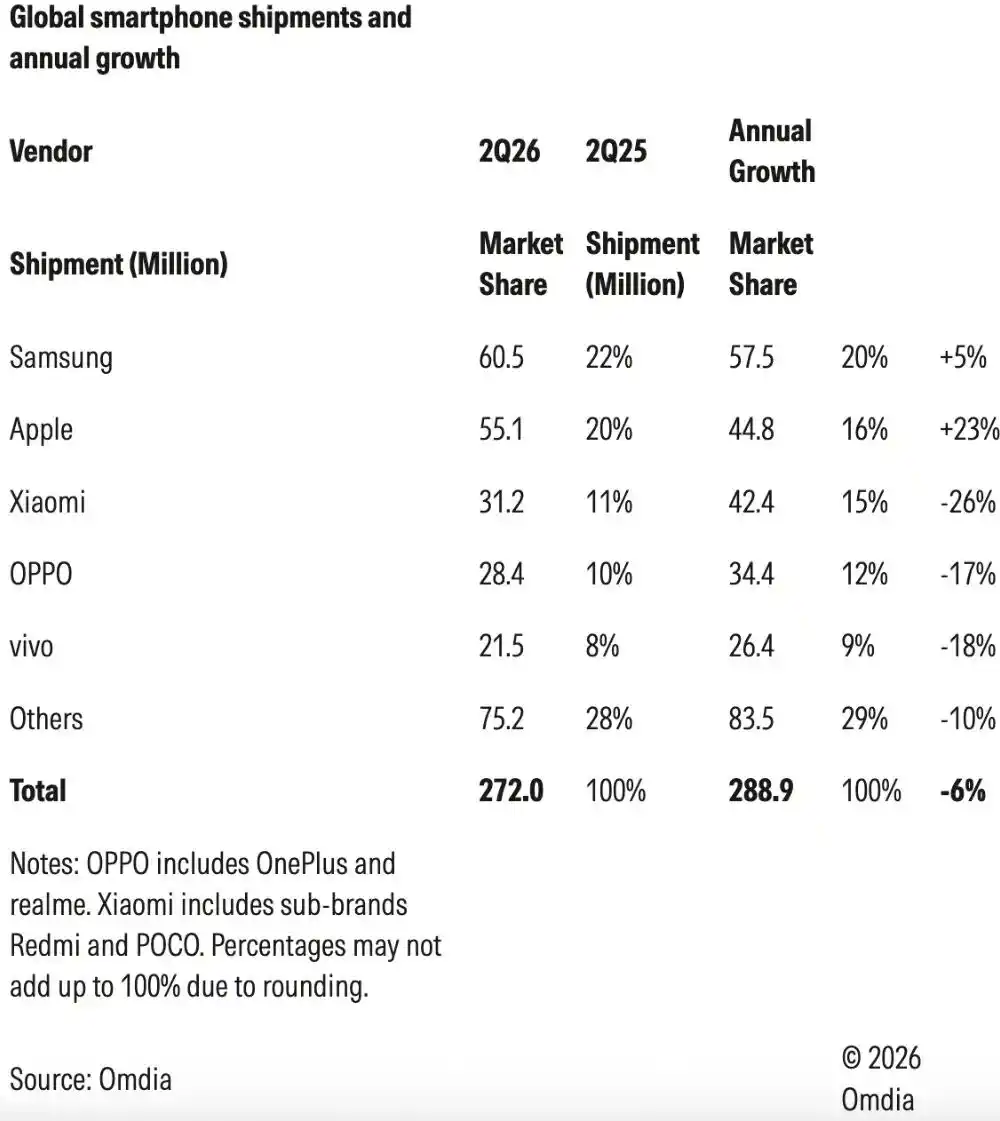
Global Smartphone Shipment Volume and Market Share (Source: Omdia)

Simultaneously, Xiaomi ranked among the top three in smartphone shipments in 53 countries and regions globally and among the top five in 67 countries and regions globally.

Specifically, Xiaomi's smartphone shipments ranked second in Southeast Asia, Latin America, and the Middle East, with market shares of 19.3%, 16.2%, and 13.5% respectively; it ranked third in Europe and Africa, with market shares of 16.5% and 10.9% respectively.

For other products, according to Omdia data, in Q2 2026, Xiaomi's global tablet shipments ranking rose to fourth, with its ranking in the Chinese mainland market also at fourth; global TWS headset shipments ranked second, with its ranking in the Chinese mainland market at second; global wearable band device shipments ranked second, with its ranking in the Chinese mainland market at second.

Regarding Xiaomi's ecosystem, the financial report shows that as of June 30, 2026, the number of IoT devices connected to the Xiaomi AIoT platform (excluding smartphones and tablets) reached 1.16 billion, a year-on-year increase of 17.4%; the number of users with five or more devices connected to the Xiaomi AIoT platform (excluding smartphones and tablets) reached 24.6 million, a year-on-year increase of 20.2%.

In June 2026, the monthly active users of the Mi Home app increased by 9.7% year-on-year to 124 million, and the monthly active users of Little Love Classmate increased by 14.2% year-on-year to 175 million.

In Q2 2026, overall revenue from Xiaomi's smart electric vehicles and AI segments increased by 17.1% year-on-year to 24.9 billion yuan. Among this, smart electric vehicles contributed 23.9 billion yuan in revenue.

The financial report shows that in Q2, Xiaomi delivered a total of 104,199 new vehicles, a year-on-year increase of 28.2%. In the first half of 2026, among pure electric sedans priced above 200,000 yuan in the Chinese mainland market, the Xiaomi SU7 series ranked first in sales volume. As of August 17, 2026, the cumulative deliveries of the Xiaomi SU7 series have exceeded 500,000 units.

03. Conclusion: Revenue and Profit Under Pressure, Xiaomi in Transition Pains

From this Q2 report, Xiaomi is in a period where new businesses are still growing while legacy businesses continue to face pressure.

On one hand, Xiaomi's core smartphone business maintained its market share amid an industry downturn. Premiumization is indeed taking effect, with ASP and high-end segment share showing tangible growth. On the other hand, its new businesses in automotive and AI are still "burning" significant cash, with a 2.6 billion yuan loss and 2.4 billion yuan in capital expenditures. It's difficult to see a profitability inflection point in the short term.

Regarding AI progress, products like agents, operating systems, and embodied intelligence models have been intensively released within half a year, indicating Xiaomi's desperate efforts to catch up in AI.

Market validation is just beginning for whether these technologies can ultimately translate into product competitiveness and truly help "connect Xiaomi's cars and IoT devices into a cohesive network."

This article is from the WeChat public account "Zhixiangxi" (ID: zhidxcom), Author: Wang Han, Editor: Bing Qian


Пов'язані питання

QAccording to the article, what are the key financial figures for Xiaomi's Q2 2026 performance, specifically for revenue and adjusted net profit?

AIn Q2 2026, Xiaomi reported revenue of approximately 108.9 billion RMB, a year-on-year decrease of 6.1%. The adjusted net profit was about 6.2 billion RMB, a year-on-year decrease of 42.6%.

QWhat is the current status and performance of Xiaomi's 'Xuanjie O1' chip mentioned in the article?

AThe Xuanjie O1 chip, launched last year, has achieved a cumulative shipment of over one million units across three terminal products. A new generation of the Xiaomi Xuanjie chip is also set to be released soon.

QHow did Xiaomi's smartphone average selling price (ASP) and market position change in Q2 2026, and what was the primary reason for the ASP increase?

AIn Q2 2026, Xiaomi's smartphone ASP increased by 25.9% year-on-year to 1351 RMB, reaching a historical high. The primary reason for this increase was the company's high-endization strategy. Despite a decrease in shipments, Xiaomi maintained its position as the third largest smartphone vendor globally for the 24th consecutive quarter.

QWhat is the financial situation of Xiaomi's innovation business segments, which include Smart EVs and AI, as reported for Q2 2026?

AThe innovation business segments (Smart EVs and AI) generated revenue of 24.9 billion RMB in Q2 2026, a 17.1% year-on-year increase (with Smart EVs contributing 23.9 billion RMB and AI about 1 billion RMB). However, these segments are still in a strategic investment phase, resulting in an operating loss of 2.6 billion RMB for the quarter.

QWhat key AI-related products or technologies did Xiaomi announce or release between June and August 2026, as detailed in the article?

ABetween June and August 2026, Xiaomi announced/released several key AI products: the Xiaomi MiMo-V2.5-Pro model with its UltraSpeed mode, the AI programming assistant MiMoCode V0.1.0, the personal Agent Xiaomi MiMo Claw, the smart home solution Xiaomi Miloco 2.0, the new Xiaomi HyperOS 4 Beta, the 'Super Xiaoai 2.0', and the unified embodied generative model Xiaomi-Robotics-U0.

Пов'язані матеріали

Manufacturing's Share Drops Below 25%: Is Hangzhou Unconcerned?

Hangzhou is entering a critical phase of industrial restructuring. While its manufacturing-to-GDP ratio has fallen below 25%, the city is not alarmed. Instead, it is strategically navigating a dual focus: advancing advanced manufacturing and expanding its service sector, particularly producer services. Recently, the city celebrated the IPO of a humanoid robotics company, seen as a milestone in moving beyond its e-commerce era. Simultaneously, it set an ambitious target for its service sector: to exceed 2 trillion yuan in value by 2030, with producer services making up over 60%. Data shows a clear trend: the service sector's share of GDP has risen to 75.3%, while manufacturing's share has declined to around 20.1%. This shift revives the debate on whether a strong service sector weakens a city's manufacturing "foundation." Hangzhou's approach challenges the notion of a fixed manufacturing "red line" near 25%. The city argues that the quality and integration of industries matter more than simple ratios. Its strategy is "using software to drive hardware," leveraging its core strengths in digital economy and producer services—like R&D, software, and supply chain management—to empower and add value to manufacturing. This is embodied by its emerging "AI era" companies, whose innovation in Hangzhou feeds into national industrial chains. The city believes that for a hub like Hangzhou, the key is not merely boosting visible manufacturing output, but strengthening the "invisible" competitive edge provided by high-end producer services, which ultimately determine manufacturing profitability. National policy is also shifting from insisting on a "stable" manufacturing share to acknowledging a "reasonable" range, allowing for quality-focused development. Hangzhou's future industrial blueprint aims for a manufacturing share above 22% of GDP by 2027, coupled with a dominant, high-value service sector. The goal is not to choose between manufacturing and services, but to deeply integrate them, using advanced services as the accelerator for next-generation manufacturing.

marsbit25 хв тому

Manufacturing's Share Drops Below 25%: Is Hangzhou Unconcerned?

marsbit25 хв тому

SEC Suddenly Proposes "Regulation Crypto": U.S. Token Fundraising May Become Legal Again

On August 18, the U.S. Securities and Exchange Commission (SEC) proposed a landmark set of permanent rules, "Regulation Crypto Assets," specifically designed for crypto asset investment contracts. The 402-page proposal introduces two registration exemption paths and a groundbreaking safe harbor mechanism, representing the SEC's first dedicated crypto-specific regulatory framework. Two exemption tiers are proposed: a "Startup Exemption" allowing a one-time raise of up to $5 million within four years with basic disclosure requirements, and a "Financing Exemption" permitting raises of up to $75 million every 12 months with stricter obligations, including financial statements and ongoing reporting. Both paths require "principles-based narrative disclosure," a flexible approach distinct from traditional IPO forms. The most transformative element is the investment contract safe harbor. It provides a legal path for tokens to "graduate" from being classified as securities. If an issuer completes or permanently ceases its "essential managerial efforts" as promised in the investment contract and meets specific conditions, it can file with the SEC to have the token exit the securities framework. This creates a novel legal lifecycle where a token can begin as a regulated security for fundraising and later become a non-security asset as the network decentralizes. This move is seen as the SEC pragmatically filling a legislative vacuum, as the stalled CLARITY Act in Congress faces significant delays. The proposal aims to offer a compliant pathway for token offerings within the U.S., countering the trend of projects moving overseas. While currently a proposal open for a 60-day public comment period, it signals a major potential shift from an enforcement-heavy approach toward establishing clearer rules for the crypto industry.

marsbit29 хв тому

SEC Suddenly Proposes "Regulation Crypto": U.S. Token Fundraising May Become Legal Again

marsbit29 хв тому

Late Qing County Magistrates' 'Official Debt' and the Crypto World's 'Exchange Listings': The Cross-Temporal Truth of Financializing Power

This article draws parallels between financialization of power in late Qing Dynasty China and the modern cryptocurrency industry. It opens with a staggering contemporary corruption case involving billions, illustrating how official positions control massive cash flows, akin to toll booths. The core analysis focuses on Du Fengzhi, a late Qing county magistrate. His 22-year journey from passing the provincial exam to finally obtaining a post highlights how bureaucratic "qualification" (like a VC investment) doesn't guarantee immediate benefit. Crucially, upon receiving his appointment, Du had to borrow heavily—"official debt"—to cover travel and networking costs to actually assume his position. Lenders, seeing his future post as a revenue-generating asset, offered loans with exorbitant effective interest rates (e.g., borrowing 4000 taels but receiving only 2000), effectively discounting and financializing his future power. Once in office, Du faced immense pressure from both public tax quotas and his crippling private debt. His diaries reveal aggressive, sometimes extreme, tax collection methods (sealing ancestral temples, pressuring local gentry) to meet these demands. The article argues this created a system where public duty and private financial survival became indistinguishable, with corruption evolving from operational necessity to normalized practice. The piece consistently analogizes this to crypto: VC funding as mere "qualification," the costly "listing" process on exchanges, the role of market makers and KOLs as intermediaries akin to local gentry, and the relentless pressure on funded projects to deliver returns—often leading to perpetual pivots, artificial metrics, and ultimately, the extraction of value from retail liquidity. Both systems, it concludes, are driven by the financialization of future potential, trapping individuals in cycles of debt and obligation with limited alternatives for upward mobility.

marsbit36 хв тому

Late Qing County Magistrates' 'Official Debt' and the Crypto World's 'Exchange Listings': The Cross-Temporal Truth of Financializing Power

marsbit36 хв тому

U.S. Stock Market Trends (August 19th): AI Hardware Rally Loosens, Long-Term Bond Yields Challenge Tech Valuations

U.S. stocks weakened further on Tuesday, with major indices hitting two-week lows for a third consecutive session. Pressure centered on the AI hardware sector, as the previously rebounding Philadelphia Semiconductor Index fell sharply. Meanwhile, persistently high long-term Treasury yields and rising oil prices fueled by Middle East tensions prompted a cautious reassessment of high-valuation tech assets. Key closing data: The S&P 500 fell 0.69%, the Dow Jones dropped 0.22%, and the Nasdaq declined 1.33%. The 10-year Treasury yield hovered near 4.70%, while the 30-year yield briefly touched a new high since 2007 before settling around 5.28%. WTI crude rose to $84.94. The chip sector led the decline, with the Philadelphia Semiconductor Index dropping about 5%. Losses spread across memory, optical communication, and AI infrastructure stocks. This shift indicates investor focus is moving from chasing AI demand momentum to evaluating valuations and earnings timing. The "Magnificent Seven" stocks showed mixed performance, with pressure more concentrated on AI hardware than software giants. The market is observing whether capital will rotate back to large-cap tech, sustaining the internal AI sector rotation, or if the broader AI trade is entering a cooling phase. Chinese stocks were mostly weaker, with the Nasdaq Golden Dragon China Index down about 1%. Baidu's stock fell sharply post-earnings due to profit pressure from AI investments, while Alibaba gained. Persistently high long-term bond yields and rising oil prices are re-emerging as key anchors for U.S. stock pricing, constraining valuation multiples for AI-related companies. Corporate events, including earnings from Home Depot and AI financing news like Anthropic's reported credit line expansion, continue to highlight cost and capital expenditure pressures. Focus for the coming sessions: 1) Whether the 30-year Treasury yield stabilizes below 5.30%, and 2) The market's ability to absorb the chip sector sell-off, determining if it's a pre-earnings consolidation or the start of a broader AI hardware cool-down.

marsbit40 хв тому

U.S. Stock Market Trends (August 19th): AI Hardware Rally Loosens, Long-Term Bond Yields Challenge Tech Valuations

marsbit40 хв тому

Galaxy Research: Crypto Lending Contracts for Third Consecutive Quarter, Market Undergoing Orderly Deleveraging

**Galaxy Research Report: Crypto Lending Market Sees Orderly Deleveraging for Third Consecutive Quarter** The crypto asset-backed lending market contracted for a third consecutive quarter in Q2 2026, shrinking by $11.33B (-16.78%) to a total of $56.16B. This represents a 40.13% decline from the Q3 2025 peak. The process is marked by a controlled, "stair-step" decline rather than the sharp, cascading collapses seen in 2022, suggesting a healthier, more orderly deleveraging driven by market retrenchment rather than forced liquidations. Key findings include: * **CeFi vs. DeFi:** Centralized Finance (CeFi) lending ($22.98B) surpassed Decentralized Finance (DeFi) lending ($20.43B) for the first time since Q3 2023, as DeFi loan volumes fell 27.61% quarter-over-quarter. * **Market Leaders:** Tether remains the dominant CeFi lender, holding 58.54% market share. CeFi's top three players (Tether, Maple, Nexo) control nearly 75% of that segment. * **Corporate Debt:** Debt used by companies for digital asset treasury strategies declined by $1.5B to $16.1B, mainly due to a debt buyback by MicroStrategy. * **Rates & Leverage:** Stablecoin borrowing costs edged higher. Analysis of Aave V3 shows e-mode loans, primarily used for leveraged Ethereum staking strategies, carry significantly higher risk (debt-weighted avg. Health Factor ~1.06) compared to standard loans. * **Futures:** Aggregate futures open interest (OI) was relatively stable, down only 3.08% to $103.2B at quarter-end, though it has since rebounded. BTC and ETH futures OI together comprised 65% of the total. In conclusion, the crypto market continues to shed leverage in a measured manner. If this trend persists, the market may avoid the type of disorderly, cascading failures seen in the last cycle, even if lending activity continues to contract.

marsbit1 год тому

Galaxy Research: Crypto Lending Contracts for Third Consecutive Quarter, Market Undergoing Orderly Deleveraging

marsbit1 год тому

Торгівля

Спот
活动图片