Manufacturing's Share Drops Below 25%: Is Hangzhou Unconcerned?

marsbitОпубліковано о 2026-08-19Востаннє оновлено о 2026-08-19

Анотація

Hangzhou is entering a critical phase of industrial restructuring. While its manufacturing-to-GDP ratio has fallen below 25%, the city is not alarmed. Instead, it is strategically navigating a dual focus: advancing advanced manufacturing and expanding its service sector, particularly producer services. Recently, the city celebrated the IPO of a humanoid robotics company, seen as a milestone in moving beyond its e-commerce era. Simultaneously, it set an ambitious target for its service sector: to exceed 2 trillion yuan in value by 2030, with producer services making up over 60%. Data shows a clear trend: the service sector's share of GDP has risen to 75.3%, while manufacturing's share has declined to around 20.1%. This shift revives the debate on whether a strong service sector weakens a city's manufacturing "foundation." Hangzhou's approach challenges the notion of a fixed manufacturing "red line" near 25%. The city argues that the quality and integration of industries matter more than simple ratios. Its strategy is "using software to drive hardware," leveraging its core strengths in digital economy and producer services—like R&D, software, and supply chain management—to empower and add value to manufacturing. This is embodied by its emerging "AI era" companies, whose innovation in Hangzhou feeds into national industrial chains. The city believes that for a hub like Hangzhou, the key is not merely boosting visible manufacturing output, but strengthening the "invisible" co...

Hangzhou is entering a critical period of a new round of industrial adjustment.

On August 19, Unitree Robotics will list on the SSE Sci-Tech Innovation Board, becoming the "first humanoid robot stock" on the A-share market. The first of the "Six Little Dragons" to achieve an IPO is considered another milestone for Hangzhou in moving beyond the "e-commerce era."

Just a few days earlier, Hangzhou further deepened its commitment to its "traditional strength" in the services sector—setting a clear goal at a high-profile city-wide services industry conference: by 2030, the added value of the services industry will exceed 2 trillion yuan, with producer services accounting for over 60%.

On one side is manufacturing, on the other is services, bringing to light the long-discussed issue of Hangzhou's perceived "imbalance" in manufacturing.

In recent years, Hangzhou has continuously ramped up its emphasis on manufacturing, proposing to "rebuild a Hangzhou industry." However, from the data, the proportion of added value from large-scale industries in Hangzhou has been declining, accounting for only 20.1% of GDP last year.

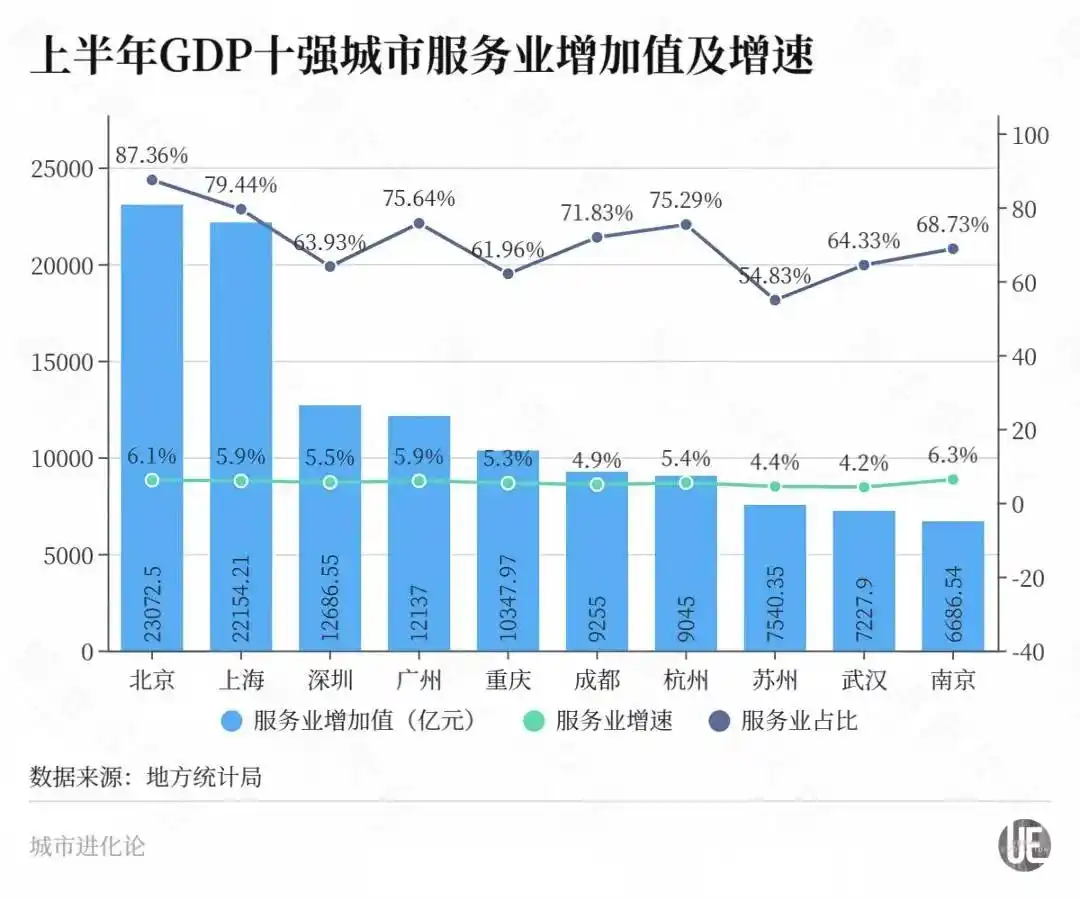
The other side of the coin is the continuous growth of the services sector. In the first half of this year, the added value of Hangzhou's services industry reached 904.5 billion yuan, a year-on-year increase of 5.4%, the highest growth rate in two years; the services sector's share of GDP exceeded 75% for the first time, reaching 75.3%, second only to Beijing, Shanghai, and Guangzhou.

This "rise and fall" has brought an old question back to the surface: as the services sector climbs higher, will the "foundation" of manufacturing become thinner? Under the requirement to maintain a reasonable proportion of manufacturing, what kind of reference can Hangzhou provide for cities hoping to bet on the next "little dragon"?

"25%"

25% was once considered a "red line" for the proportion of manufacturing in a city's economy.

The most representative example is Shanghai, which, in the "Shanghai Three-Year Action Plan for Promoting High-Quality Development of the Manufacturing Industry (2023-2025)" issued in 2023, explicitly drew a red line: by 2025, the proportion of industrial added value in Shanghai's regional GDP should reach over 25%. This was also the first time in seven years that Shanghai re-emphasized this goal.

Authoritative validation comes from a report by a World Bank research team: for megacities like Shanghai, the proportion of manufacturing should be between 25% and 30%. Consistent with this, many cities have also drawn their own "red lines." For example, Shenzhen, a major industrial city, although its manufacturing share is still significantly above 30%, still proactively set a red line for the city, mandating that the proportion of industrial land should not be less than 30%.

Although Hangzhou did not explicitly state such a red line at the time, under the national overall requirement to keep manufacturing's share "basically stable," Hangzhou also made similar arrangements in its 14th Five-Year Plan outline, proposing to deeply implement the "New Manufacturing Plan" and advance the "New Factory Plan."

However, this did not prevent the continuous rise in the services sector share in many cities. Several years later today, the manufacturing "red lines" in more and more cities are showing signs of loosening.

Looking at data from the first half of this year, as most cities have not released specific manufacturing data, if we only refer to the proportion of services sector added value in GDP, among the trillion-yuan GDP cities, there are four where this indicator exceeds 75%. Particularly Shanghai, where this indicator reached 79.4%, an increase of 4.2 percentage points compared to 2023, second only to Beijing.
Hangzhou is one of them.

A set of data repeatedly cited by local media is that in 2023, after Hangzhou's services sector added value share exceeded 70%, it continued to rise, increasing by 5 percentage points in three years, and further broke through 75% in the first half of this year, with the gap with Guangzhou narrowing to 0.3 percentage points.

In fact, Hangzhou has not relaxed its emphasis on manufacturing. In the past few years, under the goal of building a "global advanced manufacturing base," Hangzhou has, on one hand, reshaped its industrial geography, creating the East Hangzhou Intelligent Manufacturing Corridor to synergize with the West Hangzhou Science and Technology Innovation Corridor, forming a "two corridors" linkage. On the other hand, it has restructured its industrial framework, building the "296X" advanced manufacturing clusters, aiming to break the "significant deficiencies" in manufacturing in terms of total volume, growth rate, investment, industrial level, and enterprise attraction capacity.

But at the same time, the services sector remains a key development direction for Hangzhou. Just from a policy perspective, starting in 2022, Hangzhou has held high-level conferences on the high-quality development of the modern services industry for three consecutive years, hoping to further promote the upgrading of the services industry.

At this year's services industry conference, Hangzhou Municipal Party Committee Secretary Liu Fei further pointed out that the services industry is the "driving force industry" for Hangzhou to promote economic and social development, concerning industrial development, economic circulation, and people's livelihood and employment. It is necessary to "take promoting the expansion, quality improvement, and efficiency enhancement of the services industry as a major task, continuously achieve new results, and continue to lead the nation."

"Dual 70%"

Why does Hangzhou continue to push for an increase in the services sector share while under the requirement to stabilize the industrial proportion? One reason is that Hangzhou experienced the debate between manufacturing and services very early on.

One consensus is that the year 2000 was the starting point for Hangzhou's new-era promotion of the "industry revitalizing the city" strategy. Subsequently, Hangzhou's total industrial output value grew at a pace of crossing a 100-billion-yuan threshold almost every year, reaching 800 billion yuan by 2007.

The 2008 financial crisis became a turning point in Hangzhou's development. For many years thereafter, Hangzhou's GDP growth rate once fell to the bottom among sub-provincial cities. Issues such as a lack of land resources and high production factor prices made it difficult for manufacturing to maintain its inherent development model. Also in 2008, Hangzhou officially proposed the "services first" development strategy, achieving a landmark "tertiary-secondary-primary" industrial structure transformation the following year, marking a new starting point for Hangzhou's development of the services industry.

The lever for the shift towards services was precisely what later became Hangzhou's pride: the electronic information industry. As Liu Ting, former Deputy Director of the Zhejiang Provincial Development and Reform Commission, pointed out, from the "industry revitalizing the city" strategy to the information economy as the "No. 1 Project," Hangzhou's economy underwent a strategic leap from industrial-led to information-led, from industrial economy-dominated to information economy-dominated. This became the major background for Hangzhou's leading development in the new economy.

And now, more than a decade of accumulation in the services sector has, in turn, become the key to Hangzhou's advancement in manufacturing.

Last year, the emergence of Hangzhou's "Six Little Dragons" was seen as a milestone marking Hangzhou's transition from the "e-commerce era" to the "AI era." But if we look closely at the "Six Little Dragons," peeling back the shell of "hardcore manufacturing," it is precisely the core of Hangzhou's services industry, represented by the digital economy, that provides support.

Among them, Game Science and DeepSeek, which gained attention earlier, are backed by Hangzhou's advantage in software and information services—in 2025, the revenue of just large-scale information services exceeded 1.3 trillion yuan. Even Unitree Robotics, which focuses more on hardware development, has in the past year "conquered" many cities across the country, integrating into the industrial chains of major manufacturing cities like Chongqing. However, as a research and development center, Hangzhou's focus remains on its advantages in the digital economy, technological innovation, and the integration of the digital and real economies.

As pointed out in an article published on the official WeChat account of the Hangzhou Investment Promotion Bureau, this essentially injects Hangzhou's innovation genes into the national industrial and innovation chains. Such a city "truly deserves the term 'national strategic force.'" To achieve this goal, Hangzhou's services must not be just the "human touch" of consumer services; more importantly, they must be producer services that act as an "accelerator" for manufacturing.

Looking closely at the composition of "Hangzhou Services," the keyword also falls on "producer services"—a set of data repeatedly cited by local media in Hangzhou is that as early as 2024, the share of producer services in Hangzhou's services sector added value reached 63.2%, surpassing Shanghai and second only to Beijing.

In Hangzhou's 5.3% services sector growth last year, revenue from information transmission, software, and information technology services maintained double-digit growth for 11 consecutive months, with a full-year growth of 13.4%.

Comparing with the internationally commonly used "dual 70%" indicator for observing urban economic development levels, Hangzhou's services sector share has already "crossed the line." The next step is to fill the gap in producer services.

"Imbalance"?

In this sense, for Hangzhou, a more fundamental question is whether it actually needs to maintain an unchanged proportion of manufacturing.

Last year, at a Hangzhou conference on producer services, Huang Qifan, former Mayor of Chongqing, raised an "Apple question":

Apple doesn't build factories, has no production lines, and doesn't engage in manufacturing, so why does it take the vast majority of the product's profit? The reason is that it firmly controls every link of producer services, including research and development, logistics and distribution, market access, inspection and testing, digital empowerment, financial clearing, sales, and after-sales service. These are the foundation of the industrial chain and the bestowers of its core value.

In other words, to increase added value, manufacturing must extend into links such as R&D design, industrial software, supply chain management, brand services, and financial services. It is precisely these producer services that ultimately determine the profit and industrial added value of manufacturing, determining the gold content of modern manufacturing.

Going further, industry insiders have summarized the development path of Hangzhou's "Six Little Dragons" as a "soft driving hard" development model with Hangzhou characteristics. Compared to the longboards of Beijing, Shanghai, and Shenzhen in computing infrastructure and talent density, Hangzhou's artificial intelligence industry, based on the advantages of the digital economy and the services sector, has the potential to carve out a distinctive path of promoting innovation through application and gathering resources through ecology.

It is difficult to fully reflect the quality of a region's manufacturing development simply by looking at the increase or decrease in numbers.

Liu Ting once recalled in an interview that a few years ago, Hangzhou's economic growth rate was once at the bottom within the province. The local government became anxious, wondering whether to invite back heavy and chemical industries to boost the manufacturing proportion. After debate, a sober judgment emerged: the root of Hangzhou's problem was not insufficient industry, but insufficiently strong producer services. Sacrificing invisible competitiveness for visible numbers was not worthwhile.

One reason is that, unlike the "visible" manufacturing, the manufacturing growth driven by producer services is relatively "invisible." Many places have already realized this issue. According to media reports, in order to make this part of manufacturing data visible, Jiangsu changed its assessment method for manufacturing, no longer isolating and assessing the secondary industry share, but instead looking at the combined proportion of manufacturing and producer services in GDP. "The former is the 'skeleton,' the latter is the 'muscle'; looking at either one alone will be distorted."

From a national perspective, policies are also changing.

In the outline of the 15th Five-Year Plan, the phrasing of keeping manufacturing's share "basically stable" was replaced with a "reasonable proportion." Xiao Rongmei, Deputy Director of the Policy and Economics Research Institute of the China Academy of Information and Communications Technology, and others once wrote in an article that this means "after fully considering various internal and external risk impacts and balancing development stages and industrial structure issues, allowing the proportion of manufacturing to fluctuate within a certain reasonable range," "not only pursuing the scale expansion of manufacturing, but more importantly striving to achieve a systematic improvement in quality."

Under the new round of adjustment, how should we re-examine the judgment of Hangzhou's services sector "imbalance"? Where exactly is the "reasonable proportion" for Hangzhou's manufacturing? Hangzhou has already made its judgment. According to the "Hangzhou Three-Year Action Plan for Accelerating Manufacturing Development (2025-2027)," by 2027, the total added value of large-scale industries will reach 530 billion yuan, with an average annual growth of over 6%, and the proportion of industrial added value in GDP will be over 22%.

This article is from the WeChat public account "City Evolution Theory," author: Yang Qifei

Трендові криптовалюти

Пов'язані питання

QWhy is the service industry considered the 'main driving force industry' for Hangzhou's economic and social development?

AThe service industry is considered the 'main driving force industry' for Hangzhou's economic and social development because it is crucial for industrial development, economic circulation, and people's livelihoods and employment. Hangzhou aims to continuously promote the expansion and quality improvement of the service industry to maintain its leading position nationally.

QWhat is the significance of the '25%' manufacturing share threshold mentioned for major cities?

AThe '25%' manufacturing share threshold is a benchmark often discussed for major cities. A World Bank research team report suggests that for megacities like Shanghai, the manufacturing share should be between 25% and 30%. Many cities, including Shanghai and Shenzhen, have used or referenced this threshold in their planning to ensure a stable industrial foundation. However, the article notes that this threshold is becoming more flexible in many cities.

QHow does Hangzhou's development of 'producer services' relate to its manufacturing sector?

AHangzhou's development of 'producer services' is closely tied to and supports its manufacturing sector. Producer services act as an 'accelerator' for manufacturing. The high value-added segments of manufacturing, such as R&D, industrial software, and supply chain management, are embedded within producer services. Hangzhou's strength in the digital economy and information services provides the core support for its advanced manufacturing clusters, enabling a 'soft drives hard' development model.

QWhat was the strategic shift in Hangzhou's industrial policy around 2008, and what triggered it?

AAround 2008, Hangzhou shifted its strategy from 'industrial revitalization' to prioritizing the service industry ('service industry first'). This strategic shift was triggered by the 2008 financial crisis, which exposed challenges for Hangzhou's traditional manufacturing model, including a lack of land resources and high production factor costs. This marked the beginning of Hangzhou's transition towards an economy led by information and services.

QAccording to the article, how has the national policy perspective on the manufacturing share in GDP changed recently?

AThe national policy perspective on the manufacturing share in GDP has shifted from emphasizing the need to keep its share 'basically stable' to maintaining a 'reasonable share' or 'reasonable proportion.' This change, noted in the context of the 15th Five-Year Plan, indicates a more flexible approach. It recognizes that the manufacturing share can fluctuate within a reasonable range based on various factors, with a greater focus on achieving systematic quality improvement rather than just scale expansion.

Пов'язані матеріали

The Philadelphia Semiconductor Index Tumbles Nearly 5% in a Single Night, Optical and Memory Sectors 'Collapse' Together: Surging U.S. Bond Yields Shake AI Belief

On the evening of August 18th, the US stock market saw a sharp sell-off concentrated in the AI hardware sector, with the Philadelphia Semiconductor Index plummeting nearly 5%. Leading AI infrastructure and components companies in fields like optical communication and memory chips experienced some of the steepest declines, such as Fabrinet (-19.38%) and Kioxia ADR (-13%). The sell-off was not broad-based but rather targeted the long-duration, high-momentum stocks previously driven by AI narrative optimism. This market shift is primarily attributed to a significant surge in long-term US Treasury yields, with the 30-year yield hitting its highest level since 2007. Rising yields increase discount rates, disproportionately impacting the valuations of growth stocks whose profits are projected far into the future—a category that includes most AI hardware plays. Additional pressure came from climbing oil prices due to Middle East tensions, which fueled inflation concerns. The article identifies three structural reasons for the severity of the drop in these specific subsectors: excessive prior gains and crowded positioning, high sensitivity to the sustainability of AI capital expenditure narratives, and inherent high volatility within the supply chain. Importantly, the sell-off appears to be a valuation and positioning reset rather than a fundamental repudiation of AI, evidenced by the relatively modest decline in a bellwether like Nvidia (-2.34%). Looking ahead, the direction hinges on three key indicators: whether the 30-year Treasury yield stabilizes, the trajectory of oil prices and geopolitical risks, and the market's pricing of new AI-related corporate debt. For related Asian and A-share markets, short-term negative sentiment spillover is expected, but medium-term drivers like domestic cloud capex may provide divergence. The episode signifies a market transition from pricing AI's "story" to rigorously evaluating its returns against a backdrop of higher financing costs.

marsbit38 хв тому

The Philadelphia Semiconductor Index Tumbles Nearly 5% in a Single Night, Optical and Memory Sectors 'Collapse' Together: Surging U.S. Bond Yields Shake AI Belief

marsbit38 хв тому

Ten Years, Wang Xingxing's Comeback: Unitree Valued at 400 Billion

Over a decade ago, Wang Xingxing, a 29-year-old with a passion for robotics but little funding, demonstrated his struggling robot dog to investors in Hangzhou. In 2019, with his company Unitree nearly out of cash, he captured the attention of Sequoia Capital China's managing director Li Yannan. Despite initial skepticism about the niche market for robot dogs, Wang's vision and deep technical conviction led Sequoia to make an initial seed investment. This marked a turning point. Following Sequoia's lead, a wave of prominent investors including Meituan, Tencent, Alibaba, and various venture capital and state-backed funds joined subsequent funding rounds. Wang's relentless focus and Unitree's technological advancements propelled the company to become a global leader in humanoid robotics. On August 19th, 2027, Unitree Robotics debuted on Shanghai's STAR Market as the first listed humanoid robotics company in China. Its shares skyrocketed over 500% at opening, reaching a market valuation of approximately 400 billion yuan. Wang Xingxing became one of the wealthiest individuals of his generation on the exchange, while Sequoia China, having invested across multiple rounds, remained a major shareholder. The story is celebrated as a classic outlier's triumph—a founder without elite credentials achieving success through pure belief and perseverance. Unitree's IPO is seen as a major milestone for China's embodied AI industry, providing a valuation benchmark and accelerating the sector's maturation. As Wang once stated, he aims to be "a small boat riding the mighty torrent of technology." His journey symbolizes the beginning of a new narrative for Chinese robotics on the global stage.

marsbit38 хв тому

Ten Years, Wang Xingxing's Comeback: Unitree Valued at 400 Billion

marsbit38 хв тому

SEC Suddenly Proposes "Regulation Crypto": U.S. Token Fundraising May Become Legal Again

On August 18, the U.S. Securities and Exchange Commission (SEC) proposed a landmark set of permanent rules, "Regulation Crypto Assets," specifically designed for crypto asset investment contracts. The 402-page proposal introduces two registration exemption paths and a groundbreaking safe harbor mechanism, representing the SEC's first dedicated crypto-specific regulatory framework. Two exemption tiers are proposed: a "Startup Exemption" allowing a one-time raise of up to $5 million within four years with basic disclosure requirements, and a "Financing Exemption" permitting raises of up to $75 million every 12 months with stricter obligations, including financial statements and ongoing reporting. Both paths require "principles-based narrative disclosure," a flexible approach distinct from traditional IPO forms. The most transformative element is the investment contract safe harbor. It provides a legal path for tokens to "graduate" from being classified as securities. If an issuer completes or permanently ceases its "essential managerial efforts" as promised in the investment contract and meets specific conditions, it can file with the SEC to have the token exit the securities framework. This creates a novel legal lifecycle where a token can begin as a regulated security for fundraising and later become a non-security asset as the network decentralizes. This move is seen as the SEC pragmatically filling a legislative vacuum, as the stalled CLARITY Act in Congress faces significant delays. The proposal aims to offer a compliant pathway for token offerings within the U.S., countering the trend of projects moving overseas. While currently a proposal open for a 60-day public comment period, it signals a major potential shift from an enforcement-heavy approach toward establishing clearer rules for the crypto industry.

marsbit1 год тому

SEC Suddenly Proposes "Regulation Crypto": U.S. Token Fundraising May Become Legal Again

marsbit1 год тому

Late Qing County Magistrates' 'Official Debt' and the Crypto World's 'Exchange Listings': The Cross-Temporal Truth of Financializing Power

This article draws parallels between financialization of power in late Qing Dynasty China and the modern cryptocurrency industry. It opens with a staggering contemporary corruption case involving billions, illustrating how official positions control massive cash flows, akin to toll booths. The core analysis focuses on Du Fengzhi, a late Qing county magistrate. His 22-year journey from passing the provincial exam to finally obtaining a post highlights how bureaucratic "qualification" (like a VC investment) doesn't guarantee immediate benefit. Crucially, upon receiving his appointment, Du had to borrow heavily—"official debt"—to cover travel and networking costs to actually assume his position. Lenders, seeing his future post as a revenue-generating asset, offered loans with exorbitant effective interest rates (e.g., borrowing 4000 taels but receiving only 2000), effectively discounting and financializing his future power. Once in office, Du faced immense pressure from both public tax quotas and his crippling private debt. His diaries reveal aggressive, sometimes extreme, tax collection methods (sealing ancestral temples, pressuring local gentry) to meet these demands. The article argues this created a system where public duty and private financial survival became indistinguishable, with corruption evolving from operational necessity to normalized practice. The piece consistently analogizes this to crypto: VC funding as mere "qualification," the costly "listing" process on exchanges, the role of market makers and KOLs as intermediaries akin to local gentry, and the relentless pressure on funded projects to deliver returns—often leading to perpetual pivots, artificial metrics, and ultimately, the extraction of value from retail liquidity. Both systems, it concludes, are driven by the financialization of future potential, trapping individuals in cycles of debt and obligation with limited alternatives for upward mobility.

marsbit1 год тому

Late Qing County Magistrates' 'Official Debt' and the Crypto World's 'Exchange Listings': The Cross-Temporal Truth of Financializing Power

marsbit1 год тому

Торгівля

Спот

Популярні статті

Що таке $S$

Розуміння SPERO: Комплексний огляд Вступ до SPERO Оскільки ландшафт інновацій продовжує еволюціонувати, виникнення технологій web3 та криптовалютних проектів відіграє ключову роль у формуванні цифрового майбутнього. Один з проектів, який привернув увагу в цій динамічній сфері, — це SPERO, позначений як SPERO,$$s$. Ця стаття має на меті зібрати та представити детальну інформацію про SPERO, щоб допомогти ентузіастам та інвесторам зрозуміти його основи, цілі та інновації в рамках web3 та крипто-сектору. Що таке SPERO,$$s$? SPERO,$$s$ — це унікальний проект у криптопросторі, який прагне використати принципи децентралізації та технології блокчейн для створення екосистеми, що сприяє залученню, корисності та фінансовій інклюзії. Проект розроблений для полегшення взаємодії між користувачами новими способами, надаючи їм інноваційні фінансові рішення та послуги. У своїй основі SPERO,$$s$ прагне надати можливості індивідам, забезпечуючи інструменти та платформи, які покращують користувацький досвід у криптовалютному просторі. Це включає в себе можливість більш гнучких методів транзакцій, сприяння ініціативам, що підтримуються спільнотою, та створення шляхів для фінансових можливостей через децентралізовані додатки (dApps). Основна концепція SPERO,$$s$ обертається навколо інклюзивності, прагнучи зменшити розриви в традиційній фінансовій системі, використовуючи переваги технології блокчейн. Хто є творцем SPERO,$$s$? Особистість творця SPERO,$$s$ залишається дещо невідомою, оскільки є обмежені публічно доступні ресурси, що надають детальну інформацію про його засновників. Ця відсутність прозорості може бути наслідком зобов'язання проекту до децентралізації — етики, яку багато проектів web3 поділяють, ставлячи колективні внески вище за індивідуальне визнання. Зосереджуючи обговорення навколо спільноти та її колективних цілей, SPERO,$$s$ втілює суть наділення без виділення конкретних осіб. Таким чином, розуміння етики та місії SPERO є більш важливим, ніж ідентифікація єдиного творця. Хто є інвесторами SPERO,$$s$? SPERO,$$s$ підтримується різноманітними інвесторами, починаючи від венчурних капіталістів до ангельських інвесторів, які прагнуть сприяти інноваціям у крипто-секторі. Зосередження цих інвесторів зазвичай узгоджується з місією SPERO — пріоритет надається проектам, які обіцяють технологічний прогрес у суспільстві, фінансову інклюзію та децентралізоване управління. Ці інвесторські фонди зазвичай зацікавлені в проектах, які не лише пропонують інноваційні продукти, але й позитивно впливають на спільноту блокчейн та її екосистеми. Підтримка з боку цих інвесторів підкріплює SPERO,$$s$ як значного конкурента в швидко змінюваній сфері крипто-проектів. Як працює SPERO,$$s$? SPERO,$$s$ використовує багатогранну структуру, яка відрізняє його від традиційних криптовалютних проектів. Ось деякі ключові особливості, які підкреслюють його унікальність та інноваційність: Децентралізоване управління: SPERO,$$s$ інтегрує моделі децентралізованого управління, надаючи користувачам можливість активно брати участь у процесах прийняття рішень щодо майбутнього проекту. Цей підхід сприяє відчуттю власності та відповідальності серед членів спільноти. Корисність токена: SPERO,$$s$ використовує свій власний криптовалютний токен, розроблений для виконання різних функцій в екосистемі. Ці токени дозволяють здійснювати транзакції, отримувати винагороди та полегшувати послуги, що пропонуються на платформі, підвищуючи загальну залученість та корисність. Шарова архітектура: Технічна архітектура SPERO,$$s$ підтримує модульність та масштабованість, що дозволяє безперешкодно інтегрувати додаткові функції та додатки в міру розвитку проекту. Ця адаптивність є надзвичайно важливою для збереження актуальності в постійно змінюваному крипто-ландшафті. Залучення спільноти: Проект підкреслює ініціативи, що підтримуються спільнотою, використовуючи механізми, які стимулюють співпрацю та зворотний зв'язок. Підтримуючи сильну спільноту, SPERO,$$s$ може краще задовольняти потреби користувачів та адаптуватися до ринкових тенденцій. Фокус на інклюзію: Пропонуючи низькі комісії за транзакції та зручні інтерфейси, SPERO,$$s$ прагне залучити різноманітну базу користувачів, включаючи осіб, які раніше не брали участі в крипто-просторі. Це зобов'язання до інклюзії узгоджується з його загальною місією наділення через доступність. Хронологія SPERO,$$s$ Розуміння історії проекту надає важливі уявлення про його розвиток та етапи. Нижче наведено пропоновану хронологію, що відображає значні події в еволюції SPERO,$$s$: Етап концептуалізації та ідеації: Початкові ідеї, що стали основою SPERO,$$s$, були сформовані, тісно пов'язані з принципами децентралізації та фокусом на спільноті в індустрії блокчейн. Запуск білого паперу проекту: Після концептуального етапу був випущений комплексний білий папір, що детально описує бачення, цілі та технологічну інфраструктуру SPERO,$$s$, щоб залучити інтерес та зворотний зв'язок від спільноти. Створення спільноти та ранні залучення: Активні зусилля були спрямовані на створення спільноти ранніх прихильників та потенційних інвесторів, що полегшило обговорення цілей проекту та отримання підтримки. Подія генерації токенів: SPERO,$$s$ провів подію генерації токенів (TGE) для розподілу своїх рідних токенів серед ранніх прихильників та встановлення початкової ліквідності в екосистемі. Запуск початкового dApp: Перший децентралізований додаток (dApp), пов'язаний з SPERO,$$s$, став доступним, дозволяючи користувачам взаємодіяти з основними функціями платформи. Постійний розвиток та партнерства: Безперервні оновлення та вдосконалення пропозицій проекту, включаючи стратегічні партнерства з іншими учасниками блокчейн-простору, сформували SPERO,$$s$ у конкурентоспроможного та еволюціонуючого гравця на крипто-ринку. Висновок SPERO,$$s$ є свідченням потенціалу web3 та криптовалют для революціонізації фінансових систем та наділення індивідів. Завдяки зобов'язанню до децентралізованого управління, залучення спільноти та інноваційно спроектованих функцій, він прокладає шлях до більш інклюзивного фінансового ландшафту. Як і з будь-якими інвестиціями в швидко змінюваному крипто-просторі, потенційним інвесторам та користувачам рекомендується ретельно досліджувати та обдумано взаємодіяти з поточними подіями в SPERO,$$s$. Проект демонструє інноваційний дух крипто-індустрії, запрошуючи до подальшого дослідження його численних можливостей. Хоча подорож SPERO,$$s$ ще триває, його основні принципи можуть справді вплинути на майбутнє того, як ми взаємодіємо з технологією, фінансами та один з одним у взаємопов'язаних цифрових екосистемах.

359 переглядів усьогоОпубліковано 2024.12.17Оновлено 2024.12.17

Що таке $S$

Що таке AGENT S

Агент S: Майбутнє автономної взаємодії в Web3 Вступ У постійно змінюваному ландшафті Web3 та криптовалюти інновації постійно переосмислюють, як люди взаємодіють з цифровими платформами. Один з таких новаторських проектів, Агент S, обіцяє революціонізувати взаємодію людини з комп'ютером через свою відкриту агентну структуру. Прокладаючи шлях для автономних взаємодій, Агент S прагне спростити складні завдання, пропонуючи трансформаційні застосування в штучному інтелекті (ШІ). Це детальне дослідження заглиблюється в складності проекту, його унікальні особливості та наслідки для сфери криптовалюти. Що таке Агент S? Агент S є революційною відкритою агентною структурою, спеціально розробленою для вирішення трьох основних викликів в автоматизації комп'ютерних завдань: Набуття специфічних знань у галузі: Структура інтелектуально навчається з різних зовнішніх джерел знань та внутрішнього досвіду. Цей подвійний підхід дозволяє їй створити багатий репозиторій специфічних знань у галузі, покращуючи її продуктивність у виконанні завдань. Планування на довгих горизонтах завдань: Агент S використовує планування з підкріпленням досвіду, стратегічний підхід, який полегшує ефективний розподіл та виконання складних завдань. Ця функція значно підвищує її здатність ефективно та результативно управляти кількома підзавданнями. Обробка динамічних, неоднорідних інтерфейсів: Проект представляє Інтерфейс Агент-Комп'ютер (ACI), інноваційне рішення, яке покращує взаємодію між агентами та користувачами. Використовуючи багатомодальні великі мовні моделі (MLLMs), Агент S може безперешкодно орієнтуватися та маніпулювати різноманітними графічними інтерфейсами користувача. Завдяки цим новаторським функціям Агент S надає надійну структуру, яка вирішує складнощі, пов'язані з автоматизацією людської взаємодії з машинами, прокладаючи шлях для численних застосувань у ШІ та за його межами. Хто є творцем Агент S? Хоча концепція Агент S є фундаментально новаторською, конкретна інформація про його творця залишається невідомою. Творець наразі невідомий, що підкреслює або початкову стадію проекту, або стратегічний вибір зберегти засновників у таємниці. Незважаючи на анонімність, акцент залишається на можливостях та потенціалі структури. Хто є інвесторами Агент S? Оскільки Агент S є відносно новим у криптографічній екосистемі, детальна інформація про його інвесторів та фінансових спонсорів не задокументована. Відсутність публічно доступних відомостей про інвестиційні фонди або організації, що підтримують проект, викликає питання щодо його фінансової структури та дорожньої карти розвитку. Розуміння підтримки є критично важливим для оцінки стійкості проекту та потенційного впливу на ринок. Як працює Агент S? В основі Агент S лежить передова технологія, яка дозволяє йому ефективно функціонувати в різних умовах. Його операційна модель побудована навколо кількох ключових функцій: Взаємодія з комп'ютером, подібна до людської: Структура пропонує розширене планування ШІ, прагнучи зробити взаємодії з комп'ютерами більш інтуїтивними. Імітуючи людську поведінку при виконанні завдань, вона обіцяє підвищити досвід користувачів. Наративна пам'ять: Використовується для використання високорівневого досвіду, Агент S використовує наративну пам'ять для відстеження історій завдань, тим самим покращуючи свої процеси прийняття рішень. Епізодична пам'ять: Ця функція надає користувачам покрокові інструкції, дозволяючи структурі пропонувати контекстуальну підтримку в міру виконання завдань. Підтримка OpenACI: Завдяки можливості працювати локально, Агент S дозволяє користувачам зберігати контроль над своїми взаємодіями та робочими процесами, узгоджуючи з децентралізованою етикою Web3. Легка інтеграція з зовнішніми API: Його універсальність і сумісність з різними платформами ШІ забезпечують те, що Агент S може безперешкодно вписатися в існуючі технологічні екосистеми, роблячи його привабливим вибором для розробників та організацій. Ці функціональні можливості колективно сприяють унікальному положенню Агент S у крипто-просторі, оскільки він автоматизує складні, багатоступеневі завдання з мінімальним втручанням людини. У міру розвитку проекту його потенційні застосування в Web3 можуть переосмислити, як відбуваються цифрові взаємодії. Хронологія Агент S Розробка та етапи Агент S можуть бути узагальнені в хронології, яка підкреслює його значні події: 27 вересня 2024 року: Концепція Агент S була представлена в комплексній науковій статті під назвою “Відкрита агентна структура, яка використовує комп'ютери як людина”, що демонструє основи проекту. 10 жовтня 2024 року: Наукова стаття була опублікована на arXiv, пропонуючи детальне дослідження структури та її оцінки продуктивності на основі бенчмарку OSWorld. 12 жовтня 2024 року: Було випущено відеопрезентацію, що надає візуальне уявлення про можливості та особливості Агент S, ще більше залучаючи потенційних користувачів та інвесторів. Ці маркери в хронології не лише ілюструють прогрес Агент S, але й вказують на його прихильність до прозорості та залучення громади. Ключові моменти про Агент S У міру розвитку структури Агент S кілька ключових характеристик виділяються, підкреслюючи її новаторський характер та потенціал: Інноваційна структура: Розроблена для забезпечення інтуїтивного використання комп'ютерів, подібного до людської взаємодії, Агент S пропонує новий підхід до автоматизації завдань. Автономна взаємодія: Здатність автономно взаємодіяти з комп'ютерами через GUI означає стрибок до більш інтелектуальних та ефективних обчислювальних рішень. Автоматизація складних завдань: Завдяки своїй надійній методології він може автоматизувати складні, багатоступеневі завдання, роблячи процеси швидшими та менш схильними до помилок. Безперервне вдосконалення: Механізми навчання дозволяють Агенту S покращуватися на основі минулого досвіду, постійно підвищуючи свою продуктивність та ефективність. Універсальність: Його адаптивність до різних операційних середовищ, таких як OSWorld та WindowsAgentArena, забезпечує його здатність служити широкому спектру застосувань. Оскільки Агент S займає своє місце в ландшафті Web3 та криптовалюти, його потенціал покращити можливості взаємодії та автоматизувати процеси означає значний прогрес у технологіях ШІ. Завдяки своїй інноваційній структурі Агент S є прикладом майбутнього цифрових взаємодій, обіцяючи більш безперешкодний та ефективний досвід для користувачів у різних галузях. Висновок Агент S представляє собою сміливий крок вперед у поєднанні ШІ та Web3, з можливістю переосмислити, як ми взаємодіємо з технологією. Хоча проект все ще на ранніх стадіях, можливості для його застосування є величезними та переконливими. Завдяки своїй комплексній структурі, що вирішує критичні виклики, Агент S прагне вивести автономні взаємодії на передній план цифрового досвіду. У міру того, як ми заглиблюємося в сфери криптовалюти та децентралізації, проекти, подібні до Агент S, безсумнівно, відіграватимуть ключову роль у формуванні майбутнього технологій та співпраці людини з комп'ютером.

977 переглядів усьогоОпубліковано 2025.01.14Оновлено 2025.01.14

Що таке AGENT S

Як купити S

Ласкаво просимо до HTX.com! Ми зробили покупку Sonic (S) простою та зручною. Дотримуйтесь нашої покрокової інструкції, щоб розпочати свою криптовалютну подорож.Крок 1: Створіть обліковий запис на HTXВикористовуйте свою електронну пошту або номер телефону, щоб зареєструвати обліковий запис на HTX безплатно. Пройдіть безпроблемну реєстрацію й отримайте доступ до всіх функцій.ЗареєструватисьКрок 2: Перейдіть до розділу Купити крипту і виберіть спосіб оплатиКредитна/дебетова картка: використовуйте вашу картку Visa або Mastercard, щоб миттєво купити Sonic (S).Баланс: використовуйте кошти з балансу вашого рахунку HTX для безперешкодної торгівлі.Треті особи: ми додали популярні способи оплати, такі як Google Pay та Apple Pay, щоб підвищити зручність.P2P: Торгуйте безпосередньо з іншими користувачами на HTX.Позабіржова торгівля (OTC): ми пропонуємо індивідуальні послуги та конкурентні обмінні курси для трейдерів.Крок 3: Зберігайте свої Sonic (S)Після придбання Sonic (S) збережіть його у своєму обліковому записі на HTX. Крім того, ви можете відправити його в інше місце за допомогою блокчейн-переказу або використовувати його для торгівлі іншими криптовалютами.Крок 4: Торгівля Sonic (S)Легко торгуйте Sonic (S) на спотовому ринку HTX. Просто увійдіть до свого облікового запису, виберіть торгову пару, укладайте угоди та спостерігайте за ними в режимі реального часу. Ми пропонуємо зручний досвід як для початківців, так і для досвідчених трейдерів.

2.1k переглядів усьогоОпубліковано 2025.01.15Оновлено 2026.06.02

Як купити S

Обговорення

Ласкаво просимо до спільноти HTX. Тут ви можете бути в курсі останніх подій розвитку платформи та отримати доступ до професійної ринкової інформації. Нижче представлені думки користувачів щодо ціни S (S).

活动图片